Pacific

Islands
Monthly
November 1990
sdfsdfdf
King Solomon’s Mind
Amazing Mamaloni shatters his opposition with a political coup
Iplomon Mbmaloni
American Samoa US$2.5O: Australia A 52.50; Cook Islands NZ$3; Fiji F 51.75? FS of Micronesia US$3; Guam US$3; Hawaii US$3; Kiribati A 52.50; Nauru A 52.50; Niue NZ$3; Norfolk As 3; New Caledonia cfp2so; New Zealand (id GST) NZ53.45; Nth Marianas US$3; Papua New Guinea K 3; Palau US$3; Marshalls US$3; Solomon Islands Sls3; Tahiti cfp3oo; Tonga P 3; USA US$3; Vanuatu VT2OO; Western Samoa W 553.25. These are recommended retail prices only
Advertisements & other items, p. 2 (1 item)
Europe.
BANK LINE and
COLUMBUS LINE
24 day service to
Europe.
Need we say more...
o The Joint Service Partners offer facilities for shipment of; Containers (FCL/LCL) and Break-bulk Cargo plus reefer space and deeptanks for carriage of vegetable oils and other liquid bulk cargo.
Carriers also accept heavy lifts, overlength and cumbersome parcels.
Ports of Service: Loading: Papeete, Apia, Suva, Lautoka, Noumea, Port Vila, Santo, Honiara, Port Moresby, Lae, Madang, Kimbe, Rabaul, Kieta, Darwin. For: Rotterdam, Antwerp, Hamburg, Hull, Dunkirk, Le Havre.
Additional ports on enquiry.
Please contact our regional offices for further information: The Bank Line (Australasia) Pty Ltd Columbus Line Reederei GmbH Suite 701 51 Pitt St P.O. Box 1 667, Lae/Papua New Guinea Sydney, NSW, Australia 2000 Phone: 423466/423487/AH. 422481 Phone 251 6688 Telex 24063 Telex: Colline NE 441 71 The South Pacific Specialists for over 75 years
Pacific
Islands
Monthly
Vol 60, No.ll
Voice Of The Pacific
November 1990
[interview
Sir Michael Somare: When Papua New Guinea Foreign Minister Sir Michael Somare visited Fiji last month he did so on a private basis. But he took some time off to talk business with his Fijian counterpart Ratu Sir Kamisese Mara and Forum Secretariat’s Secretary General Henry Naisali.
Asked about his country’s future, he answered: There will be much progress in two years/ p5l ■ Health: Measles is a killer disease in American Samoa. But what worries the health authorities is the high incidence of measles among American Samoans at home and abroad. The disease is also killing Samoans on the Mainland. Why? Some believe Pago Pago is not promoting a better inoculation programme / 46
[Departments
Subscription Form: 4 Letters: 4 David Barber: 5 Jemima Garrett: 6 Headlines: 7 Books: 47
People: 49
Marketplace: 54
[The Region
Issues: What worries the region most? According to statements presented at the United Nations General Assembly in New York last month, they include Fiji, French Polynesia, New Caledonia and Johnston Atoll. There were much concern over the environment and colonialism. Ulafala Aiavao reports from New York on what the Pacific Islands talk about at the UN / 14 ■ Politics: Why did the Nationals win so many seats in New Zealand last month? According to our report, “the pain had become too great’ . Jim Bolger’s landslide victory gave New Zealand its fourth leader in 14 months.
Karen Mangnall reports from Auckland on how Labour “went down the gurgler” / 19 ■ Focus: What’s it like on the farm?
Hard work, financial hardship and little politics. That’s what we found out when we spent a day on one of Fiji’s canefarms. Water is precious and religion is ever present. Lois Bhagwan took her camera to the heart of the cane belt on a trip of discovery / 39
Publisher: Geoffrey Hussey Editor: Jale Moala Correspondents: Al Prince, Angela McCarthy, David North, David Robie, Diana McManus, Dykes Angiki, Frank Senge, Frank Madoeuf, Irene Nisbet, John Hunter, Karen Mangnall, Lito Vilisoni, Macel Manua, Nicholas Rothwell, Pesi Fonua, Richard Dinnen, Ulafala Aiavao, Wally Hiambohn Business Correspondent: Robin Bromby, Columnists: David Barber
(Wellington), Jemima Garrett (Sydney) Advertising Manager: Lionel Heffernan Advertising Sales • Fiji: Peter Prasad, Tel (679) 304111, Fx (679) 303809 • Sydney, Melbourne: Fergus Maclagan, Tel (61-2) 4134689, Fx (61-2) 4123918 • Brisbane; Robert Walker, Tel (61-7) 3710533
• Adelaide: Hastwell Williamsons Rep resentations. Tel (61-8)799522 • Japan: Universal Media Corporation, Tokyo. Tel(3) 6663036, 6663094, Cable: UNIMEDIA Tokyo, Tx 2524665 Founded 1930 (USPS 952480). A Fiji Times Limited production.
Cover prices are recommended retail only. Registered by Australia Post, Pub lication No. NBPI2IO. © Copyright Fiji Times Limited, 177 Victoria Parade,
Suva, Fiji, Tel (679) 304111, Fx (679)
303809, Tx Fj2124
Pacific Islands Monthly is published monthly by Fiji Times Limited, a division of Nationwide News, 2 Holt Street, Surry Hills, Sydney, NSW 2010.
Send address changes to: • Pacific Islands Monthly, PO Box 1167, Suva, Fiji, Typeset and printed by Fiji Times Lim ited, 117 Victoria Parade, Suva, Fiji.
Staying
in power
Solomon Mamaloni has often con fused political observers. He has ref used to see some visiting government representatives and has stayed away from regional meetings like the South Pacific Forum. Last month just when it seemed like he was going to fall, he resigned from his governing party and formed a coalition that by month’s end was well and trully in control.
Correspondent Dykes Angiki, who lives in Honiara, reports on on the outcome / plO.
Letters
Awake!
Awake!
NEW Caledonian Europeans are living a dream. After the Ouvea bloodshed, life is suddenly easy and money flows. They could be steering towards a less comfortable awakening.
External factors are quickly catching up. The up-to-now relatively peaceful revolution in Eastern Europe, striving to take out a third of the world out of the system of a command economy, means that the Western World is obliged to help and has earmarked billions ofUS dollars to this purpose. This money will no more be available to Africa or the Pacific Island states. Australia does not have the financial strength to take over. France’s purse strings are going to be tightened, starting with the 1991 Budget.
In New Caledonia, the Tiebaghi Chrome mine is shut. The international nickel market is in the doldrums due to the heavy selling of nickel by the Soviet Union. The big tourist projects are set back a few years due to the war in the
Gulf and the new petrol crisis.
The building boom in Noumea has been sustained by a flurry of private as well as public projects. Banks are being more difficult, taking on only part of the costs in loans extended for 10 years instead of 15. Unhappily, private building has been only for luxury homes and the market is saturated. The local paper is full of sales offers ofhouses
nobody buys. Expatriate civil servants
have been building houses on bank loans
in preference to paying huge rents.
If the next winter in F ranee is colder, and the petrol bill higher, drastic cuts in the Budget might be unavoidable.
From now on, New Caledonia and French Polynesia might find themselves suffering from indifference instead of media coverage. They are no more in the news and weigh too little in world affairs.
France will transfer its nuclear testing programme to the Kerguelen islands where penguins cannot trade their natural status of passive observers for financial hand-outs. The CEA is going away step by step. The military establishment in both countries will
inevitably be scaled down and less, much less money spent.
The commercial establishment in New Caledonia is overblown, set up as if the population was over 2 million. A
complete reorganisation is overdue.
The opening of gigantic supermarkets, Euromarche and Rallye, is causing the downfall of many small traders.
The projects for the future concentrate on tourism development. But nobody in New Caledonia has taken the trouble to study the reasons for the success of Hawaii and Fiji. Traders tend to despise Australian and New Zealand tourists because they do not spend enough. This is a mistake they will only realise when
Japanese tourists come injapanese
planes, sleep injapanese hotels, eat in
Japanese restaurants, buy injapanese
stores and get around injapanese-owned buses.
Nobody is waking up. Europeans will
find themselves forgotten. Melanesians will realise that promises made will not be kept. Both will have to take a hard look at reality.
Professor Jean Finart
Paris.
Advertisements & other items, p. 4 (1 item)
sdfdsfdsf
Remember your Friend
There are times in your life when you feel your friends have been missing out on something good. Now’s your chance to do something about it and share with them one of the good things you have. Buy your friend a subscription to Pacific Islands Monthly and let him or her join you and the thousands of other people worldwide who are kept informed of the latest political, social and cultural changes taking place in the Pacific.
PACIFIC
ISLANDS
JU Please send my friend Pacific Islands Monthly for one year (12 issues).
I enclose my cheque for $ (made payable to Pacific Islands Monthly) or debit $ to my: □ Bankcard □ Visacard □ Mastercard Card No; 1111111 I i I I I I 1..-U Ex P ir y Date
NAME
.SIGNATURE.
MY FRIEND'S NAME.
MY FRIEND’S ADDRESS.
CITY
COUNTRY.
Comment
So much for Democracy
AS some of the Pacific Island states begin tentative moves towards more democratic systems of government they would do well to ponder the political scene in New Zealand after more than 130 years of Parliamentary democracy.
The lead-up to last month’s general ejection showed that large numbers of voters are not just disenchanted with the system but are heartily sick and tired of politicians of all colours, regarding them with the same sort ofdistaste they have for used car dealers and door-to-door salesmen.
Two months out from the poll, nearly 15 per cent of eligible voters had not registered on the electoral roll, as they are legally bound to do. More significantly, more than one in three people aged between 18 and 29 (the
student and young persons group that traditionally used to be the most politically aware segment of the population) were not enrolled.
One survey showed that 35 per cent of those not on the roll did not even know an election was due in a few weeks and nearly one-half who had enrolment forms said they were not going to fill them in.
A frantic last minute campaign did boost the number enrolled to a respectable 90 per cent, but the message was clear a significant number of people were thinking in terms of the old-adage: “Don’t vote, it only encourages them.” The reason for this apathy was illustrated by a study that showed a majority of voters did not trust the people in government no matter which party was in power -
to “do the right thing rather than look after themselves”.
The same study showed that nearly three out offive voters thought public officials and political parties were not interested in their opinions. In other words, it didn’t matter who you voted for, or whether you voted, the politicians wouldn’t listen but would pursue their own sweet selfish interests anyway.
Despite this, the politicians had the gall to ask voters, in a referendum conducted with the selection, to extend the current three-year electoral term to four years. The ballot had not been held at the time of writing. A disturbing development in terms of the democratic process in this year’s election campaign was a call by the conservative Maori Council of Churches for Maori to boycott the election in protest at a system that has denied Maori rights “for 150 long, unjust years”.
Few doubt the Maori have legitimate grievances (though it is true that the Labour government has done more to address them in the last six years than any other) but the boycott call came at a time when the Maori people, never enthusiastic
about voting anyway, need more than ever to involve themselves in the political process. Besides, as former Maori Affairs Minister Matiu Rata observed; “There is only one alternative to the ballot box and that is sharpening our spears.
We gave that away a long time ago, when we signed the Treaty ofWaitangi.” The one encouraging sign in all this was that a growing number of politicians were listening to the deafening silence of apathy at large in the country and themselves questioning the system and wondering aloud how it could be improved to restore public confidence.
Both major.parties committed themselves to holding referendums on introducing some form of proportional representation in Parliament. This would give minor parties, so far shut out by the first-past-the-post electoral system, the chance ofwininng some seats, thus making Parliament more representative of the nation as a whole. That there is something fundamentally wrong with the present system can be seen from voting figures in 1978 and 1981 when Labour won more votes than National but failed to become the government. In 1981, Social Credit (now the New Zealand Democratic Party) took more than 20 per cent of the total vote but won only two seats.
The National Party has promised to allow referendums on any subject ifdemandcd by 10 per cent of voters and to hold a poll on whether to re-establish an upper House of Parliament to provide a built-in check on MPs.
They are steps in the right direction, but voters remained suspicious. National’s referendum results, for instance, would not be binding on the government and given the electorate’s feelings about politicians generally there is not much enthusiasm for having more of them in an upper chamber, however eloquently its advantages are argued.
A number of politicians, particularly retiring Labour ministers, did little for public confidence in the system before the election with their frank comments on the existing
Parliamentary system.
Former Foreign Minister Russell Marshall described the goings-on in Parliament as “not much more than a charade” and confessed: “I am by now totally weary of
the adverserial nature of the Westminister system.” Former Prime Minister David Lange said the House was “not just tedious but
provocatively irrelevant and repetitive”.
Other MPs have openly criticised a system which requires them to toe a party line, implicitly arguing and voting against the other party even on issues which should be non political. MPs are obliged to look for confrontation even when no reason exists, they
say.
No wonder voters are fed up.
With 20 per cent of New Zealand’s population Polynesian the future direction of politics in this country and how voters see their politicians must beofimmense concern to every Pacific island country.
And the message and warning for those in island states like Western Samoa and Tonga who are campaigning for more democratic government is to heed their people. The New Zealand example shows that in the long run and by one means or another the people will show that they are not interested in replacing one form of autocracy with another. □
Wellington
David
Barber
Head I win,
Tail you lose
THOUSANDS of Pacific islanders living in Australia are about to feel the long arm of the law as the immigration department begins a new crackdown on illegal immigrants. The crackdown was sparked by a rapid increase in the number of illegals—up 30,000 to 90,000 in the 10 months to April this year.
And there is no doubt that the government means business. It has trebled its compliance staffand installed new computer systems which link data bases in the immigration department with those in social security and medicare (Australia’s universal health insurance scheme). It will also involve spot checks on employers and on educational institutions.
Although the number of Pacific Island migrants to Australia is small compared to the overall intake, the proportion who
overstay their visas is high. Nearly a quarter of all Tongans coming to Australia end up as overstayers like 10 per cent of arrivals from Fiji most ofwhom are Fiji Indians who fled after the 1987 coups.
The Minister for I mmigration, Gerry Hand, has made it clear that he sees illegals as queue jumpers who threaten the integrity of the immigration programme and, he says, there will be no special treatment for Pacific Islanders.
Once it gets underway the crackdown is likely to take a heavy toll.
One Tongan church minister in Sydney estimates that up to half his congregation is made up ofillegals people who have come to Australia because they have relatives and friends here and because, in Tonga, they have no land and few opportunities for paid employment.
Since the end ofWhite Australian policy, Australia has prided itselfon its “global non-discriminatory immigration policy”, a policy which applies the same rules to all would-be migrants and does not allow for decisions giving one race preference over another.
The immigration programme is supposed to provide a
mixture ofhumanitarian assistance, family reunion, and skilled and business migration to fill the gaps in Australia’s skill base.
For Pacific Islanders it is practically impossible to migrate unless one has a degree or a recognised trade certificate.
Very few Pacific Islanders fall into that category.
Illegal immigration is not a new problem. Most Tongans who are now Australian citizens either began their life in Australia as illegals and took advantage of the 1980 amnesty, or were sponsored by people who gained their permanent residence through that amnesty.
This latest crackdown has not been
accompanied by the amnesty many were expecting and to make matters worse it has gone hand in hand with other changes which have tightened the immigration rules even further.
Until now visitors to Australia, whatever their status, had the right to apply for permanent residence if, for instance, they got married here or were sponsored by an employer.
At the end of October all avenues for illegals and those on visitors’ visas to gain permanent residency were closed. Other new regulations introduced last year have made it almost impossible to sponsor relatives other than parents, spouses or dependent children. So harsh are the new rules that the Bureau of Immigration Research attributes this year’s 25 per cent drop in migration to those changes and to restrictions on “independent” category migrants.
The rationale behind the points test which so many Pacific Islanders fail is to make sure that those people accepted out of the hundreds of thousands who apply are those most likely to get jobs and to settle well.
But of all the migrants to Australia Pacific Islanders make only minimal use of social services. They have families here and a culture which, by placing great importance on helping one another, assists with the process of settling into a new country.
Because they speak English, Pacific Islanders have no more difficulty than others in finding work and might even find it easier to get jobs. There is now a growing belief amongst Pacific Islanders in Australia that it is the immigration rules themselves which have created the problem with overstayers and there’s a feeling that the government is not taking their
problems seriously.
There have been calls for a review of the way the points test applies to people from the Pacific. Demands are also being made for a short-term guest worker migration scheme which would give Pacific Islanders the skills and experience they need without exacerbating the brain drain which takes place under the current system.
The Fiji Indian community is also asking for special consideration. The government says there are 6100 overstayers from Fiji in Australia and most are Fiji Indians who left their country in the wake of the coups in 1987. Some claim they were harrassed and threatened by the army in the immediate post coup period, others just do not want to go back to a country which, through a new constitution, has elevated the political power of the indigenous race and made second-class citizens
out of the rest. Most, having no other option, have applied for permanent residence on humanitarian grounds .. they are quick to point out that it was the indentured labour policy of the Australian company, CSR, and the British government late last century that landed them in Fiji in the first
place.
As yet the Australian government has not granted permanent residence on humanitarian grounds to anyone from Fiji. Unless there is a major shift in policy a lot of very unhappy Fiji Indians are likely to be going home again. Li
Sydney
Jemima
Garrett
without Fiji
Headlines
Feeling insecure without Fiji
THE Australian Opposition has called on the Australian government to end its ban on maritime surveillance of Fiji’s 200 nautical mile exclusive ecomomic zone.
The surveillance was curtailed as part of Australia’s protest over Fiji’s 1987 mili tary coups.
“The resumption ofmaritime surveillance is of considerable
importance to Australian security
interests,” Opposition defence spokesman Peter Durack said. He said the move would also be an important first step in re-establishing a more
constructive bilateral relationship. “Fiji
is too important to regional security for Canberra to ignore or shun,” the Senator said. “Some moves have to be made to re establish the good relations once enjoyed between us. The Labor government has allowed the relationship to drift for too long, at direct cost to Australian and
regional security.”
He said it was hardly possible to develop a credible South Pacific surveillance network if Fiji was not included. He pointed out that Fiji’s recently announced constitution and plans for elections next year would provide a stepping stone for further constitutional change. □ Samoans vote for rights WESTERN Samoans have voted by a narrow majority for universal suffrage that will allow all men and women of 21 years and over to take part in parliamentary elections. But most of the voters taking part in last month’s plebiscite rejected the setting up of a
second parliamentary chamber.
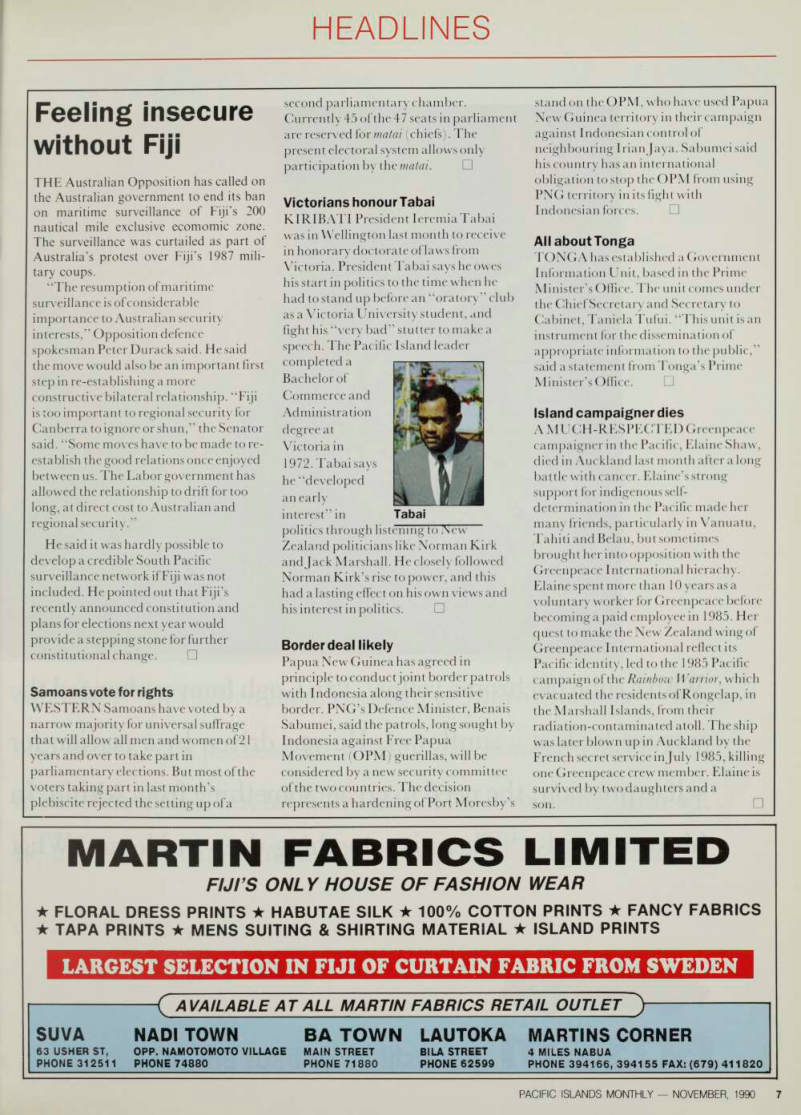
Currently 45 of the 47 seats in parliament are reserved for matai (chiefs). The present electoral system allows only participation by the matai. □ Victorians honour Tabai KIRIBATI President leremiaTabai was in Wellington last month to receive in honorary doctorate oflaws from Victoria. President Tabai says he owes his start in politics to the time when he had to stand up before an “oratory” club as a Victoria University student, and fight his “very bad” stutter to make a speech. The Pacific Island leader
completed a Bachelor of Commerce and Administration degree at Victoria in 1972. Tabai says he “developed an early interest” in
politics through listening to New Zealand politicians like Norman Kirk andjack Marshall. He closely followed Norman Kirk’s rise to power, and this had a lasting effect on his own views and his interest in politics. □ Border deal likely Papua New Guinea has agreed in principle to conduct joint border patrols with Indonesia along their sensitive border. PNG’s Defence Minister, Benais Sabumei, said the patrols, long sought by Indonesia against Free Papua Movement (OPM) guerillas, will be considered by a new security committee of the two countries. The decision represents a hardening of Port Moresby’s
stand on the OPM, who have used Papua New Guinea territory in their campaign against Indonesian control of neighbouring Irianjaya. Sabumei said his country has an international obligation to stop the OPM from using PNG territory in its fight with Indonesian forces. □ All aboutlonga TONGA has established a Government Information Unit, based in the Prime Minister’s Office. The unit comes under the ChicfSecretary and Secretary to Cabinet, Taniela Tufui. “This unit is an instrument for the dissemination of appropriate information to the public,” said a statement from Tonga’s Prime Minister’s Office.
Island campaigner dies A MUCH-RESPECTED Greenpeace campaigner in the Pacific, Elaine Shaw, died in Auckland last month after a long battle with cancer. Elaine’s strong support for indigenous self determination in the Pacific made her many friends, particularly in Vanuatu, Tahiti and Bclau, but sometimes brought her into opposition with the Greenpeace International hierachy.
Elaine spent more than 10 years as a voluntary worker for Greenpeace before becoming a paid employee in 1985. Her quest to make the New Zealand wing of Greenpeace International reflect its Pacific identity, led to the 1985 Pacific campaign of the Rainbow Warrior, which evacuated the residents of Rongelap, in the Marshall Islands, from their radiation-contaminated atoll. The ship was later blown up in Auckland by the French secret service in July 1985, killing one Greenpeace crew member. Elaine is survived by two daughters and a son. □
Tabai
Advertisements & other items, pp. 7-9 (1 item)
Martin Fabrics Limited
FIJI’S ONLY HOUSE OF FASHION WEAR
★ FLORAL DRESS PRINTS ★ HABUTAE SILK ★ 100% COTTON PRINTS ★ FANCY FABRICS ★ TAPA PRINTS ★ MENS SUITING & SHIRTING MATERIAL ★ ISLAND PRINTS LARGEST SELECTION IN FIJI OF CURTAIN FABRIC FROM SWEDEN ( AVAILABLE AT ALL MARTIN FABRICS RETAIL SUVA NADI TOWN BA TOWN LAUTOKA MARTINS CORNER 63 USHER ST, OPP. NAMOTOMOTO VILLAGE MAIN STREET BILA STREET 4 MILES NABUA PHONE 312511 PHONE 74880 PHONE 71880 PHONE 62599 PHONE 394166, 394155 FAX: (679) 411820
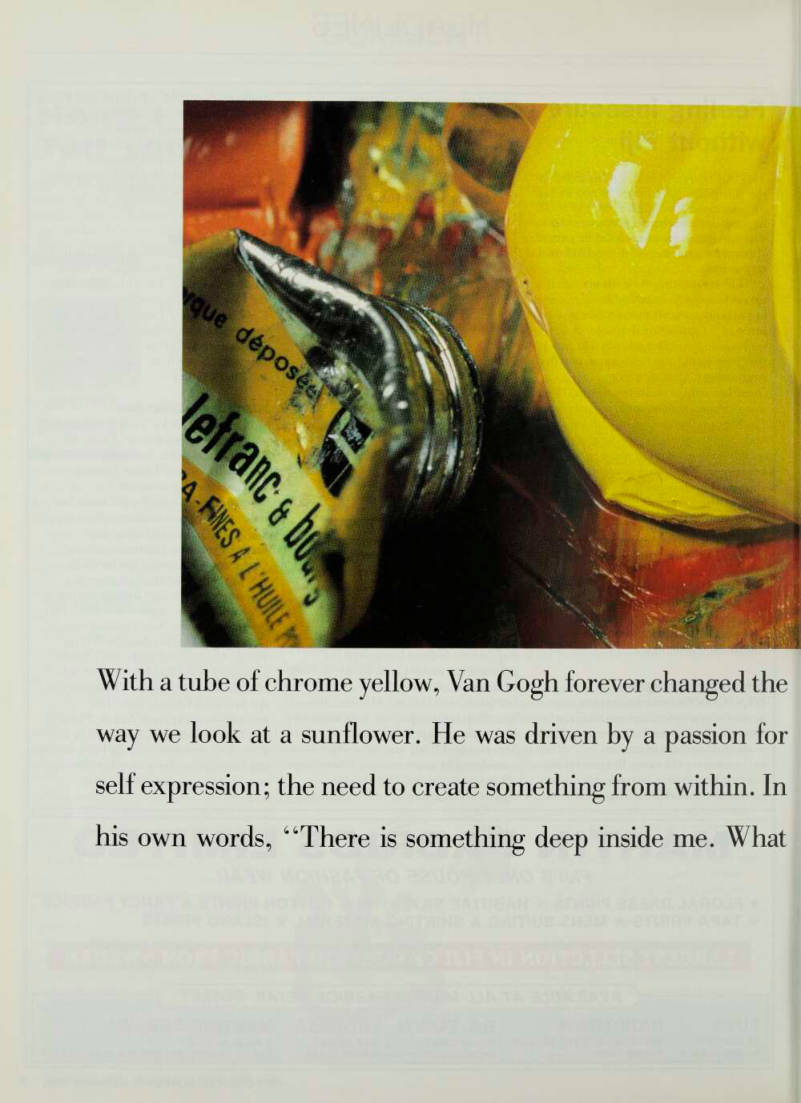
w£, H* % % IP With a tube of chrome yellow, Van Gogh forever changed the way we look at a sunflower. He was driven by a passion for self expression; the need to create something from within. In his own words, 4 ‘There is something deep inside me. What
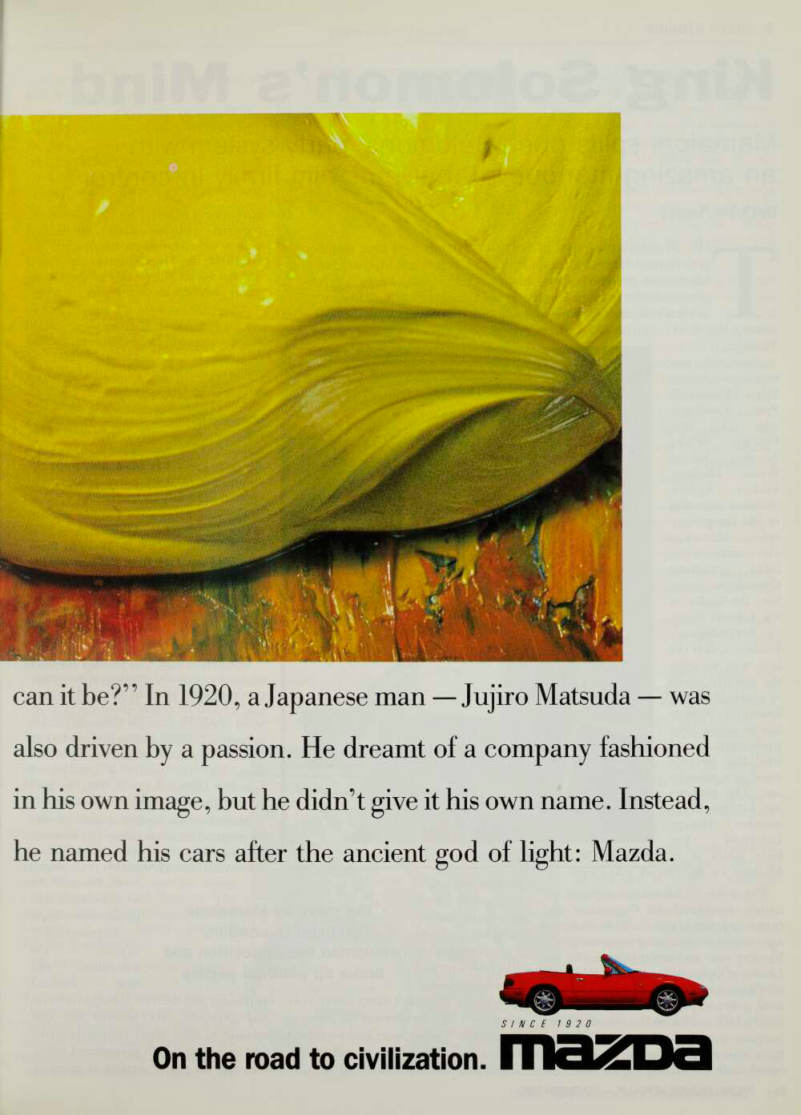
can it be?” In 1920, a Japanese man —Jujiro Matsuda was also driven by a passion. He dreamt of a company fashioned in his own image, but he didn’t give it his own name. Instead, he named his cars after the ancient god of light: Mazda.
©sasasa^*
SINCE 1920
On the road to civilization. ITI3ZD3
King Solomon’s Mind
Cover Stories
Mamaloni splits open Solomons’ party system with an amazing manouevre that puts him firmly in control
By Dykes Angiki
THE 19-month-old reign of Solomon Islands first ever single-party government came to an end October 9 when Prime Minister Solomon Mamaloni resigned from his ruling Alliance Party to form a government of national unity. He did this by dropping five ministers in his all-Alliance Cabinet and appointed five replacements, four from among the ranks of the Opposition group, and Alliance backbencher Job
Tausiga.
Among the new ministers is former Prime Minister Sir Peter Kenilorea, who takes over Foreign Affairs.
Another former Prime Minister, Ezekiel Alebua, declined the offer to join the govern ment. Mamaloni also convinced an other prominent
Opposition mem
ber, the leader of the Liberal Party, Bartholomew Ulufa’alu, that the best way to serve the country is not to entangle in par
liamentary debate
but to resign from parliament and join the govern ment as a consult ant. The remain ing Liberal Party
member, George
Luialamo, has been sworn is as
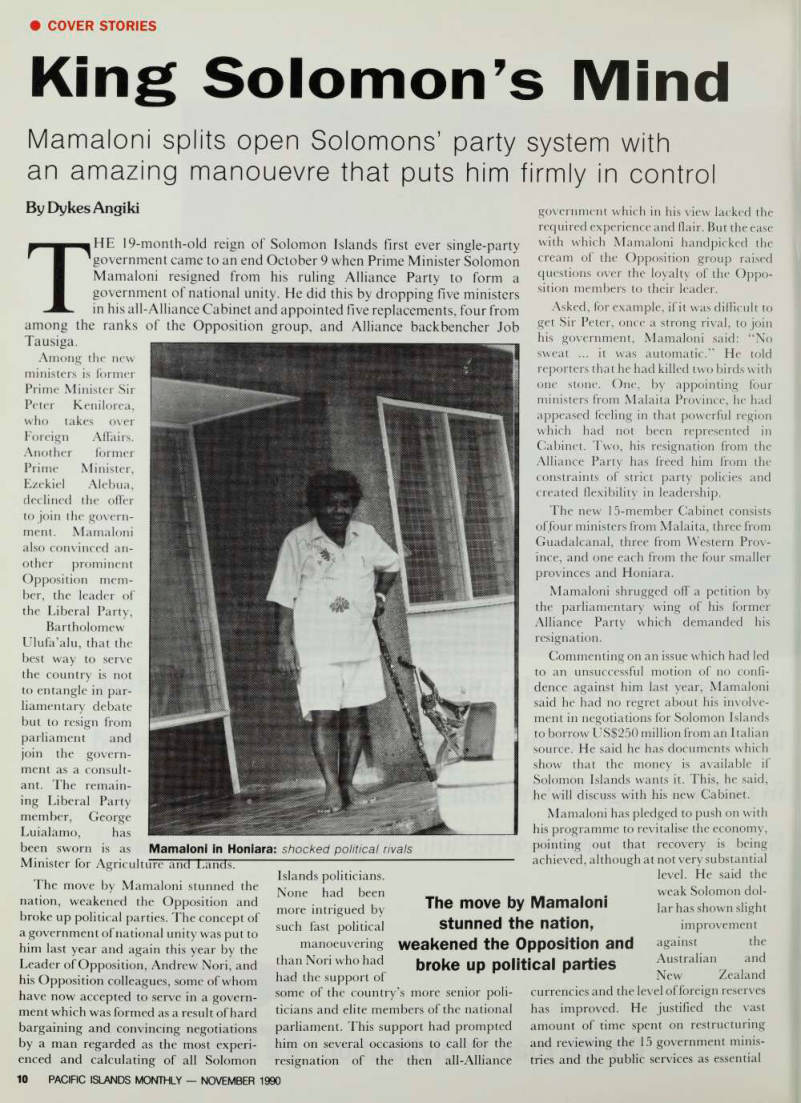
Minister for Agriculture and Lands.
The move by Mamaloni stunned the nation, weakened the Opposition and broke up political parties. The concept of a government of national unity was put to him last year and again this year by the Leader of Opposition, Andrew Nori, and his Opposition colleagues, some of whom have now accepted to serve in a govern ment which was formed as a result of hard
bargaining and convincing negotiations
by a man regarded as the most experi enced and calculating of all Solomon
Islands politicians.
None had been more intrigued by such fast political manoeuvering than Nori who had had the support of
some of the country’s more senior poli ticians and elite members of the national parliament. This support had prompted him on several occasions to call for the resignation of the then all-Alliance
government which in his view lacked the required experience and flair. But the ease with which Mamaloni handpicked the cream of the Opposition group raised questions over the loyalty of the Oppo sition members to their leader.
Asked, for example, if it was difficult to get Sir Peter, once a strong rival, to join his government, Mamaloni said: “No sweat ... it was automatic. He told reporters that he had killed two birds with one stone. One, by appointing four ministers from Malaita Province, he had appeased feeling in that powerful region which had not been represented in Cabinet. Two, his resignation from the Alliance Party has freed him from the constraints of strict party policies and created flexibility in leadership.
The new 15-member Cabinet consists of four ministers from Malaita, three from Guadalcanal, three from Western Prov ince, and one each from the four smaller provinces and Honiara.
Mamaloni shrugged off a petition by the parliamentary wing of his former Alliance Party which demanded his resignation.
Commenting on an issue which had led to an unsuccessful motion of no confi dence against him last year, Mamaloni said he had no regret about his involve ment in negotiations for Solomon Islands to borrow US$25O million from an Italian source. He said he has documents which show that the money is available if Solomon Islands wants it. This, he said, he will discuss with his new Cabinet.
Mamaloni has pledged to push on with his programme to revitalise the economy, pointing out that recovery is being achieved, although at not very substantial
The move by Mamaloni stunned the nation, weakened the Opposition and broke up political parties
level. He said the weak Solomon dol lar has shown slight improvement against the Australian and New Zealand
currencies and the level of foreign reserves has improved. He justified the vast amount of time spent on restructuring and reviewing the 15 government minis tries and the public services as essential
Mamaloni in Honiara: shocked political rivals
and a pre-requisite to sound political and economic management.
Mamaloni, a founder of one of the country’s first political parties, the Peoples Progressive Party (PPP), said the creation of his Government of National Unity, will not end the party system. He. in fact, plans to revive the PPP which had merged with the Rural Alliance to form what is now the Solomon Islands People Alliance (SIPA).
But the most shattering aspect of Mamaloni’s latest political moves was the return of a coalition government. His landslide victory in last year’s general elections brought to power Solomon Islands’ first single- party government since independence 12 years ago. His popular victory brought new political expectations. But, alas, it did not last.
Mamaloni conceded that politics in the Solomons evolves around personalities rather than party affiliations.
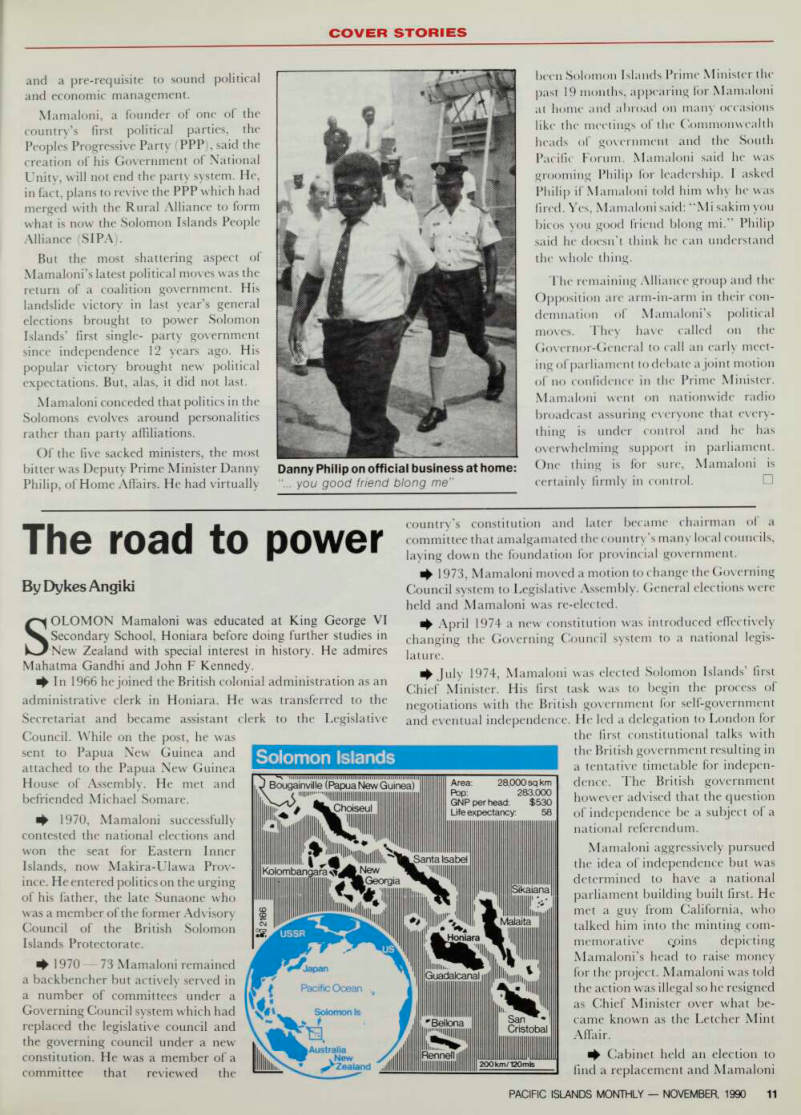
Of the five sacked ministers, the most bitter was Deputy Prime Minister Danny Philip, of Home Affairs. He had virtually
been Solomon Islands Prime Minister the past 19 months, appearing for Mamaloni at home and abroad on many occasions like the meetings of the Commonwealth heads of government and the South Pacific Forum. Mamaloni said he was grooming Philip for leadership. I asked Philip if Mamaloni told him why he was fired. Yes, Mamaloni said: “Mi sakim you bicos you good friend blong mi." Philip said he doesn’t think he can understand the whole thing.
The remaining Alliance group and the Opposition arc arm-in-arm in their con demnation of Mamaloni’s political moves. They have called on the Governor-General to call an early meet ing of parliament to debate a joint motion of no confidence in the Prime Minister.
Mamaloni went on nationwide radio broadcast assuring everyone that every thing is under control and he has overwhelming support in parliament.
One thing is for sure, Mamaloni is certainly firmly in control. □
Danny Philip on official business at home: "... you good friend blong me"
The road to power
By Dykes Angiki
SOLOMON Mamaloni was educated at King George VI Secondary School, Honiara before doing further studies in New Zealand with special interest in history. He admires Mahatma Gandhi and John F Kennedy. ln 1966 he joined the British colonial administration as an administrative clerk in Honiara. He was transferred to the Secretariat and became assistant clerk to the Legislative Council. While on the post, he was
sent to Papua New Guinea and attached to the Papua New Guinea House of Assembly. He met and befriended Michael Somare. 1970, Mamaloni successfully contested the national elections and won the seat for Eastern Inner Islands, now Makira-Ulawa Prov ince. He entered politics on the urging of his father, the late Sunaone who was a member of the former Advisory Council of the British Solomon Islands Protectorate. 1970 73 Mamaloni remained a backbencher but actively served in a number of committees under a Governing Council system which had replaced the legislative council and the governing council under a new constitution. He was a member of a committee that reviewed the
country’s constitution and later became chairman of a committee that amalgamated the country’s many local councils, laying down the foundation for provincial government. + 1973, Mamaloni moved a motion to change the Governing Council system to Legislative Assembly. General elections were held and Mamaloni was re-elected.
April 1974 a new constitution was introduced effectively changing the Governing Council system to a national legis lature.
July 1974, Mamaloni was elected Solomon Islands’ first Chief Minister. His first task was to begin the process of negotiations with the British government for self-government and eventual independence. He led a delegation to London for
the first constitutional talks with the British government resulting in a tentative timetable for indepen dence. The British government however advised that the question of independence be a subject of a national referendum.
Mamaloni aggressively pursued the idea of independence but was determined to have a national parliament building built first. He met a guy from California, who talked him into the minting com memorative cpins depicting Mamaloni’s head to raise money for the project. Mamaloni was told the action was illegal so he resigned as Chief Minister over what be came known as the Letcher Mint Affair.
Cabinet held an election to find a replacement and Mamaloni
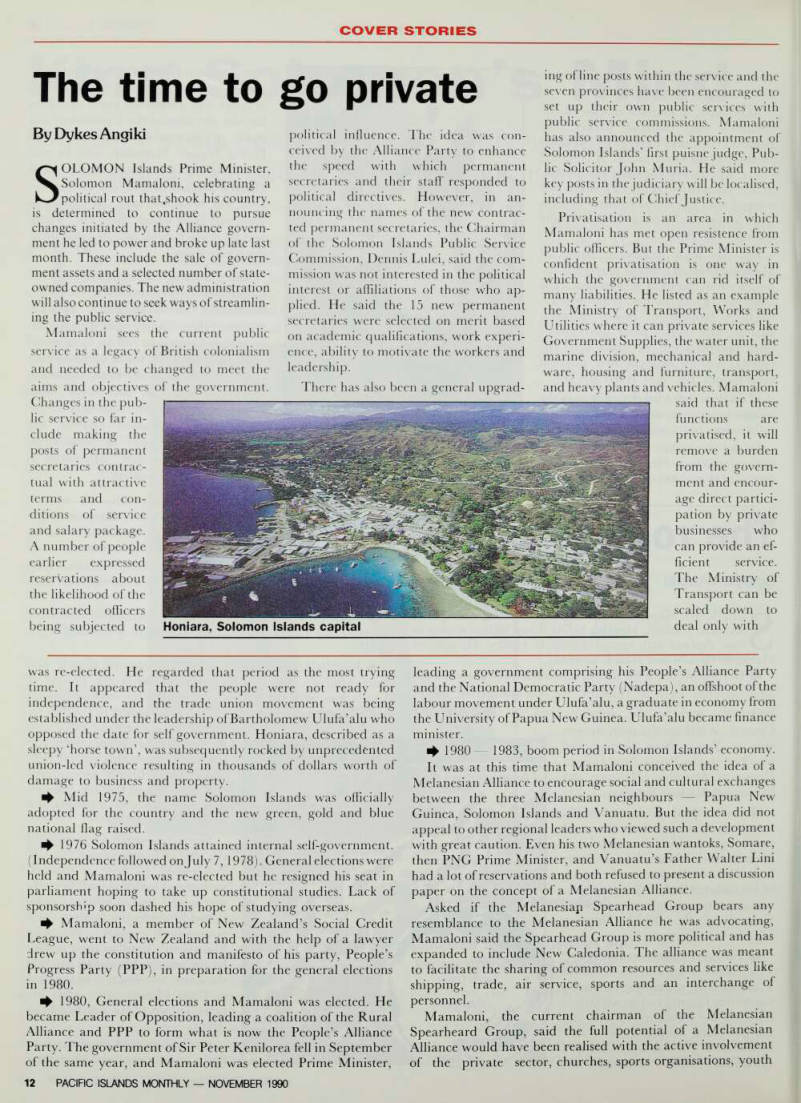
Solomon Islands
was re-elected. He regarded that period as the most trying time. It appeared that the people were not ready for independence, and the trade union movement was being established under the leadership ofßartholomew Ulufa’alu who opposed the date for self government. Honiara, described as a sleepy ‘horse town’, was subsequently rocked by unprecedented union-led violence resulting in thousands of dollars worth of damage to business and property.
Mid 1975, the name Solomon Islands was officially adopted for the country and the new green, gold and blue national flag raised. (Independence followed on July 7, 1978). General elections were held and Mamaloni was re-elected but he resigned his seat in parliament hoping to take up constitutional studies. Lack of sponsorship soon dashed his hope of studying overseas. + Mamaloni, a member of New Zealand’s Social Credit League, went to New Zealand and with the help of a lawyer drew up the constitution and manifesto of his party. People’s Progress Party (PPP), in preparation for the general elections in 1980. became Leader of Opposition, leading a coalition of the Rural Alliance and PPP to form what is now the People’s Alliance Party. The government of Sir Peter Kenilorea fell in September of the same year, and Mamaloni was elected Prime Minister,
leading a government comprising his People’s Alliance Party and the National Democratic Party (Nadepa), an offshoot of the labour movement under Ulufa’alu, a graduate in economy from the University of Papua New Guinea. Ulufa’alu became finance minister.
It was at this time that Mamaloni conceived the idea of a Melanesian Alliance to encourage social and cultural exchanges between the three Melanesian neighbours Papua New Guinea, Solomon Islands and Vanuatu. But the idea did not appeal to other regional leaders who viewed such a development with great caution. Even his two Melanesian wantoks, Somare, then PNG Prime Minister, and Vanuatu’s Father Walter Lini had a lot of reservations and both refused to present a discussion paper on the concept of a Melanesian Alliance.
Asked if the Spearhead Group bears any resemblance to the Melanesian Alliance he was advocating, Mamaloni said the Spearhead Group is more political and has expanded to include New Caledonia. The alliance was meant to facilitate the sharing of common resources and services like shipping, trade, air service, sports and an interchange of
personnel.
Mamaloni, the current chairman of the Melanesian Spearheard Group, said the full potential of a Melanesian Alliance would have been realised with the active involvement of the private sector, churches, sports organisations, youth
groups and others who must engage in co-operative efforts that
must have the backing of their governments who must provide funds and other assistance to facili tate such efforts.
He said the success of such an alliance between three sovereign states hinges on maintaining intergrity, credibility and mutual trust. Each member must respect the sovereignty of the other.
Mamaloni strongly believes that if the Melanesian concept of sharing and solving disputes was taken seriously, the magnitude of the Bougainville crisis in Papua New Guinea would have been lessened.
Asked why he has not been attending overseas meetings of re gional leaders, Mamaloni said:
“Unfortunately I had been so busy that 1 couldn't attend such important regional gatherings. I had been working so hard to make my historic one-party government work.
“It would seem now that at this stage ofour development, that
the formation of a govern ment is not the answer.
What matters most is what a government can do, what it can achieve to benefit the people and the nation. With the forma tion of my new Cabinet under a new formula, I have now some of the country’s most experi enced leaders and poli ticians who can be trusted to execute their
responsibilities. The prob
lem with the all-Alliance government was that I had to spend lots of time briefing, clarifying and
translating government policies to implementable plans. This I had done with ministers and staff. In future I will be able to participate in person in regional and internatinal meetings.” □
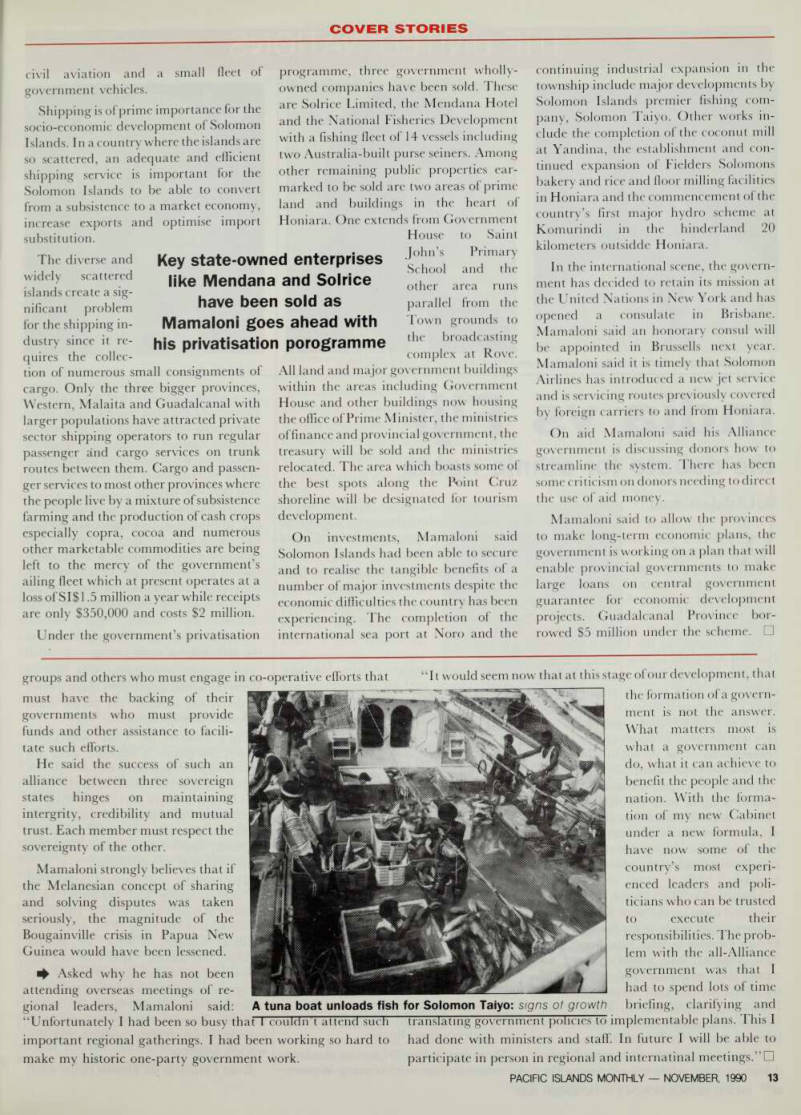
A tuna boat unloads fish for Solomon Taiyo: signs oF growth
The time to go private
By Dykes Angiki
SOLOMON Islands Prime Minister, Solomon Mamaloni, celebrating a political rout that 4 shook his country, is determined to continue to pursue changes initiated by the Alliance govern ment he led to power and broke up late last month. These include the sale of govern ment assets and a selected number of state owned companies. The new administration will also continue to seek ways of streamlin ing the public service.
Mamaloni sees the current public service as a legacy of British colonialism and needed to be changed to meet the aims and objectives of the government.
Changes in the pub lic service so far in clude making the posts of permanent secretaries contrac tual with attractive terms and con ditions of service and salary package.
A number of people earlier expressed reservations about the likelihood of the contracted officers being subjected to
political influence. The idea was con ceived by the Alliance Party to enhance the speed with which permanent secretaries and their staff responded to political directives. However, in an nouncing the names of the new contrac ted permanent secretaries, the Chairman of the Solomon Islands Public Service Commission, Dennis Lulei, said the com mission was not interested in the political interest or affiliations of those who ap plied. He said the 15 new permanent secretaries were selected on merit based on academic qualifications, work experi ence, ability to motivate the workers and
leadership.
There has also been a general upgrad-
ing of line posts within the service and the seven provinces have been encouraged to set up their own public services with public service commissions. Mamaloni has also announced the appointment of Solomon Islands’ first puisne judge, Pub lic Solicitor John Muria. He said more key posts in the judiciary will be localised, including that of Chief Justice.
Privatisation is an area in which Mamaloni has met open resistence from public officers. But the Prime Minister is confident privatisation is one way in which the government can rid itself of many liabilities. He listed as an example the Ministry of Transport, Works and Utilities where it can private services like Government Supplies, the water unit, the marine division, mechanical and hard ware, housing and furniture, transport, and heavy plants and vehicles. Mamaloni
said that if these functions are privatised, it will remove a burden from the govern ment and encour age direct partici
pation by private
businesses who can provide an ef ficient service.
The Ministry of Transport can be scaled down to deal only with
Honiara, Solomon Islands capital
civil aviation and a small fleet of government vehicles.
Shipping is of prime importance for the socio-economic development of Solomon Islands. In a country where the islands are so scattered, an adequate and efficient shipping service is important for the Solomon Islands to be able to convert from a subsistence to a market economy, increase exports and optimise import substitution.
The diverse and
widely scattered
islands create a sig nificant problem for the shipping in dustry since it re quires the collec
tion of numerous small consignments of cargo. Only the three bigger provinces, Western, Malaita and Guadalcanal with larger populations have attracted private sector shipping operators to run regular passenger and cargo services on trunk routes between them. Cargo and passen ger services to most other provinces where the people live by a mixture of subsistence farming and the production of cash crops especially copra, cocoa and numerous other marketable commodities are being left to the mercy of the government’s ailing fleet which at present operates at a loss of SIS 1.5 million a year while receipts are only 5350,000 and costs S 2 million.
Under the government’s privatisation
programme, three government wholly owned companies have been sold. These are Solrice Limited, the Mendana Hotel and the National Fisheries Development with a fishing fleet of 14 vessels including two Australia-built purse seiners. Among other remaining public properties ear marked to be sold are two areas of prime land and buildings in the heart of Honiara. One extends from Government House to Saint
Key state-owned enterprises like Mendana and Solrice have been sold as Mamaloni goes ahead with his privatisation porogramme
John’s Primary School and the other area runs parallel from the Town grounds to the broadcasting complex at Rove.
All land and major government buildings within the areas including Government House and other buildings now housing the office of Prime Minister, the ministries offmance and provincial government, the treasury will be sold and the ministries relocated. The area which boasts some of the best spots along the Point Cruz shoreline will be designated for tourism development.
On investments, Mamaloni said Solomon Islands had been able to secure and to realise the tangible benefits of a number of major investments despite the economic difficulties the country has been experiencing. The completion of the international sea port at Noro and the
continuing industrial expansion in the township include major developments by Solomon Islands premier fishing com pany, Solomon Taiyo. Other works in clude the completion of the coconut mill at Yandina, the establishment and con tinued expansion of Fielders Solomons bakery and rice and floor milling facilities in Honiara and the commencement of the country’s first major hydro scheme at Komurindi in the hinderland 20 kilometers outsidde Honiara.
In the international scene, the govern ment has decided to retain its mission at the United Nations in New York and has opened a consulate in Brisbane.
Mamaloni said an honorary consul will be appointed in Brussells next year.
Mamaloni said it is timely that Solomon Airlines has introduced a new jet service and is servicing routes previously covered by foreign carriers to and from Honiara.
On aid Mamaloni said his Alliance government is discussing donors how to streamline the system. There has been some criticism on donors needing to direct the use of aid money.
Mamaloni said to allow the provinces to make long-term economic plans, the government is working on a plan that will enable provincial governments to make large loans on central government guarantee for economic development projects. Guadalcanal Province bor rowed $5 million under the scheme. □
Advertisements & other items, p. 14 (1 item)
The United Nations
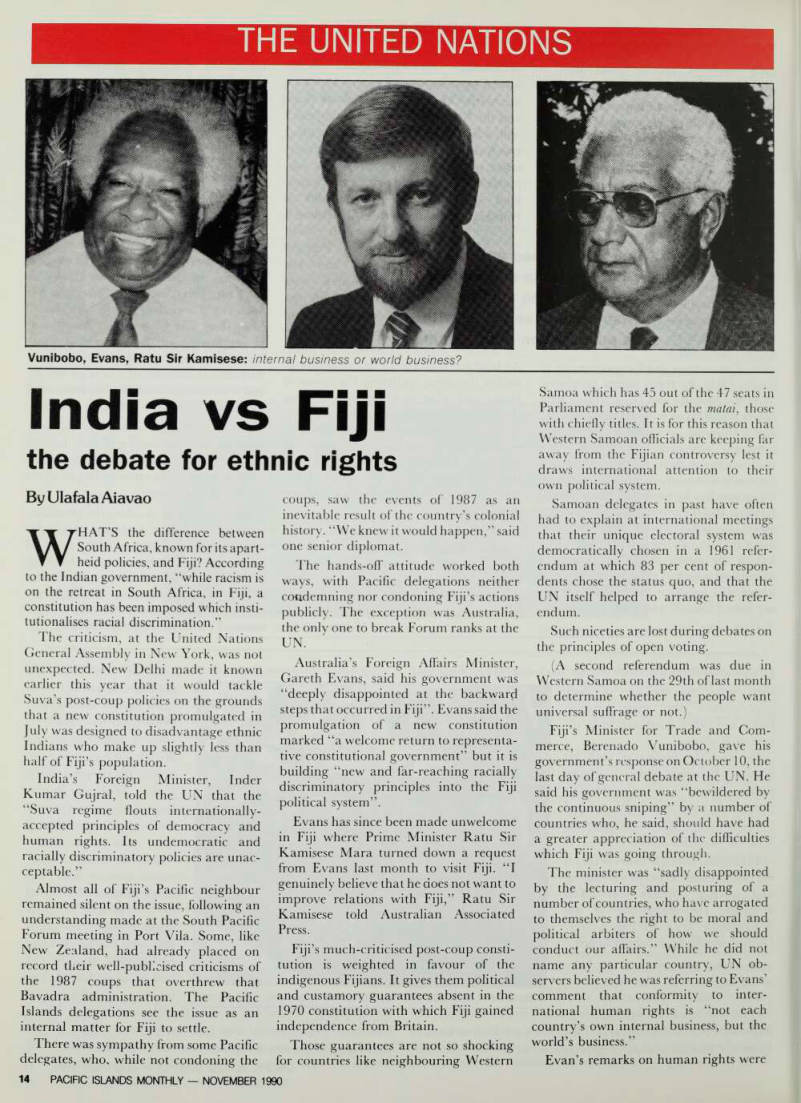
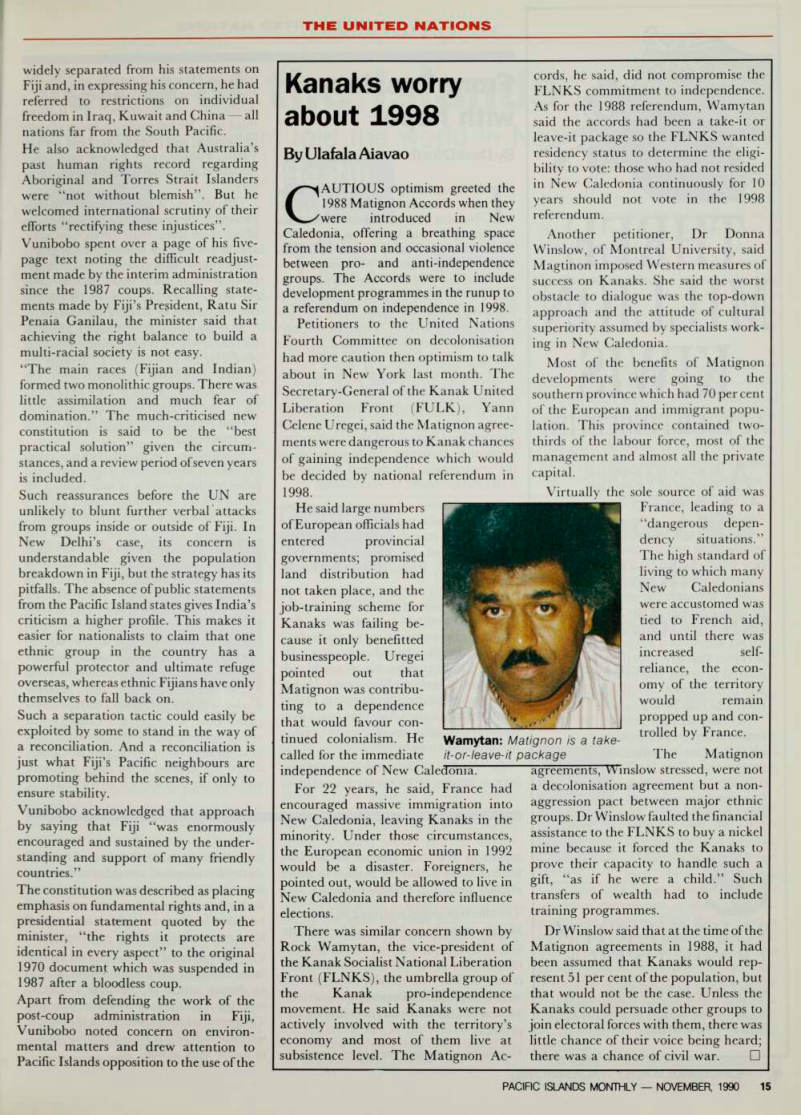
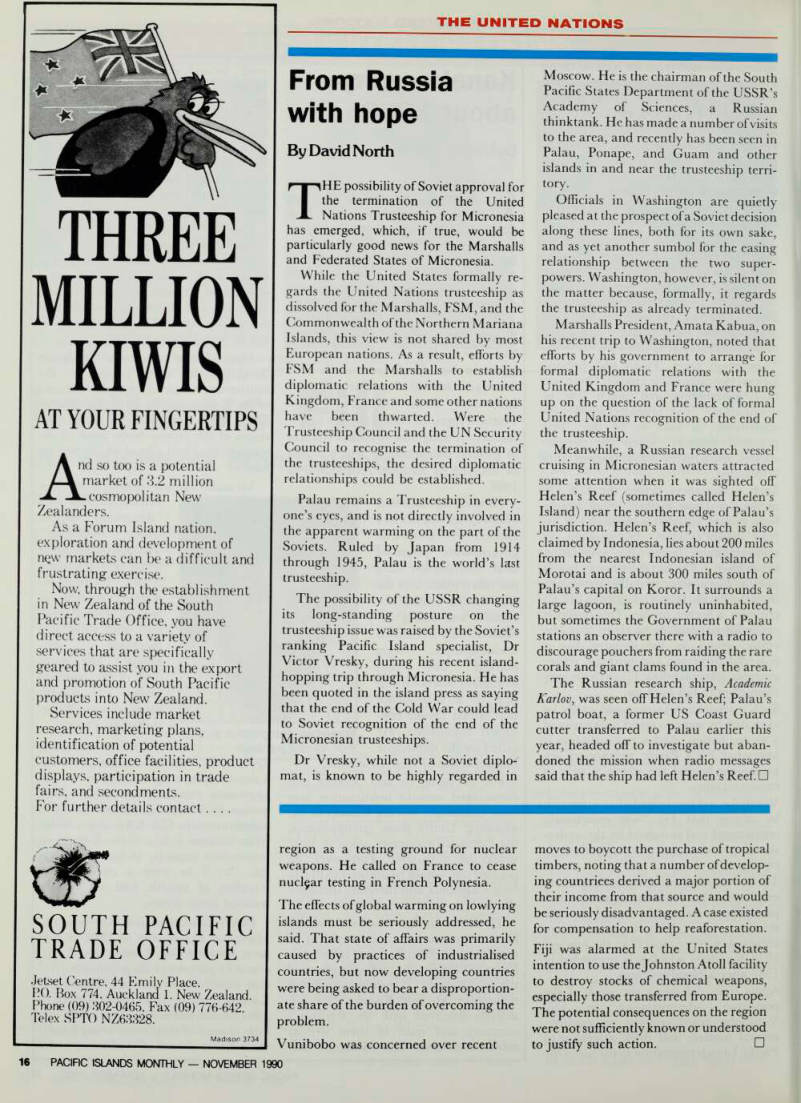
Vunibobo, Evans, Ratu Sir Kamisese: internal business or world business?
India vs Fiji
the debate for ethnic rights
By Ulafala Aiavao
WHAT’S the difference between South Africa, known for its apart heid policies, and Fiji? According to the Indian government, “while racism is on the retreat in South Africa, in Fiji, a constitution has been imposed which insti tutionalises racial discrimination.”
The criticism, at the United Nations General Assembly in New York, was not unexpected. New Delhi made it known earlier this year that it would tackle Suva’s post-coup policies on the grounds that a new constitution promulgated in July was designed to disadvantage ethnic Indians who make up slightly less than half of Fiji’s population.
India’s Foreign Minister, Inder Kumar Gujral, told the UN that the “Suva regime flouts internationally accepted principles of democracy and human rights. Its undemocratic and racially discriminatory policies are unac ceptable.”
Almost all of Fiji’s Pacific neighbour remained silent on the issue, following an understanding made at the South Pacific Forum meeting in Port Vila. Some, like New Zealand, had already placed on record their well-publicised criticisms of the 1987 coups that overthrew that Bavadra administration. The Pacific Islands delegations see the issue as an internal matter for Fiji to settle.
There was sympathy from some Pacific delegates, who, while not condoning the
coups, saw the events of 1987 as an inevitable result of the country’s colonial history. “We knew it would happen,” said one senior diplomat.
The hands-off attitude worked both ways, with Pacific delegations neither condemning nor condoning Fiji’s actions publicly. The exception was Australia, the only one to break Forum ranks at the UN.
Australia’s Foreign Affairs Minister, Gareth Evans, said his government was “deeply disappointed at the backward steps that occurred in Fiji”. Evans said the promulgation of a new constitution marked “a welcome return to representa tive constitutional government” but it is building “new and far-reaching racially discriminatory principles into the Fiji political system”.
Evans has since been made unwelcome in Fiji where Prime Minister Ratu Sir Kamisese Mara turned down a request from Evans last month to visit Fiji. “I genuinely believe that he does not want to improve relations with Fiji,” Ratu Sir Kamisese told Australian Associated Press.
Fiji’s much-criticised post-coup consti tution is weighted in favour of the indigenous Fijians. It gives them political and custamory guarantees absent in the 1970 constitution with which Fiji gained independence from Britain, Those guarantees are not so shocking for countries like neighbouring Western
Samoa which has 45 out of the 47 seats in Parliament reserved for the matai , those with chiefly titles. It is for this reason that Western Samoan officials are keeping far away from the Fijian controversy lest it draws international attention to their own political system.
Samoan delegates in past have often had to explain at international meetings that their unique electoral system was democratically chosen in a 1961 refer endum at which 83 per cent of respon dents chose the status quo, and that the UN itself helped to arrange the refer endum.
Such niceties are lost during debates on the principles of open voting. (A second referendum was due in Western Samoa on the 29th of last month to determine whether the people want universal suffrage or not.) Fiji’s Minister for Trade and Com merce, Berenado Vunibobo, gave his government’s response on October 10, the last day of general debate at the UN. He said his government was “bewildered by the continuous sniping” by a number of countries who, he said, should have had a greater appreciation of the difficulties which Fiji was going through.
The minister was “sadly disappointed by the lecturing and posturing of a number of countries, who have arrogated to themselves the right to be moral and political arbiters of how we should conduct our affairs.” While he did not name any particular country, UN ob servers believed he was referring to Evans’ comment that conformity to inter national human rights is “not each country’s own internal business, but the world’s business.”
Evan’s remarks on human rights were
widely separated from his statements on Fiji and, in expressing his concern, he had referred to restrictions on individual freedom in Iraq, Kuwait and China all nations far from the South Pacific.
He also acknowledged that Australia’s past human rights record regarding Aboriginal and Torres Strait Islanders were “not without blemish”. But he welcomed international scrutiny of their efforts “rectifying these injustices”.
Vunibobo spent over a page of his five page text noting the difficult readjust ment made by the interim administration since the 1987 coups. Recalling state ments made by Fiji’s President, Ratu Sir Penaia Ganilau, the minister said that achieving the right balance to build a multi-racial society is not easy.
“The main races (Fijian and Indian) formed two monolithic groups. There was little assimilation and much fear of domination.” The much-criticised new constitution is said to be the “best practical solution” given the circum stances, and a review period of seven years is included.
Such reassurances before the UN are unlikely to blunt further verbal attacks from groups inside or outside of Fiji. In New Delhi’s case, its concern is understandable given the population breakdown in Fiji, but the strategy has its pitfalls. The absence of public statements from the Pacific Island states gives India’s criticism a higher profile. This makes it easier for nationalists to claim that one ethnic group in the country has a powerful protector and ultimate refuge overseas, whereas ethnic Fijians have only themselves to fall back on.
Such a separation tactic could easily be exploited by some to stand in the way of a reconciliation. And a reconciliation is just what Fiji’s Pacific neighbours are promoting behind the scenes, if only to
ensure stability.
Vunibobo acknowledged that approach
by saying that Fiji “was enormously
encouraged and sustained by the under standing and support of many friendly countries.”
The constitution was described as placing emphasis on fundamental rights and, in a presidential statement quoted by the minister, “the rights it protects are identical in every aspect” to the original 1970 document which was suspended in 1987 after a bloodless coup.
Apart from defending the work of the post-coup administration in Fiji, Vunibobo noted concern on environ mental matters and drew attention to Pacific Islands opposition to the use of the
region as a testing ground for nuclear weapons. He called on France to cease testing in French Polynesia.
The effects of global warming on lowlying islands must be seriously addressed, he said. That state of affairs was primarily caused by practices of industrialised countries, but now developing countries were being asked to bear a disproportion ate share of the burden of overcoming the problem.
Vunibobo was concerned over recent
moves to boycott the purchase of tropical timbers, noting that a number of develop ing countriees derived a major portion of their income from that source and would be seriously disadvantaged. A case existed for compensation to help reaforestation.
Fiji was alarmed at the United States intention to use the Johnston Atoll facility to destroy stocks of chemical weapons, especially those transferred from Europe.
The potential consequences on the region were not sufficiently known or understood to justify such action. □
about 1998
Kanaks worry about 1998
By Ulafala Aiavao
CAUTIOUS optimism greeted the 1988 Matignon Accords when they were introduced in New Caledonia, offering a breathing space from the tension and occasional violence between pro- and anti-independence groups. The Accords were to include development programmes in the runup to a referendum on independence in 1998.
Petitioners to the United Nations Fourth Committee on decolonisation had more caution then optimism to talk about in New York last month. The Secretary-General of the Kanak United Liberation Front (FULK), Yann Celene Uregei, said the Matignon agree ments were dangerous to Kanak chances of gaining independence which would be decided by national referendum in 1998.
He said large numbers of European officials had entered provincial
governments; promised
land distribution had not taken place, and the job-training scheme for Kanaks was failing be cause it only benefitted
businesspeople. Uregei
pointed out that Matignon was contribu
ting to a dependence
that would favour con tinued colonialism. He called for the immediate
independence of New Caledonia.
For 22 years, he said, France had encouraged massive immigration into New Caledonia, leaving Kanaks in the minority. Under those circumstances, the European economic union in 1992 would be a disaster. Foreigners, he pointed out, would be allowed to live in New Caledonia and therefore influence elections.
There was similar concern shown by Rock Wamytan, the vice-president of the Kanak Socialist National Liberation Front (FLNKS), the umbrella group of the Kanak pro-independence movement. He said Kanaks were not actively involved with the territory’s economy and most of them live at subsistence level. The Matignon Ac
cords, he said, did not compromise the FLNKS commitment to independence.
As for the 1988 referendum, Wamytan said the accords had been a take-it or leave-it package so the FLNKS wanted residency status to determine the eligi bility to vote: those who had not resided in New Caledonia continuously for 10 years should not vote in the 1998 referendum.
Another petitioner, Dr Donna Winslow, of Montreal University, said Magtinon imposed Western measures of success on Kanaks. She said the worst obstacle to dialogue was the top-down approach and the attitude of cultural superiority assumed by specialists work ing in New Caledonia.
Most of the benefits of Matignon developments were going to the southern province which had 70 per cent of the European and immigrant popu lation. This province contained two thirds of the labour force, most of the management and almost all the private
capital.
Virtually the sole source of aid was
France, leading to a “dangerous depen dency situations.”
The high standard of living to which many New Caledonians were accustomed was tied to French aid, and until there was increased self reliance, the econ omy of the territory would remain propped up and con trolled by France.
The Matignon
agreements, Winslow stressed, were not a decolonisation agreement but a non aggression pact between major ethnic groups. Dr Winslow faulted the financial assistance to the FLNKS to buy a nickel mine because it forced the Kanaks to prove their capacity to handle such a gift, “as if he were a child.” Such transfers of wealth had to include training programmes.
Dr Winslow said that at the time of the Matignon agreements in 1988, it had been assumed that Kanaks would rep resent 51 per cent of the population, but that would not be the case. Unless the Kanaks could persuade other groups to join electoral forces with them, there was little chance of their voice being heard; there was a chance of civil war. □
Wamytan: Matignon is a take it-or-leave-it package
with hope
From Russia with hope
By David North
THE possibility of Soviet approval for the termination of the United Nations Trusteeship for Micronesia has emerged, which, if true, would be particularly good news for the Marshalls and Federated States of Micronesia.
While the United States formally re gards the United Nations trusteeship as dissolved for the Marshalls, FSM, and the Commonwealth of the Northern Mariana Islands, this view is not shared by most European nations. As a result, efforts by FSM and the Marshalls to establish diplomatic relations with the United Kingdom, France and some other nations have been thwarted. Were the Trusteeship Council and the UN Security Council to recognise the termination of the trusteeships, the desired diplomatic relationships could be established.
Palau remains a Trusteeship in every one’s eyes, and is not directly involved in the apparent warming on the part of the Soviets. Ruled by Japan from 1914 through 1945, Palau is the world’s last
trusteeship.
The possibility of the USSR changing its long-standing posture on the trusteeship issue was raised by the Soviet’s ranking Pacific Island specialist, Dr Victor Vresky, during his recent island hopping trip through Micronesia. He has been quoted in the island press as saying that the end of the Cold War could lead to Soviet recognition of the end of the
Micronesian trusteeships.
Dr Vresky, while not a Soviet diplo mat, is known to be highly regarded in
Moscow. He is the chairman of the South Pacific States Department of the USSR’s Academy of Sciences, a Russian thinktank. He has made a number of visits to the area, and recently has been seen in Palau, Ponape, and Guam and other islands in and near the trusteeship terri tory.
Officials in Washington are quietly pleased at the prospect of a Soviet decision along these lines, both for its own sake, and as yet another sumbol for the easing relationship between the two super powers. Washington, however, is silent on the matter because, formally, it regards the trusteeship as already terminated.
Marshalls President, Amata Kabua, on his recent trip to Washington, noted that efforts by his government to arrange for formal diplomatic relations with the United Kingdom and France were hung up on the question of the lack of formal United Nations recognition of the end of
the trusteeship.
Meanwhile, a Russian research vessel cruising in Micronesian waters attracted some attention when it was sighted off Helen’s Reef (sometimes called Helen’s Island) near the southern edge of Palau’s jurisdiction. Helen’s Reef, which is also claimed by Indonesia, lies about 200 miles from the nearest Indonesian island of Morotai and is about 300 miles south of Palau’s capital on Koror. It surrounds a large lagoon, is routinely uninhabited, but sometimes the Government of Palau stations an observer there with a radio to discourage pouchers from raiding the rare corals and giant clams found in the area.
The Russian research ship, Academic Karlov , was seen off Helen’s Reef; Palau’s patrol boat, a former US Coast Guard cutter transferred to Palau earlier this year, headed off to investigate but aban doned the mission when radio messages said that the ship had left Helen’s Reef. □
Advertisements & other items, p. 16 (1 item)
Kiwis
THREE
MILLION
AT YOUR FINGERTIPS
cosmopolitan New Zealanders.
As a Forum Island nation, exploration and development of new markets can be a difficult and frustrating exercise.
Now, through the establishment in New Zealand of the South Pacific Trade Office, you have direct access to a variety of services that are specifically geared to assist you in the export and promotion of South Pacific products into New Zealand.
Services include market research, marketing plans, identification of potential customers, office facilities, product displays, participation in trade fairs, and secondments.
For further details contact...
SOUTH PACIFIC
TRADE OFFICE
Jetset Centre. 44 Emily Place.
RO. Box 774. Auckland 1. New Zealand.
Phone (09) 802-0465. Fax (09) 776-642.
Telex SPTO NZ68828. nd so too is a potential market of 3.2 million Madison 3734
Voice of the Islands
What island leaders told the world in New York
Media blamed
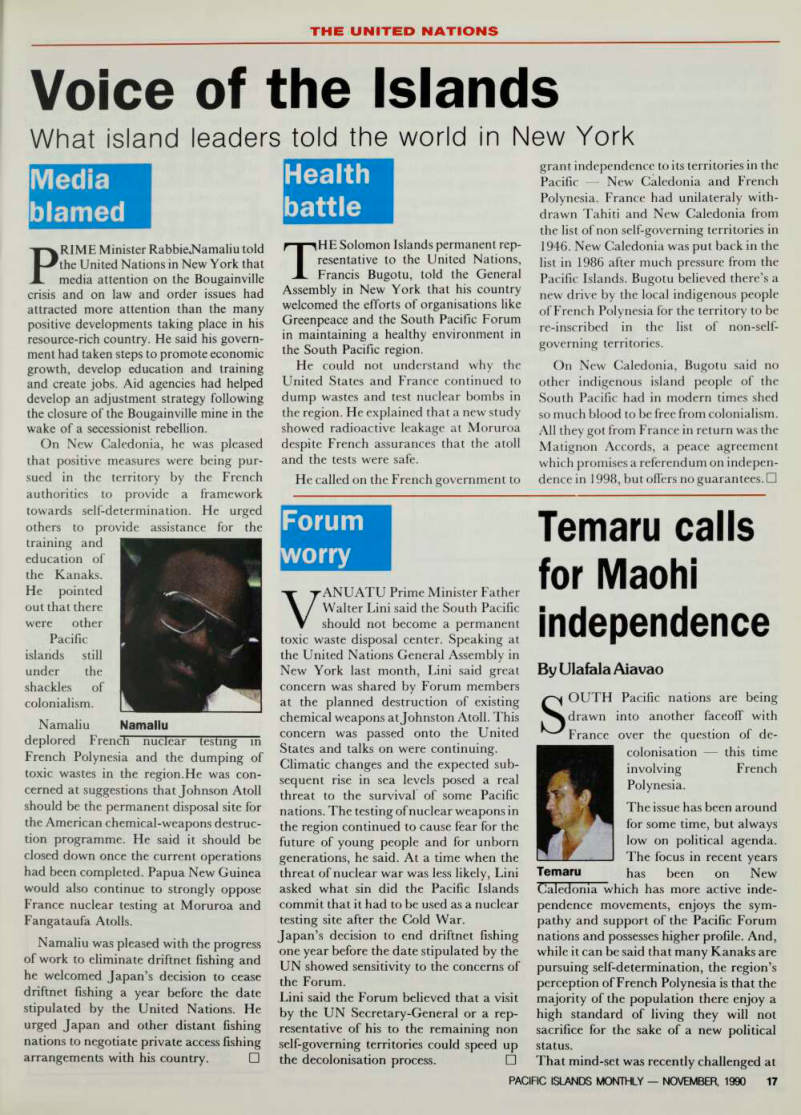
PRIME Minister RabbieJ'Jamaliu told the United Nations in New York that media attention on the Bougainville crisis and on law and order issues had attracted more attention than the many positive developments taking place in his resource-rich country. He said his govern ment had taken steps to promote economic growth, develop education and training and create jobs. Aid agencies had helped develop an adjustment strategy following the closure of the Bougainville mine in the wake of a secessionist rebellion.
On New Caledonia, he was pleased that positive measures were being pur sued in the territory by the French authorities to provide a framework towards self-determination. He urged others to provide assistance for the
training and education of the Kanaks.
He pointed out that there were other Pacific islands still under the shackles of colonialism.
Namaliu
deplored French nuclear testing m French Polynesia and the dumping of toxic wastes in the region.He was con cerned at suggestions that Johnson Atoll should be the permanent disposal site for the American chemical-weapons destruc tion programme. He said it should be closed down once the current operations had been completed. Papua New Guinea would also continue to strongly oppose France nuclear testing at Moruroa and
Fangataufa Atolls.
Namaliu was pleased with the progress of work to eliminate driftnet fishing and he welcomed Japan’s decision to cease driftnet fishing a year before the date stipulated by the United Nations. He urged Japan and other distant fishing nations to negotiate private access fishing arrangements with his country. □
Health battle
THE Solomon Islands permanent rep resentative to the United Nations, Francis Bugotu, told the General Assembly in New York that his country welcomed the efforts of organisations like Greenpeace and the South Pacific Forum in maintaining a healthy environment in the South Pacific region.
He could not understand why the United States and France continued to dump wastes and test nuclear bombs in the region. He explained that a new study showed radioactive leakage at Moruroa despite French assurances that the atoll and the tests were safe.
He called on the French government to
grant independence to its territories in the Pacific New Caledonia and French Polynesia. France had unilateraly with drawn Tahiti and New Caledonia from the list of non self-governing territories in 1946. New Caledonia was put back in the list in 1986 after much pressure from the Pacific Islands. Bugotu believed there’s a new drive by the local indigenous people of French Polynesia for the territory to be re-inscribed in the list of non-self governing territories.
On New Caledonia, Bugotu said no other indigenous island people of the South Pacific had in modern times shed so much blood to be free from colonialism.
All they got from France in return was the Matignon Accords, a peace agreement which promises a referendum on indepen dence in 1998, but offers no guarantees. □
Forum worry
VANUATU Prime Minister Father Walter Lini said the South Pacific should not become a permanent toxic waste disposal center. Speaking at the United Nations General Assembly in New York last month, Lini said great concern was shared by Forum members at the planned destruction of existing chemical weapons at Johnston Atoll. This concern was passed onto the United States and talks on were continuing.
Climatic changes and the expected sub sequent rise in sea levels posed a real threat to the survival of some Pacific nations. The testing of nuclear weapons in the region continued to cause fear for the future of young people and for unborn generations, he said. At a time when the threat of nuclear war was less likely, Lini asked what sin did the Pacific Islands commit that it had to be used as a nuclear testing site after the Cold War.
Japan’s decision to end driftnet fishing one year before the date stipulated by the UN showed sensitivity to the concerns of the Forum.
Lini said the Forum believed that a visit by the UN Secretary-General or a rep resentative of his to the remaining non self-governing territories could speed up the decolonisation process. □
Namaliu
independence
Temaru calls for Maohi independence
By Ulafala Aiavao
SOUTH Pacific nations are being drawn into another faceoff with France over the question of de-
colonisation this time
involving French
Polynesia.
The issue has been around for some time, but always
low on political agenda.
The focus in recent years has been on New
Caledonia which has more active inde pendence movements, enjoys the sym pathy and support of the Pacific Forum nations and possesses higher profile. And, while it can be said that many Kanaks are pursuing self-determination, the region’s perception of French Polynesia is that the majority of the population there enjoy a high standard of living they will not sacrifice for the sake of a new political status.
That mind-set was recently challenged at
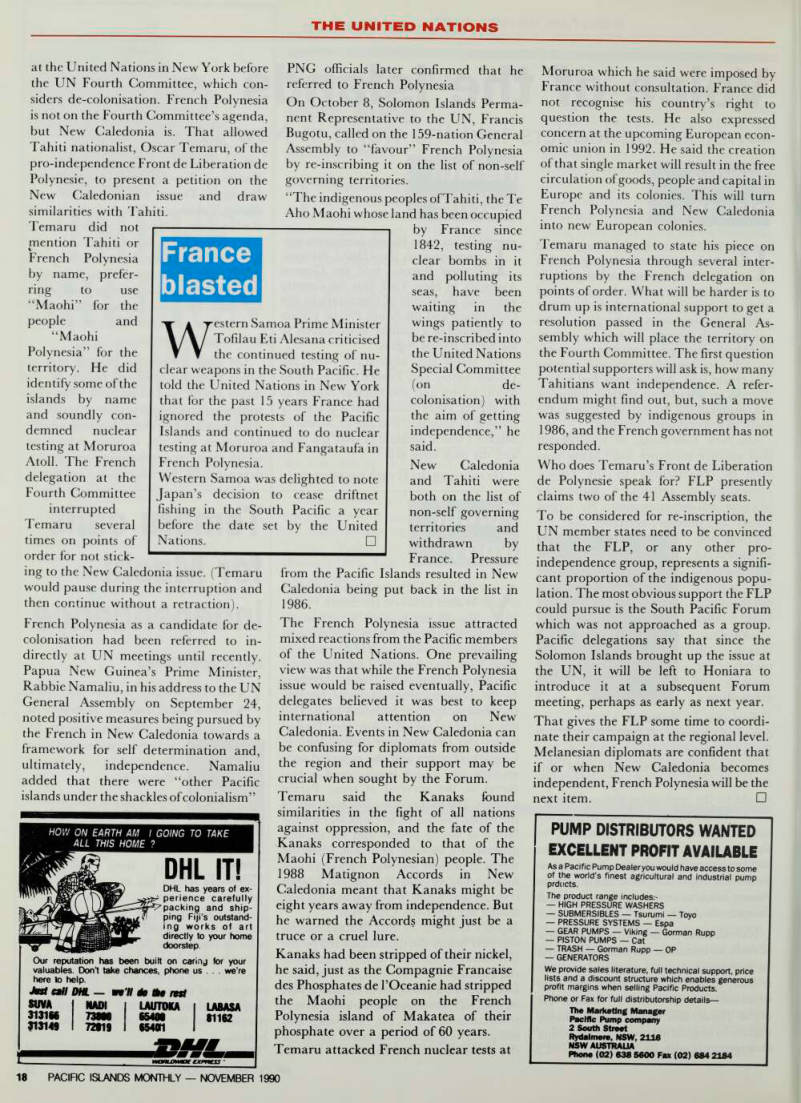
Temaru
at the United Nations in New York before the UN Fourth Committee, which con siders de-colonisation. French Polynesia is not on the Fourth Committee’s agenda, but New Caledonia is. That allowed Tahiti nationalist, Oscar Temaru, of the pro-independence Front de Liberation de Polynesie, to present a petition on the New Caledonian issue and draw similarities with Tahiti.
Temaru did not mention Tahiti or % French Polynesia by name, prefer ring to use “Maohi” for the people and “Maohi Polynesia” for the territory. He did identify some of the islands by name and soundly con demned nuclear testing at Moruroa Atoll. The French delegation at the Fourth Committee
interrupted
Temaru several times on points of order for not stick
ing to the New Caledonia issue. (Temaru would pause during the interruption and then continue without a retraction).
French Polynesia as a candidate for de colonisation had been referred to in directly at UN meetings until recently.
Papua New Guinea’s Prime Minister, Rabbie Namaliu, in his address to the UN General Assembly on September 24, noted positive measures being pursued by the French in New Caledonia towards a framework for self determination and,
ultimately, independence. Namaliu
added that there were “other Pacific islands under the shackles of colonialism”
PNG officials later confirmed that he referred to French Polynesia On October 8, Solomon Islands Perma nent Representative to the UN, Francis Bugotu, called on the 159-nation General Assembly to “favour” French Polynesia by re-inscribing it on the list of non-self
governing territories.
“The indigenous peoples ofTahiti, the Te Aho Maohi whose land has been occupied
by France since 1842, testing nu clear bombs in it and polluting its seas, have been waiting in the wings patiently to be re-inscribed into the United Nations
Special Committee
(on de colonisation) with the aim of getting
independence,” he
said.
New Caledonia and Tahiti were both on the list of non-self governing territories and
withdrawn by
France. Pressure
from the Pacific Islands resulted in New Caledonia being put back in the list in 1986.
The French Polynesia issue attracted mixed reactions from the Pacific members of the United Nations. One prevailing view was that while the French Polynesia issue would be raised eventually, Pacific delegates believed it was best to keep international attention on New Caledonia. Events in New Caledonia can be confusing for diplomats from outside the region and their support may be crucial when sought by the Forum.
Temaru said the Kanaks found similarities in the fight of all nations against oppression, and the fate of the Kanaks corresponded to that of the Maohi (French Polynesian) people. The 1988 Matignon Accords in New Caledonia meant that Kanaks might be eight years away from independence. But he warned the Accords might just be a truce or a cruel lure.
Kanaks had been stripped of their nickel, he said, just as the Compagnie Francaise des Phosphates de I’Oceanie had stripped the Maohi people on the French Polynesia island of Makatea of their phosphate over a period of 60 years.
Temaru attacked French nuclear tests at
Moruroa which he said were imposed by France without consultation. France did not recognise his country’s right to question the tests. He also expressed concern at the upcoming European econ omic union in 1992. He said the creation of that single market will result in the free circulation of goods, people and capital in Europe and its colonies. This will turn French Polynesia and New Caledonia into new European colonies.
Temaru managed to state his piece on French Polynesia through several inter ruptions by the French delegation on points of order. What will be harder is to drum up is international support to get a resolution passed in the General As sembly which will place the territory on the Fourth Committee. The first question potential supporters will ask is, how many Tahitians want independence. A refer endum might find out, but, such a move was suggested by indigenous groups in 1986, and the French government has not responded.
Who does Temaru’s Front de Liberation de Polynesie speak for? FLP presently claims two of the 41 Assembly seats.
To be considered for re-inscription, the UN member states need to be convinced that the FLP, or any other pro independence group, represents a signifi cant proportion of the indigenous popu lation. The most obvious support the FLP could pursue is the South Pacific Forum which was not approached as a group.
Pacific delegations say that since the Solomon Islands brought up the issue at the UN, it will be left to Honiara to introduce it at a subsequent Forum meeting, perhaps as early as next year.
That gives the FLP some time to coordi nate their campaign at the regional level.
Melanesian diplomats are confident that if or when New Caledonia becomes independent, French Polynesia will be the next item. □
blasted
France blasted
Western Samoa Prime Minister Tofilau Eti Alesana criticised the continued testing of nu clear weapons in the South Pacific. He told the United Nations in New York that for the past 15 years France had ignored the protests of the Pacific Islands and continued to do nuclear testing at Moruroa and Fangataufa in
French Polynesia.
Western Samoa was delighted to note Japan’s decision to cease driftnet fishing in the South Pacific a year before the date set by the United Nations. □
Advertisements & other items, p. 18 (2 items)
18
THE UNITED NATIONS
PACIRC ISLANDS MONTHLY NOVEMBER 1990
Dhl It!
K
DHL has years of experience carefully packing and shipping Fiji's outstanding works of art directly to your home doorstep.
Our reputation has been built on caring for your valuables. Don’t take chances, phone us we re here to help.
M call DHL - wall tomans!
SUVA
313166 313149
LABASA
61162
j mi
PUMP DISTRIBUTORS WANTED
EXCELLENT PROFIT AVAILABLE
As a Pacific Pump Dealer you would have access to some of the world’s finest agricultural and industrial pump prducts.
The product range includes;-
HIGH PRESSURE WASHERS
SUBMERSIBLES Tsurumi Toyo
PRESSURE SYSTEMS Espa
GEAR PUMPS Viking Gorman Rupp
PISTON PUMPS Cat
TRASH Gorman Rupp OP
GENERATORS
We provide sales literature, full technical support, price lists and a discount structure which enables generous profit margins when selling Pacific Products.
Phone or Fax for full distributorship details— The Marketing Manager Pacific Pump company 2 South Street Rydalmere, NSW, 2116
NSW AUSTRALIA
Phone (02) 636 5600 Fax (02) 684 2164
cleanup begins
The Region
New Zealand
Now the big cleanup begins
By Karen Mangnall
THE pain had become too great. The price of six years of monetarist Rogernomics, too high. On October 27, the New Zealand voters dumped Labour from power in the biggest political landslide since 1935.
Out went eight Cabinet Ministers, four junior Ministers, the Speaker of the House and his deputy, along with both Labour whips. Overall, Labour lost 28 seats, halving its numbers in Parliament to make it the smallest Opposition in five decades.
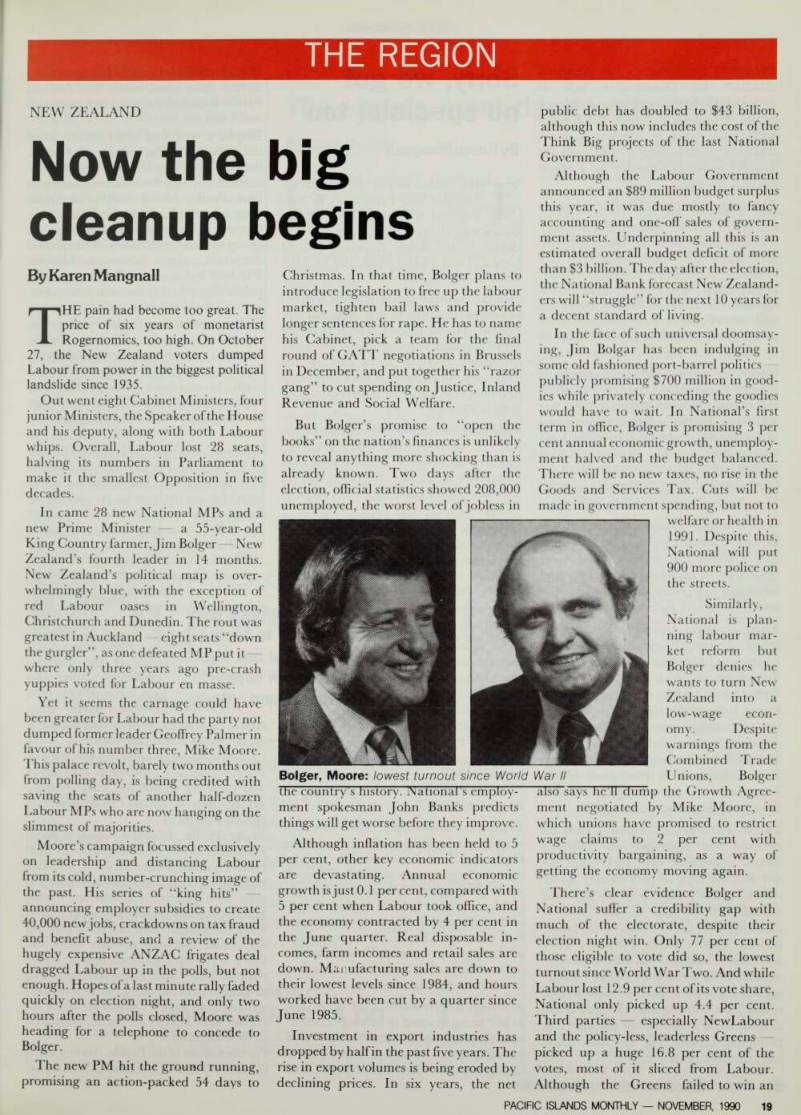
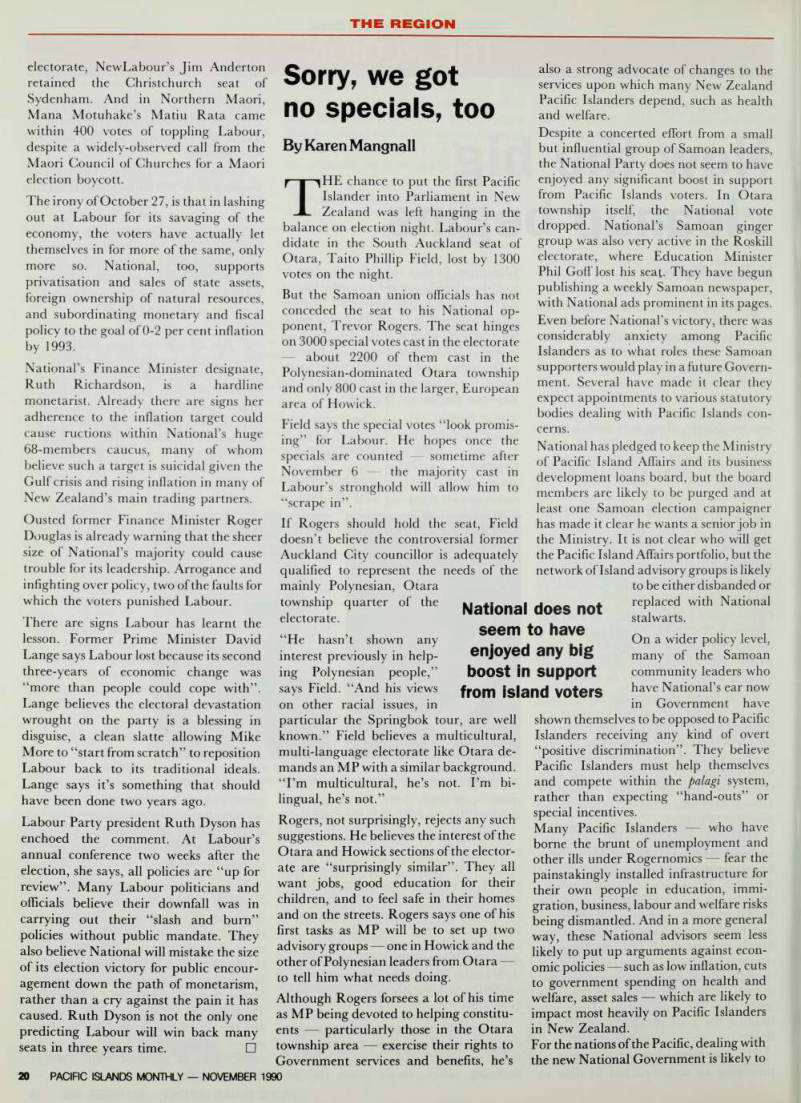
In came 28 hew National MPs and a new Prime Minister a 55-year-old King Country farmer, Jim Bolger New Zealand’s fourth leader in 14 months.
New Zealand’s political map is over whelmingly blue, with the exception of red Labour oases in Wellington, Christchurch and Dunedin. The rout was greatest in Auckland eight seats “down the gurgler”, as one defeated MP put it where only three years ago pre-crash yuppies voted for Labour en masse.
Yet it seems the carnage could have been greater for Labour had the party not dumped former leader Geoffrey Palmer in favour of his number three, Mike Moore.
This palace revolt, barely two months out from polling day, is being credited with saving the seats of another half-dozen Labour MPs who are now hanging on the slimmest of majorities.
Moore’s campaign focussed exclusively on leadership and distancing Labour from its cold, number-crunching image of the past. His series of “king hits” announcing employer subsidies to create 40,000 new jobs, crackdowns on tax fraud and benefit abuse, and a review of the hugely expensive ANZAC frigates deal dragged Labour up in the polls, but not enough. Hopes ofa last minute rally faded quickly on election night, and only two hours after the polls closed, Moore was heading for a telephone to concede to
Bolger.
The new PM hit the ground running, promising an action-packed 54 days to
Christmas. In that time, Bolger plans to introduce legislation to free up the labour market, tighten bail laws and provide longer sentences for rape. He has to name his Cabinet, pick a team for the final round of GATT negotiations in Brussels in December, and put together his “razor gang” to cut spending on Justice, Inland Revenue and Social Welfare.
But Bolger’s promise to “open the
books” on the nation’s finances is unlikely to reveal anything more shocking than is already known. Two days after the election, official statistics showed 208,000 unemployed, the worst level of jobless in
the country's history. National's cmploy ment spokesman John Banks predicts things will get worse before they improve.
Although inflation has been held to 5 per cent, other key economic indicators are devastating. Annual economic growth is just 0.1 per cent, compared with 5 per cent when Labour took office, and the economy contracted by 4 per cent in the June quarter. Real disposable in comes, farm incomes and retail sales are down. Manufacturing sales are down to their lowest levels since 1984, and hours worked have been cut by a quarter since June 1985.
Investment in export industries has dropped by half in the past five years. The rise in export volumes is being eroded by declining prices. In six years, the net
public debt has doubled to $43 billion, although this now includes the cost of the Think Big projects of the last National Government.
Although the Labour Government announced an $B9 million budget surplus this year, it was due mostly to fancy accounting and one-off sales of govern ment assets. Underpinning all this is an estimated overall budget deficit of more than $3 billion. The day after the election, the National Bank forecast New Zealand ers will “struggle” for the next 10 years for a decent standard of living.
In the face of such universal doomsay ing, Jim Bolgar has been indulging in some old fashioned port-barrel politics publicly promising $7OO million in good
ies while privately conceding the goodies
would have to wait. In National’s first term in office, Bolger is promising 3 per cent annual economic growth, unemploy ment halved and the budget balanced.
There will be no new taxes, no rise in the Goods and Services Tax. Cuts will be made in government spending, but not to
welfare or health in 1991. Despite this, National will put 900 more police on the streets.
Similarly, National is plan ning labour mar ket reform but Bolger denies he wants to turn New Zealand into a low-wage econ omy. Despite warnings from the Combined Trade Unions, Bolger
also says he'll dump the Growth Agree ment negotiated by Mike Moore, in which unions have promised to restrict wage claims to 2 per cent with productivity bargaining, as a way of getting the economy moving again.
There’s clear evidence Bolger and National suffer a credibility gap with much of the electorate, despite their election night win. Only 77 per cent of those eligible to vote did so, the lowest turnout since World War Two. And while Labour lost 12.9 per cent of its vote share, National only picked up 4.4 per cent.
Third parties especially NewLabour and the policy-less, leaderless Greens picked up a huge 16.8 per cent of the votes, most of it sliced from Labour.
Although the Greens failed to win an
Bolger, Moore: lowest turnout since World War II
electorate, NewLabour’s Jim Anderton retained the Christchurch seat of Sydenham. And in Northern Maori, Mana Motuhake’s Matiu Rata came within 400 votes of toppling Labour, despite a widely-observed call from the Maori Council of Churches for a Maori election boycott.
The irony of October 27, is that in lashing out at Labour for its savaging of the economy, the voters have actually let themselves in for more of the same, only more so. National, too, supports privatisation and sales of state assets, foreign ownership of natural resources, and subordinating monetary and fiscal policy to the goal of 0-2 per cent inflation by 1993.
National’s Finance Minister designate, Ruth Richardson, is a hardline monetarist. Already there are signs her adherence to the inflation target could cause ructions within National’s huge 68-members caucus, many of whom believe such a target is suicidal given the Gulf crisis and rising inflation in many of New Zealand’s main trading partners.
Ousted former Finance Minister Roger Douglas is already warning that the sheer size of National’s majority could cause trouble for its leadership. Arrogance and infighting over policy, two of the faults for which the voters punished Labour.
There are signs Labour has learnt the lesson. Former Prime Minister David Lange says Labour lost because its second three-years of economic change was “more than people could cope with”.
Lange believes the electoral devastation wrought on the party is a blessing in disguise, a clean slatte allowing Mike More to “start from scratch” to reposition Labour back to its traditional ideals.
Lange says it’s something that should have been done two years ago.
Labour Party president Ruth Dyson has enchoed the comment. At Labour’s annual conference two weeks after the election, she says, all policies are “up for review”. Many Labour politicians and officials believe their downfall was in carrying out their “slash and burn” policies without public mandate. They also believe National will mistake the size of its election victory for public encour agement down the path of monetarism, rather than a cry against the pain it has caused. Ruth Dyson is not the only one predicting Labour will win back many seats in three years time. □
Sorry, we got
no specials, too
By Karen Mangnall
THE chance to put the first Pacific Islander into Parliament in New Zealand was left hanging in the balance on election night. Labour’s can didate in the South Auckland seat of Otara, Taito Phillip Field, lost by 1300 votes on the night.
But the Samoan union officials has not conceded the seat to his National op ponent, Trevor Rogers. The seat hinges on 3000 special votes cast in the electorate about 2200 of them cast in the Polynesian-dominated Otara township and only 800 cast in the larger, European area of Howick.
Field says the special votes “look promis ing” for Labour. He hopes once the specials are counted sometime after November 6 the majority cast in Labour’s stronghold will allow him to
“scrape in”.
If Rogers should hold the seat, Field doesn’t believe the controversial former Auckland City councillor is adequately qualified to represent the needs of the
mainly Polynesian, Otara township quarter of the electorate.
“He hasn’t shown any interest previously in help ing Polynesian people,” says Field. “And his views on other racial issues, in
particular the Springbok tour, are well known.” Field believes a multicultural, multi-language electorate like Otara de mands an MP with a similar background.
“I’m multicultural, he’s not. I’m bi lingual, he’s not.”
Rogers, not surprisingly, rejects any such
suggestions. He believes the interest of the Otara and Howick sections of the elector ate are “surprisingly similar”. They all want jobs, good education for their children, and to feel safe in their homes and on the streets. Rogers says one of his first tasks as MP will be to set up two advisory groups one in Howick and the other of Polynesian leaders from Otara to tell him what needs doing.
Although Rogers forsees a lot of his time as MP being devoted to helping constitu ents particularly those in the Otara township area exercise their rights to Government services and benefits, he’s
also a strong advocate of changes to the services upon which many New Zealand Pacific Islanders depend, such as health and welfare.
Despite a concerted effort from a small but influential group of Samoan leaders, the National Party does not seem to have enjoyed any significant boost in support from Pacific Islands voters. In Otara township itself, the National vote dropped. National’s Samoan ginger group was also very active in the Roskill electorate, where Education Minister Phil Goff lost his seat. They have begun publishing a weekly Samoan newspaper, with National ads prominent in its pages.
Even before National’s victory, there was considerably anxiety among Pacific Islanders as to what roles these Samoan supporters would play in a future Govern ment. Several have made it clear they expect appointments to various statutory bodies dealing with Pacific Islands con cerns.
National has pledged to keep the Ministry of Pacific Island Affairs and its business development loans board, but the board members are likely to be purged and at least one Samoan election campaigner has made it clear he wants a senior job in the Ministry. It is not clear who will get the Pacific Island Affairs portfolio, but the network of Island advisory groups is likely
National does not seem to have enjoyed any big boost in support from island voters
to be either disbanded or replaced with National stalwarts.
On a wider policy level, many of the Samoan community leaders who have National’s ear now in Government have
shown themselves to be opposed to Pacific Islanders receiving any kind of overt “positive discrimination”. They believe Pacific Islanders must help themselves and compete within the palagi system, rather than expecting “hand-outs” or
special incentives.
Many Pacific Islanders who have borne the brunt of unemployment and other ills under Rogernomics fear the painstakingly installed infrastructure for their own people in education, immi gration, business, labour and welfare risks being dismantled. And in a more general way, these National advisors seem less likely to put up arguments against econ omic policies such as low inflation, cuts to government spending on health and welfare, asset sales which are likely to impact most heavily on Pacific Islanders in New Zealand.
For the nations of the Pacific, dealing with the new National Government is likely to
be business as usual. New Prime Minis ter Jim Bolger has already made it clear National will not allow foreign nuclear capable vessels or aircraft to enter New Zealand territory. But Bolger has stated he wants to renegotiate a security arrangement with the United States.
Overseas development assistance to the Pacific is likely to remain at the same low levels, although National’s foreign pol icy states the Pacific is a major area of interest for New Zealand. Immigration is most likely to suffer changes. National favours a skills-based entry criteria rather than one which lets New Zealand act as a “safety valve” for traditional allies, like Western Samoa and Tonga.
This will probably encourage the “brain drain” from the Pacific, as is evidenced by Trevor Rogers’ suggestion that New Zealand recognise tertiary qualifi cations in disciplines like medicine and nursing, gained from the University of the South Pacific.
The Pacific Islands communities in New Zealand may also find themselves in the firing line once again. National’s police spokesman John Banks claimed the increase in Auckland’s Polynesian population will turn the city into one of the most violent in the world. □
Advertisements & other items, p. 20 (1 item)
20
THE REGION
PACIRC ISLANDS MONTHLY NOVEMBER 1990
The sago’s most dangerous recipe

Guam
By David North
GUAM Governor Joseph Ada, the American medical research estab lishment, and Washington’s National Institutes of Health, are all criticised in a new report on Guam’s mysterious, always fatal, Alzheimer’s-like syndrome, which wastes mind and body before it kills.
The syndrome is not confined to Guam, but the incidence of it there, until quite recently, was much more common than elsewhere in the world. After World War II American physicians noticed the unusually high incidence of two some what similar maladies; one is amyotrophic lateral sclerosis (ALS), and the other is called Parkinsonish dementia. ALS is known in the United States as Lou Gehrig’s disease; Gehrig a remarkable baseball player and the first prominent victim of the disease, died at the age of 37. The syndrome attacks the nervous system, paralyzing the limbs and the mind; it is progressive, irreversible and without
either a cure or a clearly identified cause.
And, because of the high concentration of cases on Guam it became, in effect, a living laboratory for ALS.
The criticism in the article is both pointed and muted, for the report, by writer Terence Monmaney, appeared in the prestigeful but understated New Yorker magazine. The New Yorker , a weekly of comment and fiction, is read by the more literate members of America’s Establishment; it sometimes covers what it regards as serious medical mysteries, but seldom ventures into the Pacific.
Monmaney, in the magazine’s October 29 issue, discusses the decades of research work done on the syndrome, on Guam and elsewhere, and exhaustively describes the evolution of the various theories on the high incidence of ALS in Guam. (About 20 times as many people suffer from it there than one would expect from world wide medical statistics).
The principal theory is that ALS hits, often years to decades later, people who have consumed food made from the fruit of the false sago palm, or cycad seed, to remove its toxic qualities, and then ground up the fruit to make a flour.
One major thread of the theory was that during the Japanese occupation many Chamorros escaped into the forest and, lacking other food, ate more cycad than usual, and may not have had the time to clean the seeds properly. The toxin apparently acts quite slowly, and adversely effects some people exposed to it, but not others. A neurotoxicologist named Peter S. Spencer, a British scien tist, currently is the leading advocate of the cycad theory.
The author’s criticism of the medical research establishment was based on the one-way communication which charac terises much medical and social science research; the scientist extracts infor mation from the victim, but the victim learns little or nothing in the process, and is not helped as he or she struggles with disease.
The criticism of the National Institutes of Health (NIH) was for abandoning its ALS research station on Guam, in 1986, without consulting anyone on Guam about the decision. Since then NIH has restored funding to study the syndrome, and Congressman Ben Blaz (Republican, Guam), in a move not mentioned by the
New Yorker , has sought legislation to reopen the research station.
The criticism of Ada paralleled criticism of the medical researchers, for not openly, and publiclu urging the people of Guam to stop using cycad on the grounds that it is a high likely health hazard.
Monmaney writes that Ada, “a cheerful man with the aquiline good looks like Danny Thomas’s” has an ambiguous policy towards fadang , the traditional food made from cycad seed.
“The Governor’s ... first reaction to Spencer’s recommendation (not to con sume the stuff) was ‘There goes my favorite food!’ Officially, he (Ada) says he was anti -fadang. But then he said, smiling, that he continues to enjoy it. When he goes to fiestas Chamorro women stack fadang tortillas on his plate, and he doesn’t want to disappoint them. ‘lf I see it, I eat it,’ he said. He told me that he was not much concerned about safety because the people who cook for him know how to detoxify cycad seeds. I lost some confi
dence in his biomedical judgement when, as he graciously led me out of his office, he handed me, as a memento of my visit, a cigarette lighter with his name on it.”
The scientists’ interest in solving the mystery relates to a broader problem than the 800 or so cases of these diseases found by NIH on Guam; if they could get a better idea what caused these lingering deaths then they would be in a better position, worldwide, to seek ways to prevent, cure, or modify the impact of ALS and Parkinsonism-dementia. □
Advertisements & other items, pp. 21-22 (1 item)
ngineenng Ltd
£
SOUJH SEA ,
24 Tofua Street, Walu Bay, P.O. Box 9, Suva, Fiji.
Telephone: 302045 A/H: 362008 Fax No: (679) 302467 MARINE ENGINEERING: Access to 1000 Ton Drydocking Facilities. Specialists in servicing of Marine Engines and Underwater Gears, Generators & Hydraulics etc.
MACHINING; Fully equipped Machine Shop with Largest Lathe capable of Handling Tail Shaft 22ft in length.
MIG WELDING: Build up of Tail Shaft Bearing Surfaces in Bronze, Stainless or Steel.
TIG WELDING; Specialist in Stainless Steel and Aluminium Fabrications.
SHIPREPAIRS: Hull & Super Structure Repairs Plumbings etc.
BOILERS; Installation and Maintenance of Steam Boilers & Pressure Vessels.
FIJI AGENTS FOR
ROBERT BRYCE & CO
SUPPLIERS OF LAUNDRY EQUIPMENTS, STEAMPAC HORIZONTAL BOILERS AND
FULTON VERTICAL BOILERS.
We’re looking
for people who
love to write.
Most people can write ... a little. We can show you how to write well and how to make money from your writing.
The Writing School, founded in 1949, shows you how to write articles, short stories, novels, romances, radio and TV scripts, technical articles, children’s stories etc. Top professional writers, through the medium of The Writing School’s comprehensive home study course, give you individual tuition, showing you how to produce manuscripts that are fresh and readable. You get personal advice on selling your work to publishers who are always on the lookout for exciting new talent.
All you supply is the ambition to succeed, and then a few hours each week in a pleasurable occupation that will bring you great personal satisfaction, and useful extra income. Study at leisure in the comfort of your own home, on boring rail, sea or air journeys. Sounds interesting? It is.
And you can’t lose because you are protected by our unique double guarantee. If you have not recovered the cost of your tuition by the time you have completed the course, your fees will be refunded.
Find out how you can earn while you learn.
SEND TODAY FOR YOUR FREE BOOK
“WRITING FOR PLEASURE AND PROFIT’
AND DETAILS OF OUR 15 DAY FREE TRIAL OFFER Complete this coupon and post to:
THE WRITING SCHOOL
2/1 Vuko Place Warriewood N.S.W. Australia 2102 Telephone: 61 2 9706575 Name (Mr/Mrs/Miss/Ms Address
Washington post
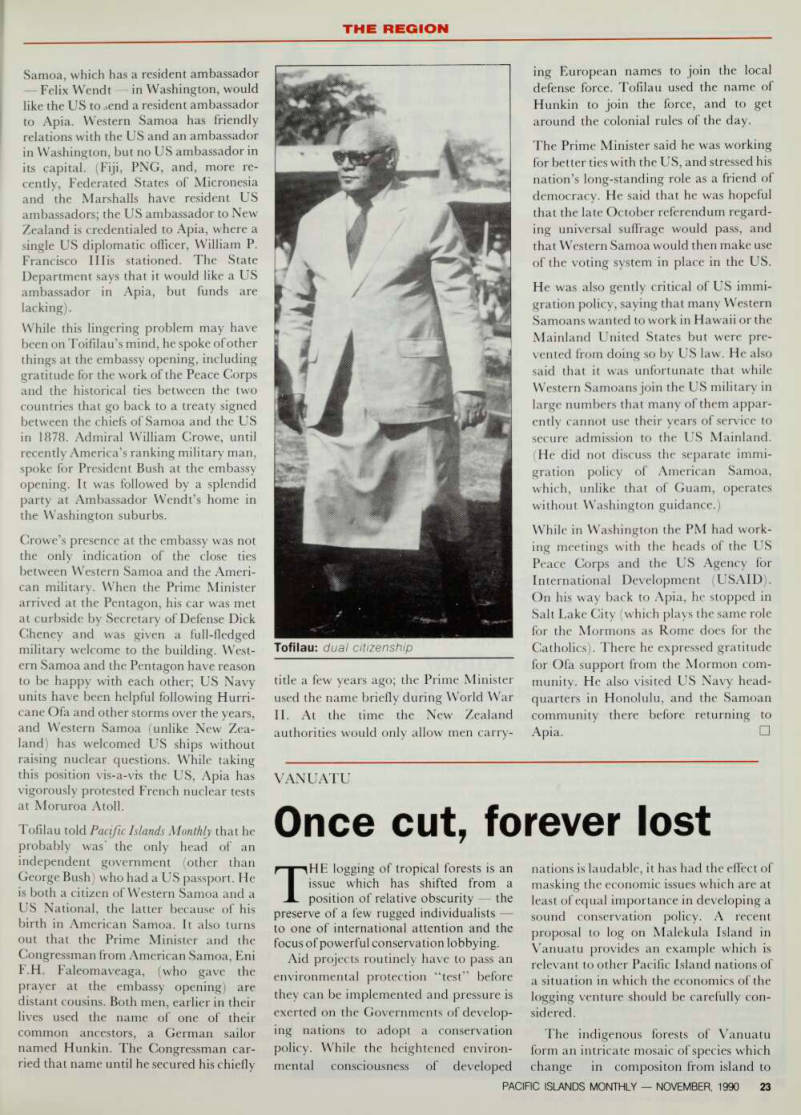
Western Samoa
Tofilau opens Washington post
WESTERN Samoa Prime, Tofilau Eti Alesana, opened his nation’s embassy in Washington, touched a number of important bases, and engaged in gentle, understated diplomacy on his September-October trip to the United States.
The trip included visits with Samoan communities in Hawaii and California, sessions at the annual meetings of the World Bank, a speech to the General Assembly of the United Nations, and participation in the UN-sponsored Sum mit on Children, in addition to a round of meetings with Washington officials.
One US official Tofilau did not attempt to see was President George Bush. Before leaving Apia, Tofilau released a copy of a cable he had sent to the White House, withdrawing his request for an appoint ment on the grounds of the President’s anticipated preoccupation with both the confrontation in the Middle East and America’s budget crisis. “Be assured” he wrote to Bush “that we fully support these efforts and pray for their success.”
It was just as well that the PM withdrew his request for a meeting because Bush was, in fact, up to his eyeballs with the threat of a war with Iraq and a very real (and so far quite unsuccessful) battle over the US budget which resulted, at the time of writing, in the President’s decision to shut down most of the operations of the US Government.
Further, the UN Children’s Summit attracted more than 80 heads of govern ment, making it that much harder for any of the 80 to see the embattled Bush.
While in Washington, Tofilau formally opened his country’s new embassy. One of the subtle messages conveyed at the occasion, but not spoken, was Western
Samoa, which has a resident ambassador Felix Wendt in Washington, would like the US to a resident ambassador to Apia. Western Samoa has friendly relations with the US and an ambassador in Washington, but no US ambassador in its capital. (Fiji, PNG, and, more re cently, Federated States of Micronesia and the Marshalls have resident US ambassadors; the US ambassador to New Zealand is credentialed to Apia, where a single US diplomatic officer, William P.
Francisco Hlis stationed. The State Department says that it would like a US ambassador in Apia, but funds are
lacking).
While this lingering problem may have been on Toifilau’s mind, he spoke of other things at the embassy opening, including gratitude for the work of the Peace Corps and the historical ties between the two countries that go back to a treaty signed between the chiefs of Samoa and the US in 1878. Admiral William Crowe, until recently America’s ranking military man, spoke for President Bush at the embassy opening. It was followed by a splendid party at Ambassador Wendt’s home in the Washington suburbs.
Crowe’s presence at the embassy was not the only indication of the close ties between Western Samoa and the Ameri can military. When the Prime Minister arrived at the Pentagon, his car was met at curbside by Secretary of Defense Dick Cheney and was given a full-fledged military welcome to the building. West ern Samoa and the Pentagon have reason to be happy with each other; US Navy units have been helpful following Hurri cane Ofa and other storms over the years, and Western Samoa (unlike New Zea land) has welcomed US ships without raising nuclear questions. While taking this position vis-a-vrs the US, Apia has vigorously protested French nuclear tests at Moruroa Atoll.
Tofilau told Pacific Islands Monthly that he probably was’ the only head of an independent government (other than George Bush) who had a US passport. He is both a citizen of Western Samoa and a US National, the latter because of his birth in American Samoa. It also turns out that the Prime Minister and the Congressman from American Samoa, Eni F.H. Faleomaveaga, (who gave the prayer at the embassy opening) are distant cousins. Both men, earlier in their lives used the name of one of their common ancestors, a German sailor named Hunkin. The Congressman car ried that name until he secured his chiefly
title a few years ago; the Prime Minister used the name briefly during World War 11. At the time the New Zealand authorities would only allow men carry
ing European names to join the local defense force. Tofilau used the name of Hunkin to join the force, and to get around the colonial rules of the day.
The Prime Minister said he was working for better ties with the US, and stressed his nation’s long-standing role as a friend of democracy. He said that he was hopeful that the late October referendum regard ing universal suffrage would pass, and that Western Samoa would then make use of the voting system in place in the US.
He was also gently critical of US immi gration policy, saying that many Western Samoans wanted to work in Hawaii or the Mainland United States but were pre vented from doing so by US law. He also said that it was unfortunate that while Western Samoans join the US military in large numbers that many of them appar ently cannot use their years of service to secure admission to the US Mainland. (He did not discuss the separate immi gration policy of American Samoa, which, unlike that of Guam, operates without Washington guidance.) While in Washington the PM had work ing meetings with the heads of the US Peace Corps and the US Agency for International Development (USAID).
On his way back to Apia, he stopped in Salt Lake City (which plays the same role for the Mormons as Rome does for the Catholics). There he expressed gratitude for Ofa support from the Mormon com munity. He also visited US Navy head quarters in Honolulu, and the Samoan community there before returning to
Apia. □
Tofilau: dual citizenship
Once cut, forever lost
Vanuatu
THE logging of tropical forests is an issue which has shifted from a position of relative obscurity the preserve of a few rugged individualists to one of international attention and the focus of powerful conservation lobbying.
Aid projects routinely have to pass an environmental protection “test” before they can be implemented and pressure is exerted on the Governments of develop ing nations to adopt a conservation policy. While the heightened environ mental consciousness of developed
nations is laudable, it has had the effect of masking the economic issues which are at least of equal importance in developing a sound conservation policy. A recent proposal to log on Malekula Island in Vanuatu provides an example which is relevant to other Pacific Island nations of a situation in which the economics of the logging venture should be carefully con sidered.
The indigenous forests of Vanuatu form an intricate mosaic of species which change in compositon from island to
island as a consequence of the vagaries of botanical migration and relative geologi cal age, tempered by the influence of periodic disturbances. They are charac terised by a low volume of merchantable timber per hectare, usually manifested in a few large trees growing in association with many smaller non-merchantable species.
As the area of forest is relatively small, the prospect of a sustainable industry is poor and the potential for over-exploitation very real. In addition, Malekula is the repository of some of the richest cultural heritage in Vanuatu which is character ised by the intimate association between man, his land, and the products of his land.
The first concept that must be conveyed with absolute clarity is that the native tree species of Malekula represent a non renewable resource and should be con sidered as such at the outset of any analysis. The land may remain in a forested state but the forest “capital”, represented by the mature individual specimens, will be permanently lost. To describe the forest as a renewable resource and thereby imply that it will return to its original biological composition, is mis
leading.
Traditional landowners take the forest for granted. It is so much a part of the fabric of their lives that it is simply unimagin able that it could cease to exist. For this very reason, they are often quite agree able to logging proposals which seem to be a sensible way to raise money from trees which are otherwise ring-barked and burnt to make way for gardens. The forest also represents the only readily identifi-
Contracts offered are often well below the real commercial value of the forest
able source of monet ary wealth for many land
owners and a contract offered by a logging company can be seen as “money for nothing” in this respect.
The fact that someone does not utilise a resource nor place any monetary value on it should not influence its value to someone who wants to utilise it. As a result, contracts offered are often well below the real commercial value of the forest.
Royalties which have been offered in the past for logging rights bear no relation to the real value of the logs as expressed by
their export price potential in the face of dwindling tropical hardwood resources.
Furthermore, the value of specific species and grades of wood-delivered in small quantities to carefully targeted end-users will continue to increase in the future.
Ifstumpage values were derived from the value of wood delivered to a port or mill (other than a mill owned by the logging contractor) less the reasonable cost of logging and cartage, environmental issues would take care of themselves.
Aid organisations also have a respons ibility to ensure that their assistance helps to foster conservation by providing access to low volume,. value-enhancing tech nology such a drying kilns, finger-jointers and veneer sheers.
The perception of indigenous forests as a “free” resource combined with a lack of dedicated landowner advocacy has re sulted in unrealistically low stumpages which have served to encourage logging for log exports or low value conversion to sawn timber.
The beneficial economic effects of logging in the national context as stated by the logging companies are run by non-citizen residents who have interests or obligations off-shore, so this is where the largest portion of revenue generated is chan nelled.
The landowners of Malekula have been recognised as the exclusive proprietors by Vanuatu’s constitution so are in a unique position to decide the fate of their forests.
To make rational decisions in a situation which has no relevance to their system of values and mores, they deserve to be
independently and sensitively advised
about the options available. They need not only a fair assessment of the value of their timber both now and in the future (should they choose to have it logged) but also an appreciation of the compensation to be expected if pressure is exerted for establishment of a reserve or national park on their land. It is presumptuous of those who campaign for conservation to assume that traditional landowners will have the same set of values and sense of perspective as themselves.
Conservation initiatives, (such as a com prehensive utilistaion policy aimed at maximising value-added processing in low volume enterprises) are excellent. For them to succeed however, they must address the economic distortions which exist in logging agreements. □
Advertisements & other items, p. 24 (1 item)
Senior Research Fellow
THE AUSTRALIAN NATIONAL UNIVERSITY.
Research Fellow/
Gender Relations Project in the Research School of Pacific
Studies.
From 1991, the Research School of Pacific Studies is embarking on a new project on Changing Gender Relations in the Pacific and Asia: Work, Reproduction, Migration and the State.
Applications are invited for a position of Research Fellow/Senior Research Fellow, tenable from 1991- 1993. The applicant should have a strong research interest and publications record in the study of gender relations in the region from the viewpoint of anthropology, demography, economics, history, human geography, politics or sociology.
Although the applicant will have a disciplinary location within a division of RSPacS she/he should also have a commitment to and capacity for inter-disciplinary work. It is envisaged that as well as pursuing a program of research and writing that the appointee would be responsible for leading the project, encouraging broader collaboration from other staff and graduate scholars within the RSPacS and the University as a whole, convening seminars, workshops and conferences and overseeing a publication program for the project.
This position is tenable from early 1991. A second post (up to research fellow level) attached to the project will be advertised later, and available from mid-1991.
For further information please contact the School Secretary, RSPacS, on telephone: (61 6) 249 2678 or FAX (61 6) 257 1893.
Closing Date: 30 November 1990. Ref PA 17.10.3.
Salary: Senior Research Fellow; A 545,729 - A 554,255 p.a.; Research Fellow; A 533,163 - A 543,096 p.a.
Applications should be submitted in duplicate to the Registrar, The Australian National University, GPO Box 4, Canberra ACT 2601, Australia, quoting reference number and including curriculum vitae, list of publications and names of at least three referees. The University reserves the right not to make an appointment or to appoint by invitation at any time. Further information is available from the Registrar.
A IHI I \l\ I.RSI IVISAN I Ql Al. OPPOR I LMIV I MIM OVI R
Pacific

Islands
Monthly
Business
Crashing crops see little revival hope
A depressed world market and internal problems are turning planters away
By Robin Bromby
THAILAND has ordered 100 million cocoa hybrid seeds developed by Papua New Guinea researchers, while Indonesia and Malaysia are bringing new plantations into production next year to which will mean even more cocoa dumped on a depressed world market. Two public sector superannuation funds have had to come up with more of their members’ money to rescue one of the country’s largest plantation companies.
Meanwhile, copra is being shipped from the Solomon Islands to keep the coconut oil mill at Rabaul in operation while coconut growers in the area are threatening to poison their trees.
Pacific Islands Monthly reported last issue that the crisis for Papua New Guinea’s agricultural sector continues to worsen. But nothing seems to be able to halt the decline.
Now the government has confirmed it will use money from the National Provi dent Fund and the Public Officers’
Superannuation Fund to keep New Guinea Plantations Pty Ltd from having to cease operations. The two funds own 56 per cent of the company, and have
already injected large amounts of money
(some reports speaking of several million kina since world prices collapsed) to meet revenue shortfalls . Now the government is to divert another K 700,000 (U 55648,000) into the company.
The decision brought a vociferous response from unions with members
covered by the two superannuation funds, including the Public Employees Union, PNG Teachers Association and unions from the telecommunications, transport and harbours sectors. Union leaders warned there would be industrial chaos if more superannuation money was lost in plantation ventures. He said the govern ment was using the funds as “mini
political banks”.
It is hard to see a solution. Both the key growing areas of the country have critical problems: in North Solomons province the central government has still been unable to restore its control and the plantations have been devastated. In East New Britain, the police have failed to suppress the gangs of criminals which daily terrorise plantation workers.
On top of that, neighbouring countries are about to significantly boost their
cocoa exports and so further depress world price levels. Indonesia will, dur ing 1991, see its new plan tations come into pro duction, Its labour costs are about a third that of Papua New Guinea. Ma
laysia, too, is lifting exports dramatically.
Even Papua New Guinea’s work in developing new hybrid varieties will injure its own industry: the country will see a massive increase in its cocoa crop next year as new plants produce between 2.5 and 3 tonnes of dry beans per hectare compared with current levels of about one
tonne. Experimental crops now being developed suggest production will eventually be lifted to 7 tonnes per hectare. Another ominous sign is that Thailand has ordered 100 million of these
hybrid seeds.
The Papua New Guinea army is attempting to re-establish central govern ment control on Bougainville Island, in North Solomons province, but reports from there as to the state of cocoa
plantations is uniformly depressing.
There is no question that it will take several million dollars to rehabilitate them, but there is considerable doubt whether the owners will be prepared ever to return to the island. The rebel forces and criminal elements have destroyed many of the buildings, cocoa plants have been burned and even those surviving have not been pruned or weeded for more than a year.
While the law and order problem in East New Britain is bad enough on its own, some of the larger plantation companies operating there also had businesses on Bougainville, a situation which has deprived them of 60 per cent of revenue and left them trying to survive in East New Britain at a time of low world prices and falling government price sup port.
It is unclear how many plantations on East New Britain have closed. News from
'The police have failed to suppress criminals which terrorise plantation workers’
some of the more remote areas is hard to come by, but many management agency firms have pulled out. These agents were appointed as a condition of PNG Development Bank loans to help
nationals taking over what were pre viously foreign owned plantations. Many of these management agencies have laid off expatriate staff and the farms they supervised are now in limbo the owners are still living there but unable to meet loan repayments.
Reports from the Gazelle Peninsula,
where many of the large plantations are located, indicate that anarchy now reigns, with managers and workers and their families subject to attack, rape, theft and assault. Many of the foreign owners are now prepared to walk away from their life’s work with nothing, just as many did last year on Bougainville.
The commercial banks have refused to allow a moratorium on loan repayments, while the government’s price support scheme is due to expire in April 1992. This three-year plan allows for the price support payments to fall each six months until it reaches zero at the end. At the moment, the guaranteed price is KlOB2 a tonne against a market price of K 920.
What will happen in the Papua New Guinea cocoa industry when price sup port runs out, no one can predict.
The planters’ association is concerned that many of the large plantation companies and even smallholder growers cannot survive even until 1992. The executive director of the Planters’ Associ ation of Papua New Guinea, David Loh, told Pacific Islands Monthly he was frus trated with the government’s attitude.
“It is difficult to convince bureaucrats, politicians and the government that without a plantation industry (which will not survive with such a bleak future ahead), the smallholder and village growers will suffer and possibly collapse,” he said. “The plantation sector has always been the leading edge in any innovations in rural industry,”
Copra’s future also looks grim. Plan tations are now losing money even with government price support, so low were world prices, said Loh many growers would poison their trees rather than meet the cost of maintenance. This in turn would lead to the closure of the country’s only coconut oil mill, owned by Carpenters (Coconut Products) Ltd. The mill is already operating at 20 per cent below full capacity even after importing copra from the Solomon Islands to meet overseas orders. □
Lihir sticks to timetable
THE joint venture partners in the rich Lihir gold project have confirmed they are trying to stick to t eir timetable despite problems with raising finance. That schedule now mcludes next January as a time when a request will go to the Papua New Guinea government for a mining licence. Oxide production is planned for late 1993, with
sulphide output to begin in the third quarter of 1994.
Niugini Mining Ltd (20 per cent) and
Kennecott Explorations (Australia) Ltd
(80 per cent) have been finding that international financiers are alarmed by reports of law and order breakdowns in PNG. This has made them reluctant to provide the money needed to develop
Lihir between USSSOO million and USS7OO milllion despite the fact that the small island has enough gold to sustain 700,000 ounces a year. Lihir has reserves of about 18 million ounces , which will ensure a mine life of 25 years.
If the PNG government approves a mining licence, development could be gin by mid 1991. Kennecott’s manager in Port Moresby, Ron Brew, said the joint venture partner were discussing a package of benefits with landowners. □
Advertisements & other items, p. 26 (1 item)
«G Samsung
The World’s Latest
PRODUCTS FOR PEOPLE WITH MORE
SENSE THAN MONEY
i 4*: / Available at Burns Phi Ip Home Centres throughout Fiji and selected Duty Free Dealers.
SOLE DISTRIBUTORS:
To own a Samsung TV Screen, Samsung Video Deck and Samsung Remote Control Unit!
That’d Great!
That makes the Samsung Combination the most inexpensive of its kind.
Go for the best view.
Should be ideal for your home! <8
SAMSUNG
CORRIE & COMPANY
HEAD OFFICE G.P.O. BOX 45, SUVA TLX: FJ2166 CABLES: ‘CORRICO’ SUVA.
TELEPHONE: 386777 BANKERS: WESTPAC, SUVA (FAX: (679) 370010 BRANCH OFFICE: 161 VITOGO PARADE P.O. BOX 83, LAUTOKA CABLES
“CORRICO” LAUTOKA TELEPHONE: 60137
Moresby’s Islander joins Pacific group
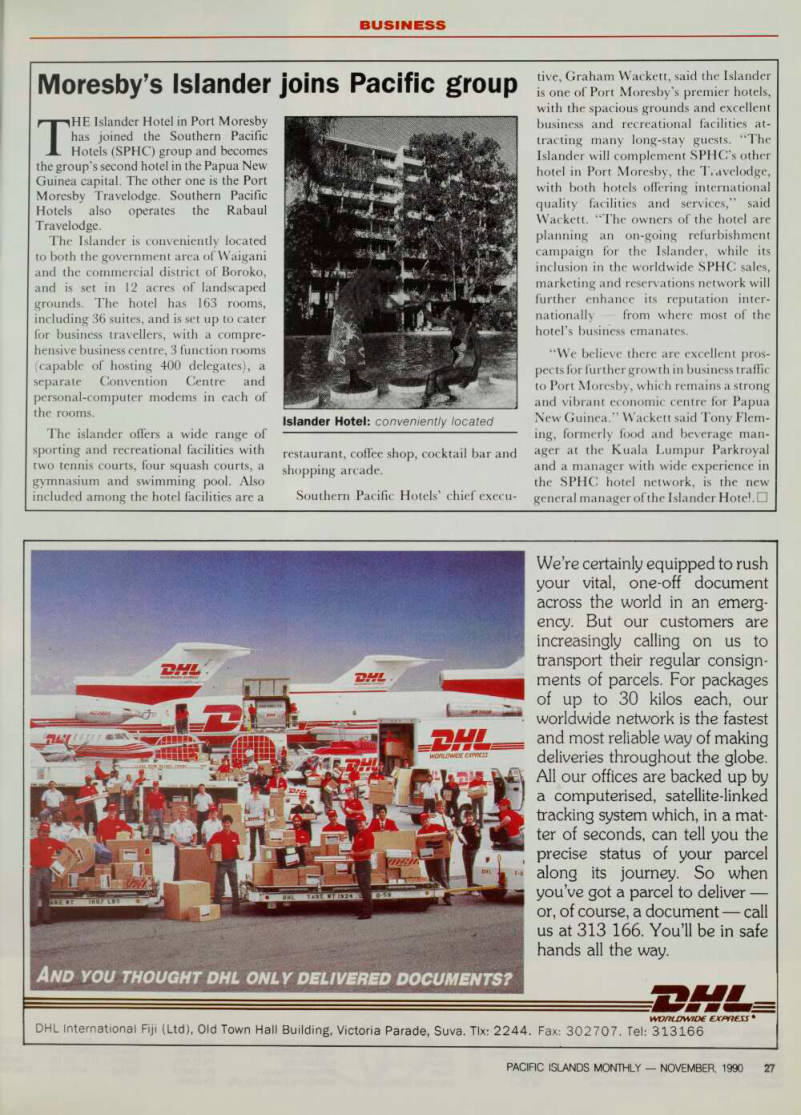
THE Islander Hotel in Port Moresby has joined the Southern Pacific Hotels (SPHC) group and becomes the group’s second hotel in the Papua New Guinea capital. The other one is the Port Moresby Travelodge. Southern Pacific Hotels also operates the Rabaul Travelodge.
The Islander is conveniently located to both the government area of Waigani and the commercial district of Boroko, and is set in 12 acres of landscaped grounds. The hotel has 163 rooms, including 36 suites, and is set up to cater for business travellers, with a compre hensive business centre, 3 function rooms
(capable of hosting 400 delegates), a
separate Convention Centre and personal-computer modems in each of the rooms.
The islander offers a wide range of sporting and recreational facilities with two tennis courts, four squash courts, a
gymnasium and swimming pool. Also
included among the hotel facilities are a
restaurant, coffee shop, cocktail bar and
shopping arcade.
Southern Pacific Hotels’ chief execu
tive, Graham Wackett, said the Islander is one of Port Moresby’s premier hotels, with the spacious grounds and excellent business and recreational facilities at tracting many long-stay guests. “The Islander will complement SPHC’s other hotel in Port Moresby, the Travelodge, with both hotels offering international quality facilities and services,” said Wackett. “The owners of the hotel are
planning an on-going refurbishment
campaign for the Islander, while its inclusion in the worldwide SPHC sales, marketing and reservations network will further enhance its reputation inter nationally from where most of the hotel’s business emanates.
“We believe there are excellent pros pects for further growth in business traffic to Port Moresby, which remains a strong and vibrant economic centre for Papua New Guinea.” Wackett said Tony Flem
ing, formerly food and beverage man
ager at the Kuala Lumpur Parkroyal and a manager with wide experience in the SPHC hotel network, is the new general manager ofthe Islander Hotel. □
Islander Hotel: conveniently located
Advertisements & other items, pp. 27-29 (1 item)
rnmm ■
L nif# iik **>a w A.' KO7
LBS
We’re certainly equipped to rush your vital, one-off document across the world in an emergency. But our customers are increasingly calling on us to transport their regular consignments of parcels. For packages of up to 30 kilos each, our worldwide network is the fastest and most reliable way of making deliveries throughout the globe.
All our offices are backed up by a computerised, satellite-linked tracking system which, in a matter of seconds, can tell you the precise status of your parcel along its journey. So when you’ve got a parcel to deliver or, of course, a document call us at 313 166. You’ll be in safe hands all the way. woncow/oe expoess • DHL international Fiji (Ltd), Old Town Hall Building, Victoria Parade, Suva. Tlx: 2244. Fax: 302707. Tel: 313166
The new Toyota brand mark. Three ellipses forming a “T” which stand for our customer, our commitment to the satisfaction of that customer through our product and for our spirit of creativity.
It’s not often that you hear descriptions like rugged or durable combined with refined and elegant. But then there’s never been a vehicle quite like the new Toyota Land Cruiser Station Wagon. The unrivalled legend of off-road reliability is now unsurpassed in comfort and sophistication as well. Attention to detail is found everywhere, from the fine trim to the instrument panel to the graceful lines of its exterior. Even in places you can’t see, like the heavy-duty ladder frame and suspension design that add to the superb
luxury-car ride.
But Toyota’s innovation goes beyond providing luxury and durability. The new Land Cruiser Station Wagon, and all of our cars, are designed to create a harmony between car and driver, and to provide you with the ultimate
driving experience.
The new Toyota Land Cruiser Station Wagon. Think of it as much more than a spacious luxury sedan with fourwheel drive. m r mmm
DISTRIBUTORS/DEALERS
AMERICAN SAMOA BURNS PHILP (S.S.) CO. LTD. PH 633-4281 GUAM & MICRONESIA ATKINS KROLL, INC. PH 646-1876/9 NORFOLK ISLANDS BORRY’S PTY LTD. PH 2114
SOLOMON ISLANDS MENDANA MOTORS PH 22884
VANUATU VANUATU MOTORS PH 2341
COOK ISLANDS PACIFIC MOTORS LTD. PH 20796
KIRIBATI TARAWA MOTORS PH 21090
PAPUA NEW GUINEA ELA MOTORS PH 217036
TAHITI NIPPON AUTOMOTO PH 429819
WESTERN SAMOA BURNS PHILP (S.S.) CO. LTD. PH 20800
FIJI ASCO (
NEW CALEDONIA S.I.A.P.'
SAIPAN MICROS
TONGA BURNSI
TOYOTA
Cooks get $5mil telecom help
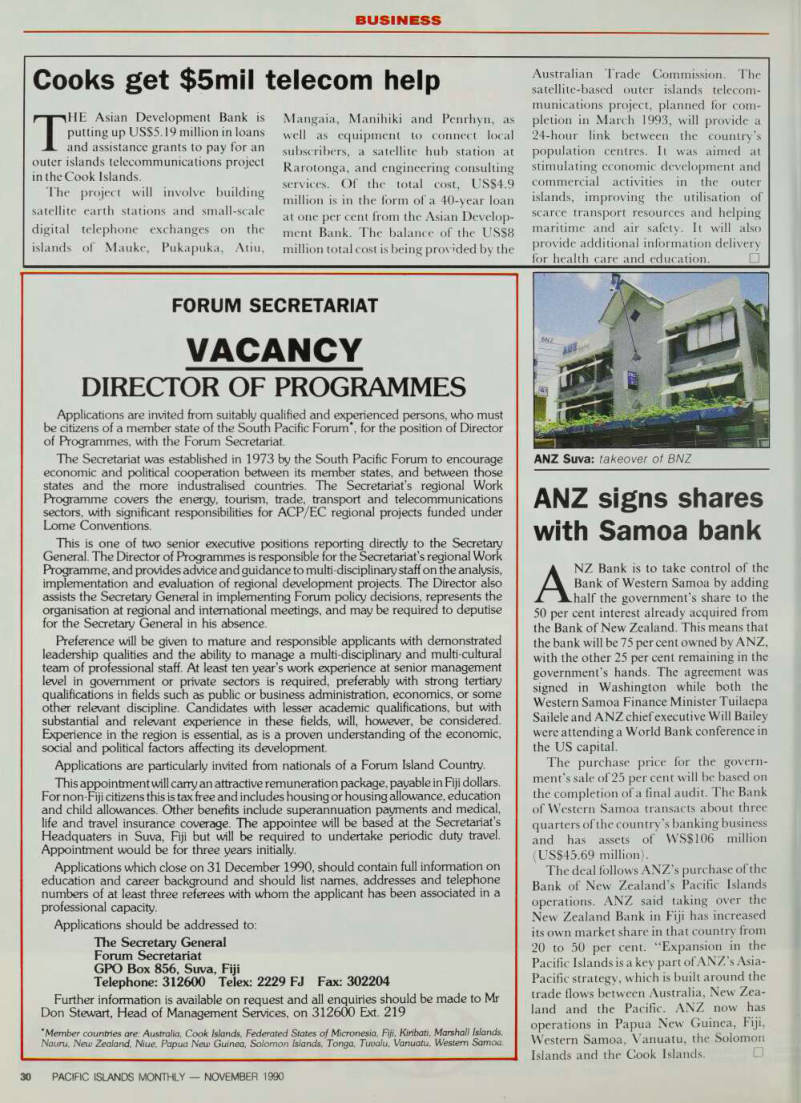
THE Asian Development Bank is putting up US$5.l9 million in loans and assistance grants to pay for an outer islands telecommunications project in the Cook Islands.
The project will involve building satellite earth stations and small-scale digital telephone exchanges on the islands of Mauke, Pukapuka, Atiu,
Mangaia, Manihiki and Penrhyn, as well as equipment to connect local subscribers, a satellite hub station at
Rarotonga, and engineering consulting
services. Of the total cost, US$4.9 million is in the form of a 40-year loan at one per cent from the Asian Develop ment Bank. The balance of the US$B million total cost is being provided by the
Australian Trade Commission. The satellite-based outer islands telecom munications project, planned for com pletion in March 1993, will provide a 24-hour link between the country’s population centres. It was aimed at
stimulating economic development and
commercial activities in the outer islands, improving the utilisation of scarce transport resources and helping maritime and air safety. It will also
provide additional information delivery
for health care and education. □
ANZ signs shares
with Samoa bank
ANZ Bank is to take control of the Bank of Western Samoa by adding half the government’s share to the 50 per cent interest already acquired from the Bank of New Zealand. This means that the bank will be 75 per cent owned by ANZ, with the other 25 per cent remaining in the government’s hands. The agreement was signed in Washington while both the Western Samoa Finance Minister Tuilaepa Sailele and ANZ chief executive Will Bailey were attending a World Bank conference in the US capital.
The purchase price for the govern ment’s sale of 25 per cent will be based on the completion of a final audit. The Bank of Western Samoa transacts about three quarters of the country’s banking business and has assets of WS$lO6 million
(U 5545.69 million).
The deal follows ANZ’s purchase of the Bank of New Zealand’s Pacific Islands operations. ANZ said taking over the New Zealand Bank in Fiji has increased its own market share in that country from 20 to 50 per cent. “Expansion in the Pacific Islands is a key part of ANZ’s Asia- Pacific strategy, which is built around the trade flows between Australia, New Zea land and the Pacific. ANZ now has operations in Papua New Guinea, Fiji, Western Samoa, Vanuatu, the Solomon Islands and the Cook Islands.
ANZ Suva: takeover of BNZ
Advertisements & other items, p. 30 (1 item)
Vacancy
FORUM SECRETARIAT
DIRECTOR OF PROGRAMMES
Applications are invited from suitably qualified and experienced persons, who must be citizens of a member state of the South Pacific Forum*, for the position of Director of Programmes, with the Forum Secretariat.
The Secretariat was established in 1973 by the South Pacific Forum to encourage economic and political cooperation between its member states, and between those states and the more industralised countries. The Secretariat’s regional Work Programme covers the energy, tourism, trade, transport and telecommunications sectors, with significant responsibilities for ACP/EC regional projects funded under Lome Conventions.
This is one of two senior executive positions reporting directly to the Secretary General. The Director of Programmes is responsible for the Secretariat’s regional Work Programme, and provides advice and guidance to multi-disciplinary staff on the analysis, implementation and evaluation of regional development projects. The Director also assists the Secretary General in implementing Forum policy decisions, represents the organisation at regional and international meetings, and may be required to deputise for the Secretary General in his absence.
Preference will be given to mature and responsible applicants with demonstrated leadership qualities and the ability to manage a multi-disciplinary and multi-cultural team of professional staff. At least ten year’s work experience at senior management level in government or private sectors is required, preferably with strong tertiary qualifications in fields such as public or business administration, economics, or some other relevant discipline. Candidates with lesser academic qualifications, but with substantial and relevant experience in these fields, will, however, be considered.
Experience in the region is essential, as is a proven understanding of the economic, social and political factors affecting its development.
Applications are particularly invited from nationals of a Forum Island Country.
This appointment will carry an attractive remuneration package, payable in Fiji dollars.
For non-Fiji citizens this is tax free and includes housing or housing allowance, education and child allowances. Other benefits include superannuation payments and medical, life and travel insurance coverage. The appointee will be based at the Secretariat’s Headquaters in Suva, Fiji but will be required to undertake periodic duty travel.
Appointment would be for three years initially.
Applications which close on 31 December 1990, should contain full information on education and career background and should list names, addresses and telephone numbers of at least three referees with whom the applicant has been associated in a professional capacity.
Applications should be addressed to: The Secretary General Forum Secretariat GPO Box 856, Suva, Fiji Telephone: 312600 Telex: 2229 FJ Fax: 302204 Further information is available on request and all enquiries should be made to Mr Don Stewart, Head of Management Services, on 312600 Ext. 219 ’Member countries are: Australia, Cook Islands, Federated States of Micronesia, Fiji, Kiribati. Marshall Islands.
Nauru, New Zealand, Niue, Papua New Guinea, Solomon Islands, Tonga, Tuvalu, Vanuatu. Western Samoa.
Fiji continues to boost growth
THE Fiji government has moved to un erpm economic growt with aging be taxation review and lifting of restrictions on wage increases, while more money is to be made available to the Fiji Development Bank. The European Community is to provide F$ 13 million (US$9.l "v o . million) tor a new tax free zone (TFZ) at g uva These moves come against a background of fears that the country’s trade deficit is growing and discontent at the Re giona Trade and Econom c gionai iraae and Economic Co-
operation Agreement (SPARTECA),
under which Fiji gains access to the Australian and New Zealand markets.
The new TFZ a. Suva will include a customs office and factories employing about 2000 people. The zones provide a 10 tQV Li;I j c 1 j-year-tax holiday and exemption from r • , excises for companies which export more than 95 per cent of their output The agreement with the EC is in the form of a grant of F 59.67 million, and a 30-year loan of Fs3 72 million Finance Minister Josevata Kamikamica said the new TFZ would be completed within three years, and will include the purchase of 33 hectares of land, the construction of 10,000 square metres of factory space, and manage-
ment training.
f ijians wanting to set themselves up in business will get further help with the
decision by the interim government to make another Fss million available to thC F f I Dw fT ,U Ban K “ f n ' d ‘° an n e “ ra ' sed *°™ F W°°o to F 5200,000, and it was hoped to S et more Fi J ians participating in
retailing and manufacturing industries.
„ , , r ...
Other measures to help Fnians m- . . elude: research by the Fijian Affairs B° ar d to determine how Fijians have done in bLlsiness > Allocating Fs2o mil,ion to the board so that Fijians can bu V more shares in local enterprises, Co b “«'"g Fijian involvement in the Uni ° ust of Fiji, programmes to help Fijians set up businesses from natural resources whlch the y ow "> and a daily newspaper to be owned by Fijians. The minister warned that it would take time for these businesses to make profits and that much patience would be needed in 7 patience would oe needed m the earlv stages tiic cdiiy stages.
Thls plan coincided with daims that overseas investors have tried to exploit their Fl j lan J oint venture P a «ners. Viti Chamber of Commerce president Koto Vakarewakobau said many joint ventures were dominated by foreign partners even if they owned as little as 10 or 15 per cent of the company. She urged foreign partners to share their expertise with indigenous Fijian partners, as a commercial way of life was foreign to her
people
But life for all business people operating in Fiji should be made easier if the
interim government proceeds with its taxation plans. Prime Minister Ratu Sir Kamisese Mara told the third joint meeting of the Fiji-Australia and Australia-Fiji business councils that his administration was considering the tax breaks, and gradual lifting of wage restrictions. He said it was hoped the statutory limits on wages would soon end, but if the government completely withdrew wage determination it was feared an incomes explosion would result.
Turning to trade, the Prime Minister urged the business people at the meeting to work to reduce the trade gap between Fiji and Australia. He said the heavy trade imbalance persisted even with SPARTECA helping Fiji gain a share of the Australian domestic market. The president of the Fiji-Australia Business Council, Ikbal Jannif, went further: he called for a complete overhaul of SPARTECA now that Australia is set on a course of lowering tariffs across the board. The fear of losing its comparative advantage in this event has been pre occupying minds in Fiji and other South Pacific countries.
Meanwhile, the Reserve Bank of Fiji has expressed concern at the country’s increasing trade deficit, which is ex pected to hit the F 5344 million mark this year. The bank’s deputy governor, Hari Pal Singh, told the business council meeting that while Fiji’s exports were expected to increase by 20 per cent to F 5637 million, imports had been esti mated to top FS 1.11 billion and this gap had to be bridged with the nation’s foreign exchange reserves. □
Pacific oil prices
Gulf crisis hits Pacific oil prices
SOUTH Pacific nations are already feeling the impact of the Gulf crisis.
The sharp rise in oil prices is now working its way through into the basic economic functions electricity gener ation and transport. A great proportion of the power generated in the island states is by means of diesel generators (although there are moves to have more hydro electricity). Shipping and aviation are particularly hit by the great distances both between countries and even within those which consists of far-flung islands.
The Solomon Islands Electricity Auth
ority spends 54 per cent of its total outlays on diesel fuel. Last year’s fuel bill ran to 5155.01 million (US$l.9B million). The authority has been caught in the pincer of rising oil prices and the devalaution of the Solomon Islands dollar.
The country’s problem will be felt, to a lesser degree, throughout the South Pacific higher power charges will work their way through to all parts of the economy. For example, Blue Pacific Laundry on Rarotonga is expecting its electricity bill to shoot up and this will have to be passed on to customers.
But transport will be even more dras tically affected. The price of aviation fuel at Fiji’s Nadi International Airport has increased by 55 per cent since the crisis
began. Western Samoa has announced that air cargo rates out of Apia will rise by seven per cent, passenger fares by eight per cent.
In the Cook Islands, shippers have been told that Pacific Forum Line rates have gone up four per cent. Another shipping line, Tasman Asia, has reported that bunker fuel costs had risen by 60 per cent and was still rising. But the impact, while being felt in both import and export sectors, will also permeate through to the region’s other significant earner: tourism.
Some air fares out of Australia have already gone up by eight per cent, and there will be temptation for all airlines to use the fuel issue as an opportunity to raise fares. n
Going traditional
Shipping
AN outrigger canoe built tradition ally, is becoming very popular in Likiep, Marshall Islands, because of fuel shortage. The canoe was built as part of the Waan Aelon Kein Project funded by Marshall Islands’ Aide Mu seum. Museum staff Alfred Capelle was reported to have been told by Likiep Mayor Paul deßrum that his community was using the 17-foot canoe for fishing, transportation and food gathering during the fuel shortage. □
A canoe like being used in Likiep
Putting your trust on wind power
THE United Nations Regional Fish ery Support Programme has devel oped an emergency sail rig for use on small fishing boats. It can be used on fibreglass, wood or alumunium boats 4.5 to 8 metres long.
“It is generally recognised that small motor boats should never venture out of the lagoon into the open ocean relying only on one outboard engine,” said Robert Gillett, Project Manager for the South Pacific Regional Fisheries Support Programme.
“Carrying a second outboard engine certainly helps prevent accidents, but it is not the perfect solution. If the second outboard is seldom used, it may not be mechanically reliable. Also if the cause of the primary outboard not functioning is lack of fuel, a second outboard will not help. Furthermore, many fishermen may have difficulty in paying for an additional
engine.
“For these reasons it is thought that in many cases a simple emergency sail may be the best means of secondary propulsion for outboard-powered fishing craft,”
The sail arrangement developed by the
fishery support programme consists of a sail, supporting spars, and a rudder. The gear can be easily stored in little space.
Trials sshowed that a boat using the emergency rig can sail about 75 degrees off the wind, not enough to win a race but enough to crawl back to land after an outboard engine has failed.
The estimated cost of the material used to make the sail, spar and rudder is between US$2OO and US$3OO, depend ing on the choice of sail cloth.
Next month the United Nations Re gional Fishery Support Programme will issue a booklet of easy-to-follow instruc tions and plans for making the emergency sail rig. D
The new sail rig: in case of emergency
Abandon ship
THE Papua New Guinea government ship, MV Taurama, ran aground last month and was abandoned at Carteret Island in North Solomons Prov ince. Transport Minister Anthony Temo said there was no casualties.
Six crew members and seven passen gers were aboard the ship when it ran aground on a reef on the southern end of the island. She was on a routine voyage to Tasman and Mortlock islands deliver ing goods and was diverted to pick up a sick person at Cateret when she hit the reef at 1.30 am.
Islanders rescued the people on board and took them ashore. The crew managed to take some equipment. A Defence Force patrol boat picked up the crew and passengers fro Cateret and took them to Rabaul.
Advertisements & other items, p. 32 (2 items)
32
PACIFIC ISI-ANDS MONTHLY NOVEMBER 1990
Co., Ltd.
KYOWA
KYOWA
SHIPPING
CO., LTD.
Liner Service
FROM ©JAPAN
CKOREA
OTAIWAN
THAILAND
to Paciffic Islands
OHONG KONG
OSINGAPORE
OPHILIPPINES
O MALAYSIA
INDONESIA
TO OSAIPAN
O FEDERATED STATES
OF MICRONESIA
OMARSHAL ISLANDS
©AMERICAN SAMOA
ONEW CALEDONIA
O FIJI
OGUAM
OYAP
OPALAU
©WESTERN SAMOA
©SOLOMON ISLANDS
©VANUATU
©PAPUA NEW GUINEA
HEAD OFFICE
6th Floor , Kikushima Bldg 2-3, Hamamatsucho 2-chome Mmato-ku, Tokyo 105, Japan Phone: 03(437)2885 (Rep ) Cables: MARIQUEEN" Tokyo Telex: 242-4651 Kyowa J.
OSAKA OFFICE
Dai San Fuji Bldg. 3-13. Itachibon 1-chome, Osaka 550.
Phone: 06(533)5821 (Rep ) Cables: MARIQUEEN Osaka Telex: 525-6271 Ssiosa J
Listen! this sounds like trouble
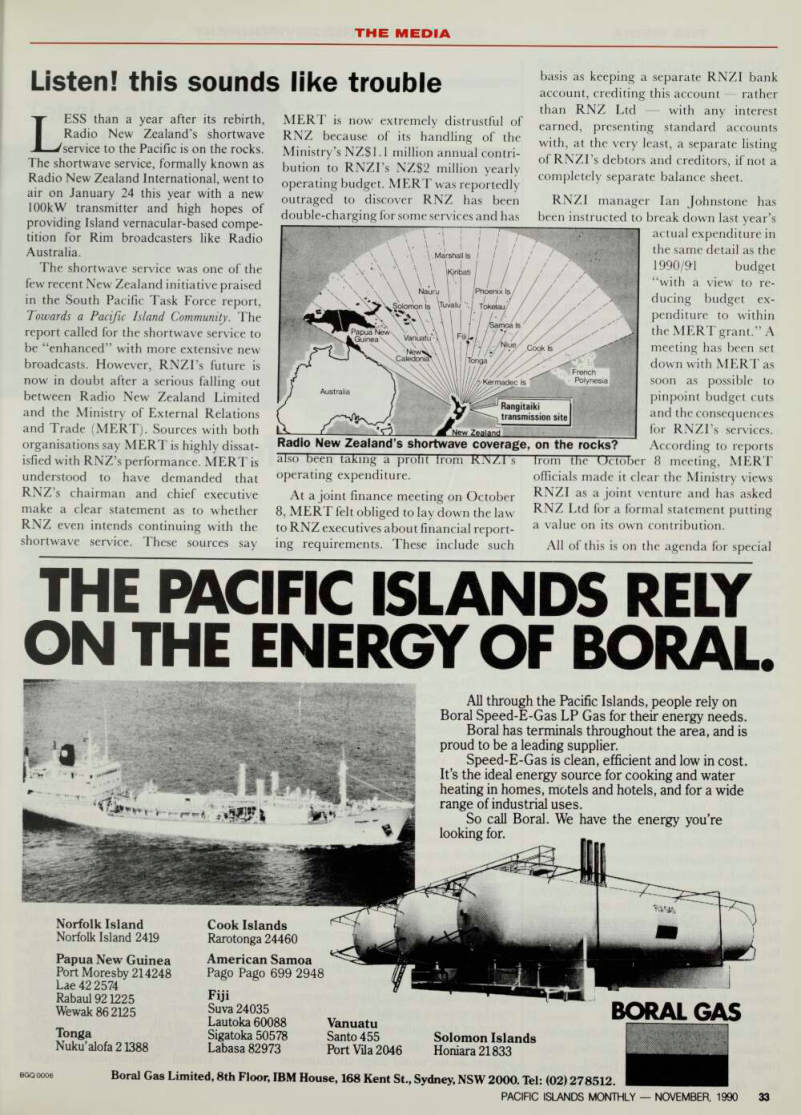
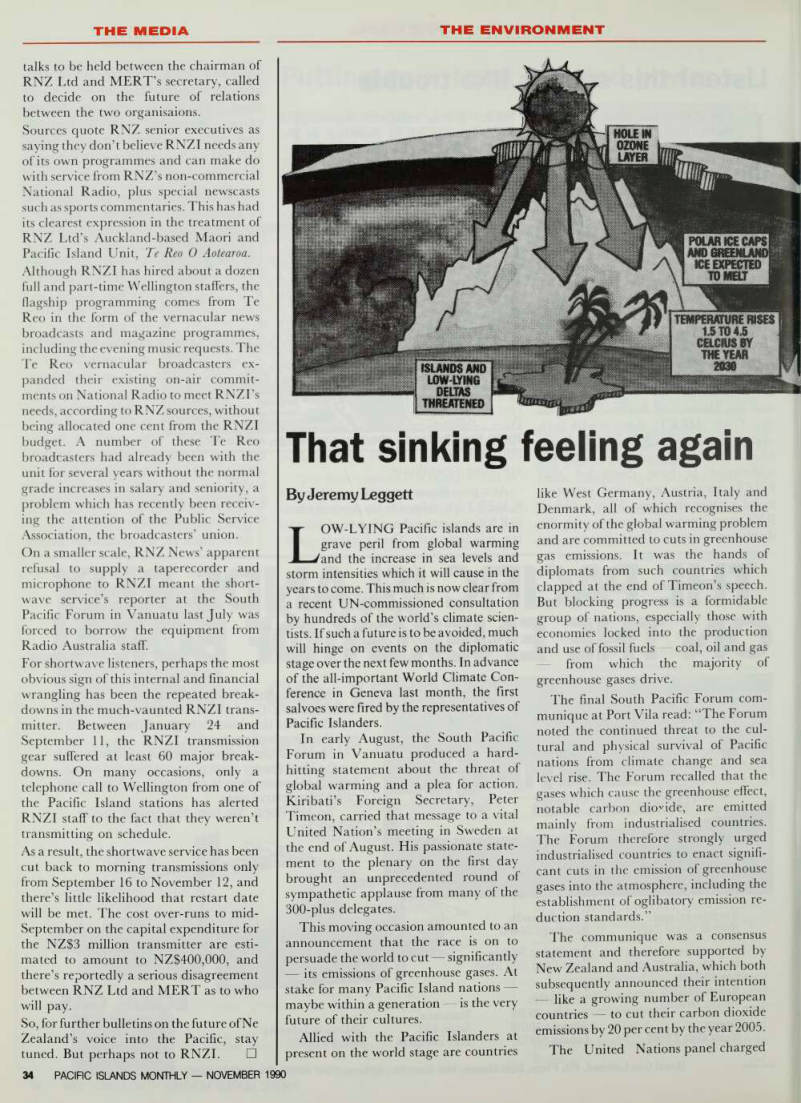
The Media
LESS than a year after its rebirth, Radio New Zealand’s shortwave service to the Pacific is on the rocks.
The shortwave service, formally known as Radio New Zealand International, went to air on January 24 this year with a new IOOkW transmitter and high hopes of providing Island vernacular-based compe tition for Rim broadcasters like Radio Australia.
The shortwave service was one of the few recent New Zealand initiative praised in the South Pacific Task Force report, Towards a Pacific Island Community. The report called for the shortwave service to be “enhanced” with more extensive new broadcasts. However, RNZTs future is now in doubt after a serious falling out between Radio New Zealand Limited and the Ministry of External Relations and Trade (MERT). Sources with both organisations say MERT is highly dissat isfied with RNZ’s performance. MERT is understood to have demanded that RNZ’s chairman and chief executive make a clear statement as to whether RNZ even intends continuing with the shortwave service. These sources say
MERT is now extremely distrustful of RNZ because of its handling of the Ministry’s NZ$l.l million annual contri bution to RNZTs NZ$2 million yearly operating budget. MERT was reportedly outraged to discover RNZ has been double-charging for some services and has
also been taking a protit from KN/.I s operating expenditure.
At a joint finance meeting on October 8, MERT felt obliged to lay down the law to RNZ executives about financial report ing requirements. These include such
basis as keeping a separate RNZI bank account, crediting this account rather than RNZ Ltd with any interest earned, presenting standard accounts with, at the very least, a separate listing of RNZTs debtors and creditors, if not a completely separate balance sheet.
RNZI manager lan Johnstone has been instructed to break down last year’s
actual expenditure in the same detail as the
1990/91 budget
“with a view to re ducing budget ex penditure to within the MERT grant.” A meeting has been set down with MERT as soon as possible to
pinpoint budget cuts
and the consequences for RNZI’s services.
According to reports
irom the October 8 meeting, MERT officials made it clear the Ministry views RNZI as a joint venture and has asked RNZ Ltd for a formal statement putting a value on its own contribution.
All of this is on the agenda for special
Radio New Zealand’s shortwave coverage, on the rocks?
talks to be held between the chairman of RNZ Ltd and MERT’s secretary, called to decide on the future of relations between the two organisaions.
Sources quote RNZ senior executives as saying they don’t believe RNZI needs any of its own programmes and can make do with service from RNZ’s non-commercial National Radio, plus special newscasts such as sports commentaries. This has had its clearest expression in the treatment of RNZ Ltd’s Auckland-based Maori and Pacific Island Unit, Te Reo 0 Aotearoa.
Although RNZI has hired about a dozen full and part-time Wellington staffers, the flagship programming comes from Te Reo in the form of the vernacular news broadcasts and magazine programmes, including the evening music requests. The Te Reo vernacular broadcasters ex panded their existing on-air commit ments on National Radio to meet RNZI’s needs, according to RNZ sources, without being allocated one cent from the RNZI budget. A number of these Te Reo broadcasters had already been with the unit for several years without the normal grade increases in salary and seniority, a problem which has recently been receiv ing the attention of the Public Service Association, the broadcasters’ union.
On a smaller scale, RNZ News’ apparent refusal to supply a taperecorder and microphone to RNZI meant the short wave service’s reporter at the South Pacific Forum in Vanuatu last July was forced to borrow the equipment from Radio Australia staff.
For shortwave listeners, perhaps the most obvious sign of this internal and financial wrangling has been the repeated break downs in the much-vaunted RNZI trans mitter. Between January 24 and September 11, the RNZI transmission gear suffered at least 60 major break downs. On many occasions, only a telephone call to Wellington from one of the Pacific Island stations has alerted RNZI staff to the fact that they weren’t transmitting on schedule.
As a result, the shortwave service has been cut back to morning transmissions only from September 16 to November 12, and there’s little likelihood that restart date will be met. The cost over-runs to mid- September on the capital expenditure for the NZ$3 million transmitter are esti mated to amount to NZ$4OO,OOO, and there’s reportedly a serious disagreement between RNZ Ltd and MERT as to who will pay.
So, for further bulletins on the future of Ne Zealand’s voice into the Pacific, stay tuned. But perhaps not to RNZI. □
Advertisements & other items, p. 33 (1 item)
The Pacific Islands Rely
ON THE ENERGY OF BORAL
I a ' • -■ ft *'» All through the Pacific Islands, people rely on Boral Speed-E-Gas LP Gas for their energy needs.
Boral has terminals throughout the area, and is proud to be a leading supplier.
Speed-E-Gas is clean, efficient and low in cost.
It's the ideal energy source for cooking and water heating in homes, motels and hotels, and for a wide range of industrial uses.
So call Boral. We have the energy you’re looking for. - •-* Cook Islands Rarotonga 24460 Norfolk Island Norfolk Island 2419 Papua New Guinea Port Moresby 214248 Lae 42 2574 Rabaul 921225 Wewak 862125 Tonga Nukualofa 21388 American Samoa Pago Pago 699 2948 Fiji Suva 24035 Lautoka 60088 Sigatoka 50578 Labasa 82973 Vanuatu Santo 455 Port Vila 2046
BORAL GAS
Solomon Islands Honiara 21833 Boral Gas Limited, Bth Floor, IBM House, 168 Kent St., Sydney, NSW 2000. Tel: (02) 278512.
That sinking feeling again
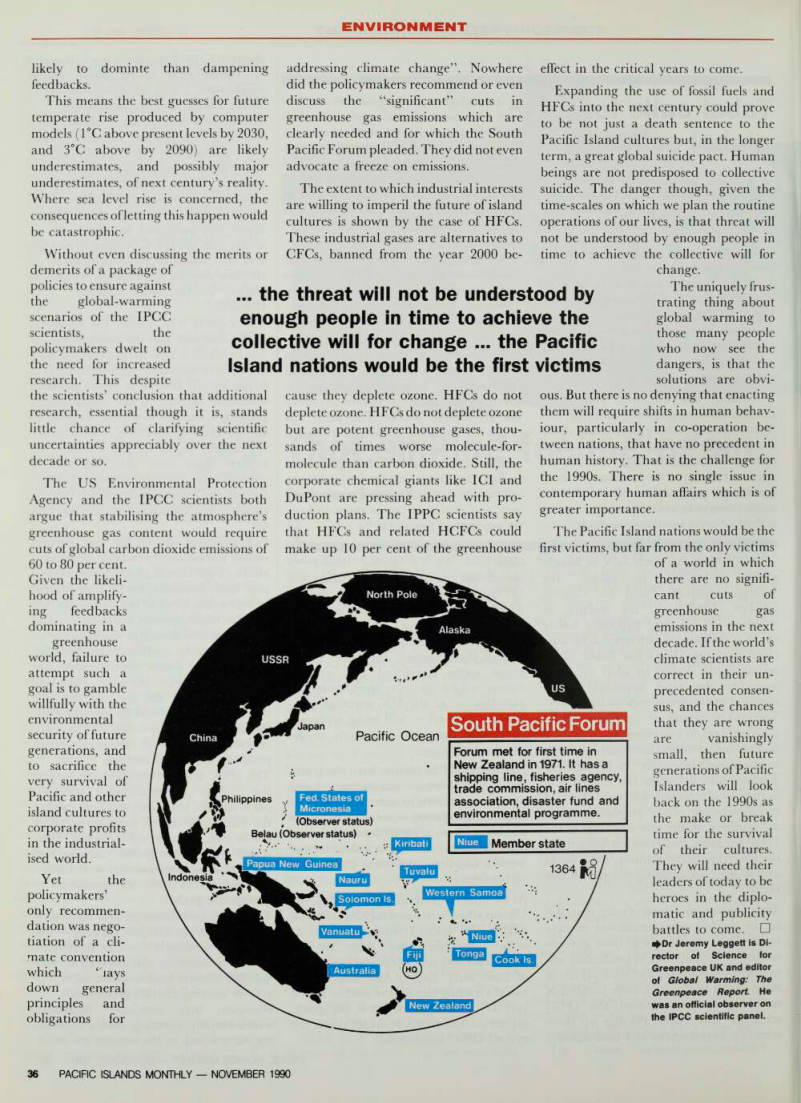
The Environment
By Jeremy Leggett
LOW-LYING Pacific islands are in grave peril from global warming and the increase in sea levels and storm intensities which it will cause in the years to come. This much is now clear from a recent UN-commissioned consultation by hundreds of the world’s climate scien tists. If such a future is to be avoided, much will hinge on events on the diplomatic stage over the next few months. In advance of the all-important World Climate Con ference in Geneva last month, the first salvoes were fired by the representatives of Pacific Islanders.
In early August, the South Pacific Forum in Vanuatu produced a hard hitting statement about the threat of global warming and a plea for action.
Kiribati’s Foreign Secretary, Peter Timeon, carried that message to a vital United Nation’s meeting in Sweden at the end of August. His passionate state ment to the plenary on the first day brought an unprecedented round of sympathetic applause from many of the
300-plus delegates.
This moving occasion amounted to an announcement that the race is on to persuade the world to cut significantly its emissions of greenhouse gases. At stake for many Pacific Island nations maybe within a generation is the very future of their cultures.
Allied with the Pacific Islanders at present on the world stage are countries
like West Germany, Austria, Italy and Denmark, all of which recognises the enormity of the global warming problem and are committed to cuts in greenhouse gas emissions. It was the hands of diplomats from such countries which clapped at the end of Timeon’s speech.
But blocking progress is a formidable group of nations, especially those with economies locked into the production and use of fossil fuels coal, oil and gas from which the majority of greenhouse gases drive.
The final South Pacific Forum com munique at Port Vila read: “The Forum noted the continued threat to the cul tural and physical survival of Pacific nations from climate change and sea level rise. The Forum recalled that the gases which cause the greenhouse effect, notable carbon dioxide, are emitted mainly from industrialised countries.
The Forum therefore strongly urged industrialised countries to enact signifi cant cuts in the emission of greenhouse gases into the atmosphere, including the establishment of oglibatory emission re duction standards.”
The communique was a consensus statement and therefore supported by New Zealand and Australia, which both subsequently announced their intention like a growing number of European countries to cut their carbon dioxide emissions by 20 per cent by the year 2005.
The United Nations panel charged
with adivising the world how to handle global warming is called the Intergovernmental Panel on Climate Change (IPCC). At the meeting in Sweden, IPCC’s final gathering before the World Climate Conference, it became clear that the IPCC has failed in its responsibility. Failed in what has been arguably the most important international consultation process in history.
The main reason is that the IPCC policymakers, in a working group chaired by the United States, have failed to listen to the panel s scientists. In his address, imeon told delegates the final IPCC ummary document fell well short of
recommending policy responses ‘com-
mensurate with the dire warnings of the IPCC scientists, and as such it fails to offer the low-lying island nations of the world any prospect of escaping the greenhouse threat 55 The scientists, consisting of more than 300 of the world’s most emininent climate researchers, most of them from governments, are unanimous in predicting unprecedented warming and sea-level rise in the decades to come. A mere handful of scientific doubters contest the IPCC scientists conclusion. Playing up these scientific uncertainties and undoubtedly
influenced by a strong lobby of greenhouse-gas-emitting inudstries, the IPCC policymakers effectively recom mended handing out bandaids in the face of an authoritative plague warning.
Taking their cue from White House chief of staff John Sununu, the IPCC policy group seems convinced that making serious efforts to cut greenhouse gas pollution as the UN scientists’ con clusions demand will bring economic chaos and dramatic reductions in the standard of living.
Nothing could be further from the truth.
But even if this view was correct and not a genuflection to auto, oil, coal and chemical companies we could still have no choice but to cut greenhouse emissions if we genuinely wanted to guarantee the world’s children, and their children, a viable future.
At the final IPCC meeting in Sweden, the US was allied in its foot dragging by Saudi Arabia, the Soviet Union and China. It is no coincidence that these are the world’s leading producers and consumers of fossil fuels. Sadly, Australia the world’s leading exporter of coal kept a very low profile and when it did speak, supported US efforts to water down the overall IPCC conclusions.
Australia’s performance was a betrayal of its commitment to its South Pacific neighbours, a cynical abrogation of the South Pacific Forum communique.
Determined that the truth about global warming and possible solutions should not be eclipsed by the UN policy group, Greenpeace asked 20 of the world’s pre eminent climate scientists and energy exports to compile a “shadow IPCC report”. Global Warming: the Greenpeace Report was published worldwide to co incide with the IPCC meeting in Sweden and was presented to all delegations on the first day by Greenpeace delegation leader, ex-Australian diplomat Paul Hohnen.
The experts who wrote The Greenpeace Report conclude that the anti-greenhouse future which is now an imperative, need not involve dramatic cuts in standards of living for all. Instead it could maintain economic activity in the industrialised countries, expand economic activity in the developing countries, and improve the quality of life for all. Further, the experts show how the industrialised countries can dramatically cut their fossil fuel use and reap a significant side benefit; eliminating dependence on Middle East oil.
Full practical use of the best energy saving technologies available could save about 75 per cent of all electricity and oil now used. Similarly, massive investment in renewable forms of energy production solar, wind, biomass and so on could within the next decade or so displace most or even all of the world’s current fossil fuel
dependence. These technologies are
available today, through massively
under-used, and are cost effective. All they require is the will by governments, industries and people to face the challenge of change, to rearrange the world’s energy priorities and infrastructure.
The IPCC scientists believe that despite the huge remaining scientific uncertainties, the question is not whether the human-enhanced greenhouse effect will be bad, but how bad and when. They stated clearly that global warning will occur in a business-as-usual world with out policies to stem the emissions of
greenhouse gases.
The only uncertainties are over the degree which amplify or dampen warning the so-called “feedbacks” can come into play in a warming climate system, and that few of these feedbacks are incorpor ated in existing climate predictions.
However, they concluded feedbacks which amplify warming, such a decreas ing carbon sink in the oceans, are more
likely to dominte than dampening feedbacks.
This means the best guesses for future temperate rise produced by computer models (1 °C above present levels by 2030, and 3°C above by 2090) are likely underestimates, and possibly major underestimates, of next century’s reality.
Where sea level rise is concerned, the consequences ofletting this happen would be catastrophic.
Without even discussing the merits or
demerits of a package of
policies to ensure against
the global-warming scenarios of the IPCC scientists, the policymakers dwelt on the need for increased research. This despite
the scientists’ conclusion that additional research, essential though it is, stands little chance of clarifying scientific uncertainties appreciably over the next decade or so.
The US Environmental Protection Agency and the IPCC scientists both argue that stabilising the atmosphere’s greenhouse gas content would require cuts of global carbon dioxide emissions of
60 to 80 per cent.
Given the likeli hood of amplify
ing feedbacks
dominating in a greenhouse world, failure to attempt such a goal is to gamble willfully with the environmental security of future generations, and to sacrifice the very survival of Pacific and other island cultures to corporate profits in the industrial ised world.
Yet the
policymakers’
only recommen dation was nego tiation of a cli mate convention which ‘hays down general principles and
obligations for
addressing climate change”. Nowhere
did the policymakers recommend or even discuss the “significant” cuts in greenhouse gas emissions which are clearly needed and for which the South Pacific Forum pleaded. They did not even advocate a freeze on emissions.
The extent to which industrial interests are willing to imperil the future of island cultures is shown by the case of HFCs.
These industrial gases are alternatives to CFCs, banned from the year 2000 be
... the threat will not be understood by enough people in time to achieve the collective will for change ... the Pacific Island nations would be the first victims
cause they deplete ozone. HFCs do not deplete ozone. HFCs do not deplete ozone but are potent greenhouse gases, thou sands of times worse molecule-for molecule than carbon dioxide. Still, the corporate chemical giants like ICI and DuPont are pressing ahead with pro duction plans. The I PPG scientists say that HFCs and related HCFCs could make up 10 per cent of the greenhouse
effect in the critical years to come.
Expanding the use of fossil fuels and HFCs into the next century could prove to be not just a death sentence to the Pacific Island cultures but, in the longer term, a great global suicide pact. Human beings are not predisposed to collective suicide. The danger though, given the time-scales on which we plan the routine operations of our lives, is that threat will not be understood by enough people in time to achieve the collective will for
change.
The uniquely frus
trating thing about
global warming to those many people who now see the dangers, is that the solutions are obvi
ous. But there is no denying that enacting them will require shifts in human behav iour, particularly in co-operation be tween nations, that have no precedent in human history. That is the challenge for the 19905. There is no single issue in contemporary human affairs which is of greater importance.
The Pacific Island nations would be the first victims, but far from the only victims
of a world in which there are no signifi cant cuts of greenhouse gas emissions in the next decade. If the world’s climate scientists are correct in their un
precedented consen
sus, and the chances that they are wrong
are vanishingly
small, then future generations of Pacific Islanders will look back on the 1990 s as the make or break time for the survival of their cultures.
They will need their leaders of today to be heroes in the diplo matic and publicity battles to come. □
Dr Jeremy Leggett is Di rector of Science for Greenpeace UK and editor of Global Warming: The Greenpeace Report. He was an official observer on the IPCC scientific panel.
global solidarity
Tabai calls for global solidarity
SOUTH Pacific nations must take to the international stage in force if their concerns about global warming to be heard and acted upon. That was the call from Kiribati leader leremia Tabai just before the World Climate Change confer ence in Geneva last month.
“Small island states tend to be over looked in such a big meeting,” says President Tabai. “It helps to advertise ourselves. They talk about the problems of Bangladesh, or wherever But they may never have been to a small island state or know how it will affect us.”
Kiribati has attended two inter
national meeting on global warming, and
Tabai says most countries are clear on the threat but there’s no agreement on how to respond. The industrialised nations are reluctant to make the necessary cuts in greenhouse gas emissions. Tabai says the money motive behind their foot-dragging is “too obvious to escape anybody.”
Australia is a good regional example of this reluctance. Tabai says Australia’s performance at the recent meeting of the Intergovernmental Panel on Climate Change (IPCC) was disappointing and not representative of the South Pacific Forum’s position on global warming. The Australian Government has since dicided to reduce greenhouse gas emissions by 20 per cent.
But Tabai says it’s too soon to applaud wholeheartedly because there are so many qualifications, including a pro vision that reductions must no adversely affect Australia’s competitive trade stand ing.
Tabai says the South Pacific nations are working towards the 1992 world conference on climate change and a strong global statement on how to reduce the greenhouse threat. The issue was raised by regional leaders during the Hawaii summit with President Bush last month. In the meantime, the region needs to find the money to get its leaders to international meetings in greater num bers, as Tabai says, “to go there and say we are part of this world.” □
Spanish wreck reveals Marianas link
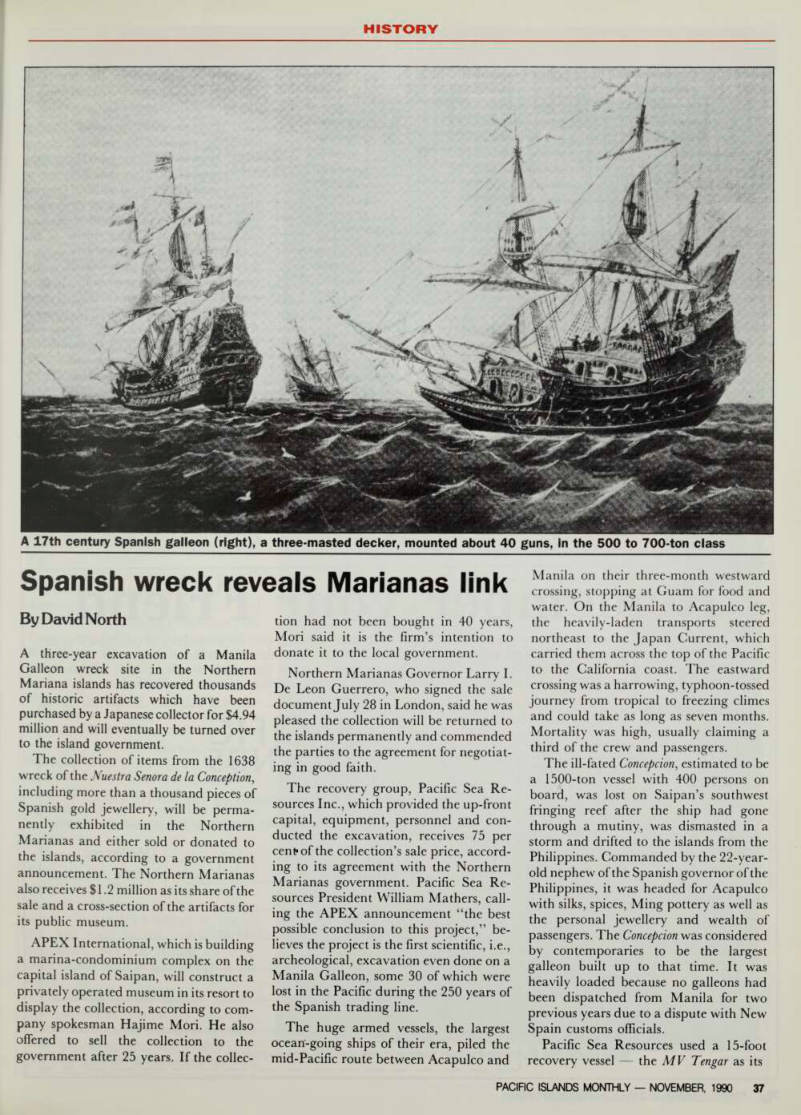
By David North
A three-year excavation of a Manila Galleon wreck site in the Northern Mariana islands has recovered thousands of historic artifacts which have been purchased by a Japanese collector for $4.94 million and will eventually be turned over to the island government.
The collection of items from the 1638 wreck of the Nuestra Senora de la Conception , including more than a thousand pieces of Spanish gold jewellery, will be perma nently exhibited in the Northern Marianas and either sold or donated to the islands, according to a government announcement. The Northern Marianas also receives $ 1.2 million as its share of the sale and a cross-section of the artifacts for its public museum, APEX International, which is building a marina-condominium complex on the capital island of Saipan, will construct a privately operated museum in its resort to display the collection, according to com pany spokesman Hajime Mori. He also offered to sell the collection to the government after 25 years. If the collec
tion had not been bought in 40 years, Mori said it is the firm’s intention to donate it to the local government.
Northern Marianas Governor Larry I.
De Leon Guerrero, who signed the sale document July 28 in London, said he was pleased the collection will be returned to the islands permanently and commended the parties to the agreement for negotiat
ing in good faith.
The recovery group, Pacific Sea Re sources Inc., which provided the up-front
capital, equipment, personnel and con
ducted the excavation, receives 75 per cent of the collection’s sale price, accord ing to its agreement with the Northern Marianas government. Pacific Sea Re sources President William Mathers, call ing the APEX announcement “the best possible conclusion to this project,” be lieves the project is the first scientific, i.e., archeological, excavation even done on a Manila Galleon, some 30 of which were lost in the Pacific during the 250 years of
the Spanish trading line.
The huge armed vessels, the largest ocean-going ships of their era, piled the mid-Pacific route between Acapulco and
Manila on their three-month westward crossing, stopping at Guam for food and water. On the Manila to Acapulco leg, the heavily-laden transports steered northeast to the Japan Current, which carried them across the top of the Pacific to the California coast. The eastward
crossing was a harrowing, typhoon-tossed
journey from tropical to freezing climes
and could take as long as seven months.
Mortality was high, usually claiming a
third of the crew and passengers.
The ill-fated Concepcion , estimated to be a 1500-ton vessel with 400 persons on board, was lost on Saipan’s southwest fringing reef after the ship had gone through a mutiny, was dismasted in a storm and drifted to the islands from the Philippines. Commanded by the 22-year old nephew of the Spanish governor of the Philippines, it was headed for Acapulco with silks, spices, Ming pottery as well as the personal jewellery and wealth of passengers. The Concepcion was considered
by contemporaries to be the largest
galleon built up to that time. It was heavily loaded because no galleons had been dispatched from Manila for two previous years due to a dispute with New Spain customs officials.
Pacific Sea Resources used a 15-foot recovery vessel the MV Tengar as its
A 17th century Spanish galleon (right), a three-masted decker, mounted about 40 guns, In the 500 to 700-ton class
base during the excavation, living on the vessel and conducting all survey, exca vation and recovery operations from the ship, which was anchored over the wreck site. The Tengar also contained a fully
equipped conservation laboratory where
initial restoration work was conducted on the artifacts. After being photographed and recorded on the ship’s computer data system, the artificacts were sent to the British Museum and the Institute for Archaeology for further restorations and research.
At a 1988 Northern Marianas exhibit of some of the collection, Mathers described the Tengar’s self-contained approach to marine archaeological recovery as a way of bringing the sophisticated acoustic survey and state of the art locating and recovery equipment to the remote lo cations in the Asia-Pacific region where historic shipwrecks are located. The Concepcion project is the first for the company, which specialised in the archaeological recovery of historic wrecks.
The 28-member team of divers, composed of Asians, Europeans and Americans, worked in depths ranging from 20 to 200 feet, and explored even deeper areas with the aid of a diving bell and remotely
operated vehicle equipped with a video camera. Over two seasons, in 1987 and 1988, the team spent 10 months on site.
The results of the survey and excavation indicate that the Concepcion had struck the reef several times, and continued to disgorge its cargo as it was blown south along the boulder-strewn coral platform.
Some large sections of the ship sank in 50 feet of water while other parts drifted into deeper water before going down.
The recovery work also found that most of the pieces of jewellery and other loose cargo had accumulated in cracks and crevices in the reef and under large coral heads. The project used large suction tubes to draw off up 10 feet of sand from these fissures. The 22.5 karat gold items in the collection include gem-studded broaches, pendants, rings and crucifixes, as well as gold neck chains, filigreed buttons, sections of plate and coins. One of the most stunning items in the collec tion is a small gold perfume decanter inlaid with 44 diamonds.
Other items in the collection include hundreds of 17th century storage jars, ship fittings, a 12-foot anchor, cannon shot, and Ming porcelain. All of the ship’s cannon, and probably some of its other cargo, had been salvaged by Spanish
recovery expeditions in the late 17th century. The islanders recovered much of the cargo following the initial sinking.
The project’s three years of archival research, overseen by renown marine exploration historian Sir John Hale, of the University of London, has brought to light a greater degree of cultural interac tion between the Chammoro population of the Marianas and galleon traders than previously realised. The extent of the interaction, motivated largely by an iron for-food-and-water trade between the islanders and the Spanish resulted in some early alliances between Chamorro chiefs and galleon castaways. Some survivors of the Concepcion , for example, were well treated and taken back to the Philippines a 1500 mile two-week sail by Chamorro seamen in open island canoes.
Though the islands were not colonised until 1668, the Spanish had used the islands regularly from 1565 on as a reprovisioning stop on the westward crossing and refuge from storms on the eastward passage. Unfortunately the abundance of reefs throughout the archi pelago and the lack of sheltered harbours led to numerous mishaps and several galleons are believed to have gone down on Marianas’ waters. □
Advertisements & other items, p. 38 (2 items)
38
HISTORY
PACIRC ISLANDS MONTHLY NOVEMBER 1990
Remember your Friend
'lnhere are times in your life when you feel your friends have been missing out on something good. Now’s your chance to do something about it and share with them one of the good things you have. Buy your friend a subscription to Pacific Islands Monthly and let him or her join you and the thousands of other people worldwide who are kept informed of the latest political, social and cultural changes taking place in the Pacific.
SUBSCRIPTIONS
American Samoa US$45 Australia AUSS3O Canada US$45 Cook Islands AUSS46 Fiji F $24 French Polynesia US$45 Guam US$45 Hawaii US$45 Japan US$3B Kiribati AUSS46 Micronesia US$35 Nauru AUSS42 New Caledonia US$32 New Zealand AUSS42 Niue AUSS46 Norfolk Island AUSS42 Northern Marianas US$36 Papua New Guinea AUSS42 Solomon Islands AUSS46 Tonga AUSS46 Tuvalu AUSS46 United Kingdom Stg£2B US (Mainland) U§s4s Vanuatu AUSS42 Western Samoa AUSSSO Elsewhere AUSS63 Payments to Pacific Islands Monthly Subscriptions Dept, GPO Box 1167, Suva, Fiji Subscriptions rates includes the cost of airspeeding to all destinations set out above Direct airmail rates on application
PACIFIC
ISLANDS
[MON T H I
Please send my friend Pacific Islands Monthly for one year (12 issues).
I enclose my cheque for $ (made payable to Pacific Islands Monthly) or debit $ to my: □ Bankcard □ Visacard □ Mastercard Card No: I I II M I I I I I I I I I I Expiry Date
NAME
SIGNATURE
MY FRIEND’S NAME
MY FRIEND'S ADDRESS
CITY COUNTRY
Sons
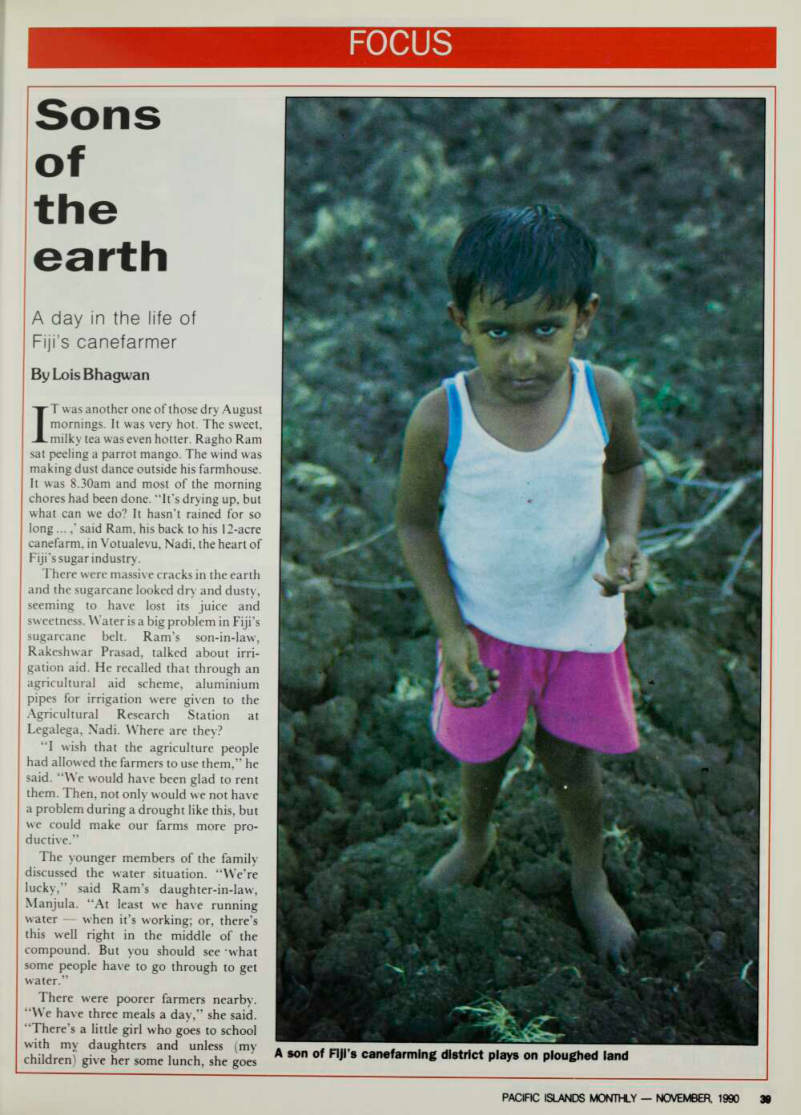
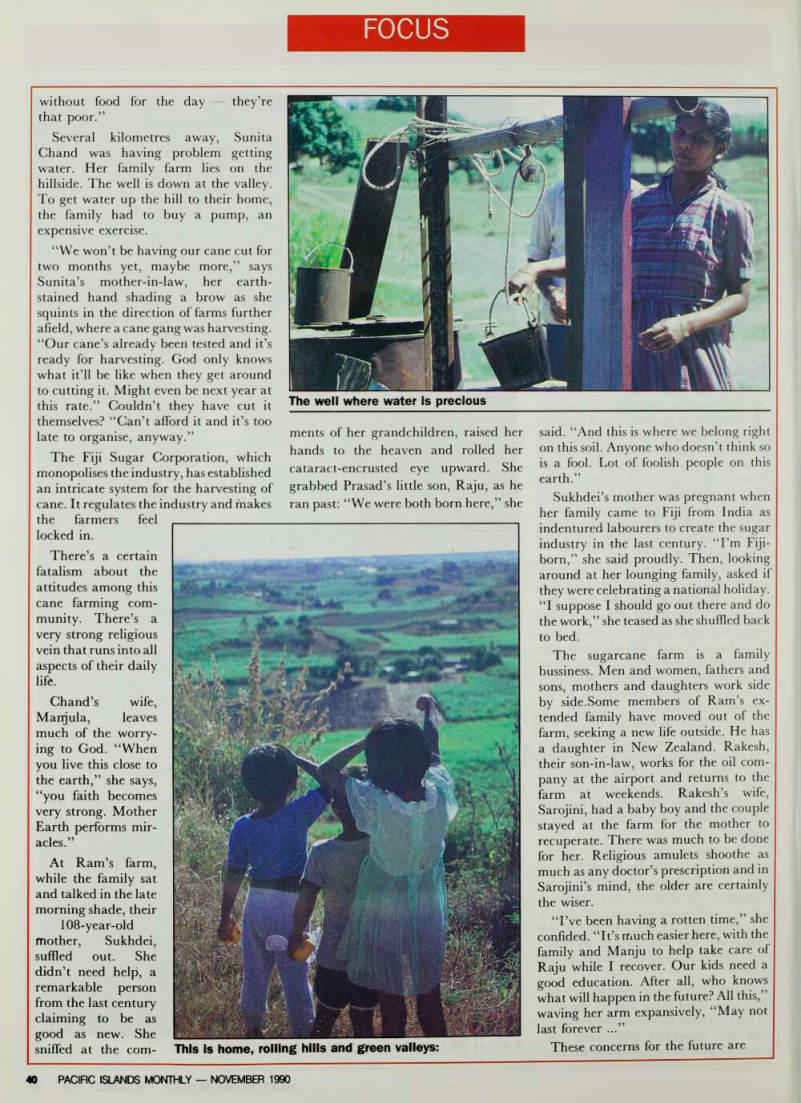
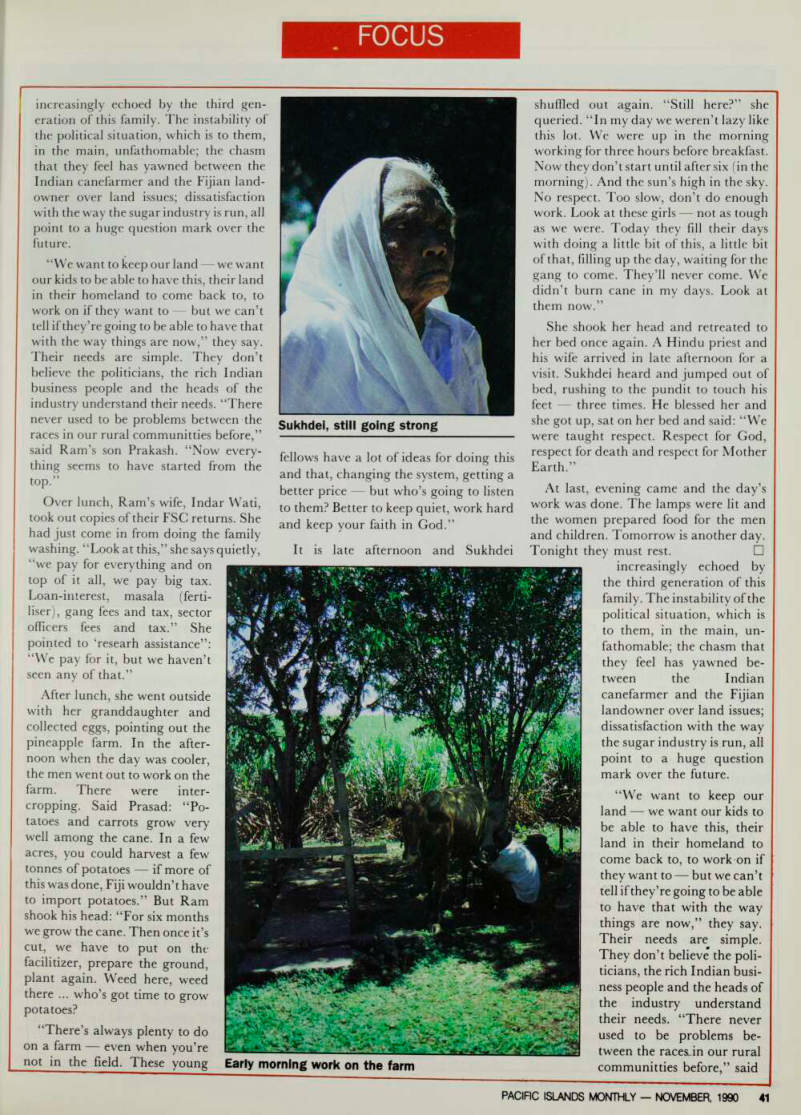
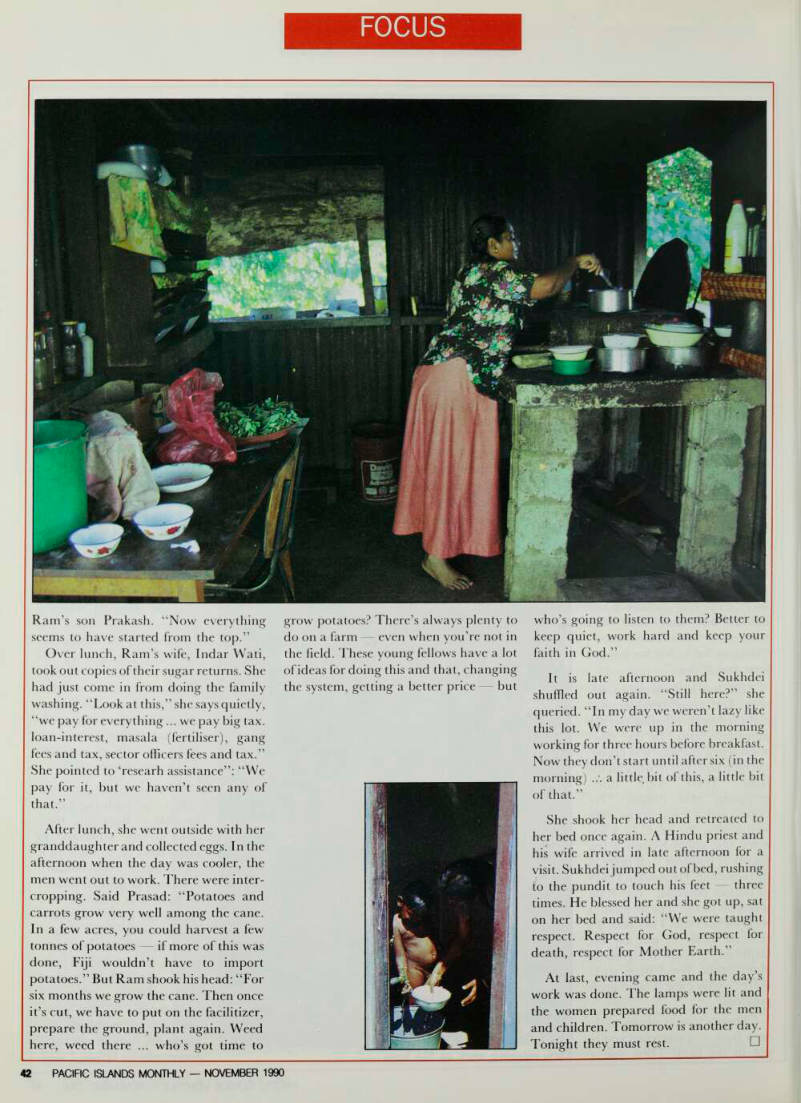
Focus
Sons of the earth
A day in the life of Fiji’s canefarmer
By Lois Bhagwan
IT was another one of those dry August mornings. It was very hot. The sweet, milky tea was even hotter. Ragho Ram sat peeling a parrot mango. The wind was making dust dance outside his farmhouse.
It was 8.30 am and most of the morning chores had been done. “It’s drying up, but what can we do? It hasn’t rained for so long ...,' said Ram, his back to his 12-acre canefarm, in Votualevu, Nadi, the heart of Fiji’s sugar industry.
There were massive cracks in the earth and the sugarcane looked dry and dusty, seeming to have lost its juice and sweetness. Water is a big problem in Fiji’s sugarcane belt. Ram’s son-in-law, Rakeshwar Prasad, talked about irri gation aid. He recalled that through an agricultural aid scheme, aluminium pipes for irrigation were given to the Agricultural Research Station at Legalega, Nadi. Where are they?
“I wish that the agriculture people had allowed the farmers to use them,” he said. “We would have been glad to rent them. Then, not only would we not have a problem during a drought like this, but we could make our farms more pro ductive.”
The younger members of the family discussed the water situation. “We’re
lucky,” said Ram’s daughter-in-law,
Manjula. “At least we have running water when it’s working; or, there’s this well right in the middle of the compound. But you should see 'what some people have to go through to get water.”
There were poorer farmers nearby.
“We have three meals a day,” she said.
“There’s a little girl who goes to school with my daughters and unless (my children) give her some lunch, she goes
A son of Fiji’s canefarming district plays on ploughed land
without food for the day they’re
that poor.”
Several kilometres away, Sunita
Chand was having problem getting
water. Her family farm lies on the hillside. The well is down at the valley.
To get water up the hill to their home, the family had to buy a pump, an expensive exercise.
“We won’t be having our cane cut for two months yet, maybe more,” says Sunita’s mother-in-law, her earth stained hand shading a brow as she squints in the direction of farms further afield, where a cane gang was harvesting.
“Our cane’s already been tested and it’s ready for harvesting. God only knows what it’ll be like when they get around to cutting it. Might even be next year at this rate.” Couldn’t they have cut it themselves? “Can’t afford it and it’s too late to organise, anyway.”
The Fiji Sugar Corporation, which
monopolises the industry, has established an intricate system for the harvesting of cane. It regulates the industry and makes
the farmers feel locked in.
There’s a certain fatalism about the attitudes among this cane farming com munity. There’s a very strong religious vein that runs into all aspects of their daily life.
Chand’s wife, Marrjula, leaves much of the worry ing to God. “When you live this close to the earth,” she says, “you faith becomes very strong. Mother Earth performs mir acles.”
At Ram’s farm, while the family sat and talked in the late morning shade, their 108-year-old mother, Sukhdei, sullied out. She didn’t need help, a remarkable person from the last century claiming to be as good as new. She sniffed at the com-
ments of her grandchildren, raised her hands to the heaven and rolled her cataract-encrusted eye upward. She grabbed Prasad’s little son, Raju, as he ran past: “We were both born here,” she
said. “And this is where we belong right on this soil. Anyone who doesn’t think so is a fool. Lot of foolish people on this earth.”
Sukhdei’s mother was pregnant when her family came to Fiji from India as indentured labourers to create the sugar industry in the last century. “I’m Fiji born,” she said proudly. Then, looking around at her lounging family, asked if they were celebrating a national holiday.
“I suppose I should go out there and do the work,” she teased as she shuffled back to bed.
The sugarcane farm is a family bussiness. Men and women, fathers and sons, mothers and daughters work side by side. Some members of Ram’s ex tended family have moved out of the farm, seeking a new life outside. He has a daughter in New Zealand. Rakesh, their son-in-law, works for the oil com pany at the airport and returns to the farm at weekends. Rakesh’s wife, Sarojini, had a baby boy and the couple stayed at the farm for the mother to recuperate. There was much to be done for her. Religious amulets shoothe as much as any doctor’s prescription and in Sarojini’s mind, the older are certainly the wiser.
“I’ve been having a rotten time,” she confided. “It’s much easier here, with the family and Manju to help take care of Raju while I recover. Our kids need a good education. After all, who knows what will happen in the future? All this,” waving her arm expansively, “May not last forever ...”
These concerns for the future are
This is home, rolling hills and green valleys:
The well where water is precious
increasingly echoed by the third gen eration of this family. The instability of the political situation, which is to them, in the main, unfathomable; the chasm that they feel has yawned between the Indian canefarmer and the Fijian land owner over land issues; dissatisfaction with the way the sugar industry is run, all point to a huge question mark over the future.
“We want to keep our land we want our kids to be able to have this, their land in their homeland to come back to, to work on if they want to but we can’t tell if they’re going to be able to have that with the way things are now,” they say.
Their needs are simple. They don’t believe the politicians, the rich Indian business people and the heads of the industry understand their needs. “There never used to be problems between the races in our rural communitties before,” said Ram’s son Prakash. “Now every thing seems to have started from the top.”
Over lunch, Ram’s wife, Indar Wati, took out copies of their FSC returns. She had just come in from doing the family washing. “Look at this,” she says quietly,
“we pay for everything and on top of it all, we pay big tax.
Loan-interest, masala (ferti liser), gang fees and tax, sector officers fees and tax.” She pointed to ‘researh assistance”: “We pay for it, but we haven’t seen any of that.”
After lunch, she went outside with her granddaughter and collected eggs, pointing out the pineapple farm. In the after noon when the day was cooler, the men went out to work on the farm. There were inter cropping. Said Prasad: “Po tatoes and carrots grow very well among the cane. In a few acres, you could harvest a few tonnes of potatoes if more of this was done, Fiji wouldn’t have to import potatoes.” But Ram shook his head: “For six months we grow the cane. Then once it’s cut, we have to put on the facilitizer, prepare the ground, plant again. Weed here, weed there ... who’s got time to grow potatoes?
“There’s always plenty to do on a farm even when you’re not in the field. These young
fellows have a lot of ideas for doing this and that, changing the system, getting a better price but who’s going to listen to them? Better to keep quiet, work hard and keep your faith in God.”
It is late afternoon and Sukhdei
shuffled out again. “Still here?” she queried. “In my day we weren’t lazy like this lot. We were up in the morning working for three hours before breakfast.
Now they don’t start until after six (in the morning). And the sun’s high in the sky.
No respect. Too slow, don’t do enough work. Look at these girls not as tough as we were. Today they fill their days with doing a little bit of this, a little bit of that, filling up the day, waiting for the gang to come. They’ll never come. We didn’t burn cane in my days. Look at them now.”
She shook her head and retreated to her bed once again. A Hindu priest and his wife arrived in late afternoon for a visit. Sukhdei heard and jumped out of bed, rushing to the pundit to touch his feet three times. He blessed her and she got up, sat on her bed and said: “We were taught respect. Respect for God, respect for death and respect for Mother Earth.”
At last, evening came and the day’s work was done. The lamps were lit and the women prepared food for the men and children. Tomorrow is another day.
Tonight they must rest. □
increasingly echoed by
the third generation of this family. The instability of the political situation, which is to them, in the main, un fathomable; the chasm that they feel has yawned be tween the Indian canefarmer and the Fijian landowner over land issues; dissatisfaction with the way the sugar industry is run, all
point to a huge question
mark over the future.
“We want to keep our land we want our kids to be able to have this, their land in their homeland to come back to, to work on if they want to but we can’t tell if they’re going to be able to have that with the way things are now,” they say.
Their needs are simple.
They don’t believe the poli ticians, the rich Indian busi ness people and the heads of the industry understand their needs. “There never used to be problems be tween the racesdn our rural communitties before,” said
Sukhdei, still going strong
Early morning work on the farm
Ram’s son Prakash. “Now everything seems to have started from the top.”
Over lunch, Ram’s wife, Indar Wati, took out copies of their sugar returns. She had just come in from doing the family washing. “Look at this,” she says quietly, “we pay for everything ... we pay big tax. loan-interest, masala (fertiliser), gang fees and tax, sector officers fees and tax.”
She pointed to ‘researh assistance”: “We pay for it, but we haven’t seen any of that.”
After lunch, she went outside with her granddaughter and collected eggs. In the afternoon when the day was cooler, the men went out to work. There were inter cropping. Said Prasad: “Potatoes and carrots grow very well among the cane.
In a few acres, you could harvest a few tonnes of potatoes if more of this was done, Fiji wouldn’t have to import potatoes.” But Ram shook his head: “For six months we grow the cane. Then once it’s cut, we have to put on the facilitizer, prepare the ground, plant again. Weed here, weed there ... who’s got time to
grow potatoes? There’s always plenty to
do on a farm even when you’re not in the field. These young fellows have a lot of ideas for doing this and that, changing the system, getting a better price but
who’s going to listen to them? Better to keep quiet, work hard and keep your faith in God.”
It is late afternoon and Sukhdei shuffled out again. “Still here?” she queried. “In my day we weren’t lazy like this lot. We were up in the morning working for three hours before breakfast.
Now they don’t start until after six (in the morning) a little bit of this, a little bit of that.”
She shook her head and retreated to her bed once again. A Hindu priest and his wife arrived in late afternoon for a visit. Sukhdei jumped out of bed, rushing to the pundit to touch his feet three times. He blessed her and she got up, sat on her bed and said: “We were taught respect. Respect for God, respect for death, respect for Mother Earth.”
At last, evening came and the day’s work was done. The lamps were lit and the women prepared food for the men and children. Tomorrow is another day.
Tonight they must rest. □
Advertisements & other items, pp. 40-42 (2 items)
Focus
40
PACIRC ISLANDS MONTHLY NOVEMBER 1990
Focus
The Army has landed
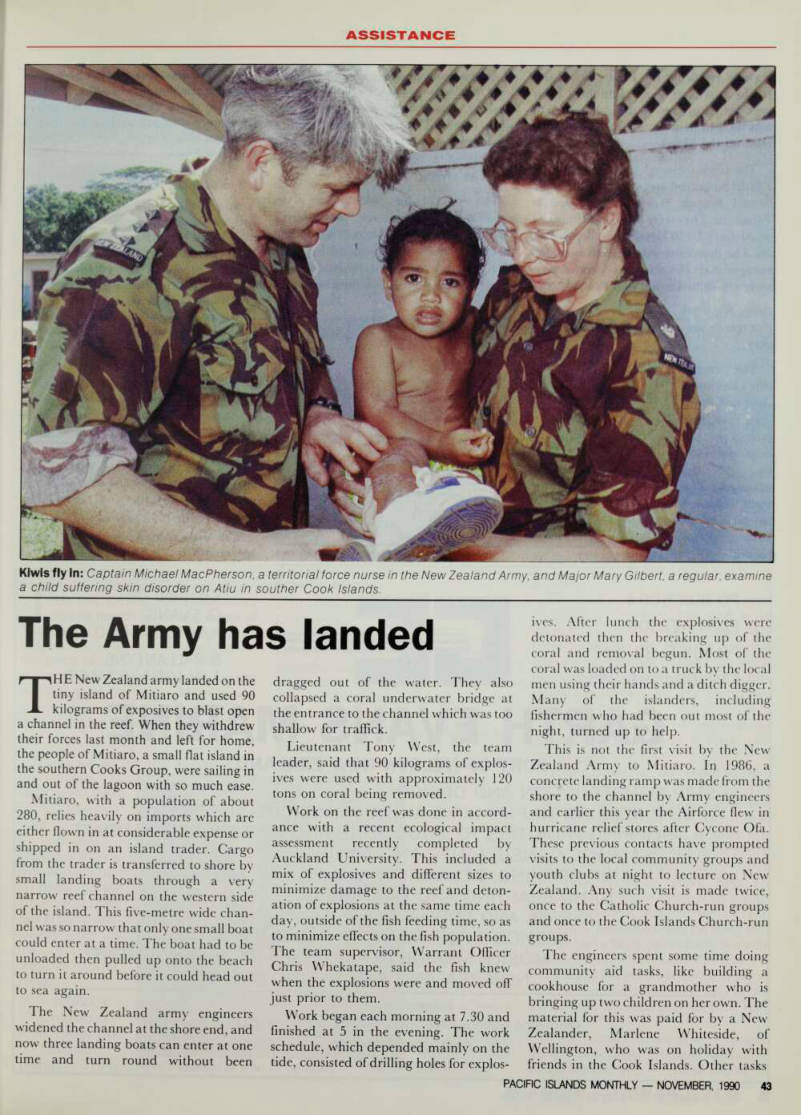
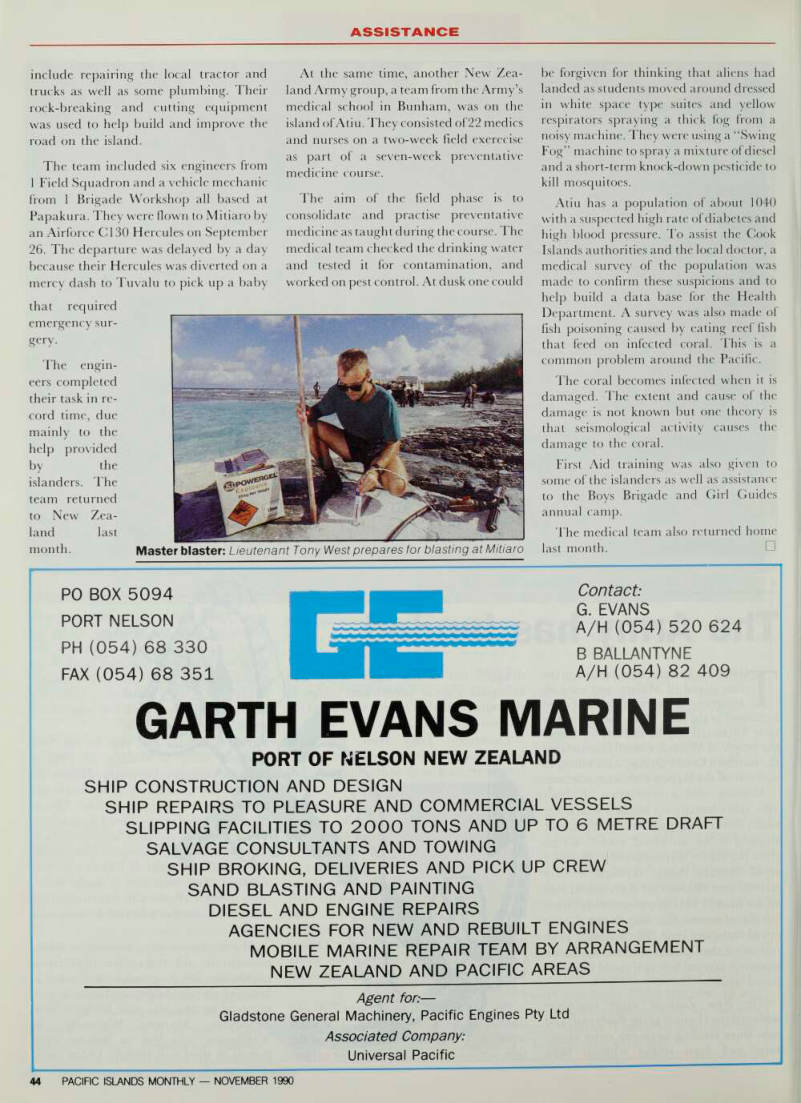
Assistance
ives. After lunch the explosives were detonated then the breaking up of the coral and removal begun. Most of the coral was loaded on to a truck by the local men using their hands and a ditch digger.
Many of the islanders, including fishermen who had been out most of the night, turned up to help.
This is not the first visit by the New Zealand Army to Mitiaro. In 1986, a concrete landing ramp was made from the shore to the channel by Army engineers and earlier this year the Airforce flew in hurricane relief stores after Cycone Ofa.
These previous contacts have prompted visits to the local community groups and youth clubs at night to lecture on New Zealand. Any such visit is made twice, once to the Catholic Church-run groups and once to the Cook Islands Church-run groups.
The engineers spent some time doing community aid tasks, like building a cookhouse for a grandmother who is bringing up two children on her own. The material for this was paid for by a New Zealander, Marlene Whiteside, of Wellington, who was on holiday with friends in the Cook Islands. Other tasks
THE New Zealand army landed on the tiny island of Mitiaro and used 90 kilograms of exposives to blast open a channel in the reef. When they withdrew MV o '* and fn , T e the people of Mitiaro, a small flat island in the southern Cooks Group, were sailing in and out of the lagoon with so much ease.
Mitiaro, with a population of about 280, relies heavily on imports which are either flown in at considerable expense or shipped in on an island trader Cargo from the trader is transferred to shore by small landing boats through a very narrow reef channel on the western side of the island. This five-metre wide channel was so narrow that only one small boat could enter at a time. The boat had to be unloaded then pulled up onto the beach to turn it around before it could head out to sea again Ihe New Zealand army engineers widened the channel at the shore end, and now three landing boats can enter at one time and turn round without been
dragged out of the water. They also collapsed a coral underwater bridge at the entrance to the channel which was too sha llow for traflick.
Lieutenant Tony West, the team r , leade C said that 90 ktlograms of exp os- IVCS WCTe US f*? wlth a PP roxlmatel y 120 tOnS ° n COra bemg removed - Work on the reef was done in accordance with a recent ecol °g ical im pac:t
assessment recently completed by
Auckland University. This included a mlx of ex P loslves and d, ff erent sizes to mmlm ‘ ze dama S e to tke reef and deton atlon of lexplosions 1 explosions at the same time each day ’° UtS l de okthe flsh [ eed '"S 50 a * £ m,nim,ze effects on the fish population, IK KIT su P ervlsor - VVarrant Officer Ckrls Whekatape, said the fish knew when the explosions were and moved off just prior to them.
Work began each morning at 7.30 and finished at 5 in the evening. The work schedule, which depended mainly on the tide, consisted of drilling holes for explos-
Kiwis fly In: Captain Michael MacPherson, a territorial force nurse in the New Zealand Army, and Major Mary Gilbert, a regular, examine a child suffering skin disorder on Atiu in souther Cook Islands.
include repairing the local tractor and trucks as well as some plumbing. Their rock-breaking and cutting equipment was used to help build and improve the road on the island.
The team included six engineers from 1 Field Squadron and a vehicle mechanic from 1 Brigade Workshop all based at Papakura. They were flown to Mitiaro by an Airforce Cl3o Hercules on September 26. The departure was delayed by a day because their Hercules was diverted on a mercy dash to Tuvalu to pick up a baby
that required
emergency sur gery.
The engin
eers completed
their task in re cord time, due mainly to the
help provided
by the islanders. The team returned to New Zea land last month.
At the same time, another New Zea land Army group, a team from the Army’s medical school in Bunham, was on the island of Atiu. They consisted 0f22 medics and nurses on a two-week field exerecise as part of a seven-week preventative medicine course.
The aim of the field phase is to
consolidate and practise preventative
medicine as taught during the course. The medical team checked the drinking water and tested it for contamination, and worked on pest control. At dusk one could
be forgiven for thinking that aliens had landed as students moved around dressed in white space type suites and yellow respirators spraying a thick fog from a noisy machine. They were using a “Swing Fog” machine to spray a mixture of diesel and a short-term knock-down pesticide to
kill mosquitoes.
Atiu has a population of about 1040 with a suspected high rate of diabetes and high blood pressure. To assist the Cook Islands authorities and the local doctor, a medical survey of the population was made to confirm these suspicions and to help build a data base for the Health Department. A survey was also made of fish poisoning caused by eating reef fish that feed on infected coral. This is a common problem around the Pacific.
The coral becomes infected when it is damaged. The extent and cause of the damage is not known but one theory is that seismological activity causes the damage to the coral.
First Aid training was also given to some of the islanders as well as assistance to the Boys Brigade and Girl Guides annual camp.
The medical team also returned home last month.
Master blaster: Lieutenant Tony West prepares for blasting at Mitiaro
Advertisements & other items, p. 44 (1 item)
Garth Evans Marine
PO BOX 5094
PORT NELSON
PH (054) 68 330
FAX (054) 68 351
Contact:
G.EVANS
A/H(054)520 624
B BALLANTYNE
A/H (054) 82 409
GARTH EVANS MARINE
SHIP CONSTRUCTION AND DESIGN
SHIP REPAIRS TO PLEASURE AND COMMERCIAL VESSELS SLIPPING FACILITIES TO 2000 TONS AND UP TO 6 METRE DRAFT
SALVAGE CONSULTANTS AND TOWING
SHIP BROKING, DELIVERIES AND PICK UP CREW
SAND BLASTING AND PAINTING
DIESEL AND ENGINE REPAIRS
AGENCIES FOR NEW AND REBUILT ENGINES
MOBILE MARINE REPAIR TEAM BY ARRANGEMENT
NEW ZEALAND AND PACIFIC AREAS
Agent for: — Gladstone General Machinery, Pacific Engines Pty Ltd Associated Company: Universal Pacific
PORT OF NELSON NEW ZEALAND
The eye team that’s making
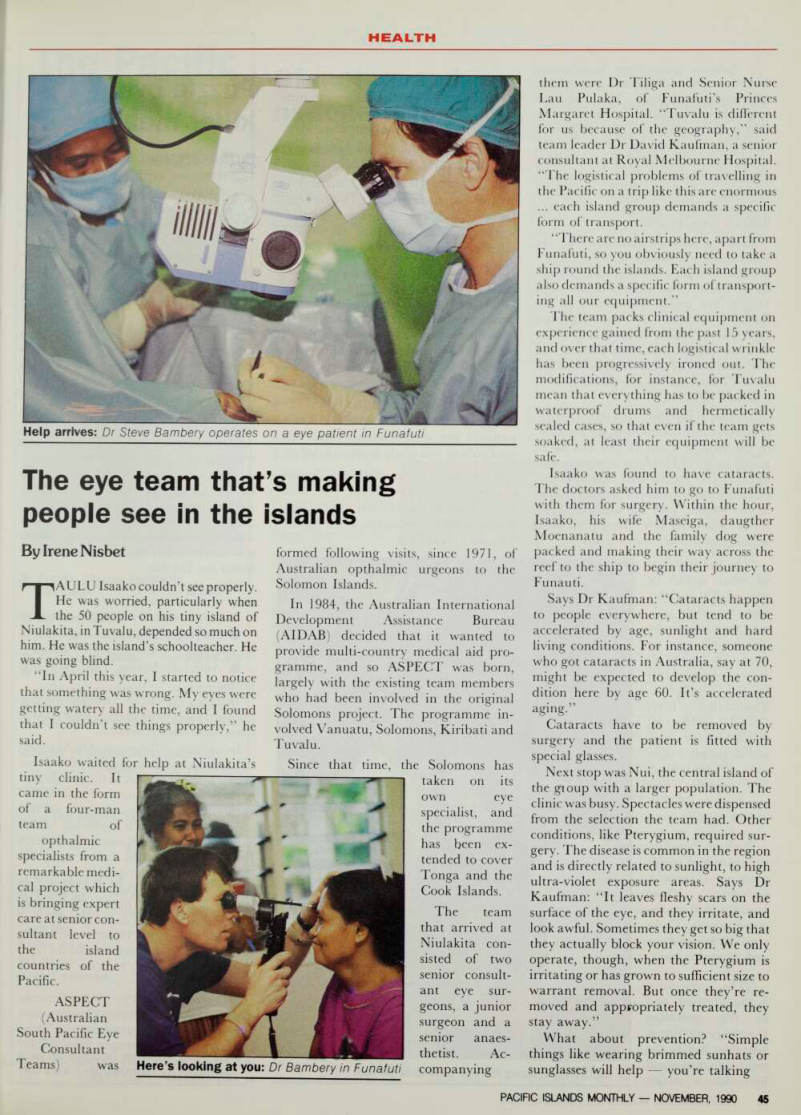
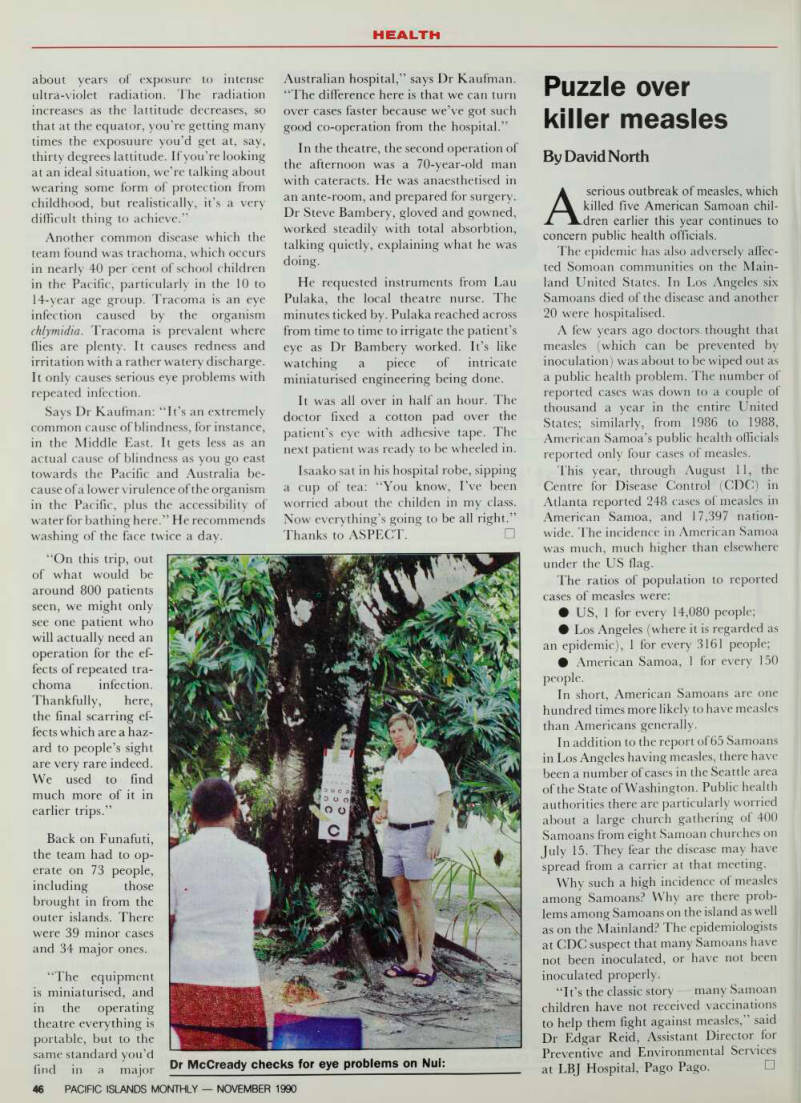
Health
The eye team that’s making people see in the islands
By Irene Nisbet TAULU Isaako couldn’t see properly.
He was worried, particularly when the 50 people on his tiny island of Niulakita, in Tuvalu, depended so much on him. He was the island’s schoolteacher. He was going blind.
“In April this year, I started to notice that something was wrong. My eyes were getting watery all the time, and I found that I couldn’t see things properly,” he said.
Isaako waited for help at Niulakita’s
tiny clinic. It came in the form of a four-man team of opthalmic specialists from a remarkable medi cal project which is bringing expert care at senior con sultant level to the island countries of the Pacific.
Aspect
(Australian South Pacific Eye Consultant
Teams) was
formed following visits, since 1971, of Australian opthalmic urgeons to the Solomon Islands.
In 1984, the Australian International Development Assistance Bureau (AIDAB) decided that it wanted to provide multi-country medical aid pro gramme, and so ASPECT was born, largely with the existing team members who had been involved in the original Solomons project. The programme in volved Vanuatu, Solomons, Kiribati and Tuvalu.
Since that time, the Solomons has
taken on its own eye specialist, and the programme has been ex tended to cover Tonga and the Cook Islands.
The team that arrived at Niulakita con sisted of two senior consult ant eye sur geons, a junior surgeon and a senior anaes thetist. Ac
companying
them were Dr Tiliga and Senior Nurse Lau Pulaka, of Funafuti’s Princes Margaret Hospital. “Tuvalu is different for us because of the geography,” said team leader Dr David Kaufman, a senior consultant at Royal Melbourne Hospital.
“The logistical problems of travelling in the Pacific on a trip like this are enormous ... each island group demands a specific form of transport.
“There are no airstrips here, apart from Funafuti, so you obviously need to take a ship round the islands. Each island group also demands a specific form of transport ing all our equipment.”
The team packs clinical equipment on experience gained from the past 15 years, and over that time, each logistical wrinkle has been progressively ironed out. The modifications, for instance, for Tuvalu mean that everything has to be packed in waterproof drums and hermetically sealed cases, so that even if the team gets soaked, at least their equipment will be safe.
Isaako was found to have cataracts.
The doctors asked him to go to Funafuti with them for surgery. Within the hour, Isaako, his wife Maseiga, daugther Moenanatu and the family dog were packed and making their way across the reef to the ship to begin their journey to Funauti.
Says Dr Kaufman: “Cataracts happen to people everywhere, but tend to be accelerated by age, sunlight and hard living conditions. For instance, someone who got cataracts in Australia, say at 70, might be expected to develop the con dition here by age 60. It’s accelerated aging.”
Cataracts have to be removed by surgery and the patient is fitted with special glasses.
Next stop was Nui, the central island of the gioup with a larger population. The clinic was busy. Spectacles were dispensed from the selection the team had. Other conditions, like Pterygium, required sur gery. The disease is common in the region and is directly related to sunlight, to high ultra-violet exposure areas. Says Dr Kaufman: “It leaves fleshy scars on the surface of the eye, and they irritate, and look awful. Sometimes they get so big that they actually block your vision. We only operate, though, when the Pterygium is irritating or has grown to sufficient size to warrant removal. But once they’re re moved and appropriately treated, they stay away.”
What about prevention? “Simple things like wearing brimmed sunhats or
sunglasses will help you’re talking
Help arrives: Dr Steve Bambery operates on a eye patient in Funafuti
Here’s looking at you: Dr Bambery in Funafuti
about years of exposure to intense ultra-violet radiation. The radiation increases as the lattitude decreases, so that at the equator, you’re getting many times the exposuure you’d get at, say, . . . , 1 T f , , , • thirty degrees lattitude. 11 you re looking ~■, ' . at an ideal situation, we re talking about r r • c wearing some form ot protection from childhood, but realistically, it’s a very difficult thing to achieve.” ' ~, . , , Another common disease which the „ . ... team found was trachoma, which occurs in nearly 40 per cent of school children in the Pacific, particularly in the 10 to 14-year age group. Tracoma is an eye infection caused by the organism chlymidia. Tracoma is prevalent where flies are plenty. It causes redness and irritation with a rather watery discharge.
It only causes serious eye problems with repeated infection. r Says Dr Kaufman: “It’s an extremely common cause of blindness, for instance, in the Middle East It gets less as an actual cause of blindness as you go east towards the Pacific and Australia because of a lower virulence of the organism in the Pacific, plus the accessibility of water for bathing here.” He recommends washing of the face twice a day.
“On this trip, out of what would be around 800 patients seen, we might only see one patient who will actually need an operation for the ef fects of repeated tra choma infection.
Thankfully, here, the final scarring ef fects which are a haz ard to people’s sight are very rare indeed.
We used to find much more of it in earlier trips.”
Back on Funafuti, the team had to op erate on 73 people,
including those
brought in from the outer islands. There were 39 minor cases and 34 major ones.
“The equipment is miniaturised, and in the operating theatre everything is portable, but to the same standard you’d find in a major
Australian hospital,” says Dr Kaufman.
“The difference here is that we can turn over cases faster because we’ve got such good co-operation from the hospital.”
T ,., , • r In the theatre, the second operation ot . r nr , r the afternoon was a 70-year-old man , . TT , • , • with cateracts. He was anaesthetised in an ante-room, and prepared for surgery, Dr Steve Bambery, gloved and gowned, worked steadily with total absorbtion, . , ... , , talking quietly, explaining what he was , .
He requested instruments from Lau Pulaka, the local theatre nurse. The minutes ticked by. Pulaka reached across from time to time to irrigate the patient’s eye as Dr Bambery worked. It’s like watching a piece of intricate
miniaturised engineering being done.
T n . , , r , It was all over in half an hour. Ihe doc(or fixed a cotton pad over the tient > s with adhe sive tape. The nex( atient was ready t 0 be wheeled in.
Isaako sat in his hospital robe, sipping a cup of tea: “You know, I ve been worried about the childen in my class, Now everything’s going to be all right.”
Thanks to ASPECT. □
Dr McCready checks for eye problems on Nui:
Puzzle over killer measles
killer measles
By David North
A serious outbreak of measles, which killed five American Samoan chil dren earlier this year continues to concern public health officials.
The epidemic has also adversely affec ted Somoan communities on the Main land United States. In Los Angeles six Samoans died of the disease and another 20 were hospitalised.
A few years ago doctors, thought that
measles (which can be prevented by
inoculation) was about to be wiped out as a public health problem. The number of reported cases was down to a couple of thousand a year in the entire United States; similarly, from 1986 to 1988, American Samoa’s public health officials reported only four cases of measles.
This year, through August 11, the Centre for Disease Control (CDC) in Atlanta reported 248 cases of measles in American Samoa, and 17,397 nation wide. The incidence in American Samoa was much, much higher than elsewhere under the US flag.
The ratios of population to reported cases of measles were: • US, 1 for every 14,080 people; Los Angeles (where it is regarded as an epidemic), 1 for every 3161 people; American Samoa, 1 for every 150
people.
In short, American Samoans are one hundred times more likely to have measles than Americans generally.
In addition to the report of 65 Samoans in Los Angeles having measles, there have been a number of cases in the Seattle area of the State of Washington. Public health authorities there are particularly worried about a large church gathering of 400 Samoans from eight Samoan churches on July 15. They fear the disease may have spread from a carrier at that meeting.
Why such a high incidence of measles among Samoans? Why are there prob lems among Samoans on the island as well as on the Mainland? The epidemiologists at CDC suspect that many Samoans have not been inoculated, or have not been
inoculated properly.
“It’s the classic story many Samoan children have not received vaccinations to help them fight against measles,” said Dr Edgar Reid, Assistant Director for Preventive and Environmental Services at LBJ Hospital, Pago Pago.
Of matyrs and
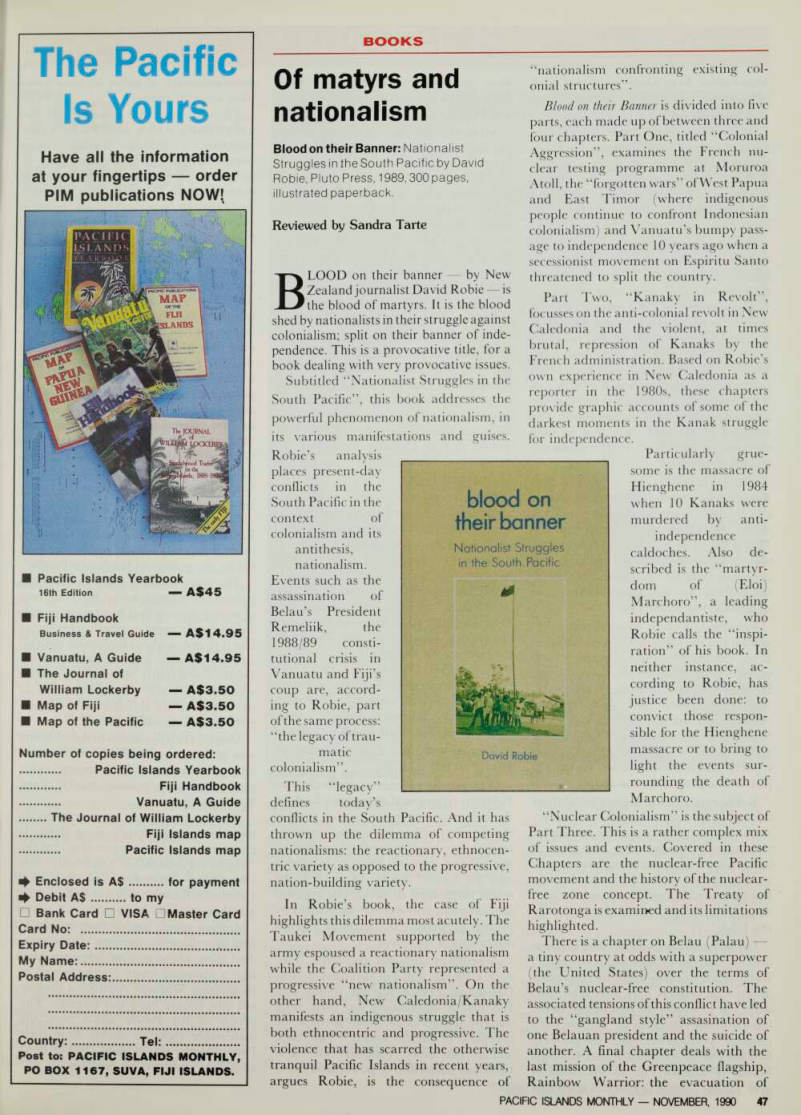
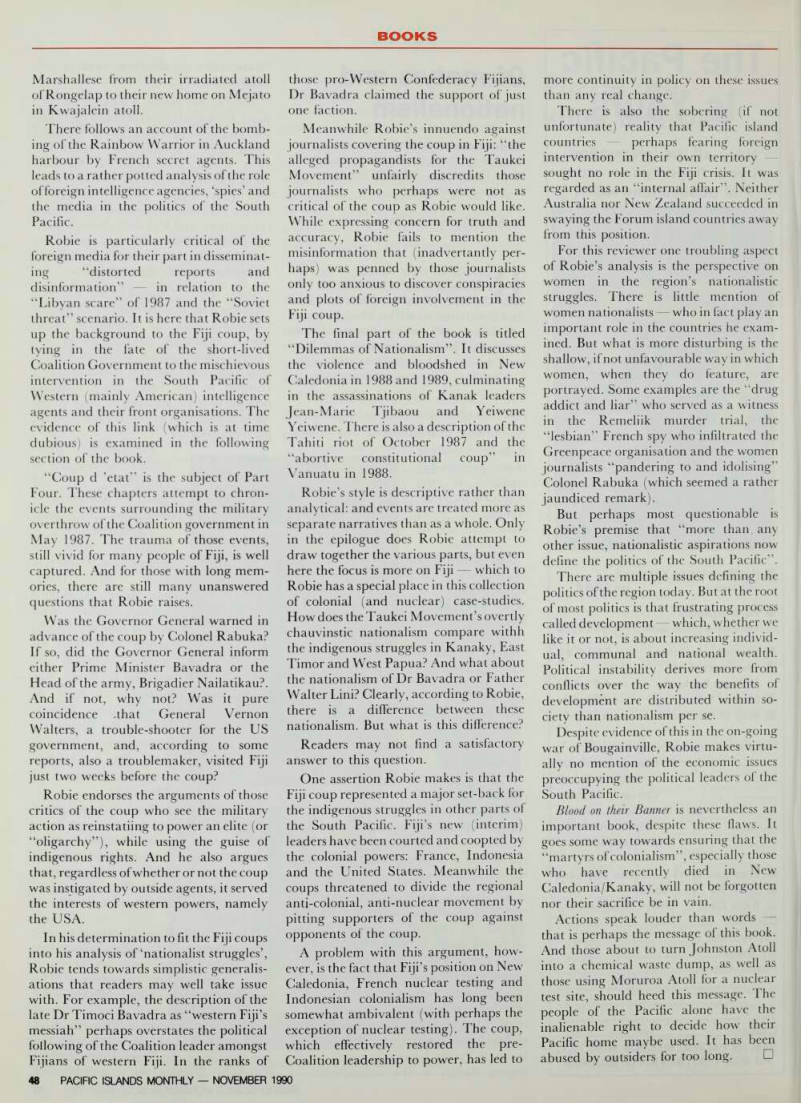
Books
Of matyrs and nationalism
Blood on their Banner: Nationalist Struggles in the South Pacific by David Robie, Pluto Press, 1989,300 pages, illustrated paperback.
Reviewed by Sandra Tarte
BLOOD on their banner by New Zealand journalist David Robie is the blood of martyrs. It is the blood shed by nationalists in their struggle against colonialism; split on their banner of inde pendence. This is a provocative title, for a book dealing with very provocative issues.
Subtitled “Nationalist Struggles in the South Pacific”, this book addresses the powerful phenomenon of nationalism, in its various manifestations and guises.
Robie’s analysis
places present-day
conflicts in the South Pacific in the context of colonialism and its antithesis, nationalism.
Events such as the assassination of Belau’s President Remeliik, the 1988/89 consti tutional crisis in Vanuatu and Fiji’s coup are, accord ing to Robie, part of the same process: “the legacy of trau matic colonialism”.
This “legacy”
defines today’s
conflicts in the South Pacific. And it has thrown up the dilemma of competing nationalisms: the reactionary, ethnocen tric variety as opposed to the progressive, nation-building variety.
In Robie’s book, the case of Fiji highlights this dilemma most acutely. The Taukei Movement supported by the army espoused a reactionary nationalism while the Coalition Party represented a progressive “new nationalism”. On the other hand, New Caledonia/Kanaky manifests an indigenous struggle that is both ethnocentric and progressive. The violence that has scarred the otherwise tranquil Pacific Islands in recent years, argues Robie, is the consequence of
“nationalism confronting existing col onial structures”.
Blood on their Banner is divided into five parts, each made up of between three and four chapters. Part One, titled “Colonial Aggression”, examines the French nu clear testing programme at Moruroa Atoll, the “forgotten wars” ofWest Papua and East Timor (where indigenous people continue to confront Indonesian colonialism) and Vanuatu’s bumpy pass age to independence 10 years ago when a secessionist movement on Espiritu Santo threatened to split the country.
Part Two, “Kanaky in Revolt”, focusses on the anti-colonial revolt in New Caledonia and the violent, at times brutal, repression of Kanaks by the French administration. Based on Robie’s own experience in New Caledonia as a reporter in the 1980 s, these chapters provide graphic accounts of some of the darkest moments in the Kanak struggle
for independence.
Particularly grue some is the massacre of Hienghene in 1984 when 10 Kanaks were murdered by anti
independence
caldoches. Also de scribed is the “martyr dom of (Eloi) Marchoro”, a leading
independantiste, who
Robie calls the “inspi ration” of his book. In neither instance, ac cording to Robie, has justice been done: to convict those respon sible for the Hienghene massacre or to bring to light the events sur rounding the death of Marchoro.
“Nuclear Colonialism” is the subject of Part Three. This is a rather complex mix of issues and events. Covered in these Chapters are the nuclear-free Pacific movement and the history of the nuclear free zone concept. The Treaty of Rarotonga is examined and its limitations highlighted.
There is a chapter on Belau (Palau) a tiny country at odds with a superpower (the United States) over the terms of Belau’s nuclear-free constitution. The associated tensions of this conflict have led to the “gangland style” assasination of one Belauan president and the suicide of another. A final chapter deals with the last mission of the Greenpeace flagship, Rainbow Warrior: the evacuation of
Marshallese from their irradiated atoll of Rongelap to their new home on Mejato in Kwajalein atoll.
There follows an account of the bomb ing of the Rainbow Warrior in Auckland harbour by French secret agents. This leads to a rather potted analysis of the role offoreign intelligence agencies, ‘spies’ and the media in the politics of the South Pacific.
Robie is particularly critical of the foreign media for their part in disseminat ing “distorted reports and disinformation” in relation to the “Libyan scare” of 1987 and the “Soviet threat” scenario. It is here that Robie sets up the background to the Fiji coup, by tying in the fate of the short-lived Coalition Government to the mischievous intervention in the South Pacific of Western (mainly American) intelligence agents and their front organisations. The evidence of this link (which is at time dubious) is examined in the following section of the book.
“Coup d ’etat” is the subject of Part Four. These chapters attempt to chron icle the events surrounding the military overthrow of the Coalition government in May 1987. The trauma of those events, still vivid for many people of Fiji, is well captured. And for those with long mem ories, there are still many unanswered questions that Robie raises.
Was the Governor General warned in advance of the coup by Colonel Rabuka?
If so, did the Governor General inform either Prime Minister Bavadra or the Head of the army, Brigadier Nailatikau?.
And if not, why not? Was it pure coincidence .that General Vernon Walters, a trouble-shooter for the US government, and, according to some reports, also a troublemaker, visited Fiji just two weeks before the coup?
Robie endorses the arguments of those critics of the coup who see the military action as reinstatiing to power an elite (or “oligarchy”), while using the guise of indigenous rights. And he also argues that, regardless of whether or not the coup was instigated by outside agents, it served the interests of western powers, namely the USA.
In his determination to fit the Fiji coups into his analysis of‘nationalist struggles’, Robie tends towards simplistic generalis ations that readers may well take issue with. For example, the description of the late Dr Timoci Bavadra as “western Fiji’s messiah” perhaps overstates the political following of the Coalition leader amongst Fijians of western Fiji. In the ranks of
those pro-Western Confederacy Fijians, Dr Bavadra claimed the support of just one faction.
Meanwhile Robie’s innuendo against journalists covering the coup in Fiji: “the alleged propagandists for the Taukei Movement” unfairly discredits those journalists who perhaps were not as critical of the coup as Robie would like.
While expressing concern for truth and accuracy, Robie fails to mention the misinformation that (inadvertantly per haps) was penned by those journalists only too anxious to discover conspiracies and plots of foreign involvement in the Fiji coup.
The final part of the book is titled “Dilemmas of Nationalism”. It discusses the violence and bloodshed in New Caledonia in 1988 and 1989, culminating in the assassinations of Kanak leaders Jean-Marie Tjibaou and Yeiwene Yeiwene. There is also a description of the Tahiti riot of October 1987 and the “abortive constitutional coup” in Vanuatu in 1988.
Robie’s style is descriptive rather than analytical: and events are treated more as separate narratives than as a whole. Only in the epilogue does Robie attempt to draw together the various parts, but even here the focus is more on Fiji which to Robie has a special place in this collection of colonial (and nuclear) case-studies.
How does the Taukei Movement’s overtly chauvinstic nationalism compare withh the indigenous struggles in Kanaky, East Timor and West Papua? And what about the nationalism of Dr Bavadra or Father Walter Lini? Clearly, according to Robie, there is a difference between these nationalism. But what is this difference?
Readers may not find a satisfactory answer to this question.
One assertion Robie makes is that the Fiji coup represented a major set-back for the indigenous struggles in other parts of the South Pacific. Fiji’s new (interim) leaders have been courted and coopted by the colonial powers: France, Indonesia and the United States. Meanwhile the coups threatened to divide the regional anti-colonial, anti-nuclear movement by pitting supporters of the coup against opponents of the coup.
A problem with this argument, how ever, is the fact that Fiji’s position on New Caledonia, French nuclear testing and Indonesian colonialism has long been somewhat ambivalent (with perhaps the exception of nuclear testing). The coup, which effectively restored the pre- Coalition leadership to power, has led to
more continuity in policy on these issues than any real change.
There is also the sobering (if not unfortunate) reality that Pacific island countries perhaps fearing foreign intervention in their own territory sought no role in the Fiji crisis. It was regarded as an “internal affair”. Neither Australia nor New Zealand succeeded in swaying the Forum island countries away from this position.
For this reviewer one troubling aspect of Robie’s analysis is the perspective on women in the region’s nationalistic struggles. There is little mention of women nationalists who in fact play an important role in the countries he exam ined. But what is more disturbing is the shallow, if not unfavourable way in which women, when they do feature, are portrayed. Some examples are the “drug addict and liar” who served as a witness in the Remeliik murder trial, the “lesbian” French spy who infiltrated the Greenpeace organisation and the women journalists “pandering to and idolising”
Colonel Rabuka (which seemed a rather
jaundiced remark).
But perhaps most questionable is Robie’s premise that “more than, any other issue, nationalistic aspirations now define the politics of the South Pacific”.
There are multiple issues defining the politics of the region today. But at the root of most politics is that frustrating process called development which, whether we like it or not, is about increasing individ ual, communal and national wealth.
Political instability derives more from conflicts over the way the benefits of development are distributed within so ciety than nationalism per se.
Despite evidence of this in the on-going war of Bougainville, Robie makes virtu ally no mention of the economic issues preoccupying the political leaders of the South Pacific.
Blood on their Banner is nevertheless an important book, despite these flaws. It goes some way towards ensuring that the “martyrs of colonialism”, especially those who have recently died in New Caledonia/Kanaky, will not be forgotten nor their sacrifice be in vain.
Actions speak louder than words that is perhaps the message of this book.
And those about to turn Johnston Atoll into a chemical waste dump, as well as those using Moruroa Atoll for a nuclear test site, should heed this message. The people of the Pacific alone have the inalienable right to decide how their Pacific home maybe used. It has been abused by outsiders for too long.
Advertisements & other items, p. 47 (1 item)
The Pacific
is Yours
Have all the information
at your fingertips order
PIM publications NOW[
MAF
lOURNAL
a ■ Pacific Islands Yearbook 16th Edition As4s ■ Fiji Handbook Business & Travel Guide Asl 4.95 ■ Vanuatu, A Guide ■ The Journal of William Lockerby ■ Map of Fiji ■ Map of the Pacific A 514.95 A 53.50 A 53.50 A 53.50 Number of copies being ordered: Pacific Islands Yearbook Fiji Handbook Vanuatu, A Guide The Journal of William Lockerby Fiji Islands map Pacific Islands map Enclosed is A$ for payment + Debit A$ to my □ Bank Card □ VISA □ Master Card Card No: Expiry Date: My Name: Postal Address: Country: Tel:
Post to: PACIFIC ISLANDS MONTHLY,
PO BOX 1167, SUVA, FIJI ISLANDS.
history
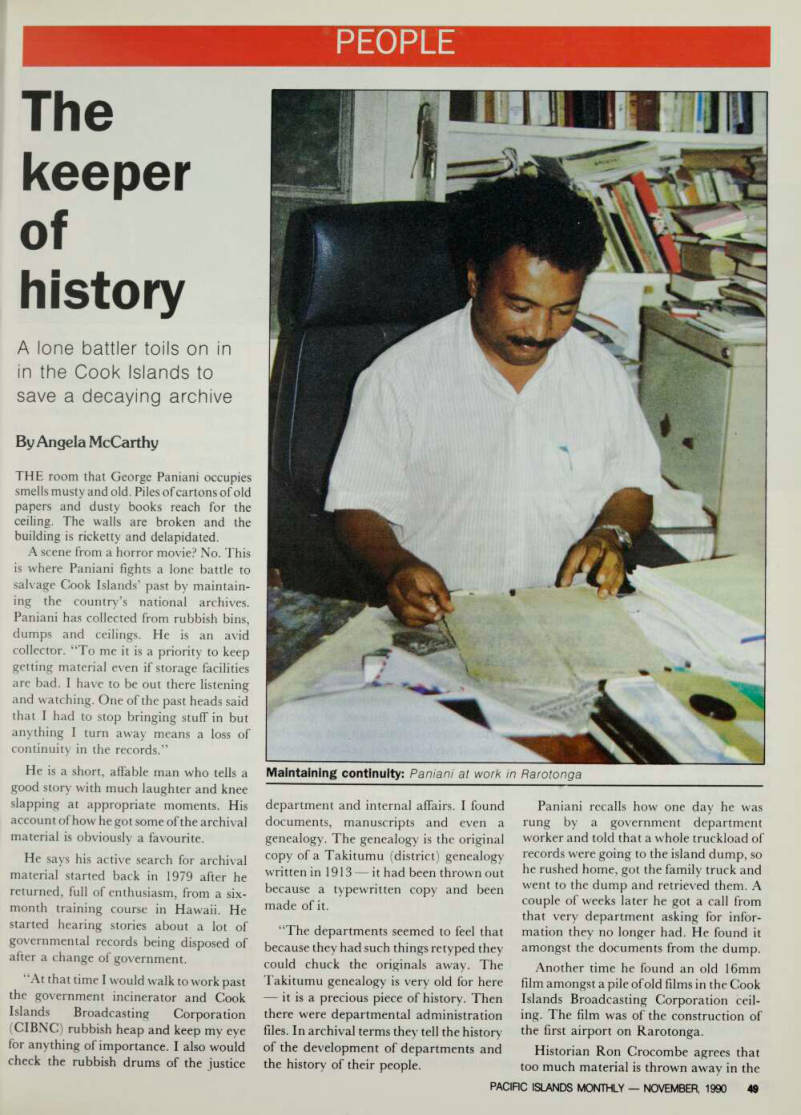
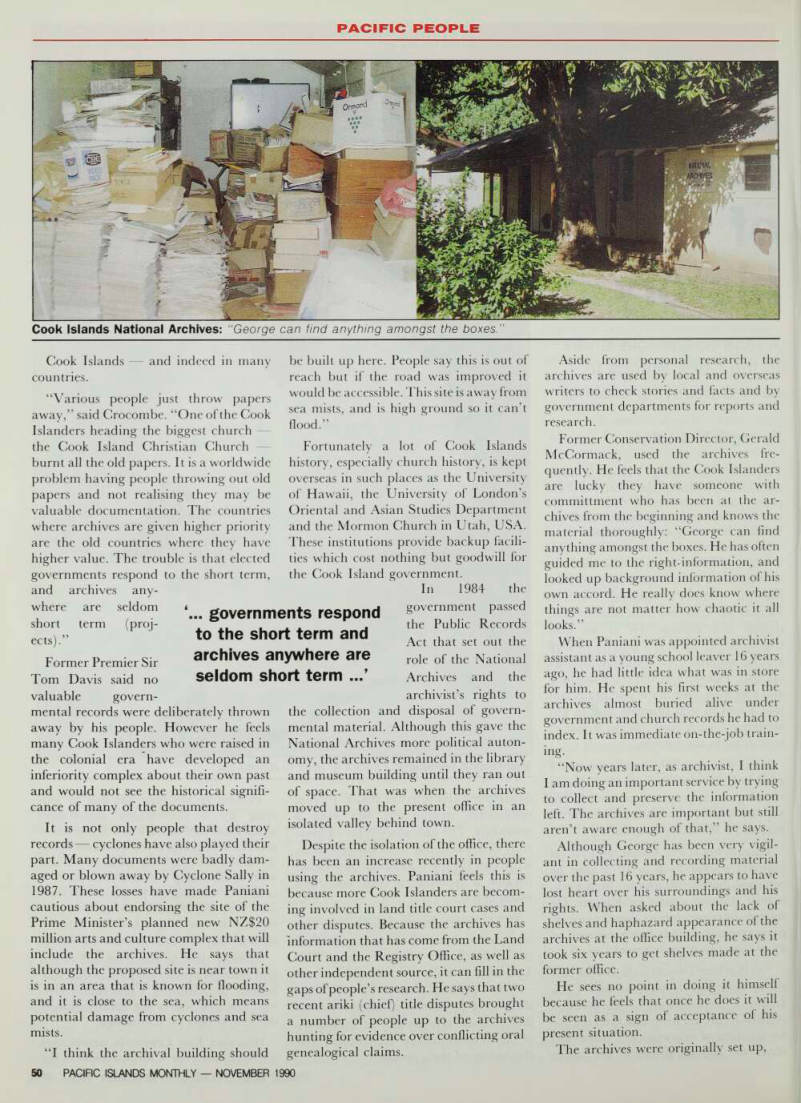
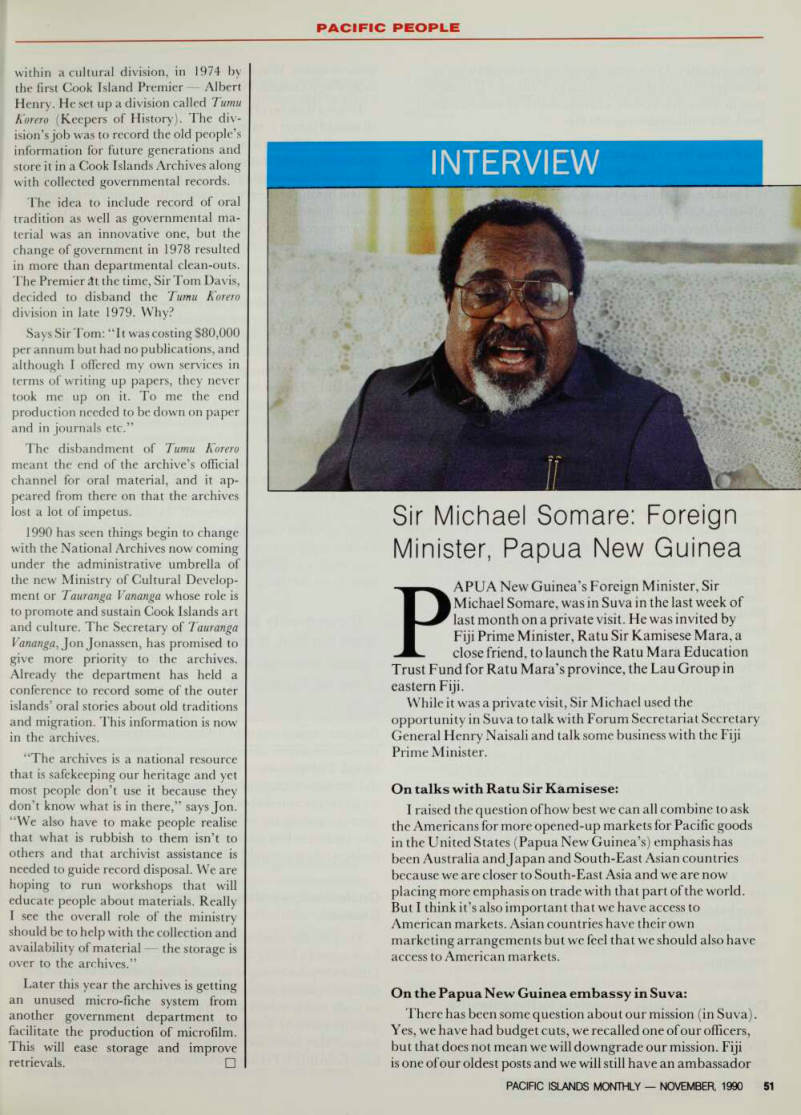
People
The keeper of history
A lone battler toils on in in the Cook Islands to save a decaying archive
By Angela McCarthy
THE room that George Paniani occupies smells musty and old. Piles of cartons of old papers and dusty books reach for the ceiling. The walls are broken and the building is ricketty and delapidated.
A scene from a horror movie? No. This is where Paniani fights a lone battle to salvage Cook Islands’ past by maintain ing the country’s national archives.
Paniani has collected from rubbish bins, dumps and ceilings. He is an avid collector. “To me it is a priority to keep getting material even if storage facilities are bad. I have to be out there listening and watching. One of the past heads said that I had to stop bringing stuff in but anything I turn away means a loss of continuity in the records.”
He is a short, affable man who tells a good story with much laughter and knee slapping at appropriate moments. His account of how he got some of the archival material is obviously a favourite.
He says his active search for archival material started back in 1979 after he returned, full of enthusiasm, from a six month training course in Hawaii. He started hearing stories about a lot of governmental records being disposed of after a change of government.
At that time I would walk to work past the government incinerator and Cook
Islands Broadcasting Corporation
(CIBNC) rubbish heap and keep my eye for anything of importance. I also would check the rubbish drums of the justice
department and internal affairs. I found documents, manuscripts and even a genealogy. The genealogy is the original copy of a Takitumu (district) genealogy written in 1913 it had been thrown out because a typewritten copy and been made of it.
“The departments seemed to feel that because they had such things retyped they could chuck the originals away. The Takitumu genealogy is very old for here it is a precious piece of history. Then there were departmental administration files. In archival terms they tell the history of the development of departments and the history of their people.
Paniani recalls how one day he was rung by a government department worker and told that a whole truckload of records were going to the island dump, so he rushed home, got the family truck and went to the dump and retrieved them. A couple of weeks later he got a call from that very department asking for infor mation they no longer had. He found it amongst the documents from the dump.
Another time he found an old 16mm film amongst a pile of old films in the Cook
Islands Broadcasting Corporation ceil
ing. The film was of the construction of the first airport on Rarotonga.
Historian Ron Crocombe agrees that too much material is thrown away in the
Maintaining continuity: Paniani at work in Rarotonga
Cook Islands and indeed in many countries.
“Various people just throw papers away,” said Crocombe. “One of the Cook Islanders heading the biggest church the Cook Island Christian Church burnt all the old papers. It is a worldwide problem having people throwing out old papers and not realising they may be valuable documentation. The countries where archives are given higher priority are the old countries where they have higher value. The trouble is that elected governments respond to the short term, and archives any
where are seldom short term (proj ects).”
Former Premier Sir Tom Davis said no valuable govern
mental records were deliberately thrown away by his people. However he feels many Cook Islanders who were raised in the colonial era have developed an inferiority complex about their own past and would not see the historical signifi cance of many of the documents.
It is not only people that destroy records cyclones have also played their part. Many documents were badly dam aged or blown away by Cyclone Sally in 1987. These losses have made Paniani cautious about endorsing the site of the Prime Minister’s planned new NZS2O million arts and culture complex that will include the archives. He says that although the proposed site is near town it is in an area that is known for flooding, and it is close to the sea, which means potential damage from cyclones and sea mists.
“I think the archival building should
be built up here. People say this is out of reach but if the road was improved it would be accessible. This site is away from sea mists, and is high ground so it can’t flood.”
Fortunately a lot of Cook Islands history, especially church history, is kept overseas in such places as the University of Hawaii, the University of London’s Oriental and Asian Studies Department and the Mormon Church in Utah, USA.
These institutions provide backup facili ties which cost nothing but goodwill for the Cook Island government.
In 1984 the
‘... governments respond to the short term and archives anywhere are seldom short term ...’
government passed
the Public Records Act that set out the role of the National Archives and the archivist’s rights to
the collection and disposal of govern mental material. Although this gave the National Archives more political auton omy, the archives remained in the library and museum building until they ran out of space. That was when the archives moved up to the present office in an isolated valley behind town.
Despite the isolation of the office, there has been an increase recently in people using the archives. Paniani feels this is because more Cook Islanders are becom ing involved in land title court cases and other disputes. Because the archives has information that has come from the Land Court and the Registry Office, as well as other independent source, it can fill in the gaps of people’s research. He says that two recent ariki (chief) title disputes brought a number of people up to the archives hunting for evidence over conflicting oral
genealogical claims.
Aside from personal research, the archives are used by local and overseas writers to check stories and facts and by government departments for reports and research.
Former Conservation Director, Gerald McCormack, used the archives fre quently. He feels that the Cook Islanders are lucky they have someone with committment who has been at the ar chives from the beginning and knows the material thoroughly: “George can find anything amongst the boxes. He has often guided me to the right-information, and looked up background information of his own accord. He really does know where things are not matter how chaotic it all looks.”
When Paniani was appointed archivist assistant as a young school leaver 16 years ago, he had little idea what was in store for him. He spent his first weeks at the archives almost buried alive under government and church records he had to index. It was immediate on-the-job train ing.
“Now years later, as archivist, I think I am doing an important service by trying to collect and preserve the information left. The archives are important but still aren’t aware enough of that,” he says.
Although George has been very vigil ant in collecting and recording material over the past 16 years, he appears to have lost heart over his surroundings and his rights. When asked about the lack of shelves and haphazard appearance of the archives at the office building, he says it took six years to get shelves made at the former office.
He sees no point in doing it himself because he feels that once he does it will be seen as a sign of acceptance of his present situation.
The archives were originally set up,
Cook Islands National Archives: “George can find anything amongst the boxes."
within a cultural division, in 1974 by the first Cook Island Premier Albert Henry. He set up a division called Tumu Korero (Keepers of History). The div ision’s job was to record the old people’s information for future generations and store it in a Cook Islands Archives along with collected governmental records.
The idea to include record of oral tradition as well as governmental ma terial was an innovative one, but the change of government in 1978 resulted in more than departmental clean-outs.
The Premier at the time, Sir Tom Davis, decided to disband the Tumu Korero division in late 1979. Why?
Says Sir Tom: “It was costing $BO,OOO per annum but had no publications, and although I offered my own services in terms of writing up papers, they never took me up on it. To me the end production needed to be down on paper and in journals etc.”
The disbandment of Tumu Korero meant the end of the archive’s official channel for oral material, and it ap peared from there on that the archives lost a lot of impetus. 1990 has seen things begin to change with the National Archives now coming under the administrative umbrella of the new Ministry of Cultural Develop ment or Tauranga Vananga whose role is to promote and sustain Cook Islands art and culture. The Secretary of Tauranga Vananga, Jon Jonassen, has promised to give more priority to the archives.
Already the department has held a conference to record some of the outer islands’ oral stories about old traditions and migration. This information is now in the archives.
“The archives is a national resource that is safekeeping our heritage and yet most people don’t use it because they don’t know what is in there,” says Jon.
“We also have to make people realise that what is rubbish to them isn’t to others and that archivist assistance is needed to guide record disposal. We are hoping to run workshops that will educate people about materials. Really I see the overall role of the ministry should be to help with the collection and availability of material the storage is over to the archives.”
Later this year the archives is getting an unused micro-fiche system from another government department to facilitate the production of microfilm.
This will ease storage and improve retrievals. □
Interview
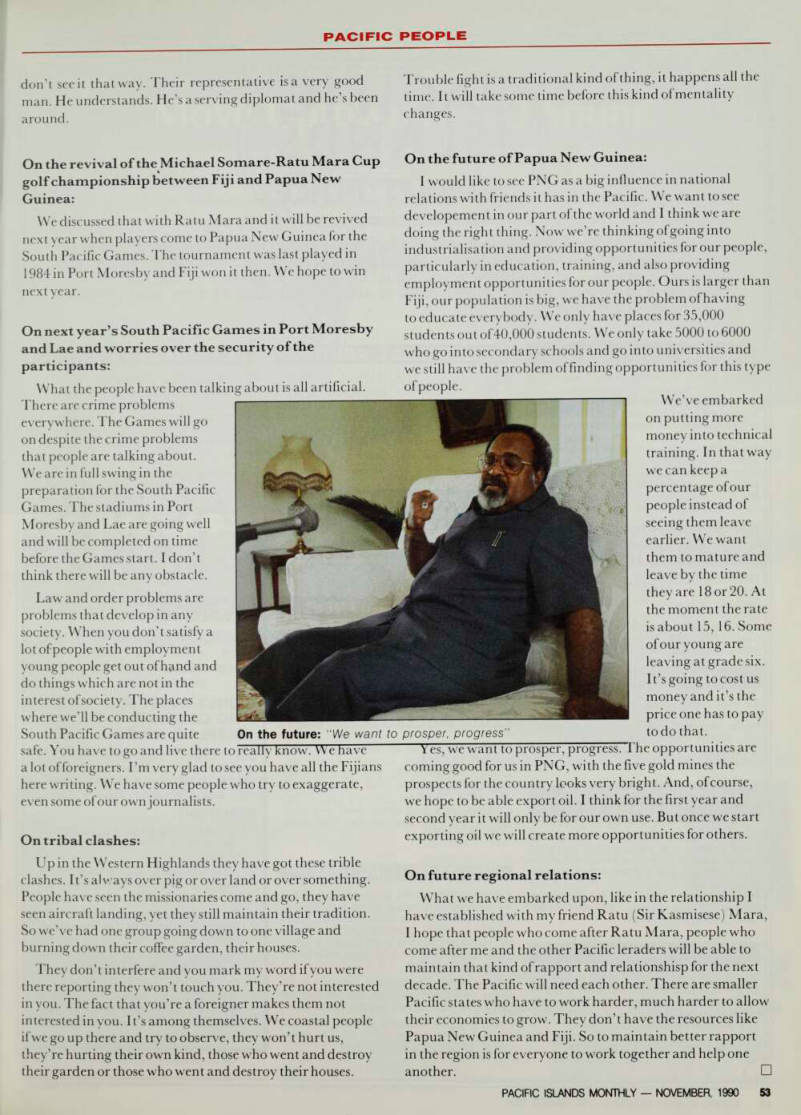
PAPUA New Guinea’s Foreign Minister, Sir Michael Somare, was in Suva in the last week of last month on a private visit. He was invited by Fiji Prime Minister, Ratu Sir Kamisese Mara, a close friend, to launch the Ratu Mara Education Trust Fund for Ratu Mara’s province, the Lau Group in
eastern Fiji.
While it was a private visit, Sir Michael used the opportunity in Suva to talk with Forum Secretariat Secretary General Henry Naisali and talk some business with the Fiji Prime Minister.
On talks with Ratu Sir Kamisese: I raised the question of how best we can all combine to ask the Americans for more opened-up markets for Pacific goods in the United States (Papua New Guinea’s) emphasis has been Australia and Japan and South-East Asian countries because we are closer to South-East Asia and we are now placing more emphasis on trade with that part of the world.
But I think it’s also important that we have access to American markets. Asian countries have their own marketing arrangements but we feel that we should also have access to American markets.
On the Papua New Guinea embassy in Suva: There has been some question about our mission (in Suva).
Y es, we have had budget cuts, we recalled one of our officers, but that does not mean we will downgrade our mission. Fiji is one of our oldest posts and we will still have an ambassador
Sir Michael Somare: Foreign Minister, Papua New Guinea
in the republic. We have no intention of withdrawing or downgrading our mission to charge d’affairs. Fiji is our big post in the region and we will maintain it at ambassadorial level. We will not downgrade Fiji.
On Papua New Guinea’s participation at the World Trade Show in Spain next year: I told Naisali that the Papua New Guinea Cabinet has allocated KBOO,OOO and we have appointed a Commissioner General to coordinate that particular project. My discussion with the Secretary General was for the Secretary General to get in touch with other Forum leaders, those who are members of AGP, to advice their ambassadors to take that matter up. 11 will be good for the Pacific countries to expose themselves.
On the situation with Bougainville and the closure of the Bougainville copper mine: Yes, we have problems. We have closed down Bougainville Copper which gives us one third ofour revenue, but Bougainville Copper in two years’ time will just be one of those mines. 11 has played a very important role in Papua New Guinea’s economy. 11 has given Papua New Guinea and its people revenue for things we want to do. The mine is closed now. It’s history. We hope that next year we will get the mine open again. But apart from Bougainville we have Pogera, we have Misima, we have Ok Tedi, and by 1992 we will have oil flowing. Bougainville becomes a small segment in two years time. Ifcommodity prices were not bad, ifcoffee prices were not down, we could carry on. A lot of people are predicting that the economy is going in a bad way but you have these recessions, you have the period when your household may not be good, you may not have everything in your house that you want.
People on the island of Buka have laid down their arms, particularly the rebels. There were something like 700 weapons (surrendered), two-thirds ofit were handmade, some I don’t know how they got them in, some people might have been stealing and selling to them. The people on the island of Buka are coming back to ask for services to be brought back to the island. Everything has come to a standstill. Buka used to be the administrative centre in the colonial days. We shifted to Arawa when we found copper on Bougainville. We have opened up again in Buka. We have a defence force for communication purposes there now and they are helping the people to rebuild the place. The villages are still okay but there is still threat from rebel elements. On the whole, things are moving very slowly. We have a shipping link back on to the island. Next year we hope we will open up all the schools again. The health services and other things
are going.
On the secessionist movement on Bougainville: Well that’s a question that will be raised from time to time.
Buka island people quite categorically said to us, “we don’t
want secession. What’s the point? We belong to the greater Papua New Guinea. We want more autonomy.” 11 was a little bit of mixture with the cult movement and all sorts of things ... talking about ethnic groupings that they are totally different from the rest of Melanesia, brownskin or blackskin people. But we have been able to convince them that your colour cannot do everything that you want to do you belong to the greater part of the country and that’s how it should be. The majority of the people do not like the idea ofsecession. It’s only a handful of people who are promoting that concept.
So far we have been trying to get the message across to (the rebels’ chief negotiator Joseph) Kabui and all the leaders that we need another meeting but so far we have not got our message across. They are demanding that we should withdraw our forces but we don’t believe them now. We believe that when we withdraw our forces their own people will cause more damage and carry out more atrocitiues on the island. (The problem is being created by) the young people, it’s gone out of hand, there’s no control. The BRA (Bougainville Republican Army) does not have the command anymore over these militants.
We are hoping the talks will come up but the problem is that we have no communication. The only communication we have is with the Catholic Mission and through our VHS system. I hope that Mr (Bernard) Narokobi, our Attorney- General, will get a message across for us to have a meeting.
I’m hoping to have another round of talks with them. There is no tentative date because we have not got in touch with them to set the date.
‘lf commodity prices were not bad, if coffee prices were not down we could carry on’
On the Endeavour Accord: The concept of the Endeavour Accord was first to initiate the peace agreement and to make sure
that services were returned. Once the services were returned then we could talk about having more autonomy for the island. The question of secession did not come up because we did not want to put this one down as a priority. I think what we were concenred about was the 130 to 140,000 people who were not getting the national government services. That was why we had to first establish dialogue. Once we established dialogue then we could talk to them.
On the Soviets setting up an embassy in Papua New Guinea: They are the same as any other embassy. Of course, we have signed a fishing aghreement with them. At the moment I think they are trying to establish their office. They have put up their establishment. I think they arc mainly concentrating on trade and how best we can trade with them. There have questions on why we signed a fishinbg agreement with them because they could use that as a form of espionage. So far they have been quiet. Perhaps something can happen later but I
don’t see it that way. Their representative is a very good man. He understands. He’s a serving diplomat and he’s been around.
On the revival of the Michael Somare-Ratu Mara Cup golf championship between Fiji and Papua New Guinea: We discussed that with Ratu Mara and it will be revived next year when players come to Papua New Guinea for the South Pacific Games. The tournament was last played in 1984 in Port Moresby and Fiji won it then. We hope to win next year.
On next year’s South Pacific Games in Port Moresby and Lae and worries over the security of the
participants:
What the people have been talking about is all artificial.
There are crime problems everywhere. The Games will go on despite the crime problems that people are talking about.
We are in full swing in the preparation for the South Pacific Games. The stadiums in Port Moresby and Lae are going well and will be completed on time before the Games start. I don’t think there will be any obstacle.
Law and order problems are problems that develop in any society. When you don’t satisfy a lot of people with employment young people get out and do things which are not in the interest of society. The places where we’ll be conducting the South Pacific Games are quite
safe. You have to go and live there to really know. V\ e have a lot offoreigners. I’m very glad to see you have all the Fijians here writing. We have some people who try to exaggerate, even some of our own journalists.
On tribal clashes: Up in the Western Highlands they have got these trible clashes. It’s always over pig or over land or over something.
People have seen the missionaries come and go, they have seen aircraft landing, yet they still maintain their tradition.
So we’ve had one group going down to one village and burning down their coffee garden, their houses.
They don’t interfere and you mark my word if you were there reporting they won’t touch you. They’re not interested in you. The fact that you’re a foreigner makes them not interested in you. It’s among themselves. We coastal people if we go up there and try to observe, they won’t hurt us, they’re hurting their own kind, those who went and destroy their garden or those who went and destroy their houses.
Trouble fight is a traditional kind ofthing, it happens all the time. It will take some time before this kind of mentality
changes.
On the future of Papua New Guinea: I would like to see PNG as a big influence in national relations with friends it has in the Pacific. We want to see developement in our part of the world and I think we are doing the right thing. Now we’re thinking of going into industrialisation and providing opportunities for our people, particularly in education, training, and also providing employment opportunities for our people. Ours is larger than Fiji, our population is big, we have the problem ofhaving to educate everybody. We only have places for 35,000 students out 0f40,000 students. We only take 5000 to 6000 who go into secondary schools and go into universities and we still have the problem offinding opportunities for this type of people.
We’ve embarked on putting more money into technical training. In that way we can keep a percentage of our people instead of seeing them leave earlier. We want them to mature and leave by the time they are 18 or 20. At the moment the rate is about 15, 16. Some ofour young are
leaving at grade six.
It’s going to cost us money and it’s the price one has to pay to do that.
Yes, we want to prosper, progress. 1 he opportunities are coming good for us in PNG, with the five gold mines the prospects for the country looks very bright. And, ofcourse, we hope to be able export oil. I think for the first year and second year it will only be for our own use. But once we start exporting oil we will create more opportunities for others.
On future regional relations: What we have embarked upon, like in the relationship I have established with my friend Ratu (Sir Kasmisese) Mara, I hope that people who come after Ratu Mara, people who come after me and the other Pacific leraders will be able to maintain that kind of rapport and relationshisp for the next decade. The Pacific will need each other. There are smaller Pacific states who have to work harder, much harder to allow their economies to grow. They don’t have the resources like Papua New Guinea and Fiji. So to maintain better rapport in the region is for everyone to work together and help one another. □
On the future: “We want to prosper, progress"
Advertisements & other items, pp. 54-56 (1 item)
Pacific
ISLANDS
IMQNT H L Y I
MARKET PLRCt
For the benefit of our readers who would like to place a small classified advertisement in our magazine, Market Place will assist you in selling personal items, accommodation, real estate, boating or a service ... in fact anything you would like to sell to our over 50,000 readers.
Market Place Advertising Rates are structured to allow you to place as many advertisements as you wish, economically.
EMPLOYMENT WANTED
Golf Course Superintendent/Construction Supervisor. Qualified Superintendent and Mechanical Engineer with over 20 years experience in construction and maintenance of golf courses, installation and operation of irrigation systems, turf management, agronomy, landscape architecture and complete knowledge of machinery. Member Australian Golf Course Superintendents Association. Excellent references. Write c/- P.O.
Box 677 Tewantin, Qld Australia 4565 or Phone Noosa (074) 49 8823.
DISTRIBUTORS/RETAILERS
WANTED
Required in all Pacific Island countries for the marketing of ASAKA Electronic Double Cassette Sing-along Karaoke Entertainment System. For details and brochures contact ASAKA Australia Pty Ltd 8 Hickory Place, St.
Clair, 2759, NSW, Australia Tel. (612) 670 2758 Fax. (612) 670 2758.
TRUCK MECHANIC
32 year old with 12 years experience in Europe and New Zealand, seeks job on one of Pacific Islands. C.V. & references available.
Eric Willers, Flat 3/36A Harman St., Christchurch, New Zealand, Tel (03) 3385629.
AGENTS/DISTRIBUTORS
WANTED
Qualified Agents/Distributors wanted for small primary and rechargeable batteries.
Products available include Alkaline, Carbonzinc, Mercury, Silver, Lithium, NiCad, Gel-Cell and Lead-Acid. Please contact Pacific Power Products, P.O. Box 2756, Redmond, WA 98073 USA. Phone 206-881-0564.
Telex 212495 PACPP UR
HYDRAULICS
Distributors wanted for ail areas outside Fiji for our hydraulic fittings and hose. Send for our Company profile. Quality products at very competitive prices.
Hydraulink Fluid Connectors Limited PO Box 12 826, Penrose, Auckland, NZ. Ph: 64 9 643 787 Fax: 64 9 645 865
SELF ADHESIVE LABELS
FORUM LABELS (FIJI) LTD
P.O. Box 1167, Suva., Fiji. Phone: 314111.
We print self-adhesive labels in rolls, multi-coloured labels with hot foil, and die cut to shape, tickets and tags in rolls. We also supply labelling machines and fabric labels.
PACIFIC
SLANDS
I MONTH L Y~\
MARKET PLACE CAN WORK
UUONDERS FOR VOU ...
Promote your business, or service, sell your household
items, cars or heavy machinery
etc.
ONLY AUSSI PER WORD.
NO COMPANY LOGO. NO
DISPLAY. NO BOLD TYPE.
Just forward your Advertisement together with payment to: PACIFIC ISLANDS MONTHLY "Market Place”, P.O. Box 1167, Suva, Fiji.
CONDITIONS:
1/ All Advertisements are subject to acceptance and approval of publisher. 2. Advertisements are published as space permits: we cannot guarantee date of insertion. 3. Ail advertisements must be prepaid and should be typed or printed clearly. 4. Deadline for receipt of advertisements is the 10th of the month prior to issue.
5. PACIFIC ISLANDS MONTHLY
assumes no responsibility for any service other than publishing paid advertisements in this section.
COMMERCIAL PRINTING
Top quality four colour printing, brochures, posters, packaging, product labels, fabric labels, billboards, books, magazines, stickers, books. Export quality. Contact Fiji’s most experienced Commercial Printers. FIJI TIMES COMMER- CIAL PRINTING, P.O. Box 1167, Suva. Fiji.
Phone: 314111. Fax. 301521.
ANTIQUE BOOKS, MAPS &
PRINTS
Antique Books, Maps & Prints of Pacific Islands. Free list available of items for sale.
Colin Hinchcliffe. 12 Queens Staith Mews.
York U.K.
HYDRAULIC EQUIPMENT
Comprehensive range of competitively priced pumps, motors, cylinders and valves. Agents for Sauer-Sundstrand hydrostatics.
Australian Hydraulics Company, PC Box 227, Rydalmere NSW 2116, Australia, Fax: 61-2-638.0544.
SCRAP METAL
Good prices paid for your clean scrap Aluminium, Brass, Copper, Lead, etc.
Contact Nonferral Pty. Ltd. 23 Davis Rd.
Wetherill Park NSW 2164 Australia. Fax 61 2 604 1304 for prompt reply. Our Company is a long established and leading metal buyer and smelter. Telephone 61 2 604 8855.
“ENTIRE BUILDING TO LET”
A RARE OPPORTUNITY to immediately lease Fiji's largest and tallest office building outside of Suva. Perfect for a REGIONAL HEAD OFFICE or HOTEL CONVERSION. Located in the transportation hub of the Pacific in sunny Lautoka and only a 10 minutes drive to the International Airport.
This 2900m 2 (32,000 sq ft.) modern building is fully air-conditioned with lift and car parking for over 30 cars. It is in prime location.
Naming Rights Available Contact: Aquarian Management Services (679) 62-222 or Fax (679) 64581. We Have Others!
Move Uptown to CD Sound
There is no substitute for CD sound against the electrifying backdrop of the city.
The bright lights, the rush of people, the intensity in the air— the only way to complete this picture is with realistic sound. Fill in the picture with a high-power CD system from Pioneer including the KEH-M3OO2QR Cassette/Receiver with CD Controls and CDX-M5O CD Changer. Now the streets belong to CD sound. ■ ■ m
m w i
Flip-Down” Protective Cassette Door (during cassette eject or insertion)
KEH-M3OO2QR MHH
Auto-Reverse Cassette/Receiver
with Multi-Play CD Controls
• Power output: 25Wx2 or 15Wx4
(max.) •Supertuner™ •24-station (18
FM/6 AM) presets ®BSM (Best Stations
Memory) •Dual-groove SHC head
•Quick-Release System
Multi-Play CD Controls: •Program Play (Instant Track Program) • Random Play on 6 discs •Repeat (Track/AII Discs) Compatible for Car and Home
CDX-M5O
Trunk-Mount Multi-Play CD Player H
a obmbala \
Home Use
JD-M2OO
cdx-mso mmmmmmmm
Multi-Play Compact Disc Player
•6-disc magazine loading ®AMPS (Auto-
matic Magazine Program Selection) •“Dou-
ble-Float” anti-vibration design •Protection against heat and dust •Ultra slim profile
•Versatile Horizontal/Vertical mounting system
Note: The CDX M5O can be easily connected to units incorporating an amplifier, such as the KEH-M3OO2QR, and a set of speakers for complete system integration.
(fi PIONEER
The future of sound and vision.
For further information, please contact: Australia; Pioneer Electronics Australia Pty. Ltd. (Incorporated in Victoria), 178-184 Boundary Road, Braeside Victoria 3195 Tel: 580-9911 FIJI Islands: Brijlal & Company, G.RO. Box No. 362, Suva, Fiji Islands Tel: 22258 New Zealand: Monaco Corporation Ltd., 41 Poland Road, Glenfield, Auckland, New Zealand Tel: (09) 444-9144 Norfolk Island: Burnt Pine Traders Ltd., RO. Box 21, Norfolk Island Vanuatu; Burns Philp (Vanuatu) Ltd., Vila, Vanuatu Nauru Island: Jacob Enterprises, PO. Box N 0.4, Republic of Nauru Tahiti: Tahiti Hi-Fi, RO. Box 848, Papeete, Tahiti New Caledonia: Menard Pacifique Sari, B.R 3899, Noumea.
New Caledonia Tel: 27-62-23 American Samoa: Transpac Corporation, PO. Box 1477, Pago Pago, American Samoa 96799 Tel; 633-5224 Rarotonga: South Seas International Ltd., PO. Box 49, Rarotonga, Cook Islands Tel: 2327
Less Work, More Enjoyment.
IH
MITSUBISHI
a mmm
MSB
■ ■ Tension can be a good thing in moderate amounts. In fact, for safe driving, it’s absolutely essential, translating as driver alertness. But just where does tension stop being alertness and become discomfort, and then fatigue?
Mitsubishi Motors, in designing the Galant, spent hours on that question, using the latest technology to measure physical reactions to various aspects of driving. One such aspect is the way driving, particularly cornering and lane-changing, requires constant steering adjustments. This results in added stress for the driver. The Galant’s 4-wheel steering and Electronic Control Suspension take some of this pressure off the driver by actively controlling vehicle attitude. With less work, the driver can High Tension 80 km/h
Llk
30 40 Low Tension 10 20 30 Driver tension under cornering is measured by level of skin resistance. With ECS, higher skin resistance shows lower levels of tension in the driver. get more enjoyment from driving.
As far as Mitsubishi are concerned, human engineering is much more than a catchy phrase. It is a practical way to make cars more useful and more appealing to people. ii - & -v\
MITSUBISHI GRLRNT
A
MITSUBISHI
MOTORS
AMERICAN SAMOA: MORRIS SCANLAN SERVICE INC. P.O, Box 367, Pago Pago, Tel, 633-5520/AUSTRALIA: MITSUBISHI MOTORS AUSTRALIA LTD, Box 1284, South Road, Clovelly Park, South Australia 5042, Tel (08) 275-7223/FIJt: NIVIS MOTOR & MACHINERY CO., LTD, G.P.O Box 150, Suva, Tel 38341 1 /FRENCH POLYNESIA (TAHITI): ETS-BREDIN FRERES ET FILS P.O Box 21, Papeete, Tahiti, Tel 4-202-58/NEW CALEDONIA: SOCIETE DTMPORTATION D AUTO DU PACIFIQUE SUD S.A. B P, 438 Rond Point du Pacifique, Noumea, Tel, 274144/NEW ZEALAND; MITSUBISHI MOTORS NEW ZEALAND LTD. Todd Park, Heriot Drive, Private Bag. Porirua.Tel. 370-109/ NORFOLK ISLAND: BORRYS LTD. PO Box 169, Norfolk Island, Tel, 2114/PAPUA NEW GUINEA: TOBA PTY. LTD. P.O. Box 503, Port Moresby, Tel 21-7874/SOLOMON ISLANDS: HARVEST PACIFIC LTD. G.P.O, Box 88. Honiara, Guadalcanal. Tel. 30128/TONGA: SITANI MAPI CO., LTD. PO Box 83, Nuku ALOFA, Tel. 21-044/VANUATU: SOCOMETRA B.P 06 Route de Lagon, Port-Vila, Tel 2314/WESTERN SAMOA: A M. MACDONALD HOLDINGS LTD P.O Box 576, Apia, Tel. 22022/SAIPAN/POHNPEI/MAJURO/KOSRAE/TRUK/YAP/BELAU: MICRONESIAN MOTORS, INC. 997 South Marine Drive, Tamuning, Guam 96911, Tel. 646-6827