Pacific


Islands
Monthly
October 1990
Business
Going after the Tuna
Under
the
Bomb
New study predicts earlier disaster at Moruroa
As ? “ ; Cook Is,ands NZs3 ’ Fi J i p 5 l -75; FS of Micronesia US$3; Guam US$3; Hawaii US$3; Kiribati A 52.50; Nauru A 52.50; Niue NZ$3; Norfolk As 3; oma cfp2so; New Zealand (id GST) NZ53.45; Nth Marianas US$3; Papua New Guinea K 3; Palau US$3; Marshalls US$3; Solomon Islands Sls3; Tahiti cfp3oo; Tonga P 3; USA US$3; Vanuatu VT2OO; Western Samoa W 553.25. These are recommended retail prices only
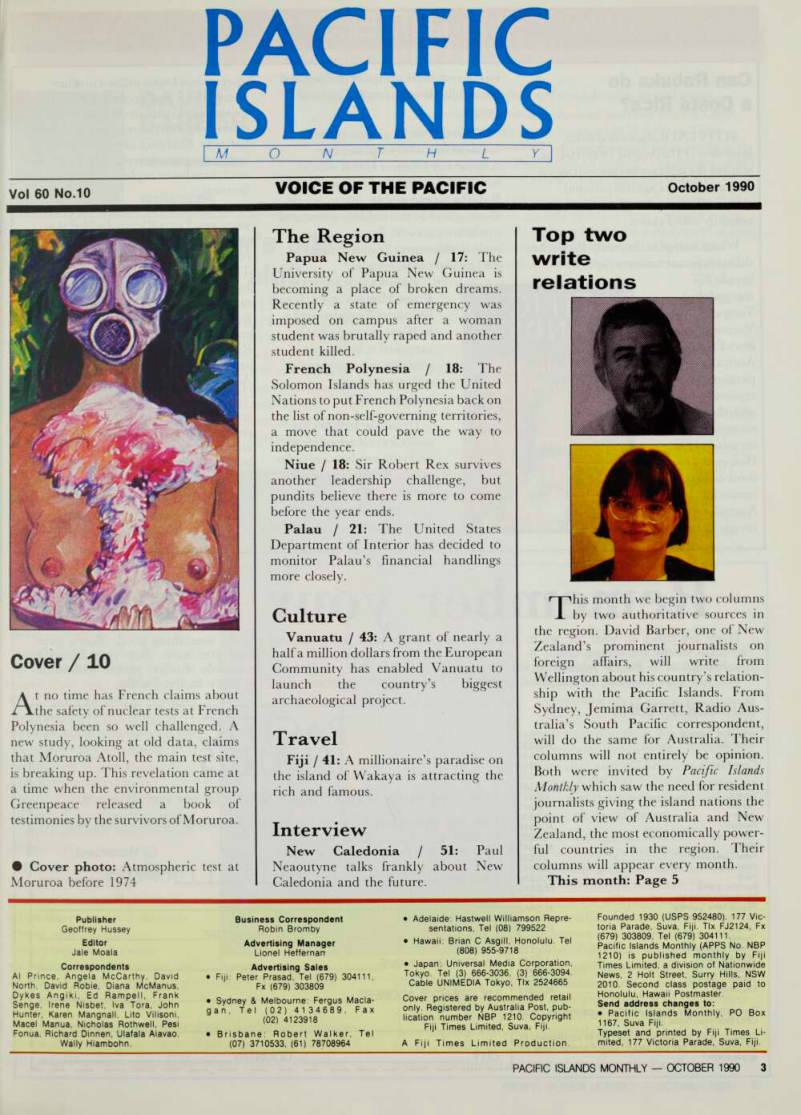
• Cover photo: Atmospheric test at Moruroa before 1974
Advertisements & other items, p. 2 (1 item)
Thanks To The Pact Network,
KEEPING IN TOUCH THROUGHOUT THE
PACIFIC WILL BE A LOT EASIER.
The good news for the future of communications in the Pacific is the PACT Network. The PACT Network is a cost-effective communications system that will link Pacific nations with their neighbours, their own rural communities and the rest of the world.
This Network provides instant and economic telephone access to friends, family and even to medical and educational facilities.
The expanded network also means that local business can communicate easily with customers by phone, fax or data link.
The PACT Network has been developed through the careful planning of the Pacific nations together with OTC International, an arm of Australia's worldwide communications company, and INTELSAT, the world’s global satellite system.
No one’s far from anyone anymore. 0 mbelsab
International Limited
Pacific
Islands
Monthly
Vol 60 No.lo
Voice Of The Pacific
October 1990
Cover/ 10
At no time has French claims about the safety of nuclear tests at French Polynesia been so well challenged. A new study, looking at old data, claims that Moruroa Atoll, the main test site, is breaking up. This revelation came at a time when the environmental group Greenpeace released a book of testimonies by the survivors of Moruroa.
The Region
Papua New Guinea / 17: The University of Papua New Guinea is becoming a place of broken dreams.
Recently a state of emergency was imposed on campus after a woman student was brutally raped and another student killed.
French Polynesia / 18: The Solomon Islands has urged the United Nations to put French Polynesia back on the list of non-self-governing territories, a move that could pave the way to
independence.
Niue / 18: Sir Robert Rex survives another leadership challenge, but pundits believe there is more to come before the year ends.
Palau / 21: The United States Department of Interior has decided to monitor Palau’s financial handlings more closely.
Culture
Vanuatu / 43: A grant of nearly a half a million dollars from the European Community has enabled Vanuatu to launch the country’s biggest archaeological project.
T ravel
Fiji/41: A millionaire’s paradise on the island of Wakaya is attracting the rich and famous.
Interview
New Caledonia / 51: Paul Neaoutyne talks frankly about New Caledonia and the future.
Publisher Geoffrey Hussey Editor Jale Moala Correspondents Al Prince, Angela McCarthy, David North, David Robie, Diana McManus, Dykes Angiki, Ed Rampell, Frank Senge, Irene Nisbet, Iva Tora, John Hunter, Karen Mangnall, Lito Vilisoni, Macel Manua, Nicholas Rothwell, Pesi Fonua, Richard Dinnen, Ulafala Aiavao, Wally Hiambohn.
Business Correspondent Robin Bromby Advertising Manager Lionel Heffernarr Advertising Sales • Fiji; Peter Prasad, Tel (679) 304111, Fx (679) 303809 • Sydney & Melbourne: Fergus Macla gan, Tel (02) 4134689, Fax (02) 4123918 • Brisbane; Robert Walker, Tel (07) 3710533, (61) 78708964
• Adelaide: Hastwell Williamson Repre sentations. Tel (08) 799522 • Hawaii: Brian C Asgill, Honolulu. Tel (808) 955-9718 • Japan: Universal Media Corporation, Tokyo. Tel (3) 666-3036, (3) 666-3094.
Cable UNIMEDIA Tokyo, Tlx 2524665 Cover prices are recommended retail only. Registered by Australia Post, pub lication number NBP 1210. Copyright Fiji Times Limited, Suva, Fiji.
A Fiji Times Limited Production.
Founded 1930 (USPS 952480). 177 Vic toria Parade, Suva, Fiji. Tlx FJ2124, Fx (679) 303809, Tel (679) 304111.
Pacific Islands Monthly (APPS No. NBP 1210) is published monthly by Fiji Times Limited, a division of Nationwide News, 2 Holt Street, Surry Hills, NSW 2010. Second class postage paid to Honolulu, Hawaii Postmaster.
Send address changes to: • Pacific Islands Monthly, PO Box 1167, Suva Fiji.
Typeset and printed by Fiji Times Li mited, 177 Victoria Parade, Suva, Fiji
Top two
write relations
This month we begin two columns by two authoritative sources in the region. David Barber, one of New Zealand’s prominent journalists on foreign affairs, will write from Wellington about his country’s relation ship with the Pacific Islands. From Sydney, Jemima Garrett, Radio Aus tralia’s South Pacific correspondent, will do the same for Australia. Their columns will not entirely be opinion.
Both were invited by Pacific Islands Monthly which saw the need for resident journalists giving the island nations the point of view of Australia and New Zealand, the most economically power ful countries in the region. Their columns will appear every month.
This month: Page 5
Letters
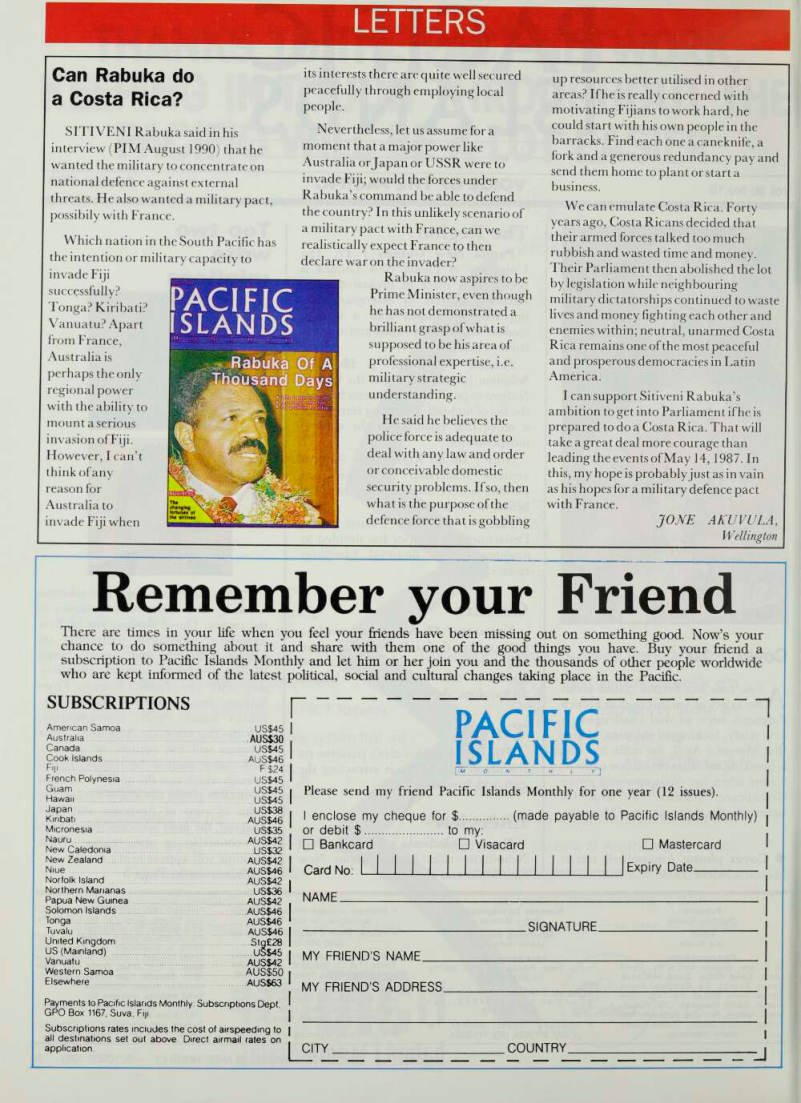
Can Rabuka do a Costa Rica?
SITIVENI Rabuka said in his interview (PIM August 1990) that he wanted the military to concentrate on national defence against external threats. He also wanted a military pact, possibily with France.
Which nation in the South Pacific has the intention or military capacity to
invade Fiji successfully?
Tonga? Kiribati?
Vanuatu? Apart from France, Australia is perhaps the only regional power with the ability to mount a serious invasion of Fiji.
However, I can’t think of any reason for Australia to invade Fiji when
its interests there are quite well secured
peacefully through employing local
people.
Nevertheless, let us assume for a moment that a major power like Australia or Japan or USSR were to invade Fiji; would the forces under Rabuka’s command be able to defend the country? In this unlikely scenario of a military pact with France, can we realistically expect France to then declare war on the invader?
Rabuka now aspires to be Prime Minister, even though he has not demonstrated a brilliant grasp of what is supposed to be his area of professional expertise, i.e.
military strategic
understanding.
He said he believes the police force is adequate to deal with any law and order or conceivable domestic security problems. If so, then what is the purpose of the defence force that is gobbling
up resources better utilised in other areas? If he is really concerned with motivating Fijians to work hard, he could start with his own people in the barracks. Find each one a caneknife, a fork and a generous redundancy pay and send them home to plant or start a business.
We can emulate Costa Rica. Forty years ago, Costa Ricans decided that their armed forces talked too much rubbish and wasted time and money.
Their Parliament then abolished the lot by legislation while neighbouring military dictatorships continued to waste lives and money fighting each other and enemies within; neutral, unarmed Costa Rica remains one of the most peaceful and prosperous democracies in Latin America.
I can support Sitiveni Rabuka’s ambition to get into Parliament if he is prepared to do a Costa Rica. That will take a great deal more courage than leading the events of May 14,1987. In this, my hope is probably just as in vain as his hopes for a military defence pact with France.
Jone Akuvula,
Wellington
Advertisements & other items, p. 4 (1 item)
Remember your Friend
There are times in your life when you feel your friends have been missing out on something good. Now’s your chance to do something about it and share with them one of the good things you have. Buy your friend a subscription to Pacific Islands Monthly and let him or her join you and the thousands of other people worldwide who are kept informed of the latest political, social and cultural changes taking place in the Pacific.
SUBSCRIPTIONS
American Samoa .
Australia Canada Cook Islands Fiji French Polynesia Guam Hawaii Japan Kiribati Micronesia Nauru New Caledonia New Zealand Niue Norfolk Island Northern Marianas Papua New Guinea Solomon Islands Tonga Tuvalu United Kingdom US (Mainland) Vanuatu Western Samoa Elsewhere Payments to Pacific Islands Monthly: Subscriptions Dept, GPO Box 1167, Suva, Fiji Subscriptions rates includes the cost of airspeeding to all destinations set out above Direct airmail rates on application r US$45
AUSS30
US$45
AUS$46
F $24 US$45 US$45 US$45 US$38
AUS$46
US$35
AUS$42
US$32
AUS$42
AUS$46
AUS$42
US$36
AUS$42
AUS$46
AUS$46
AUS$46
Stq£28 StgE2l US$45
AUS$42
AUSS50
AUS$63
PACIFIC
ISLANDS
1 Please send my friend Pacific Islands Monthly for one year (12 issues).
I enclose my cheque for $ (made payable to Pacific Islands Monthly) or debit $ to my: □ Bankcard □ Visacard □ Mastercard Card No:
Expiry Date.
NAME.
SIGNATURE.
MY FRIEND’S NAME.
MY FRIEND'S ADDRESS.
La
CITY
COUNTRY.
Opinion
Remember Labour’s big promise to boost aid?
BACK in the early 19705, Norman Kirk’s Labour government pledged to raise New Zealand’s overseas aid to 0.7 per cent of the country’s gross domestic product. 11 was a commitment most New Zealanders were happy with they were reasonably well off in the days before the first oil shock and could afford to be generous. There was an active lobby in favour of giving developmental assistance to countries less advantaged and organisations like Corso had little difficulty raising funds for aid and relief projects.
We haven’t heard much about overseas aid for a decade or so now and as the pain of Rogernomics has intensified over recent years and record
unemployment has changed the
face ofNew Zealand, generosity, both individual and governmental, has dwindled.
Last year, the ratio of official development assistance (as the bureaucrats now like to call aid) to GDP was down to a fraction over 0.2 per cent, well below the OECD average 0f0.36 per cent.
Australia and Canada spent twice as much, and Sweden and
Norway —Scandanivian
countries that New Zealand likes to think of as blood brothers in terms of their attitude to international affairs three and four times as much
respectively.
Charity, ofcourse, begins at
home and while New Zealanders can still give freely when stirred by good domestic causes, and while the government has boosted spending on health, welfare and
education, neither group has given much thought to its overseas responsibilities.
New Zealand has long given the bulk of its aid money to the Pacific currently about 70 per cent. But as the overall aid budget has been pegged, the money available for the
Pacific region has declined considerably in real terms.
One calculation shows it halved between 1982-83 and 1988-89 when looked at in constant 1979 dollars. “The diminishing levels ofODA do not measure up to our priority commitment to the Pacific Island region,” the government’s South Pacific Policy Review Group declared bluntly.
Many off the island states suffered not only from a cut in aid monies, but from the side effects of New Zealand’s own economic restructuring which forced the withdrawal of some government services (particularly in the civil aviation, meteorology, education and scientific research areas) and substantial rises in charges for others.
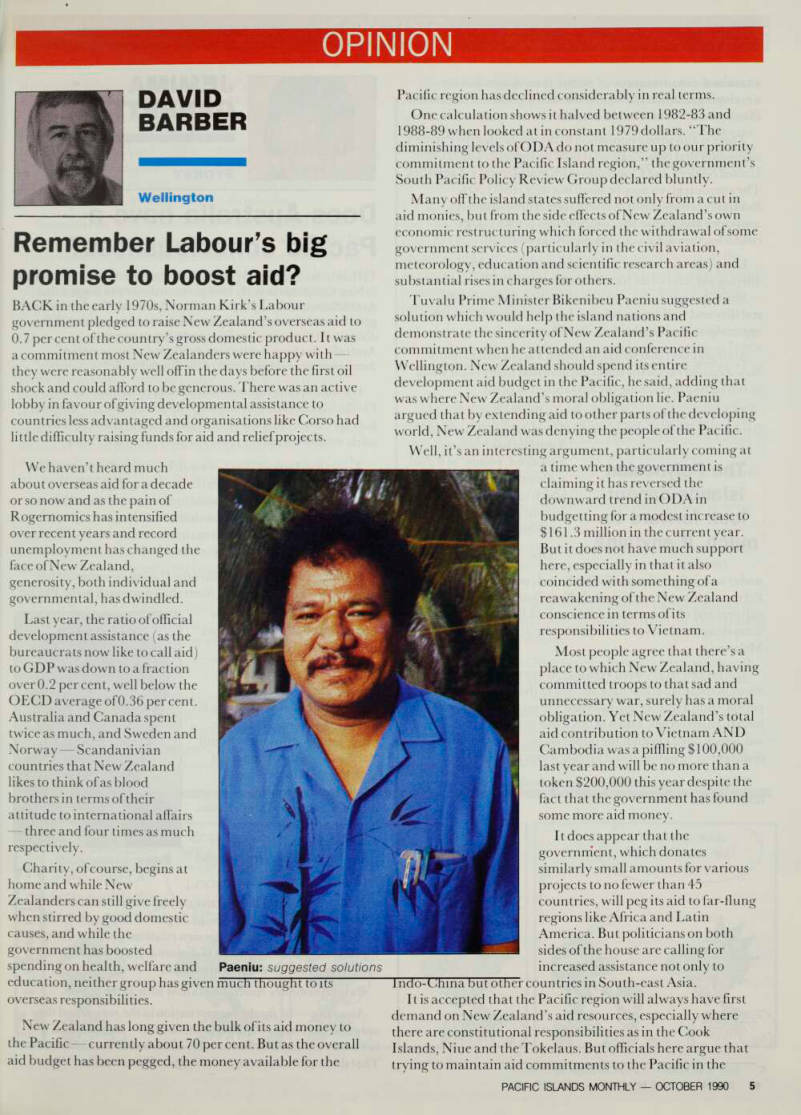
Tuvalu Prime Minister Bikenibeu Paeniu suggested a solution which would help the island nations and demonstrate the sincerity of New Zealand’s Pacific commitment when he attended an aid conference in Wellington. New Zealand should spend its entire development aid budget in the Pacific, he said, adding that was where New Zealand’s moral obligation lie. Paeniu argued that by extending aid to other parts of the developing world, New Zealand was denying the people of the Pacific.
Well, it’s an interesting argument, particularly coming at
a time when the government is claiming it has reversed the downward trend in ODA in budgetting for a modest increase to $161.3 million in the current year.
But it does not have much support here, especially in that it also coincided with something of a reawakening of the New Zealand conscience in terms of its responsibilities to Vietnam.
Most people agree that there’s a place to which New Zealand, having committed troops to that sad and unnecessary war, surely has a moral obligation. Yet New Zealand’s total aid contribution to Vietnam AND Cambodia was a piffling $ 100,000 last year and will be no more than a token $200,000 this year despite the fact that the government has found some more aid money.
It does appear that the government, which donates similarly small amounts for various projects to no fewer than 45 countries, will peg its aid to far-flung regions like Africa and Latin America. But politicians on both sides of the house are calling for increased assistance not only to
lndo-(Jhma but other countries in South-east Asia.
It is accepted that the Pacific region will always have first demand on New Zealand’s aid resources, especially where there are constitutional responsibilities as in the Cook Islands, Niue and the Tokelaus. But officials here argue that trying to maintain aid commitments to the Pacific in the
David
Barber
Wellington
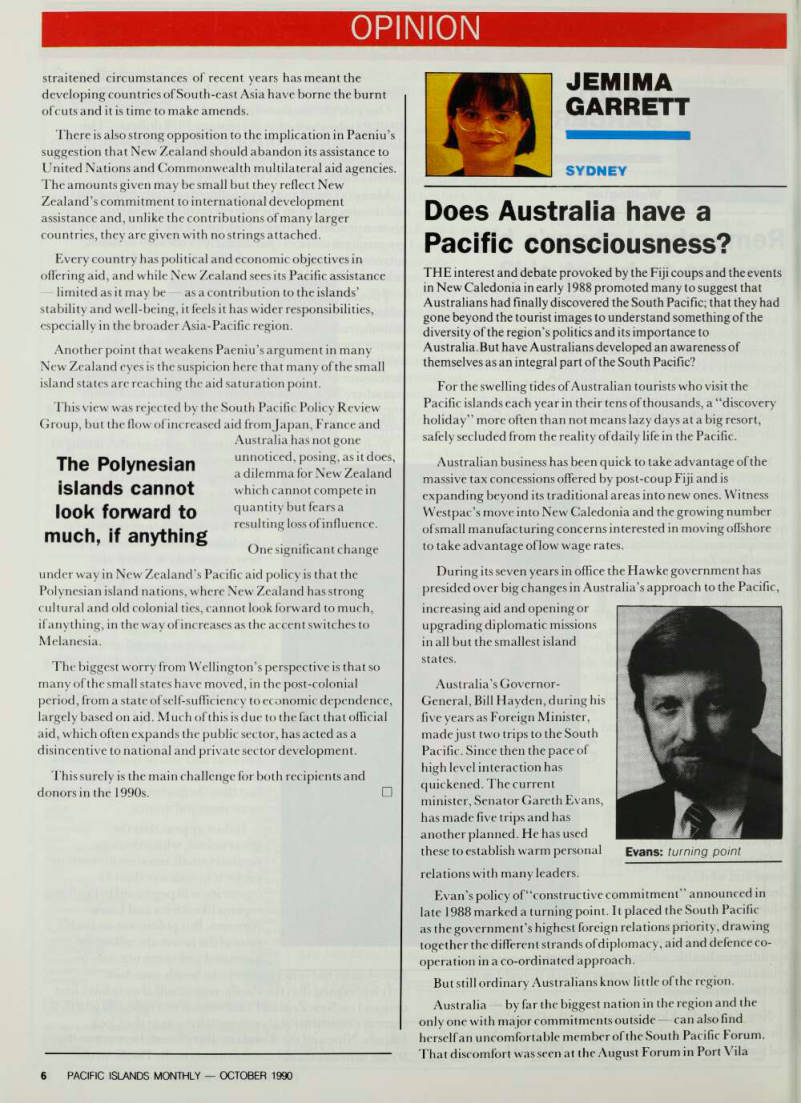
Paeniu: suggested solutions
straitened circumstances of recent years has meant the developing countries of South-east Asia have borne the burnt ofeuts and it is time to make amends.
There is also strong opposition to the implication in Paeniu’s suggestion that New Zealand should abandon its assistance to United Nations and Commonwealth multilateral aid agencies.
The amounts given may be small but they reflect New Zealand’s commitment to international development assistance and, unlike the contributions of many larger countries, they are given with no strings attached.
Every country has political and economic objectives in offering aid, and while New Zealand sees its Pacific assistance limited as it may be as a contribution to the islands’ stability and well-being, it feels it has wider responsibilities, especially in the broader Asia-Pacific region.
Another point that weakens Paeniu’s argument in many New Zealand eyes is the suspicion here that many of the small island states are reaching the aid saturation point.
This view was rejected by the South Pacific Policy Review Group, but the flow ofincreased aid fromjapan, France and
The Polynesian islands cannot look forward to much, if anything
Australia has not gone unnoticed, posing, as it does, a dilemma for New Zealand which cannot compete in quantity but fears a resulting loss ofinfluence.
One significant change
under way in New Zealand’s Pacific aid policy is that the Polynesian island nations, where New Zealand has strong cultural and old colonial ties, cannot look forward to much, ifanything, in the way ofincreases as the accent switches to Melanesia.
The biggest worry from Wellington’s perspective is that so many of the small states have moved, in the post-colonial period, from a state ofself-sufFiciency to economic dependence, largely based on aid. Much of this is due to the fact that official aid, which often expands the public sector, has acted as a disincentive to national and private sector development.
This surely is the main challenge for both recipients and donors in the 19905. □
Pacific consciousness?
Does Australia have a Pacific consciousness?
THE interest and debate provoked by the Fiji coups and the events in New Caledonia in early 1988 promoted many to suggest that Australians had finally discovered the South Pacific; that they had gone beyond the tourist images to understand something of the diversity of the region’s politics and its importance to Australia. But have Australians developed an awareness of themselves as an integral part of the South Pacific?
For the swelling tides of Australian tourists who visit the Pacific islands each year in their tens of thousands, a “discovery holiday” more often than not means lazy days at a big resort, safely secluded from the reality ofdaily life in the Pacific.
Australian business has been quick to take advantage of the massive tax concessions offered by post-coup Fiji and is expanding beyond its traditional areas into new ones. Witness Westpac’s move into New Caledonia and the growing number ofsmall manufacturing concerns interested in moving offshore to take advantage oflow wage rates.
During its seven years in office the Hawke government has presided over big changes in Australia’s approach to the Pacific,
increasing aid and opening or
upgrading diplomatic missions
in all but the smallest island states.
Australia’s Governor- General, Bill Hayden, during his five years as Foreign Minister, made just two trips to the South Pacific. Since then the pace of high level interaction has quickened. The current minister, Senator Gareth Evans, has made five trips and has another planned. He has used these to establish warm personal relations with many leaders.
Evan’s policy of“constructive commitment” announced in late 1988 marked a turning point. It placed the South Pacific as the government’s highest foreign relations priority, drawing together the different strands ofdiplomacy, aid and defence co operation in a co-ordinated approach.
But still ordinary Australians know little of the region.
Australia by far the biggest nation in the region and the only one with major commitments outside can also find herself an uncomfortable member of the South Pacific Forum.
That discomfort was seen at the August Forum in Port Vila
Jemima
Garrett
Sydney
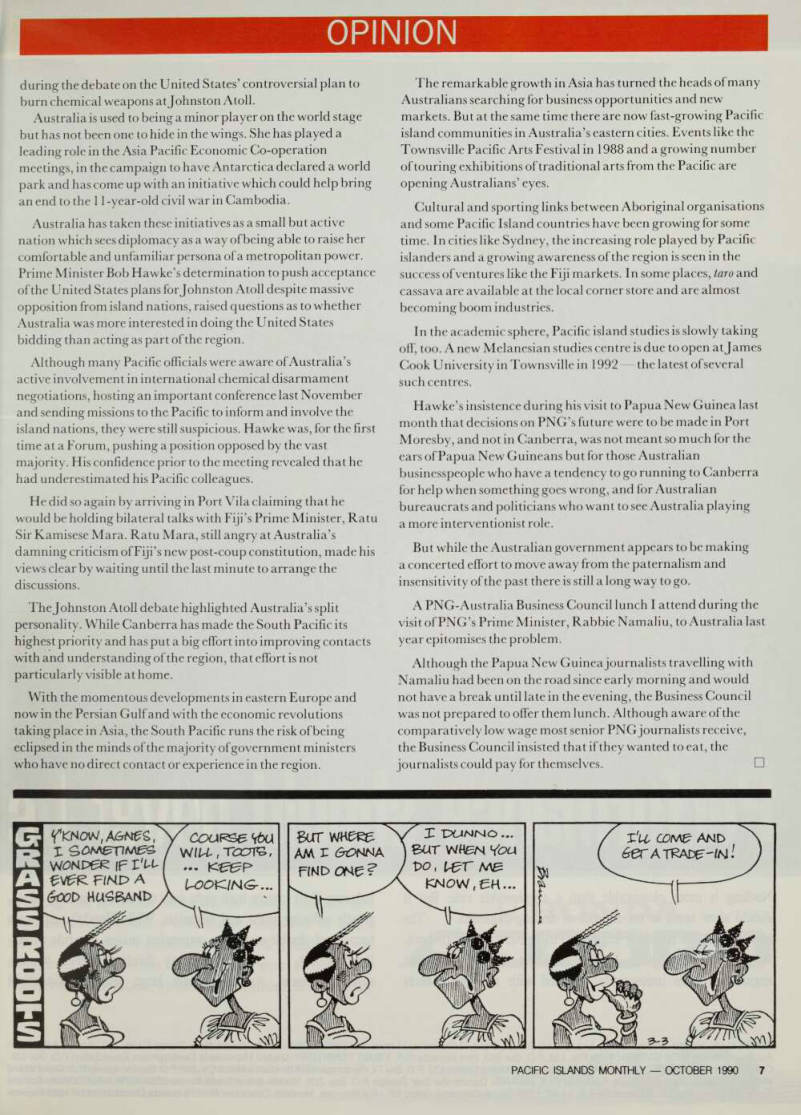
Evans: turning point
during the debate on the United States’ controversial plan to burn chemical weapons at Johnston Atoll.
Australia is used to being a minor player on the world stage but has not been one to hide in the wings. She has played a leading role in the Asia Pacific Economic Co-operation meetings, in the campaign to have Antarctica declared a world park and has come up with an initiative which could help bring an end to the 11 -year-old civil war in Cambodia.
Australia has taken these initiatives as a small but active nation which sees diplomacy as a way of being able to raise her comfortable and unfamiliar persona of a metropolitan power.
Prime Minister Bob Hawke’s determination to push acceptance of the United States plans for Johnston Atoll despite massive opposition from island nations, raised questions as to whether Australia was more interested in doing the United States bidding than acting as part of the region.
Although many Pacific officials were aware of Australia’s active involvement in international chemical disarmament negotiations, hosting an important conference last November and sending missions to the Pacific to inform and involve the island nations, they were still suspicious. Hawke was, for the first time at a Forum, pushing a position opposed by the vast majority. His confidence prior to the meeting revealed that he had underestimated his Pacific colleagues.
He did so again by arriving in Port Vila claiming that he would be holding bilateral talks with Fiji’s Prime Minister, Ratu Sir Kamisese Mara. Ratu Mara, still angry at Australia’s damning criticism of Fiji’s new post-coup constitution, made his views clear by waiting until the last minute to arrange the discussions.
Thejohnston Atoll debate highlighted Australia’s split personality. While Canberra has made the South Pacific its highest priority and has put a big effort into improving contacts with and understanding of the region, that effort is not particularly visible at home.
With the momentous developments in eastern Europe and nowin the Persian Gulf and with the economic revolutions taking place in Asia, the South Pacific runs the risk of being eclipsed in the minds of the majority of government ministers who have no direct contact or experience in the region.
The remarkable growth in Asia has turned the heads of many Australians searching for business opportunities and new markets. But at the same time there are now fast-growing Pacific island communities in Australia’s eastern cities. Events like the Townsville Pacific Arts Festival in 1988 and a growing number of touring exhibitions of traditional arts from the Pacific are opening Australians’ eyes.
Cultural and sporting links between Aboriginal organisations and some Pacific Island countries have been growing for some time. In cities like Sydney, the increasing role played by Pacific islanders and a growing awareness of the region is seen in the success of ventures like the Fiji markets. In some places, taro and cassava are available at the local corner store and are almost becoming boom industries.
In the academic sphere, Pacific island studies is slowly taking off, too. A new Melanesian studies centre is due to open at James Cook University in Townsville in 1992 the latest of several such centres.
Hawke’s insistence during his visit to Papua New Guinea last month that decisions on PNG’s future were to be made in Port Moresby, and not in Canberra, was not meant so much for the ears of Papua New Guineans but for those Australian businesspeople who have a tendency to go running to Canberra for help when something goes wrong, and for Australian bureaucrats and politicians who want to see Australia playing a more interventionist role.
But while the Australian government appears to be making a concerted effort to move away from the paternalism and insensitivity of the past there is still a long way to go.
A PNG-Australia Business Council lunch I attend during the visit of PNG’s Prime Minister, Rabbie Namaliu, to Australia last year epitomises the problem.
Although the Papua New Guinea journalists travelling with Namaliu had been on the road since early morning and would not have a break until late in the evening, the Business Council was not prepared to offer them lunch. Although aware of the comparatively low wage most senior PNG journalists receive, the Business Council insisted that if they wanted to eat, the journalists could pay for themselves. □
Advertisements & other items, pp. 8-9 (1 item)
Nothing is more pleasurable than a comfortable ride. But it
should never come at the expense of driving dynamics. The new Accord 2.0/ is quietly engineered to deliver the best of both.
Its powerfully efficient 16-valve, 2.0-liter PGM-FI-equipped engine has been innovatively designed with the new Honda balancer shaft system built right into the aluminum alloy block, greatly reducing noise and vibration. While Honda’s responsive four-wheel double-wishbone suspension makes the ride powerfully smooth. So the elegantly finished interior remains spaciously quiet, its distinctively large, slanting windshield AUSTRALIA: Honda Australia Pty., Ltd. Lot 95 Sharps Road, Tullamarine, Victoria 3043/NEW ZEALAND; Honda New Zealand Ltd. P.O. Box 97-340, South Auckland/PAPUA NEW GUINEA: Toba Pty., Ltd. P.O. Box 503, Port Moresby/U.S. TRUST TERRITORY: United Micronesia Development Association P.O. Box 235, CHRB Saipan CM 96950/COOK ISLANDS: Cook Islands Motor Centre Ltd. P.O. Box 74, Rarotonga/GUAM: Mark’s Motor Co., Inc. P.O. Box DV, Agana/FIJI: Coral Island Motors Ltd. P.O. Box 12052 Suva Fiji/NORFOLK ISLAND: Duncombe Bay Garage P.O. Box 220, Norfolk Island South Pacific 2899/NEW CALEDONIA: Societe Generale D’lmportation Automobile S.A. 11 RT 1 BIS Ducos-Complexe Delco BP 1464-Noumea, Nondelle-Caledonie/TAHITI: Honda Distribution 8P1665 Papeete
m mm fei/- '*/& k'ivsi ?^->r I—■ - ;
&0mf*Sm
l f w \ r .A fV *i*.A enhancing that open-road feeling. As the flowing contours of a tough exterior composed of 90% anti-corrosion steel by weight and the glistening wraparound headlights round out the refinement. Yet, all this elegance doesn’t mean driving will be boring. For on the Accord, dynamic performance is never a luxury.
H) In 1989, Honda engines powered the HONDA Marlboro McLaren team to victory in the Formula One Constructors' Championships. This is the fourth consecutive year that Honda has won this honor.
Moruroa
Cover Stories
Moruroa timebomb
A new study
challenges French
claims and predicts early disaster at the nuclear test site
By David Robie
FIVE, Four, Three, Two, One! The earth shudders. A column of white water bursts from the horizon, rising almost 70 metres into a cloudless blue sky; the sea boils.
ItisdawnonJune2l,l9B7, and French marine biologist Jacques Cousteau’s ship Calypso rests 40 miles offshore from Moruroa Atoll in the Tuamotus. And this is how the Cousteau Society’s magazine, Calypso Log , described the detonation of a nuclear test witnessed by the Calypso team.
Although Cousteau’s official report highlighted extensive damage to the coral of the atoll, including fissures down to a depth of 230 metres, it concluded that “at least for the near future, the tests pose no
danger to Polynesian populations”.
The French government endorsed the report and used the results to vindicate its own assurances that the underground tests were safe. But now a new scientific report had seriously challenged the claims from Paris. It reveals that radioactive waste leaking from the atoll could take less than six years after each test to reach the open sea.
The report, a fresh evaluation of the Calypso water samples prepared by Ame rican scientist Norm Buske for Search Technical Services, an independent en vironmental lobby group, was released last month and prompted widespread response in the Pacific. It urged the French government to allow independent investigators to examine the atoll
thoroughly and to resolve the controversy New Zealand’s Disarmament Minister Fran Wilde promptly called for a study off the Search report while France rejected the finding as “false infor mation”, France’s Suva-based Ambassa dor to the South Pacific, Henri Jacolin, described the nuclear testing programme as environmentally safe. Unconvincced, the 15-nation South Pacific Forum urged the French government to halt nuclear testing at Moruroa.
Greenpeace nuclear tests campaigner Stephanie Mills said her organisation would lobby a United Nations meeting on nuclear testing in January in a bid to get an underground test ban. She called on New Zealand and other Pacific nations to also lobby for a complete ban.
“The burden of proof now rests clearly with the French,” she added, “France must now stop testing immediately and provide full access for an independent and comprehensive study to determine the extent of the environmental problems at Moruroa and Fangataufa.”
According to the influential British magazine New Scientist , Buske’s alle gations cast doubt on the repeated claims by France that contaminated debris from its Pacific tests do not leak into the ocean.
“The new allegations are a cause for concern,” it added, “because in addition to being radioactive, many of the prod ucts of nuclear explosions are poisonous and do not decay for thousands of years.”
Following the 44 atmospheric nuclear tests, more than 120 underground tests
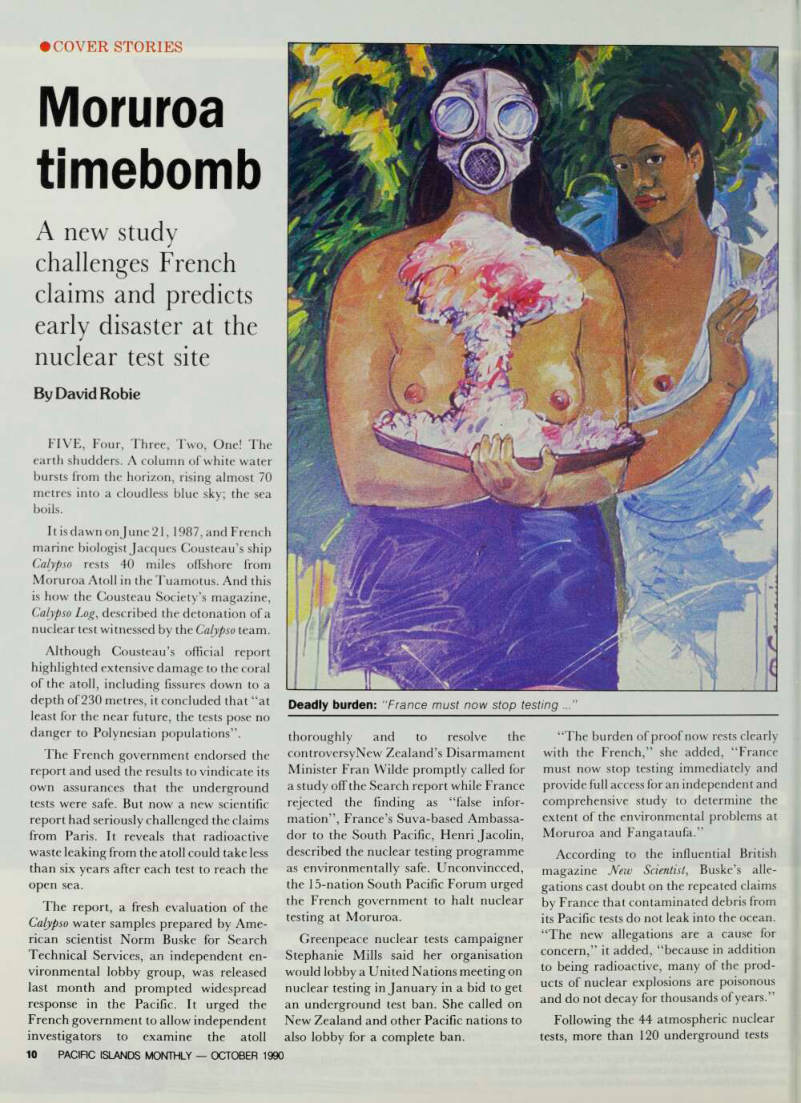
Deadly burden: "France must now stop testing ...”
have been detonated on Moruroa atoll.
The total yield of these tests have been approximately 2500 kilotons the equivalent of more than 200 Hiroshima bombs.
This year there have been four nuclear tests, with two further ones planned.
There have been three at Moruroa and one at Fangataufa.
When Cousteau visited Moruroa in the Calypso during 1987 he collected water samples from the lagoon. However, the French Defence Ministry limited Cousteau to two days for sampling and restricted his sampling zones. While some of Cousteau’s samples were contaminated with radioactive isotopes, French authorities insisted they came from atmospheric tests which began in 1966 and ceased in 1974.
Buske was a scientist on board Eitanin, a ship conducting a hydrographic survey in the South Pacific which was dusted with fallout from Moruroa test in July 1967. He focused much of his analysis on two of Cousteau’s water samples which contained the radioactive isotope caesium -134.
He argues that the only possible source of this isotope was leakage from under ground tests. Caesium-134 has a half-life of just two years so any atmospheric fallout would have decayed by the time Cousteau took samples. Only two out of the samples collected by Cousteau con tained the isotope. Buske believes the isotopes leaked from a 15-kiloton ex plosion in December 1981.
Although another radioactive isotope,
caesium-137, was also present in the samples, this could have been produced by earlier tests because it has a half-life of 30 years.
Other scientists than Buske have also alleged that radioactive leakage from the atoll is far faster than the French claim.
For example, New Zealand’s Professor Manfred Hochstein, diector of the Auckland University Geothermal Insti tute, recently claimed that leakage could come to the surface in about 30 years. He has also used Cousteau data as well as a computer “reservoir model” of the atoll which the institute has developed.
Before reaction to the Buske report quietened, the international environment group Greenpeace fuelled the controversy by publishing a book called Testimonies a 72-page publication recording inter views with people who have worked at Moruroa and Fangataufa atolls, or live on islands near the nuclear testing zone. It describes the impact of the nuclear test
programme on their lives, and the lives of their families and friends.
The interviews were made in secret during 1987 by Dr Andy Biedermann, a Swiss doctor and crew member of the Greenpeace campaign ship Rainbow War
people were so sick, they had to be taken out’
rior which was bombed by French agents in May 1985. He made two trips
to Polynesia, visiting Tahiti and some of the outer islands. Authorities expelled Biedermann from the territory at the end of his stay for alleged “interference” in French defence affairs.
Among many incidents, the book tells of an accident on Moruroa on July 6, 1979 the day before the scheduled test of France’s first neutron bomb (see box). A decontamination worker, identified only as ‘Tama’, said; “My colleague was flung out of the control room just in front of me
dying instantly.”
His French boss, Rene Villette, was killed inside the bunker and two others later died of their injuries. Plutonium and other radioactive substances were said to have scattered and cement was poured
over the bomb container.
While French authorities have con firmed two deaths in the accident, they have consistently claimed no radioac tivity was involved. A statement by the France’s Atomic Energy Commission (CEA) at the time said the explosion was caused when acetone fumes ignited dur ing a cleaning operation.
However, the Paris daily Le Matin also reported that the accident was the result of an explosion during a detonation experiment.
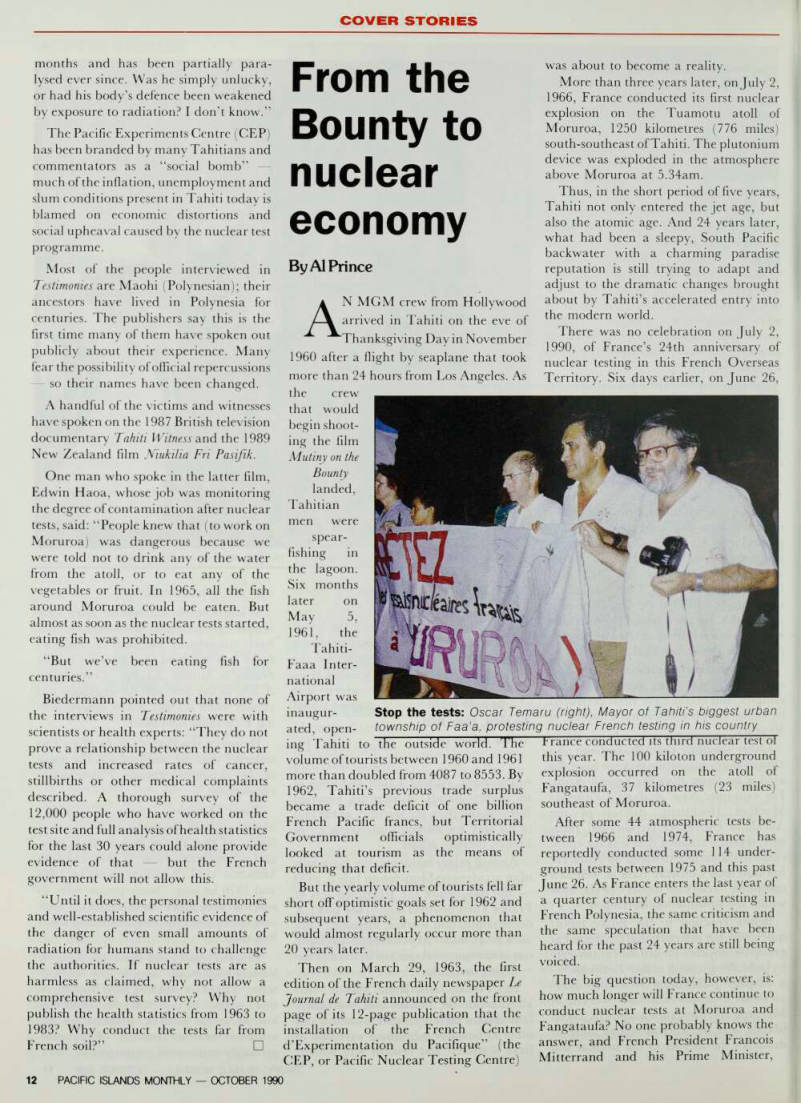
Oscar Temaru, mayor of Tahiti’s biggest urban township of Faa’a and leader of the Tavini Huiraatira party, said a “psychosis of fear” had spread over Moruroa atoll. Recalling visits in 1969 and 1970 he said: “Some people were so sick that they had to be taken off the atoll and later people heard that some of them had died.
Temaru’s party and Protestant church leaders vigorously oppose the nuclear tests. “I have six children aged from three to 15 years,” he said. “My first child was lost at seven months, stillborn for no apparent reason. Another of my sons probably contracted meningitis at six
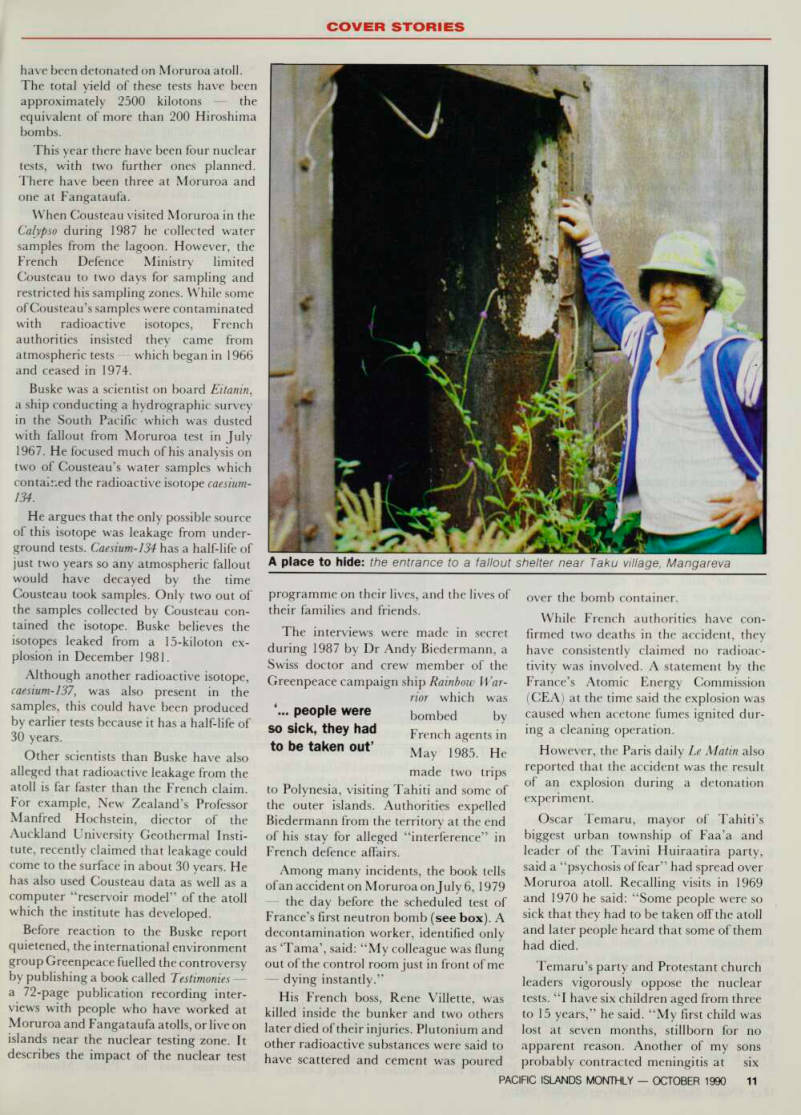
A place to hide: the entrance to a fallout shelter near Taku village, Mangareva
months and has been partially para lysed ever since. Was he simply unlucky, or had his body’s defence been weakened by exposure to radiation? I don’t know.”
The Pacific Experiments Centre (CEP) has been branded by many Tahitians and commentators as a “social bomb” much of the inflation, unemployment and slum conditions present in Tahiti today is blamed on economic distortions and social upheaval caused by the nuclear test programme.
Most of the people interviewed in Testimonies are Maohi (Polynesian); their ancestors have lived in Polynesia for centuries. The publishers say this is the first time many of them have spoken out
publicly about their experience. Many
fear the possibility of official repercussions so their names have been changed.
A handful of the victims and witnesses have spoken on the 1987 British television documentary Tahiti Witness and the 1989 New Zealand film Niukilia Fri Pasifik.
One man who spoke in the latter film, Edwin Haoa, whose job was monitoring the degree of contamination after nuclear tests, said: “People knew that (to work on Moruroa) was dangerous because we were told not to drink any of the water from the atoll, or to eat any of the vegetables or fruit. In 1965, all the fish around Moruroa could be eaten. But almost as soon as the nuclear tests started,
eating fish was prohibited.
“But we’ve been eating fish for centuries.”
Biedermann pointed out that none of the interviews in Testimonies were with scientists or health experts; “They do not prove a relationship between the nuclear tests and increased rates of cancer, stillbirths or other medical complaints described. A thorough survey of the 12,000 people who have worked on the test site and full analysis of health statistics for the last 30 years could alone provide evidence of that but the French government will not allow this.
“Until it does, the personal testimonies and well-established scientific evidence of the danger of even small amounts of radiation for humans stand to challenge the authorities. If nuclear tests are as harmless as claimed, why not allow a
comprehensive test survey? Why not
publish the health statistics from 1963 to 1983? Why conduct the tests far from French soil?” □
Bounty to
From the Bounty to nuclear economy
By Al Prince
AN MGM crew from Hollywood arrived in Tahiti on the eve of Thanksgiving Day in November 1960 after a flight by seaplane that took more than 24 hours from Los Angeles. As
the crew that would
begin shoot
ing the film Mutiny on the Bounty landed, Tahitian men were spear
fishing in
the lagoon.
Six months later on May 5, 1961, the Tahiti- Faaa Inter national
Airport was
inaugur ated, open
ing Tahiti to the outside world. The volume of tourists between 1960 and 1961 more than doubled from 4087 to 8553. By 1962, Tahiti’s previous trade surplus became a trade deficit of one billion French Pacific francs, but Territorial Government officials optimistically looked at tourism as the means of reducing that deficit.
But the yearly volume of tourists fell far short off optimistic goals set for 1962 and subsequent years, a phenomenon that would almost regularly occur more than 20 years later.
Then on March 29, 1963, the first edition of the French daily newspaper Le Journal de Tahiti announced on the front page of its 12-page publication that the installation of the French Centre
d’Experimentation du Pacifique” (the
CEP, or Pacific Nuclear Testing Centre)
was about to become a reality.
More than three years later, on July 2, 1966, France conducted its first nuclear explosion on the Tuamotu atoll of Moruroa, 1250 kilometres (776 miles) south-southeast of Tahiti. The plutonium device was exploded in the atmosphere above Moruroa at 5.34 am.
Thus, in the short period of five years, Tahiti not only entered the jet age, but also the atomic age. And 24 years later, what had been a sleepy, South Pacific backwater with a charming paradise reputation is still trying to adapt and adjust to the dramatic changes brought about by Tahiti’s accelerated entry into the modern world.
There was no celebration on July 2, 1990, of France’s 24th anniversary of nuclear testing in this French Overseas Territory. Six days earlier, on June 26,
t rance conducted its third nuclear test ol this year. The 100 kiloton underground explosion occurred on the atoll of
Fangataufa, 37 kilometres (23 miles)
southeast of Moruroa.
After some 44 atmospheric tests be tween 1966 and 1974, France has reportedly conducted some 114 under ground tests between 1975 and this past June 26. As France enters the last year of a quarter century of nuclear testing in French Polynesia, the same criticism and the same speculation that have been heard for the past 24 years are still being voiced.
The big question today, however, is: how much longer will France continue to conduct nuclear tests at Moruroa and Fangataufa? No one probably knows the answer, and French President Francois Mitterrand and his Prime Minister,
Stop the tests: Oscar Temaru (right), Mayor of Tahiti's biggest urban township of Faa’a, protesting nuclear French testing in his country
Michel Rocard have not supplied any.
The closest they came to supplying an answer was the announcement France would reduce the number of yearly tests this year from eight to six. That means three more tests are expected to be conducted this year.
But for the countries of the Pacific, six tests a year are six too many. Those countries have spent most of recent time voicing strong objections to France’s nuclear testing in the South Pacific.
However, with the United States and the Soviet Union headed toward increased nuclear and military disarmament, much world press opinion believe in the possi bility of France shutting down its nuclear testing operations in French Polynesia.
The weekly British news magazine The Economist reported in its May 19 edition: “Even the French are worried that Moruroa is in danger of being shaken to
bits, and may use the excuse of the peace dividend to end
testing there.”
The July 2 international edition of TIME magazine reported: “In the new Europe a cornerstone of Gaullism, namely France’s
independent nuclear
defense policy, may have to be modified as a result of disarmament nego tiations.” But as The Econ omist also noted “only the Polynesians would be sad to see Muroroa closed down; construction work at the testing site has given work to thousands of islanders.”
But those construction jobs are only the tip of a very huge iceberg that represents not only France’s involvement in French Polynesia but the complete change in lifestyle that has occurred during the past 24 years.
While predominantly Angol-Saxon in dependent island governments in the South Pacific struggle daily to survive as basic Third World states, Tahiti and the rest of French Polynesia have been converted into a French boutique of the modern way of life. As The Economist article noted: “Visitors are often surprised by Tahiti; not because it is paradise, but because it isn’t. The capital, Papeete, has a parking problem, and prices seem
outrageously high. But France loves it, even though last year (a typical one) it had to meet French Polynesia’s trade deficit of $753m. You cannot put a price
Nuclear testing has put Tahiti on the world map
on myth, or on la gloire of keeping the Tricolour fly ing among the palms.”
Officially,
the French State spent 59.427 billion French Pacific francs (about U 55574.27 million) in French Polynesia last year.
That covers all military and civilian expenses.
Even a superficial look around Tahiti does not fail to detect the overwhelming influence of the French State over the past 24 years.
The port of Papeete, the city’s Fare Ute
industrial zone, fTTe Motu CJta port" facilities, the Post Office, the government French State as well as Territorial buildings, the cars, the four-wheel drive vehicles, the two colour television stations, the restaurants, the boutiques, the traffic jams, the pollution, the false economy, the Territorial Government and French State subsidies, etc, etc., are all the direct or indirect result of France’s 24 years of nuclear testing in this part of the world.
Most observers agree that without those nuclear tests, Tahiti would prob ably have remained a sleepy South Pacific Paradise with a Third World economy.
But the 24-year history of French nuclear testing has put Tahiti on the world map
and brought rapid progress and change
that many of its residents are still trying to cope with, and not always successfully.
Those 24 years are also a rich history in terms of events. Who can forget the many protests against those nuclear tests over the years?
Who can forget the Radio New Zea land interviews in the early 1970 s with the crew members of a New Zealand Govern ment frigate planning a protest voyage to the Moruroa test site area? The families of those crew members where certain that their loved ones risked being contami nated with radioactivity from a French
atmospheric test.
Who can forget the United Nations debates over the French tests? Or the protests and independence threats in Tahiti directly linked to those tests?
Who can forget the Rainbow Warrior , the Greenpeace ship that was sunk in
Auckland Harbour in 1985 by two French secret service agents who planted two ex plosives aboard the vessel just before it was to make a protest voy age to the Moruroa area?
The list goes on and on, just like the nuclear tests.
Meanwhile, French officials, the French and non-French news media continue to
incorrectly identify the
major testing site as ‘Mururoa,’ instead of using its correct name, ‘Moruroa,’ which in the local language means ‘Big Secret.’
And the lid to some of the secrets surrounding those tests have been lifted.
The biggest attempt to break down the barriers was made last year with the first round-table discussion of all aspects of the tests.
The talks were organised by French Government and military officials for representatives from the Territorial Government, the Church, the political parties, the human rights organisation and the union in Tahiti. But removing the barriers only isn’t enough. What most in the Pacific want is for the test to stop. The big question is: what happens to Tahiti when it does? □
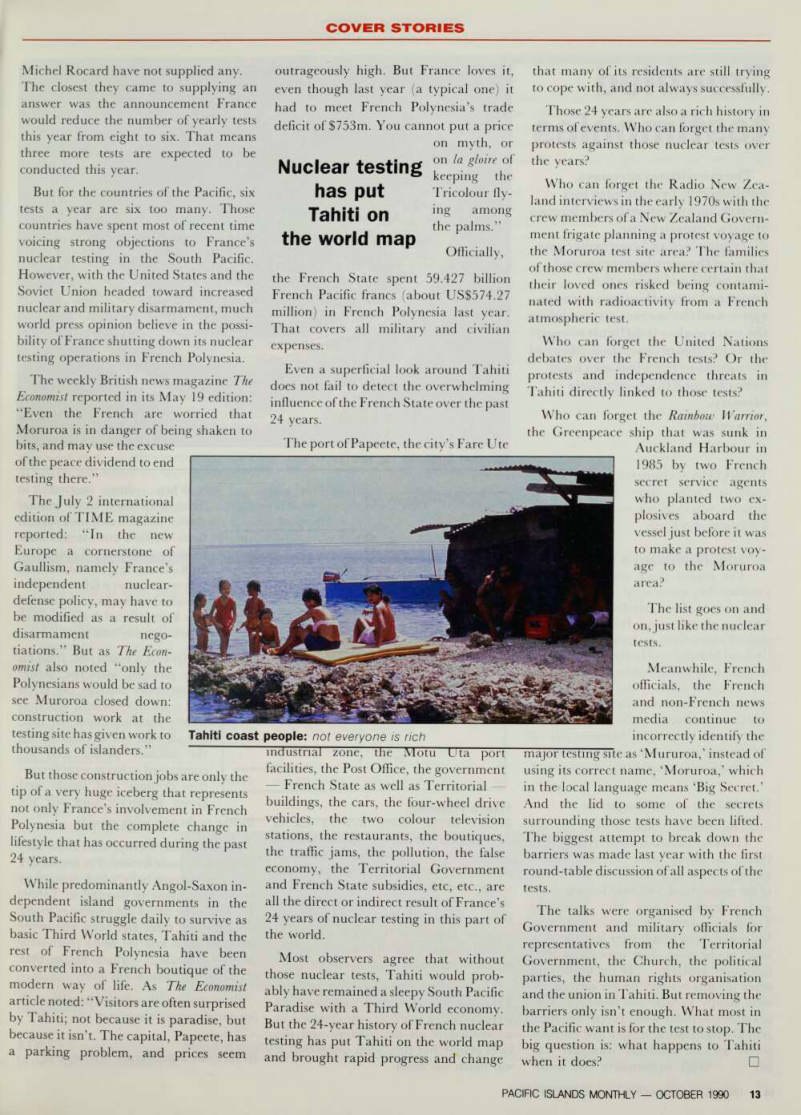
Tahiti coast people: not everyone is rich
Troubled
testimonies
The eye witness accounts, published in Testimonies last month, like most authentic human stories, contain some discrepancies and contradictions.
Some of the people interviewed were talking of events that happened more than two decades ago and the secrecy surrounding the tests makes it difficult to verify some incidents described. Many of the names of the witnesses have been changed to protect their
identity.
Excerpts:
TAMATOA was interviewed in an air craft en route from Mangareva to Papeete, where his son was going to have a medical check-up: * I don’t want to give my name because I’m scared there might be reper cussions. My son is eight. He is the jewel of my life . . . He is handicapped, I think because of the testing. Before the testing started there were no handicapped chil dren on Mangareva. In the beginning the nuclear tests brought money but now all they bring is illness. I am a farmer, I’ve seen how the animals also seem to be sick now, and the banana trees no longer bear their usual crop. The bananas fall off before they ripen. I’m against the tests . . . I think they should stop them now. 5 HINANO lives on Mangareva: CThe military first arrived in the Gambier islands in 1963. About 20 of them, including some French legion naires, settled in Taku, at the north end of the main island, and built houses, roads and a bunker. Later, they moved to Totegegie, where the airstrip was built.
More and more people were brought here until, at one stage, there were about 1000 foreigners working ... In the beginning, when the first military people arrived, we were happy to welcome them. We had never seen so many white people and their arrival meant work, money and cheaper goods because suddenly transport was free . . . With legionnaires and locals
getting drunk, there were a To! of fights. Before the testing started, a lot of VIPs came to the islands scientists, admirals, generals and the professor who constructed the bomb. They . . . talked to the people, telling us not to worry, that there were no problems . , . Most people were so impressed by these important visitors that they believed everything they said and they didn’t ask questions.
The bunker that had been built in Taku was very impressive, with walls and a roof a metre thick. It was designed to accommodate all the military and the local people but they soon discovered it was much too small.
When they moved to Totegegie, they built another shelter but it was quite different from the first one. It was built from tin and a sort of plastic . . .
In Rikitea, a large inflatable tent was set to use as a fallout shelter.
It looked rather like a turtle and was kept inflated by generators which ran day and night . . . (During a bomb test) fresh air was pumped into the shelter continuously through big filters and a sprinkler system was con stantly washing down the roof.
We all wore our day clothes but the military people who ac companied us has to wear protec tive clothing and masks and gloves whenever they left the
shelter to do any work outside . . .
Looking back, I’m appalled at the way in which we were treated. For instance, I had a premature baby which was taken by military plane to hospital in Tahiti.
The following day, I got a message to say the baby had died. Her body was never returned to us and we never received a death certificate which means that officially the baby is still alive.
Even now, years after it happened, I have nightmares about it. 5 ROLAND, a gendarme, was sent to
French Polynesia
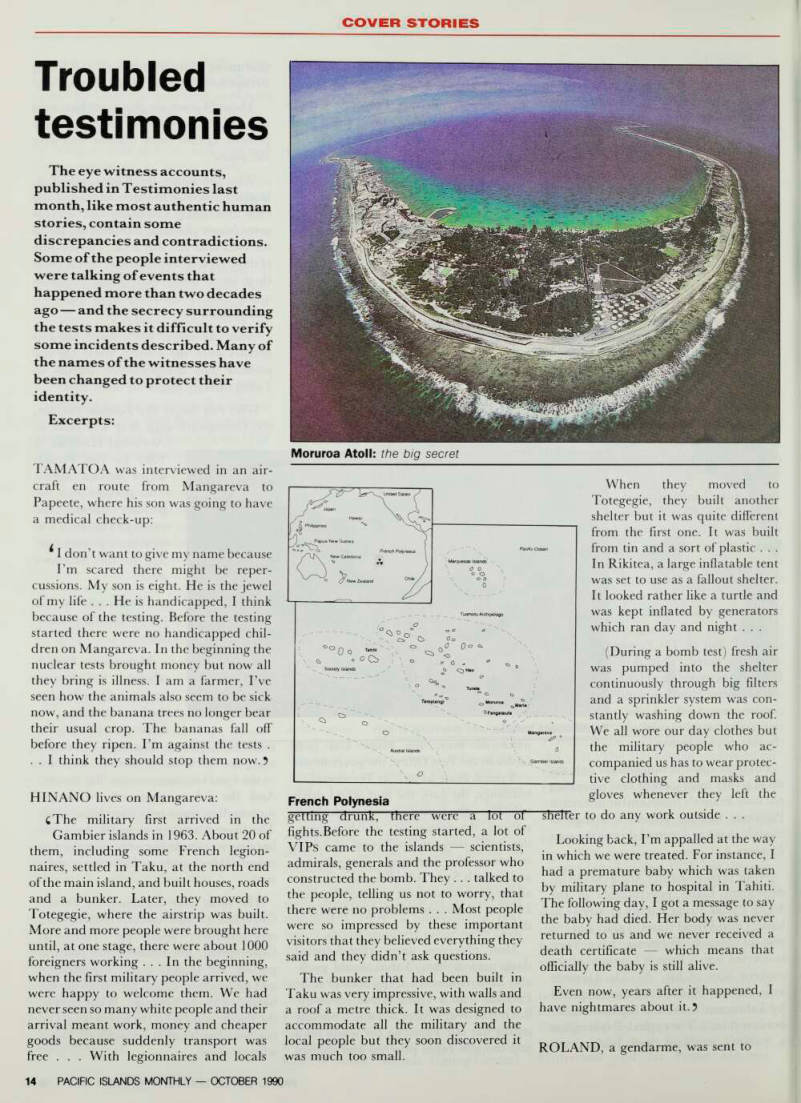
Moruroa Atoll: the big secret
Mangareva in 1963 and stayed there until 1968: C When I was offered the posting, I was promised a beautiful island, nice people and no problems. However the situation had changed with the arrival of the legionnaires. They had become the kings of the islands because they had money and alcohol. They got women by getting husbands or fathers drunk, or by buying them off.
Some of the local men had gone to work
on Moruroa, which made it “easier” for the legion naires. Fighting and the molestation of young girls were major problems. But no legal action was ever taken, either because people struck private deals or were too afraid to speak out . . .
In a single year, alcohol consumption increased by five times on
Mangareva.s
ROBERT has been living in the Gambier Islands for
the past seven years: Cl’ve heard of stillborn and premature births on the island and I know of three families with retarded children. The youngest of these children is about five or six and the oldest is about 12 or 14-years old and has epileptic fits. All the handi capped children on the island were born after the testing started . . .
Soon after the tests began, the women were sent to Tahiti to give birth. The reason given is for this was that suppos-
edly the facilities on Mangareva were not set up to handle births. This is nonsense because (before then) there were no infirmary at all and everybody gave birth at home as they had always done . . .
The fact that there were no facilities was just an excuse used so that if anything went wrong they could hush it up in the hospital in Tahiti. I can’t pin people down on the exact date the evacuations of women started. It was probably one or two years after the test started. 5
PHILIPPE worked on Murorua and Fangataufa from 1971 to 1985: C We often had to work near the prohibited zones (on Moruroa) when they were preparing for the under ground tests. Some parts of the atoll were still totally burnt out from the atmospheric testing 10 years before. Now mikimiki, a small, bushy plant, is growing in some places and the French have planted a lot of pine trees, but no
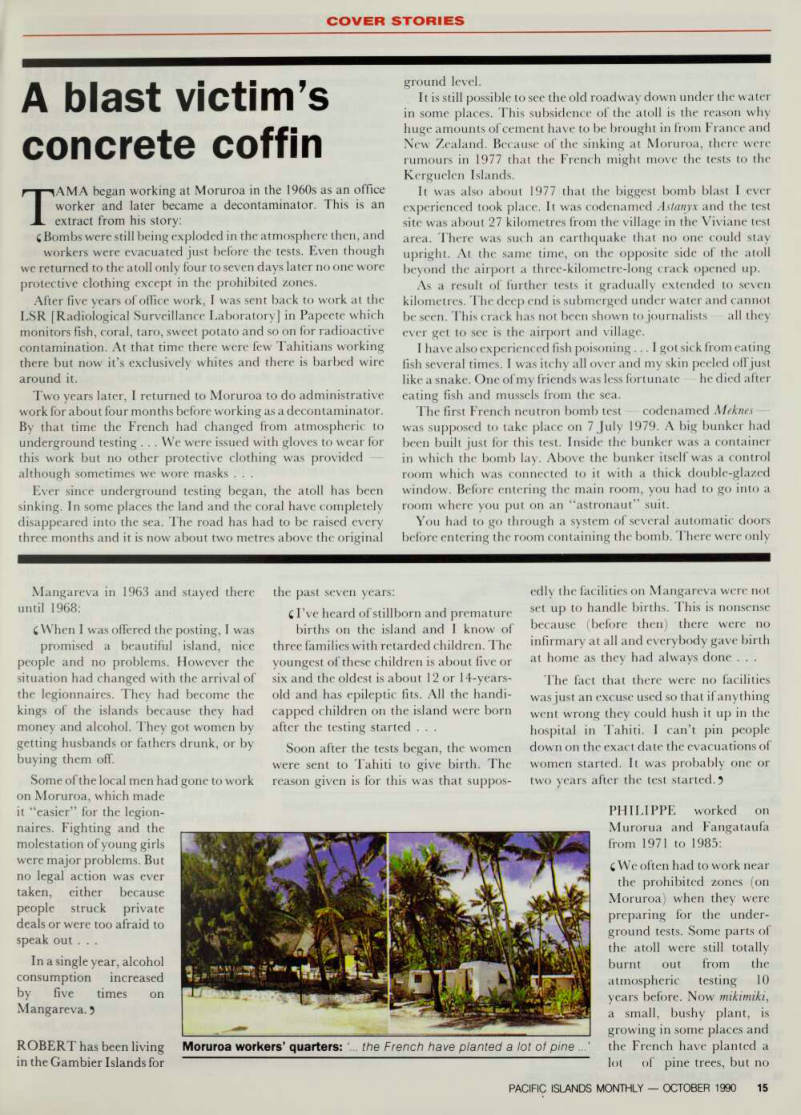
Moruroa workers’ quarters: '.. the French have planted a lot of pine...'
coconut trees seem to grow there anymore. Since the tests went under ground there are fissures all over the place. I’m sure these fissures prove that the tests are dangerous, but no one warns the workers of this when they first arrived.
In some areas we had to wear badges to measure the degree of radiation we were exposed to, and we had annual medical checkups but never got any feedback. 5 TETUAHAU worked on Moruroa from 1967 to 1985, first as a painter, then as a
storeman and eventually driving bull dozers and trucks: C During the atmospheric tests we were usually evacuated onto boats which travelled about five kilometres away from Moruroa, From this distance, we could see the rising fireballs quite clearly . . .
There would be a lot of damage to repair when we returned.
Although the bomb was exploded between five and 10 kilometres from the village (usually attached to a balloon
flying 10 metres above a two-metre-high platform), houses sometimes had their roofs blown off and often tidal waves swept through the living areas on the atoll. There were always a lot of dead fish lying around afterwards, decaying and
stinking terribly ...
On Moruroa, there are many contami nated zones and people often had to work very close to the prohibited areas. If people spoke up and refused to work so close to the radioactive zones they were dismissed and sent back to Tahiti.
After working for 18 years on Moruroa and Fangataufa and having my health destroyed by working on those sites, I am being treated like a dog. And I am not the only one. There are more and more people who have worked on the test sites for 18 to 20 years or more and are now not able to continue working because of
health problems.
A friend of mine who had worked on Moruroa for about seven years, started to lose his hair and got very sick. He had to be evacuated and was first sent to Jean Prince (hospital) in Tahiti and then to France where he died. 5
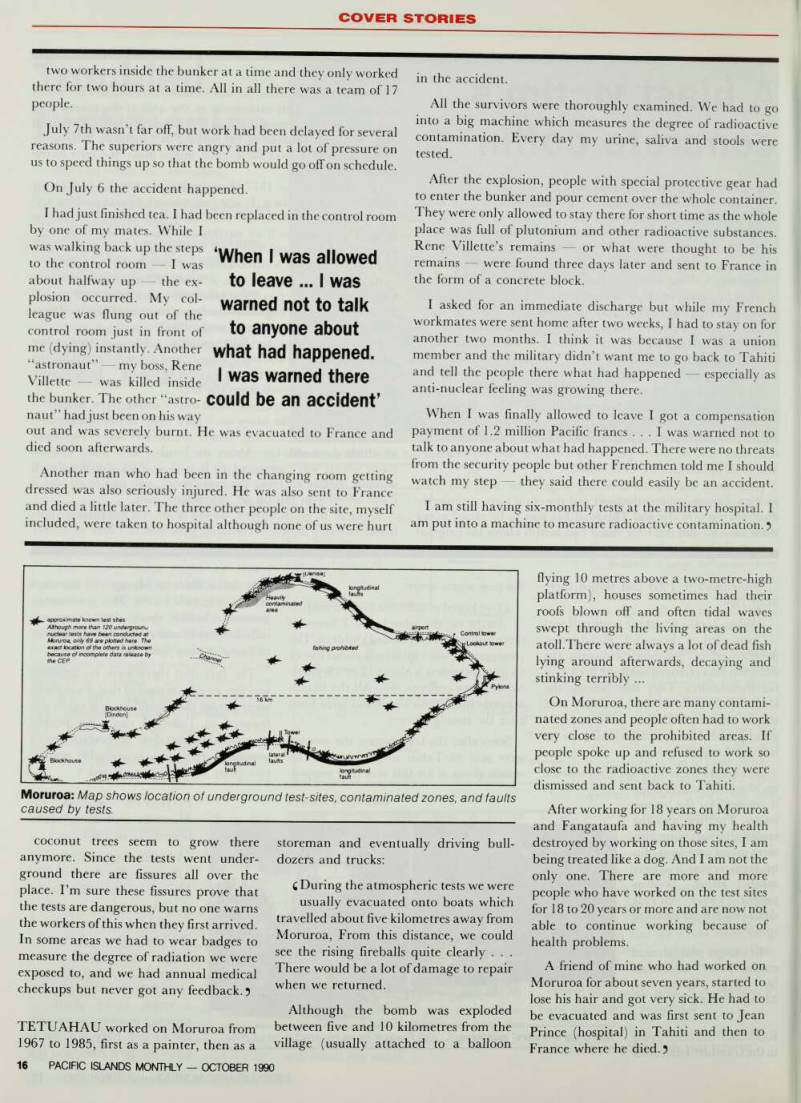
Moruroa: Map shows location of underground test-sites, contaminated zones, and faults caused by tests.
concrete coffin
A blast victim’s concrete coffin
TAMA began working at Moruroa in the 1960 s as an office worker and later became a decontaminator. This is an extract from his story: C Bombs were still being exploded in the atmosphere then, and workers were evacuated just before the tests. Even though we returned to the atoll only four to seven days later no one wore protective clothing except in the prohibited zones.
After five years of office work, I was sent back to work at the LSR [Radiological Surveillance Laboratory] in Papeete which monitors fish, coral, taro, sweet potato and so on for radioactive contamination. At that time there were few Tahitians working there but now it’s exclusively whites and there is barbed wire around it.
Two years later, I returned to Moruroa to do administrative work for about four months before working as a decontaminator.
By that time the French had changed from atmospheric to underground testing . . . We were issued with gloves to wear for this work but no other protective clothing was provided although sometimes we wore masks . . .
Ever since underground testing began, the atoll has been sinking. In some places the land and the coral have completely disappeared into the sea. The road has had to be raised every three months and it is now about two metres above the original
ground level.
It is still possible to see the old roadway down under the water in some places. This subsidence of the atoll is the reason why huge amounts of cement have to be brought in from France and New Zealand. Because of the sinking at Moruroa, there were rumours in 1977 that the French might move the tests to the
Kerguelen Islands.
It was also about 1977 that the biggest bomb blast I ever experienced took place. It was codenamed Astanyx and the test site was about 27 kilometres from the village in the Viviane test area. There was such an earthquake that no one could stay upright. At the same time, on the opposite side of the atoll beyond the airport a three-kilometre-long crack opened up.
As a result of further tests it gradually extended to seven kilometres. The deep end is submerged under water and cannot be seen. This crack has not been shown to journalists all they ever get to see is the airport and village.
I have also experienced fish poisoning ... I got sick from eating fish several times. I was itchy all over and my skin peeled off just like a snake. One of my friends was less fortunate he died after eating fish and mussels from the sea.
The first French neutron bomb test codenamed Meknes was supposed to take place on 7 July 1979. A big bunker had been built just for this test. Inside the bunker was a container in which the bomb lay. Above the bunker itself was a control room which was connected to it with a thick double-glazed window. Before entering the main room, you had to go into a room where you put on an “astronaut” suit.
You had to go through a system of several automatic doors before entering the room containing the bomb. There were only
two workers inside the bunker at a time and they only worked there for two hours at a time. All in all there was a team of 17 people.
July 7th wasn’t far off, but work had been delayed for several reasons. The superiors were angry and put a lot of pressure on us to speed things up so that the bomb would go off on schedule.
On July 6 the accident happened.
I had just finished tea. I had been replaced in the control room
by one of my mates. While I was walking back up the steps to the control room I was about halfway up the ex plosion occurred. My col league was flung out of the control room just in front of
me (dying) instantly. Another
“astronaut” my boss, Rene Villette was killed inside the bunker. The other “astro naut” had just been on his way
‘When I was allowed to leave ... I was warned not to talk to anyone about what had happened.
I was warned there could be an accident’
out and was severely burnt. He was evacuated to France and died soon afterwards.
Another man who had been in the changing room getting dressed was also seriously injured. He was also sent to France and died a little later. The three other people on the site, myself included, were taken to hospital although none of us were hurt
in the accident.
All the survivors were thoroughly examined. We had to go into a big machine which measures the degree of radioactive contamination. Every day my urine, saliva and stools were tested.
After the explosion, people with special protective gear had to enter the bunker and pour cement over the whole container.
They were only allowed to stay there for short time as the whole place was full of plutonium and other radioactive substances.
Rene Villette’s remains or what were thought to be his remains were found three days later and sent to France in the form of a concrete block.
I asked for an immediate discharge but while my French workmates were sent home after two weeks, I had to stay on for another two months. I think it was because I was a union member and the military didn’t want me to go back to Tahiti and tell the people there what had happened especially as anti-nuclear feeling was growing there.
When I was finally allowed to leave I got a compensation payment of 1.2 million Pacific francs ... I was warned not to talk to anyone about what had happened. There were no threats from the security people but other Frenchmen told me I should watch my step they said there could easily be an accident.
I am still having six-monthly tests at the military hospital. I am put into a machine to measure radioactive contamination. 5
The Region
Halls of Anger
By Frank Senge
JOHN Phoenix Sei’s dreams of a career in Papua New Guinea’s legal system came to an abrupt end early on Sunday, September 2. The third year law student from the Western Highlands prov ince received deep axe wounds to his head and back in a fight between two student groups at the University of Papua New Guinea (UPNG).
A truck load of students and outsiders went on a rampage through the campus after the fight, threatening and assaulting students. A woman student was pack raped and her boyfriend beaten so badly he was hospitalised. The riot put another man in hospital.
The next day, September 3, UPNG
Vice-Chancellor, Professor John Lynch,
declared a state of emergency on campus.
The emergency allowed police to enter the campus at any time, otherwise pro hibited unless asked by the university administration. The carrying of weapons, fighting and alcohol were banned. Both students and staff members were affected and the penalty was immediate termin ation of employment or studies.
In a letter to students and staff Professor Lynch said: “The members of the University community are as ap palled and horrified as I am at the senseless and cowardly killing of one of the students in the early hours of Sunday
morning.
“Whilst payback killing is a matter to be deplored anywhere, this is especially true on a university campus where intelligent and rational behavior is sup posed to prevail.”
Police arrested and charged 11 UPNG students all from the Highlands province of Enga with the murder of Sei.
The state of emergency was lifted within a week, but it showed the extent of the crime problem on campus, which, while on a smaller scale, was just as horrific as the national crime problem.
Lawlessness at the university really took
off from 1988. Previously, it was a problem created by outsiders entering the campus. Now the students themselves are turning UPNG into a campus of terror.
Professor Lynch said lawlessness at the university was a reflection of the national social problem. “People are a bit more disrespectful of other people’s properties and that seems to be spreading into the universities as well,” he said.
Lawlessness was not confined to UPNG in Port Moresby. Last November 8, the Vice-Chancellor of the University of Technology in Lae, Mosley Moramoro, declared a state of emergency when violence and crime rocked the campus and its neighbourhood for eight months.
Students told Prime Minister Rabbie Namaliu that there was widespread illicit sex including homosexuality, pornogra phy and group orgies amongst students and staff on campus.
Moramoro, his deputy, John Kambuou and Registrar, Mali Voi, were threatened and had to move homes often.
Moramoro was told to step down.
Namaliu commissioned an inquiry headed by Supreme Court Judge, Mr Justice Arnold Amet. It was delayed a week because nobody turned up to give evidence. In the end the commission reported that there had been cases of sex on campus but no evidence of “wide
spread sexual impropriety”.
The state of emergency restored some order. Seven students were held and subsequently released for alleged smug gling of arms onto the campus to enforce threats. The Student Representative Council President, Michael Kasi, was suspended from studies for five years as a result of the unrest. he Unitech state of emergency was the culmination of nearly a year of violence, interrupted lectures and delayed examin ations.
The longest period of unrest began in June 1989 when a third year agriculture student was shot by police outside a clubhouse in Lae. The shooting ignited riots that spread from the University of Technology in Lae to UPNG in Port
Morersby. In Lae there were clashes between police and students. In Port Moresby, Government cars were stoned and students took over security at all entrances to the university.
The alarming increase in crime, how ever, has not resulted in a drop in academic standards and performance, said Professor Lynch. What is being affected is the universsity’s ability to attract replacement staff members from abroad. The publicity of the university’s insecurities and the general lawlessness in the country have scared off qualified
people.
Professor Lynch said the last resort would be to close the universities.
In February, 1989, Kiribati pulled out most of its students because of the university’s inability to guarantee their security. In the months ahead, the Government of Papua New Guinea will be seriously weighing the usefulness of its universities as academic institutions. The halls of the University of Papua New Guinea, for example, are no longer just for learning. As in the case of John Sei, the university has become a place of broken dreams and naked terrorism.
Sir Peter picked
SOLOMON Islands’ Sir Peter Kenilorea has been appointed a member
of the Eminent Commonwealth Citizens Group who will help with the general elections in Malaysia on October 20 and 21. He was nominated by the Common wealth Secretariat. □
Advertisements & other items, p. 17 (1 item)
6 feat
For the finest in
SICHUAN CUISINE
dine at m
6 feat
dom
Cnr. Bau St/Laucala Bay Rd, Flagstaff, Suva.
LUNCH • DINNER
Phone: 301285
NOW ALSO AT:
404, Khyber Pass Rd, Newmarket, Auckland.
Phone: 5221752
• Friendly and unpretentious oriental style service. • Fully licensed bar and a splendid wine list. • All major credit cards accepted.
get France out
French Polynesia
Another move to get France out
SIX years ago the Solomon Islands was the catalyst in a move that led to New Caledonia being re-inscribed on the list of the United Nation’s non-self governing territories. The move led to the Matignon Accords, a peace agreement through which France agrees to a refer endum on independence in 1998. Now The Solomons is pushing again. This time it has asked the United Nations to get French Polynesia, France’s other big possession in the Pacific, to be put on the same list. If the Solomons’ latest move is as successful as its first, then French Polynesia, like New Caledonia, will be a step closer to indepen dence.
In a speech at the current General Assembly in New York, the UN represen tative of the solomon islands, Francis Bogutu, said France in 1946 unilaterally withdrew French Polynesia and New Caledonia from the list of such territories.
Administering powers of non-self governing territories are required to submit reports on social, economic and
political developments.
Bogutu said his country was pleased to have been one of the first, six years ago, to request that New Caledonia be re inscribed. “Today, we would ask once again that our Polynesian brothers of French Polynesia be favoured in the same manner by this world body, which believes in the legitimate freedom of man and nations to look after their own affairs.”
Bogutu said the indigenous peoples of French Polynesia have perservered with their land being occupied by France since 1842, testing nuclear bombs and pollut ing its seas. “(They) have been waiting in the wings patiently, desirous to be re inscribed ... With the aim of gaining independence and becoming a member of this community of nations in their own right.” □
Challenge
shakes Rex
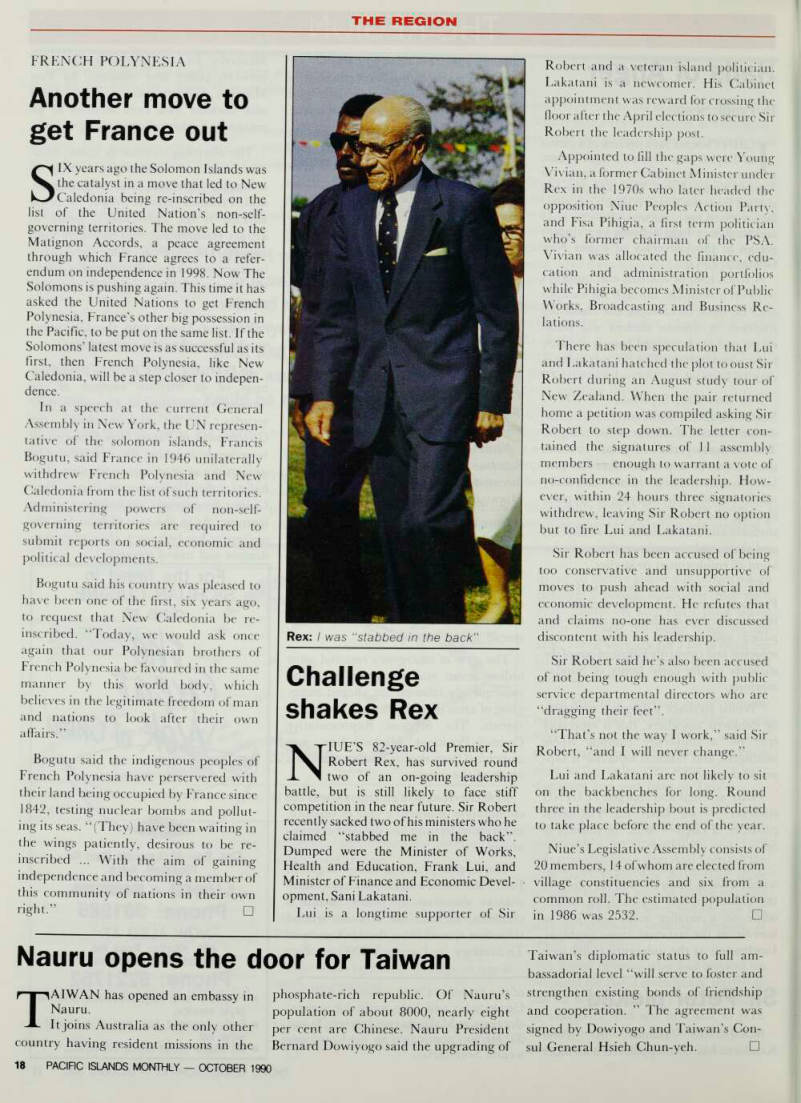
NIUE’S 82-year-old Premier, Sir Robert Rex, has survived round two of an on-going leadership battle, but is still likely to face stiff competition in the near future. Sir Robert recently sacked two of his ministers who he claimed “stabbed me in the back”.
Dumped were the Minister of Works, Health and Education, Frank Lui, and Minister of Finance and Economic Devel opment, Sani Lakatani.
Lui is a longtime supporter of Sir
Robert and a veteran island politician.
Lakatani is a newcomer. His Cabinet appointment was reward for crossing the floor after the April elections to secure Sir Robert the leadership post.
Appointed to fill the gaps were Young Vivian, a former Cabinet Minister under Rex in the 1970 s who later headed the opposition Niue Peoples Action Party, and Fisa Pihigia, a first term politician who’s former chairman of the PSA.
Vivian was allocated the finance, edu cation and administration portfolios while Pihigia becomes Minister of Public Works, Broadcasting and Business Re lations.
There has been speculation that Lui and Lakatani hatched the plot to oust Sir Robert during an August study tour of New Zealand. When the pair returned home a petition was compiled asking Sir Robert to step down. The letter con tained the signatures of 11 assembly members enough to warrant a vote of no-confidence in the leadership. How ever, within 24 hours three signatories withdrew, leaving Sir Robert no option but to fire Lui and Lakatani.
Sir Robert has been accused of being too conservative and unsupportive of moves to push ahead with social and economic development. He refutes that and claims no-one has ever discussed discontent with his leadership.
Sir Robert said he’s also been accused of not being tough enough with public service departmental directors who are “dragging their feet”.
“That’s not the way I work,” said Sir Robert, “and I will never change.”
Lui and Lakatani are not likely to sit on the backbenches for long. Round three in the leadership bout is predicted to take place before the end of the year.
Niue’s Legislative Assembly consists of 20 members, 14 of whom are elected from village constituencies and six from a common roll. The estimated population in 1986 was 2532. □
Rex: I was “stabbed in the back"
Nauru opens the door for Taiwan
TAIWAN has opened an embassy in Nauru.
It joins Australia as the only other country having resident missions in the
phosphate-rich republic. Of Nauru’s population of about 8000, nearly eight per cent are Chinese. Nauru President Bernard Dowiyogo said the upgrading of
Taiwan’s diplomatic status to full am bassadorial level “will serve to foster and strengthen existing bonds of friendship and cooperation. ” The agreement was signed by Dowiyogo and Taiwan’s Con sul General Hsieh Chun-yeh. □
The chase is on
American territories face fierce elections in the race for the top jobs
By David North
MANY hot election contests are coming on November 6 in Guam, American Samoa and Hawaii.
Two governorships, and possibly the con trol of the United States Senate, are among the prizes at stake.
In addition to the usual contests between the ins and the outs, the Democrats and the Republicans, and the young and the old, there may be some breakthroughs on gender and ethnic lines: A woman may represent Hawaii in the State, and another may become Governor of Guam — each a first; andH
• a Samoan man may become the first of his background to secure a voting seat in the House of Representa tives.
The race getting the most Main
land attention is that between sitting Democratic U.S. Senator, Daniel Akaka, and his assertive Republican opponent, Congresswoman Pat Saiki. If she wins, and she is leading by a bit in the polls, and if several other Republican challengers on the Mainland beat their Democratic opponents, the Democrats could lose their current control of the Senate. Among the by-products of such a change would be a weakened position for long-term Senator Daniel Inouye (Democrat, Hawaii), the dean of the Pacific delegation in Congress.
His prowess within the senatorial struc ture would be lessened were he to be a member of the minority,
Guam
Madeleine versus Ada There is a tight contested race for Governor, with each of the candidates seeking to break island tradition. The Republican Governor, Joseph Ada,
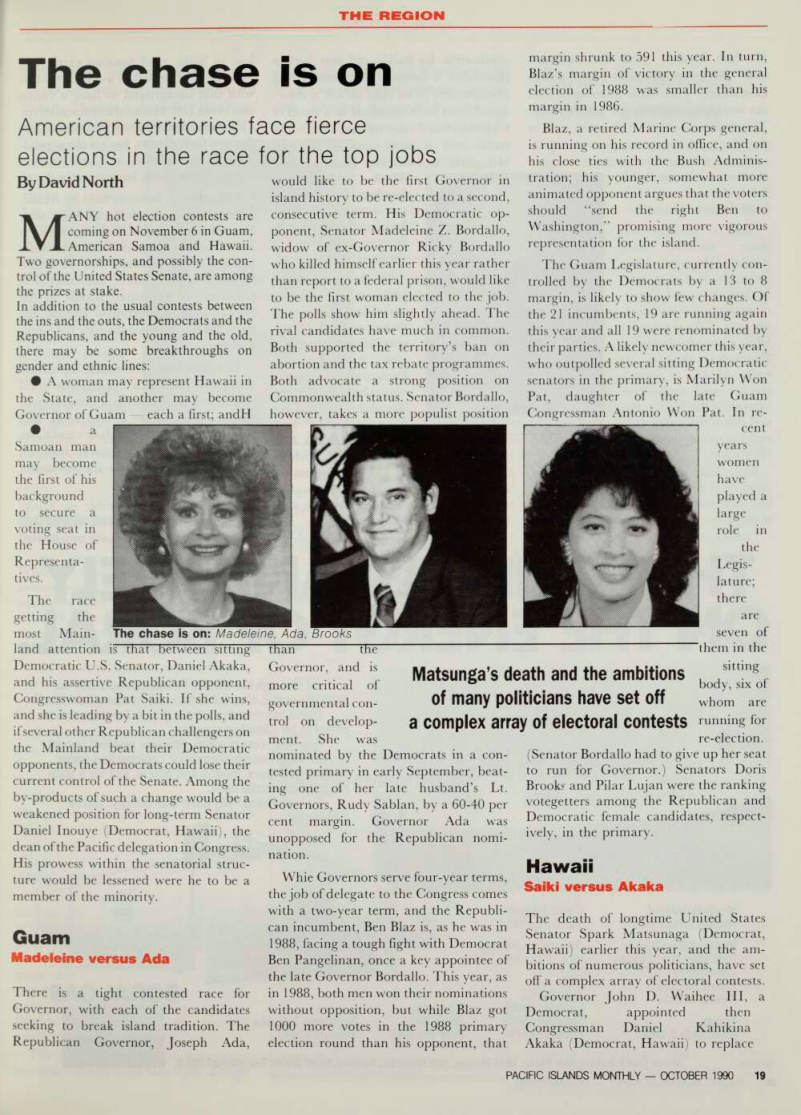
would like to be the first Governor in island history to be re-elected to a second, consecutive term. His Democratic op ponent, Senator Madeleine Z. Bordallo, widow of ex-Governor Ricky Bordallo who killed himself earlier this year rather than report to a federal prison, would like to be the first woman elected to the job.
The polls show him slightly ahead. The rival candidates have much in common.
Both supported the territory’s ban on abortion and the tax rebate programmes.
Both advocate a strong position on Commonwealth status. Senator Bordallo, however, takes a more populist position
thanthe Governor, and is more critical of
governmental con
trol on develop ment. She was
nominated by the Democrats in a con tested primary in early September, beat ing one of her late husband’s Lt.
Governors, Rudy Sablan, by a 60-40 per cent margin. Governor Ada was unopposed for the Republican nomi nation.
Whie Governors serve four-year terms, the job of delegate to the Congress comes with a two-year term, and the Republi can incumbent, Ben Blaz is, as he was in 1988, facing a tough fight with Democrat Ben Pangelinan, once a key appointee of the late Governor Bordallo. This year, as in 1988, both men won their nominations without opposition, but while Blaz got 1000 more votes in the 1988 primary election round than his opponent, that
Matsunga’s death and the ambitions of many politicians have set off a complex array of electoral contests
margin shrunk to 591 this year. In turn, Blaz’s margin of victory in the general election of 1988 was smaller than his margin in 1986.
Blaz, a retired Marine Corps general, is running on his record in office, and on his close ties with the Bush Adminis tration; his younger, somewhat more animated opponent argues that the voters should “send the right Ben to Washington,” promising more vigorous representation for the island.
The Guam Legislature, currently con trolled by the Democrats by a 13 to 8 margin, is likely to show few changes. Of the 21 incumbents, 19 are running again this year and all 19 were renominated by their parties. A likely newcomer this year, who outpolled several sitting Democratic senators in the primary, is Marilyn Won Pat, daughter of the late Guam Congressman Antonio Won Pat. In re
cent years women have
played a
large
role in the
Legis
lature; there are seven of
“them in the
sitting
body, six of whom are running for re-election.
(Senator Bordallo had to give up her seat to run for Governor.) Senators Doris Brooks and Pilar Lujan were the ranking votegetters among the Republican and Democratic female candidates, respect ively, in the primary.
Hawaii
Saiki versus Akaka The death of longtime United States Senator Spark Matsunaga (Democrat, Hawaii) earlier this year, and the am bitions of numerous politicians, have set off a complex array of electoral contests.
Governor John D. Waihee 111, a Democrat, appointed then Congressman Daniel Kahikina Akaka (Democrat, Hawaii) to replace
The chase is on: Madeleine, Ada, Brooks
the late Senator. (Both the Governor and the new Senator are native Hawaiians). Then Saiki announced that she would run against the new Senator.
This meant that both of Hawaii’s seats in the House of Representatives would be without an incumbent in the November
election, and a scramble for both nominations in both districts ensued.
Saiki is younger and more assertive than Akaka. A Japanese Ame rican, she is said to have broken the usual Demo cratic lock on this import ant part of the electorate, while securing substantial Caucasian support as well. Akaka, a former teacher and seven-term veteran of the House, has tied down the union vote
and has strong support among the native Hawaiians.
Both Saiki and Akaka were without opposition in the late September primary, but there were vigorous races for all four nominations for the two empty seats.
Leading the race for the Democratic
nomination for Saiki’s old seat (urban Honolulu) is former Congressman Neil Abercrombie (who once served a three month stint in Washington as a result of a bye-election.) Also seeking the Demo cratic nod is state senator Norman Mizaguchi and the late Senator’s son.
Mark Matsunaga.
Leading the Republi
can aspirants is Mike Liu, currently Repub lican minority leader in the State’s lower house.
In the other Con
gressional district,
which includes part of Oahu and all of the outer islands, there is a close race for the Democratic nomi nation between current
Honolulu City
Councilwoman and
lormer Kepresentative Patsy Mink and businessman Muliufi (Mufl) Hannemann. Mink spent six terms in Washington before giving up her seat to try for the Senate; Hanneman, who won the Democratic nomination in the Honolulu district four years ago only to
lose to Saiki, is of Samoan extraction.
Were he to be elected he would be the first with that background to have a voting seat in the U.S. House of Representatives. (The delegate from American Samoa, like the one from Guam, has speaking privi leges in the House, and can vote in Committee sessions, but not on the floor.) This district, formerly held by Akaka, is regarded as a safe Democratic seat.
Nevertheless there is a spirited race for the Republican nomination, with the leaders being Stanley Monsef, and ex-British Colonial Service officer who once was Governor of five small islands in the Persian Gulf, and Andrew Poepoe, the party leadership’s favourite for the nomi nations.
To complicate matters, the September voting will include a bye-election to fill out the last three months of Congressman Akaka’s term in the House. Mink and Hannemann are the leading candidates in this election which is separate from the primary contest leading to the November election.
Were either Abercrombie or Mink, (particularly the latter), or both, to win, Hawaii would regain some of its seniority
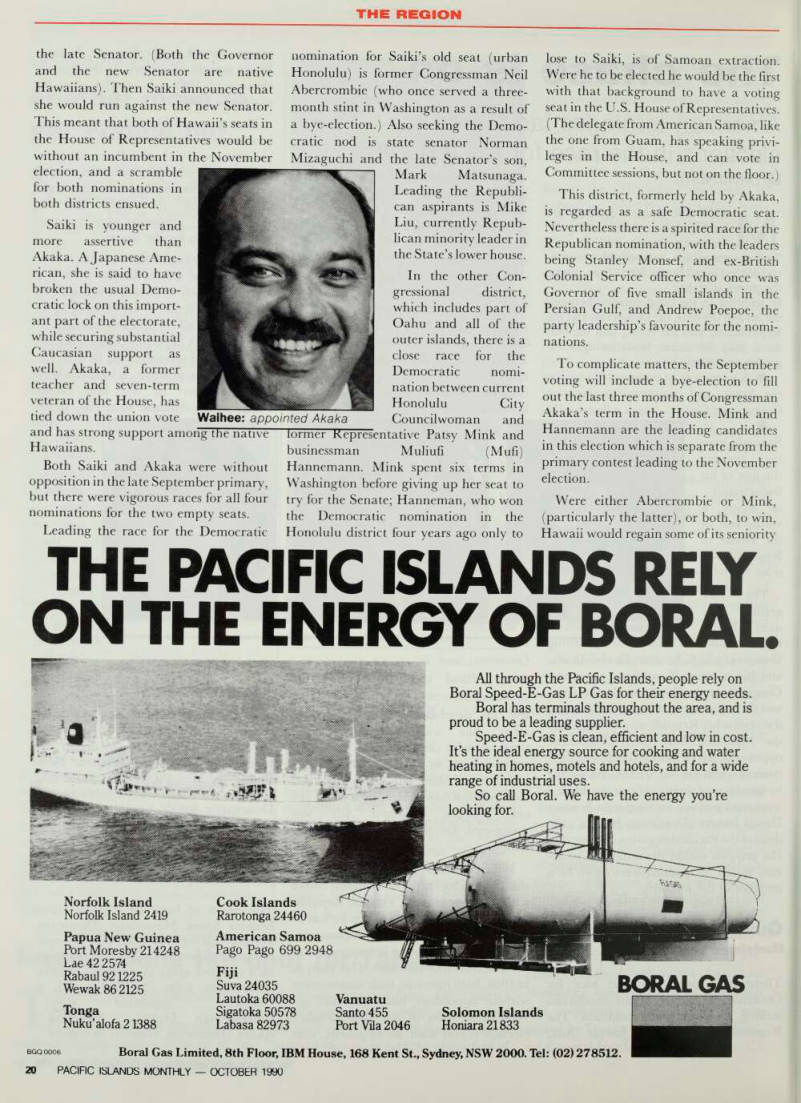
Waihee: appointed Akaka
in the House that was lost when both Akaka and Saiki decided to run for the Senate. There is a possibility that Saiki will be elected to the Senate, gaining a
seat for her party, while a Democrat is elected to the House to replace her. Such an exchange would be not be an even one the Demo crats do not need an extra seat in the House, where their control is solid, but they call ill afford to lose one in the Senate.
In November, Hawaii’s voters will also elect a Governor, and
members of the State legislature. The Democrats are expected to sweep these races.
American Samoa
Going for Congress While in Guam and Hawaii there is mosaic quality to the fields of candidates, with men and women of a variety of ethnic backgrounds running for office, there is no such scene in American Samoa. All candidates are Samoan men.
The principal race is for the delegate’s seat in Congress held for the last two years by Eni F.H. Faleomaveaga, a Democrat.
His three opponents are: • Ace Tago, the Treasurer of Ameri can Samoa, who is supported by Governor Peter Tali Coleman (Republi can); • Afoa Moega Lutu, the Attorney- General in the previous A.P. Lutali (Democratic) Administration, and • Moalii Tele Tu’ufuli, former Com missioner of Public Safety in the Lutali Administration.
Faleomavaega has the advantage of incumbency and landed on his feet in Washington, where he had once been a House staff member. T ago, though he has the support of a popular Governor, had spent much of the campaign period engaged in a politically thankless task, trying to convince the legislature in Pago Pago to accept new and higher taxes to turn around a substantial deficit.
The other two candidates have spent less time recently in the limelight, though
Lutu is remembered in Washington for being part of the legal team that success fully defended American Samoan law and practice in a battle between a
Samoan family and the Mormon Church over a land claim. That struggle took place in the Circuit Court of Appeals, and its de cision was subsequently accepted by the U.S.
Supreme Court.
The four.candidates for the delegate’s seat will all compete in the November 6 voting.
Then, if no one gets more than 50 per cent of the vote (a likely scenario) there will be a second balloting two weeks later.
As for the other elections in Samoa, Governor Coleman’s term has another two years to run. Later this year all the voters of American Samoa will elect the 20-member Territorial House of Rep resentatives, while just some of them, the matai , a group of traditional chiefs
(almost exclusively male), will chose the
members of the Territorial Senate. There has been some discussion in Pago Pago of eliminating the matai- only voting. Mean while, it will be interesting to see how Western Samoa’s voters, in October, vote on a proposal that all Western Samoans not just matais be allowed to vote in future Western Samoa □
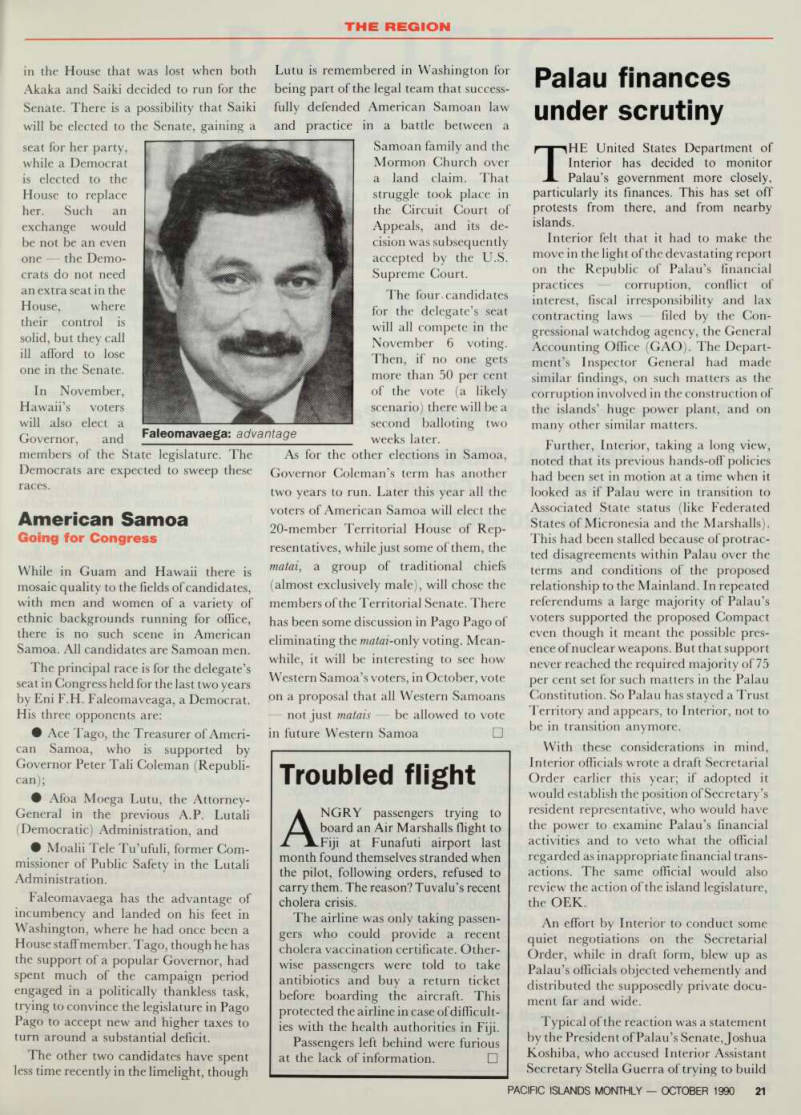
Faleomavaega: advantage
Advertisements & other items, p. 20 (1 item)
On The Energy Of Boral
THE PACIFIC ISLANDS RELY
■ % Cook Islands Rarotonga 24460 All through the Pacific Islands, people rely on Boral Speed-E-Gas LP Gas for their energy needs.
Boral has terminals throughout the area, and is proud to be a leading supplier.
Speed-E-Gas is clean, efficient and low in cost.
It’s the ideal energy source for cooking and water heating in homes, motels and hotels, and for a wide range of industrial uses.
So call Boral. We have the energy you’re looking for.
Norfolk Island Norfolk Island 2419 Papua New Guinea Port Moresby 214248 Lae 42 2574 Rabaul 921225 Wewak 862125 Tonga Nukualofa 21388 American Samoa Pago Pago 699 2948 Fiji Suva 24035 Lautoka 60088 Sigatoka 50578 Labasa 82973 Vanuatu Santo 455 Port Vila 2046
BORAL GAS
Solomon Islands Honiara 21833 Boral Gas Limited, Bth Floor, IBM House, 168 Kent St., Sydney, NSW 2000. Tel: (02) 278512.
Troubled flight
ANGRY passengers trying to board an Air Marshalls flight to Fiji at Funafuti airport last month found themselves stranded when the pilot, following orders, refused to carry them. The reason? Tuvalu’s recent cholera crisis.
The airline was only taking passen gers who could provide a recent cholera vaccination certificate. Other wise passengers were told to take antibiotics and buy a return ticket before boarding the aircraft. This protected the airline in case ofdifficult ies with the health authorities in Fiji.
Passengers left behind were furious at the lack of information. □
under scrutiny
Palau finances under scrutiny
THE United States Department of Interior has decided to monitor Palau’s government more closely, particularly its finances. This has set off protests from there, and from nearby islands.
Interior felt that it had to make the move in the light of the devastating report on the Republic of Palau’s financial practices corruption, conflict of interest, fiscal irresponsibility and lax contracting laws filed by the Con gressional watchdog agency, the General Accounting Office (GAO). The Depart ment’s Inspector General had made similar findings, on such matters as the corruption involved in the construction of the islands’ huge power plant, and on many other similar matters.
Further, Interior, taking a long view, noted that its previous hands-off policies had been set in motion at a time when it looked as if Palau were in transition to Associated State status (like Federated States of Micronesia and the Marshalls).
This had been stalled because of protrac ted disagreements within Palau over the terms and conditions of the proposed relationship to the Mainland. In repeated referendums a large majority of Palau’s voters supported the proposed Compact even though it meant the possible pres ence of nuclear weapons. But that support never reached the required majority of 75 per cent set for such matters in the Palau Constitution. So Palau has stayed a Trust Territory and appears, to Interior, not to be in transition anymore.
With these considerations in mind, Interior officials wrote a draft Secretarial Order earlier this year; if adopted it would establish the position of Secretary’s resident representative, who would have the power to examine Palau’s financial activities and to veto what the official regarded as inappropriate financial trans actions. The same official would also review the action of the island legislature, the OEK.
An effort by Interior to conduct some quiet negotiations on the Secretarial Order, while in draft form, blew up as Palau’s officials objected vehemently and distributed the supposedly private docu ment far and wide.
Typical of the reaction was a statement by the President of Palau’s Senate, Joshua Koshiba, who accused Interior Assistant Secretary Stella Guerra of trying to build
herself an “ivory tower” on Palau, from whence she could rule by dictatorship.
Palau’s President Etpison and House Speaker Shiro Kyota were similarly incensed.
Meanwhile, similarly-placed political leaders in other islands joined in the chorus, accusing Interior of seeking to restore colonial rule. In the Marianas, House of Representatives Speaker Pedro R. Guerrero attacked Interior for the plan, saying it stemmed from the refusal
of the islanders “to be coerced” by the U.S. into approving the disputed Com pact of Free Association. The CNMI House subsequently passed Guerrero’s resolution supporting the Palau position.
The Congressman in charge of the territories subcommittee of the House of Representative, Ron de Lugo (Democrat Virgin Islands) wrote an angry letter to Interior saying that the draft contains “language that is so broad or ambiguous that it suggests a colonialistic design that
may not actually be intended.”
On Guam, the newspaper, Pacific Island Daily, editorially warned that “a super power dealing with a small emerging nation is likely to be seen as a bully,” and urged the Department of Interior “to show respect to the Republic of Palau.”
The paper’s use of the word “respect” reflected the prevailing tone of the press coverage. It has concentrated, to date, on the perhaps awkward approach of the Department of Interior, and on the symbolism involved in restricting the powers of an island government. What has been remarkably lacking, probably because of Interior’s reluctance to air Palau’s dirty linen, were discussions of the underlying problem of how Palau handles Uncle Sam’s money. Had Palau managed Interior’s millions carefully or raised its own funds, there would have been no need for a Secretarial Order.
Meanwhile, there has been little sub stantive discussion of the draft. Two middle-level Interior officials were sent to Palau, but no specifics were discussed.
Palau’s leaders asked for a meeting with Assistant Secretary Stella Guerra, but there were scheduling conflicts, and they then sought one with Secretary Manual Lujan. A meeting was offered with him, in his desert hometown of Albuquerque, New Mexico, where he was holidaying at the time. But the invited Palau leaders declined because of the short notice.
According to Interior officials in Washington, repeated requests to Palau for substantive, written comments on the draft received no replies that Interior deems substantive.
Palau’s officials have said that what they want is help on law enforcement and economic development matters, not an other level of Mainland supervision.
Palau now wants a meeting, preferably in Palau, or in New York, for further discussions of the draft order. New York was suggested because Palau’s leaders are trying to get support from the United Nations on the subject, in light of Palau being the last of the United Nations trust territories. □
THE chiefs of the Solomon Islands’
Western Province have decided to send medical supplies to relatives at Siwai and Buin on Bougainville. □
Advertisements & other items, p. 22 (1 item)
Regional Trainer
Sj
Tourism Council of the South Pacific
1 post (Hotel and Catering)
FOOD PRODUCTION
The Tourism Council of the South Pacific is proposing to extend its team of regional trainers. These specialists trainers are based in Suva, Fiji, but are required to work outside of Fiji on assignments of six to eight weeks.
Applicants will require to have: a) A good education, preferably with a formal qualification in the field of Hotel and Catering. b) A high level of literacy and oral competence in the English language. c) A minimum of seven years operational experience actively involved with all aspects of Professional Cookery with at least two years at supervisory level. d) Strong personal characteristics which allow for flexibility, adaptability and reliability.
Salaries are awarded against a basic rate in Fiji plus an overseas allowance and per diem while on duty outside Fiji. The overall salary package will be within the range expected at senior management level within the industry. The initial contract is for one year.
Persons interested are invited to submit a copy of their C.V. (typed), along with a letter of application (hand written). Closing date for applications is October 31 1990. Applications will be dealt with in strict confidence. Applications should be marked “CONFIDENTIAL” and addressed to: The Director Tourism Council of the South Pacific GPO Box 13119 Suva, Fiji
Pacific
Islands
Monthly
Business
Getting caught in a tuna treaty
Moresby breaks ranks over Soviets, Majuro poses threat to Pago canneries
By Robin Bromby
FISHING in the South Pacific con tinues to be a fast-changing industry.
The agreement between the Soviet Union and Papua New Guinea for co operation on catching tuna had no sooner been signed than it became the subject of a political row. And the Marshall Islands is now threatening to take away much of the industry activity which has sustained the American Samoan economy. But while there must be some concern in Pago Pago, the failure of a commercial venture across the way in Apia once again demonstrated the problems for small island countries in getting their own fishing industries into operation. And a recent announcement that an Australian company is backing a venture in the Federated States of Micronesia (FSM) illustrates the extent of the dependence on outside partners the island companies still face.
The unpredictable nature of politics in Papua New Guinea has been amply demonstrated by a break in Cabinet ranks over the fisheries agreement signed re cently with the Soviet Union with the dissenting voice coming from none other than Fisheries Minister Allan Ebu. It was to be a move which led to his sacking from the Papua New Guinea Cabinet, but his view will be one which strikes a cord with at least some of his countrymen.
Ebu said neither he nor his department had been keen on the agreement, under which the Soviets undertook to provide a
range of technical and marketing help to PNG. Two Russian fishing boats are also to be stationed in Papua New Guinea waters.
But Ebu said he believed his country would gain “zero economic benefit” from the agreement, and that there had been serious disagreement between the Fisheries and Marine Resources Depart ment on the one hand, and Foreign Affairs on the other.
The Minister had just returned from attempting to negotiate a similar bilateral fishing deal with South Korea, and has made it clear that he will refuse any invitation to visit the Soviet Union. This poses an interesting situation as the first joint session to bring the treaty into effect is planned to be held in Moscow.
Ebu said the Government did not do
proper studies to determine the economic benefits of the agreement, and that Papua New Guinea had pressed the Soviet Union to sign the
agreement and that, while in Seoul, he had emphasised to the Korean Deep Water Fishing Corporation his opposition to Soviet help.
The Soviet embassy in Port Moresby later issued a statement assuring the
Majuro transshipment proposal promises job for 500 in Marshalls and is a threat to Pago Pago
Government that the agreement would lead to important economic help for Papua New Guinea’s fishing industry.
In developments to Micronesia, the United States Government has decided to fund a study into the feasibility of developing a tuna trans-shipment depot in Majuro, the capital of the Marshall Islands. This would take some business away from the present trans-shipment facility at Pago Pago, in American Samoa. But Majuro is closer to the important tuna grounds between Kiribati and Papua New Guinea, and labour costs in the Marshall Islands are about half those in Pago Pago.
The Marshall Islands Government is eager for the project to go ahead as it will provide more than 500 jobs in the former U.S. territory. The trans-shipment base would almost certainly lead to boats being based in Majuro and there is now also talk of a cannery being built in the future.
But attempts to base a large fishing vessel in Western Samoa have failed because of the difficulty in obtaining ice there. The country had been plagued by severe power shortages because of prob lems with local generators.
A Taiwanese company, Hsin Meng, had stationed the Lady Margaret in the Western Samoan capital of Apia but has
now put the vessel up for sale after just four months. Ice, never available in any great quantity in Apia, had almost
disappeared be
cause of the fre
quent power cuts. Lady Margaret could work only four days at a time. It was to have been at sea for three week-long voyages.
The country needs large vessels work ing out of American Samoa which has freezers capable of storing fish for up
to two months.
In the meantime, marine scientists have tagged and releaesd 30,000 tuna in the waters around the Solomon Islands, Palau and Papua New Guinea in an effort to find out more about the migratory pattern of the yellowfin tuna, as well as their mortality and growth rates. A team from the South Pacific Commission, with the backing of funds from the European Community, have chartered a pole-and line vessel and have so far recovered about 1200 of the tagged fish. Details of the project were given at a recent meeting of fisheries officials in Noumea. The meeting also discussed a proposal for a post harvest facility to help island nations produce and market high value fish products for export.
In the Federated States of Micronesia, the National Fisheries Corporation and
Pohnpei’s Economic Development Auth
ority are to join with the Perth-based Kailis and France Group to establish an operation under the name of the Caroline Fishing Company. It will have a total equity of US$l3.5 million, and will buy three reconditioned purse-seine boats, two of 550 tonnes and one 509 tonnes.
The Australian partners will provide training for crew, overall management and the marketing of the catch on the international market. The boats will be serviced in Perth.
Licensed foreign fishing boats now catch 250,000 tonnes of tuna each year in the FSM’s economic zone; that catch is worth about US$2OO million, but the government earns only US$lO million of that from fees. If the project is a success, there are plans to increase the size of the fleet to 10 vessels and build a cannery. □
Purse Seiners face the Forum axe
MEMBERS of the South Pacific Forum which represents 16 nations are trying to halt the increase in the number of purse seine vessels operating in the region to prevent the over-exploitation of the tuna fisheries.
Forum Fisheries Agency (FFA) director Philipp Muller, who is based in the Solomon Islands, said some boats may have their licences withdrawn.
About 165 purse seine vessels are in the area bounded by Papua New Guinea, Solomon Islands, Kiribati, Marshall Islands and the Federated States of Micronesia. FFA is concerned this num ber could rise to 200 by next year.
Purse seine boats catch about 300,000 tonnes annually. Muller said that unless controls are introduced, this figure could double in the short term. Skipjack tuna resources were adequate to sustain a high level of activity, but there was concern about the exploitation of juvenile yellowfin and big-eye tuna.
Meanwhile, non-U.S. fishing fleets,
with high rates of dolphin kills, will not be allowed to sell their tuna in the US market. So ordered a federal district court
judges in San Francisco. The ruling will have a number of impacts, largely beneficial if indirect, on most Pacific Island nations.
Earth Island Institute, an environ mental group, sued the U.S. Commerce Department and the Bush Adminis tration saying that they were not enforc ing a 1988, pro-dolphin law. That law said, according to Earth Island, that any foreign fleet with more than twice the dolphin kill rate of the U.S. fleet should
Dolphins set tuna barriers
loss access to U.S. markets; the Com merce Department had not ordered the embargo, arguing that it was following a different, legally-appropriate path to reach the same goal of protecting the dolphins. The judge agreed with Earth Island, but his decision probably will be appealed by the Bush Administration, and the judge’s order may be suspended during the appeal.
Purse-seiners often kill dolphin acci dentally as they net the tuna swimming beneath the air-breathing dolphins. It was for this reason that America’s principal tuna packers recently decided to only sell dolphin-safe tuna.
The winners in this court case were: • everyone associated with the Pago Pago tuna canneries. These plants work only with dolphin-safe tuna, whose value may increase as a result of the judge’s decision; • the island nations of the Western Pacific, where dolphin-safe tuna are caught.
The losers are: • The Bush Administration which often favours commercial interests when they are in conflict with environmental interests; • Vanuatu’s ship licensing pro gramme. Tuna from its flagged fleet (presumably not Vanuatu-owned) was one of the five barred by Judge Thelton E. Henderson from the American mar ket.
Earlier this year a U.S. Commerce Department official estimated that in 1989 the number of dolphins killed by foreign tuna fleets had increased by 40 per cent to 84,000, while U.S. fleet dolphin kills fell to 12,600.
The decision may increase slightly the cost of canned tuna in the U.S. □
Drawing water lines for the islands
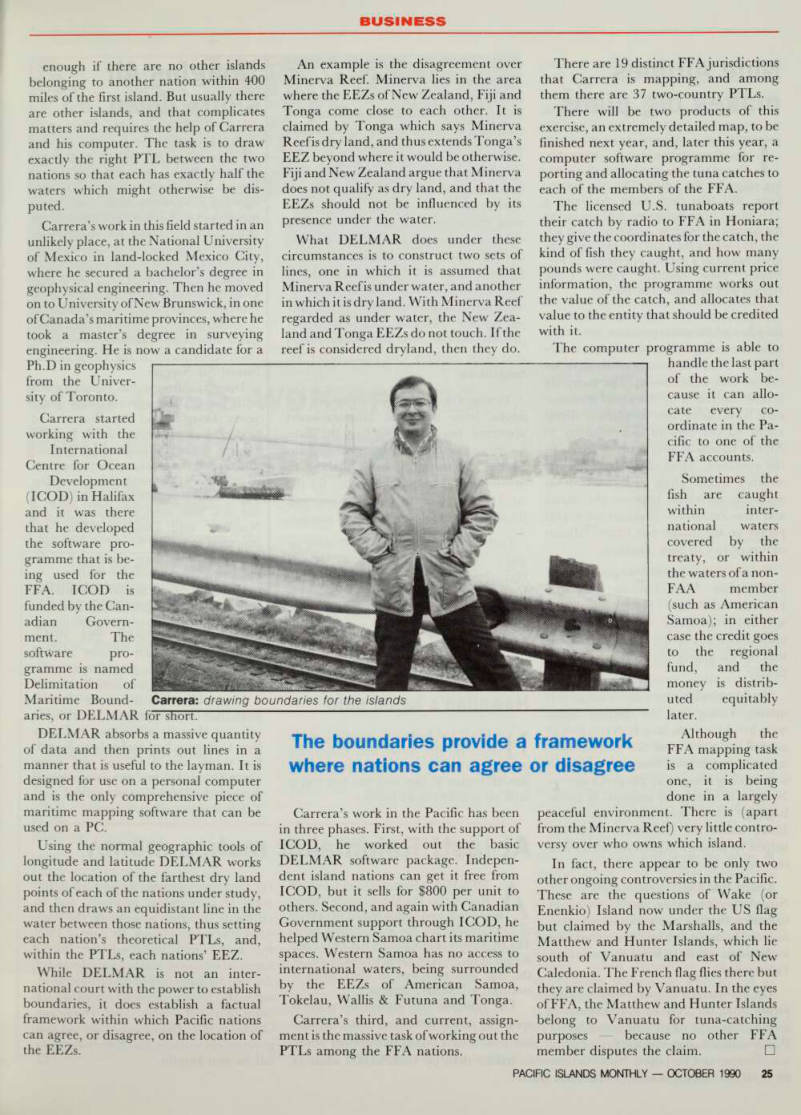
By David North
THERE are lots of people with specialised occupations in the Pa cific, but Galo Carrera is probably the only person whose specialty is drawing lines on water with a computer.
The lines he draws are important to every Pacific country, because it is his computer that helps establish the exact location of the Exclusive Economic Zones
(EEZs). Carrera’s lines are important because they determine which nation secures the money for the resources lying within those 200-mile limits, such as tuna now, and maybe oil and minerals in the future.
Carrera, being both a careful man and a scientist, is not given to sweeping statements. He stresses that his work on international lines for the Forum Fisheries Agency (FFA), for example, does not
establish formal international bound aries, but it does help create provisional treaty lines (PTEs), a useful but lesser set of demarcations. These can be used by the FFA to divide up that part of the US Tuna Treaty funds that relate to the annual tuna catch by the US tuna fleet.
EEZs usually run 200 nautical miles out to sea beyond the last dry land (at low tide) of the nation in question. That’s easy
enough if there are no other islands belonging to another nation within 400 miles of the first island. But usually there are other islands, and that complicates matters and requires the help of Carrera and his computer. The task is to draw exactly the right PTE between the two nations so that each has exactly half the waters which might otherwise be dis
puted.
Carrera’s work in this field started in an unlikely place, at the National University of Mexico in land-locked Mexico City, where he secured a bachelor’s degree in geophysical engineering. Then he moved on to University of New Brunswick, in one of Canada’s maritime provinces, where he took a master’s degree in surveying engineering. He is now a candidate for a
Ph.D in geophysics from the Univer sity of Toronto.
Carrera started working with the International Centre for Ocean
Development
(ICOD) in Halifax and it was there that he developed the software pro gramme that is be ing used for the
Ffa. Icod Is
funded by the Can adian Govern ment. The software pro gramme is named Delimitation of Maritime Bound
aries, or DELMAR for short.
DELMAR absorbs a massive quantity of data and then prints out lines in a manner that is useful to the layman. It is designed for use on a personal computer and is the only comprehensive piece of maritime mapping software that can be used on a PC.
Using the normal geographic tools of longitude and latitude DELMAR works out the location of the farthest dry land points of each of the nations under study, and then draws an equidistant line in the water between those nations, thus setting each nation’s theoretical PTEs, and, within the PTEs, each nations’ EEZ.
While DELMAR is not an inter national court with the power to establish boundaries, it does establish a factual framework within which Pacific nations can agree, or disagree, on the location of the EEZs.
An example is the disagreement over Minerva Reef. Minerva lies in the area where the EEZs of New Zealand, Fiji and Tonga come close to each other. It is claimed by Tonga which says Minerva Reef is dry land, and thus extends Tonga’s EEZ beyond where it would be otherwise.
Fiji and New Zealand argue that Minerva does not qualify as dry land, and that the EEZs should not be influenced by its presence under the water.
What DEEMAR does under these circumstances is to construct two sets of lines, one in which it is assumed that Minerva Reefis under water, and another in which it is dry land. With Minerva Reef regarded as underwater, the New Zealand and Tonga EEZs do not touch. If the reef is considered dryland, then they do.
The boundaries provide a framework where nations can agree or disagree
Carrera’s work in the Pacific has been in three phases. First, with the support of ICOD, he worked out the basic
DELMAR software package. Indepen
dent island nations can get it free from ICOD, but it sells for $BOO per unit to others. Second, and again with Canadian Government support through ICOD, he helped Western Samoa chart its maritime spaces. Western Samoa has no access to international waters, being surrounded by the EEZs of American Samoa, Tokelau, Wallis & Futuna and Tonga.
Carrera’s third, and current, assign ment is the massive task of working out the PTEs among the FFA nations.
There are 19 distinct FFA jurisdictions that Carrera is mapping, and among them there are 37 two-country PTEs, There will be two products of this exercise, an extremely detailed map, to be finished next year, and, later this year, a computer software programme for re porting and allocating the tuna catches to each of the members of the FFA.
The licensed U.S. tunaboats report their catch by radio to FFA in Honiara; they give the coordinates for the catch, the kind of fish they caught, and how many
pounds were caught. Using current price
information, the programme works out the value of the catch, and allocates that value to the entity that should be credited with it.
The computer programme is able to
handle the last part of the work be cause it can allo cate every co ordinate in the Pa cific to one of the FFA accounts.
Sometimes the fish are caught within inter national waters covered by the treaty, or within the waters of a non- FAA member (such as American Samoa); in either case the credit goes to the regional fund, and the money is distrib
uted equitably
later.
Although the
FFA mapping task is a complicated one, it is being done in a largely
peaceful environment. There is (apart from the Minerva Reef) very little contro versy over who owns which island.
In fact, there appear to be only two other ongoing controversies in the Pacific.
These are the questions of Wake (or Enenkio) Island now under the US flag but claimed by the Marshalls, and the Matthew and Hunter Islands, which lie south of Vanuatu and east of New Caledonia. The French flag flies there but they are claimed by Vanuatu. In the eyes of FFA, the Matthew and Hunter Islands belong to Vanuatu for tuna-catching purposes because no other FFA member disputes the claim. □
Carrera: drawing boundaries for the islands
makes big plans
Niue Airlines makes big plans
THE latest player to enter the South Pacific aviation scene Niue Air lines Ltd is starting small but has big plans for the future. This, the owners hope, will take them from chartering a 737-200 jet from Solomons Airlines to run the current fortnightly Auckland-Niue ser vice, to owning their aircraft and using the small island as a hub for operations to Fiji, Samoa, New Zealand, Tonga, Cook Islands and perhaps even Hawaii.
Niue Airlines ran its inaugural flight on July 9, and its main problem since then has been a dispute between major share holders. That has now been resolved by one partner withdrawing. The company is now controlled by Auckland business man Ray Young, and he plans to divest about 45 per cent of the company to Niuean nationals who want to invest in the operation. Most of the traffic in the airline’s initial phase will come from nationals travelling between the island and New Zealand there are only 2000 people on the island, but 12,000 Niuean nationals live in New Zealand.
Young said a weekly service was the initial plan, “but Cyclone Ofa last February damaged Hotel Niue and wrecked crops which were to have pro vided much outward freight. This meant that only a fortnightly service was prac ticable.
Weekly services are due to begin this month. Young said the existing flights were breaking even, largely due to freight carried to the island for Government agencies and private companies. Freight is also being boosted by the propensity of Niueans to take great amounts of excess baggage when they travel, sometimes 100 kg above the allowance. That has helped to produce significant additional revenue for the airline.
Young told Pacific Islands Monthly that Niue Airline’s booking office in Auckland had been turning away tourists wanting to travel to the island, which augured well for business when the hotel re-opens next
February.
The company is already looking to the future, and the Niuean Government is seeking bilateral rights with other South Pacific states. Young said the first priority was Tonga, and he hoped Niue Airlines
could get fifth freedom rights between Nuku’alofa and Auckland. Flights out of Niue to Nadi, Pago Pago, Apia and Rarotonga were also on the forward plan, with even Honolulu via Christmas Island
a possibility.
Under its co-operation agreement with Solomon Airlines, the Niue carrier is committed to developing its route net work using the Solomons 737. There is some spare capacity with that aircraft, but there will come a time either because Solomon Airlines expands its own services, or Niue Airlines grows when there will be the need for another jet. If the Solomons carrier cannot provide the 737, the agreement allows that Niue Airlines can make other ar rangements.
Young stresses that his company has strong links with the Honiara-based operation, but in the long term the plans for his airline include owning an aircraft.
In the shorter term, he is looking to develop inflight catering on Niue for the Auckland service to give farmers and fishermen a useful new source of income.
In the meantime, work is proceeding on night lighting equipment at Niue’s Hanan Airport. The equipment, costing U 5533,000, will allow more schedule flexibility. In the past, the limiting of the airport to daylight-only landing has been blamed for the problems in attracting air services. □
Hawaiian’s rated safe
HAWAIIAN Airlines is rated one of the safest by the travel and hospitality publication Conde Nast Traveler. A survey lists Hawaiian as one that has not had a fatal air incident in its history. □
Douglas Air
shuts down
JUST weeks after the other private domestic carrier started cutting ser vices, Papua New Guinea’s second largest third level airline Douglas Airways suddenly closed down, ceas ing services with only a day’s notice to the public. This followed the decision by Talair to close many of its less economic air services around the country.
Douglas Airways’ part-owner, Dennis Douglas, said the decision to shut down the airline was because of financial problems. A provisional liqui dator has been appointed. The other main shareholder is the Government owned Air Niugini.
Douglas Airways has been plagued with loss-making operations for three years. Douglas said Air Niugini had neglected the airline since it took control, saying the national carrier had abandoned the company by pulling out its manager at a critical, thus forcing the move into provisional liquidation. “I am sick and tired of talking to Air Niugini,” said Douglas. “They are supposed to be the 51 per cent owners but they have done nothing for the company.”
He said the Government’s decision in July to allow a 14 per cent increase in domestic air fares had come too late to save Douglas Airways. The airline serviced the smaller centres around Papua New Guinea, providing a feeder service to Air Niugini’s domestic routes.
Meanwhile Talair owner Dennis Buchanan has now promised that Talair will not close its operations in Papua New Guinea as had earlier been feared.
But routes would be cut and some aircraft sold. He said the fare increase showed the Government realised that Talair was providing a service. □
At last! Rainmaker makes money
AMERICAN Samoa’s long troubled Rainmaker Hotel has finally turned around, and announced a net profit of U 55358,000 for the year ending June.
The territory’s leading hotel has only once before in its 25-year history broken out of the red, and that was in 1981 when it recorded a US$3OB7 surplus.
The problem has always been over spending at the 182-room hotel. In June last year a new board of directors opted to reduce debt by U 55250,000 while at
the same time pressing debtors for settle ment of outstanding accounts, and to refurbish 72 rooms to upgrade the stan dard of accommodation. By August 1989 the board had stabilised the hotel’s financial situation, and towards the end of the year business picked up considerably, especially from a one-party booking for more than 270 people. Then Hurricane Ofa brought to Pago Pago many aid and government workers, and Rainmaker was full for two months. D
PNG restricts funding
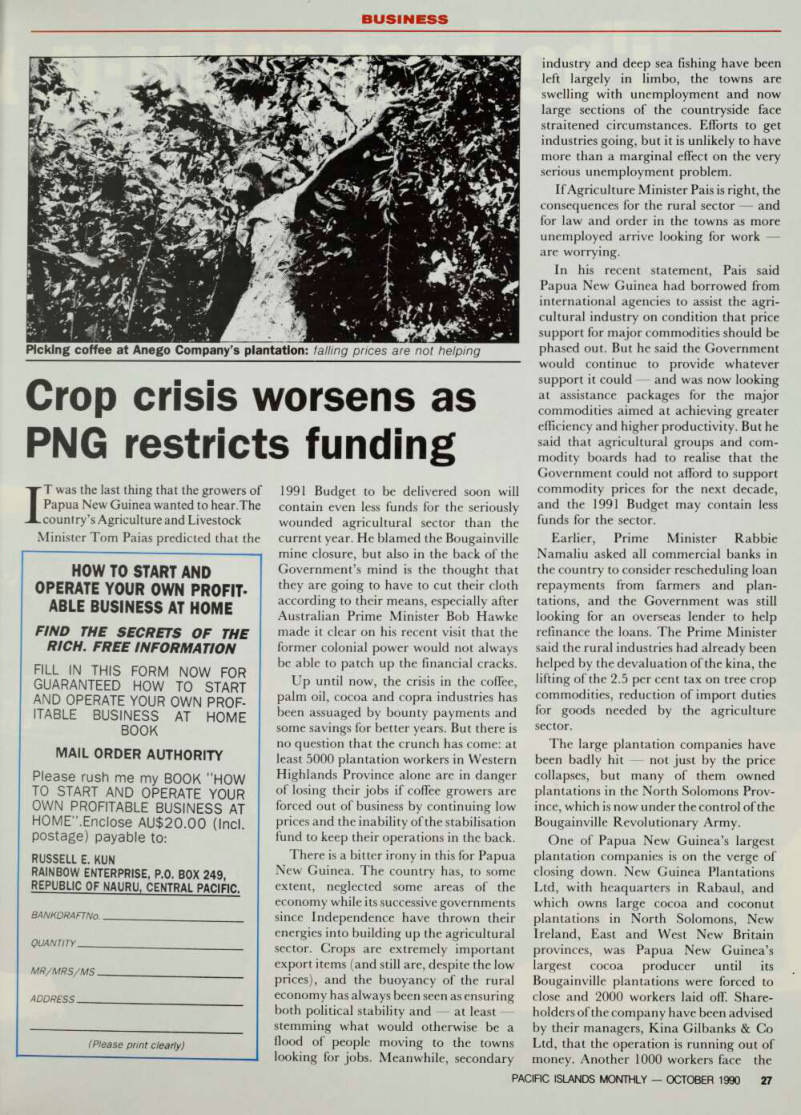


Crop crisis worsens as PNG restricts funding
IT was the last thing that the growers of Papua New Guinea wanted to hear. The country s Agriculture and Livestock Minister Tom Paias predicted that the
1991 Budget to be delivered soon will contain even less funds for the seriously wounded agricultural sector than the current year. He blamed the Bougainville mine closure, but also in the back of the Government’s mind is the thought that they are going to have to cut their cloth according to their means, especially after Australian Prime Minister Bob Hawke made it clear on his recent visit that the former colonial power would not always be able to patch up the financial cracks.
Up until now, the crisis in the coffee, palm oil, cocoa and copra industries has been assuaged by bounty payments and some savings for better years. But there is no question that the crunch has come: at least 5000 plantation workers in Western Highlands Province alone are in danger of losing their jobs if coffee growers are forced out of business by continuing low prices and the inability of the stabilisation fund to keep their operations in the back.
There is a bitter irony in this for Papua New Guinea. The country has, to some extent, neglected some areas of the economy while its successive governments since Independence have thrown their energies into building up the agricultural
sector. Crops are extremely important
export items (and still are, despite the low prices), and the buoyancy of the rural economy has always been seen as ensuring both political stability and at least stemming what would otherwise be a flood of people moving to the towns looking for jobs. Meanwhile, secondary
industry and deep sea fishing have been left largely in limbo, the towns are swelling with unemployment and now large sections of the countryside face straitened circumstances. Efforts to get industries going, but it is unlikely to have more than a marginal effect on the very
serious unemployment problem.
If Agriculture Minister Pais is right, the consequences for the rural sector and for law and order in the towns as more unemployed arrive looking for work are worrying.
In his recent statement, Pais said Papua New Guinea had borrowed from international agencies to assist the agri cultural industry on condition that price support for major commodities should be phased out. But he said the Government would continue to provide whatever support it could and was now looking at assistance packages for the major commodities aimed at achieving greater efficiency and higher productivity. But he said that agricultural groups and com modity boards had to realise that the Government could not afford to support commodity prices for the next decade, and the 1991 Budget may contain less funds for the sector.
Earlier, Prime Minister Rabbie Namaliu asked all commercial banks in the country to consider rescheduling loan repayments from farmers and plan tations, and the Government was still looking for an overseas lender to help refinance the loans. The Prime Minister said the rural industries had already been helped by the devaluation of the kina, the lifting of the 2.5 per cent tax on tree crop commodities, reduction of import duties for goods needed by the agriculture sector.
The large plantation companies have been badly hit not just by the price collapses, but many of them owned plantations in the North Solomons Prov ince, which is now under the control of the Bougainville Revolutionary Army.
One of Papua New Guinea’s largest plantation companies is on the verge of closing down. New Guinea Plantations Ltd, with heaquarters in Rabaul, and which owns large cocoa and coconut plantations in North Solomons, New Ireland, East and West New Britain provinces, was Papua New Guinea’s largest cocoa producer until its Bougainville plantations were forced to close and 2000 workers laid off. Share holders of the company have been advised by their managers, Kina Gilbanks & Co Ltd, that the operation is running out of money. Another 1000 workers face the
Picking coffee at Anego Company’s plantation: falling prices are not helping
sack if the other plantations close, too.
The company needed K 200,000 (USS 188,000) to keep it going until the end of 1990. New Guinea Plantations owes KlO million in outstanding loans.
Now the National Provident Fund
(NPF) is threaten ing to foreclose on New Guinea Plan tations Ltd which owes it KBOO,OOO, and also to take the same action against the simi larly named New Guinea Plan tations Holdings Ltd (for K 1.75 million),
Waimetke Ltd (K 250,000) and New Guinea Islands Produce Co Ltd (K 300,000). All these loans were made for plantation improvements in North Solomons, East and West New Britain.
NFP managers told Prliament’s Public Accounts Committee they were going to wind up these investments before the end of the year.
But committee members were angered to hear that former NFP attorney and now Member of Parliament Peter Garong had advised the fund against investing in plantations on the grounds that such a move was too risky. He also told the NFP board such investments would be illegal.
Auditor-General’s officials told the Public Accounts Committee that the money should instead have been placed in interest-bearing deposits where it would have been safe and at the same time earning income for the fund.
But the big question which remains unanswered is where the Government will find the money it needs to prevent the tree crop industries going bust.
Coffee Industry Board chairman Dekot Koki said the Coffee Stabilisation Board alone needed a KlO million injection. He expressed “grave concern and dismay” at the Government’s inability to help coffee growers, especially as it had recently handed K 4.5 million to copra growers (although the point should be made that the Copra Stabilisation Fund had run dry, while the coffee fund has enough to keep it going until the end of the year).
The coffee fund has Kl 4 million left, but
The low coffee prices and the current economic crisis are having a devastating impact on the economy’
that is being eked out by the recent halving of the bounty to growers, Koki has joined those who are warning of civil unrest, rampant unemployment and increasing crime if the industry which indirectly provides a million jobs
and is the third largest foreign exchange earner after copper and gold was neglected. “The low coffee prices and the current economic crisis are having a devastat
ing impact on the
economy of the country and, in
particular, on the economy of the High lands where 86 per cent of the crop is grown,” he said.
But he warned that the stabilisation fund could not support the coffee industry for much longer. While the International Coffee Organisation quota system was in limbo there was little prospect of a recovery in prices.
And Koki said most coffee plantations
and projects were not being managed
properly because managers were being squeezed by the Agriculture Bank’s strict lending policy and the high interest rates charged by the commercial banks. He warned that unless money was made available to keep the stabilisation fund going during 1991, many people now involved in the industry would be forced to earn a living illegally.
Joining the chorus of warning was the Plantations Management Agency. One of its officials, Philip Bobby, said that between 4000 and 5000 labourers in Western Highlands were in danger of losing their jobs if palntations closed, a prediction which confirms fears among provincial leaders that there will be major civil unrest if these people are suddenly
left without jobs.
Bobby said that under the current bounty of 35 toea per kilogram, it was impossible for coffee growers to recover expenses incurred in growing and har vesting the coffee beans. He urged a 15t increase to, at least, help growers break even. But the Planters’ Association stressed that all the major tree crops are facing a battle for survival as viable industries. The association said the situ ation was worst in East New Britain Province, where the cocoa and copra areas had been badly hit.
Executive Director David Loh said many plantations in that province had already closed the economic sitution being exacerbated by criminals having terrorised workers and managers on the plantations and this had in turn led to a business downturn in Rabaul. Loh estimated that 10,000 workers had been laid off, and this has resulted in “almost daily” criminal acts such as rape, armed hold-ups, harassment and intimidation.
“This is a desperate situation,” he said.
“People have decided to leave their plantations, the law and order situation is bad with managers and labourers being attacked every day.” He said he was getting depressed at all the problems in the industry, and he estimated the banks were owed about K4O million by plan tations which, despite losing money, were being asked to service these loans at high interest rates. He said the Government could help by reducing fuel prices, place a moratorium on loan repayments and help keep stabilisation funds at accept able levels.
Certainly, the Government in Port Moresby will come under increasing pressure to do something, even though its hands are tied financially. Typical of what Namaliu and his ministers will hear is the suggestion from Wapenamenda MP Masket langalio, who wants the Govern ment to seek soft loans from the World Bank and Asian Development Bank.D
Advertisements & other items, pp. 27-29 (1 item)
How To Start And
OPERATE YOUR OWN PROFIT-
ABLE BUSINESS AT HOME
FIND THE SECRETS OF THE
RICH. FREE INFORMATION
FILL IN THIS FORM NOW FOR
GUARANTEED HOW TO START
AND OPERATE YOUR OWN PROF-
ITABLE BUSINESS AT HOME
BOOK
MAIL ORDER AUTHORITY
Please rush me my BOOK "HOW
TO START AND OPERATE YOUR
OWN PROFITABLE BUSINESS AT
HOME”.Enclose AU$2O.OO (Incl. postage) payable to:
RUSSELL E. KUN
RAINBOW ENTERPRISE, P.O. BOX 249,
REPUBLIC OF NAURU. CENTRAL PACIFIC.
BANKDRAFTNO.
QUANTITY
MR/MRS/MS
ADDRESS
(Please print clearly)
w' The Toyota Hilux is the world’s most popular pick-up.
And the Hilux 4X4 is the best-selling Hilux of them all. Which stands to reason. People around the world respect Toyota’s attention to style. Hilux’s car-like comfort. Rugged reliability. And as you might expect from Toyota, power. This, of course, is the most important asset for a truck. And happily, the Hilux 4X4 offers a choice of four powerful engines: 2.8 and 2.4-litre diesel engines. Plus 2.2 and 1.8-litre petrol engines. When it comes to power and good looks, nobody can beat Toyota. Nobody.
TOYOTA
I mm t % * V ■ a -
Dispute over Mt Kare gold project
A FULL page advertisement ap peared in the Post Courier news paper claiming that there is a conpiracy to stop the Mt Kare alluvial gold project going ahead. It was signed by
members of the Kare-Puga Development Corp who have a joint venture agreement with the Australian mining company, CRA Ltd. The company said all local landowners agreed with the project. □
The Morobe mistrust
PAPUA New Guinea’s provincial government system has long drawn criticism from those who have been concerned at the way many of the administrations operate their finances.
The details of just how bad things can become have been outlined by an inquiry into the Morobe Provincial Government.
The inquiry uncovered serious breaches across the whole range of activities, including the disappearance of money from trust accounts with banks in Lae.
Overall, the problem centres on the fact that proper records were never kept with regard to government investments, and the inquiry was unable to find any instance in which those investments paid a dividend back to the provincial government. The Morobe Development Corporation, which deals in cocoa devel opment, egg production, property man agement and a trade store, has continu ously lost money; the government kept on injecting new capital in the form of loans for several years without inquiring as to the causes of the losses. At least one loan was interest-free with no terms of repayment stipulated.
The Morobe government had in vested K 265,000 (U 55260,100) in Kum- Gie Corporation, a property renting
enterprise, which also operated at a loss.
In the case of Yalu Plantation, which produced cocoa and copra, the report said that sales were inaddequate and wage records had not been kept. Several other companies had financial records which were inadequate or which showed substantial losses.
The investigators have recommended further inquiries into how public funds of K 320,500 allocated to the province’s Subsistence Agricultural Improvement Programme (SAIP) had been spent between 1986 and 1989. Receipts and documents on some advances could not be found. The report said the banks had been unco-operative in providing details of how funds were withdrawn and by whom.
As at 1989 only about KlOOO re mained in the six trust accounts (which were spread over three different banks in Lae: Bank of South Pacific, Westpac and the Papua New Guinea Banking Cor
poration).
Search warrants managed to produce only a handful of cheques from Banking Corporation, but they did reveal that two officers of SAIP received advances of
K 36,000 in total without having ac counted for previous advances. The investigators also found that advances intended for village demonstrators as payment for running courses were not paid to the people concerned instead signatures purporting to be those of the demonstrators were, in fact, those of SAIP officers.
The report also outlined other inconsistencies and irregularities.
Among them: “Our investigation (though not finalised at this stage) has unearthed evidence showing that vari ous payments totalling K 14,570 to a local trucking and building venture were made out of illegal awarding of con tracts, and other payments totalling K 14,636 paid to the same venture through sub-contracting arrange ments.”
The report also outlined what it called serious breaches of the Salaries Tribunal Act, including the provision of houses for ministers outside the terms of the Act.
There was also breaches of travel allow ances by provincial assembly members and provincial ministers, while the Premier and the Speaker had exceeded their limit for entertainment allowances which are set at K5OOO and KlOOO respectively. □
Good-news Pogera beats the odds
STAGE one of the giant Porgera project in Papua New Guinea has been completed and the first shipment of gold bullion despatched. That this has been achieved without any significant disputes with local landowners or labour problems, is possibly the most important aspect of this an nouncement. The news will lift the spirits of all resources companies operating in the country, coming as it does after all the bad news from Bougainville, which blighted the image of PNG around the world and has hurt other companies trying to raise loan money for projects, including the joint venture partners at the extraordinarily rich Lihir gold deposit.
The joint venture company has also revised resources at its mine upwards by 11 per cent and increased production forecasts. These latter have now been lifted to 900,000 ounces of gold a year over the first six years of mine life, at an average cash cost of about US$105 an ounce, which is at the lower end in world production terms. The average pro
duction cost over the mine’s life is projected at US$l5O an ounce. The previous forecast had been that Porgera would produce 800,000 ounces a year during the first six years. The new figures place the mine among the top six producers in the world.
The Porgera mine will not be operating at full capacity until the end of 1993. The project has measured and indicated min eral resources 0f99.25 million tonnes, but mineable reserves of 6 million tonnes of ore underground with an average grade of 25 grams per tonne (g/t), and open-cut potential of 50.5 million tonnes grading an average 4.07 g/t. The mine is expected to last 18 years and, all up, produce about 11 million ounces of gold. Porgera is a joint venture between subsidiary companies of Placer Pacific Ltd, High lands Gold Ltd and Renison Goldfields Consolidated Ltd (30 per cent each) with the PNG Government holding the re maining 10 per cent through its commer
cial arm, Mineral Resources Porgera Pty Ltd. The project’s general manager, Vic Botts, said that relations with local people had worked well. “So far, so good,” he said . Efforts had been made to keep landowners on side by assisting local people to set up businesses both to service contracts associated with the mine, and also other projects which included a hotel, commercial centre and a supermarket. The joint venture com pany was working with the Enga Provin cial Government to float anew enterprise which would serve as a business develop ment vehicle for the region.
Stage one of the project involves a 1500 tonnes a day plant which extracts about 60 per cent of the gold from the difficult to mill refactory ore. The high grade residue is being stored pending the completion of stage two in a year’s time, which is a pressure oxidation circuit to extact most of the remaining gold. The third and fourth stage involve the lifting of ore treatment to 4500 tonnes a day, then 8000 tonnes a day. The latter stages
of the project also involve the construc tion of a power line to bring electricity generated at the Hides gas field. The total cost of the project is now estimated at K 972 million (U 55908.6 million).
The big news from Porgera was quickly followed by an announcement from one of the mine’s partners, Highlands Gold, that it had earned a maiden profit totalling K 8.5 million after tax in the year to July 1. Highlands Gold is a subsidiary of the Australian mining giant MIM Holdings Ltd and its shares are listed on the Australian Stock Exchange. The com pany’s chairman, Norman Fussell, said that no dividend payments would be considered until Highlands Gold starts receiving cash flow from Porgera.
Highlands Gold revenue for the year totalled K 19.5 million, including the K 3.9 million refund of exploration costs when the PNG Government took up a 10 per cent share of Porgera. There were also net foreign exchange gains of K 7.9 million.
Highlands’ Astrolabe Analytical Div ision, which operates mining laboratories in Port Moresby, Lae and Madang, suffered a revenue drop which the company said reflected the general downturn in exploration activity in PNG and recorded a trading loss of K 216,000.
Apart from Porgera, the company has other interests in Papua New Guinea. In January it bought five prospects in East New Britain, including the Wild Dog prospect, from City Resources Ltd. It has 42.95 per cent of the Frieda River copper gold prospect, 27.65 per cent of the Ramu chromite-nickel-cobalt deposit and as well as 15 other gold properties. Fussell said the company would vigorously pur sue development and exploration to broaden its base in the PNG mining industry. □
Tonga’s royal shocker
FOREIGN businessmen with grandi ose plans are nothing new in the corridors of Tonga’s royal palace.
But American entreprenaur Matt Nilson and King Taufa’ahau Tupou IV have hatched a scheme which has left the international telecommunications world aghast. What has happened is that Tonga has used its rights as a sovereign nation to reserve the last 16 orbital slots which are available for communications satellites on paths which can offer links between the United States and the fast growing East Asian-Pacific Rim region.
The plan, apparently, is that Tonga will extract impressive revenue from hiring out the slots: without those slots, no intending communications operation can launch any more satellites to cover the Pacific.
Nilson, who heads a telecommuni cations research company based in San Diego, now holds the whip hand. While
industry officials are, by turns, incredulous and outraged, there is nothing wrong with what Tonga has done.
Under the rules of the
119-nation Intelsat consortium, any sov ereign nation can reserve orbital slots at no cost. Nilson said Tonga could lease some of the slots for US$2 million a year.
The idea was Nilson’s, who retired to Tonga three years ago.
The American businessman owns 20 per cent on Tongasat, the government controlled company set up to administer the Tonga’s sudden bargaining chip in space. The company has six employees, little money and very modest offices. It has indicated it might seek partners to raise the US$4OO million needed to launch its own satellite. Its 16 slots cover positions in space which provide a combined satellite footprint over more than 60 countries, spacing from the U.S.
The slots give a combined footprint over 60 countries
to Iran, and encompassing most of Asia.
Most important, there are no other vacant orbiting positions for companies wanting to provide radio, television and telecommunications links between Asia and the U.S.
Parking slots are limited by inter national law to prevent satellite signals interfering with each other. Intelsat is taking the line that the Tonga Govern ment is nothing more than a front for Nilson and financial speculation. It seems unlikely that Tonga would control its own satellites as Tongasat maintains; more likely it would prefer to rent out the spaces for a dependable annual income.
The problem for Intelsat is that what the South Pacific nation has done is perfectly legal, and there will be no chance to change the rules until 1992 when the next World Administrative Radio Confer ence is due to be held.
Meantime, Intelsat said it wants to pursue changes in global communi cations law to pre vent Tonga selling
for profit much prized orbital slots. The director-general of Intelsat has asked the International Telecommunications Union to consider actions “necessary to prevent such abuses from occuring”. He accused Tongasat of attempting “pecuniary gain and commercial exploi tation” and that the organisation planned to undermine ITC practices by letting the slots go to the highest bidders.
But it still comes back to the bottom line that a small South Pacific nation now controls any future satellite develop ments over an area containing two thirds of the world’s population. Traffic via satellite between Asia and the U.S. now produces annual revenues of more than US$2 billion a year. □
Making investment safer
AUSTRALIAN investment in Papua New Guinea is to be safeguarded under a new commercial treaty signed by both countries during Prime Minister Bob Hawke’s recent visit to Port Moresby. The treaty was drawn up against a background of increased Australian apprehension about investing in Papua New Guinea following the closure of the Boueainville copper mine, and the general lawlessness and
political capriciousness in some quarters. The Promotion and Protection of Investment Agreement is designed to provide greater security for Australian companies operating in Papua New Guinea, and included in its terms is a financial guarantee against the threat of nationalisation. Also, Australian companies will be able to import capital and skilled labour more easily to develop projects. A problem for many expatriate companies is obtaining work visas for foreign staff, with often weeks and months of delays involved. Australian firms invested about US$l.63 million in PNG last year. D
Advertisements & other items, p. 32 (1 item)
Business
Bums Philp’s profits up
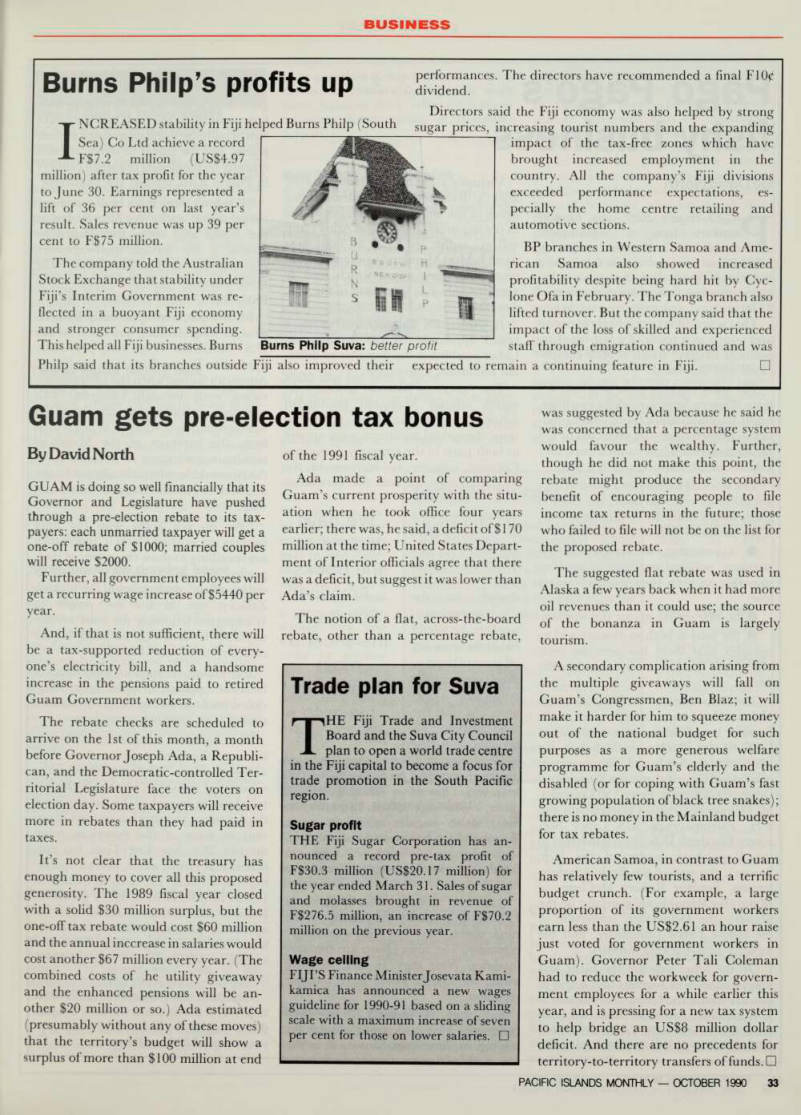
INCREASED stability in Fiji helped Burns Philp (South Sea) Co Ltd achieve a record F 57.2 million (U 554.97
million) after tax profit for the year to June 30. Earnings represented a lift of 36 per cent on last year’s result. Sales revenue was up 39 per cent to Fs7s million.
The company told the Australian Stock Exchange that stability under Fiji’s Interim Government was re flected in a buoyant Fiji economy and stronger consumer spending.
This helped all Fiji businesses. Burns
performances. The directors have recommended a final dividend.
Directors said the Fiji economy was also helped by strong sugar prices, increasing tourist numbers and the expanding
impact of the tax-free zones which have brought increased employment in the country. All the company’s Fiji divisions exceeded performance expectations, es pecially the home centre retailing and automotive sections.
BP branches in Western Samoa and Ame rican Samoa also showed increased profitability despite being hard hit by Cyc lone Ofa iii February. The Tonga branch also lifted turnover. But the company said that the impact of the loss of skilled and experienced staff through emigration continued and was
Philp said that its branches outside Fiji also improved their expected to remain a continuing feature in Fiji.
Burns Philp Suva: better profit
Guam gets pre-election tax bonus
By David North
GUAM is doing so well financially that its Governor and Legislature have pushed through a pre-election rebate to its tax payers: each unmarried taxpayer will get a one-off rebate of $1000; married couples will receive $2OOO.
Further, all government employees will get a recurring wage increase of $5440 per year.
And, if that is not sufficient, there will be a tax-supported reduction of every one’s electricity bill, and a handsome increase in the pensions paid to retired Guam Government workers.
The rebate checks are scheduled to arrive on the Ist of this month, a month before Governor Joseph Ada, a Republi can, and the Democratic-controlled Ter ritorial Legislature face the voters on election day. Some taxpayers will receive more in rebates than they had paid in taxes.
It’s not clear that the treasury has enough money to cover all this proposed generosity. The 1989 fiscal year closed with a solid $3O million surplus, but the one-off tax rebate would cost $6O million and the annual inccrease in salaries would cost another $67 million every year. (The combined costs of he utility giveaway and the enhanced pensions will be an other $2O million or so.) Ada estimated (presumably without any of these moves) that the territory’s budget will show a surplus of more than $lOO million at end
of the 1991 fiscal year.
Ada made a point of comparing Guam’s current prosperity with the situ ation when he took office four years earlier; there was, he said, a deficit ofsl 70 million at the time; United States Depart ment of Interior officials agree that there was a deficit, but suggest it was lower than Ada’s claim.
The notion of a flat, across-the-board rebate, other than a percentage rebate,
was suggested by Ada because he said he was concerned that a percentage system would favour the wealthy. Further, though he did not make this point, the rebate might produce the secondary benefit of encouraging people to file income tax returns in the future; those who failed to file will not be on the list for the proposed rebate.
The suggested flat rebate was used in Alaska a few years back when it had more oil revenues than it could use; the source of the bonanza in Guam is largely tourism.
A secondary complication arising from the multiple giveaways will fall on Guam’s Congressmen, Ben Blaz; it will make it harder for him to squeeze money out of the national budget for such purposes as a more generous welfare programme for Guam’s elderly and the disabled (or for coping with Guam’s fast growing population of black tree snakes); there is no money in the Mainland budget for tax rebates.
American Samoa, in contrast to Guam has relatively few tourists, and a terrific budget crunch. (For example, a large proportion of its government workers earn less than the US$2.6l an hour raise just voted for government workers in Guam). Governor Peter Tali Coleman had to reduce the workweek for govern ment employees for a while earlier this year, and is pressing for a new tax system to help bridge an US$B million dollar deficit. And there are no precedents for territory-to-territory transfers of funds. □
Trade plan for Suva
THE Fiji Trade and Investment Board and the Suva City Council plan to open a world trade centre in the Fiji capital to become a focus for trade promotion in the South Pacific region.
Sugar profit THE Fiji Sugar Corporation has an nounced a record pre-tax profit of F 530.3 million (U 5520.17 million) for the year ended March 31. Sales of sugar and molasses brought in revenue of F 5276.5 million, an increase of F 570.2 million on the previous year.
Wage ceiling FIJI’S Finance Ministerjosevata Kami kamica has announced a new wages guideline for 1990-91 based on a sliding scale with a maximum increase of seven per cent for those on lower salaries. □
fishy business
Pago Pago’s fishy business
By David North
PAGO Pago’s 3600 tuna cannery workers have a Washington established minimum wage of US$2.B2 an hour and are, in fact, paid a little more than that. America’s other factory workers have a minimum wage of $3.80 an hour, and most are paid more.
That wage difference is likely to persist and widen as a result of a fast-breaking political struggle which is both compli cated and one-sided.
The tuna workers, most of whom are from Western Samoa, work for two huge, multi-national corporations whose prod uct - canned tuna —is protected by US tariffs. Americans love canned tuna, they buy about $l.B billion worth a year.
The workers would like a raise. If they got 80 more cents an hour, the 3600 of them would share $5.76 million a year.
They probably will not get it. Why? • a powerful, well-connected, bi partisan, political coalition is working smoothly to keep tuna workers’ wages low. • no one speaks up for the workers • the issue is both so obscure and so complex that there has been no press attention the process is going on in the dark.
The firms involved are US-based HJ.
Heinz Company, which packs the Starkist brand, and Indonesian-owned VCS Samoa Packing, which has the Chicken of the Sea brand. The players on one side of the issue are: the Republican Governor of Samoa, Peter T ali Coleman, his Democratic rival, Congressman Eni F.H. Faleomaveaga, US Labor Sec retary Elizabeth Dole (who is married to the Republican leader of the U.S.
Senate), the rest of the Bush Adminis tration, Senator Robert McClure, of Idaho (the Republican’ specialist on the islands), the Democratic leadership of the House Labor Committee, and the wealthy tuna-packing industry.
On the other side are the silent and unorganised tuna workers and a trio of obscure Mainland labour leaders: one is in Washington, while the other two, both Irish-Americans, both Teamsters Union officials, work in Boston and New York.
Virtually all U.S, Mainland workers,
after a Reagan-imposed, decade-long
freeze in the minimum wage, got a raise in the minimum to $3.80 on April 1 and will get anther, to $4.25 an hour next April 1. Most Mainland workers are paid more than these rates, which tend to apply to only 4 5 per cent of the U.S. workforce.
In American Samoa, two years, a
board appointed by the Secretary of
Labor establishes the dozen or so differ ent minimum wages there.
The American Samoan economy re volves around Mainland tax-funded subsidies, and the Mainland appetite for tuna; the special minimum wage applies to both parts of the economy. Governor Coleman opposes an increase in the minimum wage for both the Territory’s
own employees and those working at the tuna canneries. If the minimum wage were raised sharply for the
government’s
workers, he would either have to lay off some of them or raise taxes, neither
politically desir
able. As for the tuna workers, his concern, and that
‘We have looked at the books ... American Samoa is the second most expensive place to pack tuna’
of Congressman Faleomavaega, is based on the threats laid on by the canneries: keep wages low or we will move jobs to other, lower-wage islands. In contrast to his position on the minimum wage, Faleomavaega has pressed the canneries to provide paid holidays and vacations for their workers but without results so far, American Samoa, lulled by generous U.S. funding and by the presence of the tuna plants, has an otherwise sleepy economy. The tuna plants are the only factories. Were they, in fact, to move away, the islands would have a major recession.
But that is unlikely. The tuna companies have two strong reasons for staying in American Samoa; it is the
cheapest place under the American flag to pack tuna and the flagged location gives them protective tariffs ranging from 6 per cent to 30 per cent; and they have tens of millions of dollars invested in their plants. But the threat to move, stressed recently by the closing of a small cannery in Puerto Rico, terrifies the politicians.
“We don’t think it is a bluff,” said one congressional staff. “We have looked at the books and know that American Samoa is the second most-expensive place in the world to pack tuna.” The most expensive is Puerto Rico, which pays the Mainland minimum wage.
Meanwhile, and apparently by acci dent, a long-standing provision in the U.S. Minimum Wage Act, previously applied to Puerto Rico, was applied to American Samoa when the 1989 amend ments went through Congress. This provision requires that an American Samoan employer wanting to be excused from the coverage of the Mainland minimum must open its books to show that it would be adversely affected by the application of the regular minimum wage.
“We do not know why the tuna packers are worried about it, unless they are unwilling to show the extent of their profits,’’said John Zalusky, a labour union official dealing with the matter.
Zalusky, one of the few people in Washington following the issue for the workers, is with the national labour confederation, the AFL-CIO.
If anything, the tuna industry seems to be more opposed to opening its long closed books in its Pago Pago operations than it is to granting a pay raise.
The American tuna industry is in a stronger financial position than it is willing to admit. While there has been a substantial growth in imports in the last two decades, in each of the last five years the American industry has secured 70 per cent or more of the American retail market. The New York Times has esti mated that Heinz, alone, had an operat ing profit from its tuna activities of U. 5.5145 million in 1989. A glance at Heinz’s annual report shows that its operating profits are about twice the level of the firm’s net profits, so this would suggest a net profit on tuna of $72.5 million.
Compare, then, the cost of the 80-cent raise for all the Samoan workers, not just those working for Heinz: $5.76 million a year versus $72.5 million. □
Solomon Islands
Trade Winds
New choice on coffee tables CONSUMERS in the Solomon Islands now have a local brand of coffee on their supermarket shelves. A growers’ co operative on the island of Santa Isabel has
begun shipping beans to the capital,
Honiara, where they are ground and packed into 200 g bags under the brand name of Solomons Choice. The venture is a result of the initiative of the Kolomola Association of Isabel whose members now hope that other local farmers will begin planting coffee. The first objective is to establish regularity of supply to the shops in Honiara, and then look at exporting the coffee.
Taiwan hooks fishing deal TAIWAN has signed a deal with the Solomon Islands allowing its boats to fish in Solomons waters for the next three years.
The agreement allows 20 boats to fish for the first year. Each boat will pay an annual fee of SIS 1270 (US$5OO) and will be allowed to take only 1500 metric tonnes of fish a year. All the vessels will be under the control of the Kaohsiung Fishermen’s Association. The agreement came after three years of negotiations.
Hydro power on drawing board SOLOMON Islands is planning to build its first hydro electric power station. The project, estimated to cost US$26 million, will involve diverting the Komarindi River on .Guadalcanal. The water is to be diverted by a weir and intake structure, through a 2.2 km tunnel. There will be no water storage, which means that it will run at well below its generating capacity in the dry season. During that time the existing diesel generators can be used to supplement
supply.
The station, which will be able to generate up to 4.75 megawatts, is designed to relieve the country’s dependence on
increasingly expensice imported fuel for
Honiara’s power supply. Initial design work costing US$l.3 million is beingh paid for by the Asian Development Bank.
Japanese miffed over boat sales REPORTS from Honiara suggest that the Japanese Government is upset that vessels given to the Solomon Islands under an aid package have been sold without consul tation. The vessels were part of the National Fisheries Development company sold to Canada’s British Columbia Packers
recently.
The ships were donated by Japan, with a clause in the agreement requiring Tokyo
to be consulted if they were sold. There is concern in Honiara that the sale might cause Japan to delay other aid schemes, including the upgrading of Henderson
Airport.
New button factory opens A JOINT venture between South Korea and the Solomon Islands has resulted in the opening of a button blanks factory in Honiara. The new company, Solko Co Ltd, is expected to produce about SIS 1.9 million (U 55745,000) worth of blank buttons this year, with production leaping to SIS 15.9 million next year. The plant uses trochus and other shells found in Guadalcanal and Western Province. The end product is exported, mainly to South Korea. 3000 dig for fool’s gold POLICE in East New Britain had to move in the Kerevat-Mediva River area to disperse more than 3000 people who had
pitched camp and mining what they
thought was gold.
It was iron pyrites (usually known as fool’s gold).
Witnesses say that in the past two months prospectors have gauged the lo cal hillsides. The rush began when a local villager found a piece of yellow, shining rock and was later told it could be genuine gold. Before long, truckloads of people were arriv ing in the area to pan for the metal.
Advertisements & other items, p. 35 (1 item)
Png
Germans join cement project
MADANG Premier Andrew Ariako said he was awaiting the arrival of German financiers to discuss the funding of a cement factory in the province. He said the Saidor project had received the blessing of the national government in the form of a K 1.5 million (USSI.4I million) guarantee to the provincial administration. The proposal is for the German partners and the Madang provincial government to each own 25 per cent with the remaining equity being held by local councils in the province.
Row over Mt Kare gold A FULL page advertisement appeared in the Post Courier newspaper claiming that there is a conpiracy to stop the Mt Kare
alluvial gold project from going ahead. It was signed by members of the Kare-Puga
Development Corp who have a joint
venture agreement with the Australian mining company, CRA Ltd. The members of the company said all local landowners agreed with the project. This follows
growing opposition from Enga provincial
politicians, and also from Justice Minister Bernard Narokobi who has urged that CRA be denied a special mining lease.
Reports suggest the opposition is largely an expression of dislike for CRA because of its association with the closure of the Panguna
copper mine on Bougainville (CRA being
the major shareholder in Bogainville Cop
per Ltd).
Central plans new log scheme CENTRAL Province is to introduce a logging scheme whereby customary land owners will be encouraged to log their timber resources by themselves rather than depend on expatriate contractors. The local people will be trained to use logging
and sawmilling equipment made available to them under a time pay ment system. The sawm timber will be taken to Port Moresby for pro cessing.
Voko eyes Lae A FIJI company is looking at establish ing a fish cannery in Papua New Guinea in an effort to corner some of the country’s annual USS2S million tinned fish market.
Voko Industries Ltd recently sent executives to Lae.
The company operates a cannery at Lami, outside Suva. Its domestic market is smaller than the potential in Papua New Guinea.
Iniatially, Voko plans to export canned fish to Papua New Guinea once extenstions to its existing factory are completed.
Coffee pulp turns useful Papua New Guinea’s Coffee Research Institute at Aiyura, in Eastern Highlands, has developed a machine which turns coffee pulp waste into fertiliser.
The plant, which is still at the pilot stage, first composts the pulp, then pumps it into ponds as liquid. Research staff at the institute said that more work is needed to modify the process so that it is suitable for smallholder use.
Samoan merger
WESTERN Samoa has merged the Economic Development Board and the Commerce Board to form the Department of Trade, Industry and Commerce. Finance Minister Tuilaepa Sailele said the move helps the push for new overseas trade and markets.
Mineral million JAPAN is providing Fs3 million (USSI.99 million (over the next three years to aid mineral exploration on Fiji’s main island of Viti Levu. The Fiji mineral survey is one of 15 which the Metal Mining Agency of Japan is carrying out in developing countries. □
Copra prices dive
Tonga
TONGA has abandoned exporting copra due to poor world prices. Many farmers have quit the copra business, and the Tonga Commodities Board is now process ing copra locally and exporting only coconut oil, mostly to Australia and New Zealand. In six months to May, the price for A grade copra dropped from Ts2so (US$2O4) to Ts2oo. The board attributes the continuing decline to the increasing preference for vegetable oils.
U.S. buys 3 tuna boats THE United States Agency for Inter national Development(USAlD) will pro vide T 52.9 million (U 552.37 million) to allow Tonga to buy three long-line tuna boats and train the crews. Experts will also assess Tonga’s fish stock and establish a sustainable yield rate.
Big plans for pumpkins PUMPKIN producers in Tonga are plan ning to export more than 6000 tonnes of the vegetable to Japan this year nearly twice the T 52.4 million worth shipped out last season. Two growers’ groups are involved, and planting has been extended to ensure that a good crop is available. The success of the 1989 season saw the number of pumpkin growers increase from 165 to 385.
Vanilla boom expected VAVA’U growers are expecting a record vanilla harvest this year with a total crop estimated at 45 tonnes, worth nearly Tss million (US$4.OB million). At least 1000 growers are involved in the crop on the island and 510 hectares has been planted.
Niue
Garments get mixed views HONG Kong clothing manufacturer David Lee has proposed a clothing factory on Niue which will employ 1000 imported Chinese workers and 500 Niueans. Lee has had talks with the island’s government and said he wanted to manufacture jeans for sale on the international market. He has looked at several possible factory sites including a now disused Government farm.
But while Finance and Economic Develop ment Minister Sani Lakatani has wel comed the economic benefits such a project would bring to Niue, Opposition leader Young Vivian said the planned factory was too big for a country with a population of
2000. There are also indications that local people are concerned at the thought of 1000 immigrant workers settling on the island.
Budget aims to create jobs HELP for the private sector to provide employment for school leavers is part of the NZ$lB million (US$lO.9 million) Budget just finalised by the Niue Government. The move reflects the administration’s attempt to prevent unemployed school leavers migrating to New Zealand. Tourism devel opment is also given high priority in the Budget.
Vanuatu
Names get new $4O charge AN annual charge of Vtsooo (US$4O) has been introduced in Vanuatu under a new Business Names Act which came into effect on the Ist of this month.
Maritime regulations changed
PACIFIC International Trust Company reports important changes have been made in Vanuatu’s maritime regulations, many of them aimed at making the legislation clearer and easier to comply with. There is also now to be a levy on ships registered in Port Vila. This new levy will cover the costs of marine investigation, nautical training and international participation. The levy is SUS72S a year plus four cents per tonne of a vessel’s registered tonnage, the total being payable on an annual basis.
Cook Islands
Air New Zealand flies new link AIR New Zealand is to provide a Boeing 767 service from Rarotonga to Honolulu and Los Angeles, so offering competition to Hawaiian Airlines which now operates Honolulu-Rarotonga. The service is to begin on November 8. The announcement was welcomed by local business groups as a boost to tourism. But Air Rarotonga complained, saying it believed it had the first option on air rights out of Rarotonga to either Honolulu or Papeete.
Fiji
Cocoa output doubles FIJI’S cocoa growers produced 250 tonnes of beans in the first half of this year. While that is a tiny amount by any standard, the significant point is that it was double the quantity produced in the same period last
year. The increase was due to new cocoa plants bearing pods for the first time and to improved management by growers. The greater attention paid by farmers to harvesting, drying and storage of beans resulted in 90 per cent of the crop being placed in Grade 1.
The beans were exported to Britain, New Zealand and the Netherlands and earned F 5400,000 ($U5279,000).
Tenders called for Malaysian oil OIL companies in Fiji have been asked to tender for the processing of crude oil from Malaysia. The successful tenderer will be responsible for the transport of crude oil from Port Kerten in Malaysia and process it ready for distribution. Fiji has agreed to buy 10,000 barrels a day from Malaysia.
Air deal with Marshalls signed AIR Marshall Islands will be permitted to operate into Nadi from Honolulu under a new agreement between the Marshalls and Fiji. The new service will depend upon the
airline obtaining landing rights in
Honolulu for the service it already flies out of the Hawaiian capital to Majuro. The new agreement provides that Air Marshall Islands and a Fiji carrier can operate on the Nadi-Majuro corridor, with stops at Tarawa, in Kiribati.
Tradewinds Hotel sold THE 100-room Tradewinds Hotel in Lami, outside Suva, has been bought from Fiji National Provident Fund by Reg Rafe, who runs the Plantation Island Resort in the Mamanuca Group and the Raffles Gateway at Nadi. The hotel needs major
repairs.
Samoa
Downer wins hydro contract THE large New Zealand civil engineering and building contracting firm, Downer and Co, is to build a new hydro-electric power station in Western Samoa. It is the country’s largest scheme yet and will cost NZ$2O million (US$l2.2 million). The project will be a joint venture between Downer and the West German firm of Josep Riepl with Downer being the managing partner.
Imports kill local matches CHEAP imports has forced Western Samoa’s match factory out of business.
Polynesian Match Ltd was left with insuf ficient money to pay off the staff of 40, but has stock worth WS$9O,OOO (U 5537,350), more than enough to clear the company’s bank overdraft.
Bougainville
Shipping
We’ll sail for Bougainville
CONSORT Coastal Shipping has an nounced it is willing to restore shipping links with Bougainville which has been cut off sinsce May when the Port Moresby government imposed a naval blockade on the island. The company’s general manager Papua New Guinea, Peter Kvam, said: “It is not true that shipping companies like ourselves have refused to resume shipping services to Bougainville. Consort Shipping is keen to go into Bougainville.”
The restoration of shipping links to Bougainville was part of the agreement reached at the August peace talks be tween the Government and representa tives of the Bougainville Revolutionary Army which has declared the island independent. Shipping companies were recently criticised by the Secretary of the Prime Minister’s Department and chair man of the committee overseeing the preparations to restore services to Bougainville, Paul Bengo. He said ship ping companies were reluctant to service the island.
Kvam said shipping services to
Bougainville could be restored without difficulty. But he pointed out that the Government must first declare the end of the blockade and officially open shipping links again. The order of a blockade “was indefinite and until it is withdrawn by the government we cannot do anything”, he said. “We are willing to pick up services again when the Government gets its act together. Another thing the Government has to do now is coordinate what we can take into Bougainville, say freight of up to 200 tonnes of foodstuff supplies to make the runs worthwhile.” □
Government rescue
THE Western Samoa Government is stepping in to rescue a boat-building scheme which looked to have been scuppered by increasing costs. It will inject WS$ 140,000 (U 55593,000) to make up the shortfall cost off the 17 aluminium catamaran fishing boats. The cost had drisen from US$6OOO to almost double that amount. The Government will take the money from the fisheries revolving fund and from Agriculture Department funds. □
big registry deal
Marshalls clinch big registry deal
THE Marshall Islands ship registry cashed in on the civil war in Liberia and clinched a bumper deal last month that is expected to bring in millions ofdollars.
The deal, announced by Marshalls ship registry commissioner Howard Zeder, creates a partnership with the Liberian ship registry, the largest in the world.
Marshalls’ new partner in Trust Company of the Marshall islands, is United States Life Insurance (USLI), which is based in Reston, Virginia. It owns the Liberian registry company.
Said Zeder: “The Marshalls is very secure, politically stable and economi cally predictable at least for the next 12 years. We have a good reputation, we’ve had no casualities. And we’re part of the U.S. Effective Control Fleet, which is very important for American shippers. We’ve got all the right components.’’(Ships registered in the Marshalls come under the protection of the American flag).
The Liberian registry has 65 million tonnes of ships compared to four million in the Marshalls. □
Advertisements & other items, pp. 37-38 (1 item)
Bali
FIJI
TONGA
KIRIBATI
VANUATU
COOK ISLAND
SOLOMON ISLANDS
NEW CALEDONIA
U.S. SAMOA
WESTERN SAMOA
FRENCH POLYNESIA
JAPAN . KOREA
YOU’LL FIND IT,
WHERE THE SKY MEETS
THE SEA
fj?
RORO, CONTAINER &
B.BULK SHIPPING
BALI
1 M Efl
AGENTS
and
PHONE
SUVArßurns Philp(B.P) 311 777 Carpenter Shipping (C S) 312244 LAUTOKA:B P 60777 C S 63988 APIA:B P 22611 PAGOPAGO Polynesia 1 „o«r*»7r n :COmPa ,| n,e Mari,imc POlyneSiCnne 42 84 02 N OUMEA:Etablissefnents Brands 687 283384 Nuiu*LOM BP 2?50C lusan?o, A "* :Sul ,vans (Solomon Islands) Lid 21645 TARAWA:Shlpping Corporation ol Kiribati 26195 Co Ud 778 7650 l£.n,Tpp!£ cTud ' LW ' 753 -° 4s ’ Pa " *>*«"■ JAPAN:(or general cargo Swire 03-230-9245 lor vehicle NYK Lines 03-284-5506 Mitsui O S K 03-587-7123
FORUM SECRETARIAT
VACANCIES
Applications are invited from suitably qualified and experienced persons, who must be citizens of a member state of the south Pacific Forum, for the following positions with the Forum Secretariat.
The Forum Secretariat was established in 1973 by the South Pacific forum to encourage economic and political cooperation between its member states, and between those states and the more industrialised countries. Under the control of a Secretary General, the Secretariat undertakes a regional work programme covering economic services, legal and political services and the energy, tourism, trade, transport and telecommunications sectors. The Secretariat also has significant responsibilities with regard to ACP/ EC regional projects funded under Lome conventions.
PROJECT OFFICER-CIVIL AVAITION
The successful applicant will be responsible to the Head of the South Pacific Regional Civil Aviation Development Programme and will assist with the preparation, coordination and implementation of that Programme as well as with EC-funded civil aviation projects and with other regional aviation and airline related activities as directed.
He/she may be required from time to time to travel to Forum member countries for consultations on matters relevant to the Programme and/or EC-funded projects, and may also be required to liaise and consult with donors, where appropriate.
Preference will be given to a mature and responsible person with at least five years’ work experience at senior level in government or private sectors and with a degree, or equivalent qualification, in a discipline such as civil aviation, civil engineering or economics. Experience in the South Pacific region will be highly regarded, as will a demonstrated knowledge of the economic, social and political factors affecting regional development, particularly in the transport sector.
MANAGER, INFORMATION SERVICES
The Manager, Information Services, will head a small Unit with overall responsibilty for information and publications, library and statistical services for the Secretariat. More particularly, the appointee will be required to strengthen and maintain effective information, publicity and publications services covering all aspects of the Secretariat’s activities as well as meet specific requests of member countries. This will include the production of publications such as newsletters, annual reports, brochures and other promotional material, editing and proofreading, public relations duties and liaising with news media.
This is an exciting opportunity for an experienced and versatile person to make a substantial contribution to public and governmental awareness of the role of the South Pacific Forum. Applicants should have relevant tertiary qualifications, and/or equivalent experience, in a field such as publications, media, information or public relations.
Leadership qualities, sound writing and oral communications skills, and at least a working knowledge of editing, typesetting, layout and production, are pre-requisites, while applicants with a proven understanding of the cultural sensitivities of the region, and of the political and economic factors affecting its development, will be most favourably regarded.
General Information
This appointmant will carry an attractive remuneration package, payable in Fiji dollars.
For non-Fiji citizens this is tax free and includes housing or housing allowance, education and child allowances. Other benefits include superannuation payments and medical, life and travel insurance coverage. The appointee will be based at the Secretariat’s Headquarters in Suva, Fiji. Appointment would be for three years initially, renewable by mutual agreement.
Applications, which close on 30 November 1990, should contain full information on education and career background and should list names, addresses and telephone numbers of at least three referees with whom the applicant has been associated in a professional capacity. Applications should be addressed to: The Secretary General Forum Secretariat GPO Box 856 Suva, Fiji Telephone: 312600 Telex: 2229 FJ Fax: 302204/301102 Further information is available on request and all enquiries should be made to Mrs Lailun Khan, Administration Officer on 312600 Ext. 263.
Member countries are: Australia, Cook Islands, Federated States of Micronesia, Fiji, Kiribati, Marshall Islands, Nauru, New Zealand, Niue, Papua New Guinea, Solomon Islands, Tonga, Tuvalu, Vanuatu and Western Samoa.
money belong?
Relations
To whom does this money belong?
ONCE the United States has agreed to fund a Pacific Islands activity, who decides how the money should be spent? How much control should the US continue to have over these decisions?
These questions, debated for years in Guam, the Marianas, Palau, and Ameri can Samoa, have now popped up on Bikini Atoll, in the Marshalls, where a US$9O million trust fund provides ample
opportunities for disagreement.
The money was allocated by Congress in 1988 to rehabilitate that much bombed island and nearby Eneu, and to finance the re-population of the islands.
In return for the money, the 1500 or so Bikinians, now living elsewhere, agreed to drop all lawsuits against the US Govern ment which set off some 23 nuclear bombs on those islands between 1946 and 1958.
In the spirit of the Compact of Free Association signed earlier between the Marshalls and the United States, the Congress decided to end the controversy over the islands by paying, over a period of five years, the $9O million. But the Congress also in
corporated language, now under dispute, giv ing the US Depart ment of Interior some say in the actual expenditure of the funds.
Is detailed monitoring a return to the days of colonialism?
Perhaps burned by reports by the Congressional watchdog agency, the General Accounting Office, that it was letting the Government of Palau run wild with federal funds, the Department of Interior took a look at the Bikini Trust Fund expenditures earlier this year and cracked down on its fiscal practices. From now on the Department insists that it must approve all expenditure in excess of SI 00,000.
Two financial decisions made by the Trust Fund set the Department’s teeth on edge. First was a decision to spend 52.2 million (later reduced to SI.B million) on a one-year lease of certain Bikini land which will be used for the reconstruction of roads, the expansion of the airport, and for the site of a power plant.
The second was the basic imbalance of the books (in Interior’s eyes) with the
Trust Fund spending some $4.5 million more than its income in the year in
question.
Although it has not said so in so many words, the concept of leasing lands for roads is as foreign to Mainland officials as
the concept of selling land is in the islands. On the Mainland, units ofgovern ment buy land for roads.
Further, and openly, Interior officials said that the decision to provide to
the landowning clans, through the Bikini Council, the $2.2 or $l.B million was little more than a pass through of funds to the 1500 residents, and it certainly had not been cleared with Interior. The payment would not result in any improvement to Bikini, it would simply provide money to Bikinians before they return to the island.
The precedent of spending $l.B million to lease the land for public use for one year is an interesting one; if the $9O million fund produces income at the rate of 6 per cent, then it would provide $5.4 million a year. At $ 1.8 million a year, fully a third of the anticipated income of the fund (assuming that none of the principal were used) would be spent each year on land rental; if some part of the principal were spent, then an even larger portion of the income would be used for these transfer payments.
But to what extent should Uncle Sam micro-manage funds already allocated to island activities? Is the trend towards detailed monitoring of expenditures simply a return to the bad old days of colonialism?
Looking ahead, the Bikini Council’s Washington lawyer, Jonathan Weisgall, said that the Council should have the freedom to figure out how to clean up and re-occupy the islands. He said that the islanders, who are getting some high powered scientific advice on the question, have two basic alternatives: • they can scrape the top soil off the islands and replace it with good, uncontaminated soil from somewhere else, or • they can leave the current soil in place, and distribute large quantities of potassium-rich fertilizer, like that mined on Nauru.
The point of the fertilizer is that it would block the uptake of the radio active ingredient cesium-137 into the islands’ coconut palms and other plants.
Bikini is currently habitable if those living there ate imported food out of cans.
The islanders are getting top advice
Without the blocking fertilizer, or new top soil, the inhabitants would be hurt by the contamination were they to start eating coconuts and other locally-grown fruits and vegetables.
The basic decision on new topsoil or
fertilizer is just the first of a series of decisions that need to be made, and these should be made by the islanders, says Weisgall. He says that the Bikini Council is perfectly
happy to have Department of Interior scientists continue to monitor radiation levels on the islands, and for the islanders to set aside (at Trust Fund expense) some land for these studies. But, he said, the Department should not overplay its hand.
He views the role of Interior as “minis terial only”, and it should only come into play if the Bikini Council starts using its money for totally frivolous purposes.
Negotiations are continuing between the Council and the Department on how to manage the trust fund on a proposed budget of some $4 million for infrastruc ture construction. Meanwhile, the people ofßikini, now on Kili and Ejit Islands, are looking forward to returning home. □
Advertisements & other items, p. 39 (1 item)
Dhl It!
HOW ON EARTH AM I GOING TO TAKE
ALL THIS HOME ?
DHL has years of experience carefully packing and shipping Fiji’s outstanding works of art directly to your home doorstep.
Our reputation has been built on caring for your valuables. Don’t take chances, phone us we’re here to help.
Just call DHL well do the rest wontowKX cxpness ■
PUMP DISTRIBUTORS WANTED
EXCELLENT PROFIT AVAILABLE
As a Pacific Pump Dealer you would have access to some of the world's finest agricultural and industrial pump prducts.
The product range includes;-
HIGH PRESSURE WASHERS
SUBMERSIBLES Tsurumi Toyo
PRESSURE SYSTEMS Espa
GEAR PUMPS Viking Gorman Rupp
PISTON PUMPS Cat
TRASH Gorman Rupp OP
GENERATORS
We provide sales literature, full technical support, price lists and a discount structure which enables generous profit margins when selling Pacific Products.
Phone or Fax for full distributorship details— The Marketing Manager Pacific Pump company 2 South Street Rydalmere, NSW, 2116
NSW AUSTRAUA
Phone (02) 638 5600 Fax (02) 684 2184
ORDER YOUR HANDY PACIFIC ISLAND PUBLICATIONS
NOW AT AFFORDABLE PRICES!
PACIFIC
ISLANDS
YEAR BOOK
16th. Edition
ONLY
AS4S
FIJI
HANDBOOK ,
BUSINESS
& TRAVEL
GUIDE
ONLY
A 514.95
VANUATU
-A-GUIDE
ONLY
A 514.95
THE JOURNAL
OF WILLIAM
LOCKERBY
Sandalwood Trader in the Feejee Islands 1808-1809
ONLY
ASS.SO
M Mr mm
FIJI
ISLANDS
MAPS
ONLY
ASS.SO
Please send me
ORDER FROM
copy (ies) of PACIFIC ISLAND YEAR BOOK copy (ies) of FIJI HANDBOOK, BUSINESS & TRAVEL copy (ies) of THE JOURNAL OF WILLIAM LOCKERBY
PACIFIC
ISLANDS
MAPS
ONLY
ASS.SO
copy (ies) FIJI ISLANDS MAP
copy (ies) PACIFIC ISLANDS MAP
copy (ies) of VANUATU-A-GUIDE tic I enclose herewith my cheque made payable to PACIFIC ISLANDS MONTHLY of $A or debit A$ to my □ Bank Card □ VISA □ Master Card Card No Exp. Date My Name: Postal Address City Country Tel, No Post your cheque or money order to: PACIFIC ISLANDS MONTHLY, PO BOX 1167 SUVA, FIJI.
Johnston gets
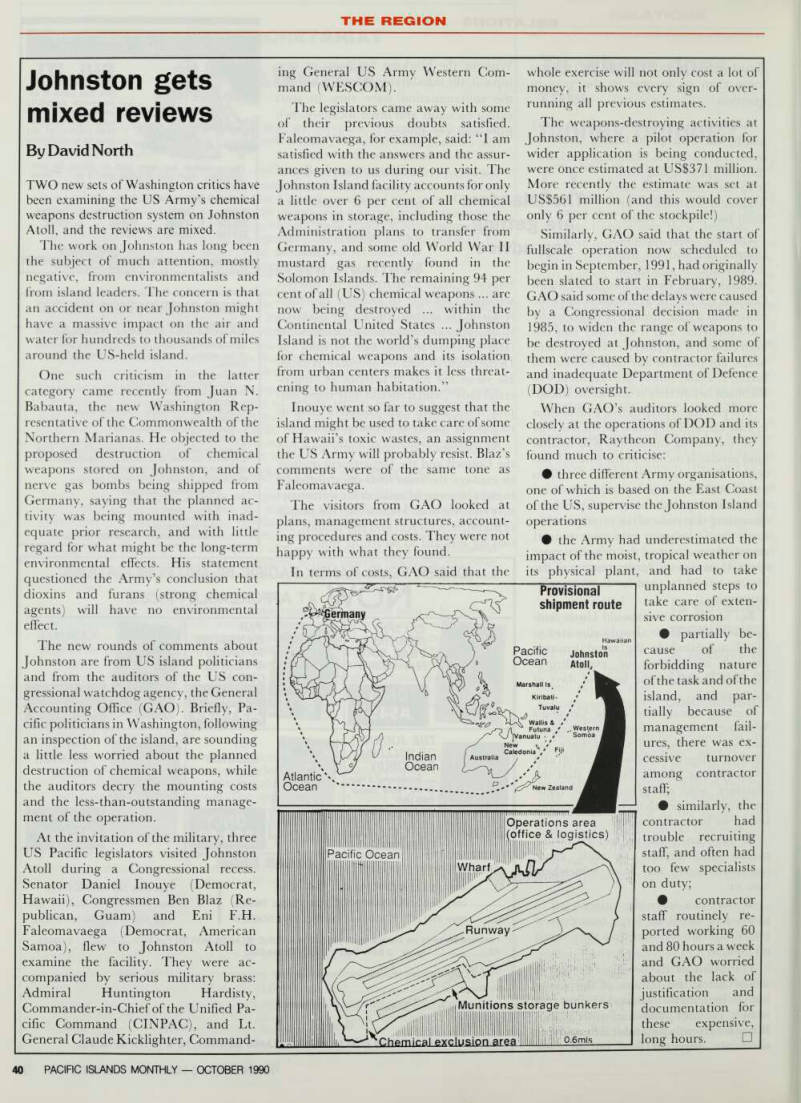
The Region
Johnston gets mixed reviews
By David North
TWO new sets of Washington critics have been examining the US Army’s chemical weapons destruction system on Johnston Atoll, and the reviews are mixed.
The work on Johnston has long been the subject of much attention, mostly negative, from environmentalists and from island leaders. The concern is that an accident on or near Johnston might have a massive impact on the air and water for hundreds to thousands of miles around the US-held island.
One such criticism in the latter category came recently from Juan N.
Babauta, the new Washington Rep resentative of the Commonwealth of the Northern Marianas. He objected to the proposed destruction of chemical weapons stored on Johnston, and of nerve gas bombs being shipped from Germany, saying that the planned ac tivity was being mounted with inad equate prior research, and with little regard for what might be the long-term environmental effects. His statement questioned the Army’s conclusion that dioxins and furans (strong chemical agents) will have no environmental effect.
The new rounds of comments about Johnston are from US island politicians and from the auditors of the US con gressional watchdog agency, the General
Accounting Office (GAO). Briefly, Pa
cific politicians in Washington, following an inspection of the island, are sounding a little less worried about the planned destruction of chemical weapons, while the auditors decry the mounting costs and the less-than-outstanding manage ment of the operation.
At the invitation of the military, three US Pacific legislators visited Johnston Atoll during a Congressional recess.
Senator Daniel Inouye (Democrat, Hawaii), Congressmen Ben Blaz (Re publican, Guam) and Eni F.H.
Faleomavaega (Democrat, American Samoa), flew to Johnston Atoll to examine the facility. They were ac
companied by serious military brass:
Admiral Huntington Hardisty, Commander-in-Chief of the Unified Pa cific Command (CINPAC), and Lt.
General Claude Kicklighter, Command
ing General US Army Western Com mand (WESCOM).
The legislators came away with some of their previous doubts satisfied.
Faleomavaega, for example, said: “I am satisfied with the answers and the assur ances given to us during our visit. The Johnston Island facility accounts for only a little over 6 per cent of all chemical weapons in storage, including those the Administration plans to transfer from Germany, and some old World War II mustard gas recently found in the Solomon Islands. The remaining 94 per cent of all (US) chemical weapons ... are now being destroyed ... within the Continental United States ... Johnston Island is not the world’s dumping place for chemical weapons and its isolation from urban centers makes it less threat ening to human habitation.”
Inouye went so far to suggest that the island might be used to take care of some of Hawaii’s toxic wastes, an assignment the US Army will probably resist. Blaz’s comments were of the same tone as Faleomavaega.
The visitors from GAO looked at plans, management structures, account ing procedures and costs. They were not happy with what they found.
In terms of costs, GAO said that the
whole exercise will not only cost a lot of money, it shows every sign of over running all previous estimates.
The weapons-destroying activities at Johnston, where a pilot operation for wider application is being conducted, were once estimated at USS37I million.
More recently the estimate was set at USSS6I million (and this would cover only 6 per cent of the stockpile!) Similarly, GAO said that the start of fullscale operation now scheduled to begin in September, 1991, had originally been slated to start in February, 1989.
GAO said some of the delays were caused by a Congressional decision made in 1985, to widen the range of weapons to be destroyed at Johnston, and some of them were caused by contractor failures and inadequate Department of Defence (DOD) oversight.
When GAO’s auditors looked more closely at the operations of DOD and its contractor, Raytheon Company, they found much to criticise: • three different Army organisations, one of which is based on the East Coast of the US, supervise the Johnston Island
operations
the Army had underestimated the impact of the moist, tropical weather on its physical plant, and had to take
unplanned steps to take care of exten sive corrosion partially be cause of the forbidding nature of the task and of the island, and par tially because of management fail ures, there was ex cessive turnover among contractor staff; similarly, the contractor had trouble recruiting staff, and often had too few specialists on duty; contractor staff routinely re ported working 60 and 80 hours a week and GAO worried about the lack of
justification and
documentation for
these expensive,
long hours. □
A treasure island for
Travel
A treasure island for the rich and famous
HISTORIC Wakaya, Fiji’s newly developed Pacific island paradise for wealthy holidaymakers, offers a “hidden extra” which just might send them home even wealthier: a hunt for real treasure.
Wakaya, with luxurious accommo dation for guests and also blocks of land on which to build hideaway homes, already has lured such american show business luminaries as Burt Reynolds, Cheryl Ladd and Australian Rocker Glenn Shorrock.
But until recently the most famous visitor to this 2200-acre islet of forests, wild deer and sandy beaches, was the notorious German sea-raider of World War I, Count Felix von Luckner. In one of the great war’s more bizarre incidents, the Count and five of his crew surren dered on September 21, 1917, to a team of six Fiji policeman in the mistaken belief that they were armed.
The embarrassed and angry Count spent the rest of the war in a New Zealand internment camp. But what happened to his loot? Where was and is the gold and other treasure trove which von Luckner and his crew of the schooner Sea Adler took from allied vessels around the world after approaching them sneakily under a neutral flag?
For decades, the rumour has been that von Luckner brought the captured goods with him to Wakaya’s Homestead Bay aboard the launch Cecilie after the See Adler was wrecked on Mopiha island in the Tuamoto Group when von Luckner foolishly anchored her too close to a reef with a storm approaching.
According to a Wakaya promotional letter from President Jay Boland, “it seems that Count von Luckner may have deposited his gold booty in Homestead Bay just before capture.”
The letter adds pointedly that scuba diving and snorkelling over the Home stead Bay reef will be a popular pasttime for residents and guests.
As for von Luckner, the old sea dog returned to the South Pacific between
the two world wars. But published reports said he was watched so closely he may not have had the opportunity to retrieve any treasure if in fact he had secreted it in the region.
Meanwhile, Wayaka has opened both to visitors or would-be residents from the far upper end of the market, one of a number of such havens of peace, palm trees and blue lagoons in the fabled South Seas where those to whom money doesn’t matter can escape from the tensions of New York, Tokyo or Sydney.
The island is owned outright by Canadian-born industrialist David Gilmour, who himself has spent about US$2 million so far on his own spacious hilltop residence with panoramic sea views.
For one cool million you can have your own sandy bay
For visitors (who must be 16 and over), the
Wakaya
Club of
fers just eight two-person bures, lavishly furnished with Fijian and imported fittings and set amid vivid tropical trees with the Pacific lapping near the front door. There’s an epicures’ restaurant offering local seafood and homegrown vegetables, plus a well-stocked bar.
Transport to the island is by Air
Wakaya, comprising one Cessna 402 c
which flies up to eight people at a time from Nadi or Nausori international airports, on Fiji’s main island of Viti Levu.
The cost of staying at the Wakaya Club: US$B75 per couple per night. That covers the accommodation, all meals and drinks plus sporting activities apart from deep-sea fishing expeditions, an optional extra. Sport includes the three hole, par-10 Cheryl Ladd Golf Course, named for the former star of television’s Charlie's Angels , and the David Niven Junior Croquet Court. Both are friends
of the Gilmour family.
Then there is a floodlit Wimbledon tex tennis court, a glass-bottom boat for
coral-viewing and scuba-diving equip
ment to help locate the von Luckner hoard.
Some 150 residential blocks have been pegged out, with 60 sold and 10 actually built-on. A two-acre block costs US$2OO,OOO but there’s one five-acre lot with its own sandy bay going for a cool US$l million. Residents may pay an extra US$35OO a year for use of the Wakaya Club facilities.
According to Wayaka’s Australian
born manager, Rob Miller, the Gilmour company has spent about US$5 million over the last couple of years alone on infrastructure. Since buying Wakaya in 1973, Gilmour has built an airstrip, jetty, a 14-metre barge to bring in supplies, a network of roads, reservoirs and water purification plants.
His stated aim: “To create a bastion of ecological and architectural sanity among nature’s inspirations and to offer privacy, time and space to Wakaya residents and guests alike.” The enterprise is staffed by Wakaya’s 200 local villagers, who have their own bures, church and school. Medical problems are handled initially by Miller and his wife Lynda. For serious cases, Nausori Airport near Suva is only 25 minutes away.
The laws of Fiji prevail on Wakaya, with a few bylaws introduced by the company including a ban on alcohol among the villagers. “They’re good methodists and are happy with that,”
Miller said.
The Wakayans weren’t always so peaceful and content. In 1789, Captain William Bligh told of being chased by canoeloads of cannibals as he passed by the island during his epic voyage in an open boat after being set adrift by the Bounty mutineers.
Some 40 years later, invaders from a rival island trapped about 100 Wakayans atop 200-metre cliffs which became known as “the chieftain’s leap” after their leader and around 20 followers jumped to their deaths on the rocks below rather than surrender. □
Farmer heads games team

Sports
A FARMER from Butibam village just outside Lae, in Papua New Guinea, is the new chairman of the South Pacific Games Foundation. He is 45-year-old Bart Philemon who replaces Sir Anthony Siaguru, now in London as Deputy Secretary General of the Common wealth Secretariat.
The foundation which Philemon now leads was set up by an Act of Parliament to organise the hosting of next year’s South Pacific Games inPNG.. The games, to be played next September, have venues in both Port Moresby and Lae. It is expected to be the biggest South Pacific
Games.Philemon paid tribute to Sir Anthony for his work with the Foun dation, saying his leadership was “very very succcessful. We all give him credit for a job well done. Sir Anthony has done a tremendous job to prepare the country for the Games and was highly successful in getting things in place. Funding through sponsorship, and venues preparation have been most successful to date due to his leadership,” He said his biggest task is to ensure that the country is ready to host the 1991 Games as scheduled. Sponsor ship has brought in a lot of money. Says Philemon: “My job is to ensure that at the end of the day the whole exercise breaks even or stays in black. Large amounts of money is being raised and spent for the Games and we must ensure we do not make a loss.”
The new chairman lives in Lae, away from the base of most sponsors in the capital Port Moresby. This, he said, is no problem. He would simply make contact and stay in touch. Two of his major sponsors, however — Rice Industries and Rothmans are based in Lae.
Philemon was the chairman of the 1980 South Pacific Festival of Arts which PNG hosted. He was an Air Niugini executive.
He quit the airline in 1980 to go and farm.
He produces two tons of bananas each week which he sells in Lae and Port Moresby, and 100,000 chickens a year.
He is the chairman of the finance board of the Evangelical Lutheran Church and a director of the church’s business arm, Kambang Holdings. He is a member of the Lae Salvation Army Red Shield
Appeal Committee.
Two of his three children Benjamin, 11, and Sarah, 9, are in the PNG junior
swimming development squad. □
Games’ man: Philemon on the farm
Advertisements & other items, p. 42 (1 item)
Pollution Solution
INDUSTRIAL WASTE
THE BURWELL HIGH TECH DUAL CHAMBER
CONTROLLED AIR INCINERATOR
Are your waste disposal costs affecting profitability?
YOU BETTER BELIEVE IT!
As waste elimination costs have soared over recent years to astronomical levels.
Many astute business men are now, more than ever, monitoring labour, stock and manufacturing expenses. However, some often ignore or overlook their expenditures on waste disposal.
It is often that a company is shocked when they quantify the cost of waste disposal in both monetary and environmental terms.
If you have combustible waste, a Burwell Controlled Air, Dual Chamber, Incinerator will slash your waste elimination costs. With on-site pollution controlled incineration you can again control your profitability. The Burwell True Blue Incinerator is A. 5.1.0. approved, meets all statutory regulations and is fully designed and manufactured in Australia by The Burwell Group.
V r j
burwell 9IOUp OF companies
8-12 Pilcher Street, 427 Wondell Road, 46 Korong Road, ENFIELD. N.S.W. 2136. WYNNUM. QLD. 4178. W. HEIDELBERG. VIC. 3081
AUSTRALIA AUSTRALIA. AUSTRALIA
Phone: (02) 642 5866 Phone: (07) 396 9999 Phone: (03) 458 3743 Fax: (02) 642 5731 Fax; (07) 396 7260 Fax: (03) 459 8572 Telex: AA20879 Telex: AA14554 Telex: 37637
Rocks of Ages
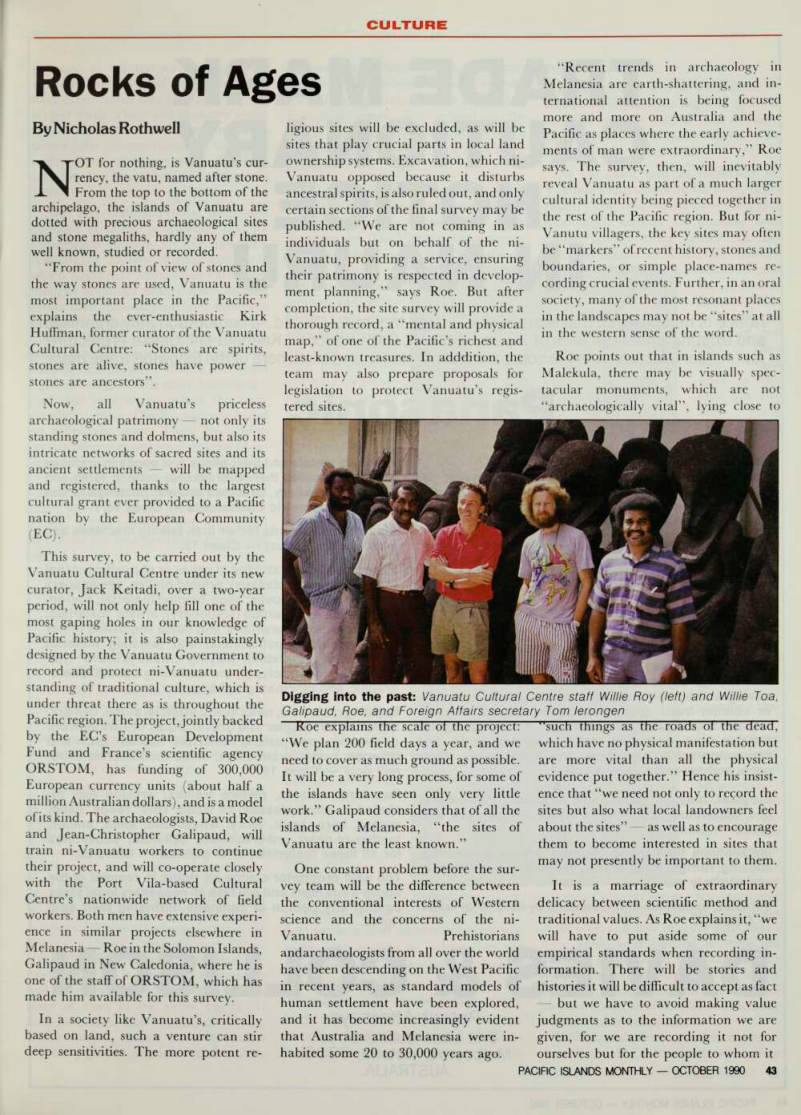

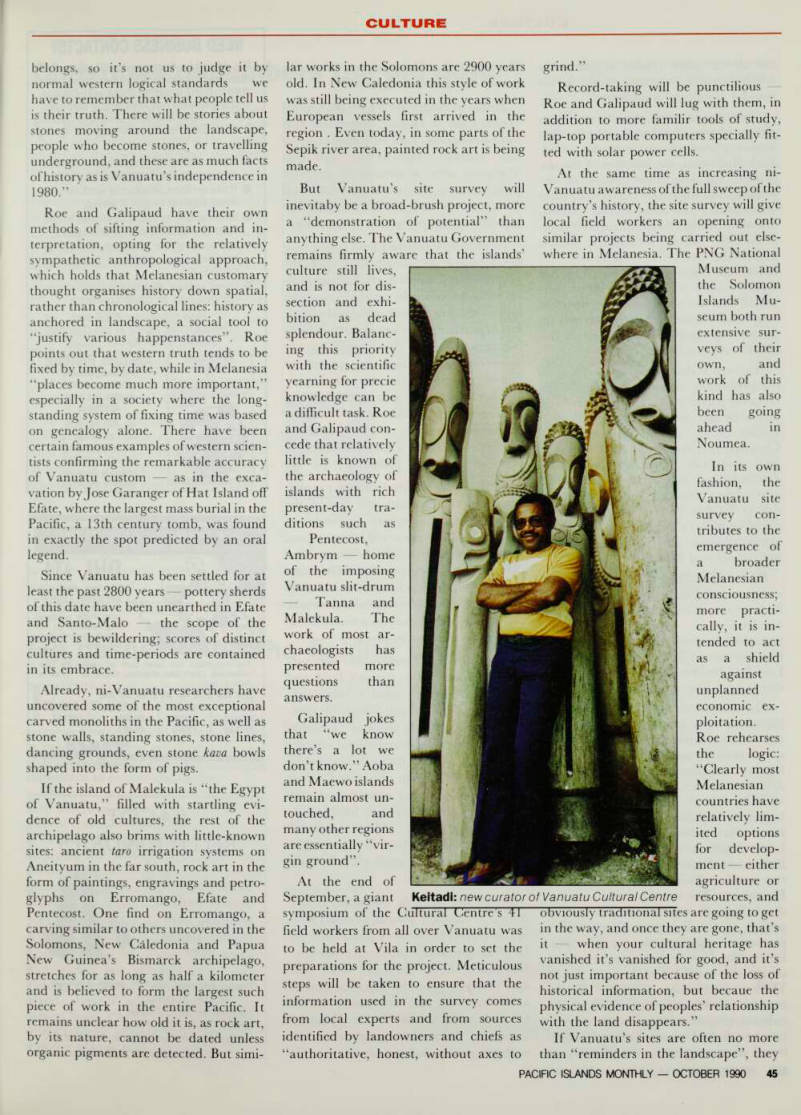
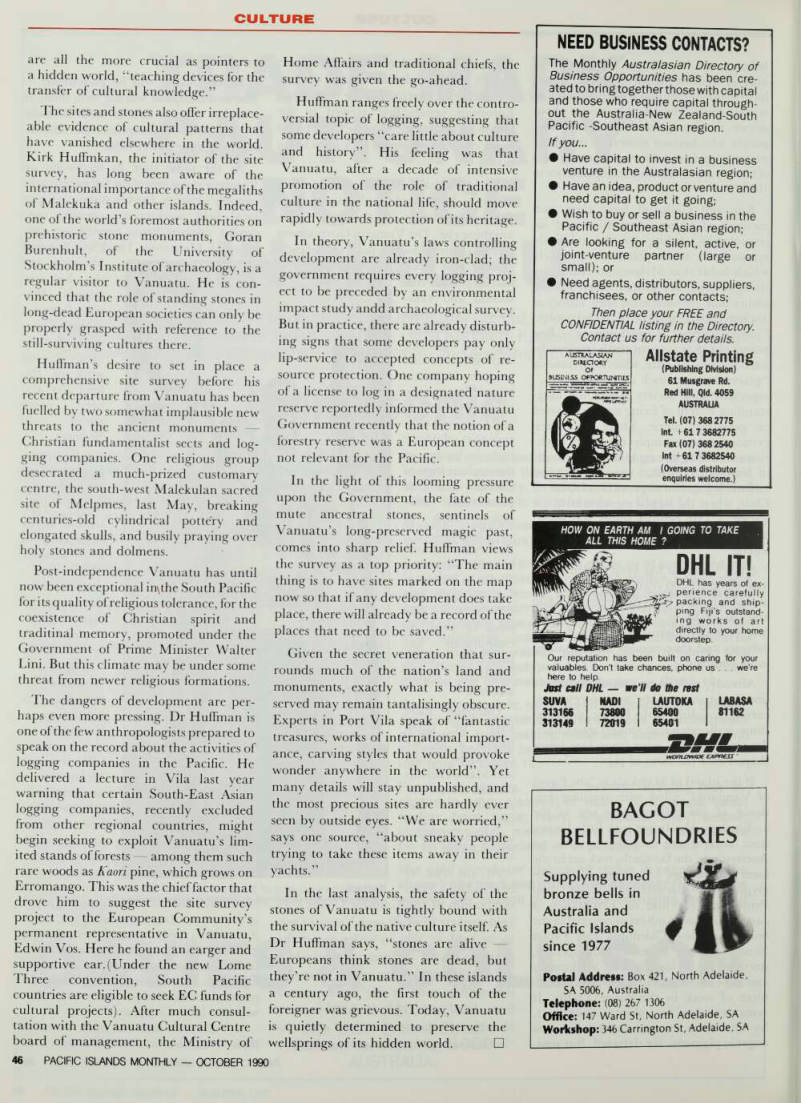
Culture
By Nicholas Roth well
NOT for nothing, is Vanuatu’s cur rency, the vatu, named after stone.
From the top to the bottom of the archipelago, the islands of Vanuatu are dotted with precious archaeological sites and stone megaliths, hardly any of them well known, studied or recorded.
“From the point of view of stones and the way stones are used, Vanuatu is the most important place in the Pacific,” explains the ever-enthusiastic Kirk Huffman, former curator of the Vanuatu Cultural Centre: “Stones are spirits, stones are alive, stones have power stones are ancestors”.
Now, all Vanuatu’s priceless archaeological patrimony not only its standing stones and dolmens, but also its intricate networks of sacred sites and its ancient settlements will be mapped and registered, thanks to the largest cultural grant ever provided to a Pacific nation by the European Community (EC).
This survey, to be carried out by the Vanuatu Cultural Centre under its new curator, Jack Keitadi, over a two-year period, will not only help fill one of the most gaping holes in our knowledge of Pacific history; it is also painstakingly designed by the Vanuatu Government to record and protect ni-Vanuatu under standing of traditional culture, which is under threat there as is throughout the Pacific region. The project, jointly backed by the EC’s European Development Fund and France’s scientific agency ORSTOM, has funding of 300,000 European currency units (about half a million Australian dollars), and is a model ofits kind. The archaeologists, David Roe
and Jean-Christopher Galipaud, will
train ni-Vanuatu workers to continue their project, and will co-operate closely with the Port Vila-based Cultural Centre’s nationwide network of field workers. Both men have extensive experi ence in similar projects elsewhere in Melanesia Roe in the Solomon Islands, Galipaud in New Caledonia, where he is one of the staff of ORSTOM, which has made him available for this survey.
In a society like Vanuatu’s, critically based on land, such a venture can stir deep sensitivities. The more potent re
ligious sites will be excluded, as will be sites that play crucial parts in local land ownership systems. Excavation, which ni- Vanuatu opposed because it disturbs ancestral spirits, is also ruled out, and only certain sections of the final survey may be published. “We are not coming in as individuals but on behalf of the ni- Vanuatu, providing a service, ensuring their patrimony is respected in develop ment planning,” says Roe. But after completion, the site survey will provide a thorough record, a “mental and physical map,” of one of the Pacific’s richest and least-known treasures. In adddition, the team may also prepare proposals for legislation to protect Vanuatu’s regis tered sites.
Koe explains the scale ot the project: “We plan 200 field days a year, and we need to cover as much ground as possible.
It will be a very long process, for some of the islands have seen only very little work.” Galipaud considers that of all the islands of Melanesia, “the sites of Vanuatu are the least known.”
One constant problem before the sur vey team will be the difference between the conventional interests of Western science and the concerns of the ni- Vanuatu. Prehistorians andarchaeologists from all over the world have been descending on the West Pacific in recent years, as standard models of human settlement have been explored, and it has become increasingly evident that Australia and Melanesia were in habited some 20 to 30,000 years ago.
“Recent trends in archaeology in Melanesia are earth-shattering, and in ternational attention is being focused more and more on Australia and the Pacific as places where the early achieve ments of man were extraordinary,” Roe says. The survey, then, will inevitably reveal Vanuatu as part of a much larger
cultural identity being pieced together in
the rest of the Pacific region. But for ni- Vanutu villagers, the key sites may often be “markers” of recent history, stones and boundaries, or simple place-names re cording crucial events. Further, in an oral society, many of the most resonant places in the landscapes may not be “sites” at all in the western sense of the word.
Roe points out that in islands such as Malekula, there may be visually spec tacular monuments, which are not “archaeologically vital”, lying close to
"such things as the roads ot the dead, which have no physical manifestation but are more vital than all the physical evidence put together.” Hence his insist ence that “we need not only to record the sites but also what local landowners feel about the sites” as well as to encourage them to become interested in sites that may not presently be important to them.
It is a marriage of extraordinary delicacy between scientific method and traditional values. As Roe explains it, “we will have to put aside some of our empirical standards when recording in formation. There will be stories and histories it will be difficult to accept as fact but we have to avoid making value judgments as to the information we are given, for we are recording it not for ourselves but for the people to whom it
Digging into the past: Vanuatu Cultural Centre staff Willie Roy (left) and Willie Toa, Galipaud, Roe, and Foreign Affairs secretary Tom lerongen
belongs, so it’s not us to judge it by normal western logical standards we have to remember that what people tell us is their truth. There will be stories about stones moving around the landscape, people who become stones, or travelling underground, and these are as much facts ofhistory as is Vanuatu’s independence in 1980.”
Roe and Galipaud have their own methods of sifting information and in terpretation, opting for the relatively sympathetic anthropological approach, which holds that Melanesian customary thought organises history down spatial, rather than chronological lines: history as anchored in landscape, a social tool to “justify various happenstances”. Roe points out that western truth tends to be fixed by time, by date, while in Melanesia “places become much more important,” especially in a society where the long standing system of fixing time was based on genealogy alone. There have been certain famous examples of western scien tists confirming the remarkable accuracy of Vanuatu custom as in the exca vation by Jose Garanger of Hat Island off Efate, where the largest mass burial in the Pacific, a 13th century tomb, was found in exactly the spot predicted by an oral legend.
Since Vanuatu has been settled for at least the past 2800 years pottery sherds of this date have been unearthed in Efate and Santo-Malo the scope of the project is bewildering; scores of distinct cultures and time-periods are contained in its embrace.
Already, ni-Vanuatu researchers have uncovered some of the most exceptional carved monoliths in the Pacific, as well as stone walls, standing stones, stone lines, dancing grounds, even stone kava bowls shaped into the form of pigs.
If the island of Malekula is “the Egypt of Vanuatu,” filled with startling evi dence of old cultures, the rest of the archipelago also brims with little-known sites: ancient taro irrigation systems on Aneityum in the far south, rock art in the form of paintings, engravings and petro glyphs on Erromango, Efate and Pentecost. One find on Erromango, a carving similar to others uncovered in the Solomons, New Caledonia and Papua New Guinea’s Bismarck archipelago, stretches for as long as half a kilometer and is believed to form the largest such piece of work in the entire Pacific. It remains unclear how old it is, as rock art, by its nature, cannot be dated unless organic pigments are detected. But simi
lar works in the Solomons are 2900 years old. In New Caledonia this style of work was still being executed in the years when European vessels first arrived in the region . Even today, in some parts of the Sepik river area, painted rock art is being made.
But Vanuatu’s site survey will inevitaby be a broad-brush project, more a “demonstration of potential” than anything else. The Vanuatu Government remains firmly aware that the islands’
culture still lives, and is not for dis section and exhi bition as dead splendour. Balanc ing this priority with the scientific yearning for precie knowledge can be a difficult task. Roe and Galipaud con cede that relatively little is known of the archaeology of islands with rich
present-day tra
ditions such as Pentecost, Ambrym home of the imposing Vanuatu slit-drum Tanna and Malekula. The work of most ar chaeologists has presented more
questions than
answers.
Galipaud jokes
that “we know there’s a lot we don’t know.” Aoba and Maewo islands remain almost un touched, and many other regions are essentially “vir gin ground”.
At the end of September, a giant
symposium of the Cultural Centre s field workers from all over Vanuatu was to be held at Vila in order to set the preparations for the project. Meticulous steps will be taken to ensure that the information used in the survey comes from local experts and from sources identified by landowners and chiefs as “authoritative, honest, without axes to
grind.”
Record-taking will be punctilious Roe and Galipaud will lug with them, in addition to more familir tools of study, lap-top portable computers specially fit ted with solar power cells.
At the same time as increasing ni- V anuatu awareness of the full sweep of the country’s history, the site survey will give local field workers an opening onto similar projects being carried out else where in Melanesia. The PNG National
Museum and the Solomon Islands Mu seum both run extensive sur veys of their own, and work of this kind has also
been going
ahead in Noumea.
In its own fashion, the Vanuatu site survey con tributes to the emergence of a broader Melanesian consciousness;
more practi
cally, it is in tended to act as a shield
against
unplanned economic ex
ploitation.
Roe rehearses the logic: “Clearly most Melanesian countries have relatively lim ited options for develop ment either
agriculture or
resources, and
obviously traditional sites are going to get in the way, and once they are gone, that’s it when your cultural heritage has vanished it’s vanished for good, and it’s not just important because of the loss of historical information, but becaue the
physical evidence of peoples’ relationship
with the land disappears.”
If Vanuatu’s sites are often no more than “reminders in the landscape”, they
Keitadi: new curator of Vanuatu Cultural Centre
are all the more crucial as pointers to a hidden world, “teaching devices for the transfer of cultural knowledge.”
The sites and stones also offer irreplace able evidence of cultural patterns that have vanished elsewhere in the world.
Kirk Huffmkan, the initiator of the site survey, has long been aware of the international importance of the megaliths of Malekuka and other islands. Indeed, one of the world’s foremost authorities on prehistoric stone monuments, Goran Burenhult, of the University of Stockholm’s Institute of archaeology, is a regular visitor to Vanuatu. He is con vinced that the role of standing stones in long-dead European societies can only be properly grasped with reference to the still-surviving cultures there.
Huffman’s desire to set in place a comprehensive site survey before his recent departure from Vanuatu has been fuelled by two somewhat implausible new threats to the ancient monuments Christian fundamentalist sects and log ging companies. One religious group desecrated a much-prized customary centre, the south-west Malekulan sacred site of Melpmes, last May, breaking centuries-old cylindrical pottery and elongated skulls, and busily praying over holy stones and dolmens.
Post-independence Vanuatu has until now been exceptional in\the South Pacific for its quality of religious tolerance, for the coexistence of Christian spirit and traditinal memory, promoted under the Government of Prime Minister Walter Lini. But this climate may be under some threat from newer religious formations.
The dangers of development are per haps even more pressing. Dr Huffman is one of the few anthropologists prepared to speak on the record about the activities of logging companies in the Pacific. He delivered a lecture in Vila last year warning that certain South-East Asian
logging companies, recently excluded
from other regional countries, might begin seeking to exploit Vanuatu’s lim ited stands of forests among them such rare woods as Kaori pine, which grows on Erromango. This was the chief factor that drove him to suggest the site survey project to the European Community’s permanent representative in Vanuatu, Edwin Vos. Here he found an earger and supportive ear. (Under the new Lome Three convention, South Pacific countries are eligible to seek EC funds for cultural projects). After much consul tation with the Vanuatu Cultural Centre board of management, the Ministry of
Home Affairs and traditional chiefs, the survey was given the go-ahead.
Huffman ranges freely over the contro versial topic of logging, suggesting that some developers “care little about culture and history”. His feeling was that Vanuatu, after a decade of intensive promotion of the role of traditional culture in the national life, should move rapidly towards protection ofits heritage.
In theory, Vanuatu’s laws controlling development are already iron-clad; the government requires every logging proj ect to be preceded by an environmental impact study andd archaeological survey.
But in practice, there are already disturb ing signs that some developers pay only lip-service to accepted concepts of re source protection. One company hoping of a license to log in a designated nature reserve reportedly informed the Vanuatu Government recently that the notion of a forestry reserve was a European concept not relevant for the Pacific.
In the light of this looming pressure upon the Government, the fate of the mute ancestral stones, sentinels of Vanuatu’s long-preserved magic past, comes into sharp relief. Huffman views the survey as a top priority: “The main thing is to have sites marked on the map now so that if any development does take place, there will already be a record of the places that need to be saved.”
Given the secret veneration that sur rounds much of the nation’s land and monuments, exactly what is being pre served may remain tantalisingly obscure.
Experts in Port Vila speak of “fantastic treasures, works of international import ance, carving styles that would provoke wonder anywhere in the world”. Yet many details will stay unpublished, and the most precious sites are hardly ever seen by outside eyes. “We are worried,” says one source, “about sneaky people trying to take these items away in their yachts.”
In the last analysis, the safety of the stones of Vanuatu is tightly bound with the survival of the native culture itself. As Dr Huffman says, “stones are alive Europeans think stones are dead, but they’re not in Vanuatu.” In these islands a century ago, the first touch of the foreigner was grievous. Today, Vanuatu is quietly determined to preserve the wellsprings of its hidden world. □
Advertisements & other items, pp. 44-46 (1 item)
Cautionary
TRADE MARK
NOTICE
IN NAURU
Notice is hereby given that Matsushita Electric Industrial Co. Ltd., a corporation duly organised and existing under the laws of Japan, of 1006, Oaza Kadoma, Kadoma-shi, Osaka Prefecture, Japan, Manufacturers, is the sole proprietor in Nauru and elsewhere of the following trade mark.
Panasonic
used in respect of:- Catalyst, oxidation catalyst, catalyst for exhaust gas purification, plastic molding materials, ceramic materials, rodent repeller, toner, developer for copier, absorbent Class 1.
Machines and machine tools; motors (excent for land vehicles); machine couplings and belting (except for land vehicles); large size agricultural implements; incubators Class 7.
Hand tools and instruments; cutlery, forks and spoons; side arms Class 8.
Scientific, nautical, surveying and electrical apparatus and instruments (including wireless), weighing, measuring, signalling, checking (supervision), lifesaving and teaching apparatus and instruments; coin or counter-freed apparatus; talking machines; cash registers; calculating machines; fire-extinguishing apparatus, but excluding optical, photographic and cinematographic apparatus and instruments, their parts and accessories Class 9.
Surgical, medical, dental and veterinary instruments and apparatus (including artificial limbs, eyes and teeth) Class 10.
Installations for lighting, heating, steam generating, cooking, refrigerating, drying, ventilating, water supply and sanitary purposes Class II Vehicles; apparatus for locomotion by land air or water Class 12.
Precious metals and their alloys and goods in precious metals or coated therewith (except cutlery, forks and spoons); jewellery, precious stones, horological and other chronometric instruments Class 14.
Musical Instruments (other than talking machines and wireless apparatus) Class 15.
Paper, cardboard articles of paper or of cardboard (not included in other classes); printed matter, newspapers and periodicals, books; book-binding material; stationery, adhesive materials (stationery); artists’ materials; paint brushes; typewriters and office requisites (other than furniture); Instructional and teaching material (other than apparatus); playing cards; printers’ type and cliches (stereotype), but excluding optical, photographic and cinematographic paper Class 16.
Building materials, natural and artificial stone, cement, lime, mortar, plaster and gravel; pipes of earthenware or cement; road-making materials; asphalt, pitch and bitumen; portable buildings; stone monuments; chimney pots Class 19.
Furniture, mirrors, picture frames; articles (not included in other classes) of wood, cork, reeds, cane, wicker, horn, bone, Ivory, whalebone, shell, amber, mother-of-pearl, meerschaum, celluloid, substitutes for all these materials, or of plastics Class 20.
The said proprietor claims all rights in respect of the above trade mark and will take all necessary legal steps against any person or company infringing their said rights.
DAVIES & COLLISON
Patent Attorneys
One Little Collins Street Melbourne, Victoria, 3000.
AUSTRALIA.
NEED BUSINESS CONTACTS?
The Monthly Australasian Directory of Business Opportunities has been created to bring together those with capital and those who require capital throughout the Australia-New Zealand-South Pacific -Southeast Asian region.
If you... • Have capital to invest in a business venture in the Australasian region; • Have an idea, product or venture and need capital to get it going; • Wish to buy or sell a business in the Pacific / Southeast Asian region; • Are looking for a silent, active, or joint-venture partner (large or
small); or
• Need agents, distributors, suppliers, franchisees, or other contacts; Then place your FREE and CONFIDENTIAL listing in the Directory.
Contact us for further details. 61 Musgrave Rd.
Red Hill, Qld. 4059
AUSTRAUA
Tel. (07) 3682775 Int. +617 3682775 Fax (07) 368 2540 Int +6l 7 3682540 (Overseas distributor enquiries welcome.)
AUSTRALASIAN
DIRICTORY
OF
BUSINLSS OPPORTUr^TUS
i -S
Allstate Printing
(Publishing Division) HOW ON EARTH AM I GOING TO TAKE
ALL THIS HOME ?
DHL IT!
DHL has years of experience carefully packing and shipping Fiji’s outstanding works of art directly to your home doorstep.
Our reputation has been built on caring for your valuables Don’t take chances, phone us . . we’re here to help Just call DHL we’ll do the rest wontowux exmess • j
BAGOT
BELLFOUNDRIES
Supplying tuned
bronze bells in Australia and Pacific Islands since 1977 4 Postal Address: Box 421, North Adelaide, SA 5006, Australia Telephone: (08) 267 1306 Office: 147 Ward St, North Adelaide, SA Workshop: 346 Carrington St, Adelaide, SA
Christmas remembers the old days
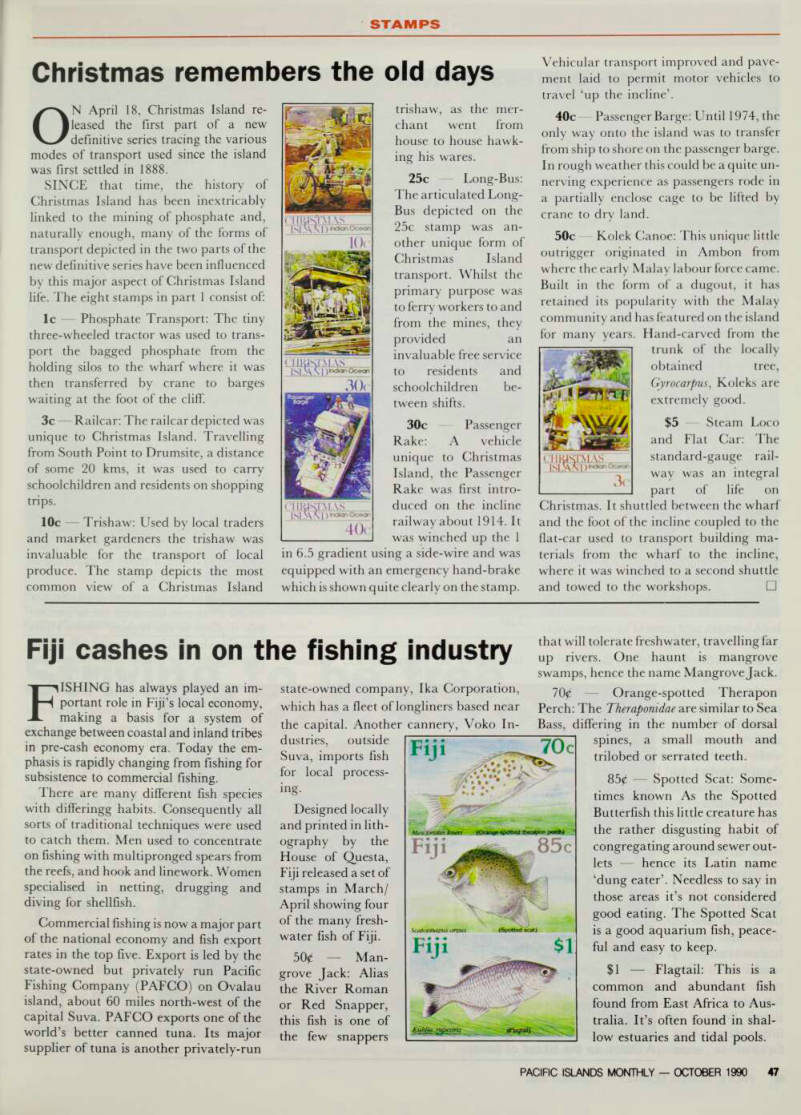
Stamps
ON April 18, Christmas Island re leased the first part of a new definitive series tracing the various modes of transport used since the island was first settled in 1888.
SINCE that time, the history of Christmas Island has been inextricably linked to the mining of phosphate and, naturally enough, many of the forms of transport depicted in the two parts of the new definitive series have been influenced by this major aspect of Christmas Island life. The eight stamps in part 1 consist of: 1c Phosphate Transport: The tiny three-wheeled tractor was used to trans port the bagged phosphate from the holding silos to the wharf where it was then transferred by crane to barges waiting at the foot of the cliff. 3c Railcar: The railcar depicted was unique to Christmas Island. Travelling from South Point to Drumsite, a distance of some 20 kms, it was used to carry schoolchildren and residents on shopping trips. 10c Trishaw: Used by local traders and market gardeners the trishaw was invaluable for the transport of local produce. The stamp depicts the most common view of a Christmas Island
trishaw, as the mer chant went from house to house hawk ing his wares.
25c Long-Bus:
The articulated Long- Bus depicted on the 25c stamp was an other unique form of Christmas Island transport. Whilst the primary purpose was to ferry workers to and from the mines, they
provided an
invaluable free service to residents and schoolchildren be tween shifts.
30c Passenger
Rake: A vehicle unique to Christmas Island, the Passenger Rake was first intro duced on the incline railway about 1914. It was winched up the 1
in 6.5 gradient using a side-wire and was equipped with an emergency hand-brake which is shown quite clearly on the stamp.
Vehicular transport improved and pave ment laid to permit motor vehicles to travel ‘up the incline’. 40c Passenger Barge: Until 1974, the only way onto the island was to transfer from ship to shore on the passenger barge.
In rough weather this could be a quite un nerving experience as passengers rode in a partially enclose cage to be lifted by crane to dry land. 50c Kolek Canoe: This unique little outrigger originated in Ambon from where the early Malay labour force came.
Built in the form of a dugout, it has retained its popularity with the Malay community and has featured on the island for many years. Hand-carved from the
trunk of the locally obtained tree, Gyrocarpus, Koleks are extremely good. $5 Steam Loco and Flat Car: The standard-gauge rail way was an integral part of life on
Christmas. It shuttled between the wharf and the foot of the incline coupled to the flat-car used to transport building ma terials from the wharf to the incline, where it was winched to a second shuttle and towed to the workshops. □
Fiji cashes in on the fishing industry
FISHING has always played an im portant role in Fiji’s local economy, making a basis for a system of exchange between coastal and inland tribes in pre-cash economy era. Today the em phasis is rapidly changing from fishing for subsistence to commercial fishing.
There are many different fish species with differingg habits. Consequently all sorts of traditional techniques were used to catch them. Men used to concentrate on fishing with multipronged spears from the reefs, and hook and linework. Women specialised in netting, drugging and diving for shellfish.
Commercial fishing is now a major part of the national economy and fish export rates in the top five. Export is led by the state-owned but privately run Pacific
Fishing Company (PAFCO) on Ovalau
island, about 60 miles north-west of the capital Suva. PAFCO exports one of the world’s better canned tuna. Its major supplier of tuna is another privately-run
state-owned company, Ika Corporation, which has a fleet of longliners based near the capital. Another cannery, Voko In
dustries, outside Suva, imports fish for local process
ing.
Designed locally and printed in lith ography by the House of Questa, Fiji released a set of stamps in March/ April showing four of the many fresh water fish of Fiji. 500 Man grove Jack: Alias the River Roman or Red Snapper, this fish is one of the few snappers
that will tolerate freshwater, travelling far up rivers. One haunt is mangrove swamps, hence the name Mangrove Jack.
700 Orange-spotted Therapon
Perch: The Theraponidae are similar to Sea Bass, differing in the number of dorsal
spines, a small mouth and trilobed or serrated teeth. 850 Spotted Scat: Some times known As the Spotted Butterfish this little creature has the rather disgusting habit of congregating around sewer out lets - hence its Latin name ‘dung eater’. Needless to say in those areas it’s not considered good eating. The Spotted Scat is a good aquarium fish, peace ful and easy to keep.
SI Flagtail: This is a common and abundant fish found from East Africa to Aus tralia. It’s often found in shal low estuaries and tidal pools.
Vanuatu sees a press revival
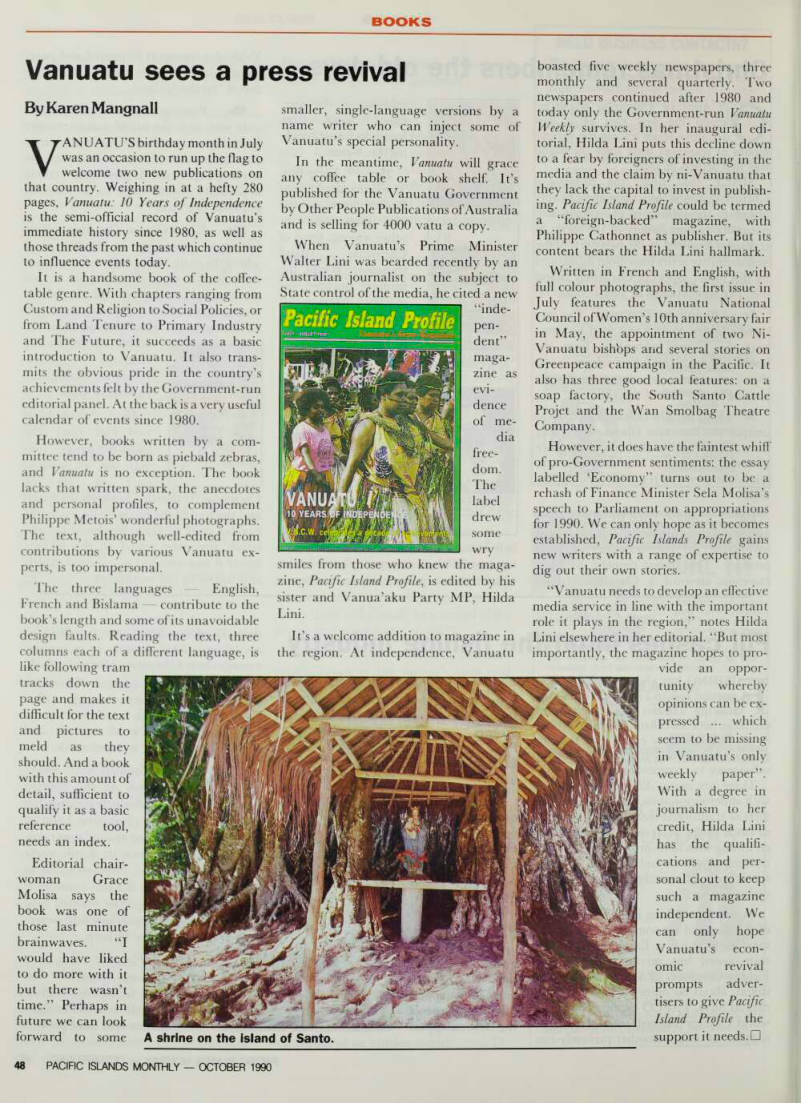
Books
By Karen Mangnall
VANUATU’S birthday month in July was an occasion to run up the flag to welcome two new publications on that country. Weighing in at a hefty 280 pages, Vanuatu: 10 Years of Independence is the semi-official record of Vanuatu’s immediate history since 1980, as well as those threads from the past which continue to influence events today.
It is a handsome book of the coffee table genre. With chapters ranging from Custom and Religion to Social Policies, or from Land Tenure to Primary Industry and The Future, it succeeds as a basic introduction to Vanuatu. It also trans mits the obvious pride in the country’s achievements felt by the Government-run editorial panel. At the back is a very useful calendar of events since 1980.
However, books written by a com mittee tend to be born as piebald zebras, and Vanuatu is no exception. The book lacks that written spark, the anecdotes and personal profiles, to complement
Philippe Metois’ wonderful photographs.
The text, although well-edited from contributions by various Vanuatu ex perts, is too impersonal.
The three languages English, French and Bislama contribute to the book’s length and some of its unavoidable design faults. Reading the text, three columns each of a different language, is
like following tram tracks down the page and makes it difficult for the text and pictures to meld as they should. And a book with this amount of detail, sufficient to qualify it as a basic reference tool, needs an index.
Editorial chair woman Grace Molisa says the book was one of those last minute brainwaves. “I would have liked to do more with it but there wasn’t time.” Perhaps in future we can look forward to some
smaller, single-language versions by a name writer who can inject some of Vanuatu’s special personality.
In the meantime, Vanuatu will grace any coffee table or book shelf. It’s published for the Vanuatu Government by Other People Publications of Australia and is selling for 4000 vatu a copy.
When Vanuatu’s Prime Minister Walter Lini was bearded recently by an Australian journalist on the subject to State control of the media, he cited a new
“inde pendent” maga zine as evi dence of me dia free dom.
The label drew some wry
smiles from those who knew the maga zine, Pacific Island Profile , is edited by his sister and Vanua’aku Party MP, Hilda Lini.
It’s a welcome addition to magazine in the region. At independence, Vanuatu
boasted five weekly newspapers, three monthly and several quarterly. Two newspapers continued after 1980 and today only the Government-run Vanuatu Weekly survives. In her inaugural edi torial, Hilda Lini puts this decline down to a fear by foreigners of investing in the media and the claim by ni-Vanuatu that they lack the capital to invest in publish ing. Pacific Island Profile could be termed a “foreign-backed” magazine, with Philippe Cathonnet as publisher. But its content bears the Hilda Lini hallmark.
Written in French and English, with full colour photographs, the first issue in July features the Vanuatu National Council of Women’s 10th anniversary fair in May, the appointment of two Ni- Vanuatu bishbps and several stories on Greenpeace campaign in the Pacific. It also has three good local features: on a soap factory, the South Santo Cattle Projet and the Wan Smolbag Theatre
Company.
However, it does have the faintest whiff of pro-Government sentiments: the essay labelled ‘Economy” turns out to be a rehash of Finance Minister Sela Molisa’s speech to Parliament on appropriations for 1990. We can only hope as it becomes established, Pacific Islands Profile gains new writers with a range of expertise to dig out their own stories.
“Vanuatu needs to develop an effective media service in line with the important role it plays in the region,” notes Hilda Lini elsewhere in her editorial. “But most importantly, the magazine hopes to pro
vide an oppor tunity whereby opinions can be ex pressed ... which seem to be missing in Vanuatu’s only weekly paper”.
With a degree in journalism to her credit, Hilda Lini has the qualifi cations and per sonal clout to keep such a magazine independent. We can only hope Vanuatu’s econ omic revival prompts adver tisers to give Pacific Island Profile the support it needs. □
A shrine on the island of Santo.
Striving to be free
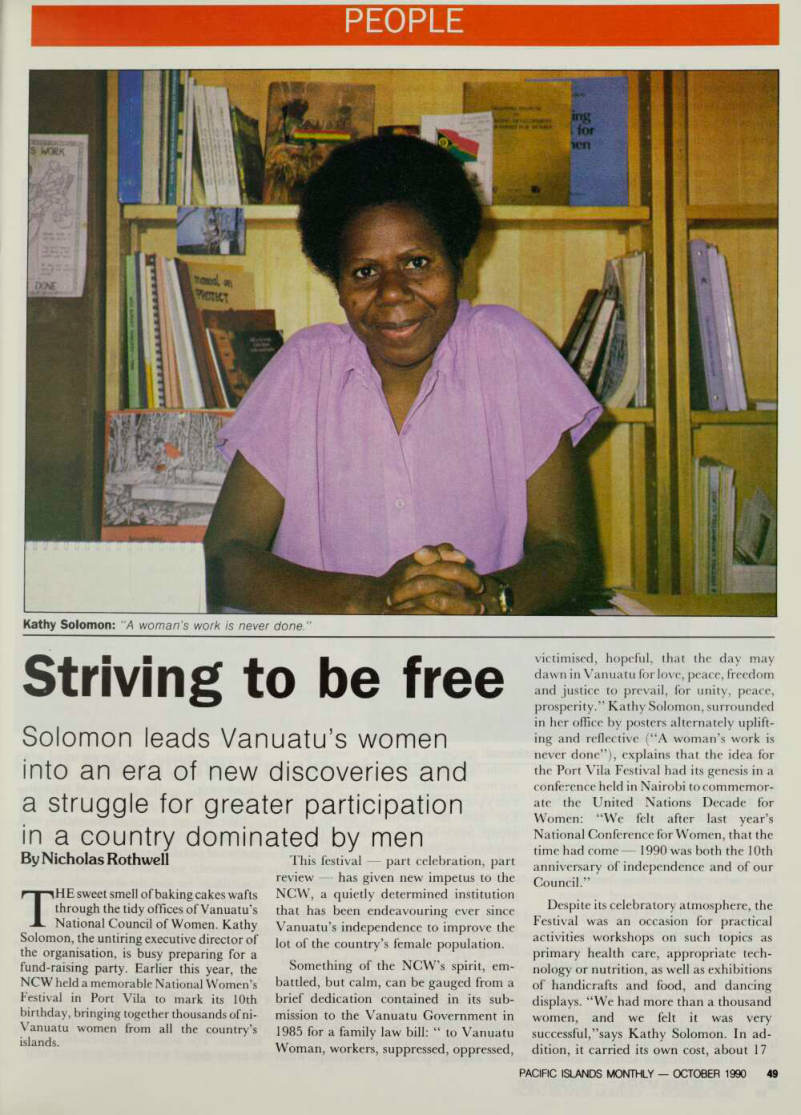
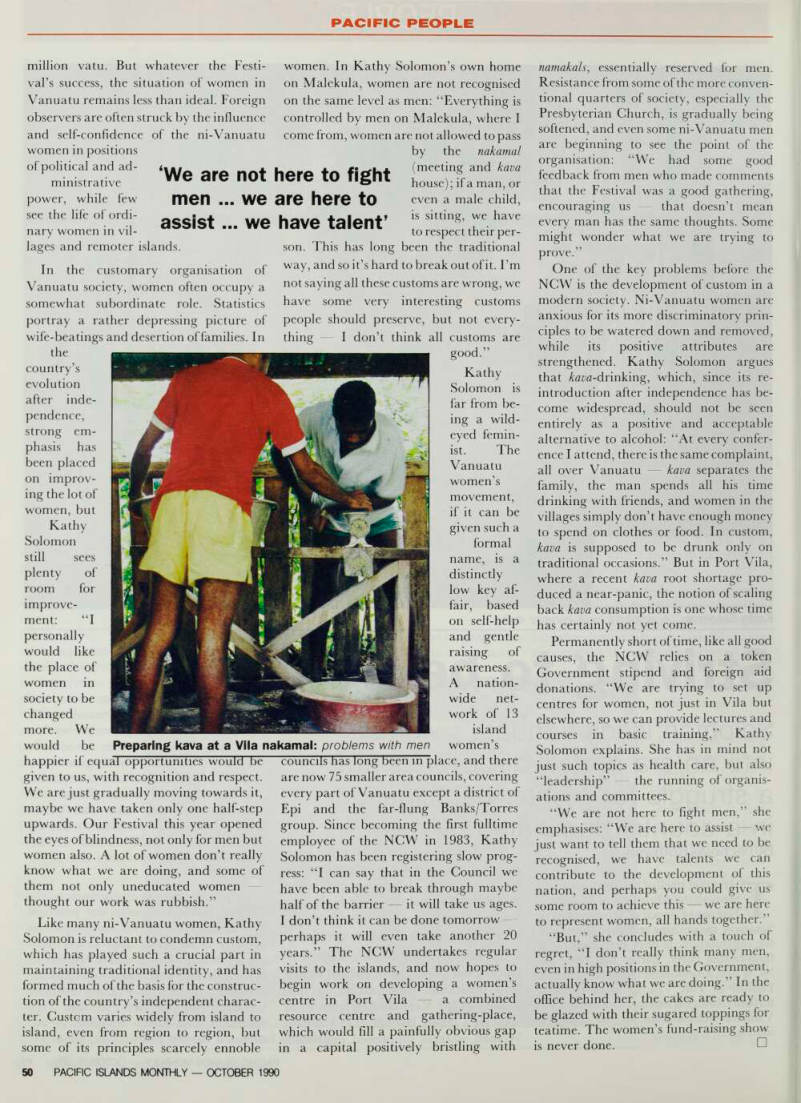
sdfdsfdsfsdsfdsfds
Solomon leads Vanuatu’s women into an era of new discoveries and a struggle for greater participation in a country dominated by men
By Nicholas Rothwell
THE sweet smell of baking cakes wafts through the tidy offices of Vanuatu’s National Council of Women. Kathy Solomon, the untiring executive director of the organisation, is busy preparing for a fund-raising party. Earlier this year, the NCW held a memorable National Women’s Festival in Port Vila to mark its 10th birthday, bringing together thousands of ni- Vanuatu women from all the country’s islands.
This festival part celebration, part review has given new impetus to the NCW, a quietly determined institution that has been endeavouring ever since Vanuatu’s independence to improve the lot of the country’s female population.
Something of the NCW’s spirit, em battled, but calm, can be gauged from a brief dedication contained in its sub mission to the Vanuatu Government in 1985 for a family law bill: “ to Vanuatu Woman, workers, suppressed, oppressed,
victimised, hopeful, that the day may dawn in Vanuatu for love, peace, freedom and justice to prevail, for unity, peace, prosperity.” Kathy Solomon, surrounded in her office by posters alternately uplift ing and reflective (“A woman’s work is never done”), explains that the idea for the Port Vila Festival had its genesis in a conference held in Nairobi to commemor ate the United Nations Decade for Women: “We felt after last year’s National Conference for Women, that the time had come 1990 was both the 10th anniversary of independence and of our Council.”
Despite its celebratory atmosphere, the Festival was an occasion for practical activities workshops on such topics as primary health care, appropriate tech nology or nutrition, as well as exhibitions of handicrafts and food, and dancing displays. “We had more than a thousand women, and we felt it was very successful,’’says Kathy Solomon, In ad dition, it carried its own cost, about 17
Kathy Solomon: “A woman’s work is never done.”
Pacific People
million vatu. But whatever the Festi val’s success, the situation of women in Vanuatu remains less than ideal. Foreign observers are often struck by the influence and self-confidence of the ni-Vanuatu
women in positions of political and ad ministrative power, while few see the life of ordi nary women in vil
lages and remoter islands.
In the customary organisation of Vanuatu society, women often occupy a somewhat subordinate role. Statistics portray a rather depressing picture of wife-beatings and desertion of families. In
‘We are not here to fight men ... we are here to assist... we have talent’
the country’s evolution after inde pendence, strong em
phasis has
been placed
on improv
ing the lot of women, but Kathy Solomon still sees
plenty of
room for improve ment: “I
personally
would like the place of women in society to be
changed
more. We would be
happier if equal opportunities would be given to us, with recognition and respect.
We are just gradually moving towards it, maybe we have taken only one half-step upwards. Our Festival this year opened the eyes of blindness, not only for men but women also. A lot of women don’t really know what we are doing, and some of them not only uneducated women thought our work was rubbish.”
Like many ni-Vanuatu women, Kathy Solomon is reluctant to condemn custom, which has played such a crucial part in maintaining traditional identity, and has formed much of the basis for the construc tion of the country’s independent charac ter. Custom varies widely from island to island, even from region to region, but some of its principles scarcely ennoble
women. In Kathy Solomon’s own home on Malekula, women are not recognised on the same level as men: “Everything is controlled by men on Malekula, where I come from, women are not allowed to pass
by the nakamal (meeting and kava house); if a man, or even a male child, is sitting, we have to respect their per
son. This has long been the traditional way, and so it’s hard to break out ofit. I’m not saying all these customs are wrong, we have some very interesting customs people should preserve, but not every thing I don’t think all customs are
good,”
Kathy
Solomon is far from be ing a wild eyed femin ist. The Vanuatu women’s movement, if it can be given such a formal name, is a distinctly low key af fair, based on self-help and gentle raising of awareness.
A nation wide net work of 13 island women’s
councils has long been m place, and there are now 75 smaller area councils, covering every part of Vanuatu except a district of Epi and the far-flung Banks/Torres group. Since becoming the first fulltime employee of the NCW in 1983, Kathy Solomon has been registering slow prog ress: “I can say that in the Council we have been able to break through maybe half of the barrier it will take us ages.
I don’t think it can be done tomorrow perhaps it will even take another 20 years.” The NCW undertakes regular visits to the islands, and now hopes to begin work on developing a women’s centre in Port Vila a combined resource centre and gathering-place, which would fill a painfully obvious gap in a capital positively bristling with
namakals, essentially reserved for men.
Resistance from some of the more conven tional quarters of society, especially the
Presbyterian Church, is gradually being
softened, and even some ni-Vanuatu men are beginning to see the point of the organisation: “We had some good feedback from men who made comments that the Festival was a good gathering, encouraging us that doesn’t mean every man has the same thoughts. Some might wonder what we are trying to
prove.”
One of the key problems before the NCW is the development of custom in a modern society. Ni-Vanuatu women are anxious for its more discriminatory prin ciples to be watered down and removed, while its positive attributes are
strengthened. Kathy Solomon argues
that fozpfl-drinking, which, since its re introduction after independence has be come widespread, should not be seen
entirely as a positive and acceptable
alternative to alcohol: “At every confer ence I attend, there is the same complaint, all over Vanuatu kava separates the family, the man spends all his time drinking with friends, and women in the
villages simply don’t have enough money
to spend on clothes or food. In custom, kava is supposed to be drunk only on traditional occasions.” But in Port Vila, where a recent kava root shortage pro duced a near-panic, the notion of scaling back kava consumption is one whose time has certainly not yet come.
Permanently short of time, like all good causes, the NCW relies on a token Government stipend and foreign aid donations. “We are trying to set up centres for women, not just in Vila but elsewhere, so we can provide lectures and courses in basic training,” Kathy Solomon explains. She has in mind not just such topics as health care, but also
“leadership” the running of organis
ations and committees.
“We are not here to fight men,” she emphasises: “We are here to assist we just want to tell them that we need to be recognised, we have talents we can contribute to the development of this nation, and perhaps you could give us some room to achieve this we are here to represent women, all hands together.’
“But,” she concludes with a touch of regret, “I don’t really think many men, even in high positions in the Government, actually know what we are doing.” In the office behind her, the cakes are ready to be glazed with their sugared toppings for teatime. The women’s fund-raising show is never done.
Preparing kava at a Vila nakamal: problems with men
Interview
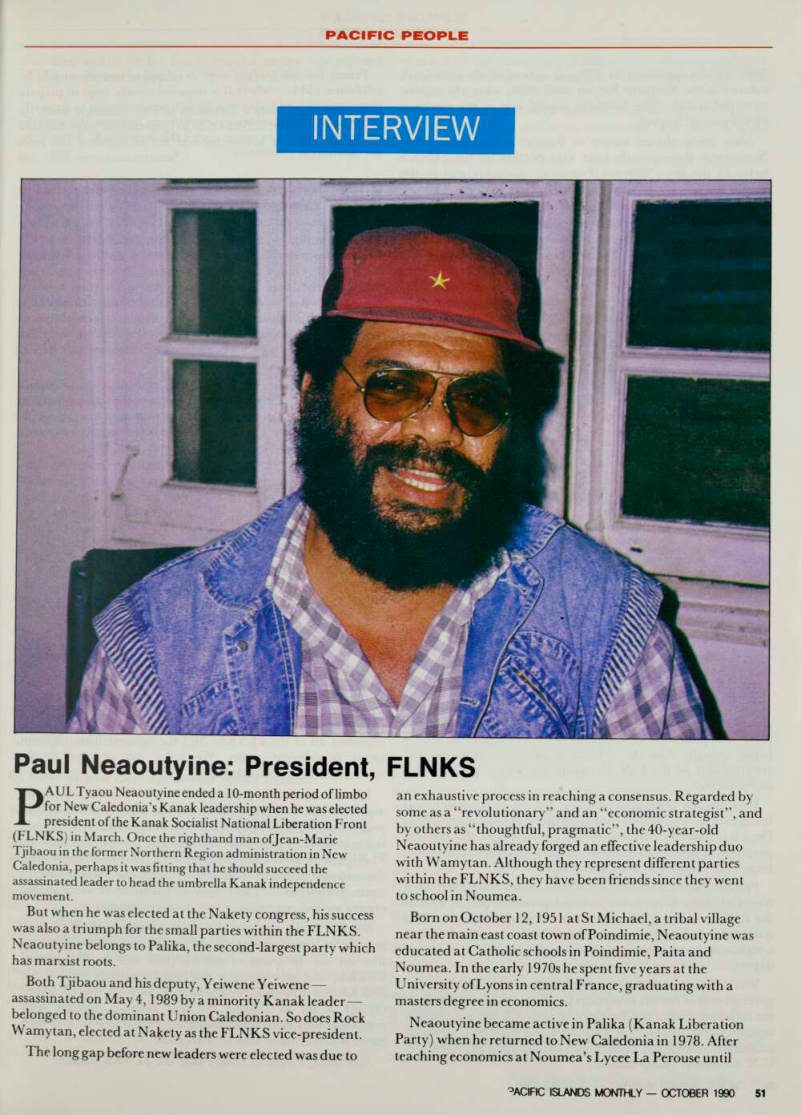
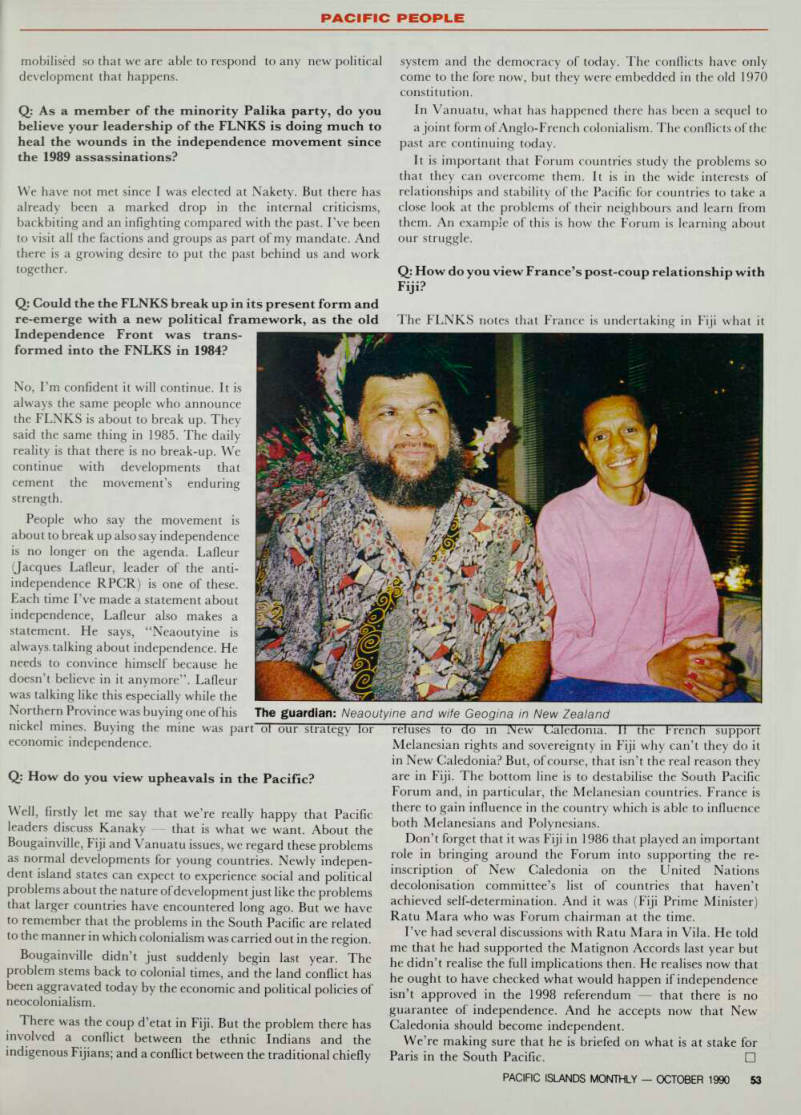
Paul Neaoutyine: President, FLNKS
PAUL Tyaou Neaoutyine ended a 10-month period of limbo for New Caledonia’s Kanak leadership when he was elected president of the Kanak Socialist National Liberation Front (FLNKS) in March. Once the righthand man ofJean-Marie Tjibaou in the former Northern Region administration in New Caledonia, perhaps it was fitting that he should succeed the assassinated leader to head the umbrella Kanak independence movement.
But when he was elected at the Nakety congress, his success was also a triumph for the small parties within the FLNKS.
Neaoutyine belongs to Palika, the second-largest party which has marxist roots.
Both Tjibaou and his deputy, Yeiwene Yeiwene — assassinated on May 4,1989 by a minority Kanak leader — belonged to the dominant Union Caledonian. So does Rock Wamytan, elected at Nakety as the FLNKS vice-president.
The long gap before new leaders were elected was due to
an exhaustive process in reaching a consensus. Regarded by some as a “revolutionary” and an “economic strategist”, and by others as “thoughtful, pragmatic”, the 40-year-old Neaoutyine has already forged an effective leadership duo with Wamytan. Although they represent different parties within the FLNKS, they have been friends since they went to school in Noumea.
Born on October 12,1951 at St Michael, a tribal village near the main east coast town of Poindimie, Neaoutyine was educated at Catholic schools in Poindimie, Paita and Noumea. In the early 1970 s he spent five years at the University of Lyons in central France, graduating with a masters degree in economics.
Neaoutyine became active in Palika (Kanak Liberation Party) when he returned to New Caledonia in 1978. After teaching economics at Noumea’s Lycee La Perouse until
1985, he was appointed by Tjibaou as head of the president’s cabinet in the Northern Region until 1988, when the regions were disbanded, (The Northern capital was in the rundown nickel port of Nepoui).
After being elected mayor of Poindimie in March 1989, Neaoutyine three months later won election on the FLNKS ticket to the new Northern Province’s Assembly and to the Territorial Congress. By the end of 1989 he was being widely touted as the likely consensus leader of the FLNKS.
Neaoutyine has travelled widely. He visited New York twice in 1987 for United Nations debates on New Caledonia. He attended the 1986 South Pacific Forum in Suva and the 1980 Forum in Port Vila. He has recently been on a three-country tour which has taken him to France, New Zealand and Papua New Guinea. He was joined by his wife, Georgina, also a Kanak militant, and Wamytan in New Zealand where he spoke to Pacific Islands Monthly's David Robie.
Q: Although the FLNKS lost its case for observer status at the South Pacific Forum, it made gains with a resolution bringing the issue of independence back into the context of the United Nations decolonisation com mittee. How do you view the progress?
We are happy with how things are going. In Vila we were able to meet informally with Pacific leaders and to brief them over reality with the Matignon Accords. The de cision to create a Forum com mittee Fiji, Nauru and the Solomon Islands which will visit New Caledonia to di rectly monitor developments will be a big help to us. That is if France accents such visits.
Once that principle is established, then it is isn’t such a big step to have a U.N. mission.
Previously, at Tarawa, the Forum nations were prepared to accept the Matignon Accords at face value. Now they realise there is no guarantee of independence. Once again the issue is being brought into the context of decolonisation and the responsibility of the U.N. to ensure the way is prepared for
independence.
Had France been sincere when the loi cadre statute was brought in we would have continued into independence as other French colonies in Africa and Asia did long ago. But the self government process was reversed by Paris and the Kanak people became a minority in their homeland.
France under the socialists now maintains a role of referee in New Caledonia between the anti-independence parties such as the RPCR and the pro-independence Kanaks. Its bottom line is to remain in New Caledonia. The difference in policy between a right-wing government in France and the left is a matter of degree.
You’d expect governments of the right to oppose us and the governments of the left to support us. But they don’t. Although the socialists are not confrontational, they will still not actively support our independence. This is why we must have as much pressure as possible on France from the Forum leaders and the U.N. to achieve independence.
France has not budged over its refusal to comply with U.N. resolution 1514 where it is required to take steps to prepare the people of New Caledonia for independence and to regularly report to the decolonisation committee on progress. We want the Matigon Accords to come under the framework of the U.N. decolonisation committee.
Q: How confident are you of winning the referendum in
1998 and gaining independence?
I’m not entirely confident. But I am very confident about the task that we in the FLNKS have set ourselves, such as convincing other ethnic groups, like Wallis islanders, Tahitians, and even the Caldoche, that New Caledonia has a vocation towards independence. We are trying to work with young Wallis islanders and Tahitians in the Oceanic Union. It is our duty and our role to organise their population. We will not let them continue to be held as hostages by the French and the RPCR
against us!
The FLNKS aspirations are deeply embedded in the Kanak culture and the Kanak people. These are our springboards in seeking national independence. In opposition to this the people with economic power have sought to mobilise groups against us
The struggle takes different forms at different stages. We tailor our strategy to the circumstances’
through fear.
Within the context of inde pendent economic develop ment and redistribution, there is no reason to be afraid of us.
We are succeeding in convinc ing them that independence is viable. That success is being demonstrated through the ef forts of Jacques Lafleur and the RPCR in trying to break up the Oceanic Union.
Q: How do you see yourself and your role?
I know some see me as a revolutionary. I’m not renouncing my convictions, nor my militant past. But today I am obliged to represent all of the FLNKS. And the struggle takes different forms at different stages. We tailor our strategy to the circumstances of the struggle.
My difficult task as president of the FLNKS has three main aspects. First, I am spokesman for the dignity of the Kanak people and their determination for independence. I have to relate to all other groups abroad and here, and explain what the FLNKS is all about. I represent the FLNKS in dialogue with the anti-independence RPCR party and the French govern ment. I also talk to other New Caledonians of other ethnic origins so that our message goes to all communities.
Second, I am the guarantor, or guardian, of the Kanak people. So I must maintain close relations with Kanak groups who are on the fringe of the FLNKS, such as FULK and USTKE, and other groups that are completely outside the FNLKS but still want independence, such as the LKS and OPAO. I try to achieve the best possible contacts with everybody and to establish dialogue. Then there are our own internal problems to take into account, And third, I have to ensure that the FLNKS remains
mobilised so that we are able to respond to any new political
development that happens.
Q: As a member of the minority Palika party, do you believe your leadership of the FLNKS is doing much to heal the wounds in the independence movement since the 1989 assassinations?
We have not met since I was elected at Nakety. But there has already been a marked drop in the internal criticisms, backbiting and an infighting compared with the past. I’ve been to visit all the factions and groups as part of my mandate. And there is a growing desire to put the past behind us and work
together.
Q: Could the the FLNKS break up in its present form and re-emerge with a new political framework, as the old
Independence Front was trans formed into the FNLKS in 1984?
No, I’m confident it will continue. It is always the same people who announce the FLNKS is about to break up. They said the same thing in 1985. The daily reality is that there is no break-up. We continue with developments that cement the movement’s enduring strength.
People who say the movement is about to break up also say independence is no longer on the agenda. Lafleur (Jacques Lafleur, leader of the anti independence RPCR) is one of these.
Each time I’ve made a statement about independence, Lafleur also makes a statement. He says, “Neaoutyine is
always, talking about independence. He
needs to convince himself because he doesn’t believe in it anymore”. Lafleur was talking like this especially while the Northern Province was buying one of his
nickel mines. Buying the mine was part ol our strategy lor
economic independence.
Q: How do you view upheavals in the Pacific?
Well, firstly let me say that we’re really happy that Pacific leaders discuss Kanaky that is what we want. About the Bougainville, Fiji and Vanuatu issues, we regard these problems as normal developments for young countries. Newly indepen dent island states can expect to experience social and political problems about the nature ofdevelopment just like the problems that larger countries have encountered long ago. But we have to remember that the problems in the South Pacific are related to the manner in which colonialism was carried out in the region.
Bougainville didn’t just suddenly begin last year. The problem stems back to colonial times, and the land conflict has been aggravated today by the economic and political policies of neocolonialism.
There was the coup d’etat in Fiji. But the problem there has involved a conflict between the ethnic Indians and the indigenous Fijians; and a conflict between the traditional chiefly
system and the democracy of today. The conflicts have only come to the fore now, but they were embedded in the old 1970 constitution.
In Vanuatu, what has happened there has been a sequel to a joint form of Anglo-French colonialism. The conflicts of the past are continuing today.
It is important that Forum countries study the problems so that they can overcome them. It is in the wide interests of relationships and stability of the Pacific for countries to take a close look at the problems of their neighbours and learn from them. An example of this is how the Forum is learning about our struggle.
Q: How do you view France’s post-coup relationship with Fiji?
The FLNKS notes that France is undertaking in Fiji what it
reluses to do m i\ew Caledonia. T 1 the trench support Melanesian rights and sovereignty in Fiji why can’t they do it in New Caledonia? But, of course, that isn’t the real reason they are in Fiji. The bottom line is to destabilise the South Pacific Forum and, in particular, the Melanesian countries. France is there to gain influence in the country which is able to influence both Melanesians and Polynesians.
Don’t forget that it was Fiji in 1986 that played an important role in bringing around the Forum into supporting the re inscription of New Caledonia on the United Nations decolonisation committee’s list of countries that haven’t achieved self-determination. And it was (Fiji Prime Minister) Ratu Mara who was Forum chairman at the time.
I’ve had several discussions with Ratu Mara in Vila. He told me that he had supported the Matignon Accords last year but he didn’t realise the full implications then. He realises now that he ought to have checked what would happen if independence isn’t approved in the 1998 referendum that there is no guarantee of independence. And he accepts now that New Caledonia should become independent.
We’re making sure that he is briefed on what is at stake for Paris in the South Pacific. □
The guardian: Neaoutyine and wife Geogina in New Zealand
Advertisements & other items, pp. 51-56 (2 items)
51
°ACIFIC ISLANDS MONTHLY OCTOBER 1990
PACIFIC PEOPLE
Pacific
ISLANDS
{month l y~ I
MARKET PLACE
For the benefit of our readers who would like to place a small classified advertisement in our magazine, Market Place will assist you in selling personal items, accommodation, real estate, boating or a service ... in fact anything you would like to sell to our over 50,000 readers.
Market Place Advertising Rates are structured to allow you to place as many advertisements as you wish, economically.
REAL ESTATE
ACREAGE LOTS: SAVUSAVU BAY, FIJI:
Beach frontage and adjacent lots. All freehold titles. All weather road to town and airport. Zoned tourist/residential. Beautiful lots from only AU520,900. From one acre to 1.9 acre and five acre lots available. Many are sold already. Buy now while the prices are low. Contact Aren Nunnink.
Phone 03/478 2993 or write to: GPO BOX 530588, Melbourne, Victoria, Australia 3001.
WANT TO BUY
Oceanfront Island Properties Wanted to purchase. Dobry, Box 388 Lihue, Hawaii 96766. USA.
SCRAP METAL
Good prices paid for your clean scrap Aluminium, Brass, Copper, Lead, etc.
Contact Nonferral Pty. Ltd. 23 Davis Rd.
Wetherill Park NSW 2164 Australia. Fax 61 2 604 1304 for prompt reply. Our Company is a long established and leading metal buyer and smelter. Telephone 61 2 604 8855.
BEACH UMBRELLA'S
LIDGARD SAILS FIJI, P.O. Box 3084, Lami Fiji. Ph. (679) 314386, Fax. (679) 300217. ' We manufacture various sizes of umbrella’s in aluminium and wood frames. Custom colours and printing available, Agents wanted m New Caledonia, Tahiti, Cook Is., Samoa, Tonga, Vanuatu & Solomons.
"INTERNATIONAL
PENFRIENDS"
We have 1000's of friends worldwide who would like to write to you, their interests are many and varied. Why not join our happy group of friends and broaden your horizons. Wite to:— Julia, P.O. Box 7419 GCMG Bundall. OLD. Australia.
STAMPS WANTED
Pacific Islands stamps on exchange basis. J. Lai, 19 Lovoni Rd, Tamavua, Suva, Fiji. A 4
COMMERCIAL PRINTING
Top quality four colour printing, brochures, posters, packaging, product labels, fabric labels, billboards, books, magazines, stickers, books. Export quality. Contact, Fiji’s most experienced Commercial Printers. FIJI TIMES COMMER- CIAL PRINTING, P.O. Box 1167, Suva. Fiji.
Phone: 314111. Fax. 301521.
"DISTRIBUTORS WANTED”:-
“Distributors/Agents wanted all areas for stainless steel and wire rope fittings, shackles, turnbuckles etc etc for marine and commercial uses. Also deck fittings, aluminium and copper swages etc. For further information contact Bridge & Company Pty Ltd, 20 Fifth Avenue, Palm Beach, Queensland 4221, Australia. Fax 61 075 98 1797, ‘Phone 61 075 98 1088.”
GENERATORS
2 only Daihatsu Diesel Powered Generators 57 5 KVH (370 KW) 41 5V 50HZ
500 RPM.
For details contact; Colin Jenner McConnell Dowell (Fiji) Ltd Suva.
Telephone (679) 362666 Fax (679) 351065.
“ENTIRE BUILDING TO LET”
A RARE OPPORTUNITY to immediately lease Fiji’s largest and tallest office building outside of Suva. Perfect for a REGIONAL HEAD OFFICE or HOTEL CONVERSION. Located in the transportation hub of the Pacific in sunny Lautoka and only a 10 minutes drive to the International Airport.
This 2900m 2 (32,000 sq ft.) modern building is fully air-conditioned with lift and car parking for over 30 cars. It is in prime location.
Naming Rights Available Contact: Aquarian Management Services (679) 62-222 or Fax (679) 64581. We Have Others!
GENTS/DISTRIBUTORS WANTED
Qualified Agents/Distributors wanted for small primary and rechargeable batteries.
Products available include Alkaline, Carbon- Zinc, Mercury, Silver, Lithium, NiCad, Gel-Cell and Lead-Acid. Please contact Pacific Power Products, P.O. Box 2756, Redmond, WA 98073 USA. Phone 206-881-0564. Telex
212495 PACPP UR
SELF ADHESIVE LABEL!
Li
FORUM LABELS (FIJI) LTD
P.O. Box 1167, Suva., Fiji. Phone: 314111.
We print self-adhesive labels in rolls, multi-coloured labels with hot foil, and die cut to shape, tickets and tags in rolls. We also supply labelling machines and fabric labels.
PACIFIC
SLANDS
|MONT H L Y
MRRK6T PLRCC CRN WORK
UUOND6RS FOR VOU ...
Promote your business, or service, sell your household
items, cars or heavy machinery
etc.
ONLY AUSSI PER WORD.
NO COMPANY LOGO. NO
DISPLAY. NO BOLD TYPE.
Just forward your Advertisement together with payment to: PACIFIC ISLANDS MONTHLY “Market Place", P.O. Box 1167, Suva, Fiji.
CONDITIONS:
1/ All Advertisements are subject to acceptance and approval of publisher. 2. Advertisements are published as space permits: we cannot guarantee date of insertion. 3. All advertisements must be prepaid and should be typed or printed clearly. 4. Deadline for receipt of advertisements is the 10th of the month prior to issue.
5. PACIFIC ISLANDS MONTHLY
assumes no responsibility for any service other than publishing paid advertisements in this section.
Fuels and lubricants.
Plastics. Chemicals. Bitumen.
Aviation Services. Bunkering.
Shell has penetrated even more of the Pacific to widen its network of offices, terminals and
Network Shell,
now servicing
even more
of the Pacific.
distributors as well as service stations.
Now you can re-assess your source of supply, because Shell quality and value is close at hand, with the service to back it up. 1 REGIONAL OFFICES; GUAM 671 477 4350. Also servicing Marshall Islands (Majuro), Northern Marianas (Saipan), Palau.
Ijl 679 m W. Also servicing Tonga. Cook Islands. American Samoa, Western Samoa • PAPUA NEW GUINEA (C 5 228 700. Also servicing Solomon Islands.
NEW CALEDONIA 68" 28S 720. Also serv icing Tahiti, Vanuatu.
Less Wbrk, More Enjoyment.
v mmem wm wm m : ■I ■
Wmm
- Tension can be a good thing in moderate amounts. In fact, for safe driving, it’s absolutely essential, translating as driver alertness. But just where does tension stop being alertness and become discomfort, and then fatigue?
Mitsubishi Motors, in designing the Galant, spent hours on that question, using the latest technology to measure drivers’ physical reactions to various aspects of driving. One such aspect is the way driving, particularly cornering and lane-changing, requires constant steering adjustments. This results in added stress for the driver. The Galant’s 4-wheel steering and Electronic Control Suspension take some of this pressure off the driver by actively controlling vehicle attitude. With less work, the driver can High Tension 20 30 40 Low Tension 10 80 km/h 20 30 Driver tension under cornering is measured by level of skin resistance. With ECS, higher skin resistance shows lower levels of tension in the driver.
V
1 tsw £
•% get more enjoyment from driving.
As far as Mitsubishi are concerned, human engineering is much more than a catchy phrase. It is a practical way to make cars more useful and more appealing to people.
A
MITSUBISHI
MOTORS
MITSUBISHI CSHLRNT
AMERICAN SAMOA: MORRIS SCANLAN SERVICE INC. PO Box 367, Pago Pago, Tel 633 5520/AUSTRALIA; MITSUBISHI MOTORS AUSTRALIA LTD. Box 1284, South Road, Clovelly Park, South Australia 5042, Tel (08) 275-7223/FIJI: NIVIS MOTOR & MACHINERY CO . LTD GP O Box 150, Suva, Tel 38341 1 FRENCH POLYNESIA (TAHITI): ETS-BREDIN FRERES ET FILS P 0 Box 21, Papeete, Tahiti, Tel 4-202-58/NEW CALEDONIA: SOCIETE D'IMPORTATION D AUTO DU PACIFIQUE SUDS.A. B.P 438 Rond Point du Paclfique, Noumea, Tel. 274144/NEW ZEALAND: MITSUBISHI MOTORS NEW ZEALAND LTD. Todd Park, Henot Drive, Private Bag, Ponrua, Tel 370-109/ NORFOLK ISLAND; BORRYS LTD. P O Box 169, Norfolk Island. Tel 2114 PAPUA NEW GUINEA: TOBA PTY. LTD. PO Box 503, Port Moresby, Tel 2 1-7874/SOLOMON ISLANDS: HARVEST PACIFIC LTD G P O Box 88, Honiara, Guadalcanal, Tel 30128/TONGA: SITANI MAFI CO.. LTD. PO Box 83. NukuALOFA, Tel 21-044/VANUATU: SOCOMETRA B.P. 06 Route de Lagon, Port-Vila, Tel 2314/WESTERN SAMOA: A M MACDONALD HOLDINGS LTD PO Box 576. Apia, Tel. 22022/SAIPAN/POHNPEI/MAJURO/KOSRAE/TRUK/YAP/BELAU: MICRONESIAN MOTORS. INC. 997 South Manne Drive. Tamuninq, Guam 96911, Tel 646-6827