Advertisements & other items, pp. 1-4 (2 items)
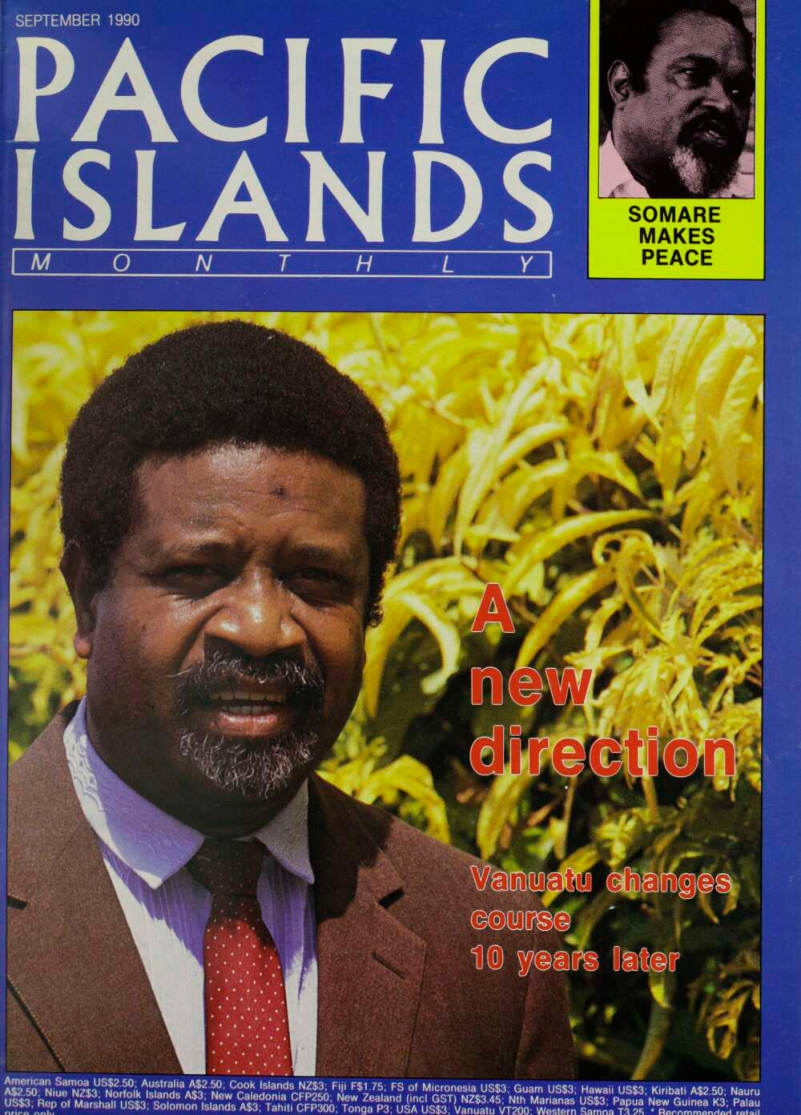
Pacific
ISLANDS
MONTHLY
SEPTEMBER 1990
SOMARE
MAKES
PEACE
w/¥ v *
mfjy
[fllrMm mn,
dtyki
h ĥ j
The
naked truth about our 6265.
You might think it rather immodest of us to show you our new models, er, in the raw.
But we’re especially proud of our bodies.
Because in the process of refining Mazda’s new generation of Mazda 626s our engineers spent a lot of
time doing bodybuilding exercises.
Using advanced computer techniques such as Finite Element Analysis and Modal Analysis, they were able actually to “see” hidden structural stress and vibration — and make minute adjustments to enhance body rigidity — within 0.1 microns of accuracy. for an even quieter ride. Even more confident
handling.
Then it was time for a workout on our Global Road Circuit proving ground. More analyses. More adjustments. More workouts.
The result ol this untiring research and development is what you see here. Three of the most beautiful bodies an engineer ever saw.
Just waiting to be dressed up and taken out for a ride.
mazoa
© Mazda Motor Corporation
THANKS TO THE PACT NETWORK,
KEEPING IN TOUCH THROUGHOUT THE
PACIFIC WILL BE A LOT EASIER.
The good news for the future of communications in the Pacific is the PACT Network. The PACT Network is a cost-effective communications system that will link Pacific nations with their neighbours, their own rural communities and the rest of the world.
This Network provides instant and economic telephone access to friends, family and even to medical and educational facilities.
The expanded network also means that local business can communicate easily with customers by phone, fax or data link.
The PACT Network has been developed through the careful planning of the Pacific nations together with OTC International, an arm of Australia's worldwide communications company, and INTELSAT, the world’s global satellite system.
No one’s far from anyone anymore.
International Limited
inbdsab
Pacific
Islands
Monyhly
Vo I 60 No. 9
Voice Of The Pacific
September 1990
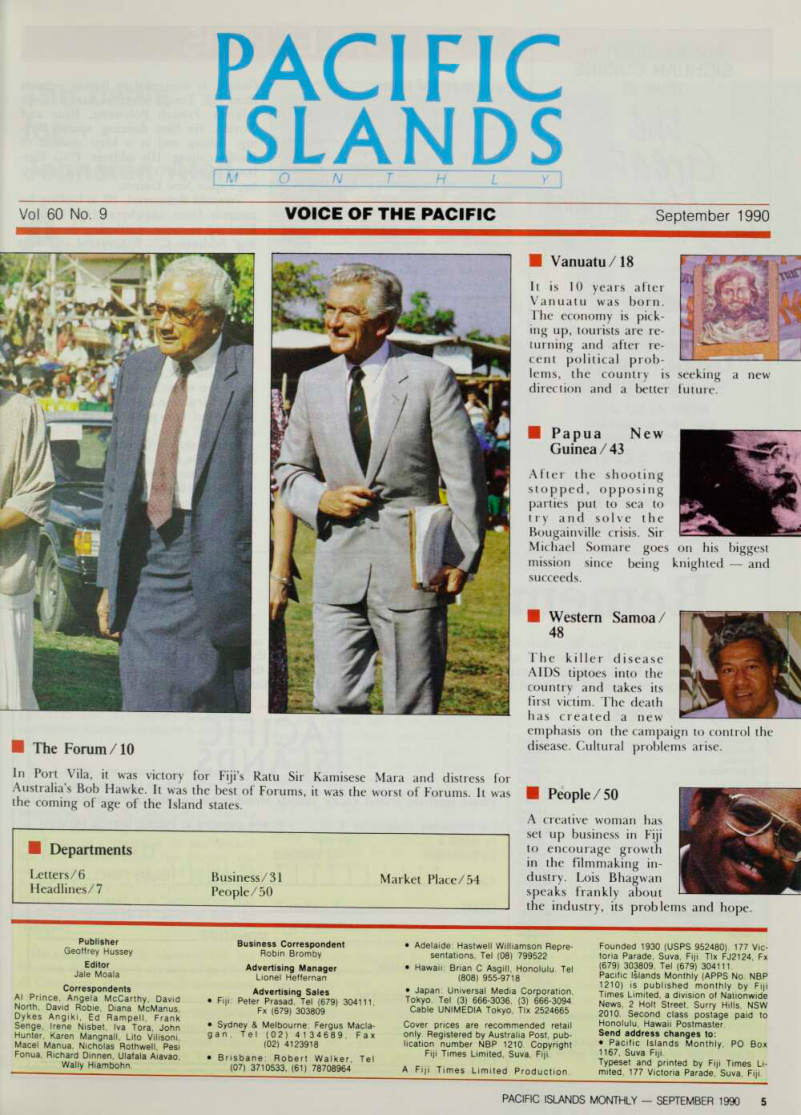
■ The Forum/10 In Port Vila, it was victory for Fiji’s Ratu Sir Kamisese Mara and distress for Australia’s Bob Hawke. It was the best of Forums, it was the worst of Forums. It was the coming of age of the Island states.
I Departments
Letters/6 Headlines/?
Business/31 People/50
Market Place/54
■ Vanuatu/18 It is 10 years after Vanuatu was born.
The economy is pick ing up, tourists are re turning and after re
cent political prob-
lems, the country is seeking a new direction and a better future.
■ Papua New Guinea/43 After the shooting
stopped, opposing
parties put to sea to try and solve the Bougainville crisis. Sir
Michael Somare goes on his biggest mission since being knighted and succeeds.
■ Western Samoa/ 48 The killer disease AIDS tiptoes into the country and takes its first victim. The death has created a new
emphasis on the campaign to control the disease. Cultural problems arise.
I People/50
A creative woman has set up business in Fiji to encourage growth in the filmmaking in
dustry. Lois Bhagwan
speaks frankly about
the industry, its problems and hope.
Publisher Geoffrey Hussey Editor Jale Moala Correspondents Al Prince, Angela McCarthy, David North, David Robie, Diana McManus, Dykes Angiki, Ed Rampell. Frank Senge, Irene Nisbet, Iva Tora, John Hunter, Karen Mangnall, Lito Vilisoni, Macel Manua, Nicholas Rothwell, Pesi Fonua, Richard Dinnen, Ulafala Aiavao, Wally Hiambohn.
Business Correspondent Robin Bromby Advertising Manager Lionel Heffernan Advertising Sales • Fiji; Peter Prasad, Tel (679) 304111, Fx (679) 303809 • Sydney & Melbourne: Fergus Macla gan, Tel (02) 41 34689, Fax (02) 4123918 • Brisbane; Robert Walker, Tel (07) 3710533, (61) 78708964
• Adelaide; Hastwell Williamson Repre sentations. Tel (08) 799522 • Hawaii: Brian C Asgill, Honolulu. Tel (808) 955-9718 • Japan; Universal Media Corporation, Tokyo. Tel (3) 666-3036, (3) 666-3094 Cable UNIMEDIA Tokyo, Tlx 2524665 Cover prices are recommended retail only. Registered by Australia Post, pub lication number NBP 1210. Copyright Fiji Times Limited, Suva, Fiji.
A Fiji Times Limited Production
Founded 1930 (USPS 952480). 177 Vic toria Parade, Suva, Fiji Tlx FJ2124, Fx (679) 303809, Tel (679) 304111.
Pacific Islands Monthly (APPS No. NBP 1210) is published monthly by Fiji Times Limited, a division of Nationwide News, 2 Holt Street, Surry Hills, NSW 2010. Second class postage paid to Honolulu, Hawaii Postmaster.
Send address changes to: • Pacific Islands Monthly, PO Box 1167, Suva Fiji.
Typeset and printed by Fiji Times Li mited, 177 Victoria Parade, Suva, Fiji.
Letters
Southworth’s letter I REFER to the letter by Bill Southworth in your August issue.
Could this be the same person who was responsible in the 1970 s for a great deal of shallow and superficial newspap er reporting on politics in Fiji? If it is, he
has clearly learned nothing about politics
here since that time. His understanding is still shallow and superficial.
Could this also be the same person who presented a fawning and biased television piece after the coups featuring the late Coalition leader Dr Bavadra? If it is, then he can be categorised as just another ill-informed, irresponsible over
seas journalist, who preaches objectivity
while practising bias.
The limitations of their experience and their own prejudice make it ex tremely difficult for such people to understand the positive role Ratu Mara has played in Fiji. They are easy and perhaps willing targets for Coalition propaganda.
Joseph Peter Falelavaki
Lautoka Penpals MURRAY Ilovua, 22, of Papua New
Guinea, is interested in having penpals from Fiji, Tonga, Western Samoa, Cook Islands, French Polynesia, Niue and Tuvalu. He likes dancing, sports, sing ing, fishing and is a keen student of Pacific culture. His address; PNG Har bours Board, PO Box 384, Port Mores by, Papua New Guinea.
Verenaisi Rokovereni, 20, is looking for penpals from anywhere. Her hobbies; listening to music, gardening, horse rid ing. Address; C/- Rokoreveni and Sons Co., PO Box 6078, Nasinu, Suva, Fiji.
Peppi Lystimaki, 21, is a student at University of Helsinki, who likes travell
ing, collecting stamps, autographs and
postcards, writing letters. Address;
Koivusaarentie 10A 4, 00200 Helsinki 20, Finland. □
Letters To The Editor Must In
clude the writer’s full name, address and home telephone number. All letters may be edited for purposes of clarity of space.
Letters should be addressed to: The Editor, Pacific Islands Monthly, PO Box 1167, Suva,
Fiji Islands.
Fax (679) 303809.
Advertisements & other items, p. 6 (2 items)
Great
For the finest in
SICHUAN CUISINE
dine at m
Great
dCHW
Cnr. Bau St/Laucala Bay Rd, Flagstaff, Suva.
LUNCH • DINNER
Phone: 301285
NOW ALSO AT:
404, Khyber Pass Rd, Newmarket, Auckland.
Phone: 5221752
• Friendly and unpretentious oriental style service. • Fully licensed bar and a splendid wine list. • All major credit cards accepted.
jhjkhkh
Remember your Friend
There are times in your life when you feel your friends have been missing out on something good. Now’s your chance to do something about it and share with them one of the good things you have. Buy your friend a subscription to Pacific Islands Monthly and let him or her join you and the thousands of other people worldwide who are kept informed of the latest political, social and cultural changes taking place in the Pacific.
PACIFIC
ISLANDS
M O N T H L Y Please send my friend Pacific Islands Monthly for one year (12 issues).
I enclose my cheque for $ (made payable to Pacific Islands Monthly) or debit $ to my; □ Bankcard □ Visacard □ Mastercard Card No: I I I I I I I I I I I I I I I I Expiry Dale
NAME,
SIGNATURE
MY FRIEND’S NAME
MY FRIEND’S ADDRESS,
CITY
COUNTRY,
Headlines
The battle for Johnston Atoll
A HAWAII district court judge will rule by September 10 on a
preliminary injunction to halt
United States Army shipments of che mical weapons from West Germany to Johnston Atoll. Greenpeace and Hawaii based indigenous rights activists failed on August 9 to get a temporary restrain ing order to halt the shipment of 100,000 rounds of nerve gas to the Johnston Atoll Chemical Agent Disposal System (J AC ADS) facility. On August 21,
they asked for a preliminary injunction
halting the transfer until the merits of the case against shipment could be argued fully in court. Judge David Ezra said he would rule by September 10, the date beyond which the Army says it can no longer hold the chemical weapons in Germany. The US Army has promised it won’t move the weapons until the judge rules, at which time he would also set a trial date for the merits of the Green peace case.
However, affidavits put to the Honolu lu court by Greenpeace show several for mer Army chemical weapons experts be lieve the shipments could pose serious dangers to people and the environment.
The ex-head of environmental toxiocolo gy at the Aberdeen chemical weapons storage site in Maryland, Dr Wayne Landis, said the Army had “seriously erred” in its environmental analysis of JACADS and its “failure to consider alternative disposal methods is unreason able”.
Dr Landis also warned that an acci
dent during shipment could cause “signi
ficant” harm to marine life and the en vironment. The US Government lawyers tried unsuccessfully to have this affidavit ruled out of contention. It was backed up by evidence from the former en vironmental resources chief of the US
Army’s Engineers Corps, Dr James
Maragos, who said it is “imperative that immediate action to be taken to halt the transport”.
Meanwhile, the US Government has released the classified version of its Glob al Commons environmental assessment on the shipment. It has come up with a FONSI A Finding Of No Significant Impact and the Army claims there is no need for a full environmental impact study, which would be open for public comment. □
Naval delivery
THE Solomon Islands will receive its second naval patrol boat from Australia next year. It will be of the same class as the first boat, Lata, which was built in Freemantle, Western Australia. The ves sel will be the last in Australia’s patrol boat project which was started to help island nations patrol their Exclusive Eco nomic Zones. The Solomon Islands navy has set up base at Bokona Bay, Honiara, where it will build a jetty big enough for the two boats, workshops and storerooms. Australia has agreed to con tinue to provide technical training and logistic support for the Solomon Islands Defence Forces. □ Sunday ban call FIJI’S Methodist Church has called for the retention of the Sunday Ban in Fiji.
The ban was imposed by Major General Sitiveni Rabuka after his second coup in September 1987 as an extension of the curfew. The ban stopped work, trading and sports on Sundays. The easing of the ban by the interim government sparked off a round of religious protests and roadblocks in December 1988 and early last year. The church’s annual con
ference also called for Fiji “to remain a Christian country”. □ MR sacked PAPUA New Guinea Prime Minister Rabbie Namaliu has sacked Marine Re sources Minister Allan Ebu after Ebu criticised the country’s fisheries agree ment with the Soviet Union. Ebu said the agreement which was made last June offered “zero economic benefits” to Papua New Guinea. He said an agree ment with the Asian countries would have been better, and he labelled the Soviet deal as being politically motivated and not based on economics. The dismis sal allowed Namaliu to make a minor Cabinet reshuffle to strengthen his
Coalition Government by inviting
another minority party to join his team.
In the changes, the Minister assisting the Prime Minister, Akoka Doi, becomes the new Fisheries and Marine Resources Minister. Jack Genia moves from Educa tion to Assisting the Prime Minister and will also be responsible for resources de velopment. Education goes to the incom ing leader of the Melanesian United Front, Utula Samana. Namaliu said he fired Ebu because of a breach in Cabinet
solidarity. □
hibiscus
All in a hibiscus
FIJI’S premier beauty
queen and charity fes tival went commercial last month under the sponsorship of Air New Zealand. The airline flies Miss Hibiscus to Los Angeles and Miss Charity to Honolulu.
Nearly 20,000 people
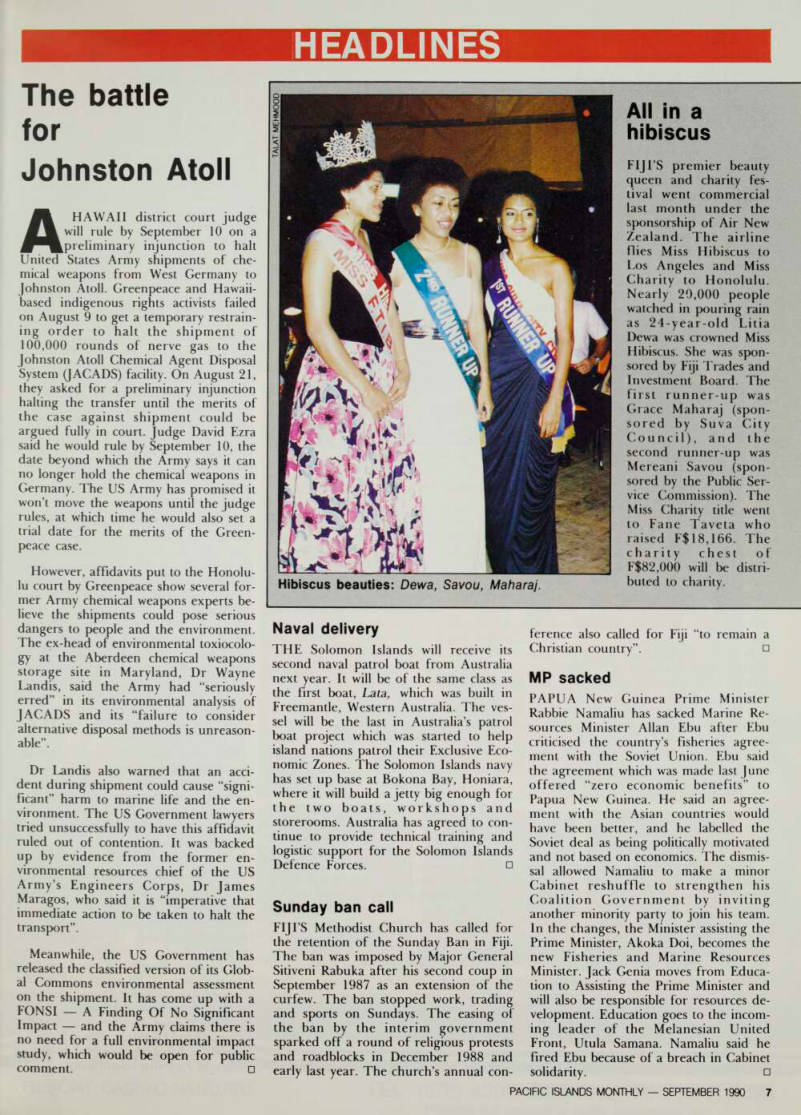
watched in pouring rain as 24-year-old Litia Dewa was crowned Miss Hibiscus. She was spon sored by Fiji Trades and Investment Board. The first runner-up was Grace Maharaj (spon sored by Suva City Council), and the second runner-up was Mereani Savou (spon sored by the Public Ser vice Commission). The Miss Charity title went to Fane Taveta who raised F 518,166. The charity chest of F 582,000 will be distri buted to charity.
Hibiscus beauties: Dewa, Savou, Maharaj.
delayed again
Tuna hearing delayed again
UNITED States Secretary of
Labor Elizabeth Dole has, again, postponed scheduled minimum wage hearings in American Samoa. Originally set for June, they were postponed until September, and then, late in August postponed again un til January 14.
T his was good news for Governor Tali Coleman and to the tuna canneries neither wants to raise wages. The raises would add to Coleman’s deficit, and cut into the canners’ profits.
The Secretary’s decision was doubly bad news for the territorial and cannery workers (most of the latter are from Western Samoa), beause if any increases are voted by Dole’s appointed Industry Committee, they will not be retroactive.
Dole postponed this round of hearings at the request of the tuna industry and
of Congressman Faleomaveaga and eight
other Democratic members of the US House of Representatives. They argued that Congress is about to pass a bill which will allow the hearings to continue without the managers of the StarKist and Chicken of the Sea plants having to show the extent of their profits in Amer ican Samoa; the tuna industry argues that this open-books provision was a technical error made by the Congress when it last revised the minimum wage law.
Both the tuna canneries and the Ter ritorial Government ask that they be ex cused from the minimum wage of US$3.BO which applies to all other US workers. There are currently several different minimum wages in effect in American Samoa, varying from about US$2 to about US$3 an hour. The tuna wage is US$2.B7 an hour. □ Stop the tests THE environmental organisation Green peace has called for an immediate end to French nuclear tests in French Polynesia.
This latest call came after the publication of a new scientific report indicating that
radioactivity from nuclear explosions
under Mururoa Atoll is likely to reach the surface in six years or sooner.
The report was made by United States scientist Norma Burke and published in the British journal New Scientists. It says that a re-evaluation of sampling data col lected by French marine explorer Jac ques Cousteau in 1987 shows water in the lagoon contaminated with Cesium
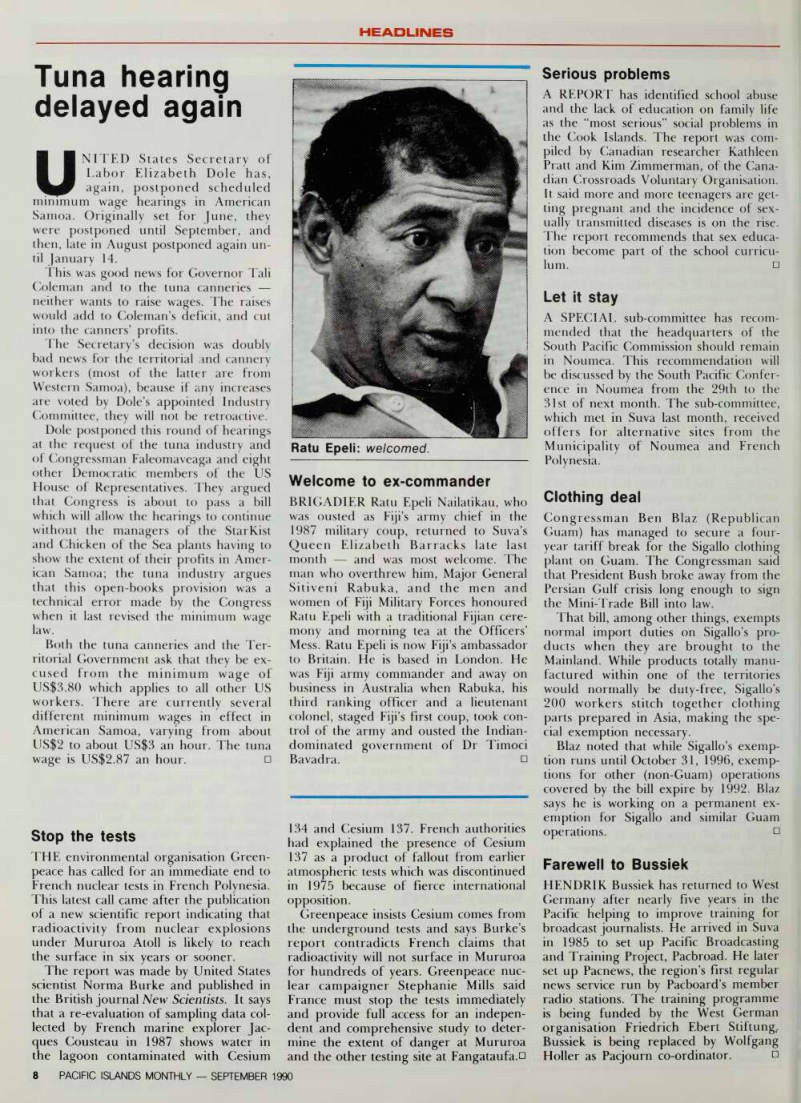
Welcome to ex-commander BRIGADIER Ratu Epeli Nailatikau, who was ousted as Fiji’s army chief in the 1987 military coup, returned to Suva’s Queen Elizabeth Barracks late last month and was most welcome. The man who overthrew him, Major General Sitiveni Rabuka, and the men and women of Fiji Military Forces honoured Ratu Epeli with a traditional Fijian cere mony and morning tea at the Officers’
Mess. Ratu Epeli is now Fiji’s ambassador to Britain. He is based in London. He was Fiji army commander and away on business in Australia when Rabuka, his third ranking officer and a lieutenant colonel, staged Fiji’s first coup, took con trol of the army and ousted the Indian dominated government of Dr Timoci Bavadra. □
134 and Cesium 137. French authorities had explained the presence of Cesium 137 as a product of fallout from earlier atmospheric tests which was discontinued in 1975 because of fierce international
opposition.
Greenpeace insists Cesium comes from the underground tests and says Burke’s report contradicts French claims that radioactivity will not surface in Mururoa for hundreds of years. Greenpeace nuc lear campaigner Stephanie Mills said France must stop the tests immediately and provide full access for an indepen dent and comprehensive study to deter mine the extent of danger at Mururoa and the other testing site at Fangataufa.D
Serious problems
A REPORT has identified school abuse and the lack of education on family life as the “most serious” social problems in the Cook Islands. The report was com piled by Canadian researcher Kathleen Pratt and Kim Zimmerman, of the Cana
dian Crossroads Voluntary Organisation.
It said more and more teenagers are get ting pregnant and the incidence of sex ually transmitted diseases is on the rise.
The report recommends that sex educa tion become part of the school curricu lum. □ Let it stay A SPECIAL sub-committee has recom mended that the headquarters of the South Pacific Commission should remain in Noumea. This recommendation will be discussed by the South Pacific Confer ence in Noumea from the 29th to the 31st of next month. The sub-committee, which met in Suva last month, received offers for alternative sites from the Municipality of Noumea and French
Polynesia.
Clothing deal
Congressman Ben Blaz (Republican
Guam) has managed to secure a four year tariff break for the Sigallo clothing plant on Guam. The Congressman said that President Bush broke away from the Persian Gulf crisis long enough to sign the Mini-Trade Bill into law.
That bill, among other things, exempts normal import duties on Sigallo’s pro ducts when they are brought to the Mainland. While products totally manu factured within one of the territories
would normally be duty-free, Sigallo’s
200 workers stitch together clothing parts prepared in Asia, making the spe cial exemption necessary.
Blaz noted that while Sigallo’s exemp tion runs until October 31, 1996, exemp tions for other (non-Guam) operations covered by the bill expire by 1992. Blaz says he is working on a permanent ex emption for Sigallo and similar Guam
operations. □
Farewell to Bussiek HENDRIK Bussiek has returned to West Germany after nearly five years in the
Pacific helping to improve training for
broadcast journalists. He arrived in Suva in 1985 to set up Pacific Broadcasting and Training Project, Pacbroad. He later set up Pacnews, the region’s first regular news service run by Pacboard’s member radio stations. The training programme is being funded by the West German
organisation Friedrich Ebert Stiftung,
Bussiek is being replaced by Wolfgang
Holler as Pacjourn co-ordinator. □
Ratu Epeli: welcomed.
Advertisements & other items, pp. 9-10 (2 items)
'wtacuAe
ut
-m m
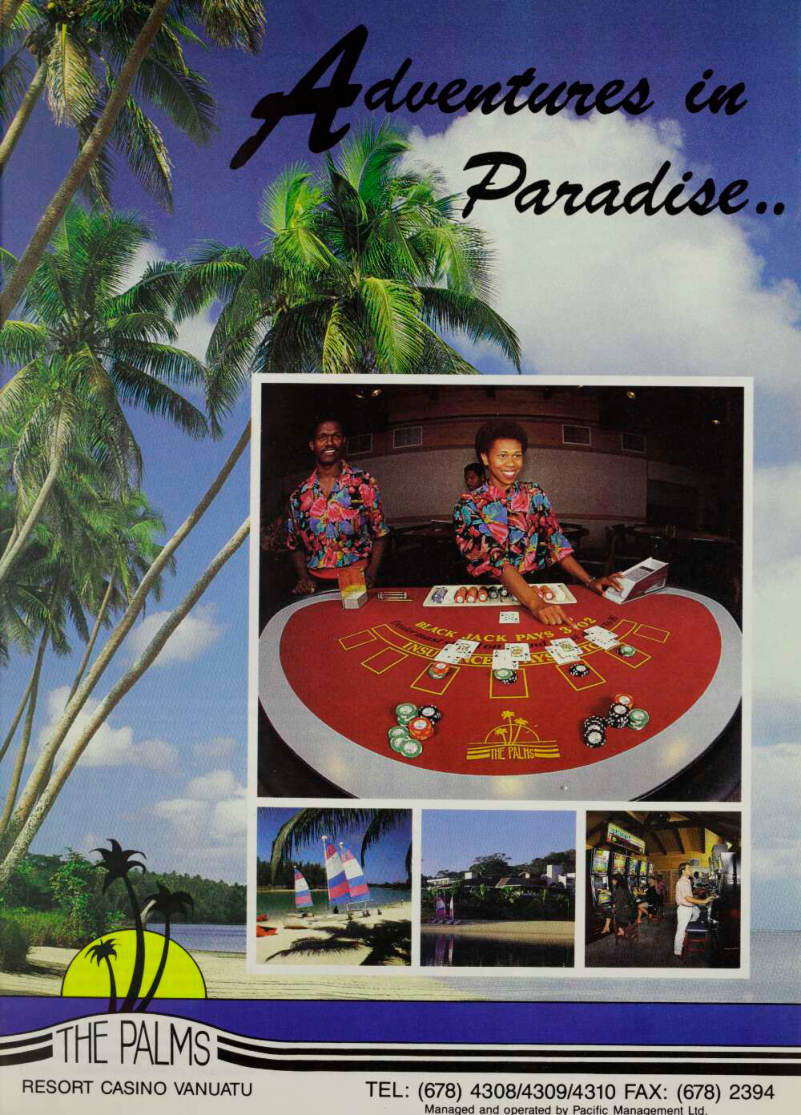
THE PALMS
RESORT CASINO VANUATU
TEL: (678) 4308/4309/4310 FAX: (678) 2394
Managed and operated bv Pacific Manaaement Ltd.
Karen Mangnall
THE FORUM
Ratu Mara and Bob Hawke in Port Vila: "eventually they met and Ratu Mara completed the rout”.
A tale of two hotels

IF any single issue emerged from this year’s South Pacific Forum, ready to dominate the 1990s, it’s the question of identity. The balance of power between the Pacific Island nations and their bigger neigh bours, Australia and New Zealand, underwent a clear and irrevocable shift in Port Vila. The issues which highlighted the gap between the two groups — chemical weapons disposal at Johnston Atoll, observer status for the Kanak Socialist National Liberation Front (FLNKS), and Fiji’s constitution — all hinge on Pacific interpretations of sovereignty. Pacific Islands Monthly looks at the implications of this split for the Forum, and Australia and New Zealand’s future roles. PIM also talks to Forum Fisheries Agency director Philipp Muller and the leading contender as the next secretary-general, Kiribati Presi dent leremia Tabai.
By Karen Mangnall
IT was the best of Forums, it was the worst of Forums. It was the com ing of age of the Pacific Island na tions, it was the age of foolishness for Australia and New Zealand. It was the season of light for the Island leaders, it was the season of darkness for Bob
Hawke. In short, that 48 hours in Port Vila was so unlike previous Forums that some of its noisiest authorities insisted on it being received in the superlative of
comparison.
Walter Lini: “I think it was special because most of the leaders actually said what they wanted to say.”
Rabbie Namaliu: “The Forum is
changing. WeTe getting younger and very articulate leaders who are confident to be able to state very firm positions, We are prepared to assert ourselves much more than before.”
Geoffrey Palmer: “The debates were very vigorous and the standard of debate very high indeed. (Johnston Atoll) was a humdinger of a debate, really.”
sheepdog”.
The South Pacific Forum
Bob Hawke: “Well, um, it may be a humdinger by New Zealand standards but by the standards of the Australian Labour Party it was pretty tame.”
The skids were under Hawke and Pal mer before they even arrived in Port Vila. While the Island delegations com muned together at one end of town at the Radisson Royal Palms Resort, the Australians and New Zealanders set themselves up in lonely, five-star splen dour across town at Le Lagon. The tale of two hotels became the leitmotif of the Forum.
That the Australian and New Zealand isolation was a major handicap soon be came apparent. New Zealand Associate Foreign Minister Fran Wilde spent vir tually the entire Forum at Le Lagon. Her last minute inclusion in the delegation became a waste of time after Fiji made it clear she would not be an acceptable candidate for resuming ministerial con tacts.
Even before interim Prime Minister Ratu Sir Kmaisese Mara arrived, Fiji offi cials were making it known that he saw no point in meeting with either Hawke
or Palmer, given their publicly expressed
condemnation of Fiji’s new constitution.
Ratu Mara first deliberately “missed” his plane to avoid Hawke and Palmer at the leader’s retreat. Then he danced away from golfing sessions, lunches and breakfasts, with Hawke and Palmer be
coming increasingly desperate to tie
down meetings. Ratu Mara was reported ly not unhappy to see this palaver head lined overseas a snub to Palmer and Hawke.
Eventually, they met and Ratu Mara completed the rout. Hawke said that, de spite its flaws, the Fiji constitution was the best that could be achieved at the moment and concluded by saying that some Commonwealth countries had “sig nificantly less democratic constitutions than the new constitution of Fiji”. Palmer was less easily won over but did concede it was better to have Fiji with a constitu tional government than to have no con stitution. Both leaders called on the Coalition to contest elections.
Ratu Mara was obviously pleased. He even went so far as to joke with some reporters and when asked who had writ ten Hawke’s statement, Ratu Mara crack ed a huge smile. Meanwhile, the discom forting of Hawke and Palmer was being
vicariously enjoyed by other Island de
legations, upset at the two leaders’ stance on Johnston Atoll. One official gleefully described Bob Hawke’s desperate attempts to talk to Ratu Mara at after noon tea on the final day as “following the old man around like a small, blond
sheepdog”.
If Fiji was a matter of picking their way through a peripheral minefield, Hawke and Palmer found themselves
under heavy bombardment over Amer ican plans to burn chemical weapons at Johnston Atoll. The division between Australia, New Zealand and the rest of the Forum became obvious at the offi
cial’s meeting.
Hawke’s public support for incinera tion of three categories of chemical weapons at Johnston weapons already there, those from West Germany and any found in the Pacific came under bitter fire as “arrogant” and trying to kneecap a full debate and consensus.
Hostility hardened with the leak of an Australian foreign affairs cable spelling out tactics, agreed upon with the Amer icans, to “manage” the debate. This in cluded not releasing Australian scientific reports on the chemical weapons destruc tion plant, called the Johnston Atoll Che mical Agent Disposal System (J AC ADS), before the Forum to avoid “provoking a fruitless technical debate without the be nefit of setting that debate in a political context”.
Several Island leaders criticised Austra
lia for keeping back the reports until the last moment. “Many islands didn’t have
enough information,” complained one
official. “They had to make instant judg ments and that’s not good enough.” In the event, the technical debate was insig nificant compared with the “political con text”.
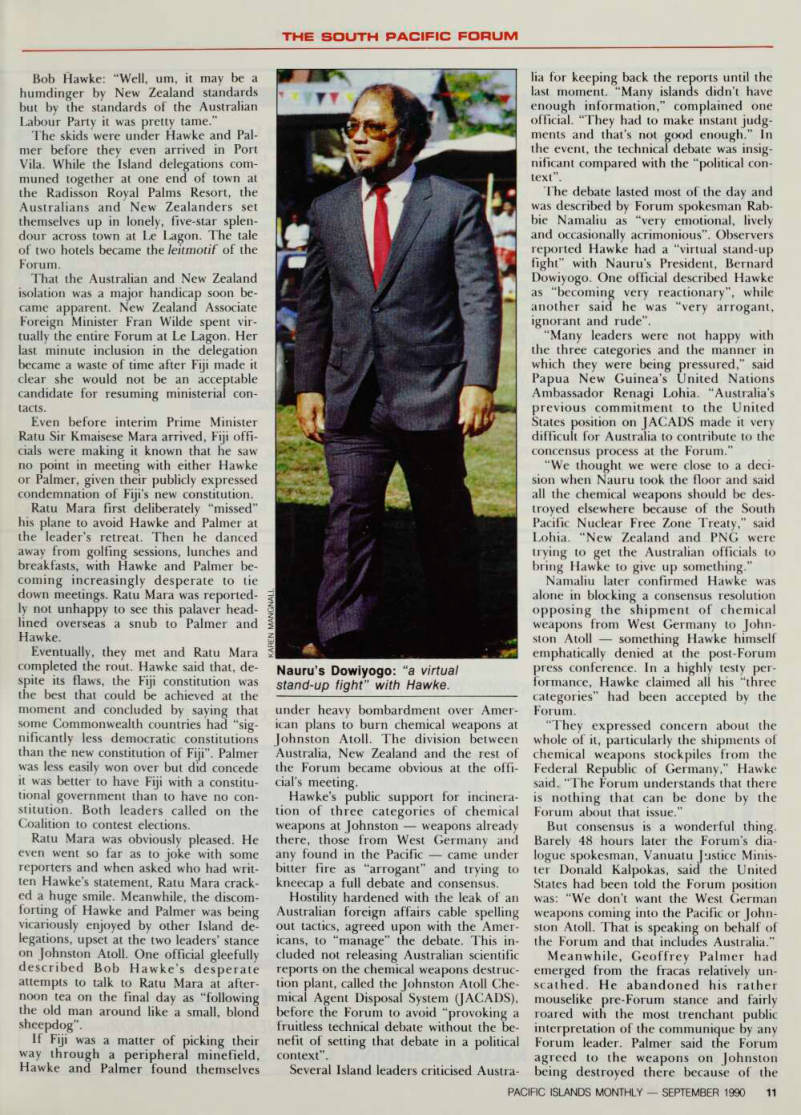
The debate lasted most of the day and was described by Forum spokesman Rab bie Namaliu as “very emotional, lively and occasionally acrimonious”. Observers reported Hawke had a “virtual stand-up fight” with Nauru’s President, Bernard Dowiyogo. One official described Hawke as “becoming very reactionary”, while another said he was “very arrogant, ignorant and rude”.
“Many leaders were not happy with the three categories and the manner in
which they were being pressured,” said
Papua New Guinea’s United Nations Ambassador Renagi Lohia. “Australia’s previous commitment to the United States position on JAG ADS made it very difficult for Australia to contribute to the concensus process at the Forum.”
“We thought we were close to a deci sion when Nauru took the floor and said all the chemical weapons should be des troyed elsewhere because of the South Pacific Nuclear Free Zone Treaty,” said Lohia. “New Zealand and PNG were trying to get the Australian officials to
bring Hawke to give up something.”
Namaliu later confirmed Hawke was alone in blocking a consensus resolution opposing the shipment of chemical weapons from West Germany to John ston Atoll something Hawke himself emphatically denied at the post-Forum press conference. In a highly testy per formance, Hawke claimed all his “three
categories” had been accepted by the
Forum.
“They expressed concern about the whole of it, particularly the shipments of chemical weapons stockpiles from the Federal Republic of Germany,” Hawke said. “The Forum understands that there is nothing that can be done by the Forum about that issue.”
But consensus is a wonderful thing.
Barely 48 hours later the Forum’s dia
logue spokesman, Vanuatu Justice Minis
ter Donald Kalpokas, said the United States had been told the Forum position was: “We don’t want the West German weapons coming into the Pacific or John ston Atoll. That is speaking on behalf of the Forum and that includes Australia.”
Meanwhile, Geoffrey Palmer had emerged from the fracas relatively un scathed. He abandoned his rather mouselike pre-Forum stance and fairly roared with the most trenchant public
interpretation of the communique by any
Forum leader. Palmer said the Forum agreed to the weapons on Johnston being destroyed there because of the
Nauru’s Dowiyogo: “a virtual stand-up fight” with Hawke.
danger of moving them, but that “no other weapons” should be brought there fer destruction.
Palmer later confirmed he interpreted the communique to mean the Forum didn’t want the West German shipment to go ahead. However, he remained “pessimistic” about reversing the American plans. “Every element of the New Zealand position is reflected in the communique,” Palmer added. “I am entirely satisfied the New Zealand policy on (JACADS) is extremely sound.”
Although New Caledonia barely raised a media ripple, neither New Zealand nor Australia can afford to be self-satisfied about their policies in that area. The issue of observer status for the Kanak Socialist National Liberation Front (FLNKS) took longest to resolve and may presage much deeper dissent within the Forum in future.
Although the communique was described by one official as “a much better deal at the Forum than ever before, ineluding investigation of the FLNKS as a dialogue partner”, its strength was due a great deal to Hawke and Palmer being knobbled by their own officials. The Melanesian Spearhead countries were threatening to withhold support for what they criticised as a “very weak” consensus resolution on New Caledonia at the UN, which had been worked out with France, PNG s Ambassador Renagi Lohia says the strength of the communique was a trade off for agreeing to let the UN
“wheels roll”. Lohia claims the UN resolution was drawn up in his absence and was another attempt by Australia and New Zealand to “pre-empt” the Forum, Although Lohia commended a “noticeable change in attitude” from Australia and New Zealand, Hawke and Palmer both opposed observer status for the FLNKS. Hawke also turned down Walter Lini’s invitation to sit on the Ministerial Committee to oversee the Matignon Accords, on the grounds that France
doesn’t appreciate foreign nosey parkers.
Both are likely to find themselves on the outer at the next Forum where the hosts, the Federated States of Micronesia, are reportedly determined that the FLNKS shall get some kind of observer status. Namaliu has also indicated the Forum’s honeymoon with the Matignon Accords is over. He said the greatest concern, with the chance of a change of Government in Paris in 1991, is “whether at the end of the Accords, the act of self-determination will inevitably lead to independence,” and that the 1998 referendum should be brought forward.
Beneath the divisions over New Galedonia, Johnston Atoll and Fiji’s constitution, lies a much more powerful divergence of interests between the Forum Island nations and Australia and New Zealand. They are becoming the targets of
increasing impatience for consistently
blocking the Island nations from explor-
ing issues of indigenous and regional
sovereignty. New Zealand and Australia,
with their developed country status, are also becoming barriers to multilateral de velopment aid through the Forum. The question is being asked; do New Zealand and Australia really belong in the Forum?
Walter Lini believes New Zealand and Australia do belong, but are isolated within the region because of their “Euro pean perspective” on life. He says they approach controversial issues like dump ing from the perspective of possible reac tions from outsiders, like France, Amer ica or any European nation, At the leaders’ retreat, Hawke was re
portedly spouting the French line against
FLNKS observer status. Lohia says the Spearhead case for observer status is based on the same principles which has seen SWAPO, the PLO and Polisario rec ognised by international bodies such as the UN, the Organisation for African Unity and the Non-Aligned Movement, “Somehow Australia and New Zealand take a different approach and try to put the FLNKS with the RPCR,” says Lohia.
“The RPCR is a political party within the French republic. The FLNKS is not; it is a liberation movement.”
Similarly, Fiji Trade Minister Bere nado Vunibobo sees New Zealand and Australia as being unable to grasp the core concept of indigenous sovereignty, He says their belief in the Westminster “one person, one vote” system has led them astray in dealing with Fiji and could mislead them again when dealing
with New Caledonia.
“We didn’t want Fiji discussed at the Forum,” Vunibobo said. “But in the long term, we would like to see a greater ex change of views on the various indige nous communities. And some are more threatened than others,”
Namaliu also concedes that while the Forum’s preoccupation still lies with the region’s non-self governing territories,
indigenous rights may come up during
the review of dialogue and observer criteria. It is a trend already apparent at the UN where the focus has left decol onisation in favour of rights of indige nous communities within independent nations. “But it has implications for many of us,” Namaliu warns. “For us, for Indonesia, Australia and New Zea land.”
A major point of contention is what Namaliu calls the “conflict of interest” between the status of Australia and New Zealand as developed nations, and their membership of the Forum. “They are a barrier to development aid,” he says.
“For example, in tourism. If we adhere to the Lome Convention then New Zea land and Australia cannot be members of the regional tourism council. But then we cannot bring it under the Forum umbrella.” Namaliu says the Forum may have to set up an umbrella Ministerial Council through which all aid should be channelled.
Lohia says Australia and New Zealand, by giving aid to the region, play a role as developed nations. “There’s a question of what the dialogue partner review should do about this because if we seriously look ahead analysis would lead me to believe their role is similar in general to that played by other dialogue partners.”
Kiribati President leremia Tabai pro fesses he has no problems with the two countries as full Forum members but does have difficulty describing their roles. “They maybe partners, but we re gard them as special partners.” Tabai agrees with Lini that the two countries do seem to believe themselves to be part of the Pacific, judging by their rhetoric.
Lohia points out they have also be nefitted considerably from being associ ated at the UN with the Forum initia tives on New Caledonia and driftnetting.
“It has made it possible for donor in stitutions and other countries to look at the Pacific in a more serious way.” But here again Australia and New Zealand try to have their cake and eat it too.
They’re identified as Pacific nations on those issues but normally are grouped with the Western nations while the Is land countries at the UN are grouped with the Asians.”
Australia’s double dealing on the South Pacific Nuclear Free Zone is a par ticular sore point. “They go about brag
ging about the treaty and then they sell uranium to the French,” complains one official. “Do they think we’re stupid and can’t work out whafs going on?”
Several Island leaders made the point at the Forum that Australia and New Zealand need to make more of a com mitment to the region. New Zealand’s task force report, Towards a Pacific Is land Community, which was tabled at the Forum was generally applauded as a step in the right direction. But it suf fered from being a last grasp by a Labour Government on the way out of office; one official labelled it “good PR”.
However, Australia’s position is much more entrenched with trade and defence
ties with Europe and north America.
Lini and Namaliu both foresee the Au stralia versus the rest schism could be come “more prominent” if Forum na tions don’t recognise their differences and work towards common goals. “It is equally important for them to acknow
ledge we’re maturing and growing,”
Namaliu says. “We’re going to become more confident and not have any wor ries about expressing ourselves. Times are changing.” The question for New Zealand and Australia is whether they have the capacity to match those changes, or whether the Tale of Two Hotels will become more than just a con venient symbol for one Forum. □
The Communique
By Karen Mangnall
Some of the main Forum decisions in Port Vila last month:
[Environment
• Noted the continued threat to the cultural and physic al survival of Pacific nations from climate change and sea level rise. • Strongly urged industrialised nations to make signifi cant cuts in emission of Greenhouse gases, notably carbon dioxide, and establish obligatory emission reduction stan dards. • Communicate these concerns to relevant international bodies, including the United Nations Environmental Prog ram, the Intergovernmental Panel on Climate Change and the World Climate Conference. Ensure Forum Island country representation at major international conferences leading up to the 1992 United Nations Conference on Environment and Development. • Strengthen the Soutn Pacific Regional Environment Programme (SPREP) which came into force on August 22, 1990, after recent ratification by Western Samoa and France. A special committee to investigate ways of doing this is to be funded by New Zealand, which is giving SPREP an extra NZSO.SO million in the 1990 financial year and another NZsl million for 1991.
Fisheries
• Endorsed the Convention for the Prohibition of Long Driftnets in the South Pacific and called on all interested parties to accede to the Convention or its Protocols. • Welcomed Japan’s decision to stop driftnetting one year ahead of tne date set out in UN resolution 225. • Find a way of involving Taiwan in negotiations for a management regime for South Pacific albacore tuna. • Called on Japan to resume negotiations on a multi lateral fisheries arrangement and recorded its disappoint ment at Japan’s continuing reluctance to do so. • Each member to give high priority to implementing the revised Minimum Terms and Conditions as the basic standard of access to the Forum Fisheries Agency (FFA) member’s EEZs. • Called for controls over the number of purse seiners licensed to fish within the EEZs of FFA members in the western Pacific because of the threat to those fisheries posed by increased activity by these vessels.
Inew Caledonia
• Called on France to expand its assistance for educa tion and training for Kanaks and hoped France would allow regular visits to New Caledonia by United Nations missions. • Set up a Ministerial committee comprising Fiji, Nauru and the Solomon Islands to monitor events in New Caledo
nia and ensure satisfactory progress in implementing the
Matignon Accords.
• Officials report to the 1991 Forum on changes to the rules to allow non-self governing territories to take part in the Forum.
[Decolonisation
• At the opening of the decade for the eradication of colonialism, many of the world’s remaining non-self governing territories are in the South Pacific. • The UN secretary general or a special representative should visit each country still on the UN’s list of non-self governing territories and the UN should undertake an extensive study of these territories. • Countries should be requested to adopt legislation to promote and safeguard the human rights of peoples living under colonialism.
Dialogue Partners
• Officials report to the 1991 Forum on criteria for post-Forum dialogue partners with a view to including Germany and Taiwan.
Johnston Atoll
• Agreed with the destruction of existing chemical weapons. • But Forum leaders said they were “posed a serious dilemma” by United States’ plans to destroy at Johnston Atoll chemical weapons stored there, any others found in the Pacific and those to be shipped from West Germany. • This was “another example of the Pacific being used by the major weapons producing states as an experimental area” and this should not continue. • Noted the stringent precautions being taken by the United States but expressed “grave concern” at what the Forum called the “substantial potential risks” and the “sig nificant uncertainties and risks” posed to the regional en vironment and peoples, especially from the shipping of weapons from West Germany. • Called for early talks with the United States on all aspects of the chemical burnoffs, including the West Ger man shipments, before they start. • Expressed the firm conviction that the Johnston Atoll facility should be closed down after the current operations and should not become the permanent toxic waste disposal centre of the world. • Called on the United States to ensure no further che mical weapons or toxic materials would be stockpiled or destroyed on Johnston Atoll. □
Advertisements & other items, p. 12 (1 item)
Welcome Aboard
SOUTH SEA SHIPPING LTD
DIVING
Owner and operator of the live aboard dive charter vessel
cTVIV CORPUS THE ULTIMATE EXPERIENCE
WELCOME ABOARD
YOUR LUXURY
PRIVATE CRUISER
MY CORIOLIS
cTWV CORPUS
South Sea Shipping Ltd PO Box 84 Port Vila Tel: (678) 2205 Fax: (678) 3304 Vanuatu is a rnecca for wo«s enced divers, an S? l griM“shoals of troamazing wrecks an( do it in the finest pical fis \'? ’P^mous d the newest and best charstyle on MV CORIOLIS t f>nuinned with all it w boat in Vanuatu * d takes to make * ba SU ndeek the hours - ith P ,easure! We| come aboard!
SHIPPING
VANUATU GENERAL AGENTS
KYOWA SHIPPING CO. SOFRANA UNILINES SA.
Dialogue with the big boys
By Karen Mangnall
THERE’S little doubt the post- Forum dialogue is a roaring suc cess. In only its second year, the “Forum Plus 6” dialogue is promising to become Plus 8, at least, with the prospect of adding Germany and Taiwan to the list of partners.
The dialogue partners can be easily divided into those with friendly agendas and those providing friction. Canada, the United Kingdom and China are in the first category, while Japan and the United States are definitely in the latter.
France is still trying to get into the
friendly camp by deliberately broadening
the dialogue agenda beyond the historic
al points of friction nuclear testing and New Caledonia.
Canada’s relations with the region are dominated by its substantial and* careful ly targetted aid programme. Last year, Canada gave $lB million in development aid to the South Pacific and assured the Forum its commitment won’t diminish in favour of supporting the emerging democracies of Eastern Europe. Fisheries and an advisory service for South Pacific
entrepreneurs are two areas Canada is looking at funding in new ways in the
coming years.
Britain is another which has fairly low key ties with the region. It’s also promis ing its aid won’t be affected by events in Eastern Europe. Well aware of regional concerns about the Greenhouse warm ing, the British delegation stressed their Government’s plan to spend $45 million on environmental research this year, in cluding how to reduce carbon dioxide emissions in Eastern Europe.
Unlike France and the United States, the British delegation could appeal for an unprecedented degree of internation al cooperation on the environment, with out risking accusations of hypocrisy: “This is not a matter of the developed world hawking its conscience round preaching environmental morality to de veloping countries. It is unacceptable for the developed world to say that now we
have become wealthy through exploiting
the world’s natural resources, we will pull up the ladder behind us and deny economic development to others.”
France, however, remains handicap ped in its efforts to present itself as hav
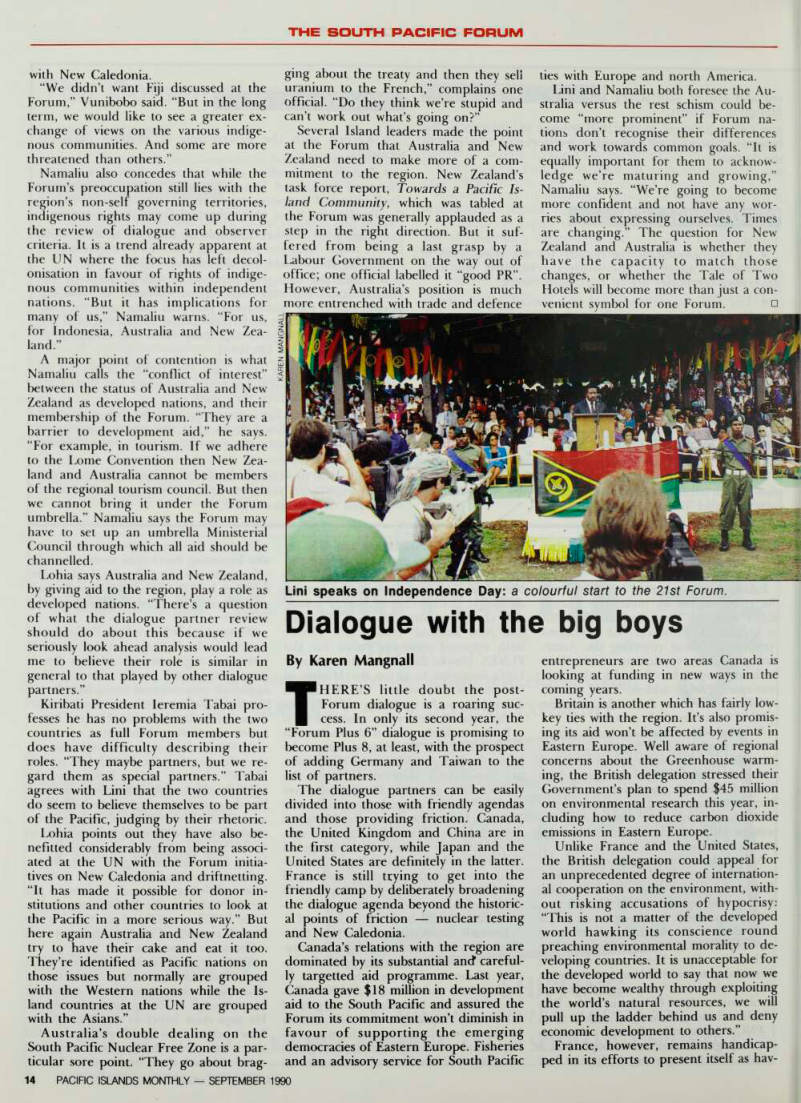
Lini speaks on Independence Day: a colourful start to the 21st Forum.
ing a legitimate common interest with the South Pacific nations. As Vanuatu Prime Minister Walter Lini observed to a pre-Forum press conference, it doesn’t matter which party’s in power in Paris, France is always France. So faced with continued Forum displeasure over nuc lear testing, France could only reiterate it considers the tests to be “safe”, and will continue as long as the other super powers see the need for a “nuclear de terrent”.
France invited Forum heads of gov ernment to visit Moruroa; the Forum secretary-general was invited to Paris; Forum heads of government were in vited to visit New Caledonia, individually or as a Forum delegation. It’s all part of French President Francois Mitterrand’s new policy of “openness”, which includes
inviting everyone possible virtually any
where, including taking relatives of Tahitian workers on day trips to Morur oa to prove its safety.
France also extended to all Pacific na tions the offer to provide surveillance for Exclusive Economic Zones (EEZ), to be arranged on a bilateral basis.
The French delegation leader, Phillip pe Baude, said France was eager for a “sensible solution” to enable New Cale donia, French Polynesia, Wallis and Futuna and France itself to join the South Pacific Geoscience Commission
(Sopac).
Baude also revealed that France would like to see the European Community Commission as a Dialogue partner.
China’s so far low-profile relations with the region are facing their first hur dle with the request by several Island nations for Taiwan to become a Dialogue partner.
The request’s being dealt with via a review of the Dialogue partner criteria to see if, as New Zealand’s Geoffrey Palmer put it, the Forum can have Taiwan as a Dialogue partner without implying offi cial recognition. The same issue’s being juggled within APEC, and Forum spokesman Rabbie Namaliu believes the variety of political and trade ties between Pacific nations and China and Taiwan puts the region in a good position to come up with a workable solution.
However, the move clearly caught Chi na off guard and Namaliu later admitted the Forum had made a tactical error in failing to warn China before going pub lic. China warned it may result in an unacceptable “two Chinas” or “one Chi na, one Taiwan” policy.
“We appreciate the One China policy pursued by the majority of the Forum member states and hope that the South Pacific Forum will guard against any
political plot by Taiwan to undermine
the friendly relations between the Pacific Rim Countries and the Forum and all its member states.”
Meanwhile, Japan continued to emphasise its colossal aid spending and diplomatically fudged the areas of con tention. Last year Japan was the world’s biggest aid donor and, according to Ambassador Takehiro Togo, aims to in crease its spending to $5O billion in the five years to 1992.
Grant aid and technical co-operation is central to Japan’s aid to the South Pacific and is increasing faster than the rise in overall overseas development aid.
Ambassador Togo promised Japan’s
aid to the region “will on the whole” remain unaffected by financial help for
Eastern Europe.
Japan deliberately stressed its intention to get its environmental back garden cleaned up by reducing carbon dioxide emissions and spending $2.2 billion over three years on environmental aid for tro
pical forest and ozone layer protection.
It also asked for the Forum’s stamp of approval for the United Nations to de signate Japan’s Centre of Global En vironment Technology as the central body for the transfer of technology to
developing nations.
Japan will look favourably on requests to help in expanding the tropical cyclone
warning networks in the South Pacific run as United Nations Development Programme (UNDP) and World
Metereological Organisation projects.
However, Ambassador Togo shrugged off the Forum’s criticism of the lack of progress on multilateral fisheries access.
Japan was not stalling, he said, but was committed to seriously conducting nego tiations. Ambassador Togo said Japan still wants to “clarify” which issues are best dealt with bilaterally or under a multilateral arrangement.
The United States dialogue delegation did not release the text of its formal presentation to the Forum panel.
However, reports from inside the meet ing, which lasted about one hour, indi cated it focussed virtually exclusively on chemical weapons disposal at Johnston Atoll (JACADS).
Although the US delegation was led by a deputy assistant secretary of the State Department, Marilyn Mayers, it was the Army’s Colonel Eric Azuma who did most of the talking.
The Americans confirmed they intend to incinerate nearly 7 per cent of their chemical weapons stocks at Johnston Atoll. That includes 1800 tonnes of weapons already moved there from Oki nawa in 1971, and another 400 tonnes to be shipped from West Germany by the end of the year.
Forum dialogue spokesman, Vanuatu
Justice Minister Donald Kalpokas, said afterwards the Americans hadn’t been forthcoming with much specific informa tion; most questions ran up against a “top secret” classification. “But we don’t need those details to make the decision that we don’t want them here.” Although Australia copped most of the Island flak over JACADS, for being what one leader called the Americans’ “bagman”, the United States was widely and bitterly criticised for its lack of consultation with in the region.
The US delegation suggested Forum scientists should inspect the JACADS facility in November. Only Australia is showing any enthusiasm. As one senior Island diplomat commented, the Forum’s already had its fingers burnt over scientific missions to Moruroa.
Despite widespread anger that the Americans have presented JACADS as a fait se accompli, the Forum still believes it has a chance of reversing the decision to ship chemical weapons to Johnston Atoll from West Germany. The Amer ican officials say any talks must be before the year’s end if they’re to take place before the weapons leave Europe. The details are still being worked out with Washington. In the meantime, Papua New Guinea is considering taking the issue to the United Nations, as JACADS falls within the scope of the South Pacific Nuclear Free Zone Treaty. □
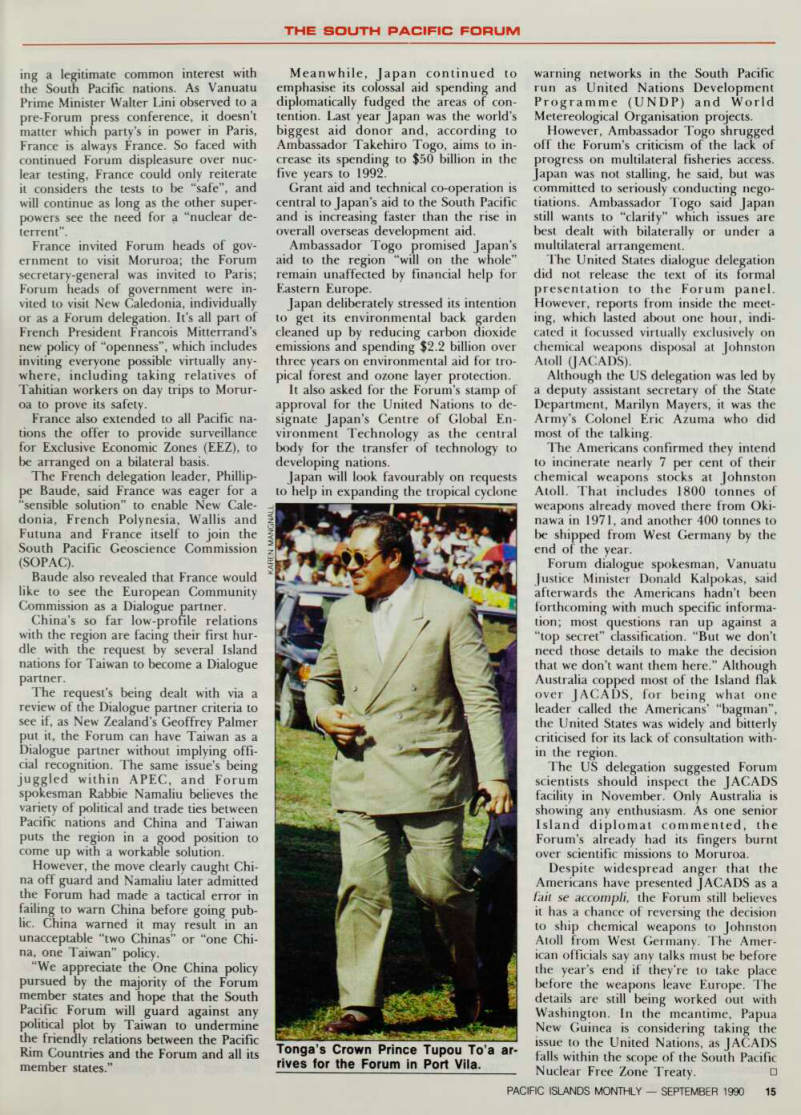
Tonga’s Crown Prince Tupou To’a ar rives for the Forum in Port Vila.
Muller battles on
By Karen Mangnall
FISHERIES development in the
Pacific is likely to remain a key item on Forum agendas in the next decade, although the issue may lose most of its media sex-appeal. Forum Fisheries Agency (FFA) director Phillipp Muller believes the 1990 s will demand “Nuts and bolts” work on fisheries issues, work that’s nevertheless crucial to ensure the well-being of Pacific peoples.
With the decision by Japan, Taiwan and Korea to stop driftnetting in the South Pacific a year ahead of the United Nations deadline, fisheries was a bit of a non-issue at last month’s South Pacific Forum in Port Vila. Muller says the ma jor remaining hurdle in the multilateral fisheries agreement with Japan which has been getting nowhere for the past three years.
“Just because we’re promoting it,
they’re suspicious,” says Muller. “They’ll
soon reason it out that they’ve shot themselves in the foot.” The next chance to restart negotiations comes in October when the FFA meets Japan over drifnet
ting.
The Japanese driftnet announcement was timed for maximum plaudits at the Forum. But the October meeting may see more FFA scepticism after a recent announcement that Japan is “testing” a new driftnet in the North Pacific this season. They say it leaves a gap of sever al metres between the surface and the top of the net. Japan claims tests so far show the dolphin catch has dropped by 25 per cent, although the nets still catch cuttlefish. Japan believes its modified driftnets fit in with United Nations re solution 225’s call for driftnet regulation under an albacore management regime.
Despite its driftnet ban, Japan still got a rap over the knuckles from the Forum for dragging its feet on multilateral ac cess. Japan’s Ambassador to the Forum
Dialogue meeting, Takehiro Togo, de
nies his country’s stalling on the multi lateral negotiations. He says Japan is
“seriously and constructively conducting
dialogue” but still wants to “clarify” which issues are best dealt with within multilateral or bilateral frameworks.
All of this merely adds to the burden of what Muller predicts will be “a lot of heavy hack work” to clear up the drift net issue and get an albacore manage ment regime. “It’s going to be extremely difficult and I will probably not see that one out in my year left on the job.”
Muller says the major hurdle is trying to link two “diametrically opposed” sides.
The coastal Pacific states want sovereign ty over the albacore in their waters while distant-water fishing nations say they’re
not bound by any regulation on the high seas. “No trade-offs are possible,” he says. We would be giving away sovereignty of the resources and they would be giving away what they already have freedom to do what they like in international waters.
Despite this, Muller remains optimistic of achieving an albacore regime which includes international water! “Human
beings are good for producing unique
bits of compromise,” he says. But the Pacific nations must be careful not to make mistakes with the albacore regime which could create a precedent to prejudice the region’s interests in other tuna species. “We have to work out what we want for the other species - yellowfin, skipjack arid blackeye - and work backwards.”
In the meantime, Muller enters his last year in the job worried about the FFA’s
financial security, particularly to employ
expert staff. The general economic downturn will make it harder for Forum members and international bodies alike to fund regional organisations like the
Ffa.
“We’ll be expected to do more with
less,” Muller worries.
“And the experts hold the key. Fortu
nately, it’s not only
the money that attracts them. It’s more the mission.”
In addition, the agency needs money to meet people,
“eyeballing each
other”, as he calls it.
“We can’t co-operate
by letter.”
The future of two key FFA staff the senior economist and the fisheries develop ment officer is still up in the air after funding was uncere
moniously cut by the
Food and Agricul
ture Organisation
and the United Na
tions Development
Programme (UNDP).
Muller says now the FAO funding is “gone forever” be cause the organisa tion refused to fund anything which could be confrontational to donor countries, like Japan. The UNDP has just decided to slice 6 per cent of its world budget and di vert the funds to Least Developed
Countries, taking from regional or
ganisations.
“They’re telling us they’ll still fund re gional projects that don’t compete with Asia and southeast Asia,” Muller says.
“But when you talk about the Pacific with so few people, any one of the Asian countries would dwarf us.”
In the meantime, the two staff are being paid for by Australian and New Zealand funds diverted from elsewhere in the budget. Muller says although the FFA has a funding shortfall for staffing, it’s got a budget surplus for consultancy and meetings; thanks to money saved on driftnet issues. The FFA is “begging” donors to let it shift this surplus, Muller says, “otherwise we can’t meet our com mitments.”
Despite the gloomy skies ahead, Mul ler admits to a tremendous amount of satisfaction when he looks back over the FFA’s achievements. Fisheries, he be lieves, is the one sector in the region where there’s been co-operation. “All other areas have had trouble. We’ve the highest level of co-operation in a sector not noted for its openness.” □
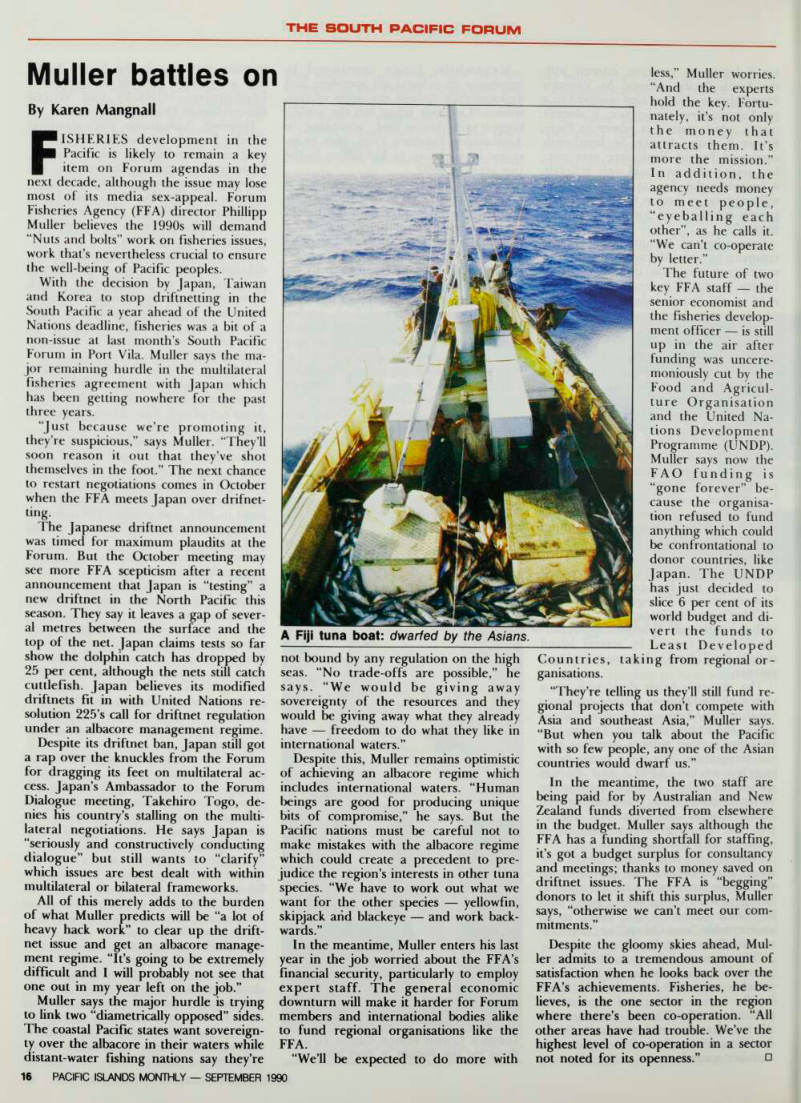
A Fiji tuna boat: dwarfed by the Asians.
The 90s
By Karen Mangnall
PRESIDENT leremia Tabai, of Kiribati, is about to end two terms as Kiribati’s President. As he commented in a much-appreciated aside to the Pacific Island leaders breakfast, he can’t try to change Kiribati’s constitution to allow a third term because he was its author. President Tabai is being widely promoted as a leading contender for the job of Forum secretary-general next year. President Tabai won’t con firm his intention to apply, but he spoke to Pacific Islands Monthly of his visiion of the region in the last decade of the century.
On the Forum: One thing is certain, the Forum has achieved real recogni tion in this part of the world and internationally. The turning point has been the Dialogue. It’s somehow formalised the relationship between the Forum and the other Dialogue coun tries. Many more countries are keen to take part in the Dia logue. The Forum will no longer be the same one we knew in the past. It’s becoming a very big organisation. The Forum will also become more assertive. It’s happening already and
that’s a good thing.
What issues are likely to be on the agenda of the 90s?
Our agenda has been on the same issues in the last few years but over time the agenda will change. In the past it was very dominated by New Caledonia. Now the issue is being looked after by the Matignon Accords. It’s no longer a central issue of the Forum meeting, we’re only monitoring. Between now and 1998 it may be come a major issue again but only time will tell.
One issue which will be on the books for quite a while is the environment: the Green house Effect and local impact on low atolls. It’s going to remain a very relevant issue, especial ly as scientists are now telling us we won’t begin to see the real impact for perhaps 15 years.
One fact we know is it’s not caused by our region, it’s the big industrial areas. What the Forum needs to do now is not only express our stance but work in international meetings on a regional basis to express our stance.
Even in Kiribati (which could be completely swamped by rising sea levels) it is not easy to accept the idea of Greenhouse warming. In Kiribati we feel we will live here forever. We take the attitude now we’ll still be there in 100 years time. We continue to develop our place.
What do we do when we’re flooded? Find a
new home. But it’s not something we are planning for now because that would be accepting the inevitability of the thing.
I still believe something can be done about it.
Because Pacific nations are in this threatened position it means the Forum can argue strongly in international meetings and speak with passion and conviction on these issues. We can get a positive response that’s required from these (industrial ised) countries.
On the importance of economic development I believe that over all these issues should be economics.
There’s a long way to go in terms of developing these islands.
We accept ultimate responsibility for developing our country.
We have to make the best use of aid and organise ourselves in a way conducive to that objective. We have a shift in emphasis now. We try not only to talk about aid but also overseas investment in a real way.
It is very hard to attract overseas investment to Kiribati.
We’ve got all the formulas prescribed in the text books but still waiting for the knock on the door. Most of the investment is going to the easiest countries like Vanuatu or Fiji, which have resources to exploit. They’re getting the roads, telecom munications and so on.
Was this behind the Forum highlighting the difficulties small island states have in building infrastructures for economic de velopment?
Yes. We have to start somewhere. Most of the infrastructure is financed by aid. Our airport was to have been funded out of the regional allocation from Lome II and when it comes to regional allocations everyone’s for themselves, those countries already better off are getting projects funded. We’re trying to get the Chinese to fund the airport because we can’t wait another five years (it’s been rolled over into Lome III) to have this resolved. A Chinese team was just in Kiribati looking at
possible funding.
There’s a body of opinion in Rim governments, development organisations and among some regional academics that the Pacific nations will never break aid dependency and achieve any real measure of self-sufficiency. Do you agree?
I hope he’s wrong. South Pacific countries follow the Western economic model which is very much into commerce and private enter prise. In Africa, it’s more a socialist model where everything is run by the Government.
They have real dictators there. We have more of a chance of success. You have to look at how long it took the developed countries, with resources, to get where they have. How long it took Europe to create the Common Market.
About the invasion of Western standards and cultural resilience We’ll see it more in towns with the very individualistic problems of employment. That what tends to happen with urbanisation. In many institutions, cultural values will discour age any of these things.
I try to take my kids once or twice a year to an atoll without power or running water or a fridge and we have to fish every day to feed ourselves. Why has Japan been so successful?
They have a strong cultural system there and despite all their successes, it is very much a rich cultural place. It’s a good side that people are proud of their culture.
I hope the South Pacific will be a good place to live in and, sure, we’ll have more of the cars and hi-fis, but it doesn’t necessarily mean we’re going to lose our basic island nature. I don’t believe so. I’ve been exposed to Western socie ty for many, many years but I still value our
culture. It is a force of stability.
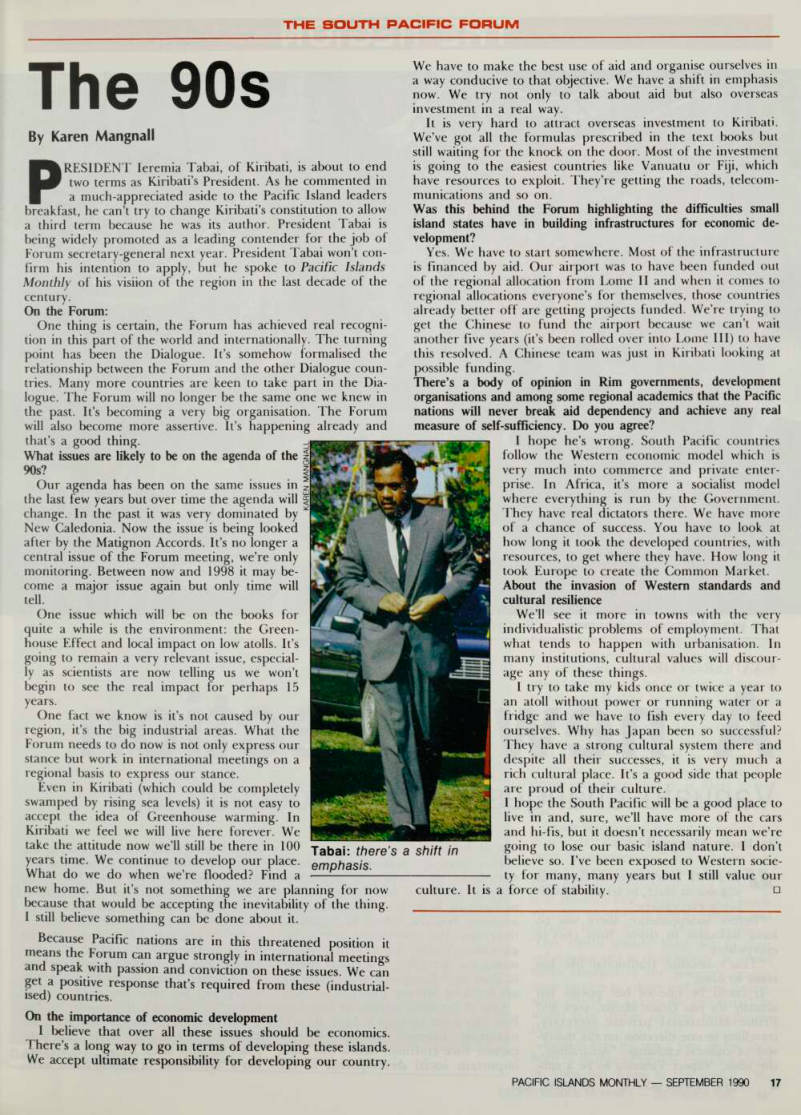
Tabai: there’s a shift in emphasis.
Advertisements & other items, p. 18 (1 item)
The Region
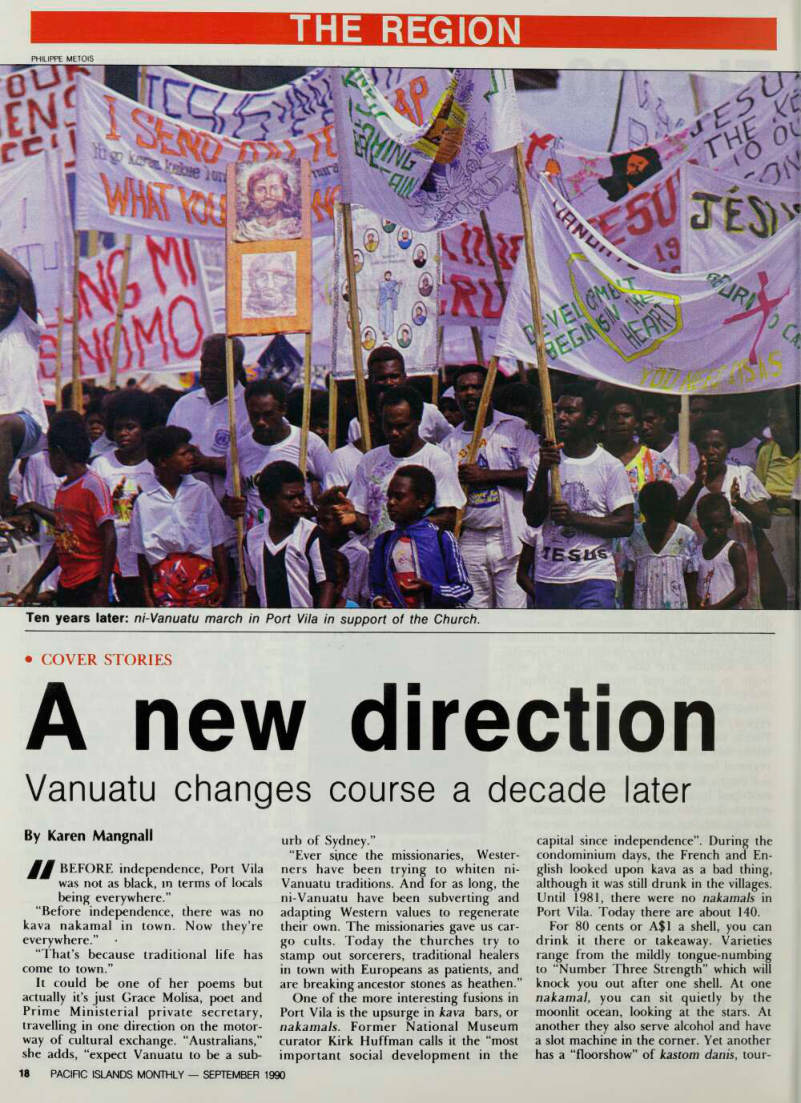
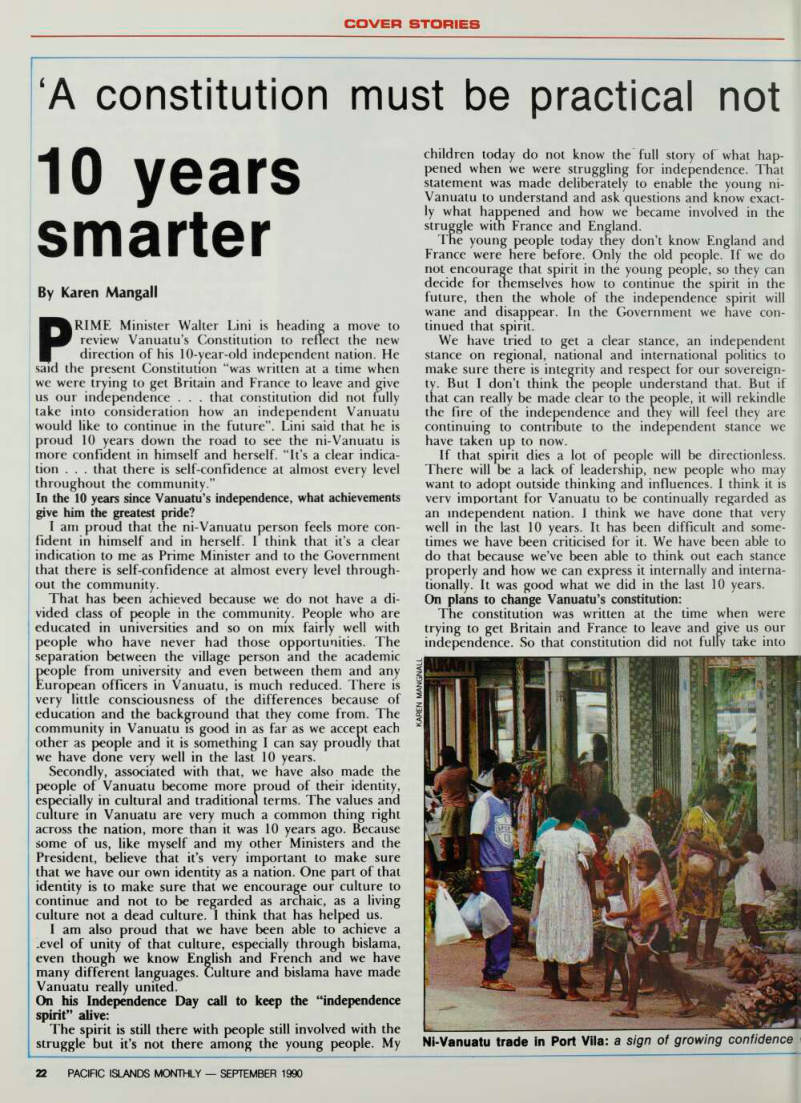
Ten years later: ni-Vanuatu march in Port Vila in support of the Church.
PHILIPPE METOIS
A new direction

Cover Stories
Vanuatu changes course a decade later
By Karen Mangnall
// BEFORE independence, Port Vila was not as black, in terms of locals
being everywhere.”
“Before independence, there was no kava nakamal in town. Now they’re
everywhere.” •
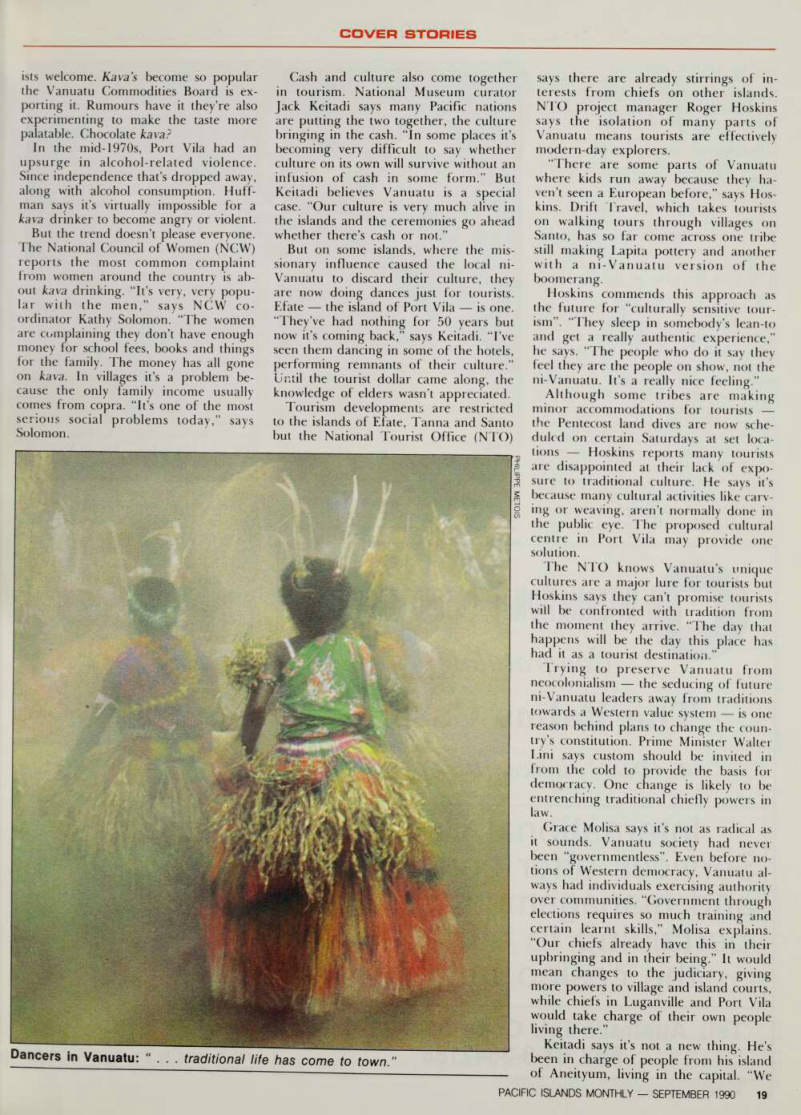
“That’s because traditional life has come to town.”
It could be one of her poems but actually it’s just Grace Molisa, poet and Prime Ministerial private secretary, travelling in one direction on the motor way of cultural exchange. “Australians,” she adds, “expect Vanuatu to be a sub
urb of Sydney.”
“Ever since the missionaries, Westerners have been trying to whiten ni- Vanuatu traditions. And for as long, the ni-Vanuatu have been subverting and adapting Western values to regenerate their own. The missionaries gave us cargo cults. Today the Churches try to stamp out sorcerers, traditional healers in town with Europeans as patients, and are breaking ancestor stones as heathen.”
One of the more interesting fusions in Port Vila is the upsurge in kava bars, or nakamals. Former National Museum curator Kirk Huffman calls it the “most important social development in the
capital since independence”. During the
condominium days, the French and En glish looked upon kava as a bad thing, although it was still drunk in the villages, Until 1981, there were no nakamals in Port Vila. Today there are about 140.
For 80 cents or A|l a shell, you can drink it there or takeaway. Varieties range from the mildly tongue-numbing to “Number Three Strength” which will knock you out after one shell. At one nakamal, you can sit quietly by the moonlit ocean, looking at the stars. At another they also serve alcohol and have a slot machine in the corner. Yet another has a “floorshow” of kastom danis, tour
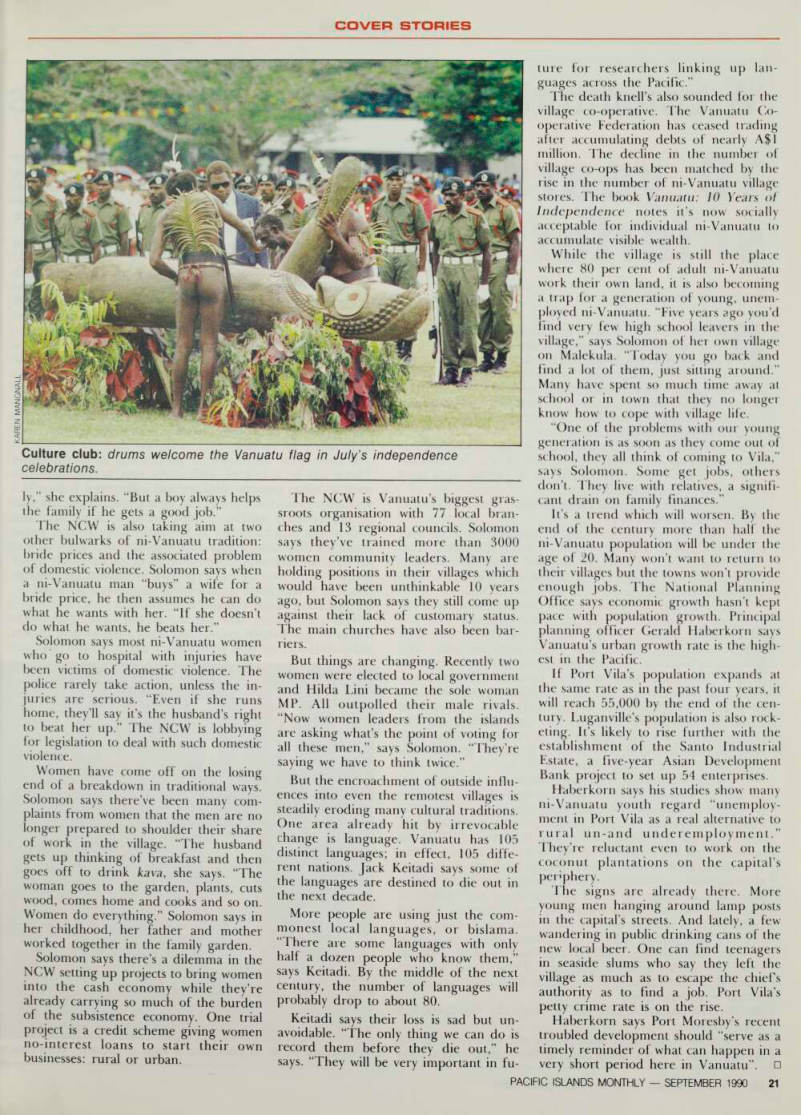
ists welcome. Kava’s become so popular the Vanuatu Commodities Board is exporting it. Rumours have it they’re also experimenting to make the taste more palatable. Chocolate kava?
In the mid-19705, Port Vila had an upsurge in alcohol-related violence.
Since independence that’s dropped away, along with alcohol consumption. Huffman says it’s virtually impossible for a kava drinker to become angry or violent.
But the trend doesn’t please everyone.
The National Council of Women (NCW) reports the most common complaint from women around the country is about kava drinking. “It’s very, very popular with the men,” says NCW coordinator Kathy Solomon. “The women are complaining they don’t have enough money for school fees, books and things for the family. The money has all gone on kava. In villages it’s a problem be-
cause the only family income usually
comes from copra. “It’s one of the most serious social problems today,” says Solomon.
Cash and culture also come together in tourism. National Museum curator Jack Keitadi says many Pacific nations are putting the two together, the culture bringing in the cash. “In some places it’s becoming very difficult to say whether culture on its own will survive without an infusion of cash in some form.” But Keitadi believes Vanuatu is a special case. “Our culture is very much alive in the islands and the ceremonies go ahead whether there’s cash or not.”
But on some islands, where the mis sionary influence caused the local ni- Vanuatu to discard their culture, they are now doing dances just for tourists, Efate the island of Port Vila is one.
“They’ve had nothing for 50 years but now it’s coming back,” says Keitadi. “I’ve seen them dancing in some of the hotels, performing remnants of their culture.”
Until the tourist dollar came along, the knowledge of elders wasn’t appreciated, Tourism developments are restricted to the islands of Efate, Tanna and Santo but the National Tourist Office (NTO)
says there are already stirrings of in terests from chiefs on other islands.
NTO project manager Roger Hoskins says the isolation of many parts of Vanuatu means tourists are effectively
modern-day explorers.
“There are some parts of Vanuatu where kids run away because they ha ven’t seen a European before,” says Hos kins. Drift Travel, which takes tourists
on walking tours through villages on
Santo, has so far come across one tribe still making Lapita pottery and another with a ni-Vanuatu version of the
boomerang.
Hoskins commends this approach as the future for “culturally sensitive tour
ism”. “They sleep in somebody’s lean-to
and get a really authentic experience,” he says. “The people who do it say they feel they are the people on show, not the ni-Vanuatu. It’s a really nice feeling.”
Although some tribes are making minor accommodations for tourists the Pentecost land dives are now sche duled on certain Saturdays at set loca tions Hoskins reports many tourists are disappointed at their lack of expo sure to traditional culture. He says it’s because many cultural activities like carv ing or weaving, aren’t normally done in the public eye. The proposed cultural centre in Port Vila may provide one solution.
The NTO knows Vanuatu’s unique cultures are a major lure for tourists but Hoskins says they can’t promise tourists will be confronted with tradition from the moment they arrive. “The day that happens will be the day this place has had it as a tourist destination.”
Trying to preserve Vanuatu from neocolonialism the seducing of future ni-Vanuatu leaders away from traditions towards a Western value system is one reason behind plans to change the coun try’s constitution. Prime Minister Waller Eini says custom should be invited in from the cold to provide the basis for democracy. One change is likely to be entrenching traditional chiefly powers in law.
Grace Molisa says it’s not as radical as it sounds. Vanuatu society had never been “governmentless”. Even before no tions of Western democracy, Vanuatu al ways had individuals exercising authority over communities. “Government through elections requires so much training and certain learnt skills,” Molisa explains.
“Our chiefs already have this in their upbringing and in their being.” It would
mean changes to the judiciary, giving
more powers to village and island courts, while chiefs in Luganville and Port Vila would take charge of their own people
living there.”
Keitadi says it’s not a new thing. He’s been in charge of people from his island of Aneityum, living in the capital. “We
Dancers in Vanuatu: "... traditional life has come to town.”
solve the cases we don’t want to take to the police,” he explains. “Little problems like fighting between friends, inter-island
fighting or somebody racing off with
someone’s wife.”
But Keitadi worries legalising these powers will entrench the automatic suc cession of chiefly titles from father to son, as proclaimed by the Council of Chiefs, the Malvatumauri. Keitadi says automatic succession is only practised in four places in Vanuatu. Everywhere else, he says, “everyone is born equal”. One must kill pigs to rise up in grade. “I feel it destroys the value of the pig killing system.”
But Keitadi is keen to see the constitu tion changed to give Island Courts, rather than the Supreme Court, the final say on land disputes. He says the Sup reme Court judges don’t take into account legends relating to land own ership, and rely solely on often dubious documentary proofs. “In one case, the Supreme Court decided one chief owned all this land and all the other people with tribal lands had to pay rent to re turn.” About 1500 people lived on that part of Aneityum, and acknowledged 10 chiefs. “It created a big fuss,” say Keita di. “There’s no way people are going to pay rent for land that their grandfathers
have been sitting on for ages.”
“It got the people very annoyed so they went and burned everything,” he says. None went to prison because the courts decided they were fighting for their traditional rights, but no-one took it a step further to discover whether they could get the land back. The Supreme Court’s made several similar decisions, says Keitadi, and with so much alienated land under dispute, there’s potential for more trouble.
Another group in ni-Vanuatu society is also dissatisfied about land but their quarrel is with tradition not Western jus tice. In many areas, ni-Vanuatu women have little or no say regarding their family’s land. “When you’re born a woman, that’s the end of yourself,” says Kathy Solomon. She says her only brother died so she remains resolutely single as it’s the only way to retain her rights to the family land. “As soon as I marry that’s the end.”
“That is wrong. Land is very pre cious,” she continues. “As long as you have land you’re rich.” But on Malekula, if a woman marries a man without land, she can’t return to her family land if a male relative disagrees.
The status of women is often the lit mus test of a society’s development. But in Vanuatu it’s also an indicator of the new pressures on tradition from West ern-inspired values. Grace Molisa be lieves ni-Vanuatu women have been in
adequately repaid for being the back
bone of the independence struggle.
Asked for details and she directs you to her book Colonised People , where she writes in the title poem: Vanuatu Womenfolk half the population remain colonised by the Free men of Vanuatu The same book lists official statistics showing women make up 36 per cent of the workforce, but overwhelmingly pre dominate as typists, cleaners, teachers, health workers and “other service workers”.
Kathy Solomon says men are “still blockades” but more women are begin ning to “climb the steps”. A few women are running their own businesses and
reaching middle-management positions
in the private sector. But the civil service remains the ground of greatest advances.
“The key to getting ahead is educa tion, nothing else,” says Solomon. The government provides equal access to education, but it’s still a struggle for many rural girls. “The families think the girl is going to get married and their money or investment will leave the fami-
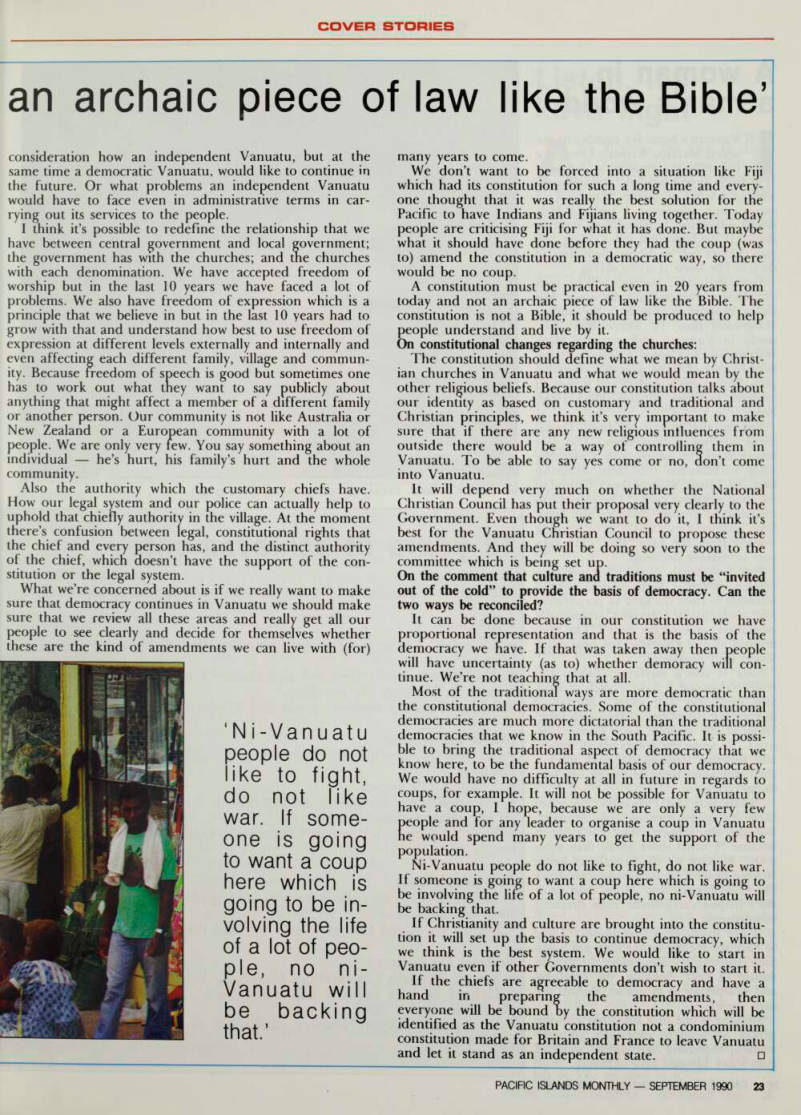
A woman shells cocoa in Vanuatu: remaining colonised.
Philippe Metois
ly,” she explains. “But a boy always helps the family if he gets a good job.”
The NCW is also taking aim at two other bulwarks of ni-Vanuatu tradition: bride prices and the associated problem of domestic violence. Solomon says when a ni-Vanuatu man “buys” a wife for a bride price, he then assumes he can do what he wants with her. “If she doesn’t do what he wants, he beats her.”
Solomon says most ni-Vanuatu women who go to hospital with injuries have been victims of domestic violence. The police rarely take action, unless the in juries are serious. “Even if she runs home, they’ll say it’s the husband’s right to beat her up.” The NCW is lobbying for legislation to deal with such domestic violence.
Women have come off on the losing end of a breakdown in traditional ways.
Solomon says there’ve been many com plaints from women that the men are no longer prepared to shoulder their share of work in the village. “The husband gets up thinking of breakfast and then goes off to drink kava, she says. “The woman goes to the garden, plants, cuts wood, comes home and cooks and so on.
Women do everything.” Solomon says in her childhood, her father and mother
worked together in the family garden.
Solomon says there’s a dilemma in the NCW setting up projects to bring women into the cash economy while they’re already carrying so much of the burden of the subsistence economy. One trial project is a credit scheme giving women no-interest loans to start their own businesses; rural or urban.
The NCW is Vanuatu’s biggest gras sroots organisation with 77 local bran ches and 13 regional councils. Solomon says they’ve trained more than 3000 women community leaders. Many are
holding positions in their villages which
would have been unthinkable 10 years ago, but Solomon says they still come up against their lack of customary status.
The main churches have also been bar riers.
But things are changing. Recently two women were elected to local government and Hilda Lini became the sole woman MP. All outpolled their male rivals.
“Now women leaders from the islands are asking what’s the point of voting for all these men,” says Solomon. “They’re saying we have to think twice.”
But the encroachment of outside influ ences into even the remotest villages is steadily eroding many cultural traditions.
One area already hit by irrevocable change is language. Vanuatu has 105 distinct languages; in effect, 105 diffe rent nations. Jack Keitadi says some of the languages are destined to die out in the next decade.
More people are using just the com monest local languages, or bislama.
“There are some languages with only half a dozen people who know them,” says Keitadi. By the middle of the next century, the number of languages will probably drop to about 80.
Keitadi says their loss is sad but un avoidable. “The only thing we can do is record them before they die out,” he says. “They will be very important in fu
ture for researchers linking up lan guages across the Pacific.”
The death knell’s also sounded for the village co-operative. The Vanuatu Co operative Federation has ceased trading after accumulating debts of nearly Asl million. The decline in the number of village co-ops has been matched by the rise in the number of ni-Vanuatu village stores. The book Vanuatu: 10 Years of Independence notes it’s now socially acceptable for individual ni-Vanuatu to accumulate visible wealth.
While the village is still the place where 80 per cent of adult ni-Vanuatu work their own land, it is also becoming a trap for a generation of young, unem ployed ni-Vanuatu. “Five years ago you’d find very few high school leavers in the village,” says Solomon of her own village on Malekula. “Today you go back and find a lot of them, just sitting around.”
Many have spent so much time away at school or in town that they no longer know how to cope with village life.
“One of the problems with our young generation is as soon as they come out of school, they all think of coming to Vila,” says Solomon. Some get jobs, others don’t. They live with relatives, a signifi cant drain on family finances.”
It’s a trend which will worsen. By the end of the century more than half the ni-Vanuatu population will be under the age of 20. Many won’t want to return to their villages but the towns won’t provide
enough jobs. The National Planning
Office says economic growth hasn’t kept
pace with population growth. Principal
planning officer Gerald Haberkorn says Vanuatu’s urban growth rate is the high est in the Pacific.
If Port Vila’s population expands at the same rate as in the past four years, it will reach 55,000 by the end of the cen tury. Luganville’s population is also rock eting. It’s likely to rise further with the establishment of the Santo Industrial Estate, a five-year Asian Development Bank project to set up 54 enterprises.
Haberkorn says his studies show many
ni-Vanuatu youth regard “unemploy
ment in Port Vila as a real alternative to rural un-and underemployment.”
They’re reluctant even to work on the coconut plantations on the capital’s
periphery.
The signs are already there. More young men hanging around lamp posts in the capital’s streets. And lately, a few wandering in public drinking cans of the new local beer. One can find teenagers in seaside slums who say they left the village as much as to escape the chiefs authority as to find a job. Port Vila’s petty crime rate is on the rise.
Haberkorn says Port Moresby’s recent troubled development should “serve as a timely reminder of what can happen in a very short period here in Vanuatu”. □
Culture club: drums welcome the Vanuatu flag in July’s independence celebrations.
Advertisements & other items, p. 20 (1 item)
International Casino Services
Congratulate The Palms Casino on their ducceddful opening
International Casino Services offer consultancy and management services pertaining to all facets of the casino industry.
Tel: Australia Int. Code 61-8-3326270 Fax 61-8-3642188
10 years
‘A constitution must be practical not
10 years smarter
By Karen Mangall
Minister Walter Lini is heading a move to review Vanuatu’s Constitution to reflect the new direction of his 10-year-old independent nation. He said the present Constitution “was written at a time when we were trying to get Britain and France to leave and give us our independence . . . that constitution did not fully take into consideration how an independent Vanuatu would like to continue in the future”. Lini said that he is proud 10 years down the road to see the ni-Vanuatu is more confident in himself and herself. “It’s a clear indica tion . . . that there is self-confidence at almost every level
throughout the community.”
In the 10 years since Vanuatu’s independence, what achievements give him the greatest pride? 1 am proud that the ni-Vanuatu person feels more con fident in himself and in herself. I think that it’s a clear indication to me as Prime Minister and to the Government that there is self-confidence at almost every level through out the community.
That has been achieved because we do not have a di vided class of people in the community. People who are educated in universities and so on mix fairly well with people who have never had those opportunities. The separation between the village person and the academic people from university and even between them and any European officers in Vanuatu, is much reduced. There is very little consciousness of the differences because of education and the background that they come from. The community in Vanuatu is good in as far as we accept each other as people and it is something I can say proudly that we have done very well in the last 10 years.
Secondly, associated with that, we have also made the people of Vanuatu become more proud of their identity, especially in cultural and traditional terms. The values and culture m Vanuatu are very much a common thing right across the nation, more than it was 10 years ago. Because some of us, like myself and my other Ministers and the President, believe tnat it’s very important to make sure that we have our own identity as a nation. One part of that identity is to make sure that we encourage our culture to continue and not to be regarded as archaic, as a living culture not a dead culture. I think that has helped us.
I am also proud that we have been able to achieve a evel of unity of that culture, especially through bislama, even though we know English and French and we have many different languages. Culture and bislama have made Vanuatu really united.
On his Independence Day call to keep the “independence spirit” alive: The spirit is still there with people still involved with the struggle but it’s not there among the young people. My
children today do not know the full story of what hap pened when we were struggling for independence. That statement was made deliberately to enable the young ni- Vanuatu to understand and ask questions and know exact ly what happened and how we became involved in the struggle with France and England.
The young people today they don’t know England and France were here before. Only the old people. If we do not encourage that spirit in the young people, so they can decide for tnemselves how to continue the spirit in the future, then the whole of the independence spirit will wane and disappear. In the Government we have con tinued that spirit.
We have tried to get a clear stance, an independent stance on regional, national and international politics to make sure there is integrity and respect for our sovereign ty. But I don’t think tne people understand that. But if that can really be made clear to the people, it will rekindle the fire of the independence and they will feel they are continuing to contribute to the independent stance we have taken up to now.
If that spirit dies a lot of people will be directionless.
There will be a lack of leadership, new people who may want to adopt outside thinking and influences. I think it is verv important for Vanuatu to be continually regarded as an independent nation. I think we have done that very well in the last 10 years. It has been difficult and some times we have been criticised for it. We have been able to do that because we’ve been able to think out each stance properly and how we can express it internally and interna tionally. It was good what we did in the last 10 years.
On plans to change Vanuatu’s constitution: The constitution was written at the time when were trying to get Britain and France to leave and give us our independence. So that constitution did not fully take into
Ni-Vanuatu trade in Port Vila: a sign of growing confidence
consideration how an independent Vanuatu, but at the same time a democratic Vanuatu, would like to continue in the future. Or what problems an independent Vanuatu would have to face even in administrative terms in car rying out its services to the people.
I think it’s possible to redefine the relationship that we have between central government and local government; the government has with the churches; and trie churches with each denomination. We have accepted freedom of worship but in the last 10 years we have faced a lot of problems. We also have freedom of expression which is a principle that we believe in but in the last 10 years had to grow with that and understand how best to use freedom of expression at different levels externally and internally and even affecting each different family, village and commun ity. Because freedom of speech is good but sometimes one has to work out what they want to say publicly about anything that might affect a member of a different family or another person. Our community is not like Australia or New Zealand or a European community with a lot of people. We are only very few. You say something about an individual he’s hurt, his family’s hurt and the whole
community.
Also the authority which the customary chiefs have.
How our legal system and our police can actually help to uphold that chiefly authority in the village. At the moment there’s confusion between legal, constitutional rights that the chief and every person has, and the distinct authority of the chief, which doesn’t have the support of the con stitution or the legal system.
What we’re concerned about is if we really want to make sure that democracy continues in Vanuatu we should make sure that we review all these areas and really get all our people to see clearly and decide for themselves whether these are the kind of amendments we can live with (for)
many years to come.
We don’t want to be forced into a situation like Fiji which had its constitution for such a long time and every one thought that it was really the best solution for the Pacific to have Indians and Fijians living together. Today people are criticising Fiji for what it has done. But maybe what it should have done before they had the coup (was to) amend the constitution in a democratic way, so there would be no coup.
A constitution must be practical even in 20 years from today and not an archaic piece of law like the Bible. The constitution is not a Bible, it should be produced to help people understand and live by it.
On constitutional changes regarding the churches: The constitution should define what we mean by Christ ian churches in Vanuatu and what we would mean by the other religious beliefs. Because our constitution talks about our identity as based on customary and traditional and Christian principles, we think it’s very important to make sure that if there are any new religious influences from outside there would be a way of controlling them in Vanuatu. To be able to say yes come or no, don’t come into Vanuatu.
It will depend very much on whether the National Christian Council has put their proposal very clearly to the Government. Even though we want to do it, 1 think it’s best for the Vanuatu Christian Council to propose these amendments. And they will be doing so very soon to the committee which is being set up.
On the comment that culture ana traditions must be “invited out of the cold” to provide the basis of democracy. Can the two ways be reconciled?
It can be done because in our constitution we have proportional representation and that is the basis of the democracy we nave. If that was taken away then people will have uncertainty (as to) whether demoracy will con tinue. We’re not teaching that at all.
Most of the traditional ways are more democratic than the constitutional democracies. Some of the constitutional democracies are much more dictatorial than the traditional democracies that we know in the South Pacific. It is possi ble to bring the traditional aspect of democracy that we know here, to be the fundamental basis of our democracy.
We would have no difficulty at all in future in regards to coups, for example. It will not be possible for Vanuatu to have a coup, I hope, because we are only a very few people and for any leader to organise a coup in Vanuatu ne would spend many years to get the support of the
population.
Ni-Vanuatu people do not like to fight, do not like war.
If someone is going to want a coup here which is going to be involving the life of a lot of people, no ni-Vanuatu will be backing that.
If Christianity and culture are brought into the constitu tion it will set up the basis to continue democracy, which we think is the best system. We would like to start in Vanuatu even if other Governments don’t wish to start it.
If the chiefs are agreeable to democracy and have a hand in preparing the amendments, then everyone will be bound by the constitution which will be identified as the Vanuatu constitution not a condominium constitution made for Britain and France to leave Vanuatu and let it stand as an independent state. □
‘Ni-Vanuatu people do not like to fight, do not like war. If some one is going to want a coup here which is going to be in volving the life of a lot of peo ple, no ni- Vanuatu will be backing that.’
Advertisements & other items, p. 23 (1 item)
an archaic piece of law like the Bible’
23
PACIFIC ISLANDS MONTHLY SEPTEMBER 1990
COVER STORIES
an archaic piece of law like the Bible’
A woman in
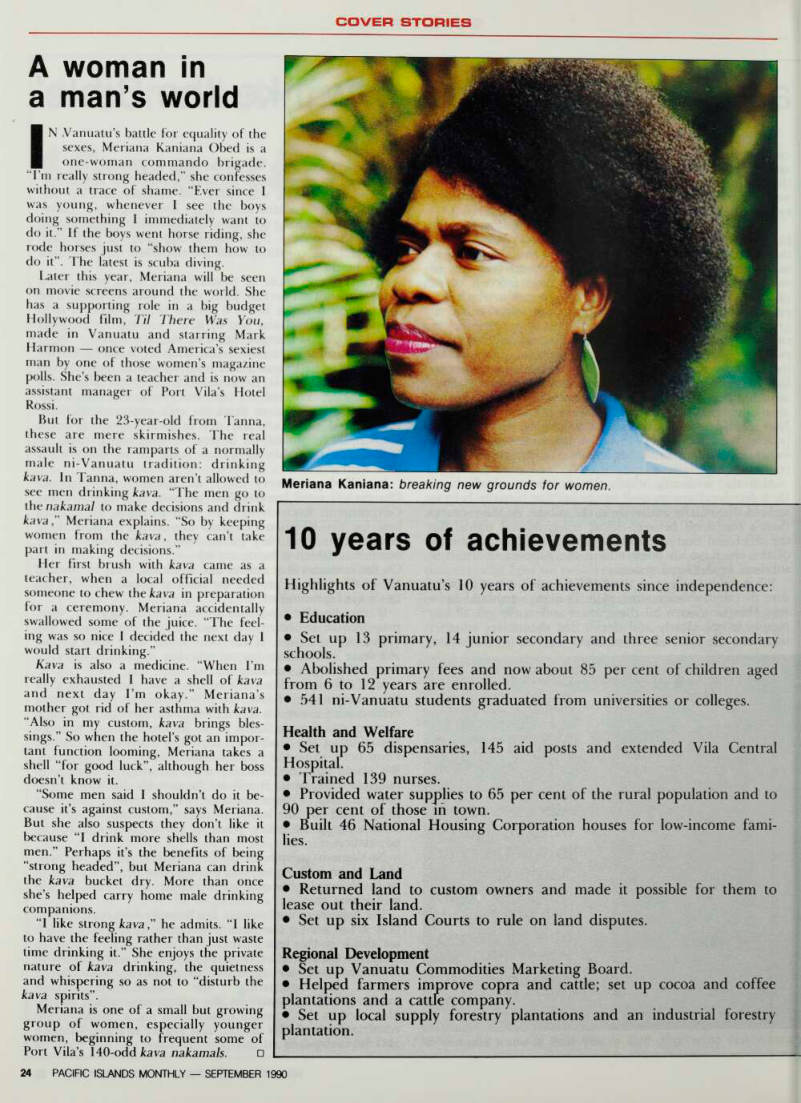
a man’s world
IN Vanuatu’s battle for equality of the sexes, Meriana Kaniana Obed is a one-woman commando brigade.
“I’m really strong headed,” she confesses without a trace of shame. “Ever since I was young, whenever I see the boys
doing something I immediately want to
do it.” If the boys went horse riding, she rode horses just to “show them how to do it”. The latest is scuba diving.
Later this year, Meriana will be seen on movie screens around the world. She has a supporting role in a big budget Hollywood film, Til There Was You, made in Vanuatu and starring Mark Harmon once voted America’s sexiest man by one of those women’s magazine polls. She’s been a teacher and is now an assistant manager of Port Vila’s Hotel Rossi.
But for the 23-year-old from Tanna, these are mere skirmishes. The real assault is on the ramparts of a normally male ni-Vanuatu tradition: drinking kava. In Tanna, women aren’t allowed to see men drinking kava. “The men go to the nakamal to make decisions and drink kava," Meriana explains. “So by keeping women from the kava, they can’t take part in making decisions.”
Her first brush with kava came as a teacher, when a local official needed someone to chew the kava in preparation for a ceremony. Meriana accidentally swallowed some of the juice. “The feel ing was so nice I decided the next day I would start drinking.”
Kava is also a medicine. “When I’m really exhausted I have a shell of kava and next day I’m okay.” Meriana’s mother got rid of her asthma with kava.
“Also in my custom, kava brings bles sings.” So when the hotel’s got an impor tant function looming, Meriana takes a shell “for good luck”, although her boss doesn’t know it.
“Some men said I shouldn’t do it be cause it’s against custom,” says Meriana.
But she also suspects they don’t like it because “I drink more shells than most men.” Perhaps it’s the benefits of being “strong headed”, but Meriana can drink the kava bucket dry. More than once she’s helped carry home male drinking companions.
“I like strong kava ,” he admits. “I like to have the feeling rather than just waste time drinking it.” She enjoys the private nature of kava drinking, the quietness and whispering so as not to “disturb the
kava spirits”.
Meriana is one of a small but growing group of women, especially younger women, beginning to frequent some of Port Vila’s 140-odd kava nakamals. □
10 years of achievements
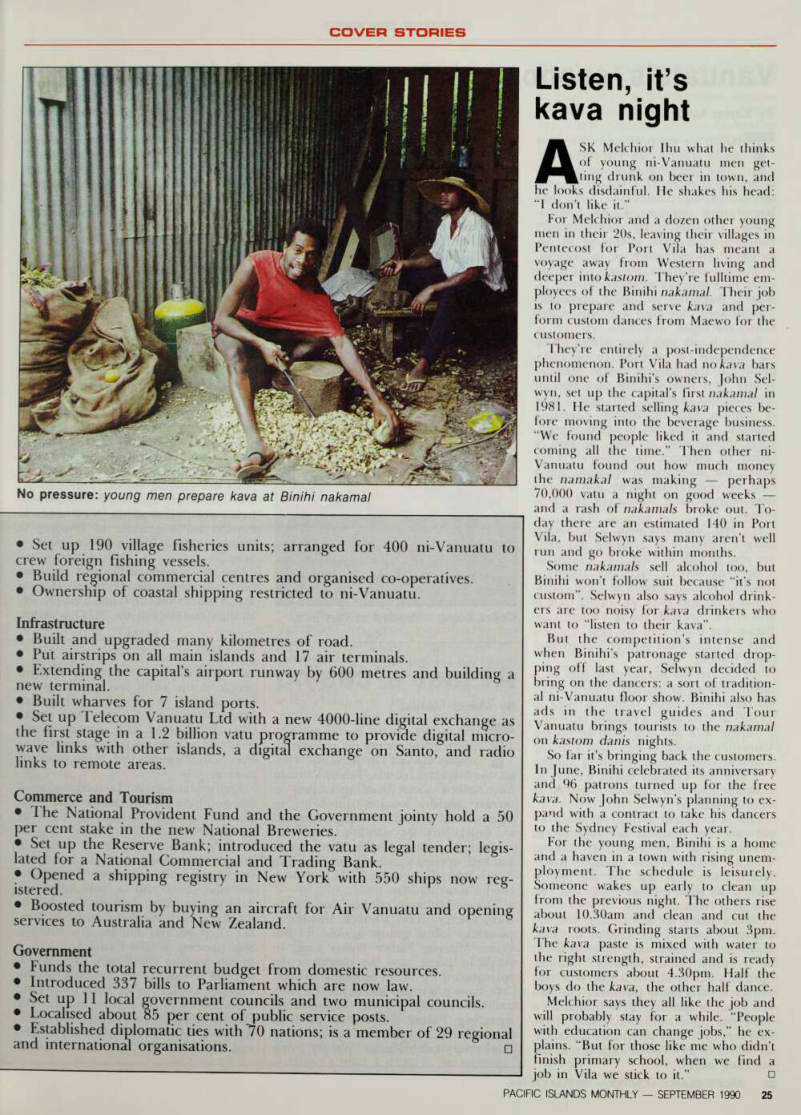
Highlights of Vanuatu’s 10 years of achievements since independence: • Education • Set up 13 primary, 14 junior secondary and three senior secondary schools. • Abolished primary fees and now about 85 per cent of children aged from 6 to 12 years are enrolled. • 541 ni-Vanuatu students graduated from universities or colleges.
Health and Welfare • Set up 65 dispensaries, 145 aid posts and extended Vila Central
Hospital.
• Trained 139 nurses. • Provided water supplies to 65 per cent of the rural population and to 90 per cent of those in town. • Built 46 National Housing Corporation houses for low-income fami lies.
Custom and Land • Returned land to custom owners and made it possible for them to lease out their land. • Set up six Island Courts to rule on land disputes.
Regional Development
• Set up Vanuatu Commodities Marketing Board. • Helped farmers improve copra and cattle; set up cocoa and coffee plantations and a cattle company. • Set up local supply forestry plantations and an industrial forestry
plantation.
Meriana Kaniana: breaking new grounds for women.
• Set up 190 village fisheries units; arranged for 400 ni-Vanuatu to
crew foreign fishing vessels.
• Build regional commercial centres and organised co-operatives. • Ownership of coastal shipping restricted to ni-Vanuatu.
Infrastructure • Built and upgraded many kilometres of road. • Put airstrips on all main islands and 17 air terminals. • Extending the capital’s airport runway by 600 metres and building a new terminal. • Built wharves for 7 island ports. • Set up Telecom Vanuatu Ltd with a new 4000-line digital exchange as the first stage in a 1.2 billion vatu programme to provide digital micro wave links with other islands, a digital exchange on Santo, and radio links to remote areas.
Commerce and Tourism • The National Provident Fund and the Government jointy hold a 50 per cent stake in the new National Breweries. • Set up the Reserve Bank; introduced the vatu as legal tender; legis lated for a National Commercial and Trading Bank. • Opened a shipping registry in New York with 550 ships now reg istered. • Boosted tourism by buying an aircraft for Air Vanuatu and opening services to Australia and New Zealand.
Government • Funds the total recurrent budget from domestic resources. • Introduced 337 bills to Parliament which are now law. • Set up 11 local government councils and two municipal councils. • Localised about S 5 per cent of public service posts. • Established diplomatic ties with *7O nations; is a member of 29 regional and international organisations. □
No pressure: young men prepare kava at Binihi nakamal
Listen, it’s
kava night
ASK Melchior Ihu what he thinks of young ni-Vanuatu men get ting drunk on beer in town, and he looks disdainful. He shakes his head: “I don’t like it.”
For Melchior and a dozen other young men in their 20s, leaving their villages in Pentecost for Port Vila has meant a voyage away from Western living and deeper into kastom. They’re fulltime em ployees of the Binihi nakamal. Their job is to prepare and serve kava and per form custom dances from Maewo for the customers.
They’re entirely a post-independence
phenomenon. Port Vila had no kava bars until one of Binihi’s owners, John Sel wyn, set up the capital’s first nakamal in 1981. He started selling kava pieces be fore moving into the beverage business.
“We found people liked it and started coming all the time.” Then other ni- Vanuatu found out how much money the namakal was making perhaps 70,000 vatu a night on good weeks and a rash of nakamals broke out. To day there are an estimated 140 in Port Vila, but Selwyn says many aren’t well run and go broke within months.
Some nakamals sell alcohol too, but Binihi won’t follow suit because “it’s not custom”. Selwyn also says alcohol drink ers are too noisy for kava drinkers who want to “listen to their kava”.
But the competition’s intense and when Binihi’s patronage started drop ping off last year, Selwyn decided to bring on the dancers: a sort of tradition al ni-Vanuatu floor show. Binihi also has ads in the travel guides and Tour Vanuatu brings tourists to the nakamal on kastom danis nights.
So far it’s bringing back the customers.
In June, Binihi celebrated its anniversary and 96 patrons turned up for the free kava. Now John Selwyn’s planning to ex pand with a contract to take his dancers to the Sydney Festival each year.
For the young men, Binihi is a home and a haven in a town with rising unem ployment. The schedule is leisurely.
Someone wakes up early to clean up from the previous night. The others rise about 10.30 am and clean and cut the kava roots. Grinding starts about 3pm.
The kava paste is mixed with water to the right strength, strained and is ready for customers about 4.30 pm. Half the boys do the kava, the other half dance.
Melchior says they all like the job and will probably stay for a while. “People with education can change jobs,” he ex plains. “But for those like me who didn’t finish primary school, when we find a job in Vila we stick to it.” □
Vanuatu’s economy spins on a high
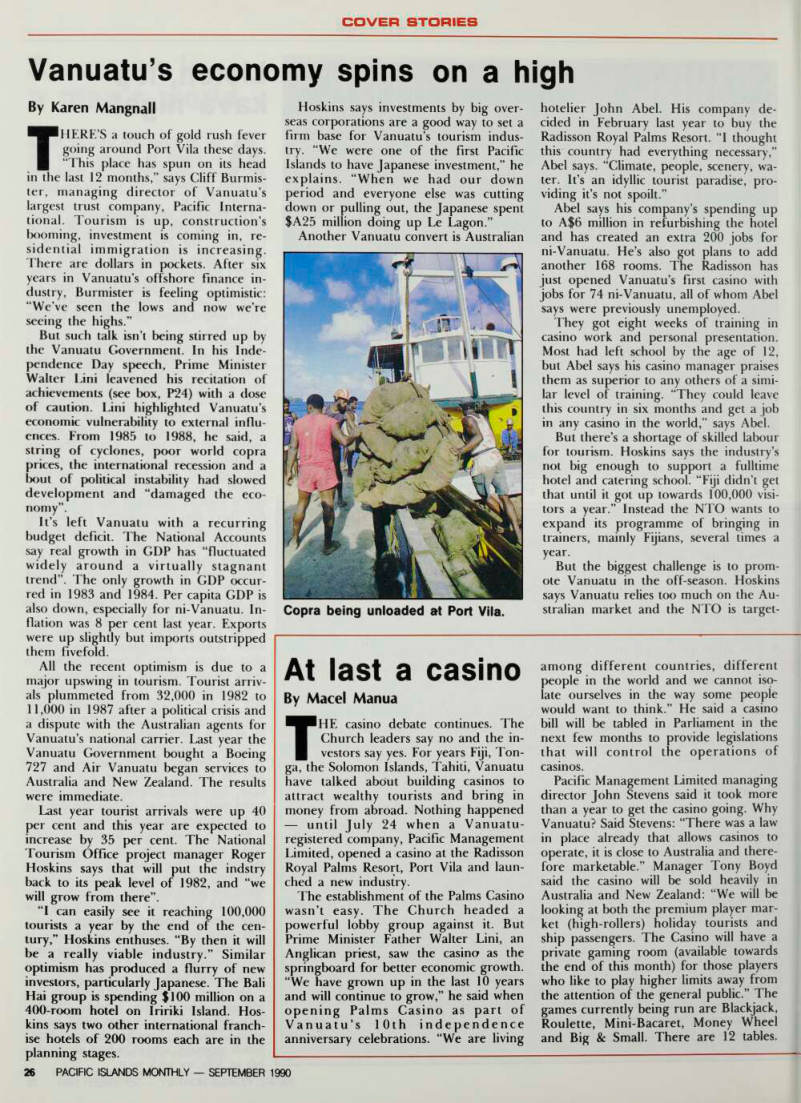
By Karen Mangnall
THERE’S a touch of gold rush fever going around Port Vila these days.
“This place has spun on its head in the last 12 months,” says Cliff Burmis ter, managing director of Vanuatu’s largest trust company, Pacific Interna tional. Tourism is up, construction’s booming, investment is coming in, re
sidential immigration is increasing.
There are dollars in pockets. After six years in Vanuatu’s offshore finance in
dustry, Burmister is feeling optimistic:
“We’ve seen the lows and now we’re
seeing the highs.”
But such talk isn’t being stirred up by the Vanuatu Government. In his Inde pendence Day speech. Prime Minister Walter Lini leavened his recitation of achievements (see box, P 24) with a dose of caution. Lini highlighted Vanuatu’s economic vulnerability to external influ ences. From 1985 to 1988, he said, a string of cyclones, poor world copra prices, the international recession and a bout of political instability had slowed development and “damaged the eco nomy”.
It’s left Vanuatu with a recurring budget deficit. The National Accounts say real growth in GDP has “fluctuated widely around a virtually stagnant trend”. The only growth in GDP occur red in 1983 and 1984. Per capita GDP is also down, especially for ni-Vanuatu. In flation was 8 per cent last year. Exports
were up slightly but imports outstripped
them fivefold.
All the recent optimism is due to a major upswing in tourism. Tourist arriv als plummeted from 32,000 in 1982 to 11,000 in 1987 after a political crisis and a dispute with the Australian agents for Vanuatu’s national carrier. Last year the Vanuatu Government bought a Boeing 727 and Air Vanuatu began services to Australia and New Zealand. The results were immediate.
Last year tourist arrivals were up 40 per cent and this year are expected to increase by 35 per cent. The National Tourism Office project manager Roger Hoskins says that will put the indstry back to its peak level of 1982, and “we will grow from there”.
“I can easily see it reaching 100,000 tourists a year by the end of the cen tury,” Hoskins enthuses. “By then it will be a really viable industry.” Similar optimism has produced a flurry of new investors, particularly Japanese. The Bali Hai group is spending $lOO million on a 400-room hotel on Iririki Island. Hos kins says two other international franch ise hotels of 200 rooms each are in the
planning stages.
Hoskins says investments by big over seas corporations are a good way to set a firm base for Vanuatu’s tourism indus try. “We were one of the first Pacific Islands to have Japanese investment,” he explains. “When we had our down period and everyone else was cutting down or pulling out, the Japanese spent SA2S million doing up Le Lagon.”
Another Vanuatu convert is Australian
hotelier John Abel. His company de cided in February last year to buy the Radisson Royal Palms Resort. “I thought this country had everything necessary,”
Abel says. “Climate, people, scenery, wa ter. It’s an idyllic tourist paradise, pro
viding it’s not spoilt.”
Abel says his company’s spending up to As 6 million in refurbishing the hotel and has created an extra 200 jobs for ni-Vanuatu. He’s also got plans to add another 168 rooms. The Radisson has just opened Vanuatu’s first casino with jobs for 74 ni-Vanuatu, all of whom Abel
says were previously unemployed.
They got eight weeks of training in casino work and personal presentation.
Most had left school by the age of 12, but Abel says his casino manager praises them as superior to any others of a simi lar level of training. “They could leave this country in six months and get a job in any casino in the world,” says Abel.
But there’s a shortage of skilled labour for tourism. Hoskins says the industry’s not big enough to support a fulltime hotel and catering school. “Fiji didn’t get that until it got up towards 100,000 visi tors a year.” Instead the NTO wants to expand its programme of bringing in trainers, mainly Fijians, several times a year.
But the biggest challenge is to prom ote Vanuatu in the off-season. Hoskins says Vanuatu relies too much on the Au stralian market and the NTO is target
Copra being unloaded at Port Vila.
ting the northern hemisphere
Europe, North America, Japan to fill in the gaps. Volume is the key to expan sion. Hotels are merely upgrading at the moment because occupancy rates are still too low about 60 per cent. “As soon as the hotels here achieve 70 per cent occupancy rates, that will trigger them to expand,” says Hoskins. “Tourism will quickly become the number one foreign
exchange earner.”
A less spectacular expansion is forecast for Vanuatu’s tax haven industry. The Finance Centre the group of com panies deal with offshore banking and overseas investment is the quiet driv ing force behind the economy. It em ploys 400 staff all but 90 are ni- Vanuatu and has about 1500 clients on the books. Finance association presi dent and Westpac manager, lan Smith, says the finance centre has “undoubtedly proven its worth”, mitigating the impact during Vanuatu’s bad years.
Today it contributes a steady 12 per cent of GDP; with As 3 million going annually to the Government in fees and stamp duty, and $1.50 million paid out in local wages. “We’re putting a lot of money into the local economy,” says Smith. “The Government averages about 30 per cent of every dollar we spend, in import duties.” The centre is also an “enormous user” of Telecom and local service industries.
While Smith can’t foresee rapid growth, the centre has plans to cash in on capital flight from Hong Kong and new European Community trust rules
which come into force in 1992. Overseas investment in Vanuatu is growing, most ly from Japanese. At the end of the year, the centre intends hiring a public rela tions firm and, later, taking a roadshow to Hong Kong. “Our main aim is to get the reputation as the place to use in the Pacific if someone’s considering an offshore centre,” says Smith.
A key element in that strategy is leg islation, drawn up with the Vanuatu reg istrar of companies, to be enacted over the next two years. One law will give “more teeth” to the registrar and the Reserve Bank in policing those using the tax haven, and will set down rules for full disclosure. Vanuatu’s never got the big name, big ticket business or the
subsequent bad reputation for hiding tax
evaders. So when American authorities recently accused it of laundering drug money, Smith told them publicly to “put up or shut up”.
Smith says there’s never been any evi dence of Vanuatu being used to launder dirty money. US Comptroller of Curren cy John Shockey was given that message during a recent visit and departed “a wiser man”. But Pacific International’s Cliff Burmister says Vanuatu has lagged behind the world in offshore banking.
The centre manages about US$6O mil lion directly and gets fees for running about 60 offshore banks. Burmister says new legislation takes the best ideas from other tax havens. “We’ve come up with a package which will be at the forefront for tax havens.”
But perhaps the finance centre’s most
significant long-term contribution has
been to Vanuatu’s pool of skilled labour.
Burmister says it provides “very good
training for ni-Vanuatu by people with
experience and qualifications not nor mally available in the Islands”. That fil ters through the whole business com munity and is about to be more firmly cemented by an exchange programme with Government departments.
The lack of skilled labour is a knotty problem at the core of Vanuatu’s de
velopment strategy. On Independence
Day, Lini emphasised two threads to the problem: youth unemployment and get ting more ni-Vanuatu into government and private sector jobs. Much of the country’s professional and technical work
is done by expatriates, particularly con
sultants or advisers on foreign aid. The National Planning Office is about to launch a year-long survey to find out the level of manpower as aid because one day Vanuatu will have to staff and pay for those jobs.
Principal planning officer Gerald
Haberkern says most international aid goes on capital development: roads, wa ter supplies, airstrips. “The Vanuatu Government can’t afford to pay for it and that’s what it wants at the moment.”
Haberkorn wants to see the Vanuatu Government gradually commit more of its own budget to development, because the handouts can’t be sustained. “What happens if Australia or New Zealand or someone else says they don’t have any money any more?”
Vanuatu is taking the first steps in that direction with PASEP, a $2O million education programme with the Austra lian Government and the World Bank.
Billed as the country’s biggest develop ment project since independence, PASEP will provide over the next five years, an extra 180 upper secondary and 560 low
er secondary places and improved
teacher training. In 1986 only 2 of every 100 ni-Vanuatu students entered senior secondary education, and Haberkorn says that’s not enough to upgrade the ni-Vanuatu skilled labour force or in crease the pace of localising managerial and technical posts.
More disturbing is the fact that half of students never go beyond primary school. About 3200 young ni-Vanuatu reach the age of 16 each year and only a small number can be absorbed into the cash economy. Haberkorn says they are expected to find employment in “tradi tional activities” such as agriculture, which still employs 80 per cent of the adult workforce. But Haberkorn says ru ral training courses reach only a fraction of those teenagers. Combined with a sig nificant rural-urban drift, it threatens
growing youth under or unemploy
ment with resulting problems of crime and social unrest.
One area which could absorb these workers is the industrial-manufacturing sector. It now contributes 12 per cent to the GDP and employs over 5 per cent of the workforce, but Haberkorn says further expansion is being stymied by the lack of skilled labour. He hopes the third national development plan will emphasise technical and adult training;
“plumbers, nurses, planning officers.”
And all this when education’s share of the budget has dropped from 30 per cent in 1980 to 19 per cent this year.
Despite a similar drop in the proportion of the health vote, Haberkorn lauds the Vanuatu Government’s “phenomenal” achievements uniting the separate French and English health and educa tion systems inherited from the con dominium. “It’s quite a political achieve ment uniting the separate French and English health and education systems in herited from the condominium. “It’s quite a political achievement to run health and education with your own domestic resources when it was com pletely paid for 10 years ago,” says Haberkorn. “Usually in the post-colonial era, health and education fall by the
wayside.” □
At last a casino
By Macel Manua
THE casino debate continues. The Church leaders say no and the in vestors say yes. For years Fiji, Ton ga, the Solomon Islands, Tahiti, Vanuatu have talked about building casinos to attract wealthy tourists and bring in money from abroad. Nothing happened until July 24 when a Vanuatu registered company, Pacific Management Limited, opened a casino at the Radisson Royal Palms Resort, Port Vila and laun ched a new industry.
The establishment of the Palms Casino wasn’t easy. The Church headed a
powerful lobby group against it. But
Prime Minister Father Walter Lini, an Anglican priest, saw the casino as the springboard for better economic growth.
“We have grown up in the last 10 years and will continue to grow,” he said when opening Palms Casino as part of Vanuatu’s 10th independence anniversary celebrations. “We are living
among different countries, different people in the world and we cannot iso late ourselves in the way some people would want to think.” He said a casino bill will be tabled in Parliament in the next few months to provide legislations that will control the operations of casinos.
Pacific Management Limited managing director John Stevens said it took more than a year to get the casino going. Why Vanuatu? Said Stevens: “There was a law in place already that allows casinos to operate, it is close to Australia and there fore marketable.” Manager Tony Boyd said the casino will be sold heavily in Australia and New Zealand: “We will be looking at both the premium player mar ket (high-rollers) holiday tourists and ship passengers. The Casino will have a private gaming room (available towards the end of this month) for those players who like to play higher limits away from the attention of the general public.” The
games currently being run are Blackjack,
Roulette, Mini-Bacaret, Money Wheel and Big & Small. There are 12 tables.
The limits begin from VTSO (Asstf) and reach VT250,000 (A 52700) in some games. There are 50 slot machines which range from VTIO to VTIOO and jack pots start from VTI million (A$ 11,000).
Gambling at Palms Casino is restricted to those above the age of 18 years and the rules are “pretty the same as those which operate throughout Australian casinos,” said Boyd. “In a couple of inst ances we are more favourable to the players than some of the casinos in Au stralia. We are more liberal with our odds.” A Palms Casino Games Club allows private membership for locals.
Otherwise admittance into the gaming rooms are only for foreign passport hol ders and guests at Radisson Royal Palms, formerly the Intercontinental.
Palms Casino employs 80 people.
There are six workers from Australia.
Staff training is being run at the Uni versity of the South Pacific complex in Port Vila. Said Stevens: “We will phase out the expatriates over the next few years and ni-Vanuatu will take up the middle management positions.”
Advertisements & other items, pp. 28-30 (1 item)
Toyota
£ m The Toyota Hilux is the world’s most popular pick-up.
And the Hilux 4X4 is the best-selling Hilux of them all. Which stands to reason. People around the world respect Toyota’s attention to style. Hilux’s car-like comfort. Rugged reliability. And as you might expect from Toyota, power. This, of course, is the most important asset for a truck. And happily, the Hilux 4X4 offers a choice of four powerful engines: 2.8 and 2.4-litre diesel engines. Plus 2.2 and 1.8-litre petrol engines. When it comes to power and good looks, nobody can beat Toyota. Nobody.
msM m
I h * * i
tsr
pAC' F ' C Ul
G ,rder jrj* C\aroP Tr °" eys Hand PAC ' F % to 20t.
Chain Blocks /a »*s!£*** I © I :
PACF.C-V.TAL Lever
Blocks % to 6t.
HITACHI Chain Hoists Va. to st.
PACIFIC HIT
// Lift Win Che // 600 to 3200 kg.
Tool °ncers 0-3 to 300 kg.
V\| inches pac\f' c h 4St Bu^ H 2 oOk«.
Capa cltv o/vriF'C B'ectnc P 2 Soto6oook9^ aJ
PACIFIC HOISTS PTY. LTD
71 Atkins Road, Ermington, N.S.W. 2115. (P.O. Box 40).
Telephone 638 4511. Fax 684 2073. Distributors in all States.
Pacific has the products and the expertise to help you improve safety, lessen operation fatigue and increase productivity. Ask for full details.
Pacific
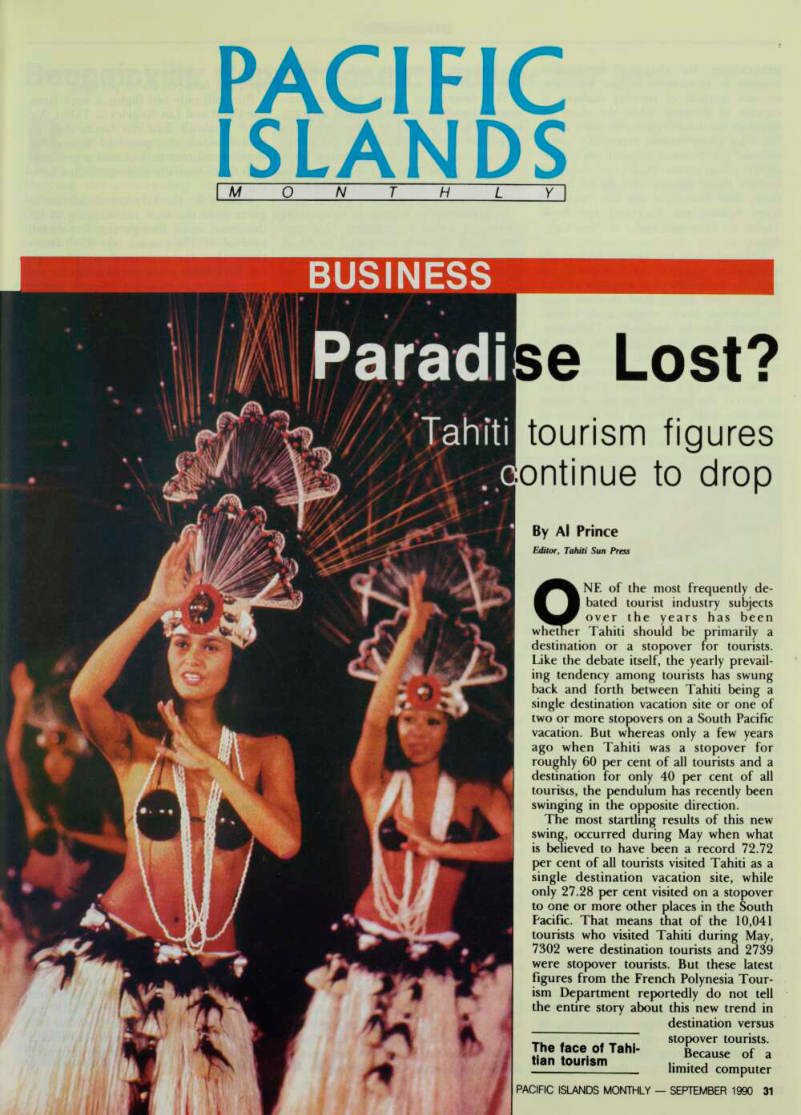
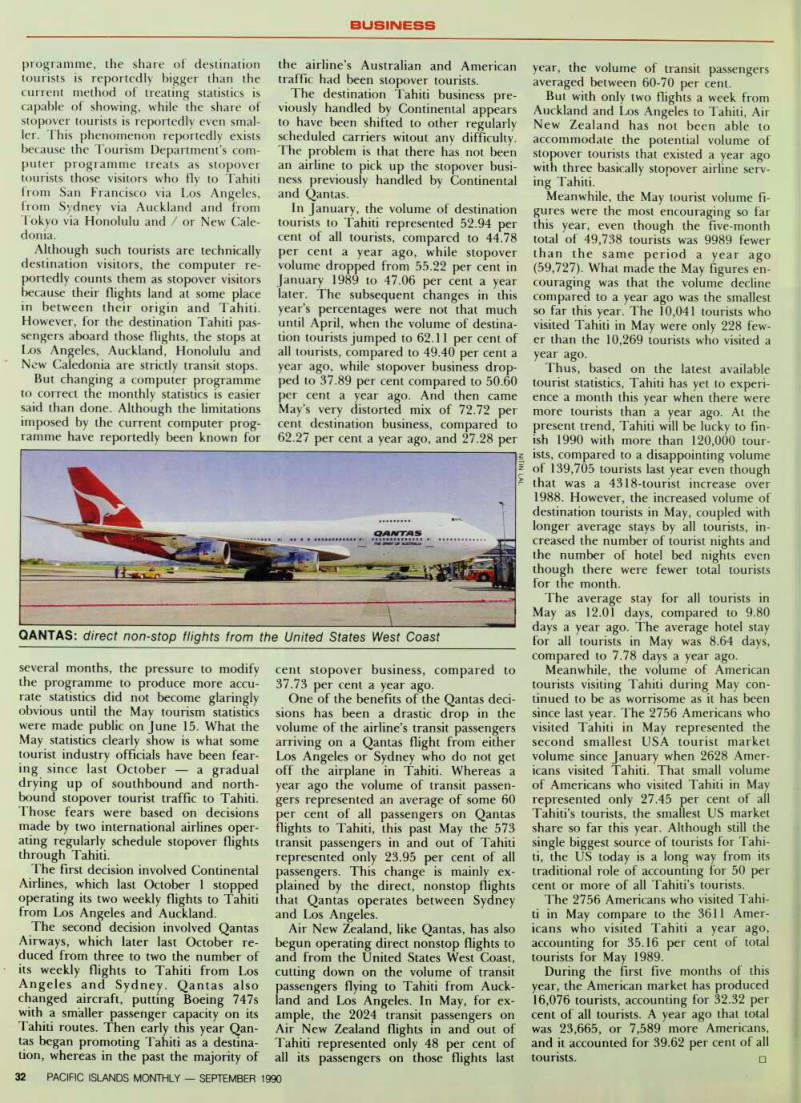
Islands
Monthly
Business
Paradise Lost?
Tahiti tourism figures BHEontinue to drop
By Al Prince
Editor, Tahiti Sun Press
NE of the most frequently de- M M bated tourist industry subjects over the years has been whether Tahiti should be primarily a destination or a stopover for tourists.
Like the debate itself, the yearly prevail ing tendency among tourists has swung back and forth between Tahiti being a single destination vacation site or one of two or more stopovers on a South Pacific vacation. But whereas only a few years ago when Tahiti was a stopover for roughly 60 per cent of all tourists and a destination for only 40 per cent of all tourists, the pendulum has recently been swinging in the opposite direction.
The most startling results of this new swing, occurred during May when what is believed to have been a record 72.72 per cent of all tourists visited Tahiti as a single destination vacation site, while only 27.28 per cent visited on a stopover to one or more other places in the South Pacific. That means that of the 10,041 tourists who visited Tahiti during May, 7302 were destination tourists and 2739 were stopover tourists. But these latest figures from the French Polynesia Tour ism Department reportedly do not tell the endre story about this new trend in
destination versus stopover tourists.
Because of a limited computer
The face of Tahi tian tourism
programme, the share of destination tourists is reportedly bigger than the current method of treating statistics is capable of showing, while the share of stopover tourists is reportedly even smaller. This phenomenon reportedly exists because the Tourism Department’s computer programme treats as stopover tourists those visitors who fly to Tahiti from San Francisco via Los Angeles, from Sydney via Auckland and from Tokyo via Honolulu and / or New Caledonia.
Although such tourists are technically destination visitors, the computer reportedly counts them as stopover visitors because their flights land at some place in between their origin and Tahiti, However, for the destination Tahiti passengers aboard those flights, the stops at Los Angeles, Auckland, Honolulu and New Caledonia are strictly transit stops.
But changing a computer programme to correct the monthly statistics is easier said than done. Although the limitations imposed by the current computer programme have reportedly been known for
the airline’s Australian and American traffic had been stopover tourists, The destination Tahiti business pre viously handled by Continental appears to have been shifted to other regularly scheduled carriers witout any difficulty, The problem is that there has not been an airline to pick up the stopover busi ness previously handled by Continental and Qantas.
In January, the volume of destination tourists to Tahiti represented 52.94 per cent of all tourists, compared to 44.78 per cent a year ago, while stopover volume dropped from 55.22 per cent in January 1989 to 47.06 per cent a year later. The subsequent changes in this year’s percentages were not that much until April, when the volume of destina tion tourists jumped to 62.11 per cent of all tourists, compared to 49.40 per cent a year ago, while stopover business drop ped to 37.89 per cent compared to 50.60 per cent a year ago. And then came May’s very distorted mix of 72.72 per cent destination business, compared to 62.27 per cent a year ago, and 27.28 per
several months, the pressure to modify the programme to produce more accurate statistics did not become glaringly obvious until the May tourism statistics were made public on June 15. What the May statistics clearly show is what some tourist industry officials have been fearing since last October a gradual drying up of southbound and northbound stopover tourist traffic to Tahiti, Those fears were based on decisions made by two international airlines oper-
ating regularly schedule stopover flights
through Tahiti.
The first decision involved Continental Airlines, which last October 1 stopped operating its two weekly flights to Tahiti from Los Angeles and Auckland.
The second decision involved Qantas Airways, which later last October reduced from three to two the number of its weekly flights to Tahiti from Los
Angeles and Sydney. Qantas also
changed aircraft, putting Boeing 747 s
with a smaller passenger capacity on its Tahiti routes. Then early this year Qantas began promoting Tahiti as a destination, whereas in the past the majority of
cent stopover business, compared to 37.73 per cent a year ago.
One of the benefits of the Qantas deci sions has been a drastic drop in the volume of the airline’s transit passengers arriving on a Qantas flight from either Los Angeles or Sydney who do not get off the airplane in Tahiti. Whereas a year ago the volume of transit passen gers represented an average of some 60 per cent of all passengers on Qantas flights to Tahiti, this past May the 573 transit passengers in and out of Tahiti represented only 23.95 per cent of all passengers. This change is mainly ex
plained by the direct, nonstop flights
that Qantas operates between Sydney and Los Angeles.
Air New Zealand, like Qantas, has also
begun operating direct nonstop flights to
and from the United States West Coast, cutting down on the volume of transit passengers flying to Tahiti from Auck land and Los Angeles. In May, for ex ample, the 2024 transit passengers on Air New Zealand flights in and out of Tahiti represented only 48 per cent of all its passengers on those flights last
year, the volume of transit passengers averaged between 60-70 per cent.
But with only two flights a week from Auckland and Los Angeles to Tahiti, Air New Zealand has not been able to accommodate the potential volume of stopover tourists that existed a year ago with three basically stopover airline serv
ing Tahiti.
Meanwhile, the May tourist volume fi gures were the most encouraging so far this year, even though the five-month total of 49,738 tourists was 9989 fewer than the same period a year ago (59,727). What made the May figures en couraging was that the volume decline compared to a year ago was the smallest so far this year. The 10,041 tourists who visited Tahiti in May were only 228 few er than the 10,269 tourists who visited a year ago.
Thus, based on the latest available tourist statistics, Tahiti has yet to experi ence a month this year when there were more tourists than a year ago. At the present trend, Tahiti will be lucky to fin ish 1990 with more than 120,000 tour ists, compared to a disappointing volume of 139,705 tourists last year even though that was a 4318-tourist increase over 1988. However, the increased volume of destination tourists in May, coupled with longer average stays by all tourists, in creased the number of tourist nights and the number of hotel bed nights even though there were fewer total tourists for the month.
The average stay for all tourists in May as 12.01 days, compared to 9.80 days a year ago. The average hotel stay for all tourists in May was 8.64 days, compared to 7.78 days a year ago.
Meanwhile, the volume of American tourists visiting Tahiti during May con tinued to be as worrisome as it has been since last year. The 2756 Americans who visited Tahiti in May represented the second smallest USA tourist market volume since January when 2628 Amer icans visited Tahiti. That small volume of Americans who visited Tahiti in May represented only 27.45 per cent of all Tahiti’s tourists, the smallest US market share so far this year. Although still the single biggest source of tourists for Tahi ti, the US today is a long way from its traditional role of accounting for 50 per cent or more of all Tahiti’s tourists.
The 2756 Americans who visited Tahi ti in May compare to the 3611 Amer icans who visited Tahiti a year ago, accounting for 35.16 per cent of total tourists for May 1989.
During the first five months of this year, the American market has produced 16,076 tourists, accounting for 32.32 per cent of all tourists. A year ago that total was 23,665, or 7,589 more Americans, and it accounted for 39.62 per cent of all tourists. n
QANTAS: direct non-stop flights from the United States West Coast
Bougainville Copper loses another $67.9m
Bougainville Copper Ltd (BCL) has reported a stiff loss for the half year to June 30 of K 69.33 million (U 5567.97 million) re flecting the continuing economic haemorrhage caused by the continuing closure of the mine, a result which con trasted to the profit of K 37.77 million reported for the same period last year.
The company warned in its latest report that its mine assets were beginning to deteriorate. BCL said that reliable in formation from Bougainville Island had not been available for several months and there was uncertainty about condi tions at the Panguna mine site.
The Bougainville mine closed in May last year and, despite peace talks with the rebels who control the island, there is no prospect of its re-opening, although the company’s share price on the Australian Stock Exchange has risen on the improved chances for a settle ment. BCL directors indicated they were prepared to be involved in peace talks if a request was made by the Papua New Guinea Government.
Chairman Don Carruthers said it was likely to be some time before conditions would allow mining to resume. “We understand that the mine’s assets are being subject to weathering and the effects of disuse the extent of which is hard to estimate without inspection,” he said. The company still regarded the mine as a going concern for accounting purposes and actual charges against pro fits could vary from the abnormal pro visional costs depending upon future events.
The latest result includes an abnormal provision of K 29.52 million to cover esti mated costs and depreciation for the second half of 1990. Carruthers said it was costing BCL about K 1 million a month to cover leases, landholder com pensation, insurance and payroll costs.
The company has no revenue.
The company has taken another step toward mothballing its operations by re assigning its managing director, Bob Cornelius, to a management study pro ject with parent CRA Ltd. This con tinues the wind-down of the company’s overheads following the closure of the Panguna mine and the subsequent dec
laration of independence by Bougainville
rebels.
Cornelius has become vice president of the staff development project at CRA, which is a study aimed at improving management performance. He will re main a director of BCL. BCL’s affairs will be handled by the managing director
of CRA Minerals (PNG) Pty Ltd, lan Johnson, who is based in Port Moresby and who also oversees the Mt Rare and
Hidden Valey gold projects in Papua
New Guinea. Only 23'people remain on BCL’s payroll, and most will be located in PNG.
Reports from Bougainville indicate that the abandoned copper mine is pow beginning to deteriorate from normal weather exposure, but there has been no news suggesting that any vandalism has taken place. BCL has estimated it will cost between K 75 million (U 5571.37 mil lion) and KlOO million to reopen the Panguna mine.
Its half-year report is expected to
show another substantial loss as some staff redundancy payments will be in cluded in the interim figures. BCL re ported a loss for the year to December 31 of K 20.6 million, compared with a profit for 1988 to K 108.5 million.
Carruthers said it was likely to be “some time” before BCL could resume operations, and that was the reason Cornelius was being reas signed. Carruthers paid tribute to what he termed Cornelius’ leadership and for titude during the crisis on Bougainville Island. “In particular his efforts in mini mising the risks to employees and main taining morale were exemplary,” said Carruthers. □ PNG stake in Kutubu PRIME Minister Rabbie Namaliu has announced that the Papua New Guinea Government will take up a 22.5 per cent carried equity in the nation’s first com mercial oil field, the Kutubu project, centred on the lagifu and Hedinia fields in the Southern Highlands Province.
This seems to make almost certain that the Cabinet will approve development of the project, a decision which is expected
by November.
The field has proven reserves of 170 million barrels and, in the absence of the Bougainville copper mine, will be the na tion’s largest income producer, contri buting K 1.4 billion (billion) to Govern ment revenue over 10 years, and pro duction is expected to begin by early 1993.
The Government will now become the largest single partner in the project as each of the joint venture companies will dilute their own holdings proportionally to provide the state’s share; as it now stands, the shareholders are Chevron 25 per cent, BP 25 per cent, BHP 12.5 per cent, Ampol 21.233 per cent, Oil Search 10.017 per cent and the Japanese-owned Merlin Petroleum 6.25 per cent.
Prime Minister Namaliu said the Gov ernment had decided against appeals from several pressure groups to limit
foreign ownership of the pipeline which
will take the oil across the Southern Highlands and Gulf provinces to an offshore loading facility in the Gulf of
Papua. Chevron had previously
announced a freeze on spending until the pipeline ownership issue was settled.
Namaliu indicated that if, in the future, the pipeline was converted to common carrier status then the Government would consider taking a greater share in the pipeline. □
Rig due to arrive
THE rig He du Levant is due to arrive in Papua New Guinea’s Fly Delta, Gulf Province, late this month to begin spud dling in at the proposed Wabuda-1 well which is being drilled by Browns Creek Gold NL, of Sydney, in a joint venture with Occidental and Husky oil com panies of Canada. The well is located in the northern channel of the Fly River delta with a water depths of about nine metres. □
Mosaic follows leads
AUSTRALIAN explorer Mosaic Oil NL said seismic work had continued on PPL 94 in the Papuan Basin. In conjunction with Royal Dutch Shell, the company had previously announced that at least one prospect had been identified with a potential of greater than 125 million bar rels of oil, with a further 12 strong leads also now being followed. □
Fiji search continues
PACIFIC Islands Gold NL has been con tinuing exploration work at two of its Fiji prospects. At Dakuniba, the company be gan an extensive trenching and mapping programme. Additional quartz veins were located, with essay results now
being awaited. Meanwhile, negotiations
were begun with the residents of the Vudibasoga are to establish environmen tal requirements for the proposed tren ching work. □
A recipe for Fijian growth
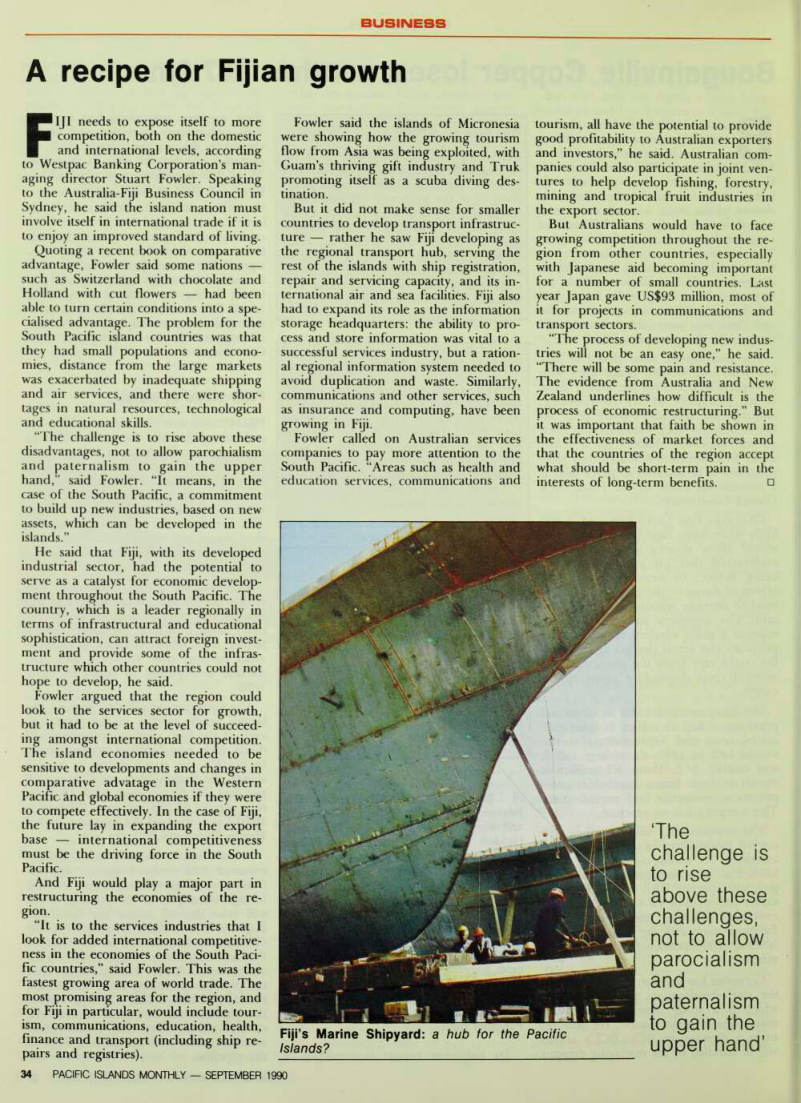
FIJI needs to expose itself to more competition, both on the domestic and international levels, according
to Westpac Banking Corporation’s man
aging director Stuart Fowler. Speaking to the Australia-Fiji Business Council in Sydney, he said the island nation must involve itself in international trade if it is to enjoy an improved standard of living.
Quoting a recent book on comparative advantage, Fowler said some nations such as Switzerland with chocolate and Holland with cut flowers had been able to turn certain conditions into a spe cialised advantage. The problem for the South Pacific island countries was that they had small populations and econo mies, distance from the large markets
was exacerbated by inadequate shipping
and air services, and there were shor tages in natural resources, technological and educational skills.
“The challenge is to rise above these disadvantages, not to allow parochialism and paternalism to gain the upper hand,” said Fowler. “It means, in the case of the South Pacific, a commitment to build up new industries, based on new assets, which can be developed in the islands.”
He said that Fiji, with its developed industrial sector, had the potential to serve as a catalyst for economic develop ment throughout the South Pacific. The country, which is a leader regionally in terms of infrastructural and educational sophistication, can attract foreign invest ment and provide some of the infras tructure which other countries could not hope to develop, he said.
Fowler argued that the region could look to the services sector for growth, but it had to be at the level of succeed
ing amongst international competition.
The island economies needed to be sensitive to developments and changes in comparative advatage in the Western Pacific and global economies if they were to compete effectively. In the case of Fiji, the future lay in expanding the export base international competitiveness must be the driving force in the South Pacific.
And Fiji would play a major part in restructuring the economies of the re
gion.
“It is to the services industries that I look for added international competitive ness in the economies of the South Paci fic countries,” said Fowler. This was the fastest growing area of world trade. The most promising areas for the region, and for Fiji in particular, would include tour ism, communications, education, health, finance and transport (including ship re
pairs and registries).
Fowler said the islands of Micronesia were showing how the growing tourism flow from Asia was being exploited, with
Guam’s thriving gift industry and Truk
promoting itself as a scuba diving des tination.
But it did not make sense for smaller countries to develop transport infrastruc ture rather he saw Fiji developing as the regional transport hub, serving the rest of the islands with ship registration, repair and servicing capacity, and its in ternational air and sea facilities. Fiji also had to expand its role as the information storage headquarters: the ability to pro cess and store information was vital to a successful services industry, but a ration al regional information system needed to avoid duplication and waste. Similarly, communications and other services, such as insurance and computing, have been
growing in Fiji.
Fowler called on Australian services companies to pay more attention to the South Pacific. “Areas such as health and education services, communications and
tourism, all have the potential to provide good profitability to Australian exporters and investors,” he said. Australian com panies could also participate in joint ven
tures to help develop fishing, forestry,
mining and tropical fruit industries in the export sector.
But Australians would have to face growing competition throughout the re gion from other countries, especially with Japanese aid becoming important for a number of small countries. Last year Japan gave US$93 million, most of it for projects in communications and transport sectors.
“The process of developing new indus tries will not be an easy one,” he said.
“There will be some pain and resistance.
The evidence from Australia and New Zealand underlines how difficult is the process of economic restructuring.” But it was important that faith be shown in the effectiveness of market forces and that the countries of the region accept what should be short-term pain in the interests of long-term benefits. □
Fiji’s Marine Shipyard: a hub for the Pacific Islands?
'The challenge is to rise " above these challenges, not to allow parocialism and paternalism to gain the upper hand’
Spending blindly
PUBLIC finance accounting in the Solomon Islands started to break down in the 1979 financial year and by 1985 all semblance of control had been lost, said a report from the coun try’s Public Accounts Committee which has revealed millions of dollars worth of
illegal spending. The inquiry, chaired by
Joses Tuhanuka, reported that between 1985 and 1987 illegal spending totalled 51581.2 million (U 5532.5 million).
The committee found that accounting officers had failed to co-operate with the Auditor-General and failed to give writ ten explanations for excess spending; there were serious errors in accounting and staff had been poorly trained; limits authorised by Parliament had been ex ceeded; the budgetry process was in effective and deteriorating and succes sive governments had been unwilling to control spending. Many public servants were found to be operating private businesses during official working hours and using government transport, tele phones, stationery and other facilities for their own enterprises.
The Public Accounts Committee had its work delayed by the refusal of accounting officers to provide written explanations and the committee was critical of the fact that no disciplinary action had been taken by the Public Ser vice Commission.
In the 1985-87 period, the Govern ment’s net domestic borrowing rose from 51520.2 million to 51562.9 million, and the total reached 51588.4 million by the end of 1989. Almost all of this deficit was raised to meet revenue shoitfalls, and the committee’s report warned that this level of deficit could not be sus tained. It said part of the problem had been budgets drawn up without con sultation with ministers responsible for
spending portfolios. Without central
policy directives, the departmental
accounting officers had ignored financial allocations when setting manpower levels; this had caused budgets to be ex ceeded and no governments had been willing to rectify these breaches.
The committee has recommended that, in the future, action be taken
against accounting officers who over spend.
But there were also unauthorised ac tions at the political level, with borrow ing limits set by Parliament having been disregarded. Nor has the Solomon Is lands Parliament been kept informed of the true budget deficit or the extent of Government borrowing. In fact, the committee reports the Auditor-General’s view that proper government accounts have not been kept since 1979.
But even when accounts have been maintained, some are wildly inaccurate; for example, the Treasury’s cash in tran sit account showed a balance of more than Sls27 million at the end of 1987 when there was actually less than Sls 10,000. It was found that adjustments of 515315 million had to be made before the committee could publish the govern ment’s accounts, and expressed some concern that plans to set up a General Accounting Service had not been im plemented. There is also to be a stand ing committee which will examine gov ernment accounts, investigate excess spending, examine other accounts sent to Parliament and have the power to summon officials to answer questions. □
Fielders rice back on Solomons export menu
SOLOMON Islands-based Fielders Industries Ltd has begun ex porting rice again as the final stage of reconstruction after the destruc tion of rice areas by Cyclone Namu in May 1986. Vanuatu and New Zealand importers have placed orders, and there is likely to be a substantial purchase from Papua New Guinea once that coun try’s quarantine officials have cleared the rice as being disease-free. In the longer term, Fielders could take advantage of efforts in Papua New Guinea to expand rice growing, which would provide an alternative source for the company it
currently imports unpolished rice from
the United States, and mills and packs it in Honiara.
The Australian-owned Fielders Indus tries has received an order for 14 tonnes of rice from Auckland, and a report from Honiara said that a further order for 10 tonnes had come from Vanuatu.
The company has been operating in the Solomon Islands for only three years the country’s rice industry was destroyed by the 1986 cyclone. General manager Steve Peterson said the company was pleased with progress, and was planning to invest about US$l million in the coun try, including spending on its biscuit manufacturing plant, a new bread fac tory and a feed stock mill.
Fielders is planning to market its rice through Associated Mills in Papua New Guinea, which is now the country’s only flour supplier. PNG Health Department quarantine officers have already ex amined samples of rice from Fielders, and Agriculture and Livestock Minister Tom Pais said they had found minimal risks of pests and diseases. Officials would travel to Honiara to inspect the mill there. Pais said imports would only be cleared when full checks had been
carried out. It is expected that Fielders could sell about 37,000 tonnes of rice in the initial shipment. The strict control tests are essential in view of Papua New Guinea’s efforts to develop its own infant rice industry any disease would be fatal to that plan.
The Government in Port Moresby re cently outlined initiatives to see rice grown on a commercial scale in Morobe’s Markham Valley, Bereina, in Central Province and on the plains of East Sepik.
Fielders has indicated it will buy un polished rice from Papua New Guinea, especially from the Markham area.
Meanwhile, Fielders is expecting to be able to sell its packaged rice in Papua New Guinea at between 50 to (US49 cents) and 60t per kilogram, compared with current prices for Australian im ported rice between 65t and 73t in Port
Moresby. □
Fishing promise
THE Solomon Islands Government has sold its National Fisheries Development Company (NFD) to British Columbia Packers (BCP), of Canada, for US$B.5 million, and the new owners have pledged to inject another US$2l million to expand the operations with new pole
line vessels and upgrading of the com pany’s base at Tulagi. NFD’s 10 existing pole line boats had lain idle during the drawn-out negotiations for the sale of the state-owned operation as part of the Government’s asset sales programme.
BCP has now put them back in service.
The company’s only purse seiner will need a major overhaul.
A BCP spokesman was reported as saying that the new Canadian owners would undertake a feasibility study on building a cannery in the Solomon Is lands. The 400 employees already on the payroll are to be retained, and the Gov ernment agreed to assume US$3.3 mil lion in liabilities incurred by NFD before the sale was completed. □
New bank lending policies
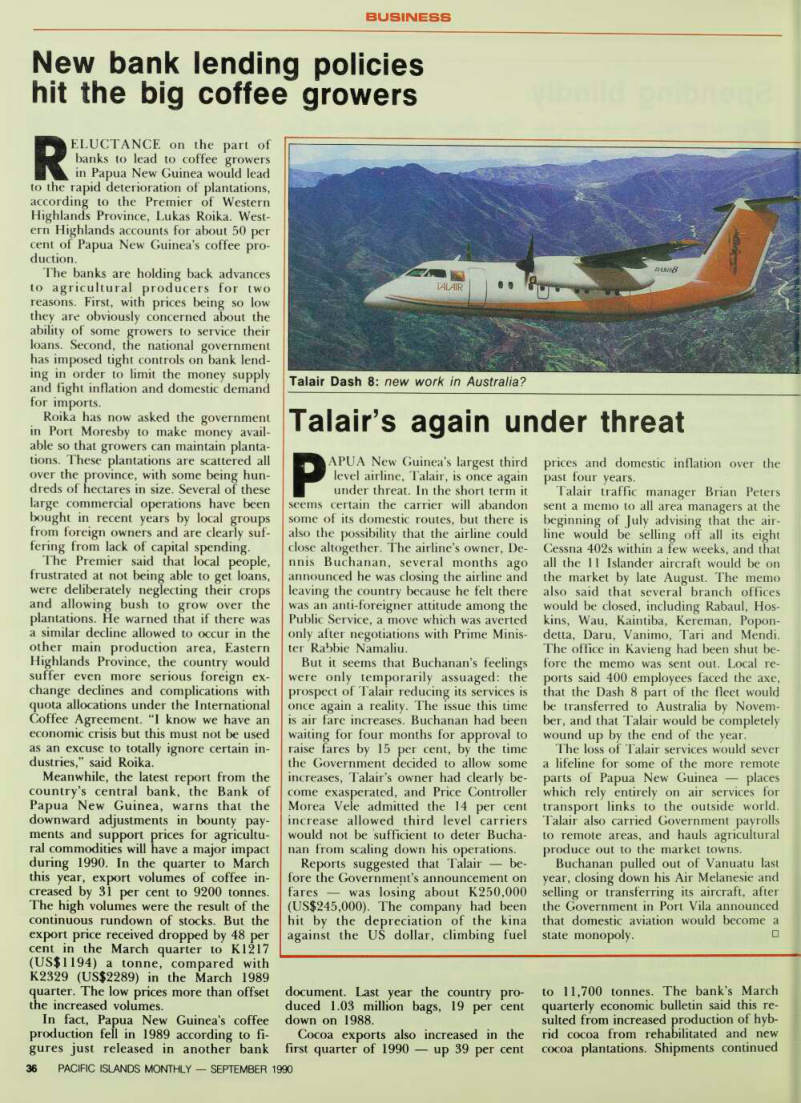
hit the big coffee growers
Reluctance on the part of banks to lead to coffee growers in Papua New Guinea would lead to the rapid deterioration of plantations, according to the Premier of Western Highlands Province, Lukas Roika. West ern Highlands accounts for about 50 per cent of Papua New Guinea’s coffee pro duction.
The banks are holding back advances to agricultural producers for two reasons. First, with prices being so low they are obviously concerned about the ability of some growers to service their loans. Second, the national government has imposed tight controls on bank lend ing in order to limit the money supply and fight inflation and domestic demand
for imports.
Roika has now asked the government in Port Moresby to make money avail able so that growers can maintain planta tions. These plantations are scattered all over the province, with some being hun dreds of hectares in size. Several of these large commercial operations have been bought in recent years by local groups from foreign owners and are clearly suf
fering from lack of capital spending.
The Premier said that local people, frustrated at not being able to get loans, were deliberately neglecting their crops and allowing bush to grow over the plantations. He warned that if there was a similar decline allowed to occur in the other main production area, Eastern Highlands Province, the country would suffer even more serious foreign ex change declines and complications with quota allocations under the International Coffee Agreement. “I know we have an economic crisis but this must not be used as an excuse to totally ignore certain in dustries,” said Roika.
Meanwhile, the latest report from the country’s central bank, the Bank of Papua New Guinea, warns that the downward adjustments in bounty pay ments and support prices for agricultu ral commodities will have a major impact during 1990. In the quarter to March this year, export volumes of coffee in creased by 31 per cent to 9200 tonnes.
The high volumes were the result of the continuous rundown of stocks. But the export price received dropped by 48 per cent in the March quarter to K 1217 (US$ll94) a tonne, compared with K 2329 (US$22B9) in the March 1989 quarter. The low prices more than offset the increased volumes.
In fact, Papua New Guinea’s coffee production fell in 1989 according to fi gures just released in another bank
document. Last year the country produced 1.03 million bags, 19 per cent down on 1988.
Cocoa exports also increased in the first quarter of 1990 up 39 per cent
to 11,700 tonnes. The bank’s March quarterly economic bulletin said this re suited from increased production of hyb rid cocoa from rehabilitated and new
cocoa plantations. Shipments continued
from North Solomons Province during the quarter but the loss of exports from the province since the Bougainville re bels declared independence is likely to have a significant impact on the total of Papua New Guinea’s exports for the re mainder of the year. Cocoa export prices fell by 29 per cent to an average of K 726 (US$7l3) per tonne compared to an average of K 1024 in the corresponding period of the previous year.
But copra suffered declines in both export prices and volume: the volume sent out of the country was down by 13 per cent over the previous March quar ter to 15,700 tonnes. The decline was attributed to falling production and the closure of the depot at Kieta in the North Solomons the country’s main copra depot. The average price received in the quarter was KlB5 (US$181) per tonne, 26 per cent lower than the March 1989 figure. The bank reports that the Government’s review of the indstry con tinues following the exhaustion of the Copra Stabilisation Fund, and the world price for copra oil continues to be de pressed as a result of increased availabil ity of substitutes, such as soya oil.
The bad news continued on the palm oil front, too.
Volumes exported went down by four per cent to 32,900 tonnes in the March quarter, largely due to bad weather. But prices fell by 20 per cent to K 243 (US$23B) a tonne.
In other agricultural crops, tea exports brought export revenue of K 1.7 million (US$l.66 milion), 42 per cent higher than the previous March quarter and rubber exports also rose by 17 per cent to K 700,000 (U 55687,050), partly helped by a slight increase in the export
price.
Export receipts from logs and other
forestry products increased by two per
cent to K 23.3 million (U 5522.86 million), but marine export income fell by five per cent to K 1.9 million (US$l.B6 mil lion), □
Talair’s again under threat
PAPUA New Guinea’s largest third level airline, Talair, is once again under threat. In the short term it seems certain the carrier will abandon some of its domestic routes, but there is also the possibility that the airline could close altogether. The airline’s owner, Dennis Buchanan, several months ago announced he was closing the airline and leaving the country because he felt there was an anti-foreigner attitude among the Public Service, a move which was averted only after negotiations with Prime Minister Rabbie Namaliu.
But it seems that Buchanan’s feelings
were only temporarily assuaged: the
prospect of Talair reducing its services is once again a reality. The issue this time is air fare increases. Buchanan had been waiting for four months for approval to raise fares by 15 per cent, by the time the Government decided to allow some increases, Talair’s owner had clearly become exasperated, and Price Controller Morea Vele admitted the 14 per cent increase allowed third level carriers would not be sufficient to deter Buchanan from scaling down his operations.
Reports suggested that Talair before the Government’s announcement on fares was losing about K 250,000 (U 55245,000). The company had been hit by the depreciation of the kina against the US dollar, climbing fuel
prices and domestic inflation over the past four years.
Talair traffic manager Brian Peters sent a memo to all area managers at the beginning of July advising that the air line would be selling off all its eight Cessna 402 s within a few weeks, and that all the 11 Islander aircraft would be on the market by late August. The memo also said that several branch offices would be closed, including Rabaul, Hos kins, Wau, Kaintiba, Kereman, Popon delta, Daru, Vanimo, Tari and Mendi.
The office in Kavieng had been shut be fore the memo was sent out. Local re ports said 400 employees faced the axe, that the Dash 8 part of the fleet would be transferred to Australia by Novem ber, and that Talair would be completely wound up by the end of the year, The loss of Talair services would sever a lifeline for some of the more remote parts of Papua New Guinea places which rely entirely on air services for transport links to the outside world, Talair also carried Government payrolls to remote areas, and hauls agricultural produce out to the market towns.
Buchanan pulled out of Vanuatu last year, closing down his Air Melanesie and selling or transferring its aircraft, after the Government in Port Vila announced that domestic aviation would become a state monopoly. □
Talair Dash 8: new work in Australia?
New hotel work begins
WORK has begun on the construction of Coconuts, a new hotel and resort de velopment at Maninoa Village, Siumu on Upolu Island in Western Samoa, after four years of negotiations with landown ers and the Government. It is located about 30 minutes from Apia on a la goon. The architecture of the resort has been described as being a combination of traditional Samoan public building and individual “South Seas” type accom modation units.
Norfolk seeks a better
shopping deal for tourists
NORFOLK Island’s Government is worried that the territory has lost its competitive edge as a shopping and duty free destination com pared with other South Pacific countries.
It is reviewing its revenue structure in an effort to find ways to lower costs for companies operating in the tourism busi ness. All existing taxes will be looked at; there is certainly no suggestion that in come taxes will be introduced, but some of the existing fiscal measures are clearly not proving effective, such as the annual hairdresser’s licence fee of Asl. The re view will also examine privatisation of some Government functions, such its
monopoly on liquor wholesaling and the
Norfolk Island philatelic bureau.
The first move to restructure the is land’s revenue base was the recent deci sion to raise the Financial Institutions Levy (FIL) from 0.25 per cent to one per cent. The banks forward the re venue from the levy on all financial transactions to the Government once a month now and this is expected to pro duce AS 1.1 million (US$870,000) a year, which together with customs duty of As2.l million (US$l.7 million), provides about 55 per cent of official revenue.
The remainder comes from a range of
government charges.
The FIL increase replaces the public
works levy which brought in only
A 5300,000 a year. Each islander over the
age of 18 years was required to pay the levy (which ran to about As3oo a year) which was intended to produce money to pay for road construction and repairs. It was enormously expensive to administer people could claim they fell below the income threshold at which one qualified to pay the levy and, because there was no income tax system, this was extraordi narily difficult to disprove. There was also a set of allowable deductions which residents could set against their pay ments.
The FIL is more like a value-added tax, and already businesses on Norfolk have begun adding one per cent to their invoices (and listing it separately, just as they would a value-added tax).
But if the FIL is not to make Norfolk Island more uncompetitive, the Govern ment will have to find a way to reduce its spending and thus the burden on businesses which cater to the tourists, most of whom come from Australia and New Zealand. Other destinations offer better priced goods than Norfolk, espe cially in the electrical and liquor lines, although the island can still be competi tive in shoes and perfumes. But when shopping is a major consideration for many who travel to South Pacific des tinations out of Australia and New Zea land, it is important that Norfolk Island retains its image of a good place to pick
up cheap goods. I=l
Swordfish under threat
ALARM is growing in Hawaii over the rapid expansion of the long line fleet operating in the state’s fishery, much of it targetting swordfish.
Catches of swordfish off Hawaii rose from 500,000 lb in 1989 to 2.5 million lb in the first five months of 1990, turning the area almost overnight from a minor to a major part of the United States longline industry. The council has be come concerned after being told by advisers that information was lacking on fish stocks in the area, even as to whether there is a single stock of sword fish in the Pacific Ocean. It has decided that, after more study, it could consider
limiting fishing operations based on
those boats operating there before June 21.
The number of longline vessels oper ating in the Hawaiian fishery has dou bled over the past two years, many of
the newcomers having quit the over exploited yellowfin tuna industry in the Gulf of Mexico or swordfish catching in the Atlantic Ocean. It is possible that vessels now experiencing declining catch es off the Alaska and United States West Coast might also be moved to Hawaiian waters and equipped with new longline gear.
There are now thought to be about 120 longliners fishing off Hawaii and fears that the number could swell to 150 in the next few months. This is a long way from the 37 boats operating there back in 1987, and at that time swordfish made up only a small proportion of fish landed in Hawaii by the longliners. Some of the boats do also fish for lobster, bot tomfish, albacore tuna and deepwater shrimp, but most of the effort is now concentrated on swordfish. □
Shpping
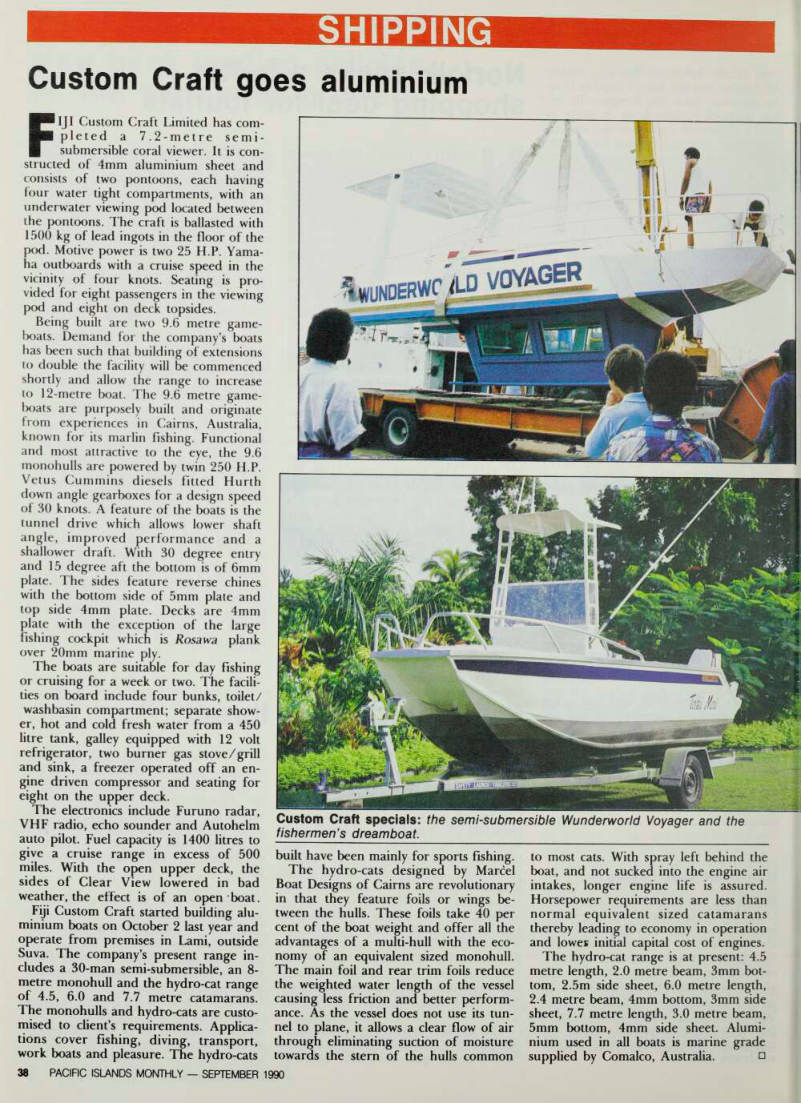
Custom Craft goes aluminium
FIJI Custom Craft Limited has com pleted a 7.2-metre semi submersible coral viewer. It is con structed of 4mm aluminium sheet and consists of two pontoons, each having four water tight compartments, with an underwater viewing pod located between the pontoons. The craft is ballasted with 1500 kg of lead ingots in the floor of the pod. Motive power is two 25 H.P. Yama ha outboards with a cruise speed in the vicinity of four knots. Seating is pro vided for eight passengers in the viewing pod and eight on deck topsides.
Being built are two 9.6 metre game boats. Demand for the company’s boats has been such that building of extensions to double the facility will be commenced shortly and allow the range to increase to 12-metre boat. The 9.6 metre game boats are purposely built and originate from experiences in Cairns, Australia, known for its marlin fishing. Functional and most attractive to the eye, the 9.6 monohulls are powered by twin 250 H.P.
Vetus Cummins diesels fitted Hurth down angle gearboxes for a design speed of 30 knots. A feature of the boats is the tunnel drive which allows lower shaft
angle, improved performance and a
shallower draft. With 30 degree entry and 15 degree aft the bottom is of 6mm plate. The sides feature reverse chines with the bottom side of smm plate and top side 4mm plate. Decks are 4mm plate with the exception of the large
fishing cockpit which is Rosawa plank
over 20mm marine ply.
The boats are suitable for day fishing or cruising for a week or two. The facili ties on board include four bunks, toilet/ washbasin compartment; separate show er, hot and cold fresh water from a 450 litre tank, galley equipped with 12 volt refrigerator, two burner gas stove/grill and sink, a freezer operated off an en gine driven compressor and seating for eight on the upper deck.
The electronics include Furuno radar, VHF radio, echo sounder and Autohelm auto pilot. Fuel capacity is 1400 litres to give a cruise range in excess of 500 miles. With the open upper deck, the sides of Clear View lowered in bad weather, the effect is of an open boat.
Fiji Custom Craft started building alu minium boats on October 2 last year and operate from premises in Lami, outside Suva. The company’s present range in cludes a 30-man semi-submersible, an 8metre monohull and the hydro-cat range of 4.5, 6.0 and 7.7 metre catamarans.
The monohulls and hydro-cats are custo mised to client’s requirements. Applica tions cover fishing, diving, transport, work boats and pleasure. The hydro-cats
built have been mainly for sports fishing,
The hydro-cats designed by Marcel
Boat Designs of Cairns are revolutionary in that they feature foils or wings between the hulls. These foils take 40 per cent of the boat weight and offer all the advantages of a multi-hull with the economy of an equivalent sized monohull.
The main foil and rear trim foils reduce the weighted water length of the vessel causing less friction and better performance. As the vessel does not use its tunnel to plane, it allows a clear flow of air through eliminating suction of moisture towards the stern of the hulls common
to most cats. With spray left behind the boat, and not sucked into the engine air intakes, longer engine life is assured, Horsepower requirements are less than normal equivalent sized catamarans
thereby leading to economy in operation
and lowe* initial capital cost of engines, The hydro-cat range is at present: 4.5 metre length, 2.0 metre beam, 3mm bot tom, 2.5 m side sheet, 6.0 metre length, 2.4 metre beam, 4mm bottom, 3mm side sheet, 7.7 metre length, 3.0 metre beam, smm bottom, 4mm side sheet. Alumi nium used in all boats is marine grade supplied by Comalco, Australia. □
Custom Craft specials: the semi-submersible Wunderworld Voyager and the fishermen's dream boat.
Advertisements & other items, p. 39 (1 item)
Europe.
BANK LINE and
COLUMBUS LINE
24 day service to
Europe.
Need we say more...
G The Joint Service Partners offer facilities for shipment of: Containers (PCL/LCL) and Break-bulk Cargo plus reefer space and deeptanks for carriage of vegetable oils and other liquid bulk cargo.
Carriers also accept heavy lifts, overlength and cumbersome parcels.
Ports of Service: Loading: Papeete, Apia, Suva, Lautoka, Noumea, Port Vila, Santo, Honiara, Port Moresby, Lae, Madang, Kimbe, Rabaul, Kieta, Darwin. For; Rotterdam, Antwerp, Hamburg, Hull, Dunkirk. Le Havre.
Additional ports on enquiry.
Please contact our regional offices for further information: The Bank Line (Australasia) Pty Ltd Columbus Line Reederei GmbH Suite 701, 51 Pitt St, P.O. Box 1 667, Lae/Papua New Guinea Sydney, NSW, Australia 2000 Phone: 423466/423487/AH. 422481 Phone 251 6688 Telex 24063 Telex: Colline N E 441 71 The South Pacific Specialists for over 75 years
Schedules
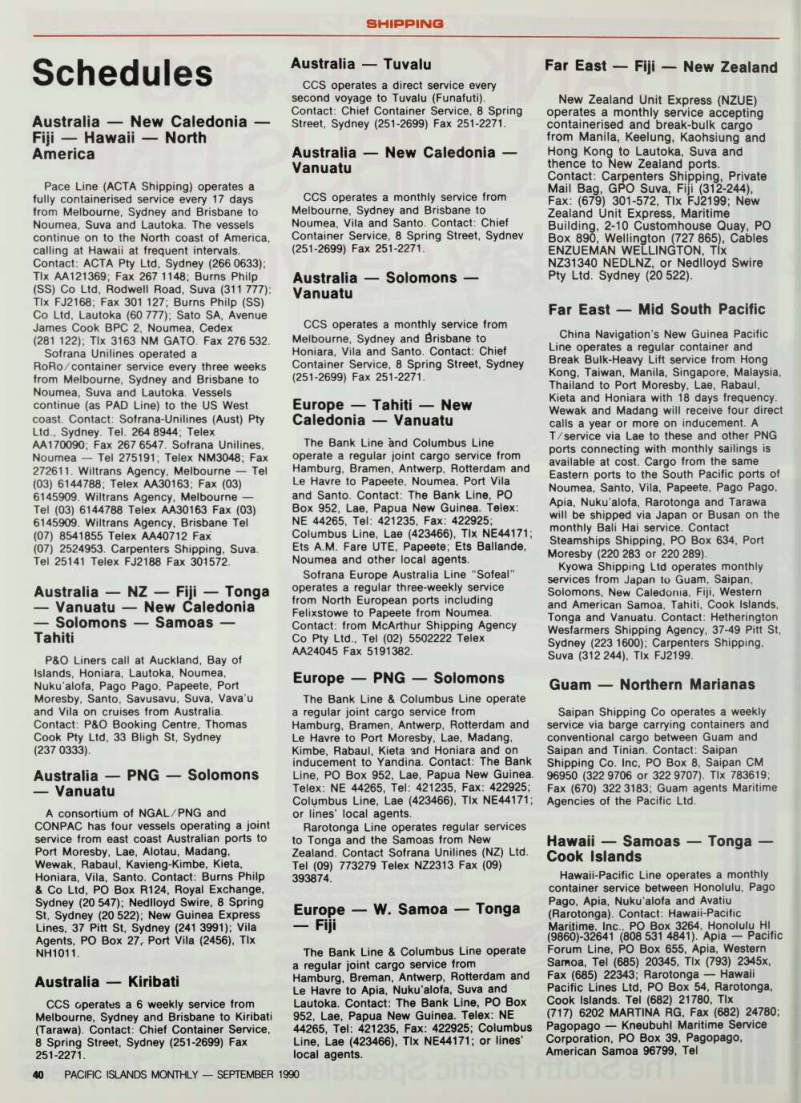
Australia New Caledonia
Fiji Hawaii North
America Pace Line (ACTA Shipping) operates a fully containerised service every 17 days from Melbourne, Sydney and Brisbane to Noumea, Suva and Lautoka. The vessels continue on to the North coast of America, calling at Hawaii at frequent intervals.
Contact: ACTA Pty Ltd, Sydney (266 0633); Tlx AA121369; Fax 267 1148; Burns Philp (SS) Co Ltd. Rodwell Road. Suva (311 777): Tlx FJ2168; Fax 301 127; Burns Philp (SS) Co Ltd, Lautoka (60 777); Sato SA, Avenue James Cook BPC 2, Noumea, Cedex (281 122); Tlx 3163 NM GATO. Fax 276 532.
Sofrana Unilines operated a Roßo/container service every three weeks from Melbourne, Sydney and Brisbane to Noumea, Suva and Lautoka. Vessels continue (as PAD Line) to the US West coast. Contact; Sofrana-Unilines (Aust) Pty Ltd., Sydney. Tel. 264 8944; Telex AA170090; Fax 267 6547. Sofrana Unilines, Noumea Tel 275191; Telex NM3048; Fax 272611. Wiltrans Agency, Melbourne Tel (03) 6144788; Telex AA30163; Fax (03) 6145909 Wiltrans Agency, Melbourne Tel (03) 6144788 Telex AA30163 Fax (03) 6145909. Wiltrans Agency. Brisbane Tel (07) 8541855 Telex AA40712 Fax (07) 2524953. Carpenters Shipping, Suva.
Tel 25141 Telex FJ2IBB Fax 301572.
Australia NZ Fiji Tonga
Vanuatu New Caledonia Solomons Samoas Tahiti P&O Liners call at Auckland, Bay of Islands, Honiara. Lautoka, Noumea, Nukualofa, Pago Pago, Papeete, Port Moresby, Santo, Savusavu, Suva, Vava’u and Vila on cruises from Australia.
Contact; P&O Booking Centre, Thomas Cook Pty Ltd, 33 Bligh St, Sydney (237 0333).
Australia PNG Solomons Vanuatu A consortium of NGAL/PNG and CONPAC has four vessels operating a joint service from east coast Australian ports to Port Moresby, Lae, Alotau, Madang, Wewak, Rabaul, Kavieng-Kimbe, Kieta.
Honiara. Vila, Santo. Contact; Burns Philp & Co Ltd, PO Box R 124, Royal Exchange, Sydney (20 547); Nedlloyd Swire, 8 Spring St, Sydney (20 522); New Guinea Express Lines. 37 Pitt St, Sydney (241 3991); Vila Agents. PO Box 27, Port Vila (2456), Tlx
Nhioii.
Australia Kiribati CCS operates a 6 weekly service from Melbourne, Sydney and Brisbane to Kiribati (Tarawa). Contact. Chief Container Service, 8 Spring Street, Sydney (251-2699) Fax 251-2271.
Australia Tuvalu
CCS operates a direct service every second voyage to Tuvalu (Funafuti).
Contact. Chief Container Service, 8 Spring Street. Sydney (251-2699) Fax 251-2271.
Australia New Caledonia
Vanuatu
CCS operates a monthly service from Melbourne, Sydney and Brisbane to Noumea, Vila and Santo. Contact. Chief Container Service, 8 Spring Street, Sydnev (251-2699) Fax 251-2271.
Australia Solomons
Vanuatu
CCS operates a monthly service from Melbourne, Sydney and Brisbane to Honiara, Vila and Santo. Contact: Chief Container Service, 8 Spring Street, Sydney (251-2699) Fax 251-2271.
Europe Tahiti New
Caledonia Vanuatu
The Bank Line and Columbus Line operate a regular joint cargo service from Hamburg. Bramen, Antwerp, Rotterdam and Le Havre to Papeete, Noumea. Port Vila and Santo. Contact: The Bank Line, PO Box 952, Lae, Papua New Guinea. Telex: NE 44265, Tel: 421235. Fax: 422925; Columbus Line. Lae (423466), Tlx NE44171; Ets A M. Fare UTE, Papeete; Ets Ballande, Noumea and other local agents.
Sofrana Europe Australia Line ‘‘SofeaT’ operates a regular three-weekly service from North European ports including Felixstowe to Papeete from Noumea.
Contact: from McArthur Shipping Agency Co Pty Ltd., Tel (02) 5502222 Telex AA24045 Fax 5191382.
Europe PNG Solomons
The Bank Line & Columbus Line operate a regular joint cargo service from Hamburg, Bramen, Antwerp, Rotterdam and Le Havre to Port Moresby, Lae, Madang, Kimbe, Rabaul, Kieta and Honiara and on inducement to Yandina. Contact: The Bank Line, PO Box 952, Lae, Papua New Guinea.
Telex: NE 44265, Tel: 421235, Fax; 422925; Columbus Line, Lae (423466), Tlx NE44171; or lines’ local agents.
Rarotonga Line operates regular services to Tonga and the Samoas from New Zealand. Contact Sofrana Unilines (NZ) Ltd.
Tel (09) 773279 Telex NZ2313 Fax (09) 393874.
Europe W. Samoa Tonga
-Fiji
The Bank Line & Columbus Line operate a regular joint cargo service from Hamburg, Breman, Antwerp, Rotterdam and Le Havre to Apia, Nukualofa, Suva and Lautoka. Contact: The Bank Line, PO Box 952, Lae, Papua New Guinea. Telex: NE 44265, Tel: 421235, Fax: 422925; Columbus Line, Lae (423466), Tlx NE44171; or lines’ local agents.
Far East Fiji New Zealand New Zealand Unit Express (NZUE) operates a monthly service accepting containerised and break-bulk cargo from Manila, Keelung, Kaohsiung and Hong Kong to Lautoka, Suva and thence to New Zealand ports.
Contact: Carpenters Shipping, Private Mail Bag, GPO Suva, Fiji (312-244), Fax: (679) 301-572, Tlx FJ2199; New Zealand Unit Express, Maritime Building, 2-10 Customhouse Quay, PC Box 890, Wellington (727 865), Cables
Enzueman Wellington, Tlx
NZ31340 NEDLNZ, or Nedlloyd Swire Pty Ltd. Sydney (20 522).
Far East Mid South Pacific China Navigation s New Guinea Pacific Line operates a regular container and Break Bulk-Heavy Lift service from Hong Kong, Taiwan, Manila, Singapore, Malaysia, Thailand to Port Moresby, Lae, Rabaul, Kieta and Honiara with 18 days frequency.
Wewak and Madang will receive four direct calls a year or more on inducement. A T/service via Lae to these and other PNG ports connecting with monthly sailings is available at cost. Cargo from the same Eastern ports to the South Pacific ports of Noumea, Santo, Vila, Papeete, Pago Pago, Apia, Nukualofa, Rarotonga and Tarawa will be shipped via Japan or Busan on the monthly Bali Hai service. Contact Steamships Shipping. PC Box 634, Port Moresby (220 283 or 220 289).
Kyowa Shipping Ltd operates monthly services from Japan to Guam, Saipan, Solomons, New Caledonia, Fiji, Western and American Samoa, Tahiti, Cook Islands, Tonga and Vanuatu. Contact; Hetherington Wesfarmers Shipping Agency, 37-49 Pitt St, Sydney (223 1600); Carpenters Shipping.
Suva (312 244), Tlx FJ2199.
Guam Northern Marianas Saipan Shipping Co operates a weekly service via barge carrying containers and conventional cargo between Guam and Saipan and Tinian. Contact: Saipan Shipping Co. Inc, PO Box 8, Saipan CM 96950 (322 9706 or 322 9707). Tlx 783619; Fax (670) 322 3183; Guam agents Maritime Agencies of the Pacific Ltd.
Hawaii Samoas Tonga Cook Islands Hawaii-Pacific Line operates a monthly container service between Honolulu, Pago Pago, Apia, Nukualofa and Avatiu (Rarotonga). Contact: Hawaii-Pacific Maritime. Inc.. PO Box 3264, Honolulu HI (9860)-32641 (808 531 4841). Apia Pacific Forum Line, PO Box 655, Apia, Western Samoa, Tel (685) 20345, Tlx (793) 2345 x, Fax (685) 22343; Rarotonga Hawaii Pacific Lines Ltd, PO Box 54, Rarotonga, Cook Islands. Tel (682) 21780, Tlx (717) 6202 MARTINA RG, Fax (682) 24780; Pagopago Kneubuhl Maritime Service Corporation, PO Box 39, Pagopago, American Samoa 96799, Tel
(684) 6335121/6335122, Tlx (682) 505
Kneubuhl Sb, Fax (684) 6335100;
Nuku’alofa.
Japan Fiji Island Ports
Kyowa Shipping Coperates a monthly containerised service from main ports of Japan to Suva, Lautoka, thence to island ports. Contact; Carpenters Shipping, Neptune House, 3/4 Floor, Tofua St, Walu Bay. Suva (31 2244); Fax (679) 301 572 Tlx FJ2199.
Japan Micronesia
The NYK Shipping Line operates a monthly cargo service from Japan to Micronesia, calling at Yoko, Nagoya, Kobe, Guam, Saipan, Truk, Ponape and Majuro, returning via Yoko, Nagoya and Kobe.
Contact: Burns Philp & Co Ltd, 51 Pitt St, Sydney (259 1000).
Saipan Shipping Co operates a monthly service from Japan to Saipan, Guam, Truk, Ponape, Majuro (Kosrae and Ebeye on inducement). Contact: Saipan Shipping Co, PO Box 8. Saipan, CM 96960 (322 9706 or 322 9707). Tlx 783619. Fax (670) 322 3183.
Japan agents: Kyowa Shipping Company Ltd; Guam Agents: Maritime Agencies of the Pacific Ltd.
Australia Samoas Tonga
Warner Pacific Lines operates a regular container service from Sydney, Brisbane and Melbourne to Nuku’alofa, Pago Pago, Apia and Vava'u with transhipment to Rarotonga. Contact: Hetherington Westfarmers Shipping Agency, 37-49 Pitt St, Sydney (223 1600).
Australia New Caledonia
Fiji Samoas Tonga
Pacific Forum Line operates a fully containerised service (general, reefer and ro-ro) from Sydney to Noumea, Lautoka, Suva, Apia, Pago Pago, Nuku’alofa, Sydney. Cargo centralised from Adelaide, Melbourne, Brisbane. Contact: Pacific Forum Line. PO Box 796, Auckland; Union Bulkships, 333 George St, Sydney, Brisbane and Melbourne; Union Co, Lautoka: Pacific Forum Line, Suva, Nuku’alofa: Pacific Forum Line, Apia; Polynesia Shipping, Pago Pago.
Sofrana Unilines operated a Roßo/container service every three weeks from Melbourne, Sydney and Brisbane to Noumea, Suva and Lautoka with transhipment to the Samoas and Tonga.
For details see above.
Australia Norfolk Island Lord Howe Island Sofrana-Unilines (Australia) Pty Ltd operates a regular monthly service with MV Capitaine Wallis. Contact: Sofrana-Unilines, Sydney (02) 2648944; Telex AA170090 Fax 2676547.
Australia New Caledonia Vanuatu Campagnie Generale Maritime operates a monthly service from Sydney, Melbourne and Brisbane to Noumea, Port Vila and Santo, for containerised and break-bulk cargo. Contact: Compagnie Generale Maritime 12 Castlereagh St, Sydney (231 3700).
Australia Nauru Nauru Pacific Line operates a regular cargo service from Melbourne to Nauru, passenger service to Nauru only. Contact; Nauru Pacific Line (Aust) Pty Ltd. Nauru House, 80 Collins St, Melbourne (653 5709), Nedlloyd Swire, 8 Spring St, Sydney, (20 522).
Australia Solomon Islands Vanuatu NGAL/PNGL joint service operates a monthly service. Contact: Nedlloyd Swire Pty Ltd, 6 Spring St. Sydney (20 522).
Australia New Zealand ANL Ltd operates the Tranztas contain er service between Australia and New Zealand, offering access to five vessels.
These vessels call at Melbourne, Sydney, Brisbane (Tasmania, Adelaide and Fre mantle via feeder services) in Australia and Auckland, Wellingtoin, Lyttelton, Port Chalmers, Nelson, Tauranga (Napier via feeder service) in New Zealand. Each ves sel operates on an approximate three weekly round voyage schedule.
Australia NZ Fiji Vanuatu New Caledonia Solomons New Guinea Sitmar Cruises operates a year-round cruise programme from Sydney to include the better-known ports in the above countries plus a number of unspoilt, and largely unknown, island paradises. Contact: Sitmar Cruises, 39 Martin Place, Sydney (239 9000) for NSW; reservations and inquiries (008 42 2277); rest of Australia, reservations and enquiries (088 22 2277).
New Zealand Tonga Samoas Warner Pacific Line Services from Auckland to Nuku’alofa, Vava’u, Apia, Pago Pago monthly carrying general and freezer
cargoes and FCL Dry Freezer. Contact: McKay Shipping Ltd, 2nd Floor, Ferry Bldg, Quay St., Auckland PO Box 3 (390 229).
Cables MACSHIP, Tlx NZ2554f; Warner Pacific Line, Box 93, Nukualofa, Tonga; Mealelel (Western Samoa Ltd), Private Bag, Apia, Western Samoa; Burns Philp (SS) Co Ltd, PO Box 129, Pago Pago, American Samoa (633 2709), Burnsouth SB.
Rarotonga Line operates regular services to Tonga and the Samoas from New Zealand. Contact; Sofrana Unilines (NZ) Ltd. Tel (09) 773279 Telex NZ2313 Fax (09) 393874.
NZ Cook Islands Aitutaki Niue Cook Islands Line services Auckland, Rarotonga, Aitutaki, Niue monthly carrying general and freezer cargoes. Contact: McKay Shipping Ltd, 2nd Floor, Ferry Bldg, Quay St, Auckland/PO Box 3, Auckland (390 229). Cables: MACSHIP. Tlx NZ2554; Fax 32 931.
Rarotonga Line operates regular services to Tonga and the Samoas from New Zealand. Contact: Sofrana Unilines (NZ) Ltd, Tel. (09) 773279 Telex NZ2313 Fax (09) 393874.
Southeast Asia Fiji Nedlloyd Lines (NZEAS) Service operates regular fast cargo service from Surabaya,
Jakarta, Port Kelang, Bangkok and Singapore via New Zealand to Suva and Lautoka. Contact: Carpenters Shipping, Neptune House, 3/4 Floor, Tof6a St., Walu Bay. Suva (312 244). Fax: (679) 301 572.
Tlx: FJ2199.
Europe Tahiti New Caledonia New Zealand Vanuatu Solomons PNG
Europe
Polish Ocean Lines offers regular monthly sailings for containerised and break-bulk cargo, also conventional reefer space and reefer containers from Hamburg, Rotterdam, Dunkirk, Le Havre to Papeete, Noumea, Auckland, Santo, Honiara, Rabaul, Lae, Singapore, returning to Europe via Suez. Other ports in the South Pacific can be served directly with inducement or otherwise via transhipment. Contact; Sotama, BP 9170, Papeete (42 7805), Tlx Sotama 373FP; SATO: BP, 02 Noumea Cedex (27 2094), Tlx 163 NM; Universal Shipping Agencies, PO Box 2282, Auckland (30 930), Tlx 21517; Vanua Navigation. PO Box 44, Vila (2027), Tlx 1033; Melan Chine Shipping Co. PO Box 71, Honiara (21 678).
Tlx 66335; Steamships Trading Co Ltd. PO Box 85, Lae (42 4666), Tlx 4243; Union Steamship Co NZ Ltd, PO Box 50, Apia (21 781); Tlx 226; Warner Pacific Line, PO Box 93. Nukualofa (22 088), Tlx 66219; Fiji Agents TBA.
Europe Tahiti New
Caledonia
Nedlloyd offers regular cargo services from Continental ports to Papeete, Apia, Fiji and New Caledonia. Contact Nedlloyd (Aust) Pty Ltd, Spring St, Sydney (27 3801); Carpenters Shipping, Ist Floor, Harbour Centre Bldg, 100 Thomson St., Suva (31 2244), Tlx 2199FJ and Vetari St., Lautoka (63 988), Tlx 5215FJ.
Sofrana Europe Australia Line operates a three-weekly cargo service from Continental ports, including Felixtowe, to Papeete and Noumea. Contact McArthur Shipping Agency Co Pty Ltd, Sydney. Tel (02) 5502222 Telex AA24045 Fax (02) 5191382.
US Hawaii Micronesia
Png
PM & O Lines operate two fully self-contained container vessels on a sailing frequency of every 30 days between the San Francisco Bay Area, Los Angeles, Honolulu and Majuro, Ebeye, Kosrae, Ponape, Truk, Saipan, Yap, Palau, Cebu, Davao, Manila, Lae, Kieta and Rabaul.
Contact; PM&O Lines, 353 Sacramento St., San Francisco, California 94111 (415 421 5400); Tlx: 278016 PMO UR; Owner’s Representative, PO Box 803, Saipan. NMI 96950 (234 8819); Tlx 783605
Cmcaa.
Advertisements & other items, pp. 41-42 (1 item)
Shipping
KYOWA
KYOWA
CO M LTD.
Liner Service to Paciffic Islands
FROM OJAPAN
OKOREA
OTAIWAN
G THAILAND
TO OSAIPAN
©FEDERATED STATES
OF MICRONESIA
©MARSHAL ISLANDS
©AMERICAN SAMOA
©NEW CALEDONIA
©FIJI
©HONG KONG
©SINGAPORE
©PHILIPPINES
©MALAYSIA
©INDONESIA
©GUAM
©YAP
©PALAU
©WESTERN SAMOA
©SOLOMON ISLANDS
©VANUATU
©PAPUA NEW GUINEA
HEAD OFFICE
6th Floor , Kikushima Bldg 2-3, Hamamatsucho 2-chome. Mmato-ku, Tokyo 105, Japan Phone: 03(437)2885 (Rep ) Cables: "MARIQUEEN" Tokyo Telex: 242-4651 Kyowa J
OSAKA OFFICE
Dai San Fuji Bldg, 3-13, Itachibon 1-chome, Osaka 550.
Phone: 06(533)5821 (Rep ) Cables: MARIQUEEN" Osaka Telex: 525-6271 Ssiosa J
THE mCIHC ISLANDS RELY
ON THE ENERGY OF BORAL
3 a;; All through the Pacific Islands, people rely on Boral Speed-E-Gas LP Gas for their energy needs.
Boral has terminals throughout the area, and is proud to be a leading supplier.
Speed-E-Gas is clean, efficient and low in cost.
It’s the ideal energy source for cooking and water heating in homes, motels and hotels, and for a wide range of industrial uses.
So call Boral. We have the energy you're looking for.
Cook Islands Rarotonga 24460 Norfolk Island Norfolk Island 2419 Papua New Guinea Port Moresby 214248 Lae 42 2574 Rabaul 921225 Wewak 86 2125 Tonga Nukualofa 21388 American Samoa Pago Pago 699 2948 Fiji Suva 24035 Lautoka 60088 Sigatoka 50578 Labasa 82973 Vanuatu Santo 455 Port Vila 2046
BORAL GAS
Solomon Islands Honiara 21833 Boral Gas Limited, Bth Floor, IBM House, 168 Kent St., Sydney, NSW 2000. Tel: (02) 278512.
Men with
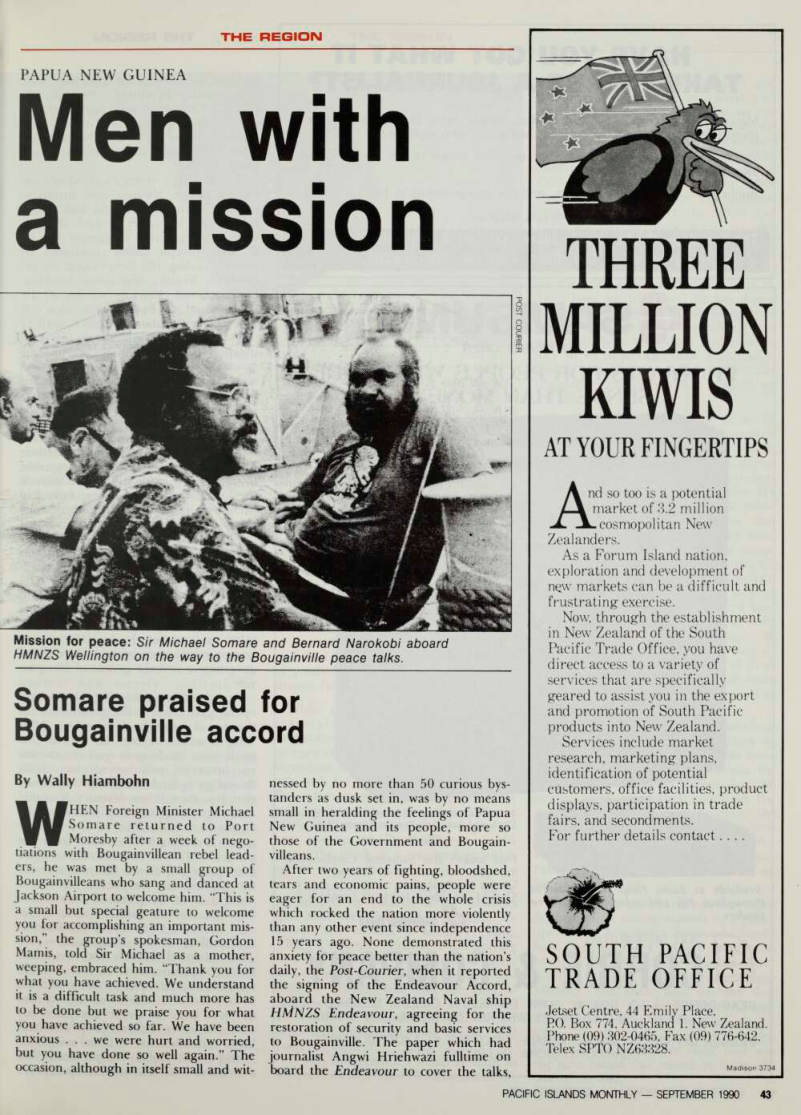

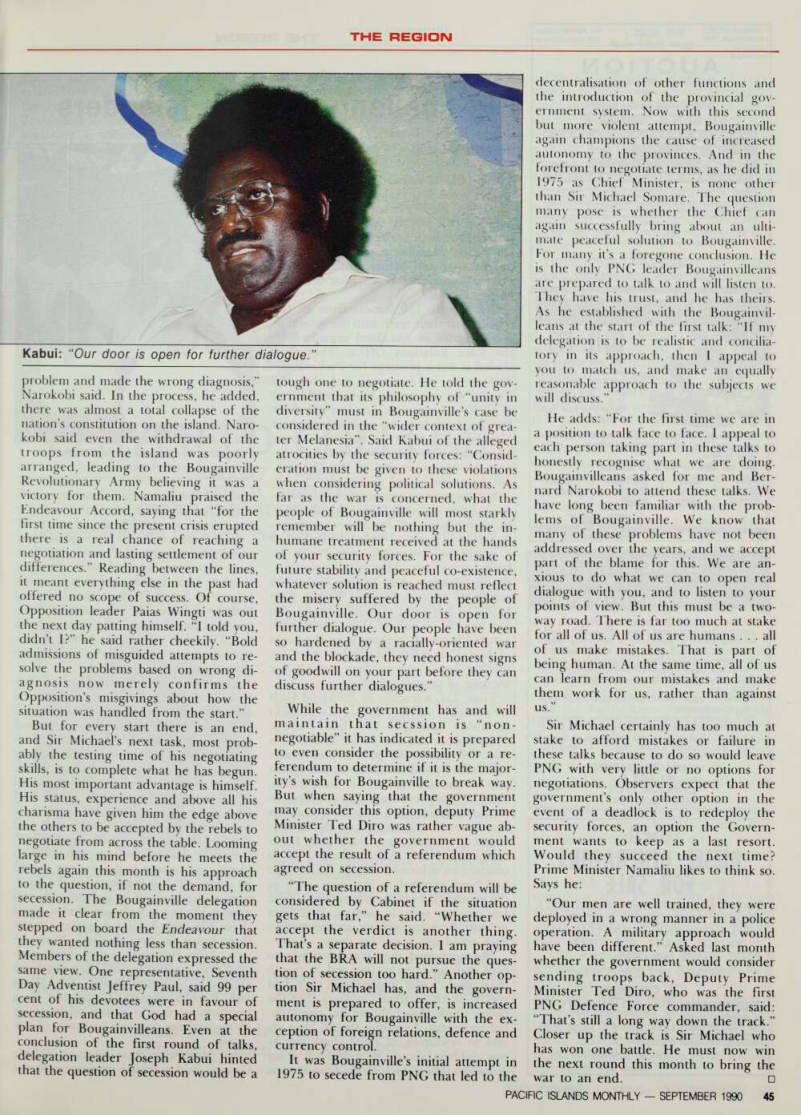
The Region
Papua New Guinea
Men with a mission
Somare praised for Bougainville accord
By Wally Hiambohn
WHEN Foreign Minister Michael
Somare returned to Port Moresby after a week of nego tiations with Bougainvillean rebel lead ers, he was met by a small group of Bougainvilleans who sang and danced at Jackson Airport to welcome him. “This is a small but special geature to welcome you for accomplishing an important mis sion,” the group’s spokesman, Gordon Mamis, told Sir Michael as a mother, weeping, embraced him. “Thank you for what you have achieved. We understand it is a difficult task and much more has to be done but we praise you for what you have achieved so far. We have been anxious ... we were hurt and worried, but you have done so well again.” The occasion, although in itself small and wit
nessed by no more than 50 curious bys tanders as dusk set in, was by no means small in heralding the feelings of Papua New Guinea and its people, more so those of the Government and Bougain villeans.
After two years of fighting, bloodshed, tears and economic pains, people were eager for an end to the whole crisis which rocked the nation more violently than any other event since independence 15 years ago. None demonstrated this anxiety for peace better than the nation’s daily, the Post-Courier, when it reported the signing of the Endeavour Accord, aboard the New Zealand Naval ship HMNZS Endeavour, agreeing for the restoration of security and basic services to Bougainville. The paper which had journalist Angwi Hriehwazi fulltime on board the Endeavour to cover the talks,
Mission for peace: Sir Michael Somare and Bernard Narokobi aboard HMNZS Wellington on the way to the Bougainville peace talks.
Post Courier
splashed the story on the front page with a screaming headline: “PEACE AT LAST”. Though it may have declared
peace rather prematurely, considering
the main issues have yet to be grappled with, PEACE was awaited almost impa tiently by all.
Sir Michael’s delegation which in cluded Justice Minister and Attorney- General Bernard Narokobi and senior bureaucrats had after a week of talks
with a Bougainville delegation led by
Premier Joseph Kabui concluded an accord binding the Government to re establish health, education, banking, transport and electricity services to the main island of Bougainville, shut off from the rest of the world since April 17 when rebel leaders unilaterally declared independence for the island. While the main issues of contention secession, and the future of the CRA-controlled Bougainville copper mine were defer red to another date and venue to be decided, many were contended with the fact that at least a start had been made by the two parties to thrash but their differences across the conference table, through word of mouth rather than in the jungles with guns. These talks had been long in coming, after three false starts. At the signing ceremony aboard the Endeavour , Sir Michael said: “It’s a great success, God has in his own way
brought us together.”
Prime Minister Rabbie Namaliu said the accord was one of the most impor tant agreements signed in the country since independence: “This accord estab lishes at long last the basis for a con tinuing relationship between the national government and the people of Bougain ville.”
For the first time, the Opposition openly gave credit to the government for the breakthrough. Its leader, Paias Wingti, whilst saying the accord had made some headway in resolving the cri sis, however, maintained that credit should go to Sir Michael and not anyone else, not even Prime Minister Namaliu.
And almost giving credibility to the Opposition’s criticisms of the govern ment’s handling of the crisis from the start, Sir Michael and Narokobi held a joint press conference the next day en dorsing this view. Despite the embarrass ment it must have caused their Prime Minister, the two ministers went on re cord to say the Government had erred in its handling of the Bougainville crisis.
They admitted that the use of security forces, appointment of various commit tees, the imposition of a curfew, and the declaration of a state of emergency had not been based on proper analysis. They said the issue became a protracted, bloody crisis because of initial misguided attempts to resolve the problem. “We addressed it as a mere law and order
problem and made the wrong diagnosis,”
Narokobi said. In the process, he added, there was almost a total collapse of the nation’s constitution on the island. Naro kobi said even the withdrawal of the troops from the island was poorly arranged, leading to the Bougainville Revolutionary Army believing it was a victory for them. Namaliu praised the Endeavour Accord, saying that “for the first time since the present crisis erupted there is a real chance of reaching a negotiation and lasting settlement of our differences.” Reading between the lines, it meant everything else in the past had offered no scope of success. Of course, Opposition leader Paias Wingti was out the next day patting himself. “I told you, didn’t I?” he said rather cheekily. “Bold admissions of misguided attempts to re solve the problems based on wrong di agnosis now merely confirms the Opposition’s misgivings about how the situation was handled from the start.”
But for every start there is an end, and Sir Michael’s next task, most prob ably the testing time of his negotiating skills, is to complete what he has begun.
His most important advantage is himself.
His status, experience and above all his charisma have given him the edge above the others to be accepted by the rebels to negotiate from across the table. Looming large in his mind before he meets the rebels again this month is his approach to the question, if not the demand, for
secession. The Bougainville delegation
made it clear from the moment they stepped on board the Endeavour that they wanted nothing less than secession.
Members of the delegation expressed the same view. One representative, Seventh Day Adventist Jeffrey Paul, said 99 per cent of his devotees were in favour of secession, and that God had a special plan for Bougainvilleans. Even at the conclusion of the first round of talks, delegation leader Joseph Kabui hinted that the question of secession would be a
tough one to negotiate. He told the gov ernment that its philosophy of “unity in diversity” must in Bougainville’s case be considered in the “wider context of grea ter Melanesia”. Said Kabui of the alleged atrocities by the security forces; “Consid eration must be given to these violations when considering political solutions. As far as the war is concerned, what the people of Bougainville will most starkly remember will be nothing but the in humane treatment received at the hands of your security forces. For the sake of future stability and peaceful co-existence, whatever solution is reached must reflect the misery suffered by the people of Bougainville. Our door is open for further dialogue. Our people have been so hardened by a racially-oriented war and the blockade, they need honest signs of goodwill on your part before they can discuss further dialogues.”
While the government has and will maintain that secssion is “non negotiable” it has indicated it is prepared to even consider the possibility or a re ferendum to determine if it is the major ity’s wish for Bougainville to break way.
But when saying that the government may consider this option, deputy Prime Minister Ted Diro was rather vague ab out whether the government would accept the result of a referendum which agreed on secession.
“The question of a referendum will be considered by Cabinet if the situation gets that far,” he said. “Whether we accept the verdict is another thing.
That’s a separate decision. I am praying that the BRA will not pursue the ques tion of secession too hard.” Another op tion Sir Michael has, and the govern ment is prepared to offer, is increased autonomy for Bougainville with the ex ception of foreign relations, defence and currency control.
It was Bougainville’s initial attempt in 1975 to secede from PNG that led to the
decentralisation of other functions and the introduction of the provincial gov ernment system. Now with this second but more violent attempt, Bougainville again champions the cause of increased autonomy to the provinces. And in the forefront to negotiate terms, as he did in 1975 as Chief Minister, is none other than Sir Michael Somare. The question many pose is whether the Chief can again successfully bring about an ulti mate peaceful solution to Bougainville.
For many it’s a foregone conclusion. He is the only PNG leader Bougainvilleans are prepared to talk to and will listen to.
They have his trust, and he has theirs.
As he established with the Bougainvil leans at the start of the first talk: “If my delegation is to be realistic and concilia tory in its approach, then I appeal to you to match us, and make an equally reasonable approach to the subjects we will discuss.”
He adds: “For the first time we are in a position to talk face to face. I appeal to each person taking part in these talks to
honestly recognise what we are doing.
Bougainvilleans asked for me and Ber nard Narokobi to attend these talks. We have long been familiar with the prob lems of Bougainville. We know that many of these problems have not been addressed over the years, and we accept part of the blame for this. We are an xious to do what we can to open real dialogue with you, and to listen to your points of view. But this must be a two way road. There is far too much at stake for all of us. All of us are humans ... all of us make mistakes. That is part of being human. At the same time, all of us can learn from our mistakes and make them work for us, rather than against us.”
Sir Michael certainly has too much at stake to afford mistakes or failure in these talks because to do so would leave PNG with very little or no options for negotiations. Observers expect that the government’s only other option in the event of a deadlock is to redeploy the security forces, an option the Govern ment wants to keep as a last resort.
Would they succeed the next time?
Prime Minister Namaliu likes to think so.
Says he:
“Our men are well trained, they were deployed in a wrong manner in a police operation. A military approach would have been different.” Asked last month whether the government would consider sending troops back, Deputy Prime Minister Ted Diro, who was the first PNG Defence Force commander, said: “That’s still a long way down the track,”
Closer up the track is Sir Michael who has won one battle. He must now win the next round this month to bring the war to an end. □
Kabul: “Our door is open for further dialogue."
Advertisements & other items, pp. 43-46 (1 item)
Kiwis
THREE
MILLION
AT YOUR FINGERTIPS
cosmopolitan New Zealanders.
As a Forum Island nation, exploration and development of new markets can be a difficult and frustrating exercise.
Now, through the establishment in New Zealand of the South Pacific Trade Office, you have direct access to a variety of services that are specifically geared to assist you in the export and promotion of South Pacific products into New Zealand.
Services include market research, marketing plans, identification of potential customers, office facilities, product displays, participation in trade fairs, and secondments.
For further details contact...
SOUTH PACIFIC
TRADE OFFICE
Jetset Centre, 44 Emily Place, PO. Box 774, Auckland 1. New Zealand.
Phone (09) 802-0465, Fax (09) 776-642, Telex SPTO NZ68828. nd so too is a potential market of 8.2 million Madison 3734
HAVE YOU COT WHAT IT
TAKES TO BE A JOURNALIST?
Manukau Polytechnic in Auckland has trained most of the Pacific Island journalists working in New Zealand, and many who work in the Pacific.
We are taking applications now for the next intake of the Pacific Islands Journalism course.
Applications close on 31 October, and the course begins in February 1991.
For details write to: The Secretary. Pacific Islands Journalism Course, Manukau Polytechnic, PO Box 61 066, Otara, Auckland, New Zealand.
41 SAMSUNG
W The World’s Latest
PRODUCTS FOR PEOPLE WITH MORE
SENSE THAN MONEY
Available at Burns Phi Ip Home Centres throughout Fiji and selected Duty Free Dealers.
SOLE DISTRIBUTORS:
To own a Samsung TV Screen, Samsung Video Deck and Samsung Remote Control Unit!
Tbat’a Great!
That makes the Samsung Combination the most inexpensive of its kind.
Go for the best view.
Should be ideal for your home! «S
SAMSUNG
CORRIE & COMPANY
HEAD OFFICE G.P.O. BOX 45. SUVA TLX: FJ2166 CABLES: ‘CORRICO' SUVA.
TELEPHONE: 386777 BANKERS: WESTPAC, SUVA (FAX; (679) 370010 BRANCH OFFICE: 161 VITOGO PARADE P.O. BOX 83, LAUTOKA CABLES:
‘‘CORRICO” LAUTOKA TELEPHONE: 60137
NAIRANA STREET
LAUNCESTON 7248
TASMANIA
TRANS OCEANIC
Waritjc frofcrs
PH 0061-03-316800
I FAX 0061-03-341815
AUCTION
12.00 pm Saturday, 22nd September, 1990
Constitution Dock, Hobart
51’ KETCH “RHONA H”
peep:
This is a rare opportunity to purchase a traditional design and traditionally built 51' Ketch The boat is 48 years old and has been used as a crayfishing boat on the West Coast of Tasmania for 40 years. The hull is constructed from Huon Pine and is fitted out in Tasmanian Blackwood and Huon Pine. The vessel has most recently been used as a charter vessel and is most suited to this type of work. 15.37 m x 4 40m x 1.9 m 4L3 Gardner 89hp Dacron Sun Soft Sails OFFERS MADE PRIOR TO AUCTION WILL BE CONSIDERED
TERMS OF PAYMENT;
10% ol Sale Price to be paid m cash on auction day Balance to be paid by bank cheque on or before 30 days from the auction date FULL DETAILS AVAILABLE NOW FROM TRANS OCEANIC MARINE BROKERS
HOW ON EARTH AM I GOING TO TAKE
ALL THIS HOME ?
DHL IT!
DHL has years of experience carefully packing and shipping Fiji’s outstanding works of art directly to your home doorstep Our reputation has been built on caring for your valuables Don't take chances, phone us we re here to help.
Just call DHL we ll do the rest wonujwioe expness
HUSBAND & WIFE TEAM
with solid Pacific Region
BUSINESS EXPERIENCE
Husband qualified Master Butcher. Extensive ex- •> 1 perience in management supervisory positions within meat industry Designing & setting-up retail/ wholesale freezer/butcher shops etc Owner/oper- ' ator several retail/wholesale meat outlets in Australia. Several years experience in overseas situations , First-hand experience in wholesale/retail grocery/ liquor trade.
Purchasing, stock control, profit & loss, expert shipping documentation f WIFE presently in management position, retail meat chain. Vast experience in retail grocery, meat etc , No small children. Excellent references. Will con- S sider any situation Pacific Region All enquiries answered. Please contact:—
MANAGER (PACIFIC)
c/- PO BOX 1
LAWNTON. O LD.
AUSTRALIA 4501
USED
DIESEL GENERATORS
FOR SALE
TWO 1875 KVA 600 RPM NIGATA
DIESELS WITH TOSHIBA 50HZ BRUSH-
LESS GENERATORS COMPLETE WITH
AUXILIARY PLANT, ELECTRICS AND
STEEL FRAME BUILDING.
FOR FURTHER DETAILS CONTACT:
S. CHAUDHURI
MERZ AUSTRALIA PTY LTD
55 LAVENDER ST.
MILSONS PT. NSW 2061
AUSTRALIA.
TEL: 61-2-9222666
FAX; 61-2-957-1474
AUSTRALIA
Talat Mehmood
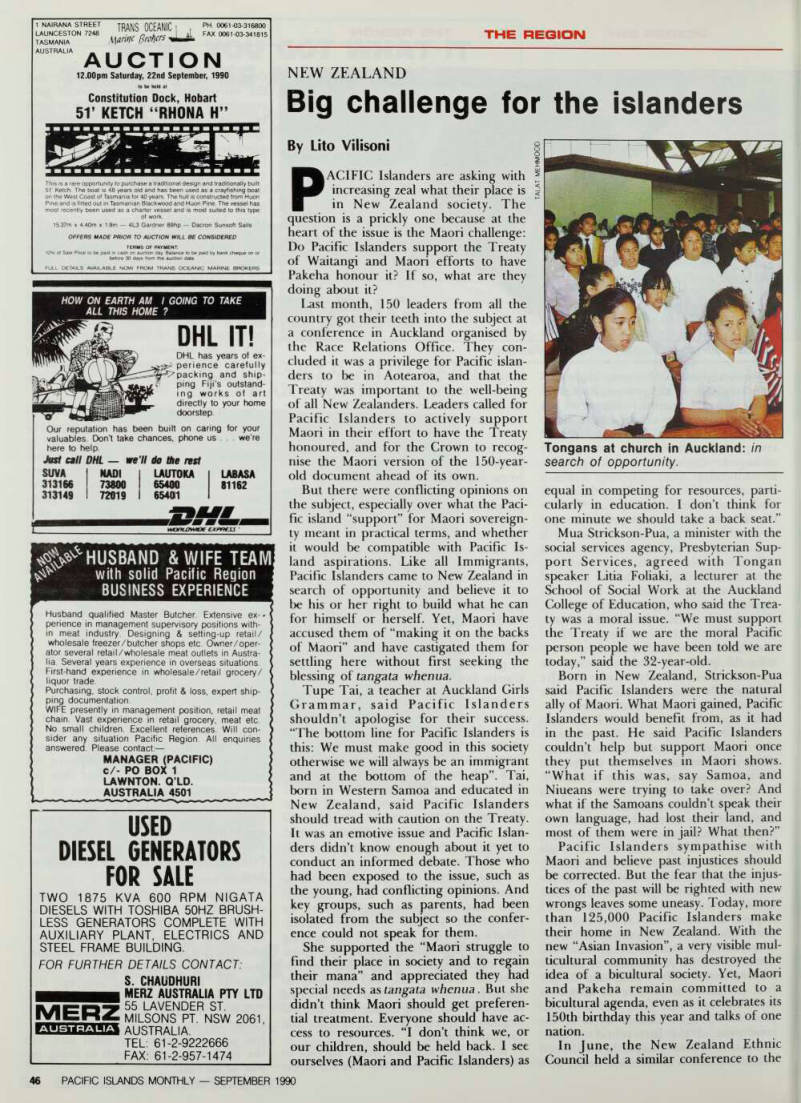
New Zealand
Big challenge for the islanders
By Lito Vilisoni
PACIFIC Islanders are asking with increasing zeal what their place is in New Zealand society. The question is a prickly one because at the heart of the issue is the Maori challenge: Do Pacific Islanders support the Treaty of Waitangi and Maori efforts to have Pakeha honour it? If so, what are they doing about it?
Last month, 150 leaders from all the country got their teeth into the subject at a conference in Auckland organised by the Race Relations Office. They con cluded it was a privilege for Pacific islan ders to be in Aotearoa, and that the Treaty was important to the well-being of all New Zealanders. Leaders called for Pacific Islanders to actively support Maori in their effort to have the Treaty honoured, and for the Crown to recog nise the Maori version of the 150-year old document ahead of its own.
But there were conflicting opinions on the subject, especially over what the Paci fic island “support” for Maori sovereign ty meant in practical terms, and whether it would be compatible with Pacific Is land aspirations. Like all Immigrants, Pacific Islanders came to New Zealand in search of opportunity and believe it to be his or her right to build what he can for himself or herself. Yet, Maori have accused them of “making it on the backs of Maori” and have castigated them for settling here without first seeking the blessing of tangata whenua.
Tupe Tai, a teacher at Auckland Girls Grammar, said Pacific Islanders shouldn’t apologise for their success.
“The bottom line for Pacific Islanders is this: We must make good in this society otherwise we will always be an immigrant and at the bottom of the heap”. Tai, born in Western Samoa and educated in New Zealand, said Pacific Islanders should tread with caution on the Treaty.
It was an emotive issue and Pacific Islan ders didn’t know enough about it yet to conduct an informed debate. Those who had been exposed to the issue, such as the young, had conflicting opinions. And key groups, such as parents, had been isolated from the subject so the confer ence could not speak for them.
She supported the “Maori struggle to find their place in society and to regain their mana” and appreciated they had special needs as tangata whenua . But she didn’t think Maori should get preferen tial treatment. Everyone should have ac cess to resources, “I don’t think we, or our children, should be held back. I see ourselves (Maori and Pacific Islanders) as
equal in competing for resources, parti
cularly in education. I don’t think for one minute we should take a back seat.”
Mua Strickson-Pua, a minister with the social services agency, Presbyterian Sup port Services, agreed with Tongan speaker Litia Foliaki, a lecturer at the School of Social Work at the Auckland College of Education, who said the Trea ty was a moral issue. “We must support the Treaty if we are the moral Pacific person people we have been told we are
today,” said the 32-year-old.
Born in New Zealand, Strickson-Pua said Pacific Islanders were the natural ally of Maori. What Maori gained, Pacific Islanders would benefit from, as it had in the past. He said Pacific Islanders couldn’t help but support Maori once they put themselves in Maori shows.
“What if this was, say Samoa, and Niueans were trying to take over? And what if the Samoans couldn’t speak their own language, had lost their land, and most of them were in jail? What then?”
Pacific Islanders sympathise with Maori and believe past injustices should be corrected. But the fear that the injus tices of the past will be righted with new wrongs leaves some uneasy. Today, more than 125,000 Pacific Islanders make their home in New Zealand. With the new “Asian Invasion”, a very visible mul ticultural community has destroyed the idea of a bicultural society. Yet, Maori and Pakeha remain committed to a bicultural agenda, even as it celebrates its 150th birthday this year and talks of one nation.
In June, the New Zealand Ethnic Council held a similar conference to the
Tongans at church in Auckland: in search of opportunity.
Talat Mehmood
Pacific Island with the theme “Multiethnic New Zealand: A Commitment for the Future.” The council called on New Zealanders to meet the challenge of formulating a national policy which responded to everyone’s culture while refleeting the special status of Maori as tangata whenua, and their special rights under the Treaty. The council outlined
an eight-point policy proposal which in-
eluded the principle “. . . Everyone should enjoy equal life chances and have equitable access to and an equitable
share of the resources which the Govern ment manages on behalf of the com
munity.”
The conference discussed fears that biculturalism as created by the Treaty, excluded non-Maori ethnic groups from decisions about New Zealand’s future, Auckland Ethnic Council president, Phi lip Khouri, said: “We think the term biculturalism is confusing because it means two cultures when the Treaty is not about culture at all. It is about an ageement between Maori and Crown.”
Emele Duituturaga, director of com munity development for the Wellington City Council, agrees with Khouri’s analy sis. She said the Treaty was the only way to redress injustices, but she didn’t agree with the belief Maori had to be under stood ahead of other groups. “I don’t agree with the view that we must go through biculturalism to reach multir acialism. I object to being left out of any definition of biculturalism because I think we have put our best into this country.”
Duituturaga, who urged Maori and Pacific Islanders to work together, was concerned about the next generation.
She said home for her was Fiji, but her children who had been born and raised in Aotearoa, may not feel the pull of Fiji as she did. She wanted to secure a place for them ... to make sure they were not
“displaced”.
Whether Maori want to work with Pacific Islanders remains unclear. Earlier this year, the Auckland District Maori Council supported a call by the synod of the Anglican Maori Church to stop all immigration to New Zealand until Maori
were accorded joint decision-making
powers in immigration policy. The synod
said immigration posed a serious threat to the livelihood, status and mana of tan gata whernia: The synod’s call was reiterated at the ethnic council in June with lawyer Peter
Rikys saying a Human Rights Commis
sion report showed up to 17,000 jobs
were occupied by illegal migrant work
ers, depriving Maori of work.
One of the first Western Samoans to settle in New Zealand, Tanuvasa Yandall (64), said he believed Maori did not want a partnership with Pacific Islanders. He said Maori had deliberately severed ties with the Pacific Immigrants because the latter were a burden to them. “Maori are claiming biculturalism for a specific pur pose ... so that two people only can settle the grievances.” Tanuvasa said the issue was a minefield for Pacific Islan ders.
“1 advise our young people to keep away from it all, to let it be settled first.
We have no right. This is not our home land. We should mind our own business.
I say to our young people ‘Don’t put your neck on the chopping block. If
something goes wrong, they might turn
around and blame us. We’ve got to keep out of criticism, be neutral and just do our work.”
The Race Relations Office plans a second conference in Wellington early next year. Leaders who attended the first, said they welcomed the chance to voice their concerns, although one said the “real debate” between Maori and Pacific Islanders had yet to take place. It would be several conferences before peo ple “really cut loose.” □
Advertisements & other items, p. 47 (1 item)
Clayfield College
zllm
yiimy
LET YOUR LIGHT SHINE
CLAYFIELD COLLEGE
GREGORY STREET.
CLAYFIELD, BRISBANE
QUEENSLAND. AUSTRALIA. 4011.
For girls day and boarding, Pre-School to Year 12, and day boys Pre-School to Year 4. wm f Clayfield College has a long, rich tradition of providing a complete education in a healthy and caring environment. Students are encouraged to achieve high academic, cultural and sporting standards.
Whilst following strong Presbyterian and Uniting Church spiritual guidelines, the College accepts children from all denominations.
The School enjoys strong support from Past Students and has an active Parents & Friends’ Association.
WE OFFER
A highly qualified and skilful Teaching staff which encourages all students to fully develop their talents.
Firm discipline.
Careful Supervision, After-School Care, Counselling and Pastoral Guidance.
Special attention for gifted and talented students, and those who need remedial assistance.
Programs to promote personal development, deportment, manners and self-confidence.
Inter-school sport and debating competitions.
An extensive range of sporting programs.
College choral and orchestral groups.
Lasting loyalty to school and school friends from city, country, outback and overseas.
Enquiries to: Principal’s Secretary
Mrs Joan Kossen (07) 262 2599
Ulafala Aiavao
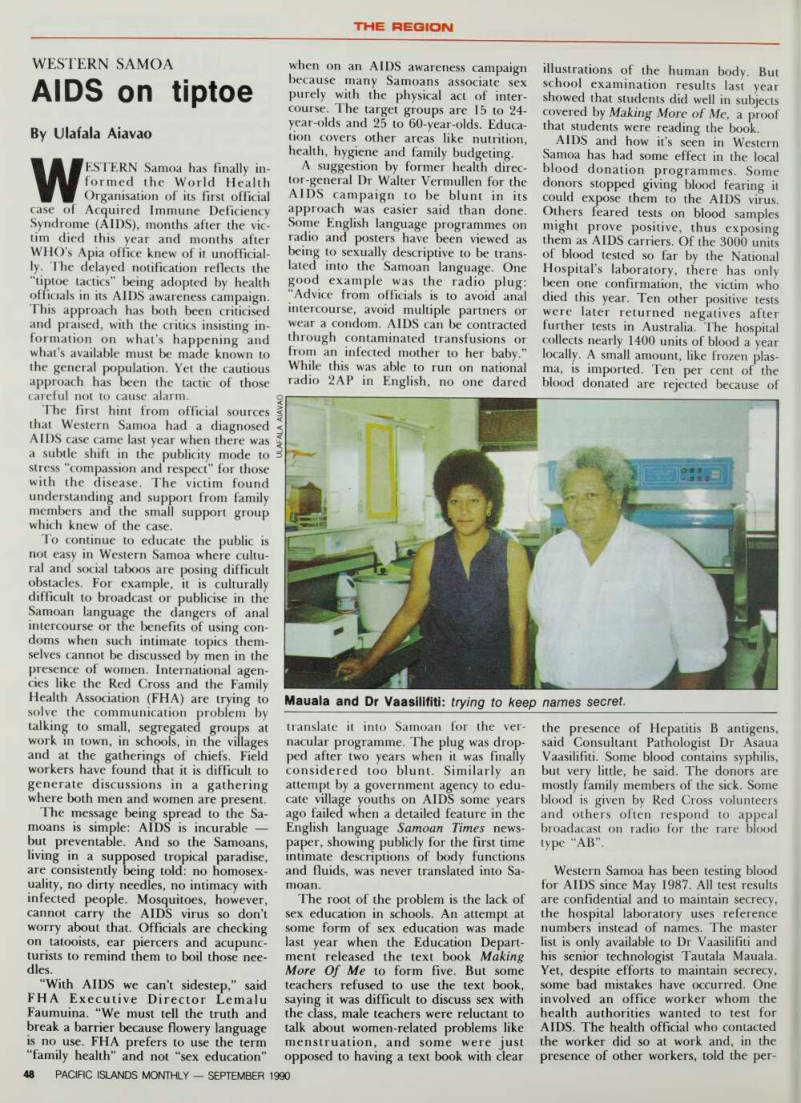
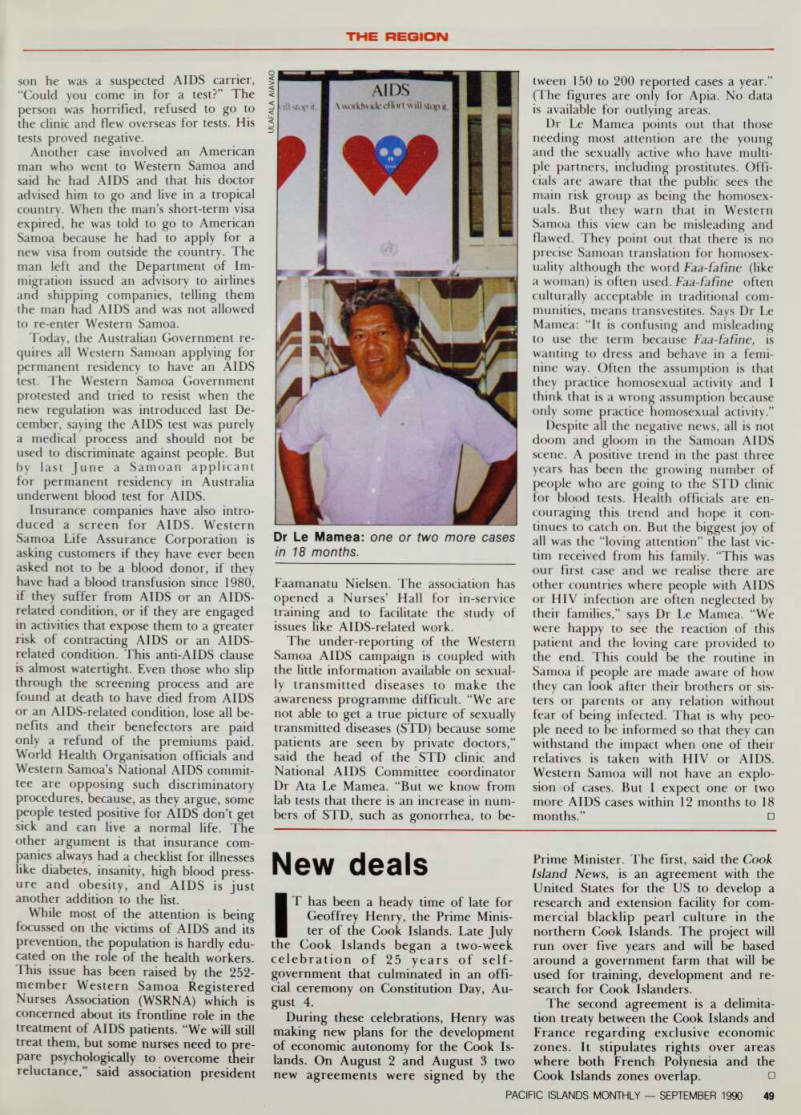
Western Samoa
AIDS on tiptoe
By Ulafala Aiavao
WESTERN Samoa has finally in formed the World Health Organisation of its first official case of Acquired Immune Deficiency Syndrome (AIDS), months after the vic tim died this year and months after WHO’s Apia office knew of it unofficial ly. The delayed notification reflects the
“tiptoe tactics” being adopted by health
officials in its AIDS awareness campaign.
This approach has both been criticised and praised, with the critics insisting in formation on what’s happening and whafs available must be made known to the general population. Yet the cautious approach has been the tactic of those careful not to cause alarm.
The first hint from official sources that Western Samoa had a diagnosed AIDS case came last year when there was a subtle shift in the publicity mode to stress “compassion and respect” for those with the disease. The victim found understanding and support from family members and the small support group which knew of the case.
To continue to educate the public is not easy in Western Samoa where cultu ral and social taboos are posing difficult obstacles. For example, it is culturally difficult to broadcast or publicise in the Samoan language the dangers of anal intercourse or the benefits of using con doms when such intimate topics them selves cannot be discussed by men in the presence of women. International agen cies like the Red Cross and the Family Health Association (FHA) are trying to solve the communication problem by talking to small, segregated groups at work in town, in schools, in the villages and at the gatherings of chiefs. Field workers have found that it is difficult to generate discussions in a gathering where both men and women are present.
The message being spread to the Sa moans is simple: AIDS is incurable but preventable. And so the Samoans,
living in a supposed tropical paradise,
are consistently being told: no homosex uality, no dirty needles, no intimacy with
infected people. Mosquitoes, however,
cannot carry the AIDS virus so don’t worry about that. Officials are checking on tatooists, ear piercers and acupunc turists to remind them to boil those nee dles.
“With AIDS we can’t sidestep,” said FHA Executive Director Lemalu Faumuina. “We must tell the truth and break a barrier because flowery language is no use. FHA prefers to use the term “family health” and not “sex education”
when on an AIDS awareness campaign because many Samoans associate sex purely with the physical act of intercourse. The target groups are 15 to 24year-olds and 25 to 60-year-olds. Education covers other areas like nutrition,
health, hygiene and family budgeting.
A suggestion by former health director-general Dr Walter Vermullen for the AIDS campaign to be blunt in its approach was easier said than done.
Some English language programmes on radio and posters have been viewed as being to sexually descriptive to be translated into the Samoan language. One good example was the radio plug: “Advice from officials is to avoid anal intercourse, avoid multiple partners or wear a condom. AIDS can be contracted through contaminated transfusions or from an infected mother to her baby.”
While this was able to run on national radio 2AP in English, no one dared
translate it into Samoan for the ver nacular programme. The plug was drop ped after two years when it was finally considered too blunt. Similarly an attempt by a government agency to edu cate village youths on AIDS some years ago failed when a detailed feature in the English language Samoan Times news paper, showing publicly for the first time intimate descriptions of body functions and fluids, was never translated into Sa moan.
The root of the problem is the lack of sex education in schools. An attempt at some form of sex education was made last year when the Education Depart ment released the text book Making More Of Me to form five. But some teachers refused to use the text book, saying it was difficult to discuss sex with the class, male teachers were reluctant to talk about women-related problems like menstruation, and some were just opposed to having a text book with clear
illustrations of the human body But school examination results last year showed that students did well in subjects covered by Making More of Me, a proof that students were reading the book, AIDS and how it’s seen in Western Samoa has had some effect in the local blood donation programmes. Some
donors stopped giving blood fearing it
could expose them to the AIDS virus, Others feared tests on blood samples might prove positive, thus exposing them as AIDS carriers. Of the 3000 units of blood tested so far by the National Hospital’s laboratory, there has only been one confirmation, the victim who died this year. Ten other positive tests were later returned negatives after further tests in Australia. The hospital collects nearly 1400 units of blood a year locally. A small amount, like frozen plas ma, is imported. Ten per cent of the blood donated are rejected because of
the presence of Hepatitis B antigens, said Consultant Pathologist Dr Asaua Vaasilifiti. Some blood contains syphilis, but very little, he said. The donors are mostly family members of the sick. Some blood is given by Red Cross volunteers and others often respond to appeal broadacast on radio for the rare blood type “AB”.
Western Samoa has been testing blood for AIDS since May 1987. All test results are confidential and to maintain secrecy, the hospital laboratory uses reference numbers instead of names. The master list is only available to Dr Vaasilifiti and his senior technologist Tautala Mauala.
Yet, despite efforts to maintain secrecy, some bad mistakes have occurred. One involved an office worker whom the health authorities wanted to test for AIDS. The health official who contacted the worker did so at work and, in the presence of other workers, told the per
Mauala and Dr Vaasilifiti: trying to keep names secret.
Ulafala Aiavao
son he was a suspected AIDS carrier, “Could you come in for a test?” The person was horrified, refused to go to the clinic and flew overseas for tests. His
tests proved negative.
Another case involved an American man who went to Western Samoa and said he had AIDS and that his doctor advised him to go and live in a tropical country. When the man’s short-term visa expired, he was told to go to American Samoa because he had to apply for a new visa from outside the country. The man left and the Department of Im migration issued an advisory to airlines
and shipping companies, telling them
the man had AIDS and was not allowed to re-enter Western Samoa.
Today, the Australian Government re quires all Western Samoan applying for permanent residency to have an AIDS test. The Western Samoa Government protested and tried to resist when the new regulation was introduced last De cember, saying the AIDS test was purely a medical process and should not be used to discriminate against people. But by last June a Samoan applicant for permanent residency in Australia underwent blood test for AIDS.
Insurance companies have also intro duced a screen for AIDS. Western Samoa Life Assurance Corporation is asking customers if they have ever been asked not to be a blood donor, if they have had a blood transfusion since 1980, if they suffer from AIDS or an AlDS related condition, or if they are engaged in activities that expose them to a greater risk of contracting AIDS or an AlDS related condition. This anti-AIDS clause is almost watertight. Even those who slip through the screening process and are found at death to have died from AIDS or an AIDS-related condition, lose all be nefits and their benefectors are paid only a refund of the premiums paid.
World Health Organisation officials and Western Samoa’s National AIDS commit tee are opposing such discriminatory procedures, because, as they argue, some people tested positive for AIDS don’t get sick and can live a normal life. The other argument is that insurance com panies always had a checklist for illnesses like diabetes, insanity, high blood press ure and obesity, and AIDS is just another addition to the list.
While most of the attention is being focussed on the victims of AIDS and its prevention, the population is hardly edu cated on the role of the health workers.
This issue has been raised by the 252member Western Samoa Registered Nurses Association (WSRNA) which is concerned about its frontline role in the treatment of AIDS patients. “We will still treat them, but some nurses need to pre pare psychologically to overcome their reluctance,” said association president
Faamanatu Nielsen. The association has opened a Nurses’ Hall for in-service training and to facilitate the study of issues like AIDS-related work.
The under-reporting of the Western Samoa AIDS campaign is coupled with the little information available on sexual ly transmitted diseases to make the awareness programme difficult. “We are not able to get a true picture of sexually transmitted diseases (STD) because some
patients are seen by private doctors,”
said the head of the STD clinic and National AIDS Committee coordinator Dr Ata Le Mamea. “But we know from lab tests that there is an increase in num bers of STD, such as gonorrhea, to be
tween 150 to 200 reported cases a year.” (The figures are only for Apia. No data is available for outlying areas.
Dr Le Mamea points out that those needing most attention are the young and the sexually active who have multi ple partners, including prostitutes. Offi cials are aware that the public sees the main risk group as being the homosex uals. But they warn that in Western Samoa this view can be misleading and flawed. They point out that there is no precise Samoan translation for homosex uality although the word Faa-fafine (like a woman) is often used. Faa-fafine often culturally acceptable in traditional com munities, means transvestites. Says Dr Le Mamea: “It is confusing and misleading to use the term because Faa-fafine, is wanting to dress and behave in a femi nine way. Often the assumption is that
they practice homosexual activity and I
think that is a wrong assumption because
only some practice homosexual activity.”
Despite all the negative news, all is not doom and gloom in the Samoan AIDS scene. A positive trend in the past three years has been the growing number of people who are going to the STD clinic for blood tests. Health officials are en couraging this trend and hope it con tinues to catch on. But the biggest joy of all was the “loving attention” the last vic tim received from his family. “This was our first case and we realise there are other countries where people with AIDS or HIV infection are often neglected by their families,” says Dr Le Mamea. “We were happy to see the reaction of this patient and the loving care provided to the end. This could be the routine in Samoa if people are made aware of how they can look after their brothers or sis ters or parents or any relation without fear of being infected. That is why peo ple need to be informed so that they can withstand the impact when one of their relatives is taken with HIV or AIDS.
Western Samoa will not have an explo sion of cases. But I expect one or two more AIDS cases within 12 months to 18 months.” □
Dr Le Mamea: one or two more cases in 18 months.
Ulafala Aiavao
New deals
IT has been a heady time of late for Geoffrey Henry, the Prime Minis ter of the Cook Islands. Late July the Cook Islands began a two-week celebration of 25 years of self government that culminated in an offi cial ceremony on Constitution Day, Au gust 4.
During these celebrations, Henry was
making new plans for the development
of economic autonomy for the Cook Is lands. On August 2 and August 3 two new agreements were signed by the
Prime Minister. The first, said the Cook Island News , is an agreement with the United States for the US to develop a research and extension facility for com mercial blacklip pearl culture in the northern Cook Islands. The project will run over five years and will be based around a government farm that will be used for training, development and re search for Cook Islanders.
The second agreement is a delimita tion treaty between the Cook Islands and France regarding exclusive economic zones. It stipulates rights over areas where both French Polynesia and the Cook Islands zones overlap. □
The new
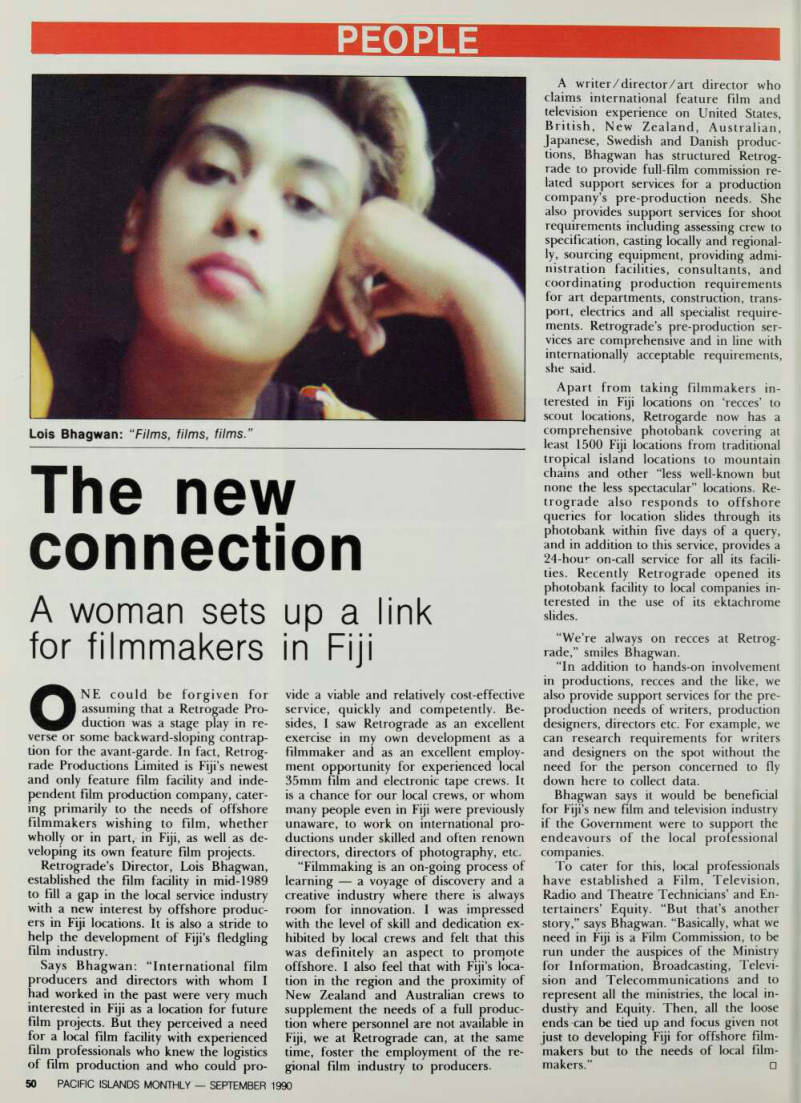
People
The new connection
A woman sets up a link for filmmakers in Fiji
ONE could be forgiven for assuming that a Retrogade Pro duction was a stage play in re verse or some backward-sloping contrap tion for the avant-garde. In fact, Retrog rade Productions Limited is Fiji’s newest and only feature film facility and inde pendent film production company, cater ing primarily to the needs of offshore filmmakers wishing to film, whether wholly or in part, in Fiji, as well as de veloping its own feature film projects.
Retrograde’s Director, Lois Bhagwan,
established the film facility in mid-1989 to fill a gap in the local service industry with a new interest by offshore produc ers in Fiji locations. It is also a stride to
help the development of Fiji’s fledgling
film industry.
Says Bhagwan: “International film producers and directors with whom I had worked in the past were very much interested in Fiji as a location for future film projects. But they perceived a need for a local film facility with experienced film professionals who knew the logistics of film production and who could pro
vide a viable and relatively cost-effective service, quickly and competently. Be sides, I saw Retrograde as an excellent exercise in my own development as a filmmaker and as an excellent employ ment opportunity for experienced local 35mm film and electronic tape crews. It is a chance for our local crews, or whom many people even in Fiji were previously unaware, to work on international pro ductions under skilled and often renown directors, directors of photography, etc.
“Filmmaking is an on-going process of learning a voyage of discovery and a creative industry where there is always room for innovation. I was impressed with the level of skill and dedication ex hibited by local crews and felt that this was definitely an aspect to promote offshore. I also feel that with Fiji’s loca tion in the region and the proximity of New Zealand and Australian crews to supplement the needs of a full produc tion where personnel are not available in Fiji, we at Retrograde can, at the same time, foster the employment of the re
gional film industry to producers.
A writer/director/art director who claims international feature film and television experience on United States, British, New Zealand, Australian, Japanese, Swedish and Danish produc tions, Bhagwan has structured Retrog rade to provide full-film commission re lated support services for a production company’s pre-production needs. She also provides support services for shoot
requirements including assessing crew to
specification, casting locally and regional
ly, sourcing equipment, providing admi
nistration facilities, consultants, and
coordinating production requirements
for art departments, construction, trans port, electrics and all specialist require
ments. Retrograde’s pre-production ser
vices are comprehensive and in line with
internationally acceptable requirements,
she said.
Apart from taking filmmakers in terested in Fiji locations on ‘recces’ to scout locations, Retrogarde now has a
comprehensive photobank covering at
least 1500 Fiji locations from traditional tropical island locations to mountain chains and other “less well-known but none the less spectacular” locations. Re trograde also responds to offshore queries for location slides through its photobank within five days of a query, and in addition to this service, provides a 24-hour on-call service for all its facili
ties. Recently Retrograde opened its
photobank facility to local companies in
terested in the use of its ektachrome slides.
“We’re always on recces at Retrog rade,” smiles Bhagwan.
“In addition to hands-on involvement in productions, recces and the like, we also provide support services for the pre production needs of writers, production designers, directors etc. For example, we can research requirements for writers and designers on the spot without the need for the person concerned to fly down here to collect data.
Bhagwan says it would be beneficial for Fiji’s new film and television industry if the Government were to support the endeavours of the local professional companies.
To cater for this, local professionals have established a Film, Television, Radio and Theatre Technicians’ and En tertainers’ Equity. “But that’s another
story,” says Bhagwan. “Basically, what we
need in Fiji is a Film Commission, to be run under the auspices of the Ministry for Information, Broadcasting, Televi sion and Telecommunications and to represent all the ministries, the local in dustry and Equity. Then, all the loose ends can be tied up and focus given not just to developing Fiji for offshore film makers but to the needs of local film makers.” □
Lois Bhagwan: “Films, films, films."
Opposition spokesman
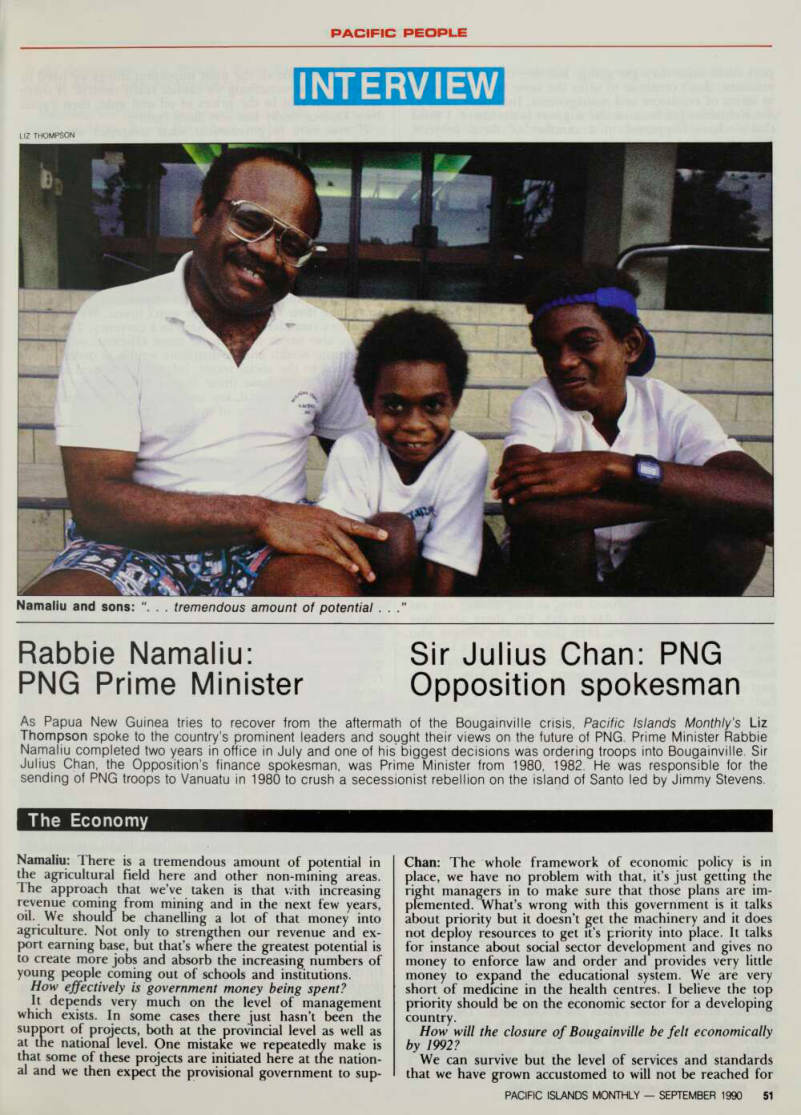
Pacific People
Interview
Rabbie Namaliu: PNG Prime Minister
Sir Julius Chan: PNG Opposition spokesman
As Papua New Guinea tries to recover from the aftermath of the Bougainville crisis, Pacific Islands Monthly’s Liz Thompson spoke to the country's prominent leaders and sought their views on the future of PNG. Prime Minister Rabbie Namaliu completed two years in office in July and one of his biggest decisions was ordering troops into Bougainville. Sir Julius Chan, the Opposition’s finance spokesman, was Prime Minister from 1980, 1982. He was responsible for the sending of PNG troops to Vanuatu in 1980 to crush a secessionist rebellion on the island of Santo led by Jimmy Stevens.
Namaliu and sons: " ... tremendous amount of potential ..."
Liz Thompson
The Economy
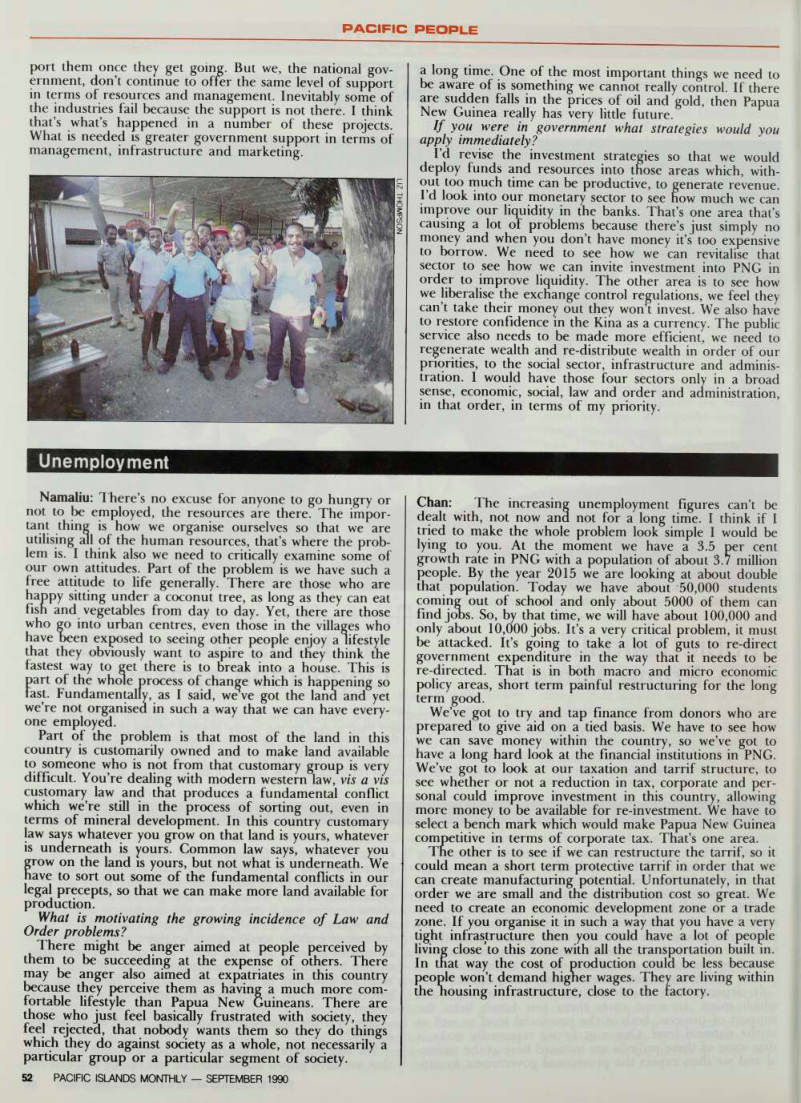
Namaliu: There is a tremendous amount of potential in the agricultural field here and other non-mining areas.
The approach that we’ve taken is that with increasing revenue coming from mining and in the next few years, oil. We should be chanelling a lot of that money into agriculture. Not only to strengthen our revenue and ex port earning base, but that’s where the greatest potential is to create more jobs and absorb the increasing numbers of young people coming out of schools and institutions.
How effectively is government money being spent?
It depends very much on the level of management which exists. In some cases there just hasn’t been the support of projects, both at the provincial level as well as at the national level. One mistake we repeatedly make is that some of these projects are initiated here at tne nation al and we then expect the provisional government to sup-
Chan: The whole framework of economic policy is in place, we have no problem with that, it’s just getting the right managers in to make sure that those plans are im plemented. What’s wrong with this government is it talks about priority but it doesn’t get the machinery and it does not deploy resources to get it’s priority into place. It talks for instance about social sector development and gives no money to enforce law and order and provides very little money to expand the educational system. We are very short of medicine in the health centres. I believe the top priority should be on the economic sector for a developing country.
How will the closure of Bougainville be felt economically by 1992?
We can survive but the level of services and standards that we have grown accustomed to will not be reached for
port them once they get going. But we, the national gov ernment, don’t continue to offer the same level of support in terms of resources and management. Inevitably some of the industries fail because the support is not there. I think that’s what’s happened in a number of these projects.
What is needed is greater government support in terms of management, infrastructure and marketing.
a long time. One of the most important things we need to be aware of is something we cannot really control. If there are sudden falls in the prices of oil and gold, then Papua New Guinea really has very little future.
If you were in government what strategies would you apply immediately?
I’d revise the investment strategies so that we would deploy funds and resources into those areas which, with out too much time can be productive, to generate revenue.
I’d look into our monetary sector to see how much we can improve our liquidity in the banks. That’s one area that’s causing a lot of problems because there’s just simply no money and when you don’t have money it’s too expensive to borrow. We need to see how we can revitalise that sector to see how we can invite investment into PNG in order to improve liquidity. The other area is to see how we liberalise the exchange control regulations, we feel they can’t take their money out they won’t invest. We also have to restore confidence in the Kina as a currency. The public service also needs to be made more efficient, we need to regenerate wealth and re-distribute wealth in order of our priorities, to the social sector, infrastructure and adminis tration. I would have those four sectors only in a broad sense, economic, social, law and order and administration, in that order, in terms of my priority.
Liz Thompson
Unemployment
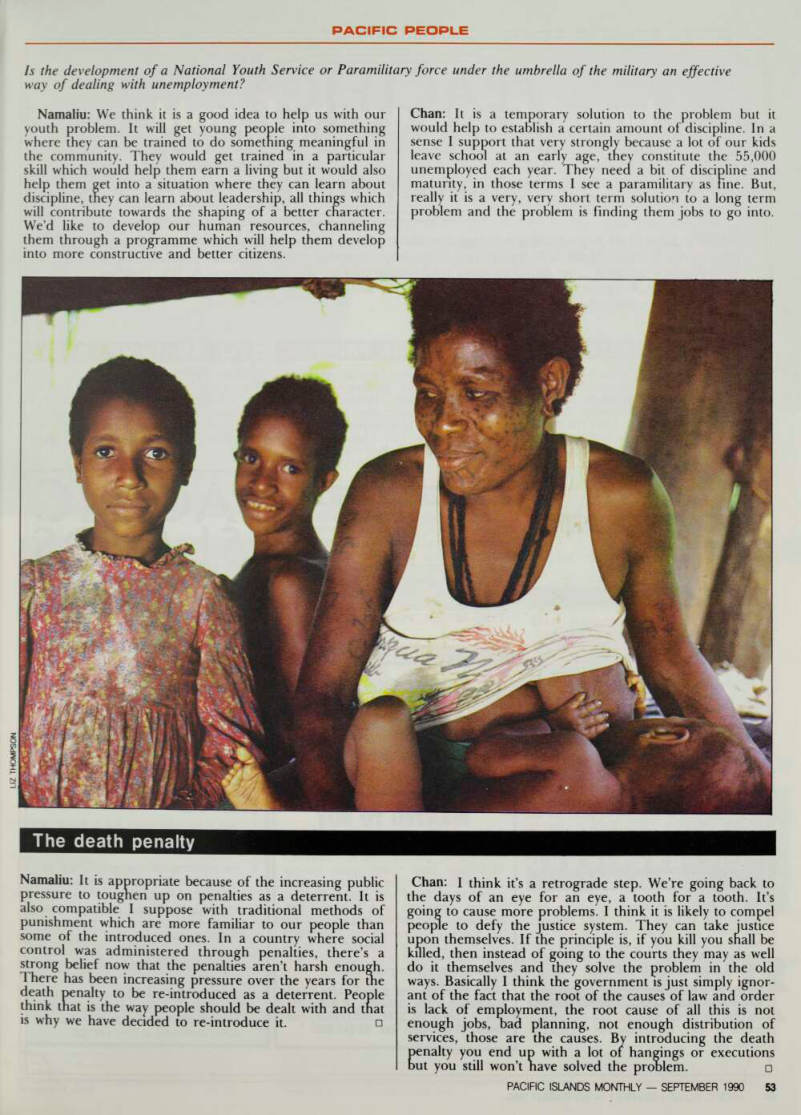
Namaliu: There’s no excuse for anyone to go hungry or not to be employed, the resources are there. The impor tant thing is how we organise ourselves so that we are utilising all of the human resources, that’s where the prob lem is. I think also we need to critically examine some of our own attitudes. Part of the problem is we have such a free attitude to life generally. There are those who are happy sitting under a coconut tree, as long as they can eat fish and vegetables from day to day. Yet, there are those who go into urban centres, even those in the villages who have Been exposed to seeing other people enjoy a lifestyle that they obviously want to aspire to and they think the fastest way to get there is to break into a house. This is part of the whole process of change which is happening so fast. Fundamentally, as I said, weve got the land and yet we’re not organised in such a way that we can have every
one employed.
Part of the problem is that most of the land in this country is customarily owned and to make land available to someone who is not from that customary group is very difficult. You’re dealing with modern western law, vis a vis customary law and that produces a fundamental conflict which we’re still in the process of sorting out, even in terms of mineral development. In this country customary law says whatever you grow on that land is yours, whatever is underneath is yours. Common law says, whatever you grow on the land is yours, but not what is underneath. We have to sort out some of the fundamental conflicts in our legal precepts, so that we can make more land available for production.
What is motivating the growing incidence of Law and Order problems?
There might be anger aimed at people perceived by them to be succeeding at the expense of others. There may be anger also aimed at expatriates in this country because they perceive them as having a much more com fortable lifestyle than Papua New Guineans. There are those vyho just feel basically frustrated with society, they feel rejected, that nobody wants them so they do things which they do against society as a whole, not necessarily a particular group or a particular segment of society.
Chan: The increasing unemployment figures can’t be dealt with, not now and not for a long time. I think if I tried to make the whole problem look simple I would be lying to you. At the moment we have a 3.5 per cent growth rate in PNG with a population of about 3.7 million people. By the year 2015 we are looking at about double that population. Today we have about 50,000 students coming out of school and only about 5000 of them can find joos. So, by that time, we will have about 100,000 and only about 10,000 jobs. It’s a very critical problem, it must be attacked. It’s going to take a lot of guts to re-direct government expenditure in the way that it needs to be re-directed. That is in both macro and micro economic policy areas, short term painful restructuring for the long
term good.
We’ve got to try and tap finance from donors who are prepared to give aid on a tied basis. We have to see how we can save money within the country, so we’ve got to have a long hard look at the financial institutions in PNG.
We’ve got to look at our taxation and tarrif structure, to see whether or not a reduction in tax, corporate and per sonal could improve investment in this country, allowing more money to be available for re-investment. We have to select a bench mark which would make Papua New Guinea competitive in terms of corporate tax. That’s one area.
The other is to see if we can restructure the tarrif, so it could mean a short term protective tarrif in order that we can create manufacturing potential. Unfortunately, in that order we are small and the distribution cost so great. We need to create an economic development zone or a trade zone. If you organise it in such a way that you have a very tight infrastructure then you could have a lot of people living close to this zone with all the transportation built m.
In that way the cost of production could be less because people won’t demand higher wages. They are living within the nousing infrastructure, close to the factory.
Is the development of a National Youth Service or Paramilitary force under the umbrella of the military an effective way of dealing with unemployment?
Namaliu: We think it is a good idea to help us with our youth problem. It will get young people into something where they can be trained to do something meaningful in the community. They would get trained in a particular skill which would help them earn a living but it would also help them get into a situation where they can learn about discipline, they can learn about leadership, all things which will contribute towards the shaping of a better character.
We’d like to develop our human resources, channeling them through a programme which will help them develop into more constructive and better citizens.
Chan: It is a temporary solution to the problem but it would help to establish a certain amount of discipline. In a sense I support that very strongly because a lot of our kids leave school at an early age, tney constitute the 55,000 unemployed each year. They neea a bit of discipline and maturity, in those terms I see a paramilitary as fine. But, really it is a very, very short term solution to a long term problem and the problem is finding them jobs to go into.
The death penalty
Namaliu: It is appropriate because of the increasing public pressure to toughen up on penalties as a deterrent. It is also compatible I suppose with traditional methods of punishment which are more familiar to our people than some of the introduced ones. In a country where social control was administered through penalties, there’s a strong belief now that the penalties aren’t harsh enough.
There has been increasing pressure over the years for the death penalty to be re-introduced as a deterrent. People think that is the way people should be dealt with and tnat is why we have decided to re-introduce it. □
Chan: I think it’s a retrograde step. We’re going back to the days of an eye for an eye, a tooth for a tooth. It’s going to cause more problems. I think it is likely to compel people to defy the justice system. They can take justice upon themselves. If the principle is, if you kill you snail be killed, then instead of going to the courts they may as well do it themselves and they solve the problem in the old ways. Basically I think the government is just simply ignor ant of the fact that the root of the causes of law and order is lack of employment, the root cause of all this is not enough jobs, Dad planning, not enough distribution of services, those are the causes. By introducing the death penalty you end up with a lot of hangings or executions but you still won’t have solved the problem. □
Advertisements & other items, pp. 54-56 (1 item)
Pacific
SLANDS
IMONT H L Y
MfIRK€T Pince
For the benefit of our readers who would like to place a small classified advertisement in our magazine, Market Place will assist you in selling personal items, accommodation, real estate, boating or a service ... in fact anything you would like to sell to our over 50,000 readers.
Market Place Advertising Rates are structured to allow you to place as many advertisements as you wish, economically.
REAL ESTATE
ACREAGE LOTS: SAVUSAVU BAY, FIJI:
Beach frontage and adjacent lots. All freehold titles. All weather road to town and airport. Zoned tourist/residential. Beautiful lots from only AU520,900. From one acre to 1.9 acre and five acre lots available. Many are sold already. Buy now while the prices are low. Contact Aren Nunnink.
Phone 03/478 2993 or write to: GPO BOX 530588, Melbourne, Victoria, Australia 3001.
WANT TO BUY
Oceanfront Island Properties Wanted to purchase. Dobry, Box 388 Lihue, Hawaii 96766, USA.
SCRAP METAL
Good prices paid for your clean scrap Aluminium, Brass, Copper, Lead, etc.
Contact Nonferral Pty. Ltd. 23 Davis Rd.
Wetherill Park NSW 2164 Australia. Fax 61 2 604 1304 for prompt reply. Our Company is a long established and leading metal buyer and smelter. Telephone 61 2 604 8855.
BEACH UMBRELLA’S
LIDGARD SAILS FIJI, P.O. Box 3084, Lami Fiji. Ph. (679) 314386, Fax. (679) 300217. ’
We manufacture various sizes of umbrella’s in aluminium and wood frames. Custom colours and printing available. Agents wanted m New Caledonia, Tahiti. Cook Is., Samoa, Tonga, Vanuatu & Solomons.
INTERNATIONAL
PENFRIENDS"
We have 1000’s of friends worldwide who would like to write to you, their interests are many and varied. Why not join our happy group of friends and broaden your horizons. Wite to:— Julia, P.O. Box 7419 GCMG Bundall. OLD. Australia.
STAMPS WANTED
Pacific Islands stamps on exchange basis. J. Lai, 19 Lovoni Rd, Tamavua, Suva, Fiji. A 4
COMMERCIAL PRINTING
Top quality four colour printing, brochures, posters, packaging, product labels, fabric labels, billboards, books, magazines, stickers, books. Export quality. Contact Fiji’s most experienced Commercial Printers. FIJI TIMES COMMER- CIAL PRINTING, P.O. Box 1167, Suva. Fiji.
Phone: 314111. Fax. 301521.
Ji DISTRIBUTORS WANTED":-
“Distributors/Agents wanted all areas for stainless steel and wire rope fittings, shackles, turnbuckles etc etc for marine and commercial uses. Also deck fittings, aluminium and copper swages etc. For further information contact Bridge & Company Pty Ltd, 20 Fifth Avenue, Palm Beach, Queensland 4221, Australia. Fax 61 075 98 1797, ‘Phone 61 075 98 1088.”
GENERATORS
2 only Daihatsu Diesel Powered Generators 57 5 KVH (370 KW) 41 5V 50HZ
500 RPM.
For details contact: Colin Jenner McConnell Dowell (Fiji) Ltd Suva.
Telephone (679) 362666 Fax (679) 351065.
SELF ADHESIVE LABELS
FORUM LABELS (FIJI) LTD
P.O. Box 1167, Suva., Fiji. Phone: 314111.
We print self-adhesive labels in rolls, multi-coloured labels with hot foil, and die cut to shape, tickets and tags in rolls. We also supply labelling machines and fabric labels.
PACIFIC
SLANDS
IMONT H L Y
MRRH6T PLAC6 CAN WORK
WOND6RS FOR VOU ...
Promote your business, or service, sell your household
items, cars or heavy machinery
etc.
ONLY AUSSI PER WORD.
NO COMPANY LOGO. NO
DISPLAY. NO BOLD TYPE.
Just forward your Advertisement together with payment to: PACIFIC ISLANDS MONTHLY “Market Place”, P.O. Box 1167, Suva, Fiji.
CONDITIONS:
1/ All Advertisements are subject to acceptance and approval of publisher. 2. Advertisements are published as space permits: we cannot guarantee date of insertion. 3. All advertisements must be prepaid and should be typed or printed clearly. 4. Deadline for receipt of advertisements is the 10th of the month prior to issue.
5. PACIFIC ISLANDS MONTHLY
assumes no responsibility for any service other than publishing paid advertisements in this section.
WANTED TO BUY
A marine based cash flow business (e.g.
S.C.U.B.A. diving, yacht, chaster/ brokerage, boat hiring, game fishing, sailboarding/windsurfing etc.) located anywhere in the Pacific Island Region.
We are interested in a business predominantly directed towards tourism that has scope for development. A business with Real Estate is preferred but is not essential. We wil also consider joint venture with existing operator.
Please direct enquires to Mr Terence Grundy of Ambrosy & Fox, Solicitors, P 0 Box 229,
SOUTH YARRA VIC 3141, AUSTRALIA. Tele-
phone: 03 827 4355. Fax: 03 240 0837.”
Move Uptown to CD Sound
There is no substitute for CD sound against the electrifying backdrop of the city The bright lights, the rush of people, the intensity in the air — the only way to complete this picture is with realistic sound. Fill in the picture with a high-power CD system from Pioneer including the KEH-M3OO2QR Cassette/Receiver with CD Controls and CDX-M5O CD Changer. Now the streets belong to CD sound.
GEMBAL
KEH-M3OO2QR
Auto-Reverse Cassette/Receiver
with Multi-Play CD Controls
• Power output; 25Wx2 or 15Wx4
(max.) •Supertuner™ •24-station (18
FM/6 AM) presets •BSM (Best Stations
Memory) •Dual-groove SHC head
• Quick-Release System Multi-Play CD Controls: •Program Play (Instant Track Program) • Random Play on 6 discs •Repeat (Track/AII Discs) Compatible for Car and Home “Flip-Down” Protective Cassette Door (during cassette eject or insertion)
CDX-M5O
Trunk-Mount Multi-Play CD Player Home-Use
JD-M2OO
CDX-Mso
Multi-Play Compact Disc Player
• 6-disc magazine loading ®AMPS (Auto-
matic Magazine Program Selection) •“Dou-
ble-Float” anti-vibration design •Protection against heat and dust • Ultra slim profile • Versatile Horizontal/Vertical mounting system Note: The CDX-M5O can be easily connected to units incorporating an amplifier, such as the KEH-M30020R, and a set of speakers for complete system integration.
CM> PIONEER
The future of sound and vision.
For further information, please contact: Australia: Pioneer Electronics Australia Pty. Ltd. (Incorporated in Victoria), 178-184 Boundary Road, Braeside Victoria 3195 Tel: 580-9911 Fiji Islands: Brijlal & Company, G.P.O. Box No. 362, Suva, Fiji Islands Tel; 22258 New Zealand: Monaco Corporation Ltd., 41 Poland Road, Glenfield, Auckland, New Zealand Tel: (09) 444-9144 Norfolk Island: Burnt Pine Traders Ltd., P.O. Box 21, Norfolk Island Vanuatu: Burns Philp (Vanuatu) Ltd., Vila, Vanuatu Nauru Island; Jacob Enterprises, PO. Box N 0.4, Republic of Nauru Tahiti: Tahiti Hi-Fi, P.O. Box 848, Papeete, Tahiti New Caledonia: Menard Pacifique Sari, B.P 3899, Noumea, New Caledonia Tel: 27-62-23 American Samoa: Transpac Corporation, RO. Box 1477, Pago Pago, American Samoa 96799 Tel: 633-5224 Rarotonga: South Seas International Ltd., PO. Box 49, Rarotonga, Cook Islands Tel: 2327 *
A Measure of Comfort.
* m m w m - * To Mitsubishi Motors, how a car feels is as important as how it performs since that performance is greatly influenced by the quality of interface between the vehicle and its driver. And by perfecting the man/ machine interface, the variety of ways that a car will ‘interact’ with its human occupant, the total driving experience becomes more satisfying.
One example is the driver’s seat. In designing the Galant, Mitsubishi’s engineers employed the latest scientific methods to determine the ideal seat design. Considering support, comfort and road-feel, they looked at a variety of physical indicators from body temperature and blood flow to weight distribution on the seat. The smaller the biophysical reaction, the more in-tune Xg = . 00 Vg = . 00 L«= .00
HCAROOB
r* \\ j V J V) Distribution of body weight is precisely measured at 200 points on the seat under conditions of changing front/rear and left/right G-forces at one second intervals. a seat is with the driver and the more it promotes fatigue-free, enjoyable driving.
The Galant’s driver’s seat does just that.
From its gentle styling to its responsive performance, the Mitsubishi Galant works in harmony with human senses.
A
MITSUBISHI
MOTORS
MITSUBISHI GRLRNT
AMERICAN SAMOA: MORRIS SCANLAN SERVICE INC. P.O. Box 367, Pago Pago, Tel 633-5520/AUSTRALIA: MITSUBISHI MOTORS AUSTRALIA LTD. Box 1284, South Road, Clovelly Park, South Australia 5042, Tel. C 08) 275-7223/RJI: NIVIS MOTOR & MACHINERY CO., LTD. G.P.O. Box 150, Suva, Tel 38341 1 /FRENCH POLYNESIA (TAHITI): ETS-BREDIN FRERES ET FILS P.O. Box 21, Papeete, Tahiti, Tel. 4-202-58/NEW CALEDONIA: SOCIETE D IMPORTATION D AUTO DU PACIFIQUE SUD S.A. B.P. 438 Rond Point du Pacifique, Noumea, Tel. 274144/NEW ZEALAND: MITSUBISHI MOTORS NEW ZEALAND LTD. Todd Park, Heriot Drive, Private Bag, Porirua, Tel 370-109/ NORFOLK ISLAND: BORRYS LTD. P.O. Box 169, Norfolk Island, Tel. 2114/PAPUA NEW GUINEA: TOBA PTY. LTD. P.O, Box 503, Port Moresby, Tel, 21-7874/SOLOMON ISLANDS: HARVEST PACIFIC LTD. G.P.O Box 88, Honiara, Guadalcanal, Tel 30128/TONGA: SITANI MAPI CO., LTD. P.O Box 83, Nuku ALOFA, Tel. 21-044/VANUATU: SOCOMETRA B.P. 06 Route de Lagon, Port-Vila, Tel, 2314/WESTERN SAMOA: A M. MACDONALD HOLDINGS LTD.
P.O Box 576, Apia, Tel 22022/SAIPAN/POHNPEI/MAJURO/KOSRAE/TRUK/YAP/BELAU: MICRONESIAN MOTORS, INC. 997 South Marine Drive, Tamuning, Guam 96911 , Tel. 646-6827