Pacific
Islands
Monthly
August 1990
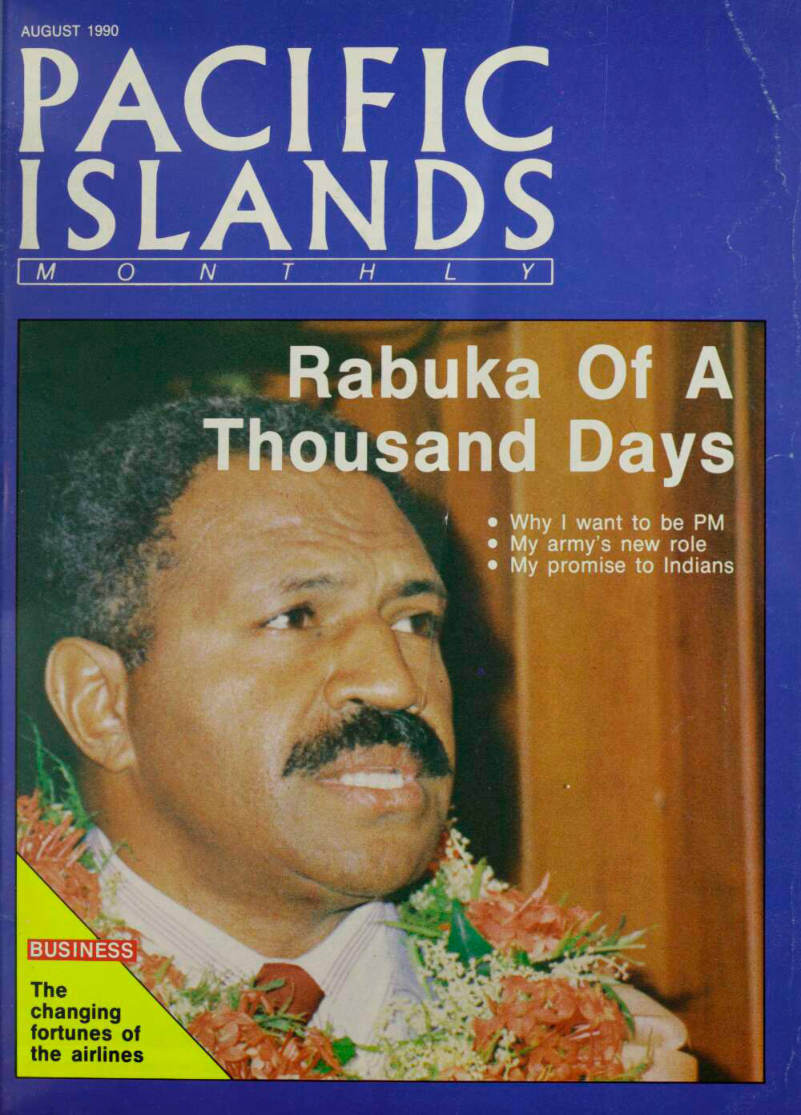
Rabuka Of A Thousand Days I#
• Why I want to be PM • My army’s new role • My promise to Indians
Business
The N changing fortunes of the airlines
Advertisements & other items, pp. 2-5 (2 items)
The image of
iyj HOISTDAi Progress with Distinction.
creative .
So many things to do, not enough time to do them all really well. But enterprise doesn't have to be a lonely struggle. For busy people who face the challenge of juggling many tasks, Honda offers powerful creative assistance: the sporty 2-door Civic Hatchback. Unlike many cars in its class, the Civic Hatchback empowers you, as its driver, to exert maximum control with minimal effort. One moment it's a stylish urban commuter that can carry you in quiet comfort, W, AUSTRALIA: Honda Australia Pty., Ltd. Lot 95 Sharps Road, Tullamarine, Victoria 3043/NEW ZEALAND: Honda New Zealand Ltd. P.O. Box 97-340, Sout Auckland/ PAPUA NEW GUINEA: Toba Pty., Ltd. P.O. Box 503, Port Moresby/U.S. TRUST TERRITORY: United Micronesia Development Association P.O. Box CHRB Saipan CM 96950/COOK ISLANDS: Cook Islands Motor Centre Ltd. P.O. Box 74, Rarotonga/GUAM: Mark’s Motor Co., Inc. P.O. Box DV, Agana/ FIJI: Coral Islam Motors Ltd. P.O. Box 12052 Suva Fiii/NORFOLK ISLAND: Duncombe Bay Garage P.O. Box 220, Norfolk Island South Pacific 2899/NEW CALEDONIA: Societi
the next it's an efficient utility vehicle with ample capacity for all your needs. Whatever the challenge before you, the Civic's responsive 16-valve engine offers the pleasure of high performance at slow as well as high speeds. Its space-efficient size, excellent visibility and easy handling help to propell you forward, rather than drag you down. And the roadholding 4-wheel double wishbone suspension makes sure you're aware of road conditions, not surprised by them.
Thanks to Civic's wide-opening rear cargo area, you can quickly load up without ever feeling weighted down.
It's a convenience that takes just seconds but could save you valuable time when time is critical.
The Honda Civic Hatchback. When you have places to go, people to see, it's nice to know you have the creative control to do it all well.
CIVIC
mm Specifications and equipment may vary in some countries.
In 1989, Honda engines powered the HONDA Marlboro McLaren team to victory in the Formula One Constructors' Championships. This is the fourth consecutive year that Honda has won this honor.
Thank
anR you
T VIIJ P\cinc ||*»l I u*» • • M:mna ;ei On July, 4 1990 Air Pacific took delivery of its first 8767-200 ER. This $l5O million aircraft will provide increased services for the people of the Pacific. Featuring Tabua Class as well as Economy Class, the aircraft will fly four times a week to Auckland and Melbourne and twice a week to Brisbane.
Air Pacific extends its sincere thanks to our loyal customers. It is only through your patronage that our new 8767 is possible.
AIR (HCiriC
FIJI'S INTERNATIONAL AIRLINE
\IR PA HRS A
Pacific
ISLANDS
M O N T H LY
Vol. 60, No. 8
VOICE OF THE PACIFIC
August 1990
Story
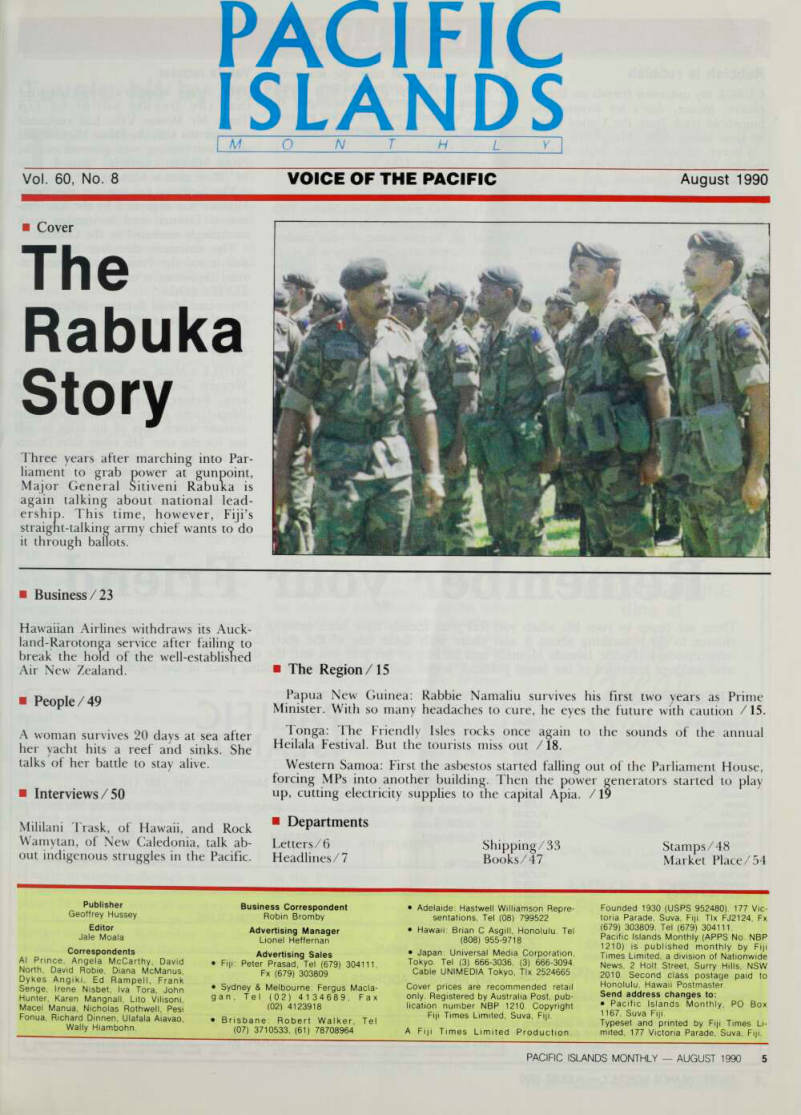
The Rabuka Story
■ Cover
Three years after marching into Par liament to grab power at gunpoint, Major General Sitiveni Rabuka is again talking about national lead ership. This time, however, Fiji’s straight-talking army chief wants to do it through ballots.
■ Business/23 Hawaiian Airlines withdraws its Auck land-Rarotonga service after failing to break the hold of the well-establisned Air New Zealand. ■ People/ 49 A woman survives 20 days at sea after her yacht hits a reef and sinks. She talks of her battle to stay alive. ■ Interviews /50 Mililani Trask, of Hawaii, and Rock Wamytan, of New Caledonia, talk ab out indigenous struggles in the Pacific.
■ The Region/15 Papua New Guinea: Rabbie Namaliu survives his first two years as Prime Minister. With so many headaches to cure, he eyes the future with caution / 15.
Tonga: The Friendly Isles rocks once again to the sounds of the annual Heilala Festival. But the tourists miss out / 18.
Western Samoa: First the asbestos started falling out of the Parliament House, forcing MPs into another building. Then the power generators started to play up, cutting electricity supplies to the capital Apia. / 19
■ Departments Letters/6 Shipping/33 Stamps/48 Headlines/? Books/47 Market Place/54
Publisher Geoffrey Hussey Editor Jale Moala Correspondents Al Prince, Angela McCarthy, David North, David Robie, Diana McManus, Dykes Angiki, Ed Rampell, Frank Senge, Irene Nisbet, Iva Tora, John Hunter, Karen Mangnall, Lito Vilisoni, Macel Manua, Nicholas Rothwell, Pesi Fonua, Richard Dinnen, Ulafala Aiavao, Wally Hiambohn.
Business Correspondent Robin Bromby Advertising Manager Lionel Heffernan Advertising Sales • Fiji: Peter Prasad, Tel (679) 304111, Fx (679) 303809 • Sydney & Melbourne: Fergus Macla gan, Tel (02) 4134689, Fax (02) 4123918 • Brisbane: Robert Walker, Tel (07) 3710533. (61) 78708964
• Adelaide; Hastwell Williamson Repre sentations. Tel (08) 799522 • Hawaii; Brian C Asgill, Honolulu. Tel (808) 955-9718 • Japan: Universal Media Corporation, Tokyo. Tel (3) 666-3036, (3) 666-3094.
Cable UNIMEDIA Tokyo, Tlx 2524665 Cover prices are recommended retail only. Registered by Australia Post, pub lication number NBP 1210. Copyright Fiji Times Limited, Suva, Fiji.
A Fiji Times Limited Production.
Founded 1930 (USPS 952480). 177 Vic toria Parade, Suva, Fiji. Tlx FJ2124, Fx (679) 303809, Tel (679) 304111.
Pacific Islands Monthly (APPS No. NBP 1210) is published monthly by Fiji Times Limited, a division of Nationwide News, 2 Holt Street, Surry Hills, NSW 2010. Second class postage paid to Honolulu, Hawaii Postmaster.
Send address changes to: • Pacific Islands Monthly, PO Box 1167, Suva Fiji.
Typeset and printed by Fiji Times Li mited, 177 Victoria Parade, Suva, Fiji.
Letters
Rubbish is rubbish I URGE my unknown friends on Ebeye: please, please, don’t let anyone put household trash from the United States on your island. (P/M, May 1990).
I have never visited your island, though I’d like to. In World War II on Guadalcanal, Bougainville, and the Phi lippines, I admired the islanders’ way of life and saw that we have much to learn from all of you. Now PIM helps me to keep informed.
Some of the things our government and a few of our people have done to you on Ebeye and other islands make me, a loyal US citizen, ashamed. Now they want you to take our garbage. Why would anyone load this stuff on ships, haul it thousands of miles, and pay you millions of dollars to take it? If it were good for people, you would have to pay for it.
They tell you it’s harmless. How do they know? Can you assure me that your neighbours’ trash is safe for my children to play in. Maybe your neighbours don’t know that flashlight batteries and paint cans contain poisons.
For $l4O million you could buy some good clean rocks and earth. But if your island will need building up because
global warming will raise the sea level, let’s all work together to stop global warming. Plant trees, for example. In the US, we could begin by trying to grow trees in that “safe” household trash.
John Carley
Massachussetts, USA Moala’s article JALE Moala’s piece on Ratu Mara’s 70th birthday celebrations almost made me throw up. In case some of your readers have selective memories. It pays to recall the following about Ratu Mara. In May 1987 Ratu Mara and those of all races who gathered around him were quite content to allow a surrogate to regain at
gunpoint the power and privileges they
had just lost at the ballot box.
Your article about Ratu Mara’s birth day recalls the type of local journalism that contributed to his shallow-examined reign of power between 1970 and 1987.
Despite the pressures of dealing with the current unelected regime’s Ministry of Information, one still lives in the hope that PIM will find the courage to cover Fiji in accordance with objective stan dards of journalism.
Bill Southworth
Wellington
Vella’s request THE Prime Minister’s Office clarified that the Deputy editor of Fiji Times Mr Mosese Velia had requested an interview with the Prime Minister and that interviewing was granted on the Prime Minister’s birthday “para 4, page 14” More than a birthday.
The birthday function ior the Prime Minister was organised by the Lau Pro vincial Council and invitations were accordingly extended by the Council.
The statement therefore on page 5 that it was the Prime Minister who in vited Diplomats is inaccurate.
Tevita Loga
Press and Media Relations Officer Prime Minister’s Office Suva Oops!
WHILE a Matai can hold many titles in Western Samoa, a Matai only has one vote. Before general elections, chiefs ifAatai) with more than one title must indicate which ones of his titles he will use for the vote. His other titles cannot be used in the elections. The report in July saying “one matai title one vote” under the heading Chance for Democra cy, was inaccurate. It was NOT the au thor’s mistake. □
Advertisements & other items, p. 6 (1 item)
Remember your Friend
There are times in your life when you feel your friends have been missing out on something good. Now’s your chance to do something about it and share with them one of the good things you have. Buy your friend a subscription to Pacific Islands Monthly and let him or her join you and the thousands of other people worldwide who are kept informed of the latest political, social and cultural changes taking place in the Pacific.
SUBSCRIPTIONS
American Samoa US$45 Australia AUSS30 Canada US$45 Cook Islands AUS$46 Fiji F $24 French Polynesia US$45 Guam US$45 Hawaii US$45 Japan US$38 Kiribati AUS$46 Micronesia US$35 Nauru AUS$42 New Caledonia US$32 New Zealand AUS$42 Niue AUS$46 Norfolk Island AUS$42 Northern Marianas US$36 Papua New Guinea AUS$42 Solomon Islands AUS$46 Tonga AUS$46 Tuvalu AUS$46 United Kingdom Stg£28 US (Mainland) US$45 Vanuatu AUS$42 Western Samoa AUS$50 Elsewhere AUS$63 Payments to Pacific Islands Monthly Subscriptions Dept, GPO Box 1167, Suva, Fiji Subscriptions rates includes the cost of airspeeding to all destinations set out above Direct airmail rates on application
r PACIFIC ”1
] ISLANDS i
M O N T H I ~Y Please send my friend Pacific Islands Monthly for one year (12 issues). I enclose my cheque for $ (made payable to Pacific Islands Monthly) j * or debit $ to my; □ Bankcard □ Visacard □ Mastercard I Card No: I I I I I I I I I I I I I I I I Expiry Date I
NAME I
I
j : SIGNATURE
MY FRIEND’S NAME I
I
j MY FRIEND’S ADDRESS
I I I I
I CITY COUNTRY
Headlines
Tuvalu hit by water crisis
TUVALU found itself in the midst of a serious water crisis during last month. On the capital Funafuti, a
prolonged dry-spell, with only 50 per
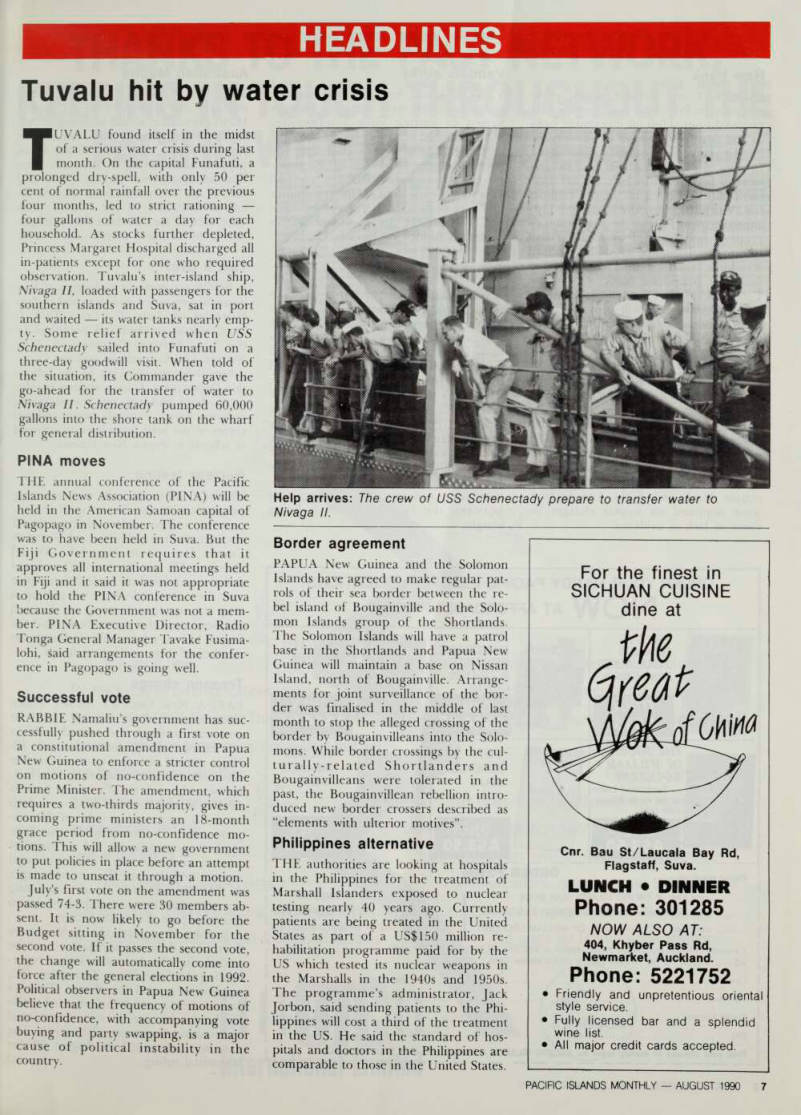
cent of normal rainfall over the previous four months, led to strict rationing four gallons of water a day for each household. As stocks further depleted, Princess Margaret Hospital discharged all in-patients except for one who required observation. Tuvalu’s inter-island ship, Nivaga 11, loaded with passengers for the southern islands and Suva, sat in port and waited its water tanks nearly emp ty. Some relief arrived when USS Schenectady sailed into Funafuti on a three-day goodwill visit. When told of the situation, its Commander gave the go-ahead for the transfer of water to Nivaga 11. Schenectady pumped 60,000 gallons into the shore tank on the wharf for general distribution.
PINA moves THE annual conference of the Pacific Islands News Association (PINA) will be held in the American Samoan capital of Pagopago in November. The conference was to have been held in Suva. But the Fiji Government requires that it approves all international meetings held in Fiji and it said it was not appropriate to hold the PINA conference in Suva because the Government was not a mem ber. PINA Executive Director, Radio Tonga General Manager Tavake Fusima lohi, said arrangements for the confer ence in Pagopago is going well.
Successful vote RABBIE Namaliu’s government has suc cessfully pushed through a first vote on a constitutional amendment in Papua New Guinea to enforce a stricter control on motions of no-confidence on the Prime Minister. The amendment, which
requires a two-thirds majority, gives in
coming prime ministers an 18-month grace period from no-confidence mo tions. This will allow a new government to put policies in place before an attempt is made to unseat it through a motion.
July’s first vote on the amendment was passed 74-3. There were 30 members ab sent. It is now likely to go before the Budget sitting in November for the second vote. If it passes the second vote, the change will automatically come into force after the general elections in 1992.
Political observers in Papua New Guinea believe that the frequency of motions of no-confidence, with accompanying vote buying and party swapping, is a major cause of political instability in the country.
Border agreement
PAPUA New Guinea and the Solomon Islands have agreed to make regular pat rols of their sea border between the re bel island of Bougainville and the Solo mon Islands group of the Shortlands.
The Solomon Islands will have a patrol base in the Shortlands and Papua New Guinea will maintain a base on Nissan Island, north of Bougainville. Arrange ments for joint surveillance of the bor der was finalised in the middle of last month to stop the alleged crossing of the border by Bougainvilleans into the Solo mons. While border crossings by the cul turally-related Shortlanders and Bougainvilleans were tolerated in the past, the Bougainvillean rebellion intro duced new border crossers described as “elements with ulterior motives”.
Philippines alternative
THE authorities are looking at hospitals in the Philippines for the treatment of Marshall Islanders exposed to nuclear
testing nearly 40 years ago. Currently
patients are being treated in the United States as part of a US$l5O million re habilitation programme paid for by the US which tested its nuclear weapons in the Marshalls in the 1940 s and 19505.
The programme’s administrator, Jack Jorbon, said sending patients to the Phi lippines will cost a third of the treatment in the US. He said the standard of hos pitals and doctors in the Philippines are comparable to those in the United States.
Help arrives: The crew of USS Schenectady prepare to transfer water to Nivaga II.
New bank PROPERTY and General, a real estate company in Port Vila, has announced a proposal to establish an investment bank in the Vanuatu capital to service the
Pacific Islands. Company Managing
Director Andrew Wrighton said the ser vices to be offered include the arrange ment and packaging of finance facilities for Vanuatu and the Pacific. This announcement follows the acquisition of Property and General by Pacific Asian International Limited (PAIL), of which Wrighton is also a director. Wrighton said the proposed bank will utilise Vanuatu’s offshore banking and finance centre facilities and will provide exper tise in tourism, agriculture and indus tries.
Drug arrest
A 21-YEAR-OLD Brisbane man was jailed for three months in Suva in July for possession of marijuana. Andrew lan Carter, an AIDS Counsellor, pleaded guilty at the Suva Magistrates Court. He was arrested aboard the cruise ship Fair star when she visited Suva last month.
Two of Carter’s companions, Sydney couple Mark and Vicki Ann Elphick, were acquitted on similar charges be cause of lack of evidence.
Vandals strike VANDALS are hindering a research programme into wave energy in Western Samoa by cutting loose a transmitter buoy anchored several miles off the Apia coastline. The buoy’s anchor line has been cut three times, letting the trans mitter float away for up to 100 kilometres each time. The transmitter buoy sends its data to Norway by satel lite. The project, and a similar one in Tonga, is funded by Norway.
New deal A NEW arrangement is being sought to replace the extradition treaty between Fiji and New Zealand which lapsed after the 1987 military coup in Fiji. This new move arose after Fiji police wanted to
question a Fiji boxing promoter believed
to have arrived in Auckland last month.
The man’s wife was stabbed to death at their home in Suva. A spokesman for Auckland Police said they were looking for the man but he was not certain if he could be extradited to Fiji. He said the court would have to decide. Meanwhile New Zealand’s Ministry of External Rela tions said a new extradition arrangement between the two countries is being sought.
Australian Maoris THE New Zealand Planning Council estimates that a tenth of New Zealand’s Maori population would be living in Au stralia by early next century. Already six per cent of the estimated 300,000 Maori population are living in Australia. New Zealand researcher Jeremy Lowe said that of the estimated 26,000 Maoris liv ing in Australia, 70 per cent of them were born in New Zealand. Maori migra tion is continuing at a high rate, he said.
Talk it over A BOOK on domestic violence and how it can be prevented was launched in Port Moresby on July 25. Let’s Talk It Over, was researched and published by the Law Reform Commission, The Women Law Committee, and the Curri culum Development Unit of the Educa tion Department. It is an attempt to edu cate school children on how domestic violence harms a good society. 60,000 copies of the book have been distributed to schools in Papua New Guinea.
Nuclear testing
FRANCE will continue its nuclear testing programme in the Pacific until the su perpowers have substantially reduced their nuclear stockpile, said France’s Consul General in Honolulu, Daniel Droulers. He said his country’s national defence was based on nuclear deterrence and there was little hope of putting a stop to nuclear testing in French Polynesia until the United States and the Soviet Union substantially reduced the number of their nuclear warheads.
Treason charge
PAPUA New Guinea’s former Police Commissioner, Paul Tohian, could be sentenced to death if convicted under a new charge laid against him on July 18.
He is accused of trying to overthrow the Government on the night of March 4.
He was charged initially under Section 39 (lb) of the Criminal Code which carries a maximum penalty of life im prisonment. But on July 18 the State applied successfully to add a charge of treason under Section 37 (e) (ii). Legal sources told the Post Courier newspaper in Port Moresby that a court convicting anyone under that section had no option but to impose the death penalty.
Boroko Committal Court Magistrate lova Geita ordered the treason count be added after the Australian lawyer repre senting the State, Brian Thompson, QC, applied to amend the charge. Tohian’s lawyer, Les Gavara-Nanu, objected to the application because, he said, it amounted to an abuse of process of the court. The case was adjourned to August 10 for committal ruling. D
Advertisements & other items, pp. 7-9 (1 item)
qreaP
For the finest in
SICHUAN CUISINE
dine at m
qreaP
Cnr. Bau St/Laucala Bay Rd, Flagstaff, Suva.
LUNCH • DINNER
Phone: 301285
NOW ALSO AT:
404, Khyber Pass Rd, Newmarket, Auckland.
Phone: 5221752
• Friendly and unpretentious oriental style service. • Fully licensed bar and a splendid wine list. • All major credit cards accepted.
ORDER YOUR HANDY PACIFIC ISLAND PUBLICATIONS
NOW AT AFFORDABLE PRICES!
I
VANUATU
-A-GUIDE
ONLY
A 514.95
PACIFIC
ISLANDS
MAPS
Please send me
ORDER FROM
copy (ies) of PACIFIC ISLAND YEAR BOOK copy (ies) of FIJI HANDBOOK, BUSINESS & TRAVEL copy (ies) of THE JOURNAL OF WILLIAM LOCKERBY copy (ies) FIJI ISLANDS MAP
copy (ies) PACIFIC ISLANDS MAP
copy (ies) of VANUATU-A-GUIDE I enclose herewith my cheque made payable to PACIFIC ISLANDS MONTHLY of $A or debit A$ to my □ Bank Card □ VISA □ Master Card Card No My Name; Postal Address.
City Exp. Date Country Tel. No.
Poet your cheque or money order to: PACIFIC ISLANDS MONTHLY, PO BOX 1167 SUVA, FIJI.
THANKS TO THE PACT NETWORK,
KEEPING IN TOUCH THROUGHOUT THE
PACIFIC WILL BE A LOT EASIER.
: The good news for the future of communications in the Pacific is the PACT Network. The PACT Network is a cost-effective communications system that will link Pacific nations with their neighbours, their own rural communities and the rest of the world.
This Network provides instant and economic telephone access to friends family and even to medical and educational facilities, The expanded network also means that local business can communicate easily with customers by phone, fax or data link.
The PACT Network has been developed through the careful planning of the Pacific nations together with OTC International, an arm of Australia’s worldwide communications company, and INTELSAT, the world’s global satellite system.
No one's far from anyone anymore. inbelsob
International Limited
Days Later
Cover Stories
A Thousand
A new Constitution and the promise of elections in '91
THE President’s voice shook a little as he spoke. “I speak to you tonight at the moment in our country’s destiny,” he said as he started to read a
23-page statement announcing the
promulgation of Fiji’s new Constitution, Present at this live broadcast on July 25 on all stations of the state-owned Radio Fiji was the Prime Minister, Ratu Sir Kamisese Mara, and his Cabinet. The
only one missing was Major General
Sitiveni Rabuka, whose two military
10 Pacific Islands Monthly August 1990
coups in 1987 changed the path of Fiji’s
history.
The promulgation of a Constitution weighted in favour of the indigenous Fijians has brought the events of 1987 around to a full circle. Now the Government, invited into office on December 5, 1987 by Rabuka, is preparing for new elections and the return to parliamentary government. For Rabuka, nearly a thousand days after he staged his second coup, his final objective is being reached,
Rabuka’s Thousand Days have been marked by a remarkable recovery prog ramme in Fiji, from the brink of disaster in 1987 to the current healthy economic growth. Much of this growth have been attributed to the adventurism of the In terim Government and a well-trained civil service. The question now is the leadership of Government after elections are held, now likely by the end of next year. Rabuka, who said in 1987 that all he wanted was to return to barracks and continue being a soldier, now wants to be the next Prime Minister. Why? “To fulfil my objectives and my promises of 1987,” he said. One key senior civil servant sup ported the idea of Rabuka returning.
“We need a strong leader,” he said.
“Don’t believe in all this talk about the economy being threatened. We will do the work for him. All Rabuka has to do is to keep people in line.”
While the promulgation of the new Constitution may have drawn Fiji closer to parliamentary democracy, it continues to aggravate hardline attitudes in the camp of the deposed Coalition govern ment. In a decision last month, the Coali tion announced it would boycott the general elections, thus threatening to subject nearly half the population to another five years without parliamentary
Nitin Lal
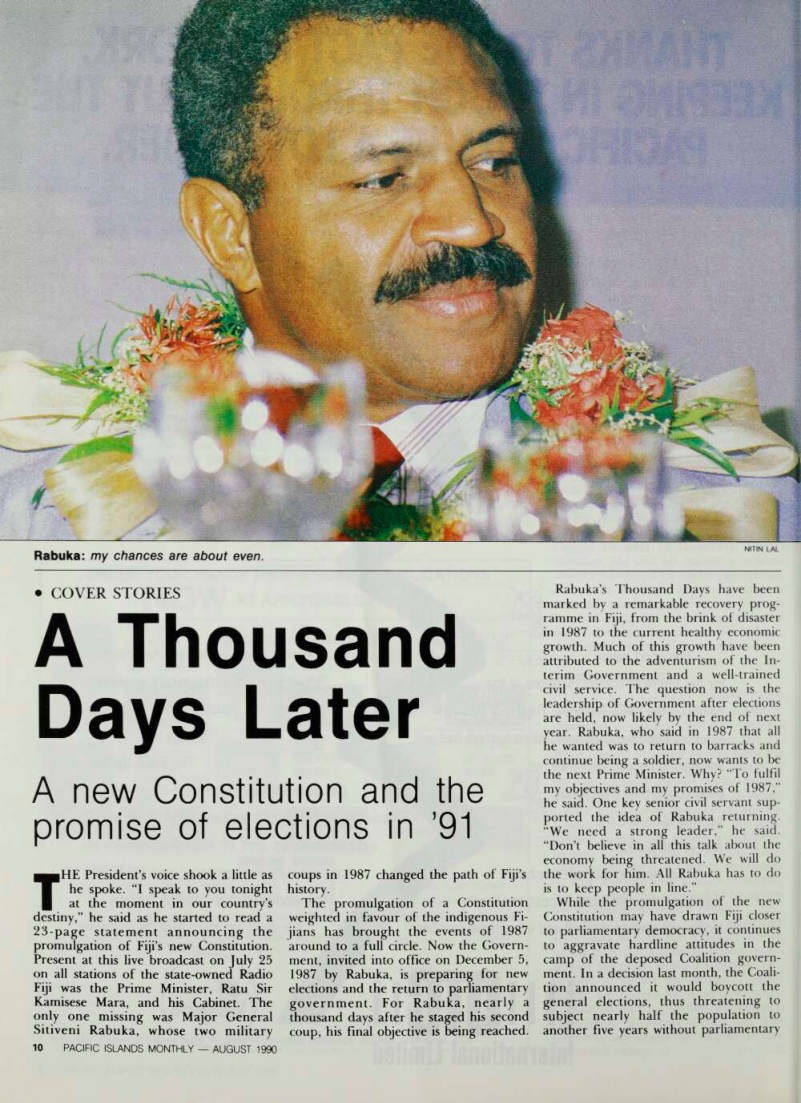
Rabuka: my chances are about even.
representation. When Australian Prime Minister Bob Hawke urged the Coalition to reconsider their stand on the boycott, Coalition leader Adi Kuini Bavadra answered: “We will boycott.” Rabuka said the stand was irresponsible: “If they were responsible enough they would come in.
I don’t think they will boycott.”
The Coalition is hoping that a boycott of the elections will keep Fiji’s Indians away from the polls. But the President of the Fiji Muslim League, Abdul Rauf, told Pacific Islands Monthly : “Half of the In dians or more will go to the polls. They don’t speak on behalf of all the Indians.
Anyway, I don’t think they will boycott.”
Observers see a Coalition boycott as the opportunity for the minority Muslim community to dominate the Indian seats in Parliament for the next five years.
Rauf, however, refused to be committed, saying it was “premature for me to say
anything”.
The new Constitution is being sold as the answer to Fiji’s racial conflict. Says Ratu Sir Penaia: “In the 20 years since independence, we have tried to build a multi-racial society which responded to the aspirations of all our citizens. Achiev ing the right balance was not easy. The main races formed two monolithic groups; there was little assimilation, and much fear of domination.” He explained that because of this, politics became pola rised: “Divisions were deepened through contrasting cultural traditions and atti tudes.”
The President said that it became necessary to “protect the special rights of the Fijians, who had become a minority in their own land. At the same time we had to take into account the legitimate interests of the other communities”.
No matter what Ratu Sir Penaia said, critics in Fiji and abroad hit back. India, whose embassy in Suva was closed by the Fiji Government in May, vowed to step up its international campaign at “every possible international forum”. India’s Minister of State for External Affairs, Hari Kishore Singh, described the new Constitution as “reprehensible” and said it “goes against human dignity; it is anti democratic and should be condemned by the world community”. Australia and New Zealand said the Constitution con tained serious flaws as compared with the 1970 Constitution with which Fiji gained independence from Britain.
Ratu Sir Penaia explained that “the changing structure and trend of the population in Fiji lend support to the proposed pattern of seat allocation in the House of Representatives (see box p!2).
The estimates of Fiji population as at December 1989, the Fijians comprise 48 per cent, Indians 46 per cent and others 6 per cent.” He said forecast points out that Fijians should be in overall majority in 1996 when the next census is held. □
Rabuka’s Dream
Cover Stories
The Indians don’t trust me.
I can say to them that they’ve seen my worst, they haven’t seen my best.
Major General Sitiveni Rabuka speaks frankly
about his hope for the future: Why do you want to be Prime Minister?
Rabuka: To fulfil my objectives and my promises of 1987. My objective was the firming up of the Fijians as the true owners of this country, and that we should run it politically, economically and socially. At the same time we must be true to our nature and our character and remain very good hosts and look after the guests in our country. My promise was to look after the guests, the non-Fijians.
When do you anticipate being Prime Minister, before or after the new elections?
Rabuka: It will have to be after the elections because we have a Prime Minister now and it will depend on whether I meet the criteria put in the new constitution, that is it’s got to be the Fijian who commands the support of the majority of the Fijians in the House. It will depend on whether I meet that criteria or not.
Do you see any problems in getting through Parlia ment?
Rabuka: No, well, I just have to take my chances. If I’m in, I’m in, otherwise even the first step of becom ing Prime Minister will not be taken.
What are your chances?
Rabuka: Very slim.
On a rating of I to 10?
Rabuka: On a rating of 1 to 10 I’d say . . . considering those who might be run ning also ... I’d like to consider that . . . about even. Even chance.
If you were Prime Minister, what kind of government would you have?
Rabuka: I would like to have a govern ment of national reconstruction. First we look at what Fiji needs first: You won your seat on these policies, we won our seats on these platform and policies, you have extreme left views we have extreme right views. Let’s forget about those ex tremities and let’s work on this sort of grey areas in our policies where they sort of merge. That’s where we run Fiji for the next five years.
Are the Indians afraid you might actually become the next Prime Minister?
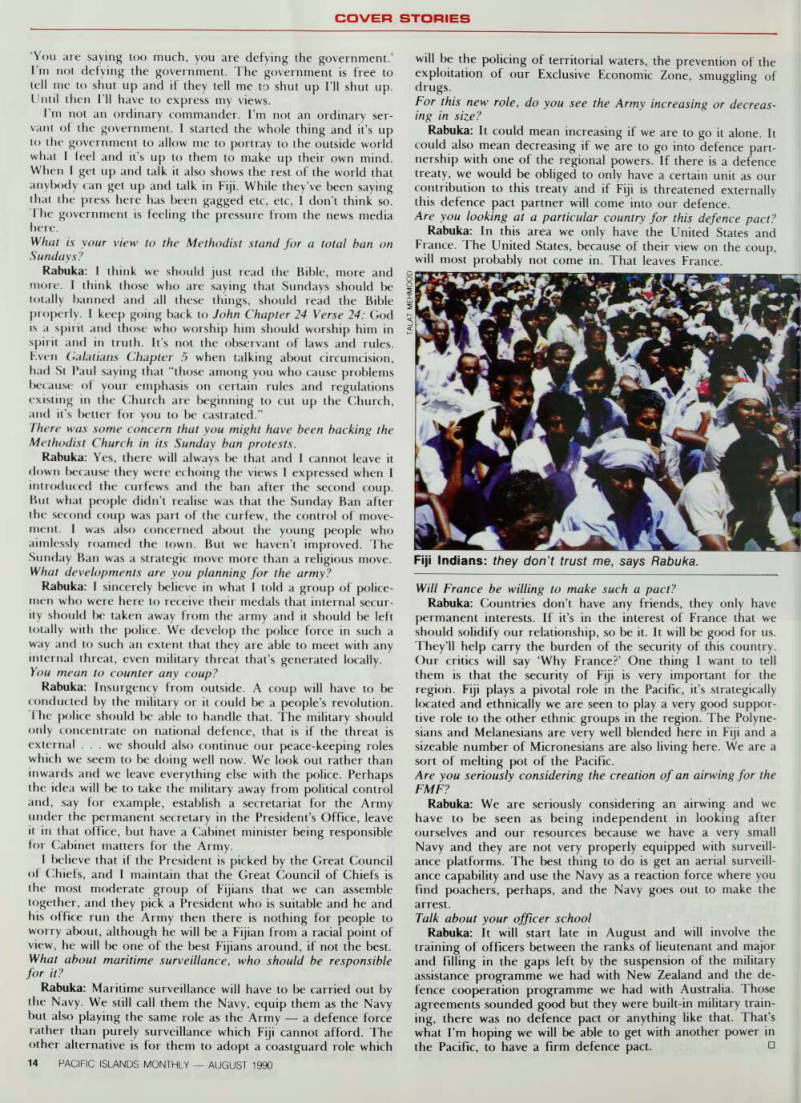
Rabuka: Oh yes, they are concerned because they don’t trust me. I can say to them that they have seen my worst, they haven’t seen my best. It’s up to them to either trust me or they don’t. I have made them a promise, on the 14th of May 1987, and I don’t want anybody coming in and ruining that promise. I’ve got to be there in order to carry that promise through that I’ll look after them. All I can say now is that whatever we do it has to be legal.
If you became Prime Minister, would it be the beginning of commoner Fijians assuming national leadership roles?
Rabuka: It could be seen as that de pending on what policy we decide to emphasise during the time a commoner
Asaeli Lave
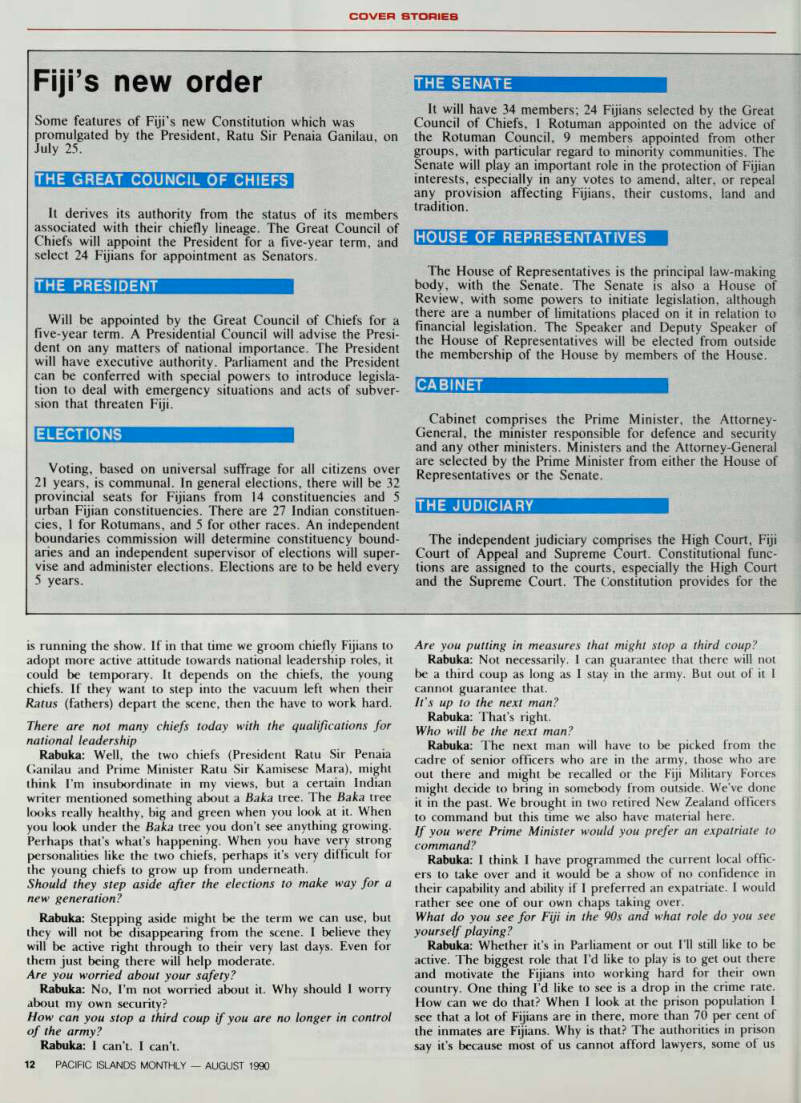
New order: President Ganilau and Major General Rabuka in Suva.
is running the show. If in that time we groom chiefly Fijians to adopt more active attitude towards national leadership roles, it could be temporary. It depends on the chiefs, the young chiefs. If they want to step into the vacuum left when their Ratus (fathers) depart the scene, then the have to work hard.
There are not many chiefs today with the qualifications for national leadership Rabuka: Well, the two chiefs (President Ratu Sir Penaia Ganilau and Prime Minister Ratu Sir Kamisese Mara), might think I’m insubordinate in my views, but a certain Indian writer mentioned something about a Baka tree. The Baka tree looks really healthy, big and green when you look at it. When you look under the Baka tree you don’t see anything growing.
Perhaps that’s what’s happening. When you have very strong personalities like the two chiefs, perhaps it’s very difficult for the young chiefs to grow up from underneath.
Should they step aside after the elections to make way for a new generation?
Rabuka: Stepping aside might be the term we can use, but they will not be disappearing from the scene. I believe they will be active right through to their very last days. Even for them just being there will help moderate.
Are you worried about your safety?
Rabuka: No, I’m not worried about it. Why should I worry about my own security?
How can you stop a third coup if you are no longer in control of the army?
Rabuka: I can’t. I can’t.
Are you putting in measures that might stop a third coup?
Rabuka: Not necessarily. I can guarantee that there will not be a third coup as long as I stay in the army. But out of it I cannot guarantee that.
It’s up to the next man?
Rabuka: That’s right.
Who will be the next man?
Rabuka: The next man will have to be picked from the cadre of senior officers who are in the army, those who are out there and might be recalled or the Fiji Military Forces might decide to bring in somebody from outside. We’ve done it in the past. We brought in two retired New Zealand officers to command but this time we also have material here.
If you were Prime Minister would you prefer an expatriate to command?
Rabuka: I think I have programmed the current local offic ers to take over and it would be a show of no confidence in their capability and ability if I preferred an expatriate. I would rather see one of our own chaps taking over.
What do you see for Fiji in the 90s and what role do you see yourself playing?
Rabuka: Whether it’s in Parliament or out I’ll still like to be active. The biggest role that I’d like to play is to get out there and motivate the Fijians into working hard for their own country. One thing I’d like to see is a drop in the crime rate.
How can we do that? When I look at the prison population I see that a lot of Fijians are in there, more than 70 per cent of the inmates are Fijians. Why is that? The authorities in prison say it’s because most of us cannot afford lawyers, some of us
cannot pay fines, so we go in.
Are you happy with the government?
Rabuka: So far, yes. There are certain areas which I wished they would be sympathetic to the Fijians in but they are also treading cautiously, not being a representative government.
They are trying to administer the affairs of the nation as responsibly as they can. They have done that. They have come under a lot of criticism from both sides. The Fijians have criticised them for not being pro-Fijian and the Indians have criticised them for not being pro-Indian. For a government such as this, when they are criticised from both sides, they can rest assured that they are doing well.
When do you prefer elections held?
Rabuka: I’ve heard the Prime Minister say 1991 but my view is that it shouldn t be until 1992 and I think we should vote according to the provinces, you see the numbers are up and down in some cases. For example Ba will have three seats in Parliament, but those three will be voted in by all Fijians in Ba.
They belong to Ba in the Vola Ni Kawa Bula (Fijian Registry) of Ba and they will be voted in by approximately 40,000 Fijians Hying in Ba. In the urban areas of Ba we have about 13,000 Fijians who have to vote in another one. But that could be a Fijian from anywhere. But Lau will have three candidates voted in by only 13,000 people in Lau. I’m talking about the total population, not the voting population and the voting population will be lesser still, and they vote in three. Cakaud rove have 27,000, twice the number of people voting in Lau and we have to vote in three. Lomaiviti will have to vote in only two but they number more than Lau, 14,500. Macuata
will have to vote in only two, but they have 18,000 Fijians.
These are the disparities that now exist.
We are basing the allocation of seats on the Vola Ni Kawa Bula and not on the number of people present in each geog raphic area. If that is the case, that we base the number of representation on the Vola Ni Kawa Bula, why don’t we vote according to the Vola Ni Kawa Bula place-of-origin voting.
Every Cakaudrovean, wherever he is, votes for a chap from Cakaudrove.
That’s why I keep saying that for the general electors, let’s not decrease their numbers from eight to five. The Indians have argued that they need their number of seats because of their contribution to this country. What about the contribution of the Europeans, the descendants of whom make up the bulk of the general electors? Although their number is very small, their contribution in the initial stages of the development of Fiji during the colonial era and early independence justifies the maintenance of their number at eight. The other thing is that their number will be swelled. The political Fijians under the 1970 Constitution will now not be Fijians because they are not in the Vola Ni Kawa Bula. I’m talking about the descen dants of the Solomon Islanders, the Samoans, Tongans, Rabi, Kioa. In the 1970 Constitution, politically they were Fijians.
Now they go on to the general electors’ roll.
We’ve all contributed but all those contributions have been based on Fijian land.
So you are not happy with the new Constitution?
Rabuka: No, I’ve already said I’m not happy with it. But if the chiefs are happy I’ll go along with it.
What other changes did you want?
Rabuka: I wanted the Muslim seats separated from the Indi ans. They, themselves came up to the Great Council of Chiefs, they sent a petition to the Great Council of Chiefs to be
considered sympathetically.
I’d like to see that Fiji declares that the official religion of this country is Christianity. Vanuatu is doing that now. 1 think that if we declare that Christianity is the official religion then it is only right that we hear the views of the Muslims, not the Indians as a whole because we will be running things accord ing to the official religion of the country.
If we take Christianity as the official religion then we can abolish the death penalty which is currently under suspension.
Will a Coalition boycott of the elections pose any threat to your final objective of fulfilling the aims of your two military coups?
Rabuka: I don’t think it should. I think if they are responsi ble enough they will come in. I don’t think they will boycott, anyway. If the Coalition Party boycotts, that’s one party. There are Indians who are not in the Coalition and there are Fijians who are not in the Coalition.
What’s your view of Coalition Leader Adi Kuini Bavadra?
Rabuka: I was hoping that she should remain objective about the whole thing. There will come a time when a leader realises that she is no longer the leader when she puts forward her policies and they clash with the views of the group that she is leading, in which case he or she will have to step down.
If he or she does not step down then she no longer is the leader but becomes the puppet. I hope that what is coming out from her now are her views as the leader ... if they have not clashed with the views of the followers, well . . . She’s in there with them. Maybe I just don’t know her well enough.
What should she do?
Rabuka: I think rather than talk to the press and the media, she should talk to the Prime Minister and the President. The door’s open.
Has the government tried to stop you talking to the press?
Rabuka: No, I think they are just trying to be objective about their jobs. You know, the finance people are trying to portray a picture of responsible financial management, trying to por tray an image to our foreign friends, to portray the right image of what’s going on in Fiji. A lot of people are saying,
‘You are saying too much, you are defying the government.’
I’m not defying the government. The government is free to tell me to shut up and if they tell me to shut up I’ll shut up.
Until then I’ll have to express my views.
I’m not an ordinary commander. I’m not an ordinary ser vant of the government. I started the whole thing and it’s up to the government to allow me to portray to the outside world what I feel and it’s up to them to make up their own mind.
When I get up and talk it also shows the rest of the world that anybody can get up and talk in Fiji. While they’ve been saying that the press here has been gagged etc, etc, I don’t think so.
I he government is feeling the pressure from the news media here.
What is your view to the Methodist stand for a total ban on Sundays?
Rabuka: I think we should just read the Bible, more and more. I think those who are saying that Sundays should be totally banned and all these things, should read the Bible properly. I keep going back to John Chapter 24 Verse 24: God is a spirit and those who worship him should worship him in spirit and in truth. It’s not the observant of laws and rules.
Even Galatians Chapter 5 when talking about circumcision, had St Paul saying that “those among you who cause problems because of your emphasis on certain rules and regulations existing in the Church are beginning to cut up the Church, and it’s better for you to be castrated.”
There was some concern that you might have been backing the Methodist Church in its Sunday ban protests.
Rabuka: Yes, there will always be that and I cannot leave it down because they were echoing the views I expressed when I introduced the curfews and the ban after the second coup.
But what people didn’t realise was that the Sunday Ban after the second coup was part of the curfew, the control of move ment. I was also concerned about the young people who aimlessly roamed the town. But we haven’t improved. The Sunday Ban was a strategic move more than a religious move.
What developments are you planning for the army?
Rabuka: I sincerely believe in what I told a group of police men who were here to receive their medals that internal secur ity should be taken away from the army and it should be left totally with the police. We develop the police force in such a way and to such an extent that they are able to meet with any internal threat, even military threat that’s generated locally.
You mean to counter any coup?
Rabuka: Insurgency from outside. A coup will have to be conducted by the military or it could be a people’s revolution.
I he police should be able to handle that. The military should only concentrate on national defence, that is if the threat is external ... we should also continue our peace-keeping roles which we seem to be doing well now. We look out rather than inwards and we leave everything else with the police. Perhaps the idea will be to take the military away from political control and, say for example, establish a secretariat for the Army under the permanent secretary in the President’s Office, leave it in that office, but have a Cabinet minister being responsible for Cabinet matters for the Army.
I believe that if the President is picked by the Great Council of Chiefs, and I maintain that the Great Council of Chiefs is the most moderate group of Fijians that we can assemble together, and they pick a President who is suitable and he and his office run the Army then there is nothing for people to worry about, although he will be a Fijian from a racial point of view, he will be one of the best Fijians around, if not the best.
What about maritime surveillance, who should be responsible for it?
Rabuka: Maritime surveillance will have to be carried out by the Navy. We still call them the Navy, equip them as the Navy but also playing the same role as the Army a defence force rather than purely surveillance which Fiji cannot afford. The other alternative is for them to adopt a coastguard role which
will be the policing of territorial waters, the prevention of the exploitation of our Exclusive Economic Zone, smuggling of
drugs.
For this new role, do you see the Army increasing or decreas ing in size?
Rabuka: It could mean increasing if we are to go it alone. It could also mean decreasing if we are to go into defence part nership with one of the regional powers. If there is a defence treaty, we would be obliged to only have a certain unit as our contribution to this treaty and if Fiji is threatened externally this defence pact partner will come into our defence.
Are you looking at a particular country for this defence pact?
Rabuka: In this area we only have the United States and France. The United States, because of their view on the coup, will most probably not come in. That leaves France.
Will France be willing to make such a pact?
Rabuka: Countries don’t have any friends, they only have permanent interests. If it’s in the interest of France that we should solidify our relationship, so be it. It will be good for us.
They’ll help carry the burden of the security of this country.
Our critics will say ‘Why France?’ One thing I want to tell them is that the security of Fiji is very important for the region. Fiji plays a pivotal role in the Pacific, it’s strategically located and ethnically we are seen to play a very good suppor tive role to the other ethnic groups in the region. The Polyne sians and Melanesians are very well blended here in Fiji and a sizeable number of Micronesians are also living here. We are a sort of melting pot of the Pacific.
Are you seriously considering the creation of an airwing for the
Fmf?
Rabuka: We are seriously considering an airwing and we have to be seen as being independent in looking after ourselves and our resources because we have a very small Navy and they are not very properly equipped with surveill ance platforms. The best thing to do is get an aerial surveill ance capability and use the Navy as a reaction force where you find poachers, perhaps, and the Navy goes out to make the arrest.
Talk about your officer school Rabuka: It will start late in August and will involve the training of officers between the ranks of lieutenant and major and filling in the gaps left by the suspension of the military assistance programme we had with New Zealand and the de fence cooperation programme we had with Australia. Those agreements sounded good but they were built-in military train ing, there was no defence pact or anything like that. That’s what I’m hoping we will be able to get with another power in the Pacific, to have a firm defence pact. D
Fiji Indians: they don’t trust me, says Rabuka.
Talat Mehmood
Fiji’s new order
Some features of Fiji’s new Constitution which was promulgated by the President, Ratu Sir Penaia Ganilau, on July 25.
The Great Council Of Chiefs
It derives its authority from the status of its members associated with their chiefly lineage. The Great Council of Chiefs will appoint the President for a five-year term, and select 24 Fijians for appointment as Senators.
Ithe President
Will be appointed by the Great Council of Chiefs for a five-year term. A Presidential Council will advise the Presi dent on any matters of national importance. The President will have executive authority. Parliament and the President can be conferred with special powers to introduce legisla tion to deal with emergency situations and acts of subver sion that threaten Fiji.
Elections
Voting, based on universal suffrage for all citizens over 21 years, is communal. In general elections, there will be 32 provincial seats for Fijians from 14 constituencies and 5 urban Fijian constituencies. There are 27 Indian constituen cies, 1 for Rotumans, and 5 for other races. An independent boundaries commission will determine constituency bound aries and an independent supervisor of elections will super vise and administer elections. Elections are to be held every 5 years.
The Senate
It will have 34 members; 24 Fijians selected by the Great Council of Chiefs, 1 Rotuman appointed on the advice of the Rotuman Council, 9 members appointed from other groups, with particular regard to minority communities. The Senate will play an important role in the protection of Fijian interests, especially in any votes to amend, alter, or repeal any provision affecting Fijians, their customs, land and tradition.
House Of Repres Entativ Es
The House of Representatives is the principal law-making body, with the Senate. The Senate is also a House of Review, with some powers to initiate legislation, although there are a number of limitations placed on it in relation to financial legislation. The Speaker and Deputy Speaker of the House of Representatives will be elected from outside the membership of the House by members of the House.
Cabinet
Cabinet comprises the Prime Minister, the Attorney- General, the minister responsible for defence and security and any other ministers. Ministers and the Attorney-General are selected by the Prime Minister from either the House of Representatives or the Senate.
|The Judiciary
The independent judiciary comprises the High Court, Fiji Court of Appeal and Supreme Court. Constitutional func tions are assigned to the courts, especially the High Court and the Supreme Court. The Constitution provides for the
enactment of provisions for the application of laws, includ ing customary laws. It declares as final and conclusive deci sions of the Native Lands Commission relating to Fijian customs, traditions and usage, and on disputes over the headship of any division or subdivision of the Fijian people with the customary right to occupy and use any native lands. It provides for the establishment of Fijian courts.
[Citizenship
Any person who was a citizen of Fiji on October 6, 1987, remains a citizen. Citizenship may be acquired by birth, descent, registration or naturalisation. There are provisions for the avoidance of dual citizenship. Parliament is empo wered to make provision for the deprivation of a person’s citizenship and for the renunciation by any person of citizenship.
Positive Discrimination
The Constitution establishes a Judicial and Legal Services Commission, Police Service Commission and Public Service Commission. The Judicial and Legal Services Commission and the Public Service Commission are to ensure that no less than 50 per cent of appointments are for Fijians and Rotumans. There are provisions for exceptions where others may be appointed.
Immunity
The Constitution guarantees immunity from civil or cri minal proceedings to members of the Fiji Military Forces, the police and the prisons service and others who assisted the leader of the two military coups of 1987 and the Fiji military government to December 5, 1987.
Whew! made it
The Region
Namaliu survives his first two years and eyes the future
By Wally Hiambohn
//I WILL provide honest,
I responsible and decisive
I political leadership to
strengthen national unity and prosperity.
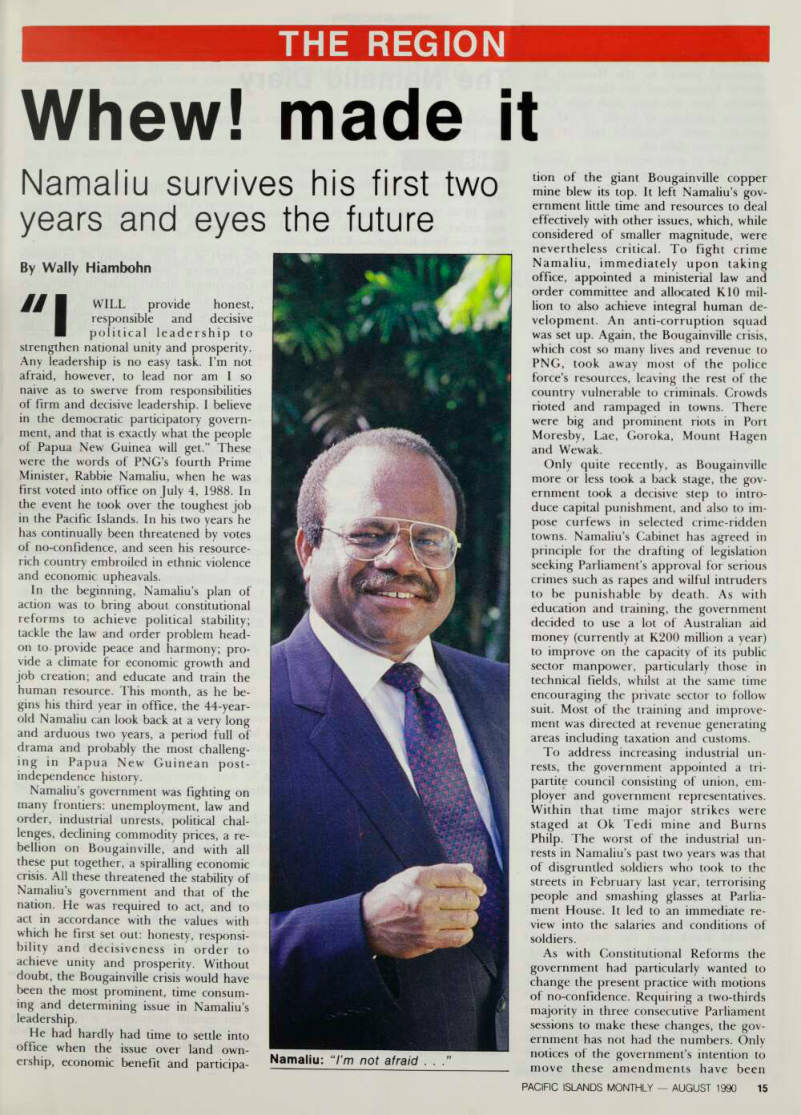
Any leadership is no easy task. I’m not afraid, however, to lead nor am I so naive as to swerve from responsibilities of firm and decisive leadership. I believe in the democratic participatory govern ment, and that is exactly what the people of Papua New Guinea will get.” These were the words of PNG’s fourth Prime Minister, Rabbie Namaliu, when he was first voted into office on July 4, 1988. In the event he took over the toughest job in the Pacific Islands. In his two years he has continually been threatened by votes of no-confidence, and seen his resource rich country embroiled in ethnic violence and economic upheavals.
In the beginning, Namaliu’s plan of action was to bring about constitutional reforms to achieve political stability; tackle the law and order problem head on to-provide peace and harmony; pro vide a climate for economic growth and job creation; and educate and train the human resource. This month, as he be gins his third year in office, the 44-year old Namaliu can look back at a very long and arduous two years, a period full of drama and probably the most challeng ing in Papua New Guinean post
independence history.
Namaliu’s government was fighting on many frontiers: unemployment, law and order, industrial unrests, political chal
lenges, declining commodity prices, a re
bellion on Bougainville, and with all these put together, a spiralling economic crisis. All these threatened the stability of Namaliu’s government and that of the nation. He was required to act, and to act in accordance with the values with which he first set out: honesty, responsi bility and decisiveness in order to achieve unity and prosperity. Without doubt, the Bougainville crisis would have been the most prominent, time consum ing and determining issue in Namaliu’s
leadership.
He had hardly had time to settle into office when the issue over land own ership, economic benefit and participa-
tion of the giant Bougainville copper mine blew its top. It left Namaliu’s gov ernment little time and resources to deal effectively with other issues, which, while considered of smaller magnitude, were nevertheless critical. To fight crime
Namaliu, immediately upon taking
office, appointed a ministerial law and order committee and allocated KlO mil lion to also achieve integral human de
velopment. An anti-corruption squad
was set up. Again, the Bougainville crisis, which cost so many lives and revenue to PNG, took away most of the police force’s resources, leaving the rest of the country vulnerable to criminals. Crowds rioted and rampaged in towns. There were big and prominent riots in Port Moresby, Lae, Goroka, Mount Hagen and Wewak.
Only quite recently, as Bougainville
more or less took a back stage, the gov ernment took a decisive step to intro duce capital punishment, and also to im pose curfews in selected crime-ridden towns. Namaliu’s Cabinet has agreed in
principle for the drafting of legislation
seeking Parliament’s approval for serious crimes such as rapes and wilful intruders to be punishable by death. As with education and training, the government decided to use a lot of Australian aid money (currently at K2OO million a year) to improve on the capacity of its public sector manpower, particularly those in technical fields, whilst at the same time encouraging the private sector to follow suit. Most of the training and improve ment was directed at revenue generating areas including taxation and customs.
To address increasing industrial un rests, the government appointed a tri partite council consisting of union, em ployer and government representatives.
Within that time major strikes were staged at Ok Tedi mine and Burns Philp. The worst of the industrial un rests in Namaliu’s past two years was that of disgruntled soldiers who took to the streets in February last year, terrorising people and smashing glasses at Parlia ment House. It led to an immediate re view into the salaries and conditions of soldiers.
As with Constitutional Reforms the government had particularly wanted to change the present practice with motions of no-confidence. Requiring a two-thirds majority in three consecutive Parliament sessions to make these changes, the gov ernment has not had the numbers. Only notices of the government’s intention to move these amendments have been
Namaliu: "I'm not afraid..."
given in Parliament. Electoral reforms
proposed jointly by the National Re
search Institute and the Electoral Com mission have not been dealt with. Con tinuous switching of loyalty of MPs to and-fro made Namaliu’s task of gov erning more difficult.
He had to make several minor reshuf fles in that time to accommodate certain groups and individuals, the prominent being that of Peoples Acting Party leader Ted Diro’s, who was first appointed State Minister, and, recently, Deputy Prime Minister. The Opposition made three moves to challenge him in a vote of no-confidence, the latest on July 12.
All three were withdrawn because the Opposition did not have the numbers to succeed.
In November, 1988 as the Bougainvil le crisis was quickly gaining momentum, the Namaliu Government brought down its first Budget. It was PNG’s second bil lion kina budget, and was geared for growth and tax reforms, to go from nar row-based direct taxation to the broad based indirect tax.
Generally, the budget reflected the government’s policies and, with in creased funding, was geared towards priorities areas. In November last year, it brought down the 1990 Budget of K 1250 million but the closure of the Bougainville copper mine, a major con tributor to the economy, took a big bite out of it. As the Bougainville crisis worsened, so did the country’s earnings.
When the Panguna mine was forced to close on May 15 last year, it closed the books to the country’s benefit to the mine. Before then Bougainville Copper Limited earned 17 per cent of the coun try’s total revenue and constituted over 40 per cent of its export earnings. Its closure meant a loss in the hundreds of millions. To deal with the Bougainville militants who were fighting for secession from PNG, Namaliu’s Government sent in troops. They pulled out in March this year and left Bougainville in the hands of the rebels. Heavy casualties were suf fered on both sides. Despite continuous
negotiations mostly through a third par
ty, a solution to the problem is still way out of reach. In the latest attempt, the New Zealand Government had offered three of its naval ships for the talks to be held late July.
The government, without the revenue from Bougainville, took urgent step to make up for the loss. It called in the World Bank and the International Monetary Fund, both of whom sug gested drastic austerity measures. The K 1250 million Budget was slashed by KlOO million. Its cost-saving measures include a retrenchment exercise and a trimming of public sector divisions.
Many aid donors were asked to help, and more recently Namaliu personally
attended the World Bank Consultative Group Meeting in Singapore, and returned with K7lO million in aid money, most in grants and concessional loans.
In its latest move the Government last month announced a revolutionary set of policies which Namaliu hopes will rescue PNG from its present economic
crisis. They include drastic administra tive, economic, legal and social measures his government would adopt now and in the future. It opened up the economy to foreign investment and gave it a very free hand, while the government created the right climate, monitored and gov erned.
Namaliu fearlessly predicted that as a result of these measures, PNG’s economy would recover fast and grow at a rate of 7 to 9 per cent a year by 1995. His measures include a drastic reduction of the public service; improvement in law and order; the abolition of the National Investment and Development Agency (NIDA); reclassification of foreign enter prises from 75 per cent national own ership to 50 per cent national own ership; levy for training and localisation; increase in Papua New Guinean business involvement; a mortgage finance com
pany to provide long-term housing
loans; disposal of all surplus government land to businesses; a joint government business committee to simplify regula tions; rural industry diversification, com mercialise all agriculture extension ser vices; eradicate compensation claims; change in visa fees and allow a perma nent resident status to investors investing more than K 250,000; a tax holiday to pioneer industries; remove duty on im ports required by manufacturers for im port creation; wage restraints; and ba lance resource development and en
vironment protection.
He said then that his government’s role was merely to create and maintain the right economic, political and social environment for private sector growth.
“We are creating the right climate for investment, and for real private sector growth. I am confident you will respond positively to the challenges we are now issuing. “We must also use the opportun ity to cut public service waste and ineffi ciency, and to bring about a real transfer of resources, of employment, and of opportunity to the private sector.
“The days of a bloated, inefficient and
irresponsible public sector were not just
numbered, they are finished. I can no longer depend on the public sector to create jobs, and its roles in job creation will diminish considerably in the immedi ate period ahead. That means smaller government, more accountable for its spending and more responsive to the changing needs of a young nation, rich in resources, including human resources.
It most certainly means less government involvement in business, not more.”
The future for Namaliu remains, again unpredictable. But to remain in control he needs to find time to com plete what he started out to do. □
The Namaliu Diary
Highlights of Rabbie Namaliu’s two years as Papua New Guinea’s Prime Minister.
July 1988-July 1990:
1988
July 4 Voted into offi. e in a successful 58-50 vote of no-confidence against Paias
Wingti.
Aug 10 Announces new policy placing emphasis on constitutional reforms, laws and order, economic growth and employment creation, and education.
Nov 8 First Budget Kll9O million.
Nov 22 Bougainville issue begins with the theft of a large quantity of explosives and destruction by militants. Troops called in December 1988. Continued destruction and killings. Mine closes May 15 1989. Government declares state of emergency July 22. More violence, resulting in over 100 deaths, mass destruction and mass exodus of people and closure of most business in the province. Troops withdrawn in March 1990 and rebels declare independence for Bougainville. Attempts for peace talks continue to fail.
Dec 12 Youths go on riot in Port Moresby.
1989
Feb 9 Soldiers go on street riot in Port Moresby.
March 2 Bid to limit vote of no-confidence motion put to Parliament.
March 3 Opposition puts first motion of no-confidence in Namaliu which was subsequently withdrawn on July 4. Major public outcry against the Opposition for its move.
March 23 Man shot dead in rampage and street battle in Port Moresby when a peace march turned nasty.
April 9 Namaliu makes nationwide appeal for peace as Bougainville situation worsens.
May 24-28 Namaliu visits Australia to discuss aid, Bougainville and assure investors.
June 30 Communications Minister Malipu Balakau is gun down in Mount Hagen a victim of rising serious crimes.
Aug 14 Namaliu assures of foreign investor confidence despite Bougainville.
Sept 6 Major rampage and looting in Lae. Thousands of kina damage and theft.
Nov 1 Second vote of no-confidence put to Parliament but withdrawn again.
Nov 9 Namaliu Government’s second Budget, K 1250 million.
Nov 20 Burns Philp strike.
Dec 25 Governor-General Sir Ignatius Kilage dies from illness.
1990
Jan Namaliu and former Prime Ministers, Somare, Chan and Wingti meet in an attempt to discuss and find solution to economic crisis. “It’s no longer the number game . . . it’s the survival of the country because things are going bad and they are going to get worse,” they said. Nothing achieved and further talks abandoned.
Jan 9 Kina devalued by 10 per cent “to stave off a fast depleting foreign exchange reserves and tipping balance of payment.”
Feb 8 International Monetary Fund called in to help ailing economy. It gives KBB million, and suggests austerity measures.
March 19 Housing Minister Gerard Sigulogo is dismissed from Parliament after found guilty on 8 of 10 charges of misconduct in office.
March 15 Police Commissioner Paul Tohian dismissed from office for alleged coup attempt. Currently facing treason charges with two senior policemen.
April 15 Jails Commissioner Pious Kerepia is stabbed to death at his Port Moresby
home by three youths.
May 17/18 Namaliu attends World Bank Consultative Group Meeting in Singa pore and secures K7lO million in grants and concessional loans.
June 7 Namaliu announces major economic reforms.
July 4 Third motion of no-confidence in Namaliu withdrawn July 12.
New institute
THE University of Guam is forming a Micronesian Language Institute to conduct research and develop ment activities with the languages of the indigenous people of the Micronesian re gion. The activities will include basic linguistic and social science research, re search and development in curriculum
and instruction, and materials develop ment.
An Advisory Council of indigenous ex perts in the languages has been formed.
One representative was selected for Guam, the Northern Marianas, Marshall Islands, Belau, and two from the Feder ated States of Micronesia one for Eastern FSM and one from Western
Fsm. □
Advertisements & other items, p. 17 (1 item)
Energy Officer
FORUM SECRETARIAT
Applications are invited from suitably qualified and experienced persons, who must be citizens of a member country* of the South Pacific Forum, for the position of Energy Officer of the Forum Secretariat's Energy Division The Forum Secretariat was established in 1973 by the South Pacific Fourm to encourage economic and political cooperation between its member states, and between those states and the more industrialised countries. Under the control of the Secretary General the Secretariat undertakes a regional work programme covering economic services, legal and political services, energy, tourism, trade, transport and telecommunications sector. The Secretariat also has significant responsibilities with regard to ACP/EC regional projects funded under Lome Conventions.
The Energy Division implements and administers a range of energy development assistance programmes aimed at increasing the ability of Forum Island Countries to plan and manage their national energy sectors. The Division also assists in coordinating the development assistance activities of other orgaisations in the region’s energy sector, convenes annual meetings of energy ministers and officials, provides technical assistance and advice to Forum Island Countries and disseminates energy information and statistics The Division has a joint work programme with the United Nations Pacific Energy Development Programme (UNPEDP).
The Energy Officer is responsible to the Secretary General and Director of Programmes through the Head, Energy Division. More specifically, the Energy Officer is responsible for: (i) coordinating of energy development under the Pacific Energy Programme with other organisations in the region. (ii) compiling and disseminating of energy information to the Forum Island Countries through regular newsletters; (iii) evaluating of energy conservation project proposals for funding by the Forum Secretariat Providing advice from time to time to Forum Island Countries on good energy saving practices in both government and private sector applications; (iv) providing terms of reference for consultants to be engaged on energy projects; (v) coordinating and implementing the Australian/New Zealand funded small energy projects programme; (vi) arranging regional training programmes, seminars and workshops.
Applicants should have tertiary qualifications preferably in economics and/or engineering and at least 3-5 years practical experience in technical aspects of energy production, control, and/or conservation. Experience in government administrative procedures is desirable. Preference will also be given to applicants possessing a sound general knowledge and an appreciation of the economic, social and political aspirations of the Forum’s region.
This appointment will carry an attractive remuneration package, payable in Fiji dollars. For non-Fiji citizens this is tax free and includes housing or a housing allowance, education and child allowances. Other benefits include superannuation payments and medical, life and travel insurance coverage. The appointee will be based at the Secretariat’s Headquarters in Suva, Fiji but will be required to undertake periodic duty travel. Appointment would be for three years initially, renewable by mutual agreement.
Applications, which close on 15 September, 1990 should contain full information on education and career background and should list names, addresses and telephone numbers of at least three referees with whom the applicant has been associated in a professional capacity.
Applications should be addressed to: The Secretary General Forum Secretariat GPO Box 856, Suva, Fiji Telephone 312600 Telex: 2229 FJ Fax: 302204 or 301102 Further information is available on request and all enquiries should be made to Mrs Lailun Khan, Administration Officer on 312600 Ext 220. * Member countries are: Australia, Cook Islands, Federated States of Micronesia, Fiji, Kiribati, Marshall Islands, Nauru, New Zealand, Niue, Papua New Guinea, Solomon Islands, Tonga, Tuvalu, Vanuatu and Western Samoa.
Tonga Chronicle
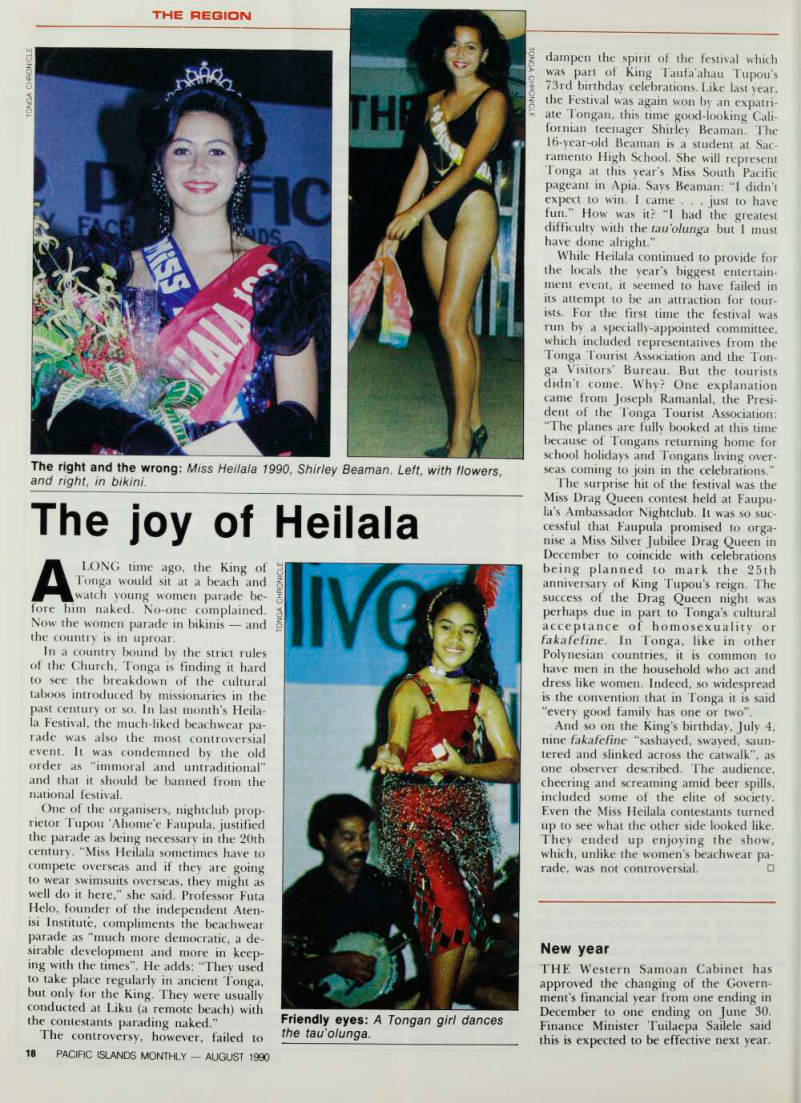
The joy of Heilala
ALONG time ago, the King of Tonga would sit at a beach and watch young women parade be fore him naked. No-one complained.
Now the women parade in bikinis and the country is in uproar.
In a country bound by the strict rules of the Church, Tonga is finding it hard to see the breakdown of the cultural taboos introduced by missionaries in the past century or so. In last month’s Heila la Festival, the much-liked beachwear pa rade was also the most controversial event. It was condemned by the old order as “immoral and untraditional” and that it should be banned from the national festival.
One of the organisers, nightclub prop rietor Tupou ’Ahome’e Faupula, justified the parade as being necessary in the 20th century. “Miss Heilala sometimes have to compete overseas and if they are going to wear swimsuits overseas, they might as well do it here,” she said. Professor Futa Helo, founder of the independent Aten isi Institute, compliments the beachwear parade as “much more democratic, a de sirable development and more in keep ing with the times”. He adds: “They used to take place regularly in ancient Tonga, but only for the King. They were usually conducted at Liku (a remote beach) with the contestants parading naked.”
The controversy, however, failed to
dampen the spirit of the festival which was part of King Taufa’ahau Tupou’s 73rd birthday celebrations. Like last year, the Festival was again won by an expatri ate Tongan, this time good-looking Cali fornian teenager Shirley Beaman. The 16-year-old Beaman is a student at Sac ramento High School. She will represent Tonga at this year’s Miss South Pacific pageant in Apia. Says Beaman: “I didn’t expect to win. I came . . . just to have fun.’ How was it? “I had the greatest difficulty with the tau’olunga but I must have done alright.”
While Heilala continued to provide for the locals the year’s biggest entertain ment event, it seemed to have failed in its attempt to be an attraction for tour ists. For the first time the festival was run by a specially-appointed committee, which included representatives from the Tonga Tourist Association and the Ton ga Visitors’ Bureau. But the tourists didn’t come. Why? One explanation came from Joseph Ramanlal, the Presi dent of the Tonga Tourist Association: “The planes are fully booked at this time because of Tongans returning home for school holidays and Tongans living over seas coming to join in the celebrations.”
The surprise hit of the festival was the Miss Drag Queen contest held at Faupu la’s Ambassador Nightclub. It was so suc cessful that Faupula promised to orga nise a Miss Silver Jubilee Drag Queen in December to coincide with celebrations being planned to mark the 25th
anniversary of King Tupou’s reign. The
success of the Drag Queen night was perhaps due in part to Tonga’s cultural acceptance of homosexuality or fakafefine. In Tonga, like in other Polynesian countries, it is common to have men in the household who act and dress like women. Indeed, so widespread is the convention that in Tonga it is said “every good family has one or two”.
And so on the King’s birthday, July 4, nine fakafefine “sashayed, swayed, saun tered and slinked across the catwalk”, as one observer described. The audience,
cheering and screaming amid beer spills,
included some of the elite of society.
Even the Miss Heilala contestants turned up to see what the other side looked like.
They ended up enjoying the show, which, unlike the women’s beachwear pa rade, was not controversial. □
Tonga Chronicle
Tonga Chronicle
Friendly eyes: A Tongan girl dances the tau’olunga.
The right and the wrong: Miss Heilala 1990, Shirley Beaman. Left, with flowers, and right, in bikini.
New year
THE Western Samoan Cabinet has approved the changing of the Govern ment’s financial year from one ending in December to one ending on June 30.
Finance Minister Tuilaepa Sailele said this is expected to be effective next year.
When power fails you’re in Samoa
Western Samoa
By Ulafala Aiavao
THE Electric Power Corporation (EPC) in Western Samoa hasn’t made many new friends in the past two months, thanks to a series of rolling cuts affecting thousands of consumers.
The problems are due partly to the lack of maintenance of generator plants a difficult job at any time because the aging generators are out of pro duction and spares can be hard to locate. There is also what the EPC General Manager, Eric Hussey, calls “an unprecedented run of bad luck.”
EPC has four hydro sta tions (one written off last May) and eight diesel generators (of which four diesels are out of action due to repairs or overhaul).
The story of what hap pened to the five gener ators out of action partly explains why Western Sa moans experienced their worst round of power cuts yet.
In August last year a bearing failed on what EPC calls Diesel Number Five.
Because the generator is out of production a spare had to be specially made overseas. So an order was placed last October and the
bearing finally arrived,
nine months later, in June this year. That was when
EPC ofticials found out the spare bearing could not fit. Although the bear ing was the right size, the tunnel bore was out by I.smm. How come? In 1979 there was a minor explosion and fire in the generator and the repair job in 1979 had changed the internal dimensions of the generator very slightly. Officials who ordered the spare bearing were not aware of the earlier repair job. EPC is pinning its hopes on a retired Australian machinist who is confident he can machine the unit so the spare can be used.
Another repair job, this time on Diesel Number Ten, was ordered after a fire last October damaged the switchboard on the unit. EPC sent the damaged switchboard to Melbourne, or, they
thought they did. In February the Mel bourne company wrote back asking when the switchboard would be sent over. And EPC officials discovered, in
February, that the damaged equipment
they thought was shipped around Christ mas was still at Apia wharf in Western Samoa. The damaged switchboard was shipped over but was further damaged in Sydney when the large package fell
during transit.
EPC soon found they had more to worry about because water had somehow entered the oil chamber in Diesel Num ber Four and emulsified the oil. Hun dreds of hours after the water was be lieved to have mixed with the oil, there was a bearing failure. Tests were made on the crankshaft and the results sent
overseas to see if re pairs could be carried out, or whether the Number Four Diesel would have to be scrapped. The gener ator is 25 years old and, if scrapped, then a replace ment would cost several million Samoan Tala.
So, with three diesels down, EPC had to take a calculated risk on whether to carry out an overdue overhaul on the large Diesel Number Nine.
Number Nine was sup posed to be overhauled ev ery 6000 hours, but had already reached 10,000 hours of operation. A deci sion was made to take it out for the overhaul to avoid a sudden and costly breakdown. Officials cros sed their fingers and
hoped no unexpected fai
lures would take place with the remaining generators which were carrying the load.
Then during a night time rainstorm on May 16, a lightning hit the power lines to two hydro stations, Alaoa and Fale o le Fee.
The lightning strike trip ped the circuits to both hydro stations but only the Alaoa station shutdown
completely.
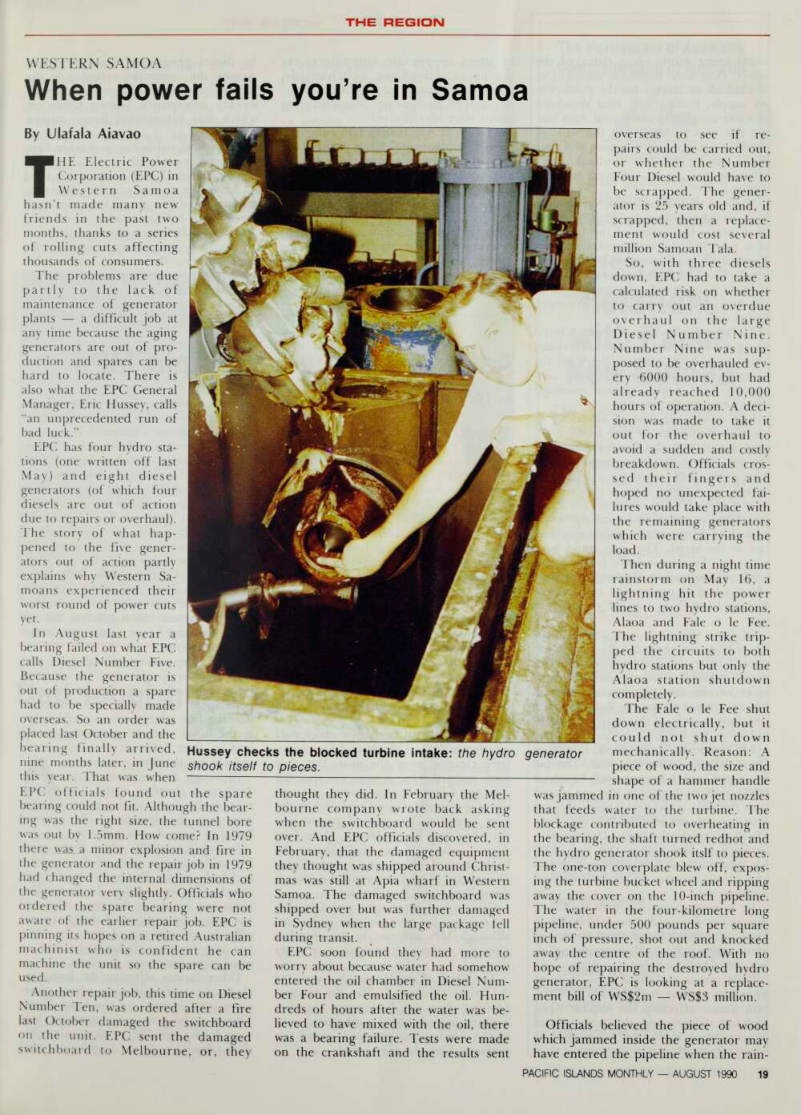
The Fale o le Fee shut down electrically, but it could not shut down mechanically. Reason: A piece of wood, the size and shape of a hammer handle
was jammed in one of the two jet nozzles that feeds water to the turbine. The blockage contributed to overheating in the bearing, the shaft turned redhot and the hydro generator shook itslf to pieces.
The one-ton coverplate blew off, expos ing the turbine bucket wheel and ripping away the cover on the 10-inch pipeline.
The water in the four-kilometre long pipeline, under 500 pounds per square inch of pressure, shot out and knocked away the centre of the roof. With no
hope of repairing the destroyed hydro
generator, EPC is looking at a replace ment bill of WSs2m WS$3 million.
Officials believed the piece of wood which jammed inside the generator may have entered the pipeline when the rain
Hussey checks the blocked turbine intake: the hydro generator shook itself to pieces.
storm swept debris which damaged the intake. (The same rainstorm damaged or blocked all six intakes for the public wa ter supply, leading to a total shutdown of water supplies to the capital Apia last ing just over a day). With the writeoff the Fale o le Fee hydro station, and four diesels out for repair or overhaul, power rationing had to be enforced to meet demand.
Much of the damage to the generators is covered by insurance. The EPC board of directors has approved the purchase of a new 3500 kilowatt generator from England which will cost WS$6 million to install. The board is considering whether to buy a secondhand generator as well as secure a replacement for the destroyed hydro station.
All this will take time, but with a hired generator from New Zealand and repairs to the large Number Nine Diesel due for completion in late July, EPC and con sumers were hoping power rationing would ease by this month.
Last month the cost of electricity to users went up from 28 sene a unit to 32 sene a unit. It is the first increase since the old 28-sene charge was introduced in June 1983. (EPC asked for a bigger in crease, but Cabinet kept it down to 32 sene a unit). Hussey said costs for diesel and other expenses had gone up in the past seven years without a corresponding rise in the tarrif. The costs could have eaten up the corporation’s reserves and left it with no cash in the bank, at a time when it had to recover the cost of pro ducing 40 million units of electricity a year.
Of those 40 million units a year, about 24 million are produced by hydro sta tions if there is a good wet season. The diesel generation is expected to carry more of the load this year as rainfall figures are not promising. Rainfall in the first four months of this year was rough ly half as for the same period last year.
EPC expects about WS$ll million from electricity sales this year. The bill for diesel and lubricants will be about WS|5 million (higher if the wet season later this year is too dry). Other costs are loan repayments of $990,000 this year, which is relatively light. Depreciation amounts to $4.6 million this year. EPC has total assets of $lOO million in gener ator plants, support services and electric
ity networks.
Its expenses went up further when it lost its tax free and duty free status in 1984 and 1985. This affected diesel gen eration especially as all materials includ ing diesel became subject to duty.
Daily power cuts have been in force since May, lasting half the day in diffe
rent areas, affecting the capital Apia,
outlying villages and the international airport. Work has to be re-arranged in many offices which has no standby pow
er units to operate computers, fax machines, telephone switchboards, copiers, printers and other powerdependent equipment. Manufacturing plants were also affected.
The WSLAC insurance company opened its doors at 7.30 am to make the most of their morning before the regular afternoon shutdown in the capital. The Bank of Western Samoa changed its hours to Sam to 2pm. Polynesian Airlines, which handles most flight reservations in Samoa, could not confirm any reservations in the afternoons until the power came back on in the evenings.
Some manufacturers switched to nighttime production while waiting for stand-
by diesel generators from overseas, Among the companies investing in the expensive standby units was the bi weekly newspaper Samoa Observer which was hit several times during
printing,
Otto’s Reef public bar, and other bars, kept candles on hand, The Electric Power Corporation tried to make the cuts practicable by broad casting scheduled cutoff times for each week over national radio. Consumers were also asked to cut down on their use of electricity as much as possible to ease demand. But there were unscheduled breaks during peak periods or when faults occurred. D
Asbestos drives out Apia MPs
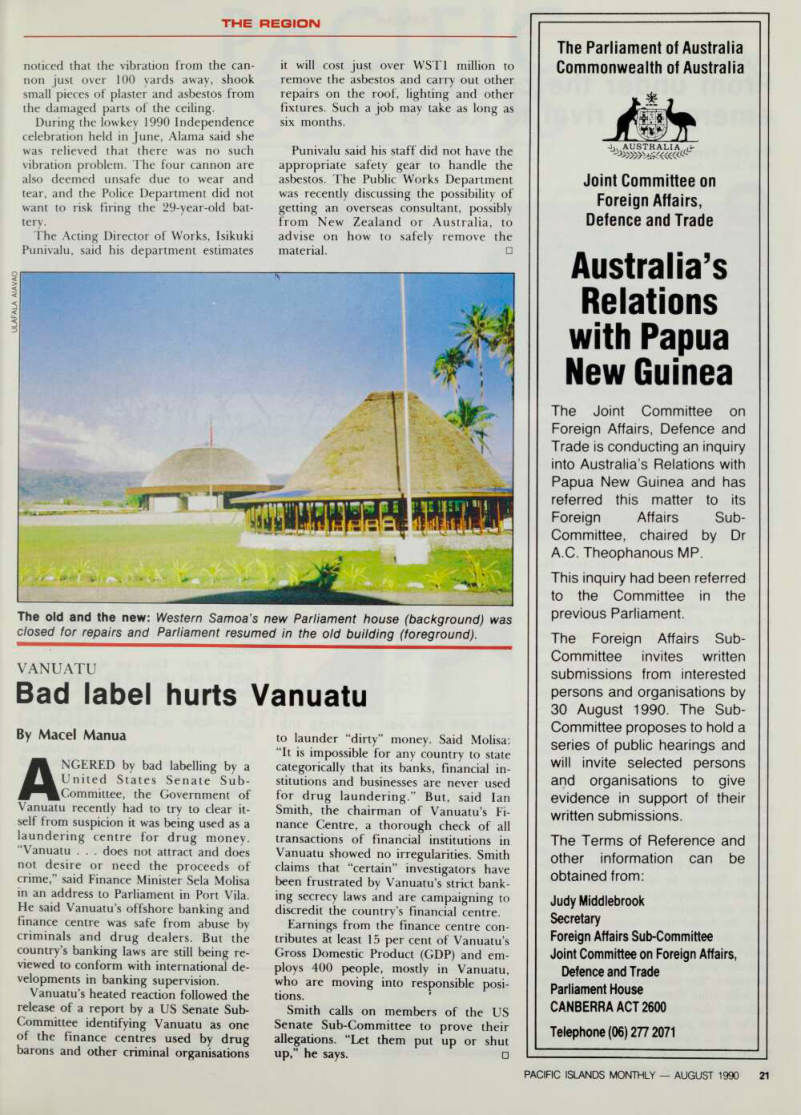
By Ulafala Aiavao
WESTERN Samoa’s 18-year-old
Parliament building has been closed temporarily because in
creasing damage to asbestos sheets lining
the ceiling mean that the chamber is a health hazard. The asbestos, used to help the acoustics and cooling of the dome-shaped chambers, was installed when the country’s second Parliament building was constructed in 1972. It was safe as long as the sheets were firmly fixed in a matrix. But wear and tear over the years, which worsened after Cyclone Ofa last February caused more leaks in the roof, has exposed the edges of the material.
Fibres have been drifting down from the central part of the ceiling to cover furniture, politicians and anyone else with a fine coat of dust if they sit still
long enough.
Earlier this year, Legislative office staff wearing makeshift gloves and facemasks, tried clearing away the dust. But they soon stopped. One reason was that the dust and fibres they vacuumed or swept up in the evenings were replaced by the next morning. The second reason was that the Clerk of the House, Mase Toia Alama, called off her staff due to the health hazard. (Alama is a gynaecologist obstetrician. The Speaker of the House, Aeau Peniamina, is a dentist).
Cabinet had approved a post-Ofa plan
to eventually remove the asbestos, although MPs still met in the chamber after the cyclone to approve a recovery
plan.
The Clerk of the House later wrote to the Prime Minister, Tofilau Eti Alesana, advising that the Parliament chamber was unsafe and should not be used until all the asbestos was removed and not
replaced. Government agreed.
The last meeting in the asbestos-lined chamber was on May 31 when the Head of State, Malietoa Tanumafili 11, opened the 1990 session, and Finance Minister, Tuilaepa Sailele, tabled a Second Sup plementary Estimates for this year.
Members of Parliament resumed their present session on June 26, this time in the original, and smaller, Parliament House which is a mango toss away from the condemned one. That meeting be gan with a suggestion by one MP, Ulualofaiga Talamaivao, for MPs to be examined to check on whether they were likely to be suffering from asbestos related illnesses. His suggestion did not reach the stage of an actual motion be fore the House.
Health Department officials later said they had no specific data on asbestos related illnesses among the general population. Officials did note however that the fine asbestos fibres could lodge in the lungs, and, in some cases, could lead to chest infection or cancer some years down the line.
Although the closure of the newer Parliament chamber is the first health related shutdown of the building, con cern over the damage to the asbestos lining in the ceiling is not new.
In February 1982, when heavy rains led to flooding in parts of the country, and leaks in the Parliament roof, large chunks of asbestos fell to the floor. (The room was empty at the time). Concern was raised by sections of the press and officials, not just out of fears for MPs, but also for the workers who had to come in to clear away the mess.
Other factors affecting the lining in clude the air-conditioning which some times stirs up some of the loose fibres.
Vibration also came in for attention. Last year during the Independence Day 21gun salute on June, Legislative staff
noticed that the vibration from the can non just over 100 yards away, shook small pieces of plaster and asbestos from the damaged parts of the ceiling.
During the lowkey 1990 Independence celebration held in June, Alama said she was relieved that there was no such vibration problem. The four cannon are also deemed unsafe due to wear and tear, and the Police Department did not want to risk firing the 29-year-old bat tery.
The Acting Director of Works, Isikuki Punivalu, said his department estimates
it will cost just over WSTI million to remove the asbestos and carry out other repairs on the roof, lighting and other fixtures. Such a job may take as long as six months.
Punivalu said his staff did not have the appropriate safety gear to handle the asbestos. The Public Works Department was recently discussing the possibility of getting an overseas consultant, possibly from New Zealand or Australia, to advise on how to safely remove the material. □
The old and the new: Western Samoa's new Parliament house (background) was closed for repairs and Parliament resumed in the old building (foreground).
Bad label hurts Vanuatu
Vanuatu
By Macel Manua
ANGERED by bad labelling by a
United States Senate Sub- Committee, the Government of Vanuatu recently had to try to clear it self from suspicion it was being used as a laundering centre for drug money.
“Vanuatu . . . does not attract and does not desire or need the proceeds of crime,” said Finance Minister Sela Molisa in an address to Parliament in Port Vila.
He said Vanuatu’s offshore banking and finance centre was safe from abuse by criminals and drug dealers. But the country’s banking laws are still being re viewed to conform with international de
velopments in banking supervision.
Vanuatu’s heated reaction followed the release of a report by a US Senate Sub- Committee identifying Vanuatu as one of the finance centres used by drug barons and other criminal organisations
to launder “dirty” money. Said Molisa: “It is impossible for any country to state categorically that its banks, financial in stitutions and businesses are never used for drug laundering.” But, said lan Smith, the chairman of Vanuatu’s Fi nance Centre, a thorough check of all transactions of financial institutions in Vanuatu showed no irregularities. Smith claims that “certain” investigators have been frustrated by Vanuatu’s strict bank ing secrecy laws and are campaigning to discredit the country’s financial centre.
Earnings from the finance centre con tributes at least 15 per cent of Vanuatu’s Gross Domestic Product (GDP) and em ploys 400 people, mostly in Vanuatu,
who are moving into responsible posi
tions.
Smith calls on members of the US Senate Sub-Committee to prove their allegations. “Let them put up or shut up,” he says. □
Advertisements & other items, p. 21 (1 item)
with Papua
The Parliament of Australia Commonwealth of Australia
Australia’s
Relations
with Papua
New Guinea
The Joint Committee on Foreign Affairs, Defence and Trade is conducting an inquiry into Australia’s Relations with Papua New Guinea and has referred this matter to its Foreign Affairs Subcommittee, chaired by Dr A.C. Theophanous MR.
This inquiry had been referred to the Committee in the previous Parliament.
The Foreign Affairs Subcommittee invites written submissions from interested persons and organisations by 30 August 1990. The Sub- Committee proposes to hold a series of public hearings and will invite selected persons and organisations to give evidence in support of their written submissions.
The Terms of Reference and other information can be obtained from: Judy Middlebrook
Secretary
Foreign Affairs Sub-Committee Joint Committee on Foreign Affairs, Defence and Trade Parliament House
CANBERRA ACT 2600
Telephone (06) 277 2071
Jj. AUSTRALIA /L t-
-L. AUSTRALIA iL l-
Joint Committee on
Foreign Affairs,
Defence and Trade
From under the counter
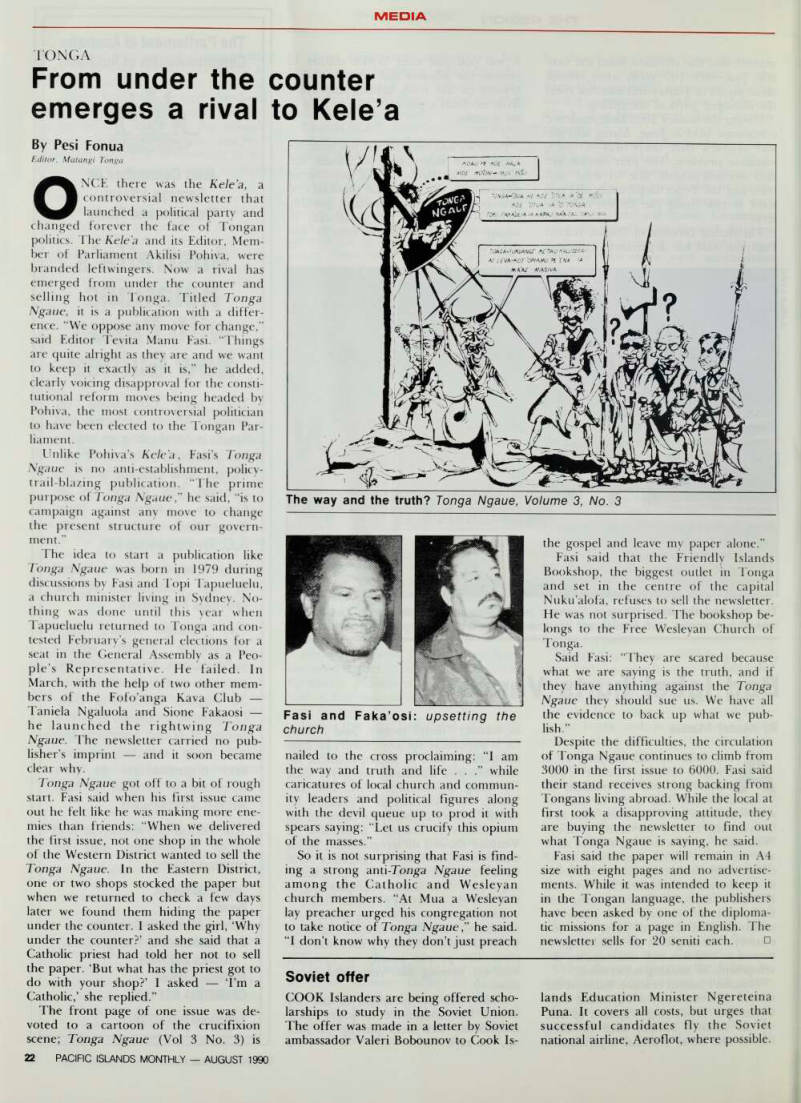
Media
Tonga
From under the counter emerges a rival to Kele’a
By Pesi Fonua
Editor, Matangi Tonga ONCE there was the Kele'a, a controversial newsletter that launched a political party and changed forever the face of Tongan politics. The Kele'a and its Editor, Mem ber of Parliament Akilisi Pohiva, were branded leftwingers. Now a rival has emerged from under the counter and selling hot in Tonga. Titled Tonga Ngaue, it is a publication with a differ ence. “We oppose any move for change,” said Editor Tevita Manu Fasi. “Things are quite alright as they are and we want to keep it exactly as it is,” he added,
clearly voicing disapproval for the consti
tutional reform moves being headed by Pohiva, the most controversial politician to have been elected to the Tongan Par liament.
Unlike Pohiva’s Kele'a, Fasi’s Tonga Ngaue is no anti-establishment, policy
trail-blazing publication. “The prime
purpose of Tonga Ngaue,” he said, “is to campaign against any move to change the present structure of our govern ment.”
The idea to start a publication like Tonga Ngaue was born in 1979 during discussions by Fasi and Topi Tapueluelu, a church minister living in Sydney. No thing was done until this year when Tapueluelu returned to Tonga and con tested February’s general elections for a seat in the General Assembly as a Peo ple’s Representative. He failed. In March, with the help of two other mem bers of the Fofo’anga Kava Club Taniela Ngaluola and Sione Fakaosi he launched the rightwing Tonga Ngaue. The newsletter carried no pub lisher’s imprint and it soon became clear why.
Tonga Ngaue got off to a bit of rough start. Fasi said when his first issue came out he felt like he was making more ene mies than friends: “When we delivered the first issue, not one shop in the whole of the Western District wanted to sell the Tonga Ngaue. In the Eastern District, one or two shops stocked the paper but when we returned to check a few days later we found them hiding the paper under the counter. I asked the girl, ‘Why under the counter?’ and she said that a Catholic priest had told her not to sell the paper. ‘But what has the priest got to do with your shop?’ I asked Tm a Catholic,’ she replied.”
The front page of one issue was de voted to a cartoon of the crucifixion scene; Tonga Ngaue (Vol 3 No. 3) is
nailed to the cross proclaiming: “I am the way and truth and life . . .” while caricatures of local church and commun ity leaders and political figures along with the devil queue up to prod it with spears saying: “Let us crucify this opium of the masses.”
So it is not surprising that Fasi is find ing a strong anti -Tonga Ngaue feeling among the Catholic and Wesleyan church members. “At Mua a Wesleyan
lay preacher urged his congregation not
to take notice of Tonga Ngaue,” he said.
“I don’t know why they don’t just preach
the gospel and leave my paper alone.”
Fasi said that the Friendly Islands Bookshop, the biggest outlet in Tonga and set in the centre of the capital Nukualofa, refuses to sell the newsletter.
He was not surprised. The bookshop be longs to the Free Wesleyan Church of Tonga.
Said Fasi: “They are scared because what we are saying is the truth, and if they have anything against the Tonga Ngaue they should sue us. We have all the evidence to back up what we pub lish.”
Despite the difficulties, the circulation of Tonga Ngaue continues to climb from 3000 in the first issue to 6000. Fasi said their stand receives strong backing from Tongans living abroad. While the local at first took a disapproving attitude, they are buying the newsletter to find out what Tonga Ngaue is saying, he said.
Fasi said the paper will remain in A 4 size with eight pages and no advertise ments. While it was intended to keep it in the Tongan language, the publishers have been asked by one of the diploma tic missions for a page in English. The newsletter sells for 20 seniti each. □
The way and the truth? Tonga Ngaue, Volume 3, No. 3
Fasi and Faka’osi: upsetting the church
Soviet offer
COOK Islanders are being offered scho larships to study in the Soviet Union.
The offer was made in a letter by Soviet ambassador Valeri Bobounov to Cook Is
lands Education Minister Ngereteina Puna. It covers all costs, but urges that successful candidates fly the Soviet national airline, Aeroflot, where possible.
Advertisements & other items, p. 23 (1 item)
Pacific
ISLANDS
M O NTHLY
Air New Zealand: unbreakable hold on Auckland-Rarotonga route.
Soaring Hope
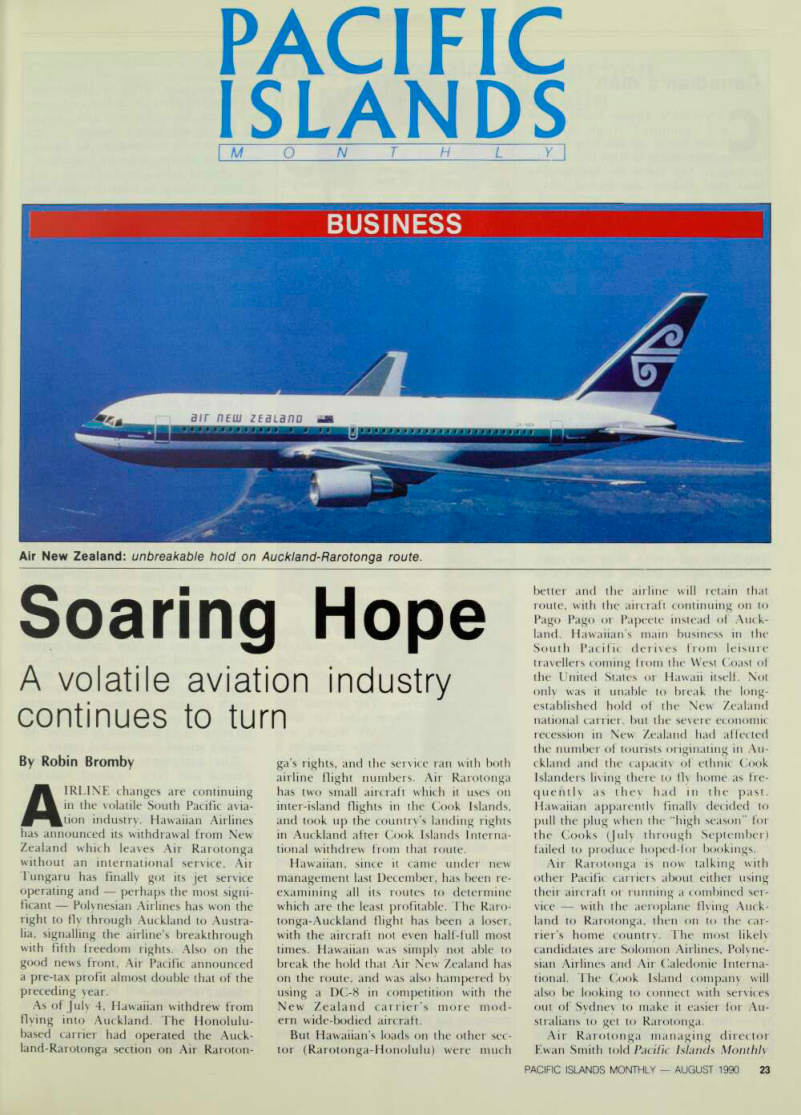
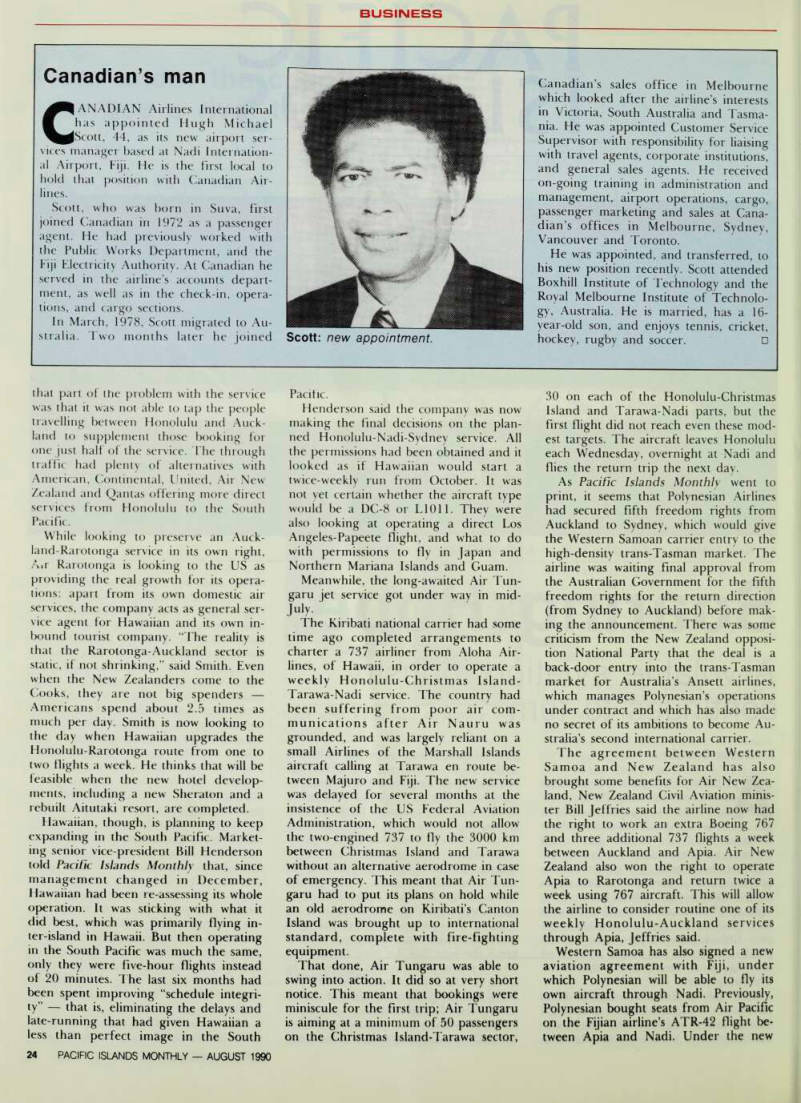
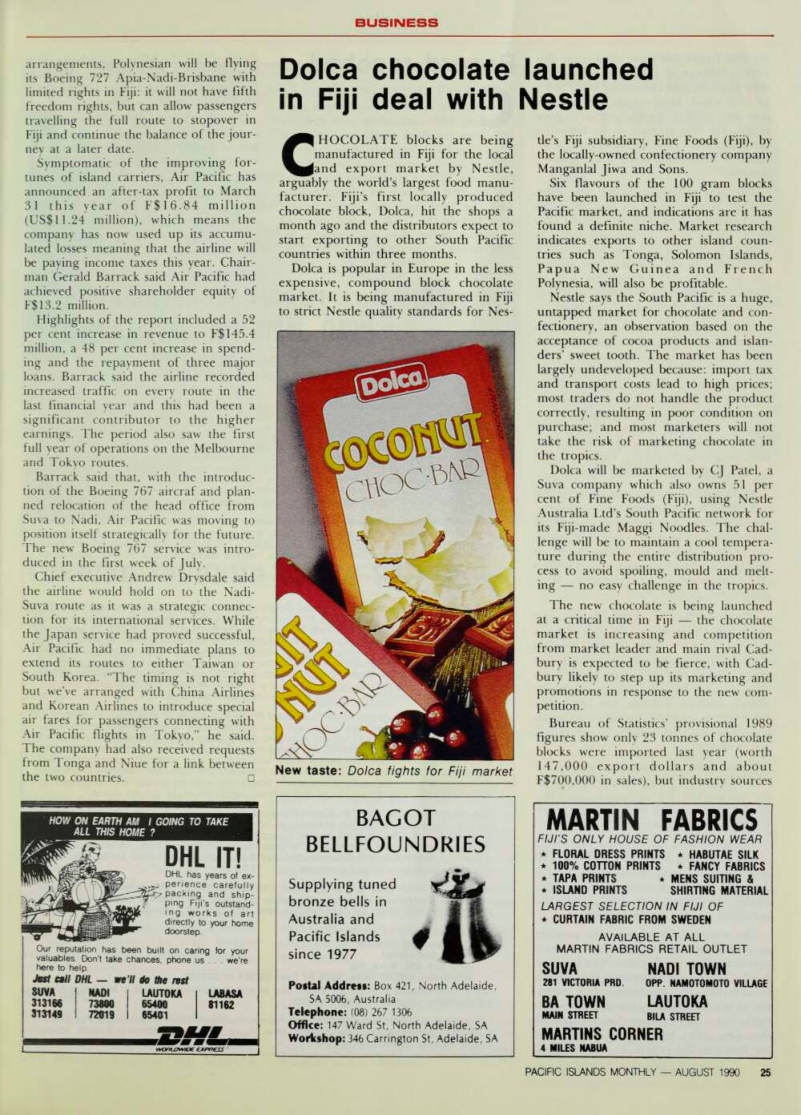
Business
A volatile aviation industry continues to turn
By Robin Bromby
AIRLINE changes are continuing
in the volatile South Pacific avia tion industry. Hawaiian Airlines has announced its withdrawal from New' Zealand which leaves Air Rarotonga without an international service, Air Tungaru has finally got its jet service
operating and perhaps the most signi
ficant Polynesian Airlines has won the right to fly through Auckland to Austra lia, signalling the airline’s breakthrough with fifth freedom rights. Also on the good news front, Air Pacific announced a pre-tax profit almost double that of the
preceding year.
As of July 4, Hawaiian withdrew from flying into Auckland. The Honolulu based carrier had operated the Auck land-Rarotonga section on Air Raroton
ga’s rights, and the service ran with both airline flight numbers. Air Rarotonga has two small aircraft which it uses on inter-island flights in the Cook Islands, and took up the country’s landing rights in Auckland after Cook Islands International withdrew from that route.
Hawaiian, since it came under new management last December, has been reexamining all its routes to determine which are the least profitable. The Rarotonga-Auckland flight has been a loser, with the aircraft not even half-full most times. Hawaiian was simply not able to break the hold that Air New Zealand has on the route, and was also hampered by using a DC-8 in competition with the New Zealand carrier’s more modern wide-bodied aircraft.
But Hawaiian’s loads on the other sector (Rarotonga-Honolulu) were much
better and the airline will retain that route, with the aircraft continuing on to Pago Pago or Papeete instead of Auck land. Hawaiian’s main business in the South Pacific derives from leisure travellers coming from the West Coast of the United States or Hawaii itself. Not only was it unable to break the long established hold of the New Zealand national carrier, but the severe economic recession in New' Zealand had affected the number of tourists originating in Au ckland and the capacity of ethnic Cook Islanders living there to fly home as fre quently as they had in the past.
Hawaiian apparentlv finally decided to pull the plug when the “high season” for the Cooks (July through September)
failed to produce hoped-for bookings.
Air Rarotonga is now talking with other Pacific carriers about either using their aircraft or running a combined ser vice with the aeroplane flying Auck land to Rarotonga, then on to the car rier’s home country. The most likely candidates are Solomon Airlines, Polyne sian Airlines and Air Caledonie Interna tional. The Cook Island company will also be looking to connect with services out of Sydney to make it easier for Au stralians to get to Rarotonga.
Air Rarotonga managing director Ewan Smith told Pacific Islands Monthly
that part of the problem with the service was that it was not able to tap the people travelling between Honolulu and Auck land to supplement those booking for one just half of the service. The through traffic had plenty of alternatives with American, Continental, United, Air New Zealand and Qantas offering more direct services from Honolulu to the South Pacific.
While looking to preserve an Auck land-Rarotonga service in its own right, A.r Rarotonga is looking to the US as providing the real growth for its opera tions; apart from its own domestic air services, the company acts as general ser vice agent for Hawaiian and its own in bound tourist company. “The reality is that the Rarotonga-Auckland sector is static, if not shrinking,” said Smith. Even when the New Zealanders come to the Cooks, they are not big spenders Americans spend about 2.5 times as much per day. Smith is now looking to the day when Hawaiian upgrades the Honolulu-Rarotonga route from one to two flights a week. He thinks that will be feasible when the new hotel develop ments, including a new Sheraton and a rebuilt Aitutaki resort, are completed.
Hawaiian, though, is planning to keep
expanding in the South Pacific. Market ing senior vice-president Bill Henderson told Pacific Islands Monthly that, since management changed in December, Hawaiian had been re-assessing its whole operation. It was sticking with what it did best, which was primarily flying in ter-island in Hawaii. But then operating in the South Pacific was much the same,
only they were five-hour flights instead
of 20 minutes. The last six months had been spent improving “schedule integri ty” that is, eliminating the delays and late-running that had given Hawaiian a less than perfect image in the South
Pacific.
Henderson said the company was now making the final decisions on the plan ned Honolulu-Nadi-Sydney service. All the permissions had been obtained and it looked as if Hawaiian would start a twice-weekly run from October. It was not yet certain whether the aircraft type would be a DC-8 or LlOll. They were also looking at operating a direct Los Angeles-Papeete flight, and what to do with permissions to fly in Japan and Northern Mariana Islands and Guam.
Meanwhile, the long-awaited Air Tun garu jet service got under way in mid- J ul Y- The Kiribati national carrier had some time ago completed arrangements to charter a 737 airliner from Aloha Air lines, of Hawaii, in order to operate a weekly Honolulu-Christmas Island- Tarawa-Nadi service. The country had been suffering from poor air com munications after Air Nauru was grounded, and was largely reliant on a small Airlines of the Marshall Islands aircraft calling at Tarawa en route be tween Majuro and Fiji. The new service was delayed for several months at the insistence of the US Federal Aviation Administration, which would not allow the two-engined 737 to fly the 3000 km between Christmas Island and Tarawa without an alternative aerodrome in case of emergency. This meant that Air Tun garu had to put its plans on hold while an old aerodrome on Kiribati’s Canton Island was brought up to international
standard, complete with fire-fighting
equipment.
That done, Air Tungaru was able to swing into action. It did so at very short notice. This meant that bookings were miniscule for the first trip; Air Tungaru is aiming at a minimum of 50 passengers on the Christmas Island-Tarawa sector,
30 on each of the Honolulu-Christmas Island and Tarawa-Nadi parts, but the first flight did not reach even these mod est targets. The aircraft leaves Honolulu each Wednesday, overnight at Nadi and flies the return trip the next day.
As Pacific Islands Monthly went to print, it seems that Polynesian Airlines had secured fifth freedom rights from Auckland to Sydney, which would give the Western Samoan carrier entry to the high-density trans-Tasman market. The airline was waiting final approval from the Australian Government for the fifth freedom rights for the return direction (from Sydney to Auckland) before mak ing the announcement. There was some criticism from the New Zealand opposi tion National Party that the deal is a back-door entry into the trans-Tasman market for Australia’s Ansett airlines,
which manages Polynesian’s operations
under contract and which has also made no secret of its ambitions to become Au stralia’s second international carrier.
The agreement between Western Samoa and New Zealand has also brought some benefits for Air New Zea land, New Zealand Civil Aviation minis ter Bill Jeffries said the airline now had the right to work an extra Boeing 767 and three additional 737 flights a week between Auckland and Apia. Air New Zealand also won the right to operate Apia to Rarotonga and return twice a week using 767 aircraft. This will allow the airline to consider routine one of its weekly Honolulu-Auckland services
through Apia, Jeffries said.
Western Samoa has also signed a new aviation agreement with Fiji, under which Polynesian will be able to fly its own aircraft through Nadi. Previously, Polynesian bought seats from Air Pacific on the Fijian airline’s ATR-42 flight be tween Apia and Nadi. Under the new
arrangements, Polynesian will be flying its Boeing 727 Apia-Nadi-Brisbane with limited rights in Fiji: it will not have fifth freedom rights, but can allow passengers travelling the full route to stopover in Fiji and continue the balance of the jour ney at a later date.
Symptomatic of the improving for tunes of island carriers, Air Pacific has announced an after-tax profit to March 31 this year of F 516.84 million (U 5511.24 million), which means the company has now used up its accumu lated losses meaning that the airline will be paying income taxes this year. Chair man Gerald Barrack said Air Pacific had achieved positive shareholder equity of F 513.2 million.
Highlights of the report included a 52 per cent increase in revenue to F$ 145.4 million, a 48 per cent increase in spend ing and the repayment of three major loans. Barrack said the airline recorded increased traffic on every route in the last financial year and this had been a significant contributor to the higher earnings. The period also saw the first full year of operations on the Melbourne and Tokyo routes.
Barrack said that, with the introduc tion of the Boeing 767 aircraf and plan ned relocation of the head office from Suva to Nadi, Air Pacific was moving to position itself strategically for the future.
The new Boeing 767 service was intro duced in the first week of July.
Chief executive Andrew Drysdale said the airline would hold on to the Nadi- Suva route as it was a strategic connec tion for its international services. While the Japan service had proved successful, Air Pacific had no immediate plans to extend its routes to either Taiwan or South Korea. “The timing is not right but we’ve arranged with China Airlines and Korean Airlines to introduce special air fares for passengers connecting with Air Pacific flights in Tokyo,” he said.
The company had also received requests from Tonga and Niue for a link between the two countries. □
Canadian’s man
CANADIAN Airlines International has appointed Hugh Michael Scott, 44, as its new airport ser vices manager based at Nadi Internation al Airport, Fiji. He is the first local to hold that position with Canadian Air lines.
Scott, who was born in Suva, first joined Canadian in 1972 as a passenger agent. He had previously worked with the Public Works Department, and the Fiji Electricity Authority. At Canadian he served in the airline’s accounts depart ment, as well as in the check-in, opera tions, and cargo sections.
In March, 1978, Scott migrated to Au stralia. Two months later he joined
Canadian’s sales office in Melbourne which looked after the airline’s interests in Victoria, South Australia and Tasma nia. He was appointed Customer Service Supervisor with responsibility for liaising with travel agents, corporate institutions, and general sales agents. He received on-going training in administration and management, airport operations, cargo, passenger marketing and sales at Cana dian’s offices in Melbourne, Sydney, Vancouver and Toronto.
He was appointed, and transferred, to his new position recently. Scott attended Boxhill Institute of Technology and the Royal Melbourne Institute of Technolo gy, Australia. He is married, has a 16year-old son, and enjoys tennis, cricket, hockey, rugby and soccer. □
Scott: new appointment.
Advertisements & other items, p. 24 (1 item)
Business
Dolca chocolate launched
in Fiji deal with Nestle
CHOCOLATE blocks are being
manufactured in Fiji for the local and export market by Nestle, arguably the world’s largest food manu facturer. Fiji’s first locally produced chocolate block, Dolca, hit the shops a month ago and the distributors expect to start exporting to other South Pacific countries within three months.
Dolca is popular in Europe in the less expensive, compound block chocolate market. It is being manufactured in Fiji to strict Nestle quality standards for Nes-
tie’s Fiji subsidiary, Fine Foods (Fiji), by
the locally-owned confectionery company
Manganlal Jiwa and Sons.
Six flavours of the 100 gram blocks have been launched in Fiji to test the Pacific market, and indications are it has found a definite niche. Market research indicates exports to other island coun tries such as Tonga, Solomon Islands, Papua New Guinea and French Polynesia, will also be profitable.
Nestle says the South Pacific is a huge, untapped market for chocolate and con fectionery, an observation based on the acceptance of cocoa products and islan ders’ sweet tooth. The market has been
largely undeveloped because: import tax
and transport costs lead to high prices; most traders do not handle the product correctly, resulting in poor condition on purchase; and most marketers will not take the risk of marketing chocolate in
the tropics.
Dolca will be marketed by CJ Patel, a Suva company which also owns 51 per cent of Fine Foods (Fiji), using Nestle Australia Ltd’s South Pacific network for its Fiji-made Maggi Noodles. The chal lenge will be to maintain a cool tempera ture during the entire distribution pro cess to avoid spoiling, mould and melt ing no easy challenge in the tropics.
The new chocolate is being launched at a critical time in Fiji the chocolate market is increasing and competition from market leader and main rival Cad bury is expected to be fierce, with Cad bury likely to step up its marketing and promotions in response to the new com petition.
Bureau of Statistics’ provisional 1989 figures show only 23 tonnes of chocolate blocks were imported last year (worth 147,000 export dollars and about F 5700,000 in sales), but industry sources
New taste: Dolca fights for Fiji market
say that figure will more than triple this year following a reduction of import duty over the last 12 months from 120% to 55% which has brought the product into the average income earner’s price range. Fiji also appears to be following the Australian trend to eat chocolate in stead of lollies and other sugar confec
tionery.
The duty reduction means consumers pay an average of $2.20 for 100 gram blocks of imported chocolate, giving Dol ca a slight price advantage with its launch price of $1.79. Market research shows price is not a vital factor around the $2 range, so competition will be based on quality and freshness, with Dol ca having the advantage in the latter.
CJ Patel initially aim to get Dolca into 80 per cent of Fiji’s retail outlets through their extensive marketing network then extend it to all outlets. They have laun ched a dynamic media and point-of-sale campaign with display material in all ma jor supermarkets, snack bars and grocery outlets, and public relations and prom otional activities such as give-away sam ples, posters and stickers. Dolca will also sponsor sporting and other events.
Nestle’s decision to manufacture in Fiji was based on evaluation and considera tion of the market potential, investment environment, cost and efficient of work ers, geographic position of the factory in the region, financial and port facilities and confidence in local partners Man ganlal Jiwa and CJ Patel.
Manganlal Jiwa, the confectionery and snack manufacturer of Ba that exports to over 20 countries, bought Nestle’s New Zealand equipment to produce 100 gram blocks. The 100 gram block is vi able in the islands, where Cadbury already markets a similar size block, but no longer has a good market in Australia and New Zealand, where larger blocks are preferred.
Nestle have a co-packing agreement
with Manganlal Jiwa whereby Nestle set
the parameters for operation, provides all the raw materials and packaging and monitors quality control.
The machinery can produce one tonne of chocolate an hour 10,000 x 100 gram blocks over twenty times the Fiji domestic market. It is anticipated that a 10-day production run will supply the predicted market for three months.
The venture may also be the prelude to producing the higher quality, more expensive Nestle chocolate blocks. Fine Foods, Nestle and Manganlal Jiwa expect to introduce the technology and exper tise to produce Nestle chocolate, which is made from cocoa rather than compound chocolate, after building up the market for Dolca in the region. □
Advertisements & other items, p. 25 (2 items)
Dhl It!
HOW ON EARTH AM I GOING TO TAKE
ALL THIS HOME ?
w.
DHL IT!
DHL has years of experience carefully packing and shipping Fiji's outstanding works of art directly to your home doorstep.
Our reputation has been built on caring for your valuables Don't take chances, phone us . . we're here to help.
Jest call DHL we ll do the rest
SUVA
313166 313149
Martin Fabrics
BAGOT
BELLFOUNDRIES
Supplying tuned
bronze bells in Australia and Pacific Islands since 1977 Postal Address: Box 421, North Adelaide, SA 5006, Australia Telephone: (08) 267 1306 Office: 147 Ward St, North Adelaide, SA Workshop: 346 Carrington St, Adelaide, SA
MARTIN FABRICS
FIJI’S ONLY HOUSE OF FASHION WEAR
* FLORAL DRESS PRINTS * HABUTAE SILK * 100% COTTON PRINTS * FANCY FABRICS * TAPA PRINTS * MENS SUITING &
* ISLAND PRINTS SHIRTING MATERIAL
LARGEST SELECTION IN FIJI OF
* CURTAIN FABRIC FROM SWEDEN
AVAILABLE AT ALL
MARTIN FABRICS RETAIL OUTLET
SUVA NADI TOWN
281 VICTORIA PRD. OPP. NAMOTOMOTO VILLAGE
BA TOWN LAUTOKA
MAIN STREET BILA STREET
MARTINS CORNER
4 MILES NABUA
Record reached
Construction activity in
Hawaii reached record levels dur ing 1989, according to a new re port from the Bank of Hawaii. The total value of private construction permits was US$l.9 billion, an increase of 20.1 per cent over 1988. Construction completed was up 26.3 per cent to US$3.2 billion.
And the bank said the higher figures were largely the result of real increases in output rather than just higher costs.
Jobs in the sector went up by 6000, in
dicating that the efforts to achieve very large production increase were the cause for such aggressive hiring with virtually no available labour supply.
The bank said the “phenomenal” strength of Hawaii’s construction boom has exceeded its economic department’s expectations each year since 1985.
“Construction activity in the state has now surpassed all previous peaks in the construction cycle,” said Bank of Hawaii.
“There is enough momentum in current trends to produce moderate growth in construction activity through 1991.” □
Advertisements & other items, p. 26 (1 item)
W Programme
FORUM SECRETARIAT
\ / HEAD, MARITIME DEVELOPMENT
Applications are invited from suitably qualified and experienced persons, who must be citizens of a member country* of the South Pacific Forum, for the position of Head of the Forum Secretariat’s Maritime Development Programme.
The Forum Secreriat was established in 1973 by the South Pacific Forum to encourage economic and political cooperation between its member states, and between those states and the more industrialised countries. Under the control of the Secretary General the Secretariat undertakes a regional programme covering economic services, legal and political services, energy tourism, trade, transport and telecommunictions sector. The Secretariat also has significant responsibilities with regard to ACP/EC regional projects funded under Lome Convention.
The Maritime Division implements and administers a range of maritime development assistance programmes aimed at increasing the ability of Forum Island Countries to plan and manage their national maritime sectors. The Division also assists in coordinating the development assistance activities of other organisations in the region's maritime sector, provides technical assistance/ short term consultancy advice to Forum Island Countries and disseminates maritime information, The Division also coordinates and liaises with Pacific Forum Line on shipping matters concerning PFL in the region.
The Head of the Maritime Development Programme is responsible to the Secretary General, through the Director of Programmes, for directing the work of the Division and administering its various maritime programme activities. More specifically, the Head is responsible for encouraging donor agencies to take up and provide funding for the projects identified, coordinating the South Pacific Maritime Development Plan activities; liaising and communicating with donor agencies, the SPMDP Management Group of the Forum Secretariat and the Regional Shipping Council, travel to all the Forum countries to encourage regional cooperation on maritime matters and manage the day to day administrative and financial details of the consultancy contracts executed to implement the Division’s projects under its Work Programme.
Applicants should have proven ability to direct the work of a team of specialists. Experience in administering maritime-related or similar technical programmes in developing countries would be highly regarded as would relevant academic qualifications, say in Economics, Development Planning or in Law with subsequent and substantive administrative/management experience. An ability to liaise effectively at senior levels with member and supporting governments and organisations, and with a wide range of people throughout the region and elsewhere is required.
Preference will also be given to applicants possessing a sound general knowledge and an appreciation of the economic, social and political aspirations of the Forum's region.
This appointment will carry an attractive remuneration package, payable in Fiji dollars. For non-Fiji citizens this is tax free and includes housing or a housing allowance, education and child allowances. Other benefits include superannuation payments and medical, life and travel insurance coverage. The appointee will be based at the Secretariat's Headquarters in Suva, Fiji but will be required to undertake periodic duty travel. Appointment would be for three years initially, renewable by mutual agreement.
Applications, which close on 15 September 1990 should contain full information on education and career background and should list names, addresses and telephone numbers of at least three referees with whom the applicant has been associated in a professional capacity.
Applications should be addressed to: The Secretary General Forum Secretariat GPO Box 856, Suva, Fiji Telephone 312600 Telex: 2229 FJ Fax: 302204 or 301102 Further information is available on request and all enquiries should be made to Mrs Lailun Khan, Administration Officer on 312600 Ext 220. * Member countries are: Australia, Cook Islands, Federated States of Micronesia, Fiji, Kiribati, Marshall Islands, Nauru, New Zealand, Niue, Papua New Guinea, Solomon Islands, Tonga, Tuvalu, Vanuatu and Western Samoa.
Tokelau revenue totals $4.72m
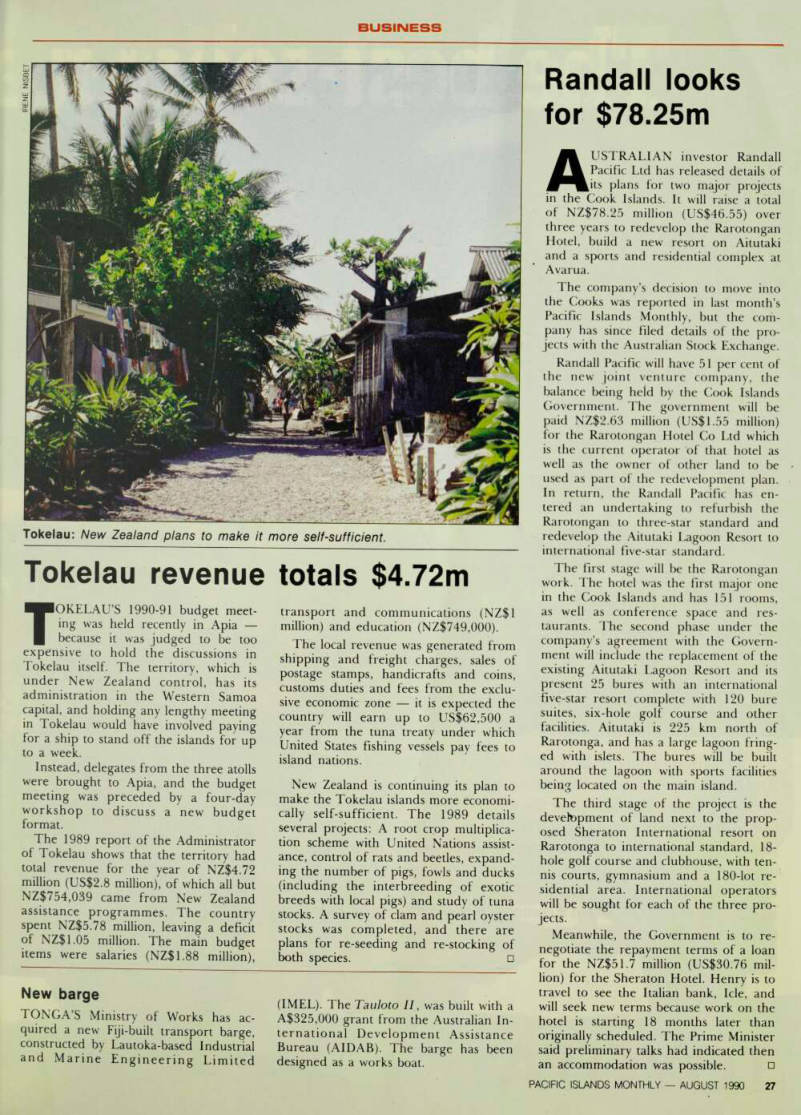
TOKELAU’S 1990-91 budget meet
ing was held recently in Apia because it was judged to be too expensive to hold the discussions in Tokelau itself. The territory, which is under New Zealand control, has its administration in the Western Samoa
capital, and holding any lengthy meeting
in Tokelau would have involved paying for a ship to stand off the islands for up to a week.
Instead, delegates from the three atolls were brought to Apia, and the budget meeting was preceded by a four-day workshop to discuss a new budget format.
The 1989 report of the Administrator of Tokelau shows that the territory had total revenue for the year of NZ54.72 million (US$2.B million), of which all but NZ5754,039 came from New Zealand assistance programmes. The country spent NZ$5.7B million, leaving a deficit of NZ$l.O5 million. The main budget items were salaries (NZ$l.BB million),
transport and communications (NZ$l million) and education (NZ5749,000).
The local revenue was generated from
shipping and freight charges, sales of
postage stamps, handicrafts and coins, customs duties and fees from the exclu sive economic zone it is expected the country will earn up to U 5562,500 a year from the tuna treaty under which United States fishing vessels pay fees to island nations.
New Zealand is continuing its plan to make the Tokelau islands more economi cally self-sufficient. The 1989 details several projects: A root crop multiplica tion scheme with United Nations assist ance, control of rats and beetles, expand ing the number of pigs, fowls and ducks (including the interbreeding of exotic breeds with local pigs) and study of tuna stocks. A survey of clam and pearl oyster stocks was completed, and there are plans for re-seeding and re-stocking of both species. □
Tokelau: New Zealand plans to make it more self-sufficient.
New barge
TONGA’S Ministry of Works has ac quired a new Fiji-built transport barge, constructed by Lautoka-based Industrial and Marine Engineering Limited
(IMEL). The Tauloto //, was built with a A 5325,000 grant from the Australian In ternational Development Assistance Bureau (AIDAB). The barge has been designed as a works boat.
for $78.25m


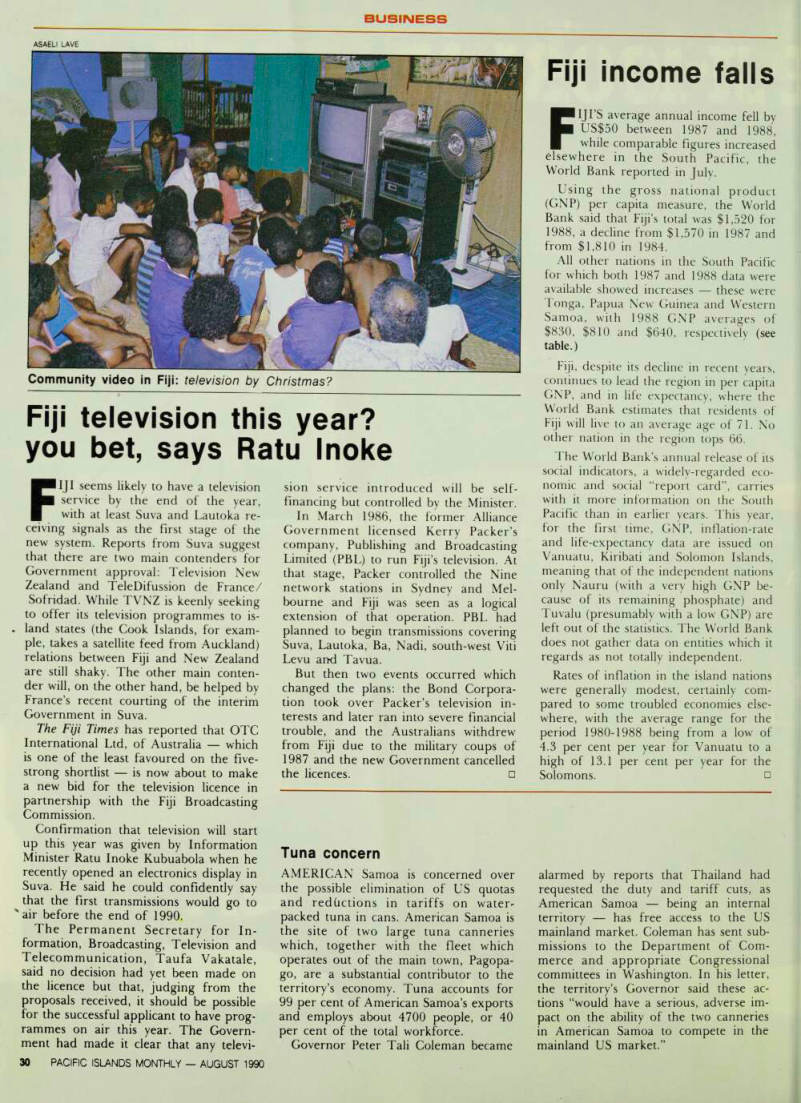
Randall looks for $78.25m
AUSTRALIAN investor Randall Pacific Ltd has released details of its plans for two major projects in the Cook Islands. It will raise a total of NZ578.25 million (U 5546.55) over three years to redevelop the Rarotongan Hotel, build a new resort on Aitutaki and a sports and residential complex at Avarua.
The company’s decision to move into the Cooks was reported in last month’s Pacific Islands Monthly, but the com pany has since filed details of the pro jects with the Australian Stock Exchange.
Randall Pacific will have 51 per cent of the new joint venture company, the balance being held by the Cook Islands Government. The government will be paid NZ52.63 million (US$l.55 million) for the Rarotongan Hotel Co Ltd which is the current operator of that hotel as well as the owner of other land to be used as part of the redevelopment plan.
In return, the Randall Pacific has en tered an undertaking to refurbish the Rarotongan to three-star standard and redevelop the Aitutaki Lagoon Resort to international five-star standard.
The first stage will be the Rarotongan work. The hotel was the first major one in the Cook Islands and has 151 rooms, as well as conference space and res taurants. The second phase under the company’s agreement with the Govern ment will include the replacement of the existing Aitutaki Lagoon Resort and its present 25 bures with an international five-star resort complete with 120 bure suites, six-hole golf course and other facilities. Aitutaki is 225 km north of Rarotonga, and has a large lagoon fring ed with islets. The bures will be built around the lagoon with sports facilities being located on the main island.
The third stage of the project is the development of land next to the prop osed Sheraton International resort on Rarotonga to international standard, 18hole golf course and clubhouse, with ten nis courts, gymnasium and a 180-lot re sidential area. International operators will be sought for each of the three pro jects.
Meanwhile, the Government is to re negotiate the repayment terms of a loan for the NZ$5l.7 million (U 5530.76 mil lion) for the Sheraton Hotel. Henry is to travel to see the Italian bank, Icle, and will seek new terms because work on the hotel is starting 18 months later than originally scheduled. The Prime Minister said preliminary talks had indicated then an accommodation was possible. □
Asaeli Lave
Community video In Fiji: television by Christmas?
Advertisements & other items, pp. 28-29 (1 item)
Toyota
The Toyota Hilux is the world’s most popular pick-up.
And the Hilux 4X4 is the best-selling Hilux of them all. Which stands to reason. People around the world respect Toyota’s attention to style. Hilux’s car-like comfort. Rugged reliability. And as you might expect from Toyota, power. This, of course, is the most important asset for a truck. And happily, the Hilux 4X4 offers a choice of four powerful engines: 2.8 and 2.4-litre diesel engines. Plus 2.2 and 1.8-litre petrol engines. When it comes to power and good looks, nobody can beat Toyota. Nobody.
I Li * \ y % 'e i % V V I B
Fiji television this year?
you bet, says Ratu Inoke
FIJI seems likely to have a television service by the end of the year, with at least Suva and Lautoka re ceiving signals as the first stage of the new system. Reports from Suva suggest that there are two main contenders for Government approval: Television New Zealand and TeleDifussion de France/ Sofridad. While TVNZ is keenly seeking to offer its television programmes to is land states (the Cook Islands, for exam ple, takes a satellite feed from Auckland) relations between Fiji and New Zealand are still shaky. The other main conten der will, on the other hand, be helped by France’s recent courting of the interim Government in Suva.
The Fiji Times has reported that OTC International Ltd, of Australia which is one of the least favoured on the five strong shortlist is now about to make a new bid for the television licence in partnership with the Fiji Broadcasting Commission.
Confirmation that television will start up this year was given by Information Minister Ratu Inoke Kubuabola when he recently opened an electronics display in Suva. He said he could confidently say that the first transmissions would go to air before the end of 1990.
The Permanent Secretary for In formation, Broadcasting, Television and Telecommunication, Taufa Vakatale, said no decision had yet been made on the licence but that, judging from the proposals received, it should be possible for the successful applicant to have prog rammes on air this year. The Govern ment had made it clear that any televi
sion service introduced will be self financing but controlled by the Minister.
In March 1986, the former Alliance Government licensed Kerry Packer’s
company, Publishing and Broadcasting
Limited (PBL) to run Fiji’s television. At that stage, Packer controlled the Nine network stations in Sydney and Mel bourne and Fiji was seen as a logical extension of that operation. PBL had planned to begin transmissions covering Suva, Lautoka, Ba, Nadi, south-west Viti Levu and Tavua.
But then two events occurred which changed the plans: the Bond Corpora tion took over Packer’s television in terests and later ran into severe financial trouble, and the Australians withdrew from Fiji due to the military coups of 1987 and the new Government cancelled the licences. □
Fiji income falls
FIJI’S average annual income fell by US$5O between 1987 and 1988, while comparable figures increased elsewhere in the South Pacific, the World Bank reported in July.
Using the gross national product (GNP) per capita measure, the World Bank said that Fiji’s total was $1,520 for 1988, a decline from $1,570 in 1987 and from $l,BlO in 1984.
All other nations in the South Pacific for which both 1987 and 1988 data were available showed increases these were Tonga, Papua New Guinea and Western Samoa, with 1988 GNP averages of $B3O, $BlO and $640, respectively (see table.) Fiji, despite its decline in recent years, continues to lead the region in per capita GNP, and in life expectancy, where the World Bank estimates that residents of Fiji will live to an average age of 71. No other nation in the region tops 66.
The World Bank’s annual release of its social indicators, a widely-regarded eco nomic and social “report card”, carries with it more information on the South Pacific than in earlier years. This year, for the first time, GNP, inflation-rate and life-expectancy data are issued on Vanuatu, Kiribati and Solomon Islands, meaning that of the independent nations only Nauru (with a very high GNP be cause of its remaining phosphate) and Tuvalu (presumably with a low GNP) are left out of the statistics. The World Bank does not gather data on entities which it
regards as not totally independent.
Rates of inflation in the island nations were generally modest, certainly com pared to some troubled economies else where, with the average range for the period 1980-1988 being from a low of 4.3 per cent per year for Vanuatu to a high of 13.1 per cent per year for the Solomons. □
Tuna concern
AMERICAN Samoa is concerned over the possible elimination of US quotas and redtictions in tariffs on water packed tuna in cans. American Samoa is the site of two large tuna canneries which, together with the fleet which operates out of the main town, Pagopa go, are a substantial contributor to the territory’s economy. Tuna accounts for 99 per cent of American Samoa’s exports and employs about 4700 people, or 40 per cent of the total workforce.
Governor Peter Tali Coleman became
alarmed by reports that Thailand had requested the duty and tariff cuts, as American Samoa being an internal territory has free access to the US mainland market. Coleman has sent sub missions to the Department of Com
merce and appropriate Congressional
committees in Washington. In his letter, the territory’s Governor said these ac tions “would have a serious, adverse im pact on the ability of the two canneries in American Samoa to compete in the mainland US market.”
Papua New Guinea
Trade Winds
Fiji
Manufacturer slams protectionism FIJI’S manufacturing industry needed unrestricted and duty-free access to in ternational raw materials, said Fiji Trade and Investment Board member Robert Lee in a paper delivered recently in Nadi. Lee, a director of Lees Trading Co, of Suva, said the Government’s poli cy of protecting local raw material sup pliers had been disastrous in its effects, causing escalating costs and creating highly inefficient but large profitable companies in Fiji. “Unless this constraint is removed, manufacturing will continue to be commodity-based with very little value-added and very little potential for sustained export,” said Lee.
Pine Commission’s going private THE Fiji Pine Commission plans to form a limited liability company by the end of August, and be ready for full privatisa tion by the end of the year. The commis sion has been working on issues relating to landowners and extension forest own ers so that the relationships are settled by the time Fii Pine Ltd is up and run
ning.
Australian companies angry AUSTRALIAN garment manufacturers are concerned over the substantial inflow of imports from Fiji, and have called on their government to curb what it sees as a threat. The Australian Textile Clothing and Footwear Council wants the Austra lian federal government to introduce measures to regulate the flow of gar ments from Fiji and has suggested a five per cent ceiling for Fiji products out of the garment imports into Australia.
Fijian to run luxury hotel A FIJIAN, Radike Qereqeretabua, has been appointed general manager of a five star, the 364-room Fijian Resort Hotel on the Coral Coast south of Nadi.
He began his hotel career in 1975 and was manager of the Fiji Mocambo in Nadi.
China to build towel factory A CHINESE company is to build and export towel from a factory under Fiji’s tax free zone system, with plans to manufacture 700,000 pieces a year. Chi na Huashi Enterprises will spend F 52.2 million (US$l.47 million) on the new plant, and will export hand towels, floor mats, face cloths and bathrobes to the United States and Australia. It is ex pected that about 160 people will be em
ployed in the factory.
Merchant Bank optimistic MERCHANT Bank of Fiji recorded more than Fsl million in new business during May, and say these trading re sults point to growing confidence both business and consumer in Fiji.
The company has experienced a steady
growth in the financing of new vehicles and equipment especially in the last three months.
Papua New Guinea
Radio hours under threat FINANCIAL problems may force the National Broadcasting Commission (NBC) to cut back its radio hours, said chairman Kedea Uru. The commission recently had its telephone and telex ser vices cut to incoming calls only after it failed to pay a K 57,000 (U 5554,000) bill from the Papua New Guinea Post and Telecommunication Corporation. Much of the money problems have been caused by the cost of installing new transmitters around the country the equipment was paid for by the Japanese Government, but the NBC had not budgetted for the installation costs which it had to meet.
Copra prices down again PAPUA New Guinea copra growers are facing even tougher times with the price for July being marked down K 4 a tonne, which followed a massive Kll a tonne drop in June. In the first half of 1990, copra prices at the main depots have dropped from K 285 per tonne to K 205
for top grades. Copra Marketing Board
chairman Sir John Guise once again pleaded with all growers to continue producing the crop so that the board could meet its contractual obligations to buyers in London, Europe and Asia.
Samoa
Suits filed against canneries AMERICAN Samoan Attorney-General Tautai Aviata Fa’alevao has announced his department has settled recent legal action against the two local tuna canner ies —Starkist Samoa and VCS Samoa Packing for allegedly polluting Pago Pago Harbour. Both companies indi cated they would settle the suits. The canneries have undertaken to pay sub stantial fines for violating local regula tions US$l5O,OOO in the case of Star kist, US$lOO,OOO from Samoa Packing.
They will also spend money on cleaning the harbour, and will begin separating waste out of water discharges, with the waste being pumped on to a new barge which in turn will take it for dumping off the coast of Tutuila.
New ferry service starts A NEW inter-island ferry service was due to begin operations in Western
Samoa by early August. The Western
Samoa Shipping Corporation has bought
the 150-passenger ferry Te Kotuku from the Pakatoa Ferry Services in Auckland, and the vessel will run between Mulifa nua, west of Apia, to Salelologa on Savai’i. The trip is expected to take ab out 50 minutes. The vessel cost the cor poration NZ5490,000 (U 55291,550).
Radio boosts signal WESTERN Samoa’s radio station, 2AP, has installed two new 10 kilowatt trans mitters to boost its signal throughout the country. The equipment, plus a new 120-metre tall mast, was part of a WS$l million (U 55424,800) aid package from Australia. The fate of the old transmitter is being discussed, and there have been suggestions it be kept as a backup for emergencies. Station 2AP was established by New Zealand administrators in 1948.
Solomon Islands
Plan to export ngali nuts
SOLOMON Islands’ Commodity Export
Marketing Authority (CEMA) is investi
gating the market for exporting ngali
nuts, to be marketed as a healthy type of
confectionery. A small processing factory
is to be established in Honiara, where employees will crack the nuts by hand and then package the kernels. Because the ngali is unknown outside the coun try, it will be marketed abroad as Solo mon Nuts with promotion concentrating
on the fact that the ngali grows naturally in Solomon Islands forests and are har vested by hand. It is expected that most foreign sales will be for the Christmas market. There will also be a grading sys tem with prices ranging from 60 cents to 25 cents a kilogram which it is hoped will encourage farmers to supply only top quality nuts.
New standards for wildlife exports WILDLIFE exports from the Solomon Islands may be subject to new regula tions which will provide standards for packing, following reports that some birds and reptiles are now not surviving en route to their destinations. The Ministry of Natural Resources has sent a report to the Cabinet with a list of re commendations; at the moment, there is no legislation governing the way the animals are packed. It has been reported that between 80 and 150 reptiles a week are exported from the Solomon Islands.
Grant for fish marketing A GRANT of U 55360,000 is being made by the United States Government to help Solomon Islands fishermen increase their income. The money will be used to help set up fish marketing centres or upgrade existing ones in seven provinces at Korovou on Shortland Island, Marau in East Guadalcanal, Star Har bour in East Makira, Lavangu in Ren nell, Atori in North Malaita, Reef Islands on Temotu and the moving of a centre from Kaolo to Buala in Isabel.
Japanese takeover
JAPANESE interests have now en tered the Papua New Guinea oil exploration scene with the giant Mitsubishi company having taken control of a minority partner in the Kutubu oil venture a project which includes the rich lagifu-Hedinia field in Southern
Highlands Province.
Mitsubishi will pay US$75 million for all the shares in the United States-based Merlin Petroleum Co, which in turn has a 6.25 per cent share in Kutubu. The deal involves buying 79.5 per cent of
Merlin’s stock from the former controll ing shareholder, the troubled Bond Cor poration, of Australia, for U 5559.6 mil lion. The deal involves a substantial loss for Bond, which paid SUS9O.B million for the stake back in April 1987.
Merlin also holds a 12.5 per cent in terest in PPL 101, another onshore li cence area in Papua New Guinea; this has so far proved prospective only for gas.
Australian analysts have valued Merlin at just under US$BO million, which sug gests that Mitsubishi Oil has negotiated a
bargain. □
Nauru phosphate dilemma
NAURU is expecting phosphate
income to fall during the com ing year, placing further strains on its already stretched budget. The main cause of the expected shortfall is a drop in demand for phosphate in Au stralia, Nauru’s main customer, resulting in exports to that country of about 500,000 tonnes half the previous year’s total.
Finance Minister Kinza Clodumar said in a recent economic report that he was
now expecting phosphate royalties to
drop from As3s million (U 5527.28 mil lion) to As2s million. He said this will force the Government to find other ways of financing its budget deficit, as hopes
are not high for increasing phosphate
sales to New Zealand and South Korea.
Nauru’s budget this year provides for total spending of A 571.2 million (U 5556.6 million). Allowing As2s mil lion in the form of phosphate royalties, Nauru could also expect to receive A 534.4 million from Air Nauru and
A 56.2 million from other sources, the report said. This would leave a deficit of about A 55.6 million.
The report said the Government plan ned to invest further money in Air Nauru this year but will not re-open di plomatic missions in Hong Kong, Amer ican Samoa, Japan, Hawaii and the Cook Islands. But it expects to launch a televi sion service on the 21 sq km island.
Meanwhile, The Dominion newspaper in Wellington, reports that the Nauru Government is considering setting up a small processing plant on the island as an alternative to exporting the raw mate rial. The plan includes the shipping from Australia of sulphuric acid part of the processing method in giant rubber bladders. The move towards set ting up the mini-plant is reported to have been considered by the Govern ment’s engineering advisors. The study arose out of frustration on Nauru that the island nation was not receiving a fair price for its rock phosphate exports. □
The mackerel war
A CHILEAN exporter is trying to carve out a share of the K6O mil lion (U 5558.25 million) market for canned fish in Papua New Guinea.
The company, Pesquera San Jose, is re leasing its Gold Medal brand of tinned mackerel initially in Port Moresby and Lae, and is pitching its price to meet a sales target of 806,000 425 gram cans within six months.
The price is to be set at about 60 toea for the first two months, but then will go up only 4t making Gold Medal prob ably the cheapest brand on the market, according to the local importer. Price is a crucial factor in any market, but particu larly so in Papua New Guinea when low local wages are combined with a rapidly
growing cost of living.
The general manager of the promo ters, DDA Savi Advertising, Rod Miller, said San Jose was committed to the pro duct’s success in Papua New Guinea af ter spending a great deal of money to research the market and the local eating habits. He said Papua New Guinea is the world’s second largest consumer of tin ned fish, buying 120 million cans a year.
The Chilean company aims to have the Gold Medal brand available through out Papua New Guinea, and will prog ressively distribute the product to all
coastal and highlands regions, selling
both through supermarkets and small trade stores. The company wants to be come the preferred mass market brand of tinned fish in Papua New Guinea. □
Forward drive in Marianas
THE 1991 budget announced by
Northern Marianas Governor Lorenzo Guerrero signals a furth er move toward economic self-sufficiency as Covenant Fund operations the money provided by the United States to underpin the budget totals just US$ll million out of a total Commonwealth spending of U 55138.42 million.
Nearly half the 1991 budget allocation goes to the five areas of the Common wealth of the Northern Marianas (CNMI) Government has designated as high priority; health and environmental services ($27.61 million), public school system ($22 million), public safety ($8.27 million), utilities ($3.94 million) and re tirement ($1 million). In his budget mes sage to the seventh CNMI legislature, Guerrero said local resources projected for 1991 reflected an increase of $17.07 million, or 16.5 per cent over fiscal 1990.
Covenant funding was down $5 million, but local revenue increases will more than offset that reduction. “The favour able or positive financial projected for fiscal year 1991 truly demonstrates the
commitment of the Commonwealth of the Northern Marianas Islands to aspire toward self-sufficiency,” the Governor said.
He said payroll and employee benefits represents 68 per cent of the total cost of government operations, with recent increases being due to higher retirement fund contributions and public service pay increases. Health costs were going to be watched closely, and efforts would be made to reduce the number of patients being referred overseas for treatment with the aim being to use savings in that area to buy more equipment for the Commonwealth Health Centre. The Government was committed to working toward the local education system being brought to the same standard as United States schooling. And, while the Com monwealth Utilities Corporation was re ceiving $3.9 million from public funds, the rates it is now charging for electric power would result in the corporation becoming self-supporting in the near fu ture. □
Advertisements & other items, p. 32 (1 item)
Trade Winds
Shipping
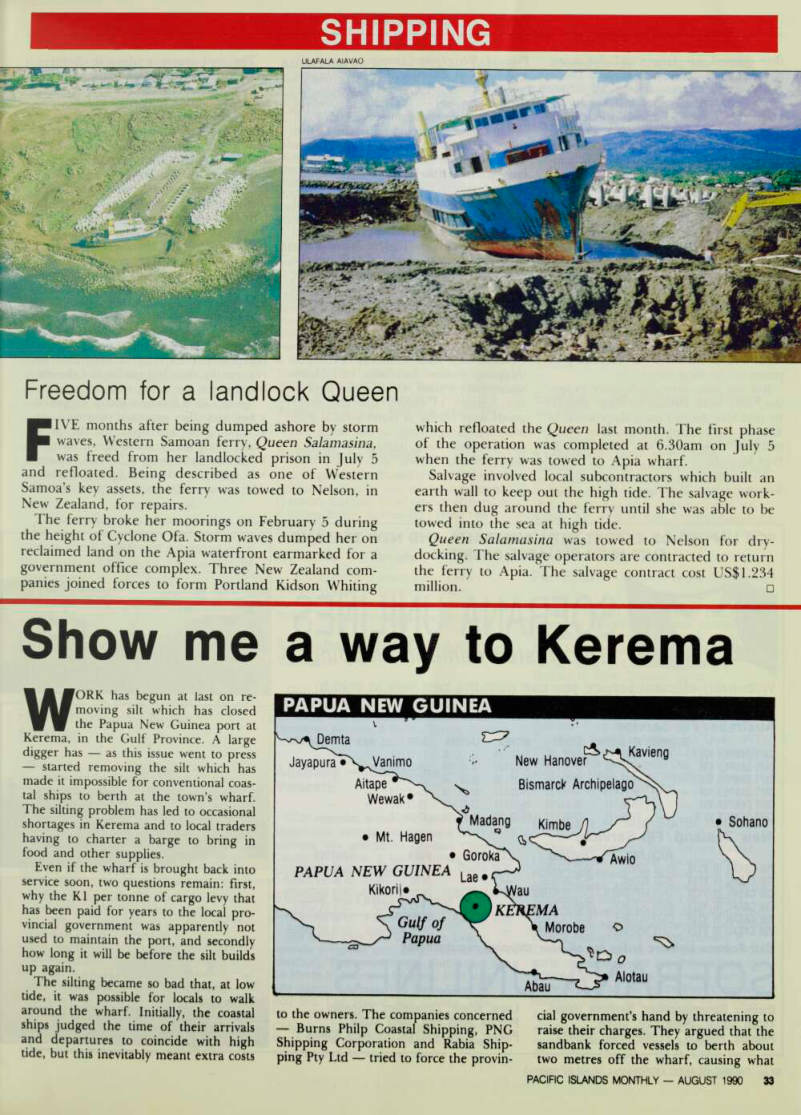
Freedom for a landlock Queen
FIVE months after being dumped ashore by storm waves, Western Samoan ferry, Queen Salamasina, was freed from her landlocked prison in July 5 and refloated. Being described as one of Western Samoa’s key assets, the ferry was towed to Nelson, in New Zealand, for repairs.
The ferry broke her moorings on February 5 during the height of Cyclone Ofa. Storm waves dumped her on reclaimed land on the Apia waterfront earmarked for a government office complex. Three New Zealand com panies joined forces to form Portland Kidson Whiting
which refloated the Queen last month. The first phase of the operation was completed at 6.30 am on July 5 when the ferry was towed to Apia wharf.
Salvage involved local subcontractors which built an earth wall to keep out the high tide. The salvage work ers then dug around the ferry until she was able to be towed into the sea at high tide.
Queen Salamasina was towed to Nelson for dry docking. The salvage operators are contracted to return the ferry to Apia. The salvage contract cost U 551,234 million. □
Ulafala Aiavao
Show me a way to Kerema
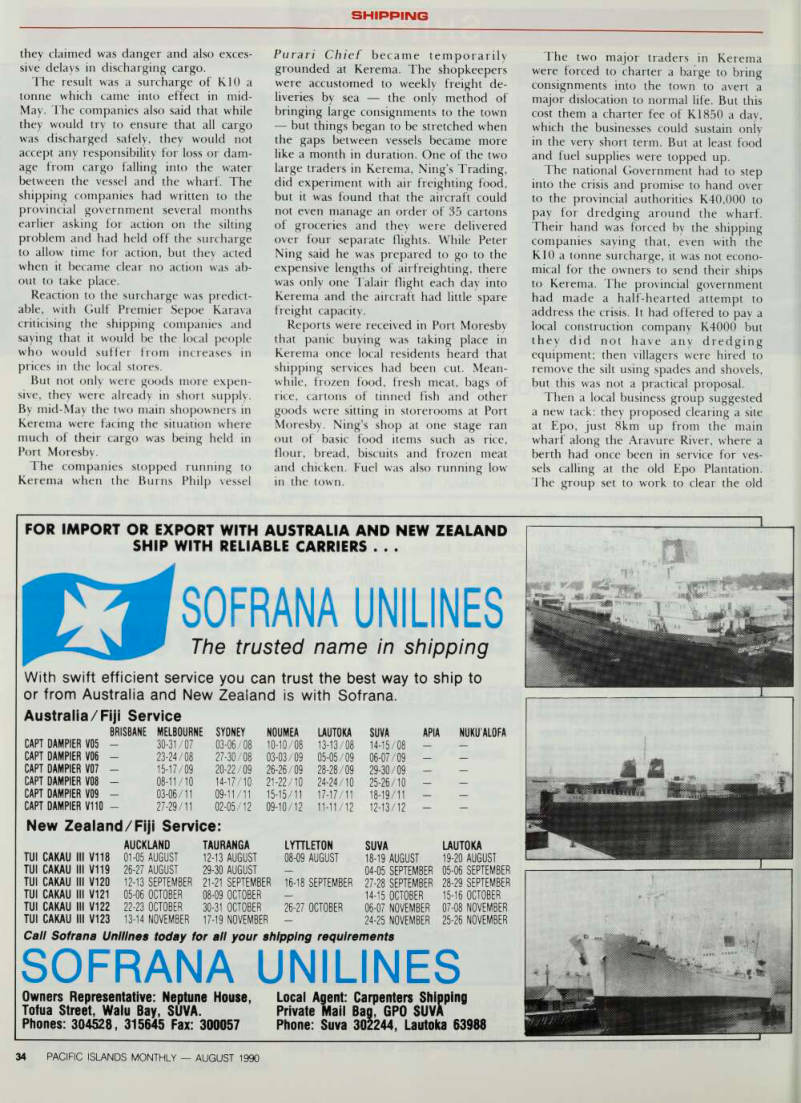
WORK has begun at last on re moving silt which has closed the Papua New Guinea port at Kerema, in the Gulf Province. A large digger has as this issue went to press started removing the silt which has made it impossible for conventional coas tal ships to berth at the town’s wharf.
The silting problem has led to occasional shortages in Kerema and to local traders having to charter a barge to bring in food and other supplies.
Even if the wharf is brought back into service soon, two questions remain: first, why the K 1 per tonne of cargo levy that has been paid for years to the local pro vincial government was apparently not used to maintain the port, and secondly how long it will be before the silt builds up again.
The silting became so bad that, at low tide, it was possible for locals to walk around the wharf. Initially, the coastal ships judged the time of their arrivals and departures to coincide with high tide, but this inevitably meant extra costs
Papua New Guinea
to the owners. The companies concerned Burns Philp Coastal Shipping, PNG
Shipping Corporation and Rabia Ship-
ping Pty Ltd tried to force the provin-
cial government’s hand by threatening to raise their charges. They argued that the sandbank forced vessels to berth about two metres off the wharf, causing what
they claimed was danger and also exces sive delays in discharging cargo.
The result was a surcharge of KlO a tonne which came into effect in mid- May. The companies also said that while they would try to ensure that all cargo was discharged safely, they would not accept any responsibility for loss or dam age from cargo falling into the water between the vessel and the wharf. The shipping companies had written to the provincial government several months earlier asking for action on the silting problem and had held off the surcharge to allow time for action, but they acted when it became clear no action was ab out to take place.
Reaction to the surcharge was predict able, with Gulf Premier Sepoe Karava
criticising the shipping companies and
saying that it would be the local people who would suffer from increases in prices in the local stores.
But not only were goods more expen sive, they were already in short supply.
By mid-May the two main shopowners in Kerema were facing the situation where much of their cargo was being held in Port Moresby.
The companies stopped running to Kerema when the Burns Philp vessel
Purari Chief became temporarily grounded at Kerema. The shopkeepers were accustomed to weekly freight deliveries by sea the only method of
bringing large consignments to the town
but things began to be stretched when the gaps between vessels became more like a month in duration. One of the two
large traders in Kerema, Ning’s Trading,
did experiment with air freighting food, but it was found that the aircraft could not even manage an order of 35 cartons of groceries and they were delivered over four separate flights. While Peter Ning said he was prepared to go to the
expensive lengths of airfreighting, there
was only one Talair flight each day into Kerema and the aircraft had little spare
freight capacity.
Reports were received in Port Moresby that panic buying was taking place in Kerema once local residents heard that shipping services had been cut. Meanwhile, frozen food, fresh meat, bags of rice, cartons of tinned fish and other goods were sitting in storerooms at Port Moresby. Ning’s shop at one stage ran out of basic food items such as rice, flour, bread, biscuits and frozen meat and chicken. Fuel was also running low in the town.
The two major traders in Kerema were forced to charter a barge to bring consignments into the town to avert a major dislocation to normal life. But this cost them a charter fee of KlB5O a day, which the businesses could sustain only in the very short term. But at least food and fuel supplies were topped up.
The national Government had to step into the crisis and promise to hand over to the provincial authorities K 40,000 to pay for dredging around the wharf.
Their hand was forced by the shipping companies saying that, even with the KlO a tonne surcharge, it was not econo mical for the owners to send their ships to Kerema. The provincial government had made a half-hearted attempt to address the crisis. It had offered to pay a local construction company K4OOO but they did not have any dredging equipment; then villagers were hired to remove the silt using spades and shovels, but this was not a practical proposal.
Then a local business group suggested a new tack: they proposed clearing a site at Epo, just Bkm up from the main wharf along the Aravure River, where a berth had once been in service for ves sels calling at the old Epo Plantation.
The group set to work to clear the old
site, but the shipping companies prompt ly declared it unsuitable saying it was not designed for quick discharge of cargo, and that Epo wharf would prove even more costly than a silted Kerema one.
The business group had planned to col lect all the wharfage dues from vessels berthing at Epo, and the provincial gov ernment said it had given the proposal the go-ahead as the river was believed to be deep enough to handle coastal vessels.
A provincial government spokesman was quoted as saying that the K 54,000 wharfage fees collected in the past year had been used by the administration for other projects and there was nothing left for clearing the silt.
While the work now under way will mean that Kerema wharf will once again be open to shipping, local business peo ple are worried that this is now perma nent solution that the sea forces which caused the silt to build up over a comparatively short period of 18 months will soon be at work reversing the dredg ing work. They will also be concerned that, from now on, wharfage fees de signed to be spent on maintaining the port will be set aside by the Gulf govern ment for that purpose they figure that the dredging work will have to be carried out on a regular basis.
The one piece of good news is that the shipping companies have undertaken to remove the KlO a tonne surcharge once the wharf is once more fully usable by their vessels. □
Advertisements & other items, p. 34 (2 items)
Shipping
Sofrana Unilines
FOR IMPORT OR EXPORT WITH AUSTRALIA AND NEW ZEALAND SHIP WITH RELIABLE CARRIERS . . .
The trusted name in shipping
With swift efficient service you can trust the best way to ship to or from Australia and New Zealand is with Sofrana.
Australia/Fiji Service Call Sofrana Unlllnes today for all your shipping requirements
SOFRANA UNILINES
Owners Representative: Neptune House, Tofua Street, Walu Bay, SUVA.
Phones; 304528, 315645 Fax: 300057 Local Agent: Carpenters Shipping Private Mail Bag, GPO SUVA Phone: Suva 302244, Lautoka 63988 1" rjm -i
Schedules
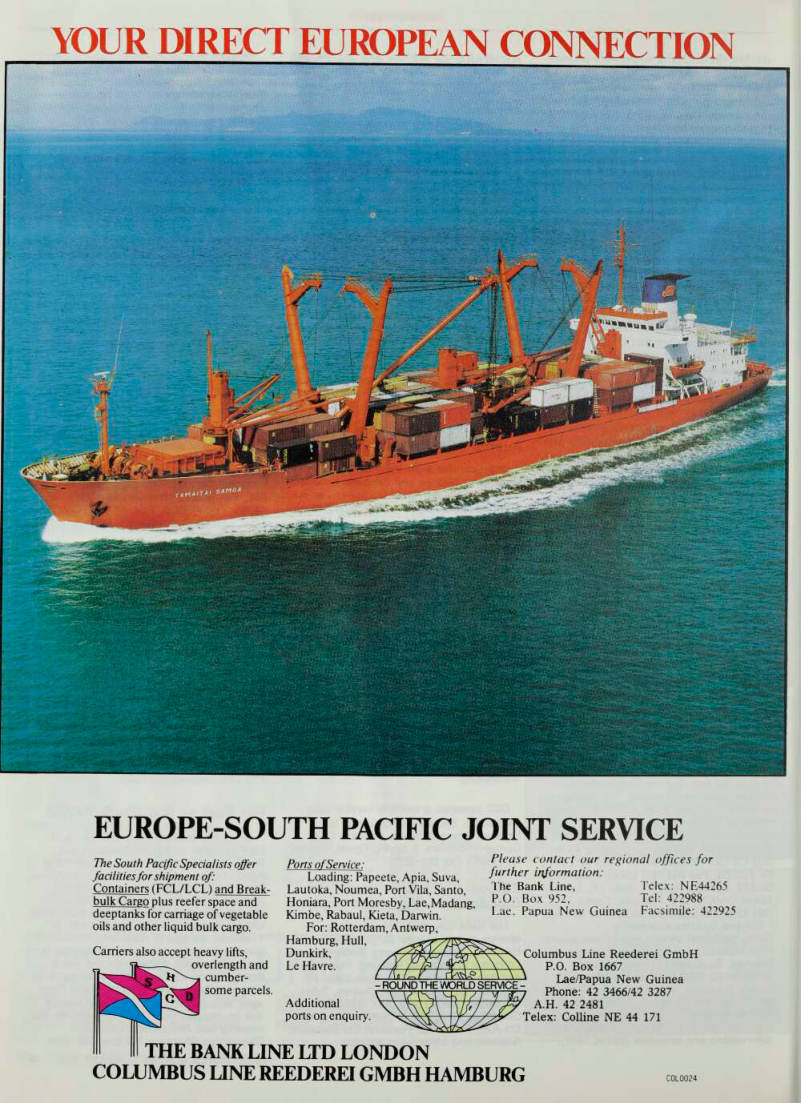
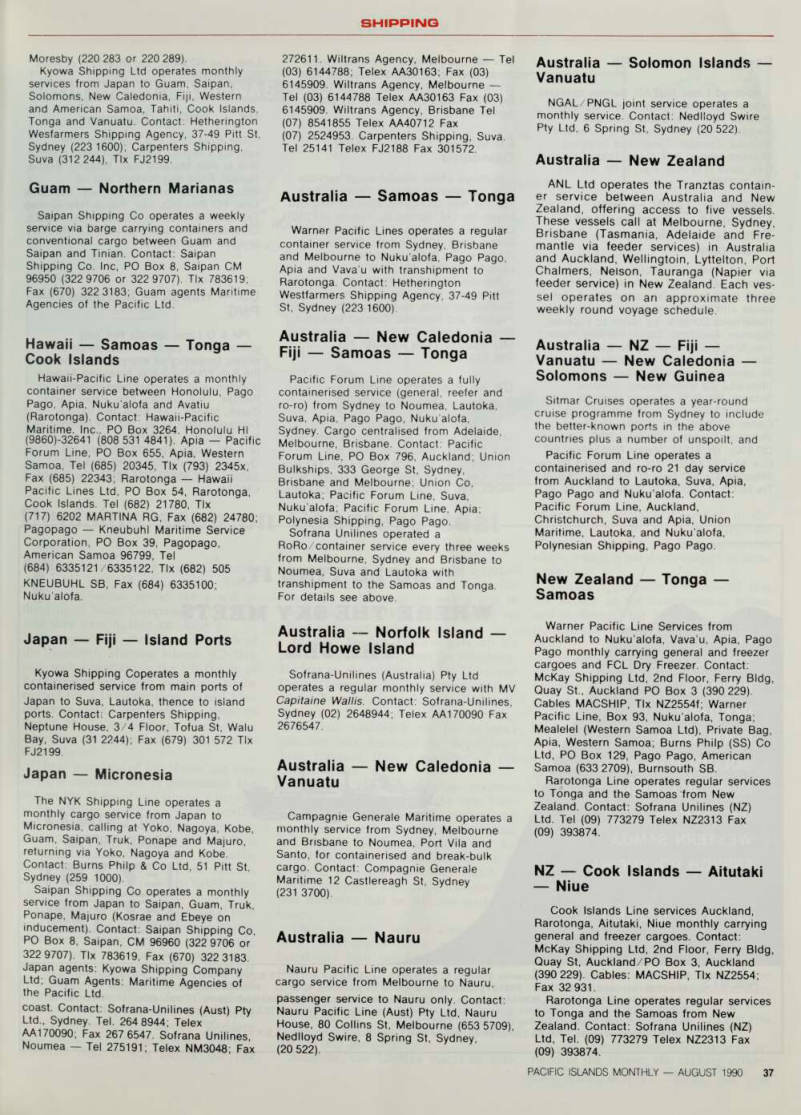
Australia New Caledonia Fiji Hawaii North America Pace Line (ACTA Shipping) operates a fully containerised service every 17 days from Melbourne, Sydney and Brisbane to Noumea, Suva and Lautoka. The vessels continue on to the North coast of America, calling at Hawaii at frequent intervals.
Contact: ACTA Pty Ltd, Sydney (266 0633); Tlx AA121369; Fax 267 1148; Burns Philp (SS) Co Ltd, Rodwell Road, Suva (311 777); Tlx FJ2168; Fax 301 127; Burns Philp (SS) Co Ltd, Lautoka (60 777); Sato SA, Avenue James Cook BPC 2, Noumea, Cedex (281 122); Tlx 3163 NM GATO. Fax 276 532.
Sofrana Unilines operated a Roßo/container service every three weeks from Melbourne, Sydney and Brisbane to Noumea, Suva and Lautoka. Vessels continue (as PAD Line) to the US West largely unknown, island paradises. Contact: Sitmar Cruises, 39 Martin Place, Sydney (239 9000) for NSW; reservations and inquiries (008 42 2277); rest of Australia, reservations and enquiries (088 22 2277).
Australia NZ Fiji Tonga
Vanuatu New Caledonia Solomons Samoas Tahiti P&O Liners call at Auckland, Bay of Islands, Honiara, Lautoka, Noumea, Nukualofa, Pago Pago, Papeete, Port Moresby, Santo, Savusavu, Suva, Vava’u and Vila on cruises from Australia.
Contact: P&O Booking Centre, Thomas Cook Pty Ltd, 33 Bligh St, Sydney (237 0333).
Australia PNG Solomons Vanuatu A consortium of NGAL/PNG and CONPAC has four vessels operating a joint service from east coast Australian ports to Port Moresby, Lae, Alotau, Madang, Wewak, Rabaul, Kavieng-Kimbe, Kieta, Honiara, Vila, Santo. Contact; Burns Philp & Co Ltd, PO Box R 124, Royal Exchange, Sydney (20 547); Nedlloyd Swire, 8 Spring St, Sydney (20 522); New Guinea Express Lines, 37 Pitt St, Sydney (241 3991); Vila Agents, PO Box 27, Port Vila (2456), Tlx
Nhioii.
Australia Kiribati CCS operates a 6 weekly service from Melbourne, Sydney and Brisbane to Kiribati (Tarawa). Contact: Chief Container Service, 8 Spring Street, Sydney (251-2699) Fax 251-2271.
Australia Tuvalu CCS operates a direct service every second voyage to Tuvalu (Funafuti).
Contact: Chief Container Service, 8 Spring Street, Sydney (251-2699) Fax 251-2271.
Australia New Caledonia Vanuatu CCS operates a monthly service from Melbourne, Sydney and Brisbane to Noumea, Vila and Santo. Contact: Chief Container Service, 8 Spring Street, Sydnev (251-2699) Fax 251-2271.
Australia Solomons Vanuatu CCS operates a monthly service from Melbourne, Sydney and Brisbane to Honiara, Vila and Santo. Contact: Chief Container Service, 8 Spring Street, Sydney (251-2699) Fax 251-2271.
Europe Tahiti New Caledonia Vanuatu The Bank Line and Columbus Line operate a regular joint cargo service from Hamburg, Bramen, Antwerp, Rotterdam and Le Havre to Papeete, Noumea. Port Vila and Santo. Contact: The Bank Line, PO Box 952, Lae, Papua New Guinea. Telex; NE 44265. Tel: 421235, Fax: 422925; Columbus Line, Lae (423466), Tlx NE44171; Ets A.M. Fare UTE, Papeete: Ets Ballande, Noumea and other local agents.
Sofrana Europe Australia Line “Sofeal" operates a regular three-weekly service from North European ports including Felixstowe to Papeete from Noumea.
Contact: from McArthur Shipping Agency Co Pty Ltd., Tel (02) 5502222 Telex AA24045 Fax 5191382.
Europe PNG Solomons
The Bank Line & Columbus Line operate a regular joint cargo service from Hamburg, Bramen, Antwerp, Rotterdam and Le Havre to Port Moresby, Lae, Madang, Kimbe, Rabaul, Kieta and Honiara and on inducement to Yandina. Contact: The Bank Line, PO Box 952, Lae, Papua New Guinea Telex: NE 44265, Tel: 421235, Fax: 422925; Columbus Line, Lae (423466), Tlx NE44171; or lines’ local agents.
Rarotonga Line operates regular services to Tonga and the Samoas from New Zealand. Contact Sofrana Unilines (NZ) Ltd.
Tel (09) 773279 Telex NZ2313 Fax (09) 393874.
Europe W. Samoa Tonga
- Fiji
The Bank Line & Columbus Line operate a regular joint cargo service from Hamburg, Breman, Antwerp, Rotterdam and Le Havre to Apia, Nukualofa, Suva and Lautoka. Contact: The Bank Line, PO Box 952, Lae, Papua New Guinea. Telex: NE 44265, Tel; 421235, Fax: 422925; Columbus Line, Lae (423466), Tlx NE44171; or lines’ local agents.
Far East Fiji New Zealand New Zealand Unit Express (NZUE) operates a monthly service accepting containerised and break-bulk cargo from Manila, Keelung, Kaohsiung and Hong Kong to Lautoka, Suva and thence to New Zealand ports.
Contact: Carpenters Shipping, Private Mail Bag, GPO Suva, Fiji (312-244), Fax: (679) 301-572, Tlx FJ2199; New Zealand Unit Express, Maritime Building, 2-10 Customhouse Quay, PO Box 890, Wellington (727 865), Cables
Enzueman Wellington, Tlx
NZ31340 NEDLNZ, or Nedlloyd Swire Pty Ltd. Sydney (20 522).
Far East Mid South Pacific China Navigation’s New Guinea Pacific Line operates a regular container and Break Bulk-Heavy Lift service from Hong Kong, Taiwan, Manila, Singapore, Malaysia, Thailand to Port Moresby, Lae, Rabaul, Kieta and Honiara with 18 days frequency.
Wewak and Madang will receive four direct calls a year or more on inducement. A T/service via Lae to these and other PNG ports connecting with monthly sailings is available at cost. Cargo from the same Eastern ports to the South Pacific ports of Noumea, Santo, Vila, Papeete, Pago Pago, Apia, Nukualofa, Rarotonga and Tarawa will be shipped via Japan or Busan on the monthly Bali Hai service. Contact Steamships Shipping, PO Box 634, Port
Moresby (220 283 or 220 289).
Kyowa Shipping Ltd operates monthly services from Japan to Guam, Saipan, Solomons, New Caledonia, Fiji, Western and American Samoa, Tahiti, Cook Islands, Tonga and Vanuatu. Contact; Hetherington Wesfarmers Shipping Agency, 37-49 Pitt St, Sydney (223 1600); Carpenters Shipping, Suva (312 244), Tlx FJ2199.
Guam Northern Marianas Saipan Shipping Co operates a weekly service via barge carrying containers and conventional cargo between Guam and Saipan and Tinian. Contact; Saipan Shipping Co. Inc, PO Box 8, Saipan CM 96950 (322 9706 or 322 9707). Tlx 783619; Fax (670) 322 3183; Guam agents Maritime Agencies of the Pacific Ltd.
Hawaii Samoas Tonga Cook Islands Hawaii-Pacific Line operates a monthly container service between Honolulu, Pago Pago, Apia, Nuku’alofa and Avatiu (Rarotonga). Contact: Hawaii-Pacific Maritime. Inc.. PO Box 3264. Honolulu HI (9860)-32641 (808 531 4841). Apia Pacific Forum Line, PO Box 655, Apia, Western Samoa, Tel (685) 20345, Tlx (793) 2345 x, Fax (685) 22343; Rarotonga Hawaii Pacific Lines Ltd, PO Box 54, Rarotonga, Cook Islands. Tel (682) 21780, Tlx (717) 6202 MARTINA RG, Fax (682) 24780; Pagopago Kneubuhl Maritime Service Corporation, PO Box 39, Pagopago, American Samoa 96799, Tel (684) 6335121/6335122, Tlx (682) 505
Kneubuhl Sb, Fax (684) 6335100;
Nuku’alofa.
Japan Fiji Island Ports
Kyowa Shipping Coperates a monthly containerised service from main ports of Japan to Suva, Lautoka, thence to island ports. Contact; Carpenters Shipping, Neptune House, 3/4 Floor, Tofua St, Walu Bay, Suva (31 2244); Fax (679) 301 572 Tlx FJ2199.
Japan Micronesia
The NYK Shipping Line operates a monthly cargo service from Japan to Micronesia, calling at Yoko, Nagoya, Kobe, Guam, Saipan, Truk, Ponape and Majuro, returning via Yoko, Nagoya and Kobe.
Contact: Burns Philp & Co Ltd, 51 Pitt St Sydney (259 1000).
Saipan Shipping Co operates a monthly service from Japan to Saipan, Guam, Truk, Ponape, Majuro (Kosrae and Ebeye on inducement). Contact: Saipan Shipping Co, PO Box 8, Saipan, CM 96960 (322 9706 or 322 9707). Tlx 783619, Fax (670) 322 3183.
Japan agents; Kyowa Shipping Company Ltd; Guam Agents: Maritime Agencies of the Pacific Ltd. coast. Contact: Sofrana-Unilines (Aust) Pty Ltd., Sydney. Tel. 264 8944; Telex AA170090; Fax 267 6547. Sofrana Unilines, Noumea Tel 275191; Telex NM3048; Fax
272611. Wiltrans Agency, Melbourne Tel (03) 6144788; Telex AA30163; Fax (03) 6145909. Wiltrans Agency, Melbourne Tel (03) 6144788 Telex AA30163 Fax (03) 6145909. Wiltrans Agency, Brisbane Tel (07) 8541855 Telex AA40712 Fax (07) 2524953. Carpenters Shipping, Suva.
Tel 25141 Telex FJ2IBB Fax 301572.
Australia Samoas Tonga
Warner Pacific Lines operates a regular container service from Sydney, Brisbane and Melbourne to Nukualofa, Pago Pago, Apia and Vava’u with transhipment to Rarotonga. Contact: Hetherington Westfarmers Shipping Agency, 37-49 Pitt St, Sydney (223 1600).
Australia New Caledonia
Fiji Samoas Tonga
Pacific Forum Line operates a fully containerised service (general, reefer and ro-ro) from Sydney to Noumea, Lautoka, Suva, Apia, Pago Pago, Nukualofa, Sydney. Cargo centralised from Adelaide, Melbourne, Brisbane. Contact: Pacific Forum Line, PO Box 796, Auckland; Union Bulkships, 333 George St, Sydney, Brisbane and Melbourne; Union Co, Lautoka; Pacific Forum Line, Suva, Nuku’alofa; Pacific Forum Line, Apia; Polynesia Shipping, Pago Pago.
Sofrana Unilines operated a Roßo/container service every three weeks from Melbourne, Sydney and Brisbane to Noumea, Suva and Lautoka with transhipment to the Samoas and Tonga.
For details see above.
Australia Norfolk Island
Lord Howe Island
Sofrana-Unilines (Australia) Pty Ltd operates a regular monthly service with MV Capitaine Wallis. Contact: Sofrana-Unilines, Sydney (02) 2648944; Telex AA170090 Fax 2676547.
Australia New Caledonia
Vanuatu
Campagnie Generale Maritime operates a monthly service from Sydney, Melbourne and Brisbane to Noumea, Port Vila and Santo, for containerised and break-bulk cargo. Contact: Compagnie Generale Maritime 12 Castlereagh St, Sydney (231 3700).
Australia Nauru
Nauru Pacific Line operates a regular cargo service from Melbourne to Nauru, passenger service to Nauru only. Contact: Nauru Pacific Line (Aust) Pty Ltd, Nauru House. 80 Collins St, Melbourne (653 5709), Nedlioyd Swire, 8 Spring St, Sydney, (20 522).
Australia Solomon Islands Vanuatu NGAL/PNGL joint service operates a monthly service. Contact: Nedlioyd Swire Pty Ltd, 6 Spring St, Sydney (20 522).
Australia New Zealand ANL Ltd operates the Tranztas contain er service between Australia and New Zealand, offering access to five vessels.
These vessels call at Melbourne, Sydney, Brisbane (Tasmania, Adelaide and Fre mantle via feeder services) in Australia and Auckland, Wellingtoin, Lyttelton, Port Chalmers, Nelson, Tauranga (Napier via feeder service) in New Zealand. Each ves sel operates on an approximate three weekly round voyage schedule.
Australia NZ Fiji Vanuatu New Caledonia Solomons New Guinea Sitmar Cruises operates a year-round cruise programme from Sydney to include the better-known ports in the above countries plus a number of unspoilt, and Pacific Forum Line operates a containerised and ro-ro 21 day service from Auckland to Lautoka, Suva, Apia, Pago Pago and Nukualofa. Contact: Pacific Forum Line, Auckland, Christchurch, Suva and Apia, Union Maritime, Lautoka, and Nukualofa, Polynesian Shipping, Pago Pago.
New Zealand Tonga Samoas Warner Pacific Line Services from Auckland to Nukualofa, Vava'u, Apia, Pago Pago monthly carrying general and freezer cargoes and FCL Dry Freezer. Contact: McKay Shipping Ltd, 2nd Floor, Ferry Bldg, Quay St.. Auckland PO Box 3 (390 229).
Cables MACSHIP, Tlx NZ2554f; Warner Pacific Line, Box 93, Nukualofa, Tonga; Mealelel (Western Samoa Ltd), Private Bag, Apia, Western Samoa; Burns Philp (SS) Co Ltd, PO Box 129, Pago Pago, American Samoa (633 2709), Burnsouth SB.
Rarotonga Line operates regular services to Tonga and the Samoas from New Zealand. Contact: Sofrana Unilines (NZ) Ltd. Tel (09) 773279 Telex NZ2313 Fax (09) 393874.
NZ Cook Islands Aitutaki Niue Cook Islands Line services Auckland, Rarotonga, Aitutaki, Niue monthly carrying general and freezer cargoes. Contact: McKay Shipping Ltd, 2nd Floor, Ferry Bldg, Quay St, Auckland/PO Box 3, Auckland (390 229). Cables. MACSHIP, Tlx NZ2554; Fax 32 931.
Rarotonga Line operates regular services to Tonga and the Samoas from New Zealand. Contact: Sofrana Unilines (NZ) Ltd, Tel. (09) 773279 Telex NZ2313 Fax (09) 393874.
Southeast Asia Fiji Nedlloyd Lines (NZEAS) Service operates regular fast cargo service from Surabaya, Jakarta, Port Kelang, Bangkok and Singapore via New Zealand to Suva and Lautoka. Contact: Carpenters Shipping, Neptune House, 3/4 Floor, Tofda St., Walu Bay, Suva (312 244). Fax; (679) 301 572.
Tlx: FJ2199.
Europe Tahiti New Caledonia New Zealand Vanuatu Solomons PNG
Europe
Polish Ocean Lines offers regular monthly sailings for containerised and break-bulk cargo, also conventional reefer space and reefer containers from Hamburg, Rotterdam, Dunkirk, Le Havre to Papeete, Noumea, Auckland, Santo, Honiara, Rabaul, Lae, Singapore, returning to Europe via Suez. Other ports in the South Pacific can be served directly with inducement or otherwise via transhipment. Contact: Sotama, BP 9170, Papeete (42 7805), Tlx Sotama 373FP; SATO: BP, 02 Noumea Cedex (27 2094), Tlx 163 NM; Universal Shipping Agencies, PO Box 2282, Auckland (30 930), Tlx 21517; Vanua Navigation, PO Box 44. Vila (2027), Tlx 1033; Melan Chine Shipping Co, PO Box 71, Honiara (21 678).
Tlx 66335; Steamships Trading Co Ltd, PO
Box 85, Lae (42 4666), Tlx 4243; Union Steamship Co NZ Ltd, PO Box 50, Apia (21 781); Tlx 226; Warner Pacific Line, PO Box 93, Nukualofa (22 088), Tlx 66219; Fiji Agents TBA.
Europe Tahiti New Caledonia Nedlloyd offers regular cargo services from Continental ports to Papeete, Apia, Fiji and New Caledonia. Contact Nedlloyd (Aust) Pty Ltd, Spring St, Sydney (27 3801); Carpenters Shipping, Ist Floor, Harbour Centre Bldg, 100 Thomson St., Suva (31 2244), Tlx 2199FJ and Vetari St..
Lautoka (63 988), Tlx 5215FJ.
Sofrana Europe Australia Line operates a three-weekly cargo service from Continental ports, including Felixtowe, to Papeete and Noumea. Contact McArthur Shipping Agency Co Pty Ltd, Sydney. Tel (02) 5502222 Telex AA24045 Fax (02) 5191382.
UK Western Samoa
Tonga Fiji
The Bank Line and Columbus Line operate a regular joint cargo service from Hull to Apia, Nukualofa, Suva and Lautoka. Contact: The Bank Line, PO Box 952, Lae, Papua New Guinea. Telex; NE 44265, Tel: 421235, Fax: 422925; Columbus
Line, Lae (423466); Tlx NE44171; or lines’ local agents.
UK PNG Solomons
The Bank Line and Columbus Line operate a regular joint cargo service from Hull to Port Moresby, Lae, Madang, Kimbe, Rabaul, Kieta and Honiara and on inducement to Yandina. Contact: The Bank Line, PO Box 952, Lae, Papua New Guinea.
Telex: NE 44265, Tel; 421235, Fax: 422925; Columbus Line, Lae (423466); Tlx NE44171; or lines' local agents.
US Hawaii Micronesia
Png
PM & O Lines operate two fully self-contained container vessels on a sailing frequency of every 30 days between the San Francisco Bay Area, Los Angeles, Honolulu and Majuro, Ebeye, Kosrae, Ponape, Truk, Saipan, Yap, Palau, Cebu, Davao, Manila, Lae, Kieta and Rabaul.
Contact; PM&O Lines, 353 Sacramento St., San Francisco, California 94111 (415 421 5400); Tlx: 278016 PMO UR; Owner’s Representative, PO Box 803, Saipan, NMI 96950 (234 8819); Tlx 783605
Cmcaa.
Advertisements & other items, pp. 36-38 (1 item)
Your Direct European Connection
EUROPE-SOUTH PACIFIC JOINT SERVICE
The South Pacific Specialists offer facilities for shipment of: Containers (FCL/LCL) and Breakbulk Cargo plus reefer space and deeptanks for carriage of vegetable oils and other liquid bulk cargo.
Carriers also accept heavy lifts, overlength and cumbersome parcels.
Ports of Service: Loading: Papeete, Apia, Suva, Lautoka, Noumea, Port Vila, Santo, Honiara, Port Moresby, Lae,Madang, Kimbe, Rabaul, Kieta, Darwin.
For: Rotterdam, Antwerp, Hamburg, Hull, Dunkirk, Le Havre.
Additional ports on enquiry.
- ROUND THE WORLD SERVICE -
Please contact our regional offices for further information: The Bank Line, Telex: NE44265 P.O. Box 952, Tel; 422988 Lae. Papua New Guinea Facsimile; 422925 Columbus Line Reederei GmbH P.O. Box 1667 Lae/Papua New Guinea Phone: 42 3466/42 3287 A.H. 42 2481 Telex: Colline NE 44 171
THE BANK LINE LTD LONDON
COLUMBUS LINE REEDEREI GMBH HAMBURG
C0L0024
TONGA
KIRIBATI
VANUATU
COOK ISLAND
SOLOMON ISLANDS
NEW CALEDONIA
l£S. SAMOA
WESTERN SAMOA
FRENCH POLYNESIA
JAPAN . KOREA
YOU’LL FIND IT,
WHERE THE SKY MEETS
THE SEA
RORO. CONTAINER &
B.BULK SHIPPING
BALI
HAL..
AGENTS
and
PHONE
SUVA:Burns Philp(B P) 311 777 Carpenter Shipping (C.S) 31 2244 LAUTOKA;B P 60777 C S 63988 APIA:B P 22611 PAGOPAGO Polynesia Shipping Services Ltd 633-1211 PAPEETE:Compagnie Maritime Polynesienne 42 84 02 NOUMEA:Etablissements Ballande 687-283384 VILA:B P 2456 SANTO:B P 230 HONlAßA:Sullivans (Solomon Islands) Ltd 21645 TARAWA:Shipping Corporation of Kiribati 26195 NUKUALOFA:B P 21500 BUSAN:for general cargo Young Chang Shipping Co., Ltd 753-0451 for vehicle Pan Continental Shipping Co , Ltd 778-7680 Soyang Shipping Co , Ltd 752-7755 JAPAN:for general cargo Swire 03-230-9245 for vehicle NYK Lines 03-284-5506 Mitsui O S K 03-587-7123
Decision soon on Congress seat
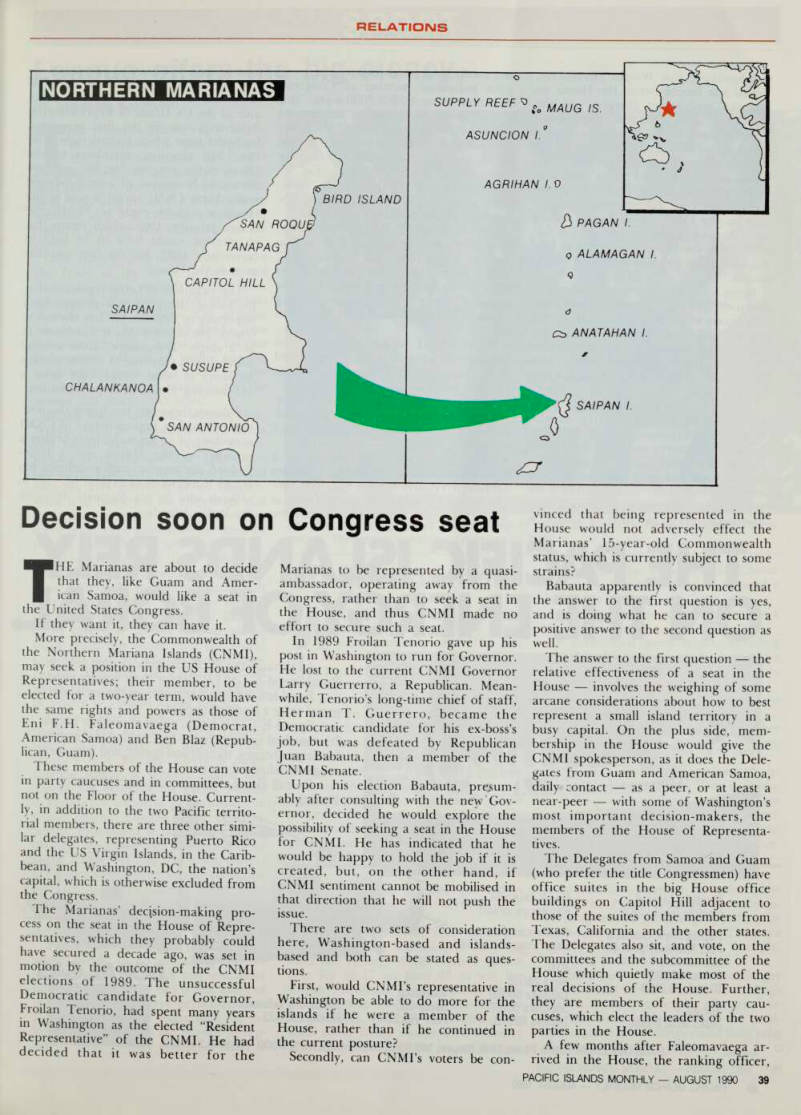
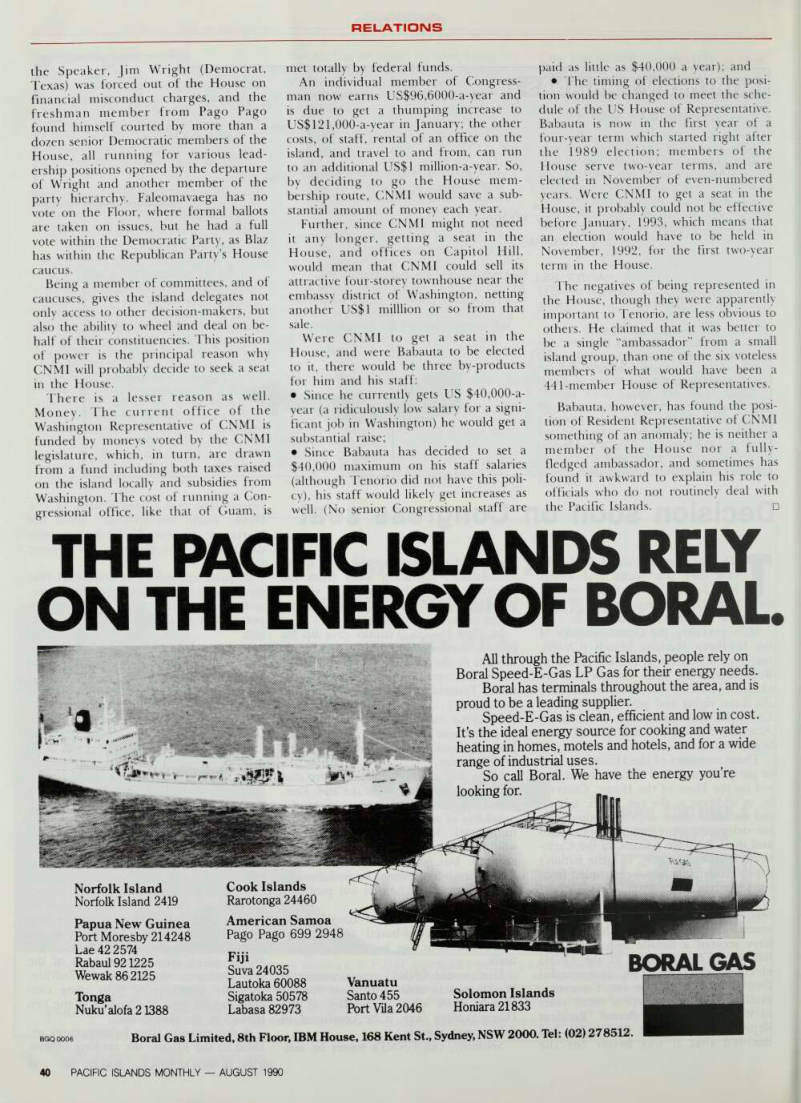
Relations
Northern Marianas
THE Marianas are about to decide that they, like Guam and Amer ican Samoa, would like a seat in the United States Congress.
If they want it, they can have it.
More precisely, the Commonwealth of the Northern Mariana Islands (CNMI), may seek a position in the US House of Representatives; their member, to be elected for a two-year term, would have the same rights and powers as those of Eni F.H. Faleomavaega (Democrat, American Samoa) and Ben Blaz (Repub lican, Guam).
These members of the House can vote in party caucuses and in committees, but not on the Floor of the House. Current ly, in addition to the two Pacific territo rial members, there are three other simi lar delegates, representing Puerto Rico and the US Virgin Islands, in the Carib bean, and Washington, DC, the nation’s capital, which is otherwise excluded from
the Congress.
The Marianas’ decision-making pro cess on the seat in the House of Repre sentatives, which they probably could have secured a decade ago, was set in motion by the outcome of the CNMI elections of 1989. The unsuccessful Democratic candidate for Governor, Froilan Tenorio, had spent many years in Washington as the elected “Resident Representative” of the CNMI. He had decided that it was better for the
Marianas to be represented by a quasi ambassador, operating away from the Congress, rather than to seek a seat in the House, and thus CNMI made no effort to secure such a seat.
In 1989 Froilan Tenorio gave up his post in Washington to run for Governor.
He lost to the current CNMI Governor Larry Guerrerro, a Republican. Mean while, Tenorio’s long-time chief of staff, Herman T, Guerrero, became the Democratic candidate for his ex-boss’s job, but was defeated by Republican Juan Babauta, then a member of the CNMI Senate.
Upon his election Babauta, presum ably after consulting with the new Gov ernor, decided he would explore the possibility of seeking a seat in the House for CNMI. He has indicated that he would be happy to hold the job if it is created, but, on the other hand, if CNMI sentiment cannot be mobilised in that direction that he will not push the issue.
There are two sets of consideration here, Washington-based and islands based and both can be stated as ques tions.
First, would CNMFs representative in Washington be able to do more for the islands if he were a member of the House, rather than if he continued in the current posture?
Secondly, can CNMFs voters be con
vinced that being represented in the House would not adversely effect the Marianas’ 15-year-old Commonwealth status, which is currently subject to some strains?
Babauta apparently is convinced that the answer to the first question is yes, and is doing what he can to secure a positive answer to the second question as well.
The answer to the first question the relative effectiveness of a seat in the House involves the weighing of some arcane considerations about how to best represent a small island territory in a busy capital. On the plus side, mem bership in the House would give the CNMI spokesperson, as it does the Dele gates from Guam and American Samoa, daily contact as a peer, or at least a near-peer with some of Washington’s most important decision-makers, the members of the House of Representa tives.
The Delegates from Samoa and Guam (who prefer the title Congressmen) have office suites in the big House office buildings on Capitol Hill adjacent to those of the suites of the members from Texas, California and the other states.
The Delegates also sit, and vote, on the committees and the subcommittee of the House which quietly make most of the real decisions of the House. Further, they are members of their party cau cuses, which elect the leaders of the two parties in the House.
A few months after Faleomavaega ar rived in the House, the ranking officer,
the Speaker, Jim Wright (Democrat,
Texas) was forced out of the House on fmancial misconduct charges, and the freshman member from Pago Pago found himself courted by more than a dozen senior Democratic members of the House, all running for various lead-
ership positions opened by the departure
of Wright and another member of the party hierarchy. Faleomavaega has no vote on the Floor, where formal ballots are taken on issues, but he had a full vote within the Democratic Party, as Blaz has within the Republican Party’s House caucus Being a member of committees, and of caucuses, gives the island delegates not only access to other decision-makers, but also the ability to wheel and deal on behalf of their constituencies. This position of power is the principal reason why CNMI will probably decide to seek a seat in the House.
There is a lesser reason as well.
Money The current office of the Washingtou Representative of CNMI is funded by moneys voted by the CNMI legislature which, in turn! are drawn from a fund including both taxes raised on the island locally and subsidies from Washington. The cost of running a Congressional office, like that of Guam, is
met totally by federal funds.
An individual member of Congress man now earns U5596,6000-a-year and is due to get a thumping increase to US$l2l,OOO-a-year in January; the other costs, of staff, rental of an office on the island, and travel to and from, can run to an additional US$l million-a-year. So, by deciding to go the House mem bership route, CNMI would save a sub stantial amount of money each year.
Further, since CNMI might not need it any longer, getting a seat in the House, and offices on Capitol Hill, would mean that CNMI could sell its attractive four-storey townhouse near the embassy district of Washington, netting another US$l milllion or so from that sale.
Were CNMI to get a seat in the House, and were Babauta to be elected to it, there would be three by-products for him and his staff: • Since he currently gets US $40,000-a -year (a ridiculously low salary for a signi ficant job in Washington) he would get a substantial raise; • Since Babauta has decided to set a $40,000 maximum on his staff salaries (although Tenorio did not have this poli cy), his staff would likely get increases as well. (No senior Congressional staff are
paid as little as $40,000 a year); and • The timing of elections to the posi tion would be changed to meet the sche dule of the US House of Representative.
Babauta is now in the first year of a four-year term which started right after the 1989 election; members of the House serve two-year terms, and are elected in November of even-numbered years. Were CNMI to get a seat in the House, it probably could not be effective before January, 1993, which means that an election would have to be held in November, 1992, for the first two-year term in the House.
The negatives of being represented in
the House, though they were apparently
important to Tenorio, are less obvious to others. He claimed that it was better to be a single “ambassador” from a small island group, than one of the six voteless members of what would have been a 441-member House of Representatives.
Babauta, however, has found the posi tion of Resident Representative of CNMI something of an anomaly ; he is neither a member of the House nor a fully fledged ambassador, and sometimes has found it awkward to explain his role to officials who do not routinely deal with the Pacific Islands. □
Advertisements & other items, p. 40 (1 item)
The Pacific Islands Rely
ON THE ENERGY OF BORAL.
a All through the Pacific Islands, people rely on Boral Speed-E-Gas LP Gas for their energy needs.
Boral has terminals throughout the area, and is proud to be a leading supplier.
Speed-E-Gas is clean, efficient and low in cost.
It’s the ideal energy source for cooking and water heating in homes, motels and hotels, and for a wide range of industrial uses.
So call Boral. We have the energy you’re looking for. * V- Norfolk Island Norfolk Island 2419 Papua New Guinea Port Moresby 214248 Lae 42 2574 Rabaul 921225 Wewak 86 2125 Tonga Nukualofa 21388 Cook Islands Rarotonga 24460 American Samoa Pago Pago 699 2948 Fiji Suva 24035 Lautoka 60088 Sigatoka 50578 Labasa 82973
BORAL GAS
Vanuatu Santo 455 Port Vila 2046 Solomon Islands Honiara 21833 Boral Gas Limited, Bth Floor, IBM House, 168 Kent St., Sydney, NSW 2000. Tel: (02) 278512.
Sport
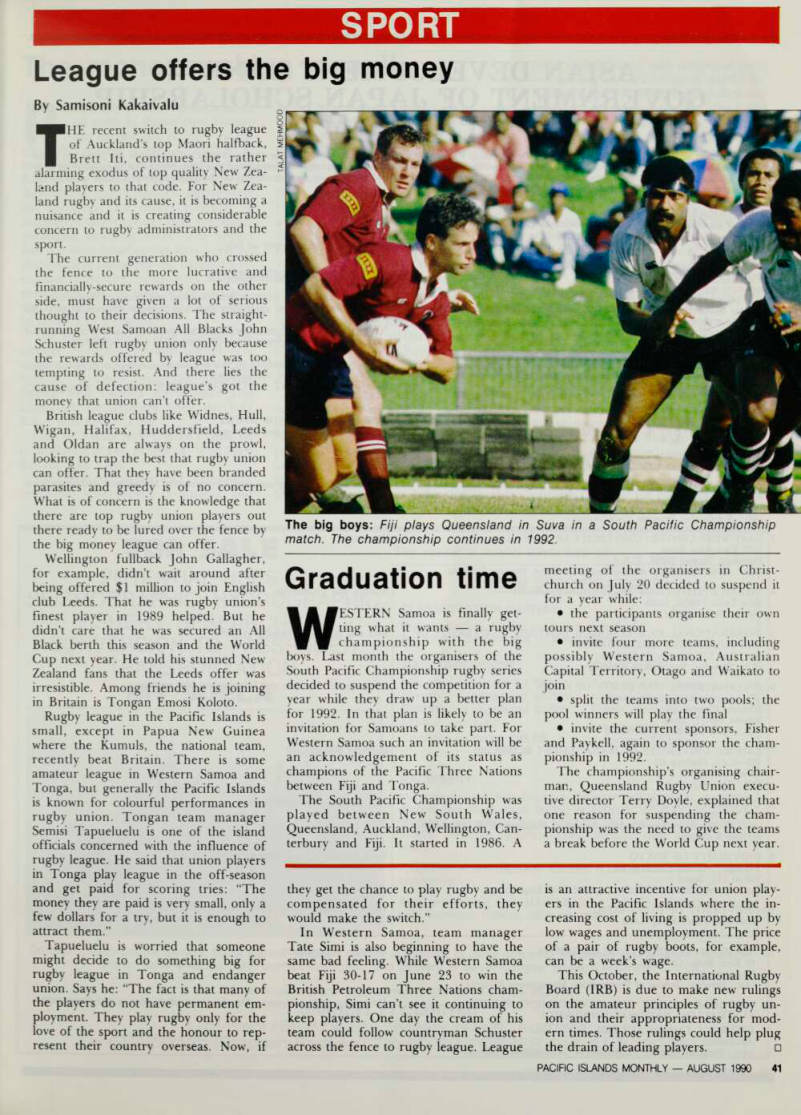
League offers the big money
By Samisoni Kakaivalu
THE recent switch to rugby league
of Auckland’s top Maori halfback, Brett Iti, continues the rather alarming exodus of top quality New Zea land players to that code. For New Zea land rugby and its cause, it is becoming a nuisance and it is creating considerable concern to rugby administrators and the sport.
The current generation who crossed the fence to the more lucrative and financially-secure rewards on the other side, must have given a lot of serious thought to their decisions. The straight running West Samoan All Blacks John Schuster left rugby union only because the rewards offered by league was too tempting to resist. And there lies the cause of defection: league’s got the money that union can’t offer.
British league clubs like Widnes, Hull, Wigan, Halifax, Huddersfield, Leeds and Oldan are always on the prowl, looking to trap the best that rugby union can offer. That they have been branded parasites and greedy is of no concern.
What is of concern is the knowledge that there are top rugby union players out there ready to be lured over the fence by the big money league can offer.
Wellington fullback John Gallagher,
for example, didn’t wait around after being offered $1 million to join English club Leeds. That he was rugby union’s finest player in 1989 helped. But he didn’t care that he was secured an All Black berth this season and the World Cup next year. He told his stunned New Zealand fans that the Leeds offer was irresistible. Among friends he is joining in Britain is Tongan Emosi Koloto.
Rugby league in the Pacific Islands is small, except in Papua New Guinea where the Kumuls, the national team, recently beat Britain. There is some amateur league in Western Samoa and Tonga, but generally the Pacific Islands is known for colourful performances in rugby union. Tongan team manager Semisi Tapueluelu is one of the island officials concerned with the influence of rugby league. He said that union players in Tonga play league in the off-season and get paid for scoring tries; “The money they are paid is very small, only a few dollars for a try, but it is enough to attract them.”
Tapueluelu is worried that someone might decide to do something big for
rugby league in Tonga and endanger
union. Says he: “The fact is that many of the players do not have permanent em ployment. They play rugby only for the love of the sport and the honour to rep resent their country overseas. Now, if
they get the chance to play rugby and be compensated for their efforts, they would make the switch.”
In Western Samoa, team manager Tate Simi is also beginning to have the same bad feeling. While Western Samoa beat Fiji 30-17 on June 23 to win the British Petroleum Three Nations cham pionship, Simi can’t see it continuing to keep players. One day the cream of his team could follow countryman Schuster across the fence to rugby league. League
is an attractive incentive for union play ers in the Pacific Islands where the in creasing cost of living is propped up by low wages and unemployment. The price of a pair of rugby boots, for example, can be a week’s wage.
This October, the International Rugby Board (IRB) is due to make new rulings on the amateur principles of rugby un ion and their appropriateness for mod ern times. Those rulings could help plug the drain of leading players. □
The big boys: Fiji plays Queensland in Suva in a South Pacific Championship match. The championship continues in 1992.
Graduation time
WESTERN Samoa is finally get ting what it wants a rugby
championship with the big
boys. Last month the organisers of the South Pacific Championship rugby series decided to suspend the competition for a year while they draw up a better plan for 1992. In that plan is likely to be an invitation for Samoans to take part. For Western Samoa such an invitation will be an acknowledgement of its status as champions of the Pacific Three Nations between Fiji and Tonga.
The South Pacific Championship was played between New South Wales, Queensland, Auckland, Wellington, Can terbury and Fiji. It started in 1986. A
meeting of the organisers in Christ church on July 20 decided to suspend it for a year while: • the participants organise their own tours next season • invite four more teams, including possibly Western Samoa, Australian
Capital Territory, Otago and Waikato to
join
• split the teams into two pools; the pool winners will play the final • invite the current sponsors, Fisher and Paykell, again to sponsor the cham pionship in 1992.
The championship’s organising chair
man, Queensland Rugby Union execu tive director Terry Doyle, explained that one reason for suspending the cham pionship was the need to give the teams a break before the World Cup next year.
Advertisements & other items, p. 42 (1 item)
Government Of Japan Scholarship
ASIAN DEVELOPMENT BANK
PROGRAM
Qualified citizens of member countries of the Asian Development Bank, who intend to pursue post-graduate studies in selected disciplines are invited to apply for scholarships under the Asian Development Bank Government of Japan Scholarship Program. It is anticipated that upon successful completion of their graduate studies under the Program, the scholars will return to their countries and contribute to its socio-economic development. Scholarships are awarded for graduate studies at designated instituions in courses of study approved by ADB.
THE SCHOLARSHIPS
* Level of education : Post-graduate (Diploma, Masters and Doctorate degrees) * Duration ; From one to three years * Coverage : Tuition fees, books and subsistence allowance, insurance, return economy air fare
ELIGIBILITY REQUIREMENTS
Prospective applicants must: * be a citizen of an ADB member country * possess qualifications acceptable to the designated institutions for entry to graduate programs * have two years work experience * have high level of academic achievement * be in good health *have gained admissiond to an approved course in a designated institution (Staff of ADB and the designated institution and their close relatives are not eligible to apply).
APPLICATION REQUIREMENTS
Applicants should: * write for application forms to the designated institutions of their choice * submit the completed application form and required documentation to the institution * Indicate on the application form that the applicant wishes to be considered for an Asian Development Bank-Government of Japan Scholarship u i among mose admitted by the designated institutions candidates for award of scholarships) ™ AT A SEPARATE APPLICATION TO ADB IS NO!
DESIGNATED INSTITUTIONS
1. ASIAN INSTITUTE OF MANAGEMENT
MCC P.O. Box 898
Makati, Metro Manila, Philippines (Atl.: Admissions Director)
2. ASIAN INSTITUTE OF TECHNOLOGY
P.O. BOX 2754
Bangkok, Thailand (Att.: Scholarship Program Coordinator)
3. EAST-WEST CENTER/UNIVERSITY OF HAWAII
1777 East-West Road Honolulu, Hawaii 96848, U.S.A. (Att.: ADB Scholarship Administrator, Resource Systems Institute)
4. INDIAN INSTITUTE OF TECHNOLOGY, DELHI
New Delhi 110016, India (Attn.: The Registrar) 5. INTERNATIONAL RICE RESEARCH INSTITUTE /UNIVERSITY OF
THE PHILIPPINES AT LOS BANOS
P.O. Box 933, Manila, Philippines (Att.: Director, Research & Training)
6. INTERNATIONAL UNIVERSITY OF JAPAN
777 Anajishinden, Yamato-machi Minami, Uonuma-gun Niigata 949-72, Japan (Att.; ADB Scholarship Division)
7. LAHORE UNIVERSITY OF MANAGEMENT SCIENCES
103—C/2, Gulberg 111 Lahore, Pakistan (Att.: The Registrar)
8. UNIVERSITY OF SYDNEY
N.S.W. 2006, Australia (Att.: (i) The Secretary, Graduate School of Management & Public Policy (ii) The Registrar
9. UNIVERSITY OF TOKYO
3-Hongo, 7-Chome, Bunkyo-ku Tokyo 113, Japan (Att.: Foreign Student Officer, Dept, of Civil Engineering)
10. UNIVERSITY OF HONG KONG
Pokfulam Road, Hong Kong (Att.: Academic Secretary
11. NATIONAL UNIVERSITY OF SINGAPORE
10 Kent Ridge Crescent Singapore 0511 (Att.: Director, School of Postgraduate Management Studies)
12. NATIONAL CENTRE FOR DEVELOPMENT STUDIES/
AUSTRALIAN NATIONAL UNIVERSITY
GPO Box 4, Canberra ACT 2601 Australia (Att.: Program Director, Economics of Development Program)
APPROVED FIELD OF STUDY
Business Management and Development Management Science and Technology including Environmental Management and Engineering Economics Science and Technology Rice and rice-based farming systems International Relations and International Management Business Management (i) Business Management & (ii) Economics Civil Engineering and Related Subjects Urban Planning, Urban Design and Medical Science Business Management Economics of Development, Development Administration and Demography
The money-making weevil
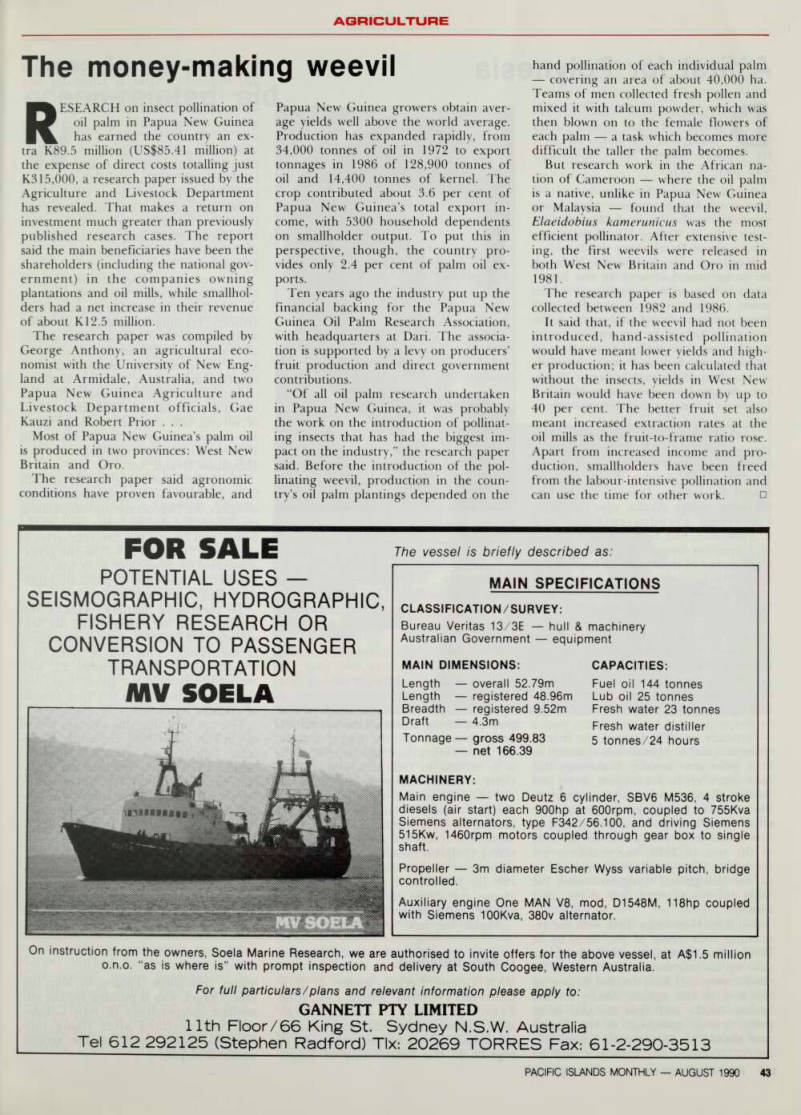
Agriculture
RESEARCH on insect pollination of oil palm in Papua New Guinea has earned the country an ex tra K 89.5 million (U 5585.41 million) at the expense of direct costs totalling just K 315,000, a research paper issued by the Agriculture and Livestock Department has revealed. That makes a return on investment much greater than previously published research cases. The report said the main beneficiaries have been the shareholders (including the national gov ernment) in the companies owning plantations and oil mills, while smallhol ders had a net increase in their revenue of about K 12.5 million.
The research paper was compiled by
George Anthony, an agricultural eco
nomist with the University of New Eng land at Armidale, Australia, and two Papua New Guinea Agriculture and Livestock Department officials, Gae Kauzi and Robert Prior . . .
Most of Papua New Guinea’s palm oil is produced in two provinces: West New Britain and Oro.
The research paper said agronomic conditions have proven favourable, and
Papua New Guinea growers obtain aver age yields well above the world average.
Production has expanded rapidly, from 34,000 tonnes of oil in 1972 to export tonnages in 1986 of 128,900 tonnes of oil and 14,400 tonnes of kernel. The crop contributed about 3.6 per cent of Papua New Guinea’s total export in come, with 5300 household dependents on smallholder output. To put this in perspective, though, the country pro vides only 2.4 per cent of palm oil ex ports.
Ten years ago the industry put up the financial backing for the Papua New Guinea Oil Palm Research Association, with headquarters at Dari. The associa tion is supported by a levy on producers’ fruit production and direct government contributions.
“Of all oil palm research undertaken in Papua New Guinea, it was probably the work on the introduction of pollinat ing insects that has had the biggest im pact on the industry,” the research paper said. Before the introduction of the pol linating weevil, production in the coun try’s oil palm plantings depended on the
hand pollination of each individual palm covering an area of about 40,000 ha.
Teams of men collected fresh pollen and mixed it with talcum powder, which was then blown on to the female flowers of each palm a task which becomes more difficult the taller the palm becomes.
But research work in the African na tion of Cameroon where the oil palm is a native, unlike in Papua New Guinea or Malaysia found that the weevil, Elaeidobius kamerunicus was the most efficient pollinator. After extensive test ing, the first weevils were released in both West New Britain and Oro in mid 1981.
The research paper is based on data collected between 1982 and 1986.
It said that, if the weevil had not been introduced, hand-assisted pollination would have meant lower yields and high er production; it has been calculated that without the insects, yields in West New Britain would have been down by up to 40 per cent. The better fruit set also meant increased extraction rates at the oil mills as the fruit-to-frame ratio rose.
Apart from increased income and pro duction, smallholders have been freed from the labour-intensive pollination and can use the time for other work. □
Advertisements & other items, p. 43 (1 item)
For Sale
The vessel is briefly described as:
POTENTIAL USES
SEISMOGRAPHIC, HYDROGRAPHIC,
FISHERY RESEARCH OR
CONVERSION TO PASSENGER
TRANSPORTATION
MV SOELA
MAIN SPECIFICATIONS
CLASSIFICATION/SURVEY:
Bureau Veritas 13/3E hull & machinery Australian Government equipment
MAIN DIMENSIONS:
CAPACITIES:
Length overall 52.79 m Length registered 48.96 m Breadth registered 9.52 m Draft —4.3 m Tonnage— gross 499.83 net 166.39 Fuel oil 144 tonnes Lub oil 25 tonnes Fresh water 23 tonnes Fresh water distiller 5 tonnes/24 hours
MACHINERY:
Main engine two Deutz 6 cylinder, SBV6 M 536, 4 stroke diesels (air start) each 900 hp at 600 rpm, coupled to 755Kva Siemens alternators, type F342/56.100, and driving Siemens 515 Kw, 1460 rpm motors coupled through gear box to single shaft.
Propeller 3m diameter Escher Wyss variable pitch, bridge controlled.
Auxiliary engine One MAN VB, mod, D1548M, 118 hp coupled with Siemens IOOKva, 380 v alternator.
On instruction from the owners, Soela Marine Research, we are authorised to invite offers for the above vessel, at Asl.s million 0.n.0. "as is where is” with prompt inspection and delivery at South Coogee, Western Australia.
For full particulars/plans and relevant information please apply to:
GANNETT PTY LIMITED
11th Floor/66 King St. Sydney N.S.W. Australia Tel 612 292125 (Stephen Radford) Tlx: 20269 TORRES Fax; 61-2-290-3513
A first for Polynesia
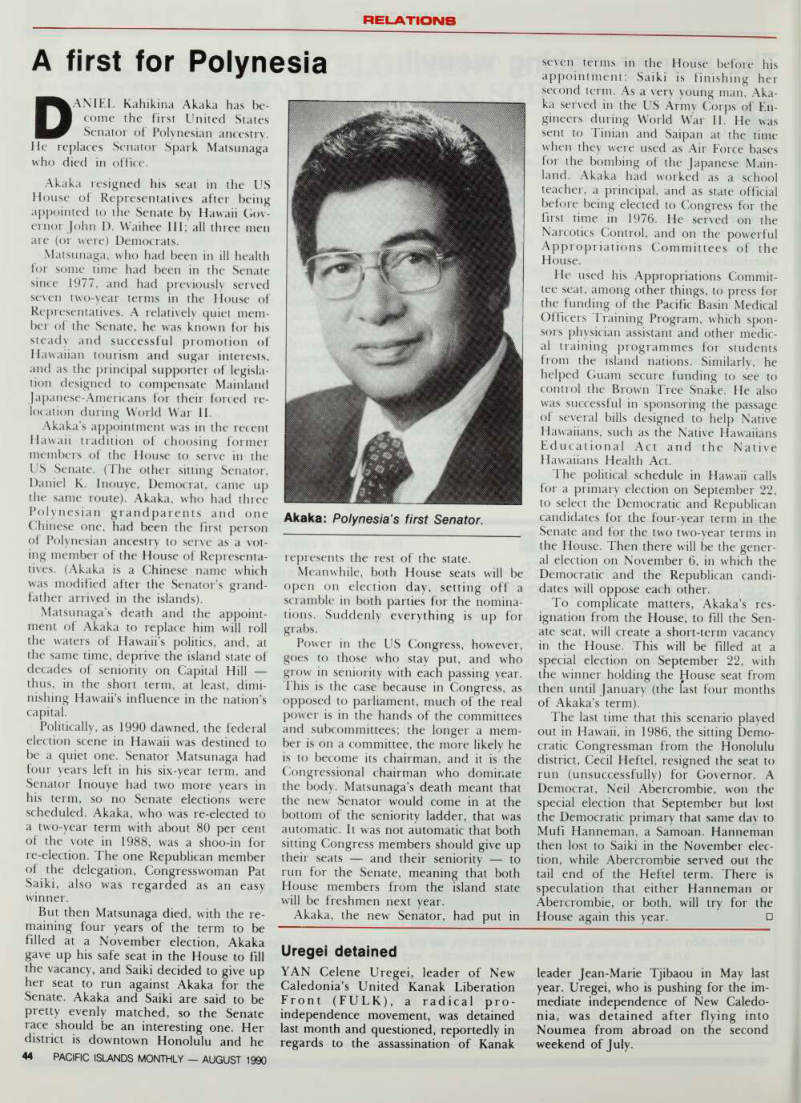
Relations
DANIEL Kahikina Akaka has be come the first United States Senator of Polynesian ancestry.
He replaces Senator Spark Matsunaga who died in office.
Akaka resigned his seat in the US House of Representatives after being appointed to the Senate by Hawaii Gov ernor John D. Waihee HI; all three men are (or were) Democrats.
Matsunaga, who had been in ill health for some time had been in the Senate since 1977, and had previously served seven two-year terms in the House of Representatives. A relatively quiet mem ber of the Senate, he was known for his steady and successful promotion of Hawaiian tourism and sugar interests, and as the principal supporter of legisla tion designed to compensate Mainland Japanese-Americans for their forced re location during World War 11.
Akaka’s appointment was in the recent Hawaii tradition of choosing former members of the House to serve in the US Senate. (The other sitting Senator, Daniel K. Inouye, Democrat, came up the same route). Akaka, who had three
Polynesian grandparents and one
Chinese one, had been the first person of Polynesian ancestry to serve as a vot ing member of the House of Representa tives. (Akaka is a Chinese name which was modified after the Senator’s grand father arrived in the islands).
Matsunaga’s death and the appoint ment of Akaka to replace him will roll the waters of Hawaii’s politics, and, at the same time, deprive the island state of decades of seniority on Capital Hill thus, in the short term, at least, dimi nishing Hawaii’s influence in the nation’s capital.
Politically, as 1990 dawned, the federal election scene in Hawaii was destined to be a quiet one. Senator Matsunaga had four years left in his six-year term, and Senator Inouye had two more years in his term, so no Senate elections were scheduled. Akaka, who was re-elected to a two-year term with about 80 per cent of the vote in 1988, was a shoo-in for re-election. The one Republican member of the delegation, Congresswoman Pat Saiki, also was regarded as an easy winner.
But then Matsunaga died, with the re maining four years of the term to be filled at a November election, Akaka gave up his safe seat in the House to fill the vacancy, and Saiki decided to give up her seat to run against Akaka for the Senate. Akaka and Saiki are said to be pretty evenly matched, so the Senate race should be an interesting one. Her district is downtown Honolulu and he
represents the rest of the state.
Meanwhile, both House seats will be open on election day, setting off a scramble in both parties for the nomina tions. Suddenly everything is up for grabs.
Power in the US Congress, however, goes to those who stay put, and who grow in seniority with each passing year.
This is the case because in Congress, as opposed to parliament, much of the real power is in the hands of the committees and subcommittees; the longer a mem ber is on a committee, the more likely he is to become its chairman, and it is the Congressional chairman who dominate the body. Matsunaga’s death meant that the new Senator would come in at the bottom of the seniority ladder, that was automatic. It was not automatic that both
sitting Congress members should give up
their seats and their seniority to run for the Senate, meaning that both House members from the island state will be freshmen next year.
Akaka, the new Senator, had put in
seven terms in the House before his appointment: Saiki is finishing her second term. As a very young man, Aka ka served in the US Army Corps of En gineers during World War 11. He was sent to Tinian and Saipan at the time when they were used as Air Force bases for the bombing of the Japanese Main land. Akaka had worked as a school teacher, a principal, and as state official before being elected to Congress for the first time in 1976. He served on the Narcotics Control, and on the powerful Appropriations Committees of the House.
He used his Appropriations Commit tee seat, among other things, to press for the funding of the Pacific Basin Medical Officers Training Program, which spon sors physician assistant and other medic al training programmes for students from the island nations. Similarly, he helped Guam secure funding to see to control the Brown Tree Snake. He also was successful in sponsoring the passage of several bills designed to help Native Hawaiians, such as the Native Hawaiians Educational Act and the Native Hawaiians Health Act.
The political schedule in Hawaii calls for a primary election on September 22, to select the Democratic and Republican candidates for the four-year term in the Senate and for the two two-year terms in the House. Then there will be the gener al election on November 6, in which the Democratic and the Republican candi dates will oppose each other.
To complicate matters, Akaka’s res ignation from the House, to fill the Sen ate seat, will create a short-term vacancy in the House. This will be filled at a special election on September 22, with the winner holding the House seat from then until January (the last four months of Akaka’s term).
The last time that this scenario played out in Hawaii, in 1986, the sitting Demo cratic Congressman from the Honolulu district, Cecil Heftel, resigned the seat to run (unsuccessfully) for Governor. A Democrat, Neil Abercrombie, won the special election that September but lost the Democratic primary that same day to Mufi Hanneman, a Samoan. Hanneman then lost to Saiki in the November elec tion, while Abercrombie served out the tail end of the Heftel term. There is speculation that either Hanneman or Abercrombie, or both, will try for the House again this year. □
Akaka: Polynesia’s first Senator.
Uregei detained
VAN Celene Uregei, leader of New Caledonia’s United Kanak Liberation Front (FULK), a radical pro independence movement, was detained last month and questioned, reportedly in regards to the assassination of Kanak
leader Jean-Marie Tjibaou in May last year. Uregei, who is pushing for the im mediate independence of New Caledo nia, was detained after flying into Noumea from abroad on the second weekend of July.
ocean-related aid
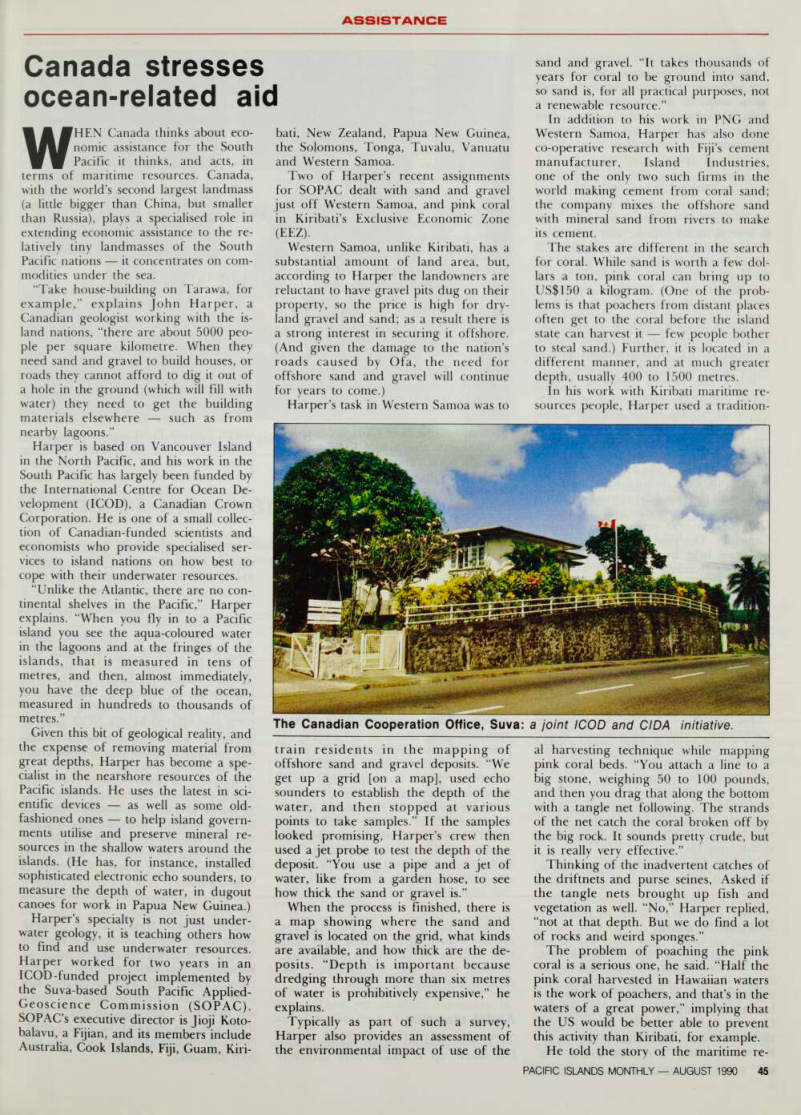
Canada stresses ocean-related aid
WHEN Canada thinks about eco nomic assistance for the South Pacific it thinks, and acts, in terms of maritime resources. Canada, with the world’s second largest landmass (a little bigger than China, but smaller than Russia), plays a specialised role in extending economic assistance to the re latively tiny landmasses of the South Pacific nations it concentrates on com modities under the sea.
“Take house-building on Tarawa, for example,” explains John Harper, a Canadian geologist working with the is land nations, “there are about 5000 peo ple per square kilometre. When they need sand and gravel to build houses, or roads they cannot afford to dig it out of a hole in the ground (which will fill with water) they need to get the building materials elsewhere such as from
nearby lagoons.”
Harper is based on Vancouver Island in the North Pacific, and his work in the South Pacific has largely been funded by the International Centre for Ocean De velopment (ICOD), a Canadian Crown Corporation. He is one of a small collec tion of Canadian-funded scientists and economists who provide specialised ser vices to island nations on how best to cope with their underwater resources.
“Unlike the Atlantic, there are no con tinental shelves in the Pacific,” Harper explains. “When you fly in to a Pacific island you see the aqua-coloured water in the lagoons and at the fringes of the islands, that is measured in tens of metres, and then, almost immediately, you have the deep blue of the ocean, measured in hundreds to thousands of metres.”
Given this bit of geological reality, and the expense of removing material from great depths, Harper has become a spe cialist in the nearshore resources of the Pacific islands. He uses the latest in sci entific devices as well as some old fashioned ones to help island govern ments utilise and preserve mineral re sources in the shallow waters around the islands. (He has, for instance, installed sophisticated electronic echo sounders, to measure the depth of water, in dugout canoes for work in Papua New Guinea.) Harper’s specialty is not just under water geology, it is teaching others how to find and use underwater resources.
Harper worked for two years in an
ICOD-funded project implemented by
the Suva-based South Pacific Applied- Geoscience Commission (SOPAC).
SOPAC’s executive director is Jioji Koto balavu, a Fijian, and its members include Australia, Cook Islands, Fiji, Guam, Kiri
bati, New Zealand, Papua New Guinea, the Solomons, Tonga, Tuvalu, Vanuatu and Western Samoa.
Two of Harper’s recent assignments for SOPAC dealt with sand and gravel just off Western Samoa, and pink coral in Kiribati’s Exclusive Economic Zone
(Eez).
Western Samoa, unlike Kiribati, has a substantial amount of land area, but, according to Harper the landowners are reluctant to have gravel pits dug on their property, so the price is high for dry land gravel and sand; as a result there is a strong interest in securing it offshore. (And given the damage to the nation’s roads caused by Ofa, the need for offshore sand and gravel will continue for years to come.) Harper’s task in Western Samoa was to
train residents in the mapping of offshore sand and gravel deposits. “We get up a grid [on a map], used echo sounders to establish the depth of the water, and then stopped at various points to take samples.” If the samples looked promising, Harper’s crew then used a jet probe to test the depth of the deposit. “You use a pipe and a jet of water, like from a garden hose, to see how thick the sand or gravel is.”
When the process is finished, there is a map showing where the sand and gravel is located on the grid, what kinds are available, and how thick are the de posits. “Depth is important because dredging through more than six metres of water is prohibitively expensive,” he
explains.
Typically as part of such a survey, Harper also provides an assessment of the environmental impact of use of the
sand and gravel. “It takes thousands of years for coral to be ground into sand, so sand is, for all practical purposes, not a renewable resource.”
In addition to his work in PNG and Western Samoa, Harper has also done co-operative research with Fiji’s cement manufacturer, Island Industries, one of the only two such firms in the world making cement from coral sand; the company mixes the offshore sand with mineral sand from rivers to make its cement.
The stakes are different in the search for coral. While sand is worth a few dol lars a ton, pink coral can bring up to US$l5O a kilogram. (One of the prob lems is that poachers from distant places often get to the coral before the island state can harvest it few people bother to steal sand.) Further, it is located in a different manner, and at much greater depth, usually 400 to 1500 metres.
In his work with Kiribati maritime re sources people, Harper used a tradition
al harvesting technique while mapping
pink coral beds. “You attach a line to a big stone, weighing 50 to 100 pounds, and then you drag that along the bottom with a tangle net following. The strands of the net catch the coral broken off by the big rock. It sounds pretty crude, but it is really very effective.”
Thinking of the inadvertent catches of the driftnets and purse seines, Asked if the tangle nets brought up fish and vegetation as well. “No,” Harper replied, “not at that depth. But we do find a lot of rocks and weird sponges.”
The problem of poaching the pink
coral is a serious one, he said. “Half the pink coral harvested in Hawaiian waters is the work of poachers, and that’s in the waters of a great power,” implying that the US would be better able to prevent this activity than Kiribati, for example, He told the story of the maritime re
The Canadian Cooperation Office, Suva: a joint ICOD and CIDA initiative.
source specialist who was visiting the Taiwan office of an entrepreneur in this line of work: “There, carefully marked on a map, in Kiribati’s waters, were several locations for pink coral known to the operator, but not to the island government.”
Speaking of poaching, the maritime scientists funded by Canada also work with island nations to help them cope with unlicensed, foreign fishing boats.
While Australia has provided patrol craft to several island nations, and while New Zealand and Australia both provide occa
sional overflights of fishing waters by
their aircraft, the Canadians’ principal contribution to date has been in the field of enforcement strategy.
Canada delivers much of its maritime related services to the South Pacific through ICOD, an organisation located in Halifax, on the North Atlantic.
When the Forum Fisheries Agency (FFA) requested advice on how to best detect poachers, ICOD recruited Don Aldous, who had spent the previous nine years working on surveillance problems for Canada’s Department of Fisheries and Oceans. (Canada has struggled for years with illicit fishing in its cod-rich EEZ, with the poachers coming from va rious ports in Europe as well as from the US). Aldous was replaced by another Canadian. The post has now been local ised and held by Cook Islander Colin Brown in Honiara.
Aldous worked with FFA to develop a regional network of people trained in maritime surveillance, he provided speci fic technical assistance to PNG as it plan ned the best way to use its small navy to cope with the foreign fishing boats, and helped Federated States of Micronesia select people to design and build its first patrol boat.
One aspect of Aldous’ work was a seven-week training programme orga nised at the Australian Maritime College
in Tasmania. Among the subjects taught
were navigation, seamanship, fisheries
biology, safety at sea, weapons and other aspects of sea-going law enforcement. A fisheries prosecution workshop, also sponsored by ICOD and FFA, was held at the same time. (A third Canadian professional, Galo Carrera, is helping the members of the
FFA map their complex maritime boundaries so that tuna treaty funds can be distributed equitably).
ICOD has also worked with FFA on one other aspect of maritime science the establishment of a series of research libraries in Suva and Honiara; research reports on how to use marine resources are not much good to anyone if they are not readily available to people in the business, and that is the objective of the Pacific Islands Marines Resources In formation System (PIMRIS).
In addition to its work with FFA and SOPAC, ICOD also has funded specific maritime-related programmes through the University of the South Pacific and the Forum Secretariat in Suva. ICOD has enlisted Philip Muller, Executive Director of the Forum Fisheries Agency, to serve as a member of its board of directors. The ICOD field office in Suva operates from the Canadian Cooperation Office, a joint ICOD and CIDA initia tive.
About two-thirds of Canada’s bi-lateral assistance to the South Pacific comes through ICOD and most of the other third of its bi-lateral assistance comes through two other channels, the Canada Fund, which specialises in small grants, and CUSO, a Canadian agency with many similarities to the US Peace Corps.
“We are very happy about the speed with which the Canada Fund can make small grants,” CIDA’s Pacific Island Desk Officer Roger Wilson told Pacific Islands Monthly recently in Ottawa. Wilson, a career foreign service officer, is several rungs down the organisation ladder
from Monique Landry, the Quebec con
servative member of Parliament who runs CIDA in her role as Minister for External Relations and International De
velopment.
Wilson, who also handles CIDA’s assistance programme in Sri Lanka, ex plained that the Canada Fund is a series of pots of money handled directly by the Canadian high commissioners and ambassadors around the world.
“These grants, in the South Pacific, have run from Cslso to C 550,000 (US$l35 to U 5545,000),” he said. The smallest grant was to buy seeds and handtools for a school garden project in the Solomons. The grants can be made
swiftly because a small committee, con sisting of three people, makes the deci sions in the region without consulting Ottawa. Further, the ground rule calls for one-page proposals. It is a model of decentralisation.
Some of these grants are to projects run by CUSO; modest lump sums are set aside for CUSO, whose field officers can make small project decisions without consulting either a High Commissioner’s Office or Ottawa. (CUSO is particularly active in PNG; there are 90 Canadian volunteers in the country, and CUSO maintains a regional office in Port
Moresby).
Some examples of Canada Fund grants, in these cases all in the Solomons, were cited:
• A small indigenous fishing operation
was likely to collapse because its only fishing boat had been wrecked on a reef in a storm; Canada Fund, for about Cslo,ooo, replaced the boat, its out board motor and its nets. • Some schools lost their roofs in a storm; Canada Fund replaced them. • The Solomons Government had the personnel and the funding for some health centres, but no buildings to house them. Canada Fund, using a local design and a local contractor, built the concrete block structures needed for the prog ramme.
“We like to fill in the gaps, as in the case of building the health centres; we like to add the missing piece of machin ery or capital that is needed to make a success of an existing grassroots opera tion,” Wilson explained.
In keeping with this approach, CIDA also makes a number of matching grants to Non-Governmental Organizations (NGOs). Sometimes CIDA matches the NGO dollar for dollar, and sometimes, it puts up as many as three dollars for every one offered by the NGO. Usually the NGOs have both a Canadian affili ate, which often does most of the fund raising, and an island one as well, so that community organisations in both the donor and the recipient country are in volved in the decision-making. Many of the NGOs in the matching grant orga nisations are based in religious organisa tions, such as the Catholic Church or the United Church, a group of Protestant organisations. □
Desperate state
THE deteriorating state of health care on the rebel island of Bougainville has caused the death of many mothers dur ing childbirth, a report said. The report by Denis Tamplin, of the Australian Catholic Relief, said that in one area alone 14 women died while giving birth.
He was quoting “a reliable source” on
Bougainville. The main hospital and medical clinics on the island have been shut because of Government blockade.
Tropical ulcers and dysentry have be come major health problems.
Aerial mapping
THE New Zealand Aerial Mapping Ltd has taken up a NZ5240,000 contract,
funded by the New Zealand Govern ment, to provide aerial maps of Western Samoa. The company used a modified Rockwell Commander aircraft and shot from 25,000 feet with German-made Zeiss cameras. The new maps will be on sale next year. New Zealand Aerial Map ping Ltd has worked in Fiji, Tonga, Niue, Solomon Islands, Norfolk and New Zealand.
Songs of the islands
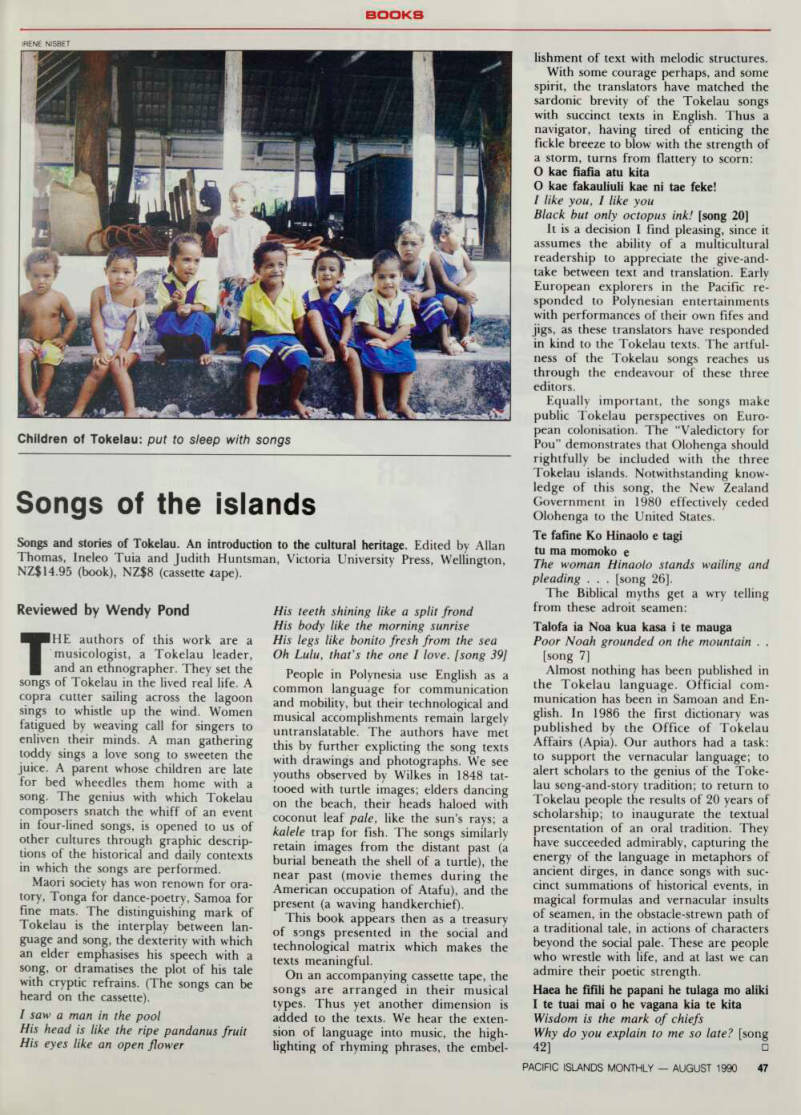
Books
Songs and stories of Tokelau. An introduction to the cultural heritage. Edited by Allan Thomas, Ineleo Tuia and Judith Huntsman, Victoria University Press, Wellington, NZ514.95 (book), NZ$B (cassette tape).
Reviewed by Wendy Pond
His teeth shining like a split frond His body like the morning sunrise His legs like bonito fresh from the sea Oh Lulu, that’s the one I love, [song 39] People in Polynesia use English as a common language for communication and mobility, but their technological and
musical accomplishments remain largely
untranslatable. The authors have met this by further explicting the song texts with drawings and photographs. We see youths observed by Wilkes in 1848 tat tooed with turtle images; elders dancing on the beach, their heads haloed with coconut leaf pale, like the sun’s rays; a kalele trap for fish. The songs similarly retain images from the distant past (a burial beneath the shell of a turtle), the near past (movie themes during the American occupation of Atafu), and the present (a waving handkerchief).
This book appears then as a treasury of songs presented in the social and technological matrix which makes the texts meaningful.
On an accompanying cassette tape, the songs are arranged in their musical types. Thus yet another dimension is added to the texts. We hear the exten sion of language into music, the high lighting of rhyming phrases, the embel-
THE authors of this work are a musicologist, a Tokelau leader, and an ethnographer. They set the songs of Tokelau in the lived real life. A copra cutter sailing across the lagoon sings to whistle up the wind. Women fatigued by weaving call for singers to enliven their minds. A man gathering toddy sings a love song to sweeten the juice. A parent whose children are late for bed wheedles them home with a song. The genius with which Tokelau composers snatch the whiff of an event in four-lined songs, is opened to us of
other cultures through graphic descrip
tions of the historical and daily contexts in which the songs are performed.
Maori society has won renown for ora tory, Tonga for dance-poetry, Samoa for fine mats. The distinguishing mark of Tokelau is the interplay between lan guage and song, the dexterity with which an elder emphasises his speech with a song, or dramatises the plot of his tale with cryptic refrains. (The songs can be heard on the cassette). / saw a man in the pool His head is like the ripe pandanus fruit His eyes like an open flower
lishment of text with melodic structures.
With some courage perhaps, and some spirit, the translators have matched the sardonic brevity of the Tokelau songs with succinct texts in English. Thus a navigator, having tired of enticing the fickle breeze to blow with the strength of a storm, turns from flattery to scorn: O kae fiafia atu kita 0 kae fakauliuli kae ni tae feke! 1 like you, I like you Black but only octopus ink! [song 20] It is a decision I find pleasing, since it assumes the ability of a multicultural
readership to appreciate the give-and
take between text and translation. Early European explorers in the Pacific re sponded to Polynesian entertainments with performances of their own fifes and jigs, as these translators have responded in kind to the Tokelau texts. The artful ness of the Tokelau songs reaches us through the endeavour of these three editors.
Equally important, the songs make public Tokelau perspectives on Euro pean colonisation. The “Valedictory for Pou” demonstrates that Olohenga should rightfully be included with the three Tokelau islands. Notwithstanding know ledge of this song, the New Zealand Government in 1980 effectively ceded Olohenga to the United States.
Te fafine Ko Hinaolo e tagi tu ma momoko e The woman Hinaolo stands wailing and
pleading . . . [song 26].
The Biblical myths get a wry telling from these adroit seamen: Talofa ia Noa kua kasa i te mauga Poor Noah grounded on the mountain . .
[song 7]
Almost nothing has been published in the Tokelau language. Official com munication has been in Samoan and En glish. In 1986 the first dictionary was published by the Office of Tokelau Affairs (Apia). Our authors had a task: to support the vernacular language; to alert scholars to the genius of the Toke lau song-and-story tradition; to return to Tokelau people the results of 20 years of scholarship; to inaugurate the textual presentation of an oral tradition. They have succeeded admirably, capturing the energy of the language in metaphors of ancient dirges, in dance songs with suc cinct summations of historical events, in magical formulas and vernacular insults of seamen, in the obstacle-strewn path of a traditional tale, in actions of characters beyond the social pale. These are people who wrestle with life, and at last we can
admire their poetic strength.
Haea he fiflli he papani he tulaga mo aliki I te tuai mai o he vagana kia te kita Wisdom is the mark of chiefs Why do you explain to me so late? [song 42] □
Irene Nisbet
Children of Tokelau: put to sleep with songs
PNG’s new move
Stamps
By John Hunter
PAPUA New Guinea is about to in troduce what is probably a world first. The country commands re spect among the stamp world because of its moderate stamp issuing policy and the attractive stamps presented. It is now about to increase its service to its custom ers. In the near future Papua New Guinea is to introduce a toll free tele phone service to its overseas customers.
In the first instance the service is to be restricted to customers in Australia.
However, if the service proves successful after a six-month trial it could be ex tended to other countries. The caller in Australia will be able to dial 0014 800 125 916 and be charged only a unit fee.
The caller will be able to order stamps using his or her standing order account.
Later it is hoped to have the caller use a charge account and inquiries are under way to use visa. The caller may also wish
to make an inquiry about his or her account or an order. However, the Bureau is asking that the inquiry be kept to under three minutes. Complex in quiries are to be submitted in writing.
Papua New Guinea is aware that in this time the Philatelic customer is harder to find and must be looked after. Collectors are still quitting the hobby in large num ber. Most philatelic agencies are still re cording falls in customers and sales. Now is the time to hold and build up client numbers.
While talking about innovations, Au stralia Post has introduced, for the first time, a peel-and-stick stamp. On May 16 Australia Post ventured into the pressure sensitive postage stamp. There are a number of instances where they have been used in other countries. Several Pacific countries have used these stamps quite a number of years ago. Tonga is one country well known to collectors of these stamps. The early examples had
mixed reception from philatelists, parti
cularly from collectors of used stamps who found them to be difficult to re move from their envelopes. Recent tech
nological developments have overcome
the deficiencies of the past and several other countries including Canada and the United States are now using pressure sensitive stamps in their product range as a practical service to their customers.
The advantage of using these stick on stamps is seen when a company has many hundreds of letters to stamp. The peel off stamp in a dispenser is much easier to use than tearing apart and lick ing hundreds of stamps.
The paper used is Jac-PS stamp paper.
The paper is detection coated semi-gloss white paper. The backing is siliconised glassinated paper. A pressure-sensitive adhesive has been formulated to allow stamps to be washed off paper without damage after being submerged for 10 minutes in warm water. Printing is done on a nine-colour Kopack continuous web rotary letterpress machine using 175 line screen. Six rows of four stamps are printed with each cylinder rotation to be cut into lengths of 100 and slit onto four. Rotary cutting tools shape cut the stamps with precisely simulated perfora tions.
For normal use the rolls of 100 stamps are packaged and sold in handy dispen ser packs. A set of three stamps is avail able for collector. Australia Post is re ceiving much criticism from collectors as it is to issue a $2O stamp on August 15.
For the collector there will be a huge financial outlay if he or she wishes to obtain the full range of material associ ated with the issue. There is the stamp $2O, a first day cover $20.20, a stamp pack $20.35, a Maximum cards $20.50. This totals $81.05.
Advertisements & other items, p. 48 (1 item)
Regional Trainer
Tourism Council of the South Pacific
1 post (Hotel and Catering)
HOUSEKEEPING
The Tourism Council of the South Pacific is proposing to extend its team of regional trainers. These specialist trainers are based in Suva, Fiji, but are required to work outside of Fiji on assignments of six to eight weeks.
Applicants will require to have: a) A good education, preferably with a formal qualification in the field of Hotel and Catering. b) A high level of literacy and oral competence in the English language. c) A minimum of seven years operational experience actively involved with all aspects of Hotel Housekeeping with at least two years at supervisory level. d) Strong personal characteristics which allow for flexibility, adaptability and reliability.
Applicants should be nationals of the council's ACP member countries. (Fiji, Kiribati, Papua New Guinea, Solomon Islands, Tonga, Tuvalu, Vanuatu and Western Samoa.) Salaries are awarded against a basic rate while in Fiji, plus an overseas allowance and per diem while on duty outside Fiji. The overall salary package will be within the range expected at management level within the industry.
The initial contract is for one year.
Persons interested are invited to submit a copy of their C.V. (typed), along with a letter of application (hand written). Closing date for applications is August 24th 1990. Applications will be dealt with in strict confidence. Envelopes should be marked "CONFIDENTIAL" and addressed to; Division of Education and Training Tourism Council of the South Pacific GPO Box 13119 Suva, Fiji
In God’s Hands
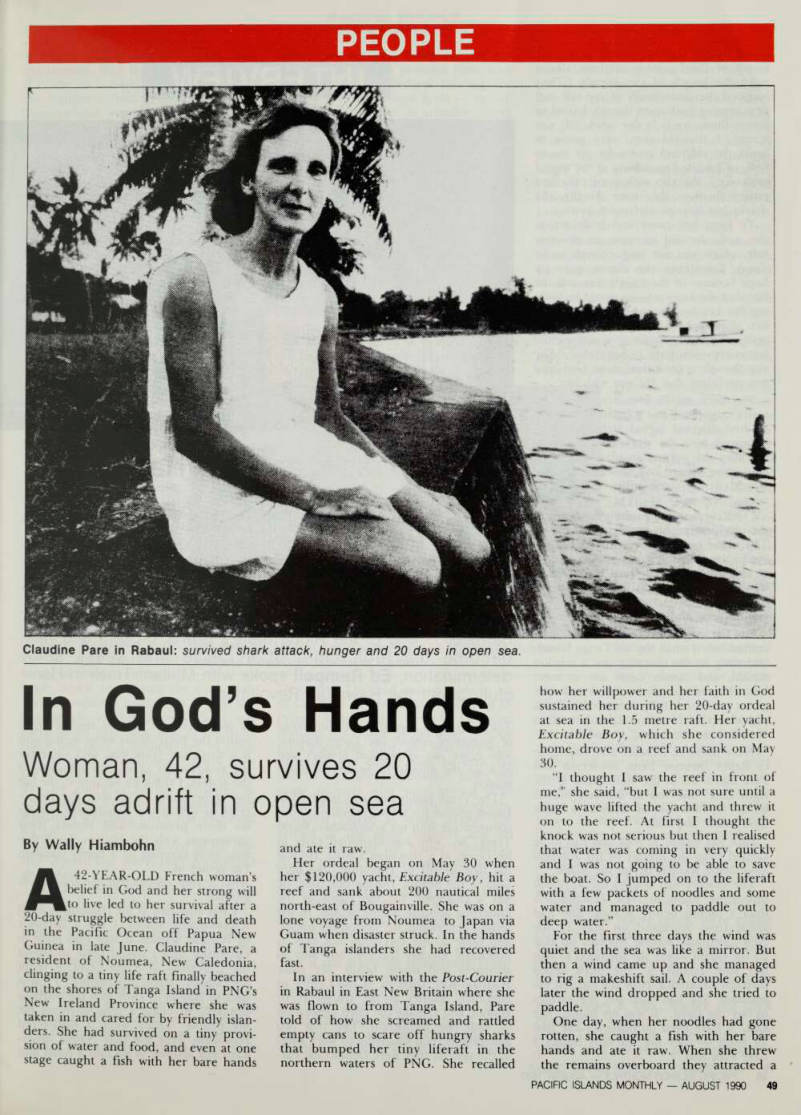
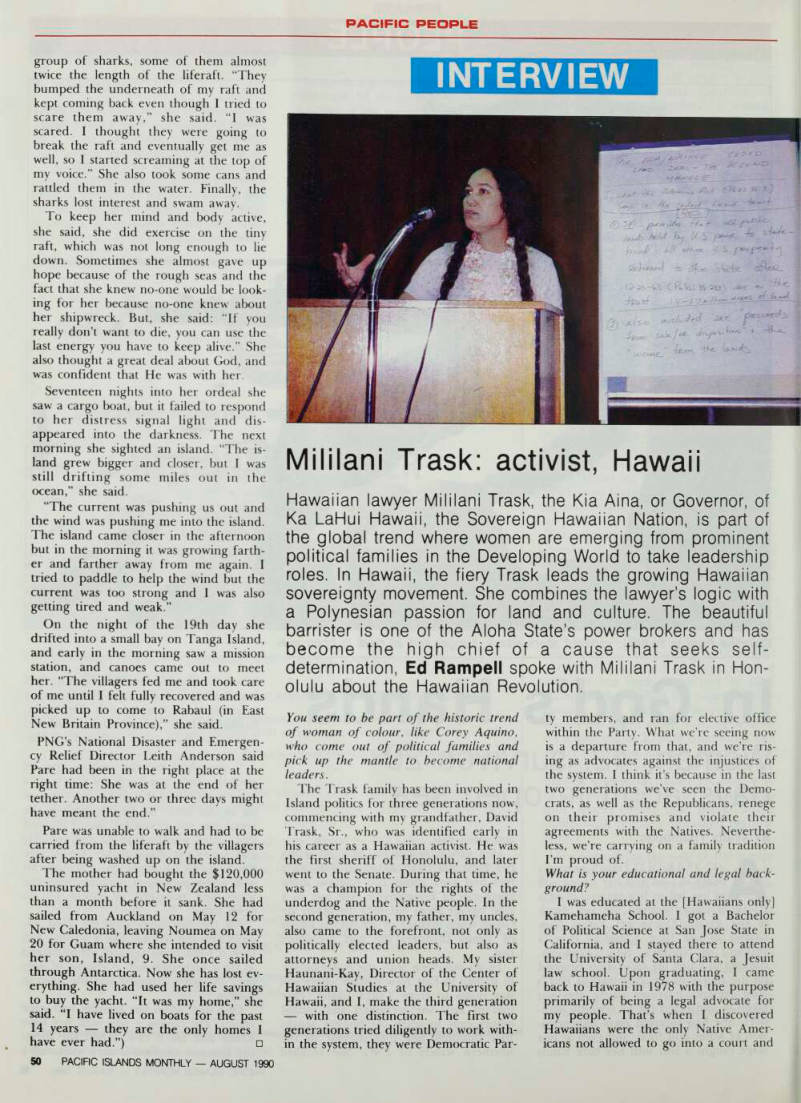
People
Woman, 42, survives 20 days adrift in open sea
By Wally Hiambohn
A 42-YEAR-OLD French woman’s belief in God and her strong will to live led to her survival after a 20-day struggle between life and death in the Pacific Ocean off Papua New Guinea in late June. Claudine Pare, a resident of Noumea, New Caledonia, clinging to a tiny life raft finally beached on the shores of Tanga Island in PNG’s New Ireland Province where she was taken in and cared for by friendly islan ders. She had survived on a tiny provi sion of water and food, and even at one stage caught a fish with her bare hands
and ate it raw.
Her ordeal began on May 30 when her $120,000 yacht, Excitable Boy, hit a reef and sank about 200 nautical miles north-east of Bougainville. She was on a lone voyage from Noumea to Japan via Guam when disaster struck. In the hands of Tanga islanders she had recovered fast.
In an interview with the Post-Courier in Rabaul in East New Britain where she was flown to from Tanga Island, Pare told of how she screamed and rattled empty cans to scare off hungry sharks that bumped her tiny liferaft in the northern waters of PNG. She recalled
how her willpower and her faith in God sustained her during her 20-day ordeal at sea in the 1.5 metre raft. Her yacht, Excitable Boy, which she considered home, drove on a reef and sank on May 30.
“I thought I saw the reef in front of me,” she said, “but I was not sure until a huge wave lifted the yacht and threw it on to the reef. At first I thought the knock was not serious but then I realised that water was coming in very quickly and I was not going to be able to save the boat. So I jumped on to the liferaft with a few packets of noodles and some water and managed to paddle out to
deep water.”
For the first three days the wind was quiet and the sea was like a mirror. But then a wind came up and she managed to rig a makeshift sail. A couple of days later the wind dropped and she tried to
paddle.
One day, when her noodles had gone rotten, she caught a fish with her bare hands and ate it raw. When she threw the remains overboard they attracted a
Claudine Pare in Rabaul: survived shark attack, hunger and 20 days in open sea.
group of sharks, some of them almost twice the length of the liferaft. “They bumped the underneath of my raft and kept coming back even though I tried to scare them away,” she said. “I was scared. I thought they were going to break the raft and eventually get me as well, so I started screaming at the top of my voice.” She also took some cans and rattled them in the water. Finally, the sharks lost interest and swam away.
To keep her mind and body active, she said, she did exercise on the tiny raft, which was not long enough to lie down. Sometimes she almost gave up hope because of the rough seas and the fact that she knew no-one would be look ing for her because no-one knew about her shipwreck. But, she said: “If you really don’t want to die, you can use the last energy you have to keep alive.” She also thought a great deal about God, and was confident that He was with her.
Seventeen nights into her ordeal she saw a cargo boat, but it failed to respond to her distress signal light and dis appeared into the darkness. The next morning she sighted an island. “The is land grew bigger and closer, but I was still drifting some miles out in the ocean,” she said.
“The current was pushing us out and the wind was pushing me into the island.
The island came closer in the afternoon but in the morning it was growing farth er and farther away from me again. I tried to paddle to help the wind but the current was too strong and I was also getting tired and weak.”
On the night of the 19th day she drifted into a small bay on Tanga Island, and early in the morning saw a mission station, and canoes came out to meet her. “The villagers fed me and took care of me until I felt fully recovered and was picked up to come to Rabaul (in East New Britain Province),” she said.
PNG’s National Disaster and Emergen cy Relief Director Leith Anderson said Pare had been in the right place at the right time: She was at the end of her tether. Another two or three days might have meant the end.”
Pare was unable to walk and had to be carried from the liferaft by the villagers after being washed up on the island.
The mother had bought the $120,000 uninsured yacht in New Zealand less than a month before it sank. She had sailed from Auckland on May 12 for New Caledonia, leaving Noumea on May 20 for Guam where she intended to visit her son, Island, 9. She once sailed through Antarctica. Now she has lost ev erything. She had used her life savings to buy the yacht. “It was my home,” she said. “I have lived on boats for the past 14 years they are the only homes I have ever had.”) □
Interview
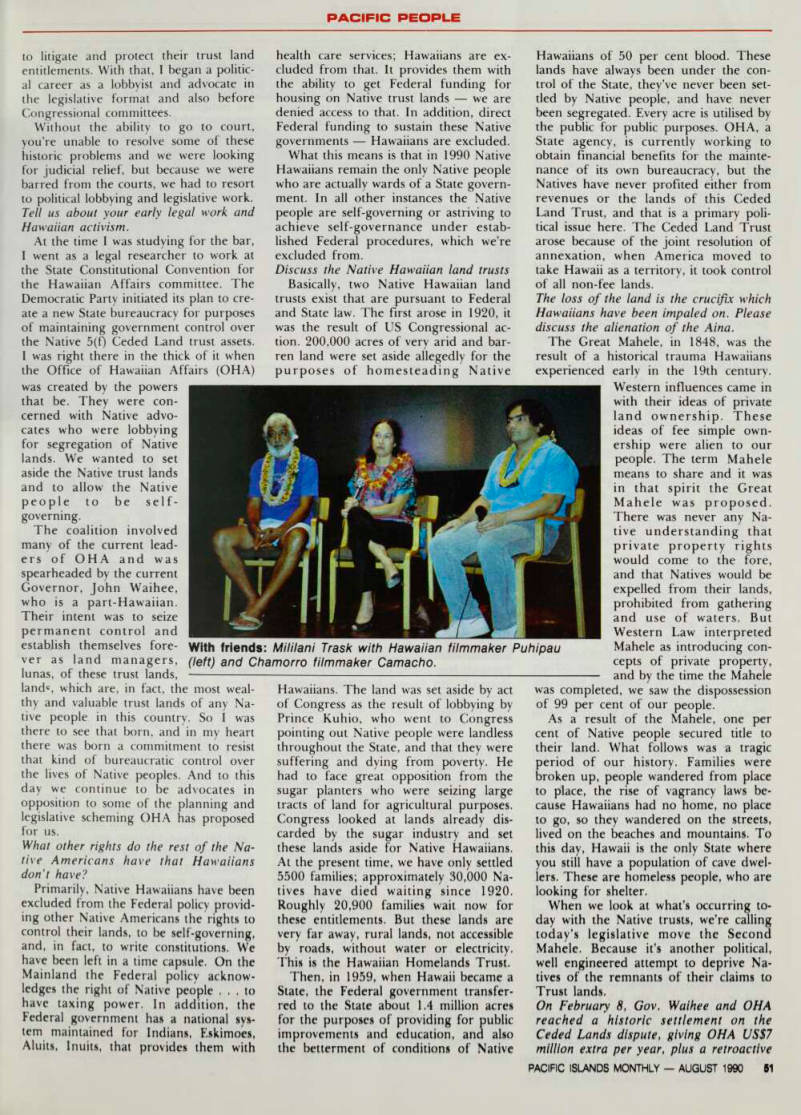
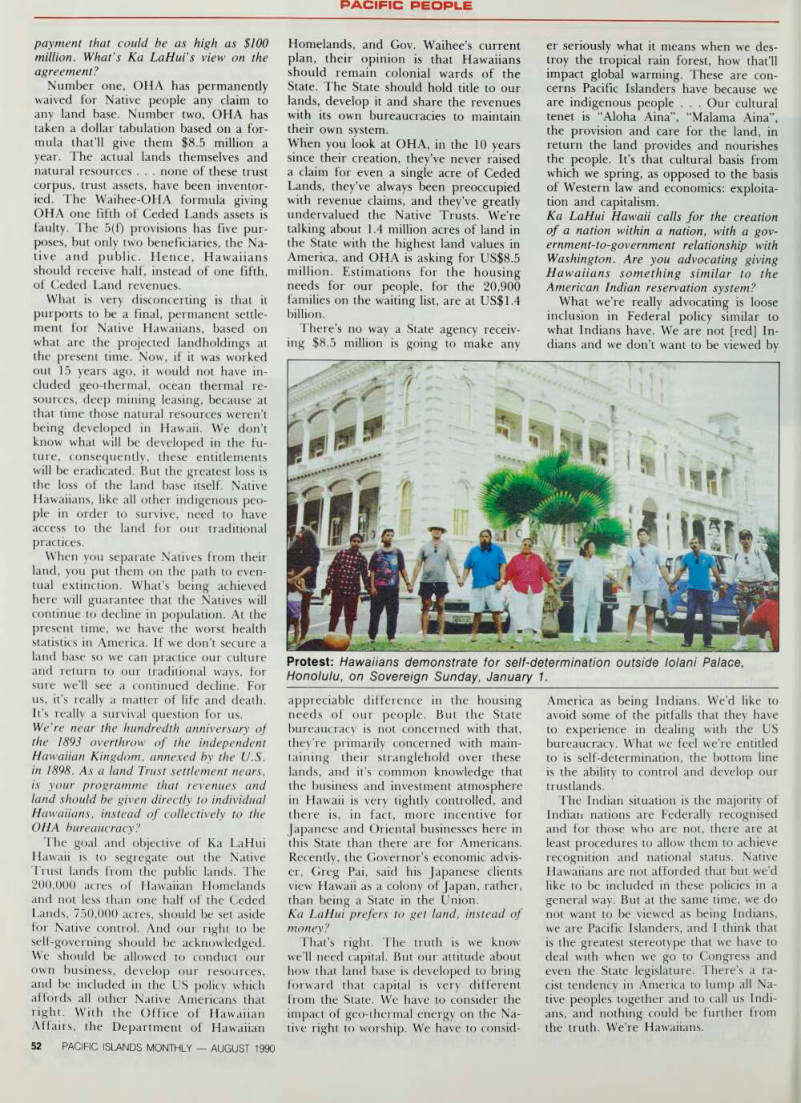
Mililani Trask: activist, Hawaii
Hawaiian lawyer Mililani Trask, the Kia Aina, or Governor, of Ka LaHui Hawaii, the Sovereign Hawaiian Nation, is part of the global trend where women are emerging from prominent political families in the Developing World to take leadership roles. In Hawaii, the fiery Trask leads the growing Hawaiian sovereignty movement. She combines the lawyer’s logic with a Polynesian passion for land and culture. The beautiful barrister is one of the Aloha State’s power brokers and has become the high chief of a cause that seeks self determination, Ed Rampell spoke with Mililani Trask in Hon olulu about the Hawaiian Revolution.
You seem to be part of the historic trend of woman of colour, like Corey Aquino, who come out of political families and pick up the mantle to become national leaders.
The Trask family has been involved in Island politics for three generations now, commencing with my grandfather, David Trask, Sr., who was identified early in his career as a Hawaiian activist. He was the first sheriff of Honolulu, and later went to the Senate. During that time, he was a champion for the rights of the underdog and the Native people. In the second generation, my father, my uncles, also came to the forefront, not only as politically elected leaders, but also as attorneys and union heads. My sister Haunani-Kay, Director of the Center of Hawaiian Studies at the University of Hawaii, and I, make the third generation with one distinction. The first two generations tried diligently to work with in the system, they were Democratic Par
ty members, and ran for elective office within the Party. What we’re seeing now is a departure from that, and we’re ris ing as advocates against the injustices of the system. I think it’s because in the last two generations we’ve seen the Demo crats, as well as the Republicans, renege on their promises and violate their agreements with the Natives. Neverthe less, we’re carrying on a family tradition I’m proud of.
What is your educational and legal back ground?
I was educated at the [Hawaiians only] Kamehameha School. I got a Bachelor of Political Science at San Jose State in California, and I stayed there to attend the University of Santa Clara, a Jesuit law school. Upon graduating, I came back to Hawaii in 1978 with the purpose primarily of being a legal advocate for my people. That’s when I discovered Hawaiians were the only Native Amer icans not allowed to go into a court and
to litigate and protect their trust land entitlements. With that, I began a politic al career as a lobbyist and advocate in the legislative format and also before
Congressional committees.
Without the ability to go to court, you’re unable to resolve some of these historic problems and we were looking for judicial relief, but because we were barred from the courts, we had to resort
to political lobbying and legislative work.
Tell us about your early legal work and Hawaiian activism.
At the time I was studying for the bar, I went as a legal researcher to work at the State Constitutional Convention for the Hawaiian Affairs committee. The Democratic Party initiated its plan to cre ate a new State bureaucracy for purposes of maintaining government control over the Native s(f) Ceded Land trust assets.
I was right there in the thick of it when the Office of Hawaiian Affairs (OHA)
was created by the powers that be. They were con cerned with Native advo cates who were lobbying for segregation of Native lands. We wanted to set aside the Native trust lands and to allow the Native people to be self
governing.
The coalition involved many of the current lead ers of OHA and was
spearheaded by the current
Governor, John Waihee, who is a part-Hawaiian.
Their intent was to seize permanent control and estabjish themselves fore ver as land managers, lunas, of these trust lands,
land s , which are, in fact, the most wealthy and valuable trust lands of any Nalive people in this country. So I was there to see that born, and in my heart there was born a commitment to resist that kind of bureaucratic control over the lives of Native peoples. And to this day we continue to be advocates in opposition to some of the planning and legislative scheming OHA has proposed f° r us - What other rights do the rest of the Nafive Americans have that Hawaiians don’t have?
Primarily, Native Hawaiians have been excluded from the Federal policy providing other Native Americans the rights to control their lands, to be self-governing, and, in fact, to write constitutions. We have been left in a time capsule. On the Mainland the Federal policy acknowledges the right of Native people ... to have taxing power. In addition, the Federal government has a national systern maintained for Indians, Eskimoes, Aluits, Inuits, that provides them with
health care services; Hawaiians are ex cluded from that. It provides them with the ability to get Federal funding for housing on Native trust lands we are denied access to that. In addition, direct Federal funding to sustain these Native governments Hawaiians are excluded.
What this means is that in 1990 Native Hawaiians remain the only Native people who are actually wards of a State govern ment. In all other instances the Native
people are self-governing or astriving to
achieve self-governance under estab lished Federal procedures, which we’re excluded from.
Discuss the Native Hawaiian land trusts Basically, two Native Hawaiian land trusts exist that are pursuant to Federal and State law. The first arose in 1920, it was the result of US Congressional ac tion. 200,000 acres of very arid and bar ren land were set aside allegedly for the purposes of homesteading Native
Hawaiians. The land was set aside by act of Congress as the result of lobbying by Prince Kuhio, who went to Congress pointing out Native people were landless throughout the State, and that they were suffering and dying from poverty. He had to face great opposition from the sugar planters who were seizing large tracts of land for agricultural purposes.
Congress looked at lands already dis carded by the sugar industry and set these lands aside for Native Hawaiians.
At the present time, we have only settled 5500 families; approximately 30,000 Na lives have died waiting since 1920, Roughly 20,900 families wait now for these entitlements. But these lands are very far away, rural lands, not accessible by roads, without water or electricity.
This is the Hawaiian Homelands Trust.
Then, in 1959, when Hawaii became a State, the Federal government transfer red to the State about 1.4 million acres for the purposes of providing for public improvements and education, and also the betterment of conditions of Native
Hawaiians of 50 per cent blood. These lands have always been under the con trol of the State, they’ve never been set tled by Native people, and have never been segregated. Every acre is utilised by the public for public purposes. OHA, a State agency, is currently working to obtain financial benefits for the mainte nance of its own bureaucracy, but the Natives have never profited either from revenues or the lands of this Ceded Land Trust, and that is a primary poli tical issue here. The Ceded Land Trust arose because of the joint resolution of annexation, when America moved to take Hawaii as a territory, it took control of all non-fee lands.
The loss of the land is the crucifix which Hawaiians have been impaled on. Please discuss the alienation of the Aina.
The Great Mahele, in 1848, was the result of a historical trauma Hawaiians experienced early in the 19th century.
Western influences came in with their ideas of private land ownership. These ideas of fee simple own ership were alien to our people. The term Mahele means to share and it was in that spirit the Great Mahele was proposed.
There was never any Na tive understanding that private property rights would come to the fore, and that Natives would be expelled from their lands, prohibited from gathering and use of waters. But Western Law interpreted Mahele as introducing con cepts of private property, and by the time the Mahele
was completed, we saw the dispossession of 99 per cent of our people.
As a result of the Mahele, one per cent of Native people secured title to their land. What follows was a tragic period of our history. Families were broken up, people wandered from place to place, the rise of vagrancy laws be cause Hawaiians had no home, no place to go, so they wandered on the streets, lived on the beaches and mountains. To this day, Hawaii is the only State where you still have a population of cave dwel lers. These are homeless people, who are looking for shelter.
When we look at what’s occurring to day with the Native trusts, we’re calling today's legislative move the Second Mahele. Because it’s another political, well engineered attempt to deprive Na tives of the remnants of their claims to Trust lands.
On February 8, Gov. Waihee and OHA reached a historic settlement on the Ceded Lands dispute, giving OHA US$7 million extra per year, plus a retroactive
With friends: Mililani Trask with Hawaiian filmmaker Puhipau (left) and Chamorro filmmaker Camacho.
payment that could be as high as $lOO million. What’s Ka LaHui’s view on the agreement?
Number one, OHA has permanently waived for Native people any claim to any land base. Number two, OHA has taken a dollar tabulation based on a for mula that’ll give them $8.5 million a year. The actual lands themselves and natural resources . . . none of these trust corpus, trust assets, have been inventor ied. The Waihee-OHA formula giving OHA one fifth of Ceded Lands assets is faulty. The s(f) provisions has five pur poses, but only two beneficiaries, the Na tive and public. Hence, Hawaiians should receive half, instead of one fifth, of Ceded Land revenues.
What is very disconcerting is that it purports to be a final, permanent settle ment for Native Hawaiians, based on what are the projected landholdings at the present time. Now, if it was worked out 15 years ago, it would not have in cluded geo-thermal, ocean thermal re
sources, deep mining leasing, because at
that time those natural resources weren’t being developed in Hawaii. We don’t know what will be developed in the fu ture, consequently, these entitlements will be eradicated. But the greatest loss is the loss of the land base itself. Native Hawaiians, like all other indigenous peo ple in order to survive, need to have access to the land for our traditional
practices.
When you separate Natives from their land, you put them on the path to even tual extinction. What’s being achieved here will guarantee that the Natives will continue to decline in population. At the present time, we have the worst health statistics in America. If we don’t secure a land base so we can practice our culture and return to our traditional ways, for sure we’ll see a continued decline. For us, it’s really a matter of life and death.
It’s really a survival question for us.
We’re near the hundredth anniversary of the 1893 overthrow of the independent Hawaiian Kingdom, annexed by the U.S. in 1898. As a land Trust settlement nears, is your programme that revenues and land should be given directly to individual Hawaiians, instead of collectively to the OHA bureaucracy?
The goal and objective of Ka LaHui Hawaii is to segregate out the Native Trust lands from the public lands. The 200,000 acres of Hawaiian Homelands and not less than one half of the Ceded Lands, 750,000 acres, should be set aside for Native control. And our right to be self-governing should be acknowledged.
We should be allowed to conduct our own business, develop our resources, and be included in the US policy which affords all other Native Americans that right. With the Office of Hawaiian Affairs, the Department of Hawaiian
Homelands, and Gov. Waihee’s current plan, their opinion is that Hawaiians should remain colonial wards of the State. The State should hold title to our lands, develop it and share the revenues with its own bureaucracies to maintain their own system.
When you look at OHA, in the 10 years since their creation, they’ve never raised a claim for even a single acre of Ceded
Lands, they’ve always been preoccupied
with revenue claims, and they’ve greatly undervalued the Native Trusts. We’re talking about 1.4 million acres of land in the State with the highest land values in America, and OHA is asking for US$B.5 million. Estimations for the housing needs for our people, for the 20,900 families on the waiting list, are at US$l.4 billion.
There’s no way a State agency receiving $8.5 million is going to make any
appreciable difference in the housing needs of our people. But the State bureaucracy is not concerned with that, they’re primarily concerned with main taining their stranglehold over these lands, and it’s common knowledge that the business and investment atmosphere in Hawaii is very tightly controlled, and there is, in fact, more incentive for Japanese and Oriental businesses here in this State than there are for Americans.
Recently, the Governor’s economic advis er, Greg Pai, said his Japanese clients view Hawaii as a colony of Japan, rather, than being a State in the Union.
Ka LaHui prefers to get land, instead of money?
That’s right. The truth is we know we’ll need capital. But our attitude about how that land base is developed to bring forward that capital is very different from the State. We have to consider the impact of geo-thermal energy on the Na tive right to worship. We have to consid
er seriously what it means when we des troy the tropical rain forest, how that’ll
impact global warming. These are con
cerns Pacific Islanders have because we are indigenous people . . . Our cultural tenet is “Aloha Aina”, “Malama Aina”, the provision and care for the land, in return the land provides and nourishes the people. It’s that cultural basis from which we spring, as opposed to the basis of Western law and economics: exploita tion and capitalism, Ka LaHui Hawaii calls for the creation of a nation within a nation, with a gov ernment-to-government relationship with Washington. Are you advocating giving Hawaiians something similar to the American Indian reservation system?
What we’re really advocating is loose inclusion in Federal policy similar to what Indians have. We are not [red] In dians and we don’t want to be viewed by
America as being Indians. We’d like to avoid some of the pitfalls that they have to experience in dealing with the US bureaucracy. What we feel we’re entitled to is self-determination, the bottom line is the ability to control and develop our trustlands.
The Indian situation is the majority of Indian nations are Federally recognised and for those who are not, there are at least procedures to allow them to achieve recognition and national status. Native Hawaiians are not afforded that but we’d like to be included in these policies in a general way. But at the same time, we do not want to be viewed as being Indians, we are Pacific Islanders, and I think that is the greatest stereotype that we have to deal with when we go to Congress and even the State legislature. There’s a ra cist tendency in America to lump all Na tive peoples together and to call us Indi ans, and nothing could be further from the truth. We’re Hawaiians.
Protest: Hawaiians demonstrate for self-determination outside lolani Palace, Honolulu, on Sovereign Sunday, January 1.
Interview
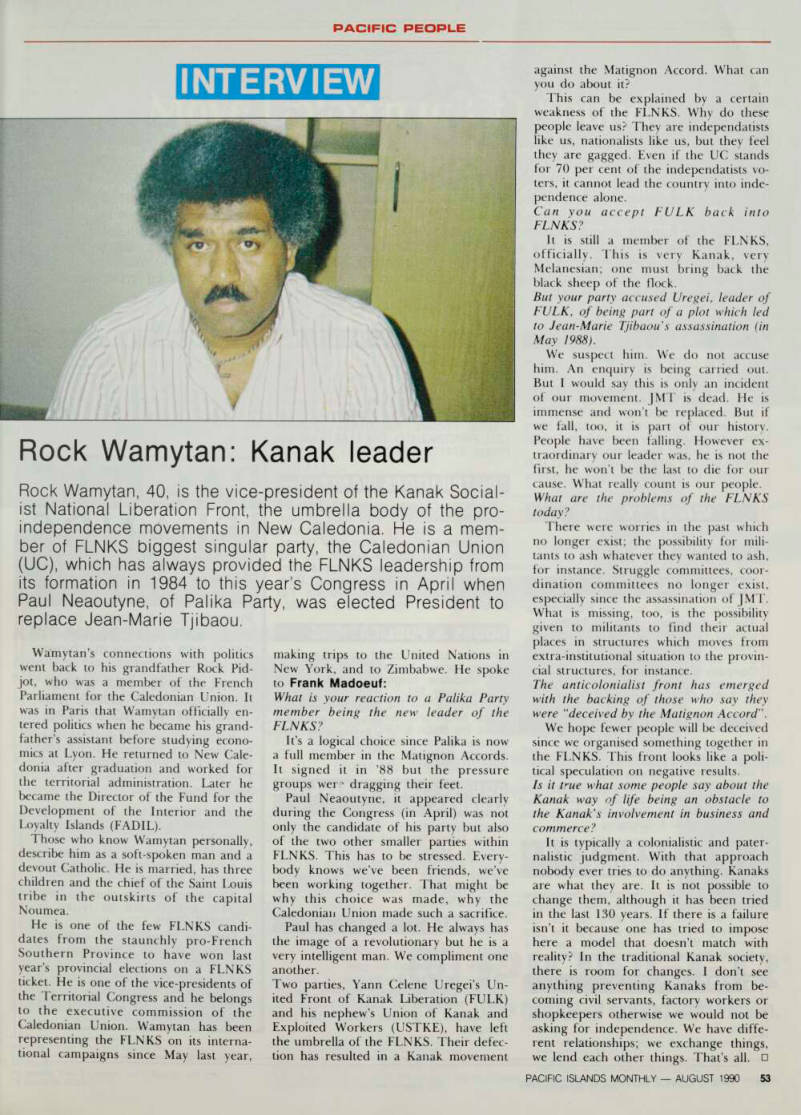
Rock Wamytan: Kanak leader
Rock Wamytan, 40, is the vice-president of the Kanak Social ist National Liberation Front, the umbrella body of the pro independence movements in New Caledonia. He is a mem ber of FLNKS biggest singular party, the Caledonian Union (UC), which has always provided the FLNKS leadership from its formation in 1984 to this year’s Congress in April when Paul Neaoutyne, of Palika Party, was elected President to replace Jean-Marie Tjibaou.
Wamytan’s connections with politics went back to his grandfather Rock Pidjot, who was a member of the French Parliament for the Caledonian Union. Ii was in Paris that Wamytan officially entered politics when he became his grandfather’s assistant before studying economics at Lyon. He returned to New Caledonia after graduation and worked for the territorial administration. Later he became the Director of the Fund for the Development of the Interior and the Loyalty Islands (FADIL).
Those who know Wamytan personally, describe him as a soft-spoken man and a devout Catholic. He is married, has three children and the chief of the Saint Louis tribe in the outskirts of the capital Noumea.
He is one of the few FLNKS candidates from the staunchly pro-French Southern Province to have won last year’s provincial elections on a FLNKS ticket. He is one of the vice-presidents of the Territorial Congress and he belongs to the executive commission of the Caledonian Union. Wamytan has been representing the FLNKS on its international campaigns since May last year,
making trips to the United Nations in New York, and to Zimbabwe. He spoke to Frank Madoeuf: What is your reaction to a Palika Party member being the new leader of the
Flnks?
It’s a logical choice since Palika is now a full member in the Matignon Accords, It signed it in ’BB but the pressure groups wer" dragging their feet,
Paul Neaoutyne, it appeared clearly
during the Congress (in April) was not only the candidate of his party but also of the two other smaller parties within FLNKS. This has to be stressed. Every body knows we’ve been friends, we’ve
been working together. That might be
why this choice was made, why the Caledonian Union made such a sacrifice.
Paul has changed a lot. He always has the image of a revolutionary but he is a very intelligent man. We compliment one another.
Two parties, Yann Celene Uregei’s Un ited Front of Kanak Liberation (FULK) and his nephew’s Union of Kanak and Exploited Workers (USTKE), have left the umbrella of the FLNKS. Their defec tion has resulted in a Kanak movement
against the Matignon Accord. What can you do about it?
This can be explained by a certain weakness of the FLNKS. Why do these people leave us? They are independatists like us, nationalists like us, but they feel they are gagged. Even if the UC stands for 70 per cent of the independatists vo ters, it cannot lead the country into inde pendence alone.
Can you accept FULK back into
Flnks?
It is still a member of the FLNKS, officially. This is very Kanak, very Melanesian; one must bring back the black sheep of the flock.
But your party accused Uregei, leader of FULK, of being part of a plot which led to Jean-Marie Tjibaou’s assassination (in May 1988).
We suspect him. We do not accuse him. An enquiry is being carried out.
But I would say this is only an incident of our movement. JMT is dead. He is immense and won’t be replaced. But if we fall, too, it is part of our history.
People have been falling. However ex traordinary our leader was, he is not the first, he won’t be the last to die for our cause. What really count is our people.
What are the problems of the FLNKS today?
There were worries in the past which no longer exist; the possibility for mili tants to ash whatever they wanted to ash, for instance. Struggle committees, coor dination committees no longer exist, especially since the assassination of JMT.
What is missing, too, is the possibility given to militants to find their actual places in structures which moves from extra-institutional situation to the provin cial structures, for instance.
The anticolonialist front has emerged with the backing of those who say they were “deceived by the Matignon Accord”.
We hope fewer people will be deceived
since we organised something together in
the FLNKS. This front looks like a poli tical speculation on negative results.
Is it true what some people say about the Kanak way of life being an obstacle to the Kanak’s involvement in business and commerce?
It is typically a colonialistic and pater nalistic judgment. With that approach nobody ever tries to do anything. Kanaks are what they are. It is not possible to change them, although it has been tried in the last 130 years. If there is a failure isn’t it because one has tried to impose here a model that doesn’t match with reality? In the traditional Kanak society, there is room for changes. I don’t see anything preventing Kanaks from be coming civil servants, factory workers or shopkeepers otherwise we would not be asking for independence. We have diffe
rent relationships; we exchange things,
we lend each other things. That’s all. □
Advertisements & other items, pp. 54-56 (1 item)
Pacifi
ISLANDS
I M N T
MfiRKCT PLRC
For the benefit of our readers who would like to place a small classified advertisement in our magazine, Market Place will assist you in selling personal items, accommodation, real estate, boating or a service ... in fact anything you would like to sell to our over 50,000 readers.
Market Place Advertising Rates are structured to allow you to place as many advertisements as you wish, economically.
REAL ESTATE'
ACREAGE LOTS: SAVUSAVU BAY, FIJI;
Beach frontage and adjacent lots. All freehold titles. All weather road to town and airport. Zoned tourist/residential. Beautiful lots from only AU520,900. From one acre to 1.9 acre and five acre lots available. Many are sold already. Buy now while the prices are low. Contact Aren Nunnink.
Phone 03/478 2993 or write to: GPO BOX 530588, Melbourne, Victoria, Australia 3001.
WANT TO BUY
Oceanfront Island Properties Wanted to purchase. Dobry, Box 388 Lihue, Hawaii 96766, USA.
SCRAP METAL
Good prices paid for your clean scrap Aluminium, Brass, Copper, Lead, etc.
Contact Nonferral Pty. Ltd. 23 Davis Rd.
Wetherill Park NSW 2164 Australia. Fax 61 2 604 1304 for prompt reply. Our Company is a long established and leading metal buyer and smelter. Telephone 61 2 604 8855.
BEACH UMBRELLA'S
LIDGARD SAILS FIJI, P.O. Box 3084 Lami Fiji. Ph. (679) 314386, Fax. (679) 300217. ’
We manufacture various sizes of umbrella’s in aluminium and wood frames. Custom colours and printing available. Agents wanted m New Caledonia. Tahiti, Cook Is., Samoa.
Tonga, Vanuatu & Solomons.
"INTERNATIONAL
PENFRIENDS”
We have 1000’s of friends worldwide who would like to write to you, their interests are many and varied. Why not join our happy group of friends and broaden your horizons. Wite to:— Julia, P.O. Box 7419 GCMG Bundall. OLD. Australia.
STAMPS WANTED
Pacific Islands stamps on exchange basis. J. Lai, 19 Lovoni Rd, Tamavua, Suva, Fiji. A 4
COMMERCIAL PRINTING
Top quality four colour printing, brochures, posters, packaging, product labels, fabric labels, billboards, books, magazines, stickers, books. Export quality. Contact Fiji’s most experienced Commercial Printers. FIJI TIMES COMMER- CIAL PRINTING, P.O. Box 1167, Suva. Fiji.
Phone; 314111. Fax. 301521.
JJ DISTRIBUTORS WANTED".-
“Distributors/Agents wanted all areas for stainless steel and wire rope fittings, shackles, turnbuckles etc etc for marine and commercial uses. Also deck fittings, aluminium and copper swages etc. For further information contact Bridge & Company Pty Ltd, 20 Fifth Avenue, Palm Beach, Queensland 4221, Australia. Fax 61 075 98 1797, ‘Phone 61 075 98 1088."
BOOKS & PUBLICATIONS
Send for our free colour catalogue of revealing expose books on: Science, Politics, Medicine, Magnetic Healing, UFOs, Pyramidology, Etc.
"MOONGATE” The latest addition, exposes NASA and reveals the real truths about the Moon & UFO’s 20 colour illustrations. Stunning. VERITAS PRESS, BOX
636, PALM BEACH, GOLD COAST, OLD.
4221. AUSTRALIA. 075-345070.
AQUACULTURE CONSULTIN'
SERVICES
Project Development. Feasibility Studies, (giant clam, topshell, pearls, abalone, oysters, shrimp). Joint ventures also sought with governments and private companies. Pacific Aquaculture Consulting, 14431 Holt Ave., Santa Ana, California,
92705, USA.
FOR SALE
PORT VILA VANUATU U 55350,000
Popular small resort for sale.
Restaurant/Bar/Bungalows in tropical gardens on quiet lagoon. Excellent return.
Easily managed by couple. Further information: P.O. Box 400, Port Vila, Vanuatu.
SELF ADHESIVE LABELS
FORUM LABELS (FIJI) LTD
P.O. Box 1167, Suva., Fiji. Phone; 314111.
We print self-adhesive labels in rolls, multi-coloured labels with hot foil, and die cut to shape, tickets and tags in rolls. We also supply labelling machines and fabric labels.
PACIFIC
SLANDS
IMONT H L Y
MRRKCT PLRC6 CRN UJORK
WOND6RS FOR VOU ...
Promote your business, or service, sell your household
items, cars or heavy machinery
etc.
ONLY AUSSI PER WORD.
NO COMPANY LOGO. NO
DISPLAY. NO BOLD TYPE.
Just forward your Advertisement together with payment to: PACIFIC ISLANDS MONTHLY “Market Place", P.O. Box 1167, Suva, Fiji.
CONDITIONS:
1/ All Advertisements are subject to acceptance and approval of publisher. 2. Advertisements are published as space permits; we cannot guarantee date of insertion. 3. All advertisements must be prepaid and should be typed or printed clearly. 4. Deadline for receipt of advertisements is the 10th of the month prior to issue.
5. PACIFIC ISLANDS MONTHLY
assumes no responsibility for any service other than publishing paid advertisements in this section.
Move Uptown to CD Sound
There is no substitute for CD sound against the electrifying backdrop of the city.
The bright lights, the rush of people, the intensity in the air— the only way to complete this picture is with realistic sound. Fill in the picture with a high-power CD system from Pioneer including the Cassette/Receiver with CD Controls and CDX-M5O CD Changer. Now the streets belong to CD sound. ■!l i / a gembal g
KEH-M3OO2QR
Auto-Reverse Cassette/Receiver with Multi-Play CD Controls • Power output: 25W x 2 or 15W x 4 (max.) •Supertuner™ •24-station (18 FM/6 AM) presets •BSM (Best Stations Memory) •Dual-groove SHC head •Quick-Release System Multi-Play CD Controls: •Program Play (Instant Track Program) • Random Play on 6 discs • Repeat (Track/AII Discs) Compatible for Car and Home
CDX-M5O
Trunk-Mount Multi-Play CD Player Flip-Down” Protective Cassette Door (during cassette eject or insertion) Home-Use
JD-M2OO
For further information, please contact: Australia: Pioneer Electronics Australia Pty. Ltd. (Incorporated in Victoria), 178-184 Boundary Road, Braeside Victoria 3195 Tel; 580-9911 Fiji Islands; Brijlal & Company, G.P.O. Box No. 362, Suva Fiji Islands Tel: 22258
CDX-M5O
Multi-Play Compact Disc Player
• 6-disc magazine loading «AMPS (Automatic Magazine Program Selection) •“Double-Float” anti-vibration design •Protection against heat and dust •Ultra slim profile • Versatile Horizontal/Vertical mounting system Note: The CDX-M5O can be easily connected to units incorporating an amplifier, such as the KEH-M3OO2QR, and a set of speakers for complete system integration.
fl I) PIONEER
The future of sound and vision.
New Zealand: Monaco Corporation Ltd., 41 Poland Road, Glenfield, Auckland, New Zealand Tel: (09) 444-9144 Norfolk Island: Burnt Pine Traders Ltd,, P.O, Box 21, Norfolk Island Vanuatu: Burns Philp (Vanuatu) Ltd., Vila, Vanuatu Nauru Island: Jacob Enterprises, PO. Box N 0.4, Republic of Nauru Tahiti; Tahiti Hi-Fi, PO. Box 848, Papeete, Tahiti New Caledonia: Menard Pacifique Sari, B.P 3899, Noumea, New Caledonia Tel: 27-62-23 American Samoa: Transpac Corporation, PO. Box 1477, Pago Pago, American Samoa 96799 Tel: 633-5224 Rarotonga: South Seas International Ltd., PO. Box 49, Rarotonga, Cook Islands Tel: 2327
A Measure of Comfort.
cs * r w v m v To Mitsubishi Motors, how a car feels is as important as how it performs since that performance is greatly influenced by the quality of interface between the vehicle and its driver. And by perfecting the man/ machine interface, the variety of ways that a car will ‘interact’ with its human occupant, the total driving experience becomes more satisfying.
One example is the driver’s seat. In designing the Galant, Mitsubishi’s engineers employed the latest scientific methods to determine the ideal seat design. Considering support, comfort and road-feel, they looked at a variety of physical indicators from body temperature and blood flow to weight distribution on the seat. The smaller the biophysical reaction, the more in-tune 70 - 99 50 - 69 V a RARY o>' O Distribution of body weight is precisely measured at 200 points on the conditions of changing front/rear and left/right G-forces at one second —*"
3 0 AUG 1390
•v a seat is with the driver and the more it promotes fatigue-free, enjoyable driving.
The Galant’s driver’s seat does just that.
From its gentle styling to its responsive performance, the Mitsubishi Galant works in harmony with human senses.
N, A
MITSUBISHI
MOTORS
MITSUBISHI GRLRNT
AMERICAN SAMOA; MORRIS SCANLAN SERVICE INC. PO Box 367. Pago Pago, Tel 633-5520/AUSTRALIA; MITSUBISHI MOTORS AUSTRALIA LTD. Box 1284. South Road, Clovelly Park. South Australia 5042, Tel. (08) 275-7223/FIJI: NIVIS MOTOR & MACHINERY CO., LTD. G PO Box 150, Suva, Tel 38341 1 /FRENCH POLYNESIA (TAHITI): ETS-BREDIN FRERESETFILS PO Box 21, Papeete, Tahiti. Tel 4-202-58/NEW CALEDONIA; SOCIETE D IMPORTATION D AUTO DU PACIFIQUE SUD SA B P 438 Rond Pointdu Pacifique. Noumea, Tel. 274144/NEW ZEALAND: MITSUBISHI MOTORS NEW ZEALAND LTD. Todd Park. Heriot Drive, Private Bag, Porirua, Tel. 370-109/ NORFOLK ISLAND; BORRYS LTD. P.O. Box 169, Norfolk Island, Tel. 2114/PAPUA NEW GUINEA: TOBA PTY LTD. P.O. Box 503, Port Moresby, Tel. 2 1-7874/SOLOMON ISLANDS; HARVEST PACIFIC LTD. G.P.O. Box 88, Honiara, Guadalcanal, Tel. 30128/TONGA: SITANI MAFI CO., LTD. PO. Box 83. Nuku ALOFA, Tel. 21-044/VANUATU: SOCOMETRA B.P. 06 Route de Lagon, Port-Vila, Tel. 2314/WESTERN SAMOA: A M. MACDONALD HOLDINGS LTD.
P.O. Box 576, Apia. Tel. 22022/SAIPAN/POHNPEI/MAJURO/KOSRAE/TRUK/YAP/BELAU: MICRONESIAN MOTORS, INC. 997 South Marine Drive, Tamuning, Guam 96911. Tel. 646-6827