Facific Reshuffle
Pacific
Islands
Honthly
PNG: violence at Mt Kare/political scandal/crisis in crops
February 1992
• Satellites: are they beyond us? • Film fantasy about Third World Women • Australia rethinks PNG policy • Computers: where we’re headed
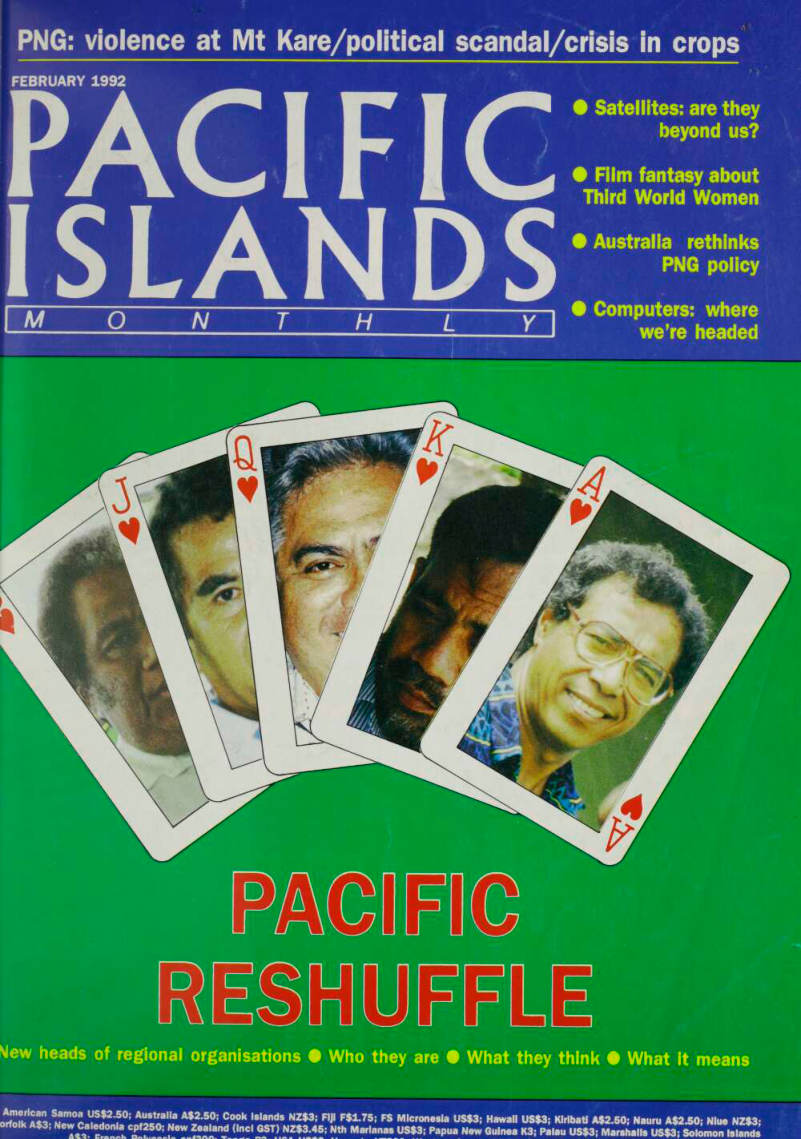
Facific Reshuffle
Mew heads of regional organisations • Who they are • What they think • What it means
As , 2 ' s . oi °.T ! , ' a " < ! s N ? s3; F 'l' Fsl - 75 ’ FS Micronesia US$3, Hawaii US$3, Kiribati *52.50, Nauru *s23o, Niue NZ$3, * ' a«I c™ k I? 1 ? 50 ’ ? ™!f nd nc OST) nz s 3 -45i Nth Marianas US$3, Papua New Guinea K 3, Palau US$3, Marshalla US$3, Solomon Islands
Advertisements & other items, p. 2 (1 item)
clarion
DIGITAL CAR AUDIO
For over 40 years Clarion car audio systems have been recognised worldwide for outstanding sound quality and ease of operation.
Clarion’s broad line of compatible products offers high flexibility and allows building a system that will match the highest expectations on the new r and exciting Digital Sound.
Clarion strive to improve and perfect the driving environment and let the driver and passengers alike relax as much as possible. . «S- Hi m 111 6-C cTanofi * T-M I clarion *jcs>'OJMr*c- -:=r r-wcES CDC9SOO
CMX 250 D
AM/FM/STEREO CASSETTE TUNER
WITH CD CHANGER CONTROL
nrii Dolby bystem j 'Dolby and the Double-0 symbol are trademarks o‘ Dolby Laooratones Licensing Corporation
CDC9SOO
6 DISC CD CHANGER
i Specifications and design are subject to change without notice
clarion
High-Tech High-Touch TT
FOR FURTHER INFORMATION Australia: Clarion Australia Pty. Ltd. Unit 17, 50 Keys Road Moorabbin, Vic 3189 / New Zealand: AWA New Zealand Limited, P.O. Box 50-248. Ponrua Fiji Islands: Brijial & Co., Ltd.. G.P.O. Box 362, Suva Tahiti: HI FI.. VAIRAATOA Avenue Chef Vairaatoa B.P 1128, Papeete / New Caledonia: Caldis, B.PM 1. Nil/ Cedex / Guam: Micropac Audio Inc., P.O. Box 3478. Agana, Guam 96910. U.S.A. Tel: 472-8091, Cable Code: HIFI AUDIO AGANA / Venuatu: The Sound Centre, P.O. Box 434, Vila / Cook Islla South Seas International Ltd.. PO. Box 49, Rarotonga / Papua New Guinea: Hagemeyer (P.N.G.) Pty. Ltd., P.O. Box 1428, Boroko, Port Moresby
Pacific
Islands
Monthly
/01. 62 No. 2
The News Magazine
February 1992
>Ng’S Paradox
?ich in resources, but with it comes 'iolence in the mines 9 legacy of political scandals 6 props in crisis, and farmers turn to Irug cultivation 11 Australia rethinks its PNG policy 23
Lur New Hand
ome of the new heads of regional rganisions, abai 14 'enilorea 15 otobalavu 16 olofa 17 fuller 20
Business:
lands disappoint ANZ 33 Pon the automotive road 34 orts Authority widens the Fiji ateway 38 ecession prompts a switch to aipan 33
He Region;
anuatu’s cyclone <po; Fiji set for Spain
AW: Moti on product liability in the Pacific
Technology:
Satellites: are they beyond our vision? 43 Fintel’s upgrading 43 Solar boost for satellites 47 Strategy for success 49 Set to copy in colour 51 Clones: cheap, but are they nasty? 52 VAT: computers could be the key 52 What the future holds 53
Art:
Film fantasy about Third World women 55 Ready for the Pacific Arts Festival? 27 Headlines 32 Letters 4 Shipping 39 Yachting 57 Barber, Wellington 13
O’Neill, Washington 21 25 McCabe on Trade 54 27 Sasako, From the Forum 26
Focus:
56 Cook Islands’ fruits of tradition 28
blisher: Geoffrey Hussey litor; Jate Moala sistant Editor: Beryl Cook nior Writer: Martin Tiffany AI Prince, Angela Carthy, David North, David Robie, ma McManus, Dykes Angiki, Frank tma, Franck Madoeuf, lan Williams, ie Nisbet, John Hunter, Karen ngnall, Lovenia Enari, Lito Vilisoni, cel Manua, Nicholas Rothwell, Pesi nua, Richard Dinnen. Ulafala Aiavao, illy Hiambohn
Columnists: David Barber (Welling ton), Futa Helu (Tonga, covering the Pacific Islands), Jemima Garrett (Syd ney). Margot O'Neill (Washington) Business and Advertising Man ager; Charlotte Thomas Advertising Sales: • Fiji: Salendra Narayan, Tel (679) 304111, Fx (679) 303809 • Sydney, Melbourne: Fergus Maclagan, Tel (61-2) 4134689, Fx (61-2) 4123918 ® Brisbane: Robert Walker, Tel (61-7) 3710533. Fx (61-7) 8798964
• Adelaide: Hastwell Williamsons Rep resentations, Tel (61-8) 799522, Fx (61-8) 799735 • Auckland: McKay International Me dia Reps Ltd, Tel (64-9) 4190561, Fx (64-9) 4192243 • Japan: Universal Media Corporation, Tokyo, Tel (3) 6663036, 6663094, Cable: UNIMEDIA Tokyo, Tx 2524665 Founded 1930 (USPS 952480), A Fiji Times Limited production.
Cover prices are recommended retail only. Registered by Australia Post,
Publication No. NBP 1210. © Copyright Fiji Times Limited, 177 Victoria Parade, Suva, Fiji. Tei (679) 304111, Fx (679)
303809, Tx Fj2124.
Pacific Islands Monthly is published monthly by Fiji Times Limited, a division of Nationwide News, 2 Holt Street, Surry Hills, Sydney, NSW 2010.
Send addross changes to: • Pacific Islands Monthly, PO Box 1167, Suva Fiji. Typeset and printed by Fiji Times Limited, 177 Victoria Parade, Suva, Fiji.
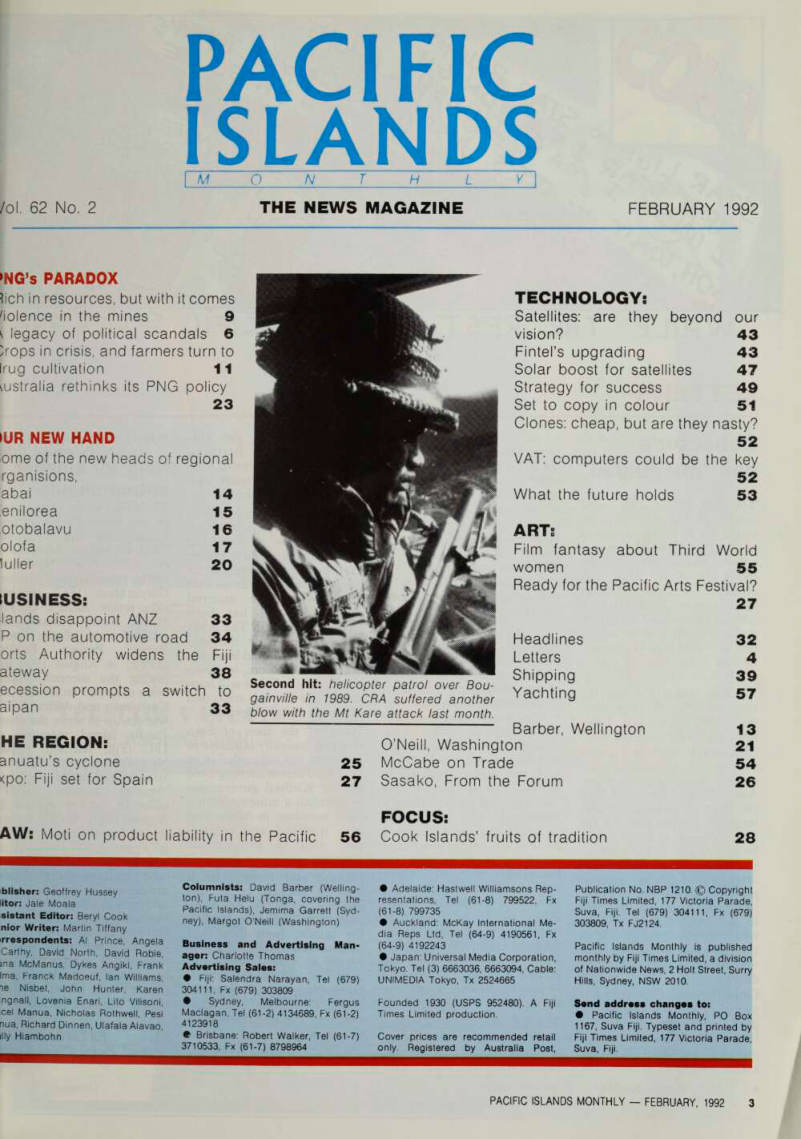
Second hit: helicopter patrol over Bou gainville in 1989. CRA suffered another blow with the Mt Kare attack last month.
aim ‘misguided’
Letters
Collector’s
THE present Pacific news magazines do not seem to satisfactorily cover aspects of cultural and historic preser vation. In fact, we see much too little of it. Thus any coverage of such topics catches my eye, and with keen interest I have read the article on Stan Gajda and the collec tion of World War II artefacts he has been able to collect (PIM Nov. 91).
Reading the article and the captions (“Saved”) my inter est quickly turned into disbe lief and finally' into horror.
As laudable as Stan Gajda’s motives are, the methods de scribed in the article are not.
Any artefact, from small as in the case of ammunition, to large, as in the case of the 20-inch naval of Betio or the large AA gun in Mr Gajda’s y'ard, form an archaeological artefact and arc an integral part of a site. They are only important as long as they' are in place and in the setting in which they belong, as long as they can be interpreted and understood as part of a larger entity.
Once removed from that set ting they are reduced to the pure artefactual aspect they are y'et one more gun, one more of many Japanese shells scattered around the
world in numerous collec tions. Thus, the restoration of the Betio guns in place is very much a laudable and com mendable act, and an act of which several other Pacific governments with World War II sites in their countries should take note. That the TCSP has agreed to fund it is an indication of the tourism, and hence economic, poten tial of such sites.
Yet, it is an abominable
disgrace that Gadja goes
along with a metal detector and removes a great number of war relics from their orig inal location, taking only “the best preserved and most un usual example home”. Al though the individual artefact may be restored, i.e. de-rusted and the decay temporarily halted, this in fact is not “saving”, but plain though doubtlessly' well intentioned vandalism, as it takes out some of the artefacts without recording their location re lationship to the other artefacts. This in fact deprives us of a great deal of know ledge which we otherwise might have learned. Where does this collection stop? May be it is just luck that the 20-inch guns are too heavy to be easily moved from the sites?
The Republic of the Marshall Islands boasts a great number of World War II sites, such as Japanese airbases replete with
runways, aircraft, gun em
placements, barracks,
manshelters and entire sup port structures complete with vehicles and the like.
The Republic of the Marshall Islands philosophy, however, is to preserve as much as possible in place and to ensure that, before anything will be removed to a museum on that island where the material came from, all has been recorded in detail. The RMI does not entertain the idea that material should leave the island it came from, let alone the Republic. What will hap pen to Mr Gajda’s collection when his contract expires?
Work of the likes of Stan Gadja is basically laudable in its intent, but misguided in its actions. There is a strong need for the Kiribati government to establish a museum with a legal mandate to follow and with qualified and enthusi astic staff to execute the projects.
Culture and history, be it World War 11, be it tra ditional culture or even prehistory, has an appeal to the public, both local and international. But this re source is very limited and most of all unrenewable.
Once it’s gone, it’s gone for good. Hence its utilisation needs to be well controlled and managed.
Dr Dirk Spenneman
Chief Archaeologist
Republic of the Marshall Islands Historic Preservation Offici
Help for smaller
entrepreneurs
THANK you for your article on the South Pacific Projecl Facility by lan Williams, “Aid to reduce dependence on aid”, PIM, Novembei 1991. International Finance
Corporation (IFC), the pri
vate sector affiliate of The World Bank, initiated the establishment of the South Pacific Project Facility (SPPF) in August 1990 fol lowing the successful oper ation of similar facilities in the Caribbean and Africa. SPPF was set up to serve the seven Pacific Island members ol IFC (Fiji, Kiribati, Papua New Guinea, the Solomon Islands, Tonga, Vanuatu and Western Samoa). SPPF’s office in Sydney opened in August 1991. SPPF’s budget for the initial five-year period is about US$7 million, ol which IFC will contribute US$l million. Other donors are Australia, Canada, Japan and New Zealand. IFCJ is the executing agency. As with the Caribbean and African facili ties, steps are under way to make SPPF a UNFP project to extend its reach to other South Pacific island countries which are not members of
Ifc.
Raymond Chid
South Pacific Project Facility Sydney
Advertisements & other items, pp. 4-5 (2 items)
%
* p a \(* a & ftnvr m. 4 m g 3$ si * m \V5. 5 » BS O' 5& O & ♦ - * O
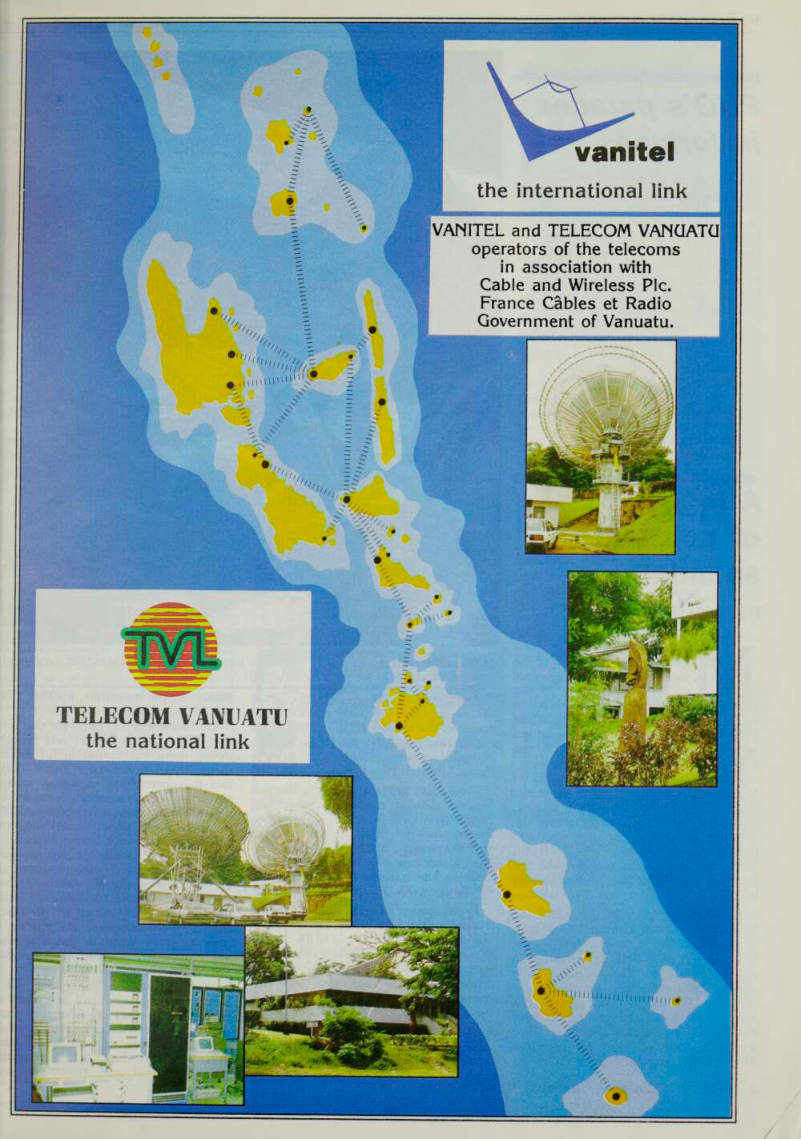
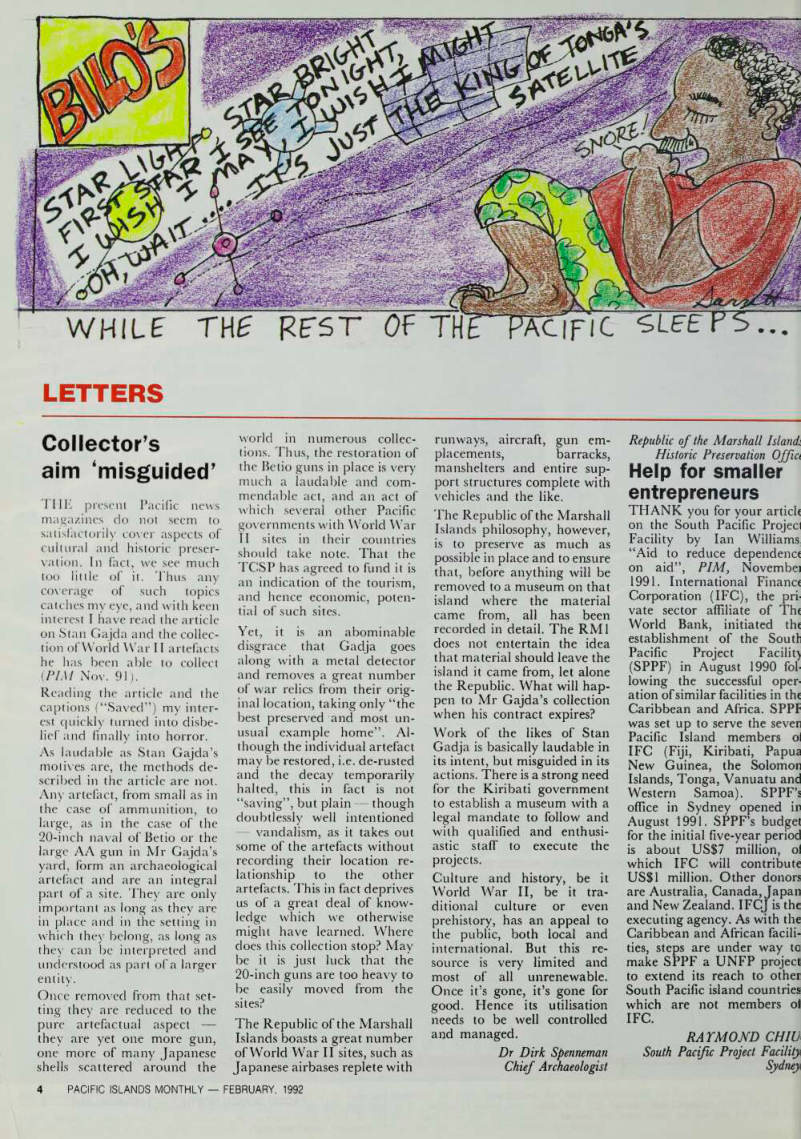
WHILF THF RFST OF THeTacif'iC
vamtel
'Jo "// 'n, ft,.
the international link
VANITEL and TELECOM VANUATU
operators of the telecoms in association with Cable and Wireless Pic.
France Cables et Radio Government of Vanuatu. ’S* *
TELECOM VANUATU
the national link m p*- ■ r m ■ A '33
PNG’s paradox
Papua New Guinea
PNG’s paradox in fortunes
WITH a fortune in natural resources, Papua New Guinea leads the region in growth. But along with wealth comes a plague of less fortunate ailments. In politics, the lure of big business has seen Ted Diro fall from grace and the exposure more recently of the Loans Affair. In mining, the forecast for vast fortunes generated a violent push for a bigger share of the action for land owners in Bougainville in 1989, and again at Mt Kare last month. In agriculture, farmers are turning to more profitable cannabis cultivation for export. Countries such as Australia are redefining their relations with PNG (see page 23) and, with elections scheduled for this year, perceptions of PNG's paradoxes in fortunes could influence the path which the country takes itself.
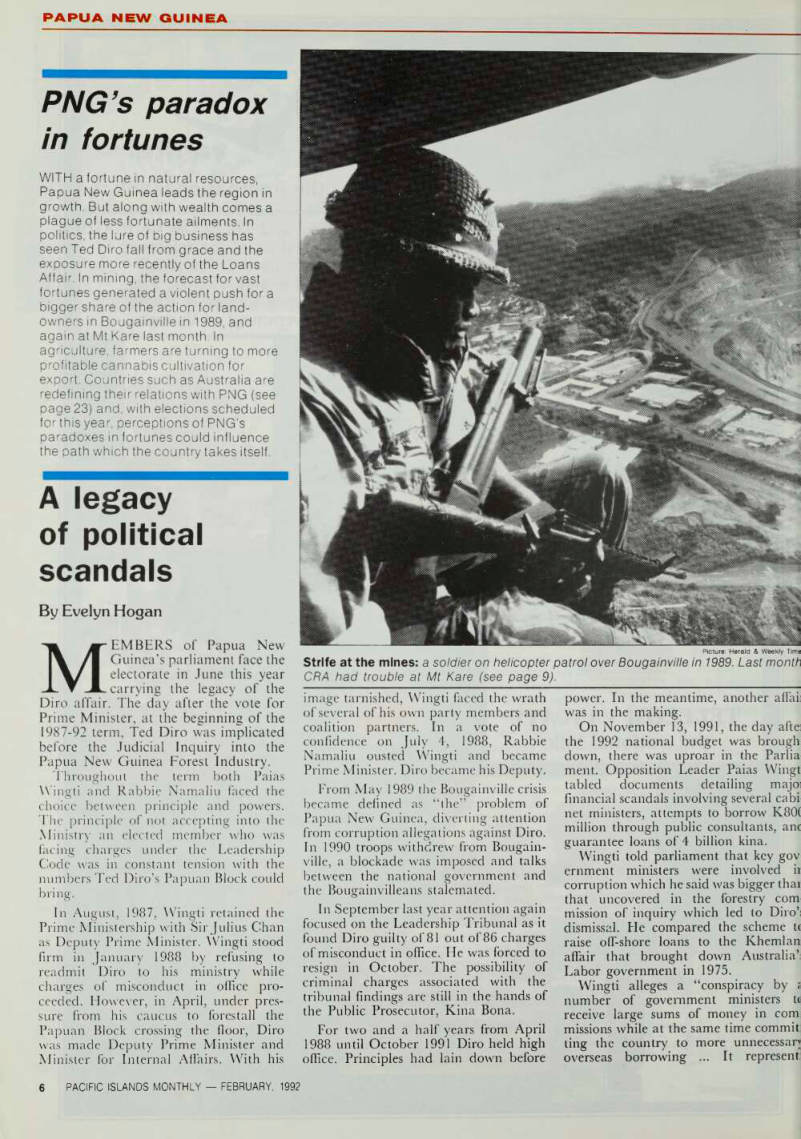
Picture: Herald & Weekly Time Strife at the mines: a soldier on helicopter patrol over Bougainville in 1989. Last month CRA had trouble at Mt Kare (see page 9).
A legacy
of political scandals
By Evelyn Hogan
MEMBERS of Papua New Guinea’s parliament face the electorate in June this year carrying the legacy of the Diro affair. The day after the vote for Prime Minister, at the beginning of the 1987-92 term, Ted Diro was implicated before the Judicial Inquiry into the Papua New Guinea Forest Industry.
Throughout the term both Paias Wingti and Rabbie Namaliu faced the choice between principle and powers.
The principle of not accepting into the Ministry an elected member who was facing charges under the Leadership Code was in constant tension with the numbers Ted Diro’s Papuan Block could bring.
In August, 1987, Wingti retained the Prime Ministership with Sir Julius Chan as Deputy Prime Minister. Wingti stood firm in January 1988 by refusing to readmit Diro to his ministry while charges of misconduct in office pro ceeded. However, in April, under pres sure from his caucus to forestall the Papuan Block crossing the floor, Diro was made Deputy Prime Minister and Minister for Internal Affairs. With his
image tarnished, Wingti faced the wrath of several of his own party members and coalition partners. In a vote of no confidence on July 4, 1988, Rabbie Namaliu ousted Wingti and became Prime Minister. Diro became his Deputy.
From May 1989 the Bougainville crisis became defined as “the” problem of Papua New Guinea, diverting attention from corruption allegations against Diro.
In 1990 troops withdrew from Bougain ville, a blockade was imposed and talks between the national government and the Bougainvilleans stalemated.
In September last year attention again focused on the Leadership Tribunal as it found Diro guilty of 81 out of 86 charges of misconduct in office. He was forced to resign in October. The possibility of criminal charges associated with the tribunal findings are still in the hands of the Public Prosecutor, Kina Bona.
For two and a half years from April 1988 until October 1991 Diro held high office. Principles had lain down before
power. In the meantime, another aflai was in the making.
On November 13, 1991, the day afte the 1992 national budget was brough down, there was uproar in the Parlia ment. Opposition Leader Paias Wingt tabled documents detailing majo financial scandals involving several cabi net ministers, attempts to borrow K 80( million through public consultants, anc guarantee loans of 4 billion kina.
Wingti told parliament that key gov eminent ministers were involved ii corruption which he said was bigger thai that uncovered in the forestry com mission of inquiry which led to Diro’ dismissal. He compared the scheme t< raise olf-shore loans to the Khemlan affair that brought down Australia’; Labor government in 1975.
Wingti alleges a “conspiracy by <
number of government ministers t( receive large sums of money in com missions while at the same time commit ting the country to more unnecessary overseas borrowing ... It represent;
the looting and mortgaging of our natural resources and our future”.
The matter was first raised in the PNG parliament on August 22, 1991 when John Kaputin, Member for Rabaul, alleged that the Minister for Finance and Planning, Paul Pora, had signed letters of authority for two foreign nationals to raise loans on behalf of the PNG government.
At first John Alexander de LTnstant- Parade (also known as John Alexander) was allegedly authorised to raise kBOO million. When this attempt failed Pora then allegedly authorised an Indonesian woman, Anna Maria Sri Poernawati, to raise k 500,000.
Papua New Guinea’s Ambassador to [apan, Evoa Lalatute, became alarmed when Poernawati turned up in Japan.
He told Pora that the loan proposal to ;he Tokai Bank stated the 500 million dna (US$5OO million) would go to the \griculture Bank, and four billion kina US$4 billion) to be received by her for Drojects she was to undertake with ‘certain PNG partners”.
He questioned the proposal “consider ng that it is the State’s wealth that is )eing used as guarantee to secure the
pan”.
Pora responded saying that his office
vas bombarded with ‘foreigners’ offering
cheap money’ for the State. To refinance ligh interest loans obtained in the 1970 s dth cheaper loans, he engaged Dreigners by asking them to prove their ources of finance to establish their redibility, he said.
Deputy Opposition Leader Sir Julius .lhan scoffed that the answers were shallow and conveniently worded”. He
aid; “The authenticity and credibility of
very person or financial institution importing to have links to the interna onal money market should be aoroughly checked before letters of uthority or intent bearing the official itterhead of the State are issued”.
Pora says he was advised that two -ustralian companies nominated in the ocumentation were: Australian Business upport Groups of Adelaide, and Prime rading Services of Sydney. However, ccording to Mr Turner of Australian
usiness Support Groups, they had
udied documentation submitted by lexander, then written to the minister isassociating themselves from the deal - well before Pora’s statements to the irliament. The two Australian com mies are annoyed at attempts to trade i their good reputation.
The documents submitted by Wingti i November 13, 1991, raise questions of >nflict of interest. On July 26, 1991,
Dra allegedly appointed Theresa’s Pty
td Consultancy Services in an irrevo [ble deed of mandate to raise off-shore
ans for Papua New Guinea. Wingti
said the principals of the company, Theresa Avenell and Stephen Avenell, are close friends and business associates of Pora, The same company is also doing consultancy work for one of the minister’s private companies, Dobel Farming and Trading Pty Ltd, Wingti alleges.
VVingti stated that, after the deed of mandate was signed on June 28 last year, a request was made to Alexander to give k 500,000 to the minister to clear some of his creditors. Several letters tabled in Parliament addressed to Alexander de manded payment. One, dated July 7, said that if the money was not forth coming the three consultants could
“literally kiss everything goodbye”. Let
ters tabled referred to kBO million worth of commission which the consultants would have received for arranging the loans for the government.
Despite pressure from the Avenells, Alexander did not pay the k 500,000.
However, Wingti continued on to allege that a cheque for k 350,000 was paid by the Avenells to one of Pora’s private companies.
On November 26, 1991, the Post Courier reported that on September 2, 1991, the ANZ Bank had demanded from Pora, together with former Min erals and Energy Secretary William David Searson and Wipa Pty Limited, more than k 300,000. When this was not paid, a writ of summons was filed in the National Court. Pora explained person ally to the Post Courier that, because of the slump in prices for tree crops, Members of Parliament and other Papua New Guineans who owned plantations owed
the banks more than kIOO million.
Peter Ryan, in his book The Landslide of Gold: Black Bonanza , writes that during the Mt Kare gold rush of 1988-89 an estimated k3OO million worth of gold was panned by landowners. “Many influen tial men cabinet ministers, members of parliament, officials and powerful businessmen had already become deeply involved in gold-buying, helicopter oper ations and trading,” says Ryan.
In 1988 Deputy Prime Minister Akoka Doi quoted the Bank of PNG as saying that, for every tonne of gold exported with tax paid, four tonnes were exported illegally. According to Ryan, when the PNG government assembled for the first time in 1989 it was startled by a statement by Paul Pora that k4O million worth of gold had been smuggled out of the country from Mt Kare alone. Then he added that he intended to grant a two-month exemption from the five per cent tax on alluvial gold. This, he said, was “to make it fair to legitimate and honest dealers and exporters”. Ryan adds that Pora himself had business interests in and around Mt Kare. So also had his friends, the Avenells.
Steve Avenell is the principal of Bradford Investments Pty Ltd, which owns a gold refinery at six-mile in Port Moresby. Here they convert almost pure gold into gold ingots. Much of Mt Kare gold passed through this refinery.
A National Executive Council (Cabi
net) paper quoted by VVingti proposes
that a major gold refinery be a joint
project financed through a “turn key”
arrangement on a 70/30 basis between
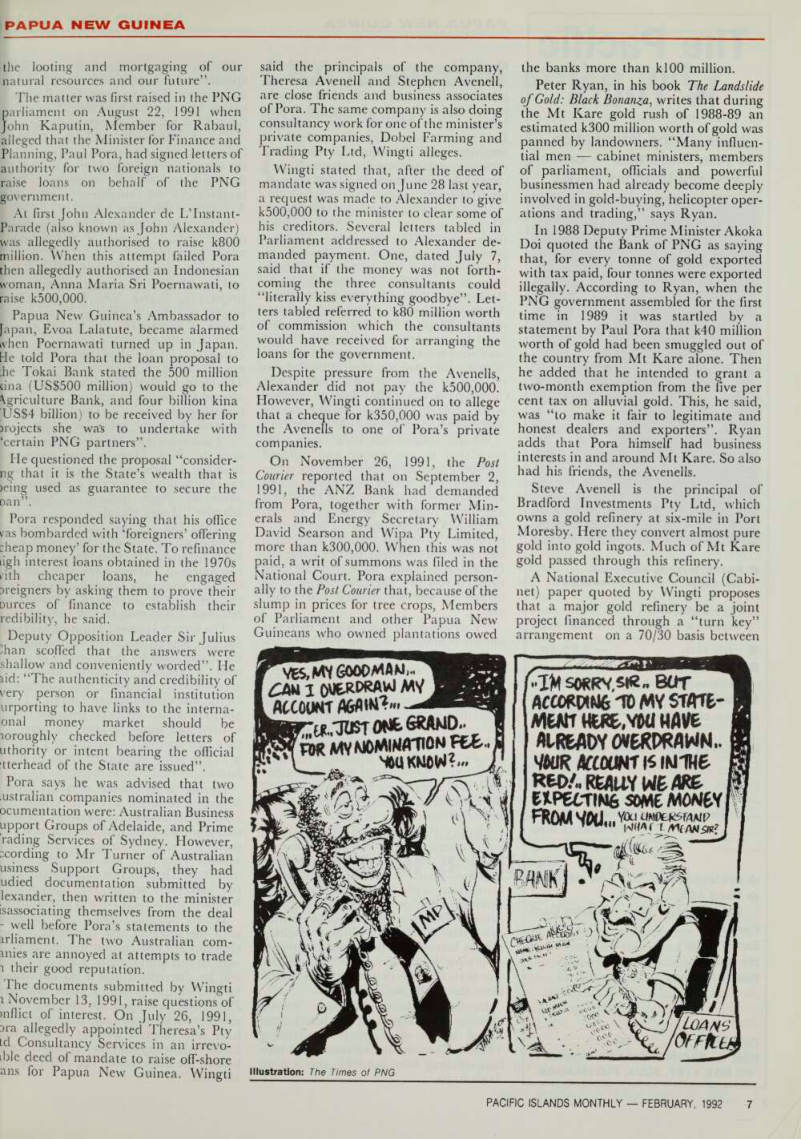
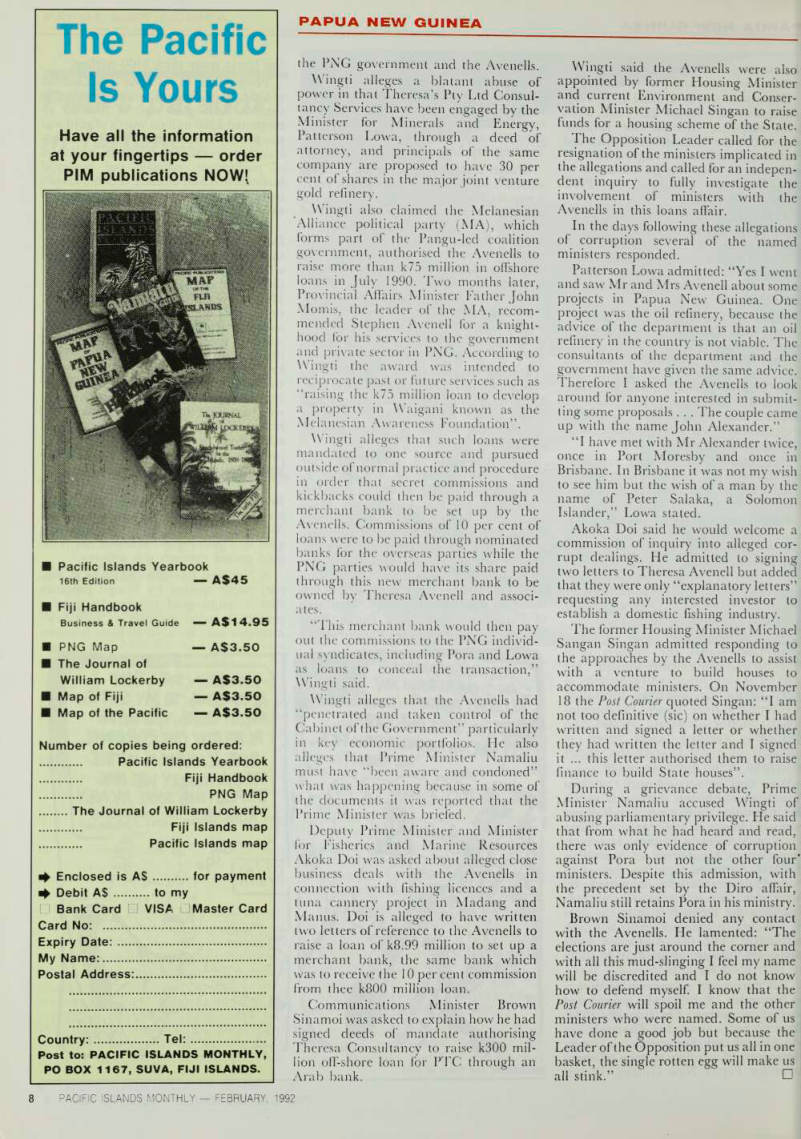
Illustration: The Times of PNG
the PNG government and the Avenells.
Wingti alleges a blatant abuse of power in that Theresa’s Pty Ltd Consul tancy Services have been engaged by the Minister for Minerals and Energy, Patterson Lowa, through a deed of attorney, and principals of the same company are proposed to have 30 per cent of shares in the major joint venture
gold refinery.
Wingti also claimed the Melanesian Alliance political party (MA), which forms part of the Pangu-led coalition government, authorised the Avenells to raise more than k 75 million in offshore loans in July 1990. Two months later, Provincial Affairs Minister Father John Momis, the leader of the MA, recom mended Stephen Avenell for a knight hood for his services to the government and private sector in PNG. According to Wingti the award was intended to reciprocate past or future services such as “raising the k 75 million loan to develop a property in Waigani known as the Melanesian Awareness Foundation”.
Wingti alleges that such loans were mandated to one source and pursued outside of normal practice and procedure in order that secret commissions and kickbacks could then be paid through a merchant bank to be set up by the Avenells, Commissions of 10 per cent of loans were to be paid through nominated banks for the overseas parties while the PNG parties would have its share paid through this new merchant bank to be owned by Theresa Avenell and associ ates.
“This merchant bank would then pay out the commissions to the PNG individ ual syndicates, including Pora and Lowa as loans to conceal the transaction,”
Wingti said.
Wingti alleges that the Avenells had “penetrated and taken control of the Cabinet of the Government” particularly in key economic portfolios. He also alleges that Prime Minister Namaliu must have “been aware and condoned” what was happening because in some of the documents it was reported that the Prime Minister was briefed.
Deputy Prime Minister and Minister for Fisheries and Marine Resources Akoka Doi was asked about alleged close business deals with the Avenells in connection with fishing licences and a tuna cannery project in Madang and Manus. Doi is alleged to have written two letters of reference to the Avenells to raise a loan of k 8.99 million to set up a merchant bank, the same bank which was to receive the 10 percent commission from thee kBOO million loan.
Communications Minister Brown Sinamoi was asked to explain how he had signed deeds of mandate authorising Theresa Consultancy to raise k3OO mil lion off-shore loan for PTC through an Arab bank.
Wingti said the Avenells were also appointed by former Housing Minister and current Environment and Conser vation Minister Michael Singan to raise funds for a housing scheme of the State.
The Opposition Leader called for the resignation of the ministers implicated in the allegations and called for an indepen dent inquiry to fully investigate the involvement of ministers with the Avenells in this loans affair.
In the days following these allegations of corruption several of the named ministers responded.
Patterson Lowa admitted: “Yes I went and saw Mr and Mrs Avenell about some projects in Papua New Guinea. One project was the oil refinery, because the advice of the department is that an oil refinery in the country is not viable. The consultants of the department and the government have given the same advice.
Therefore I asked the Avenells to look around for anyone interested in submit ting some proposals . . . The couple came up with the name John Alexander.”
“I have met with Mr Alexander twice, once in Port Moresby and once in Brisbane. In Brisbane it was not my wish to see him but the wish of a man by the name of Peter Salaka, a Solomon Islander,” Lowa stated.
Akoka Doi said he would welcome a commission of inquiry into alleged cor rupt dealings. He admitted to signing two letters to Theresa Avenell but added that they were only “explanatory letters” requesting any interested investor to establish a domestic fishing industry.
The former Housing Minister Michael
Sangan Singan admitted responding to
the approaches by the Avenells to assist with a venture to build houses to accommodate ministers. On November 18 the Post Courier quoted Singan: “I am not too definitive (sic) on whether I had written and signed a letter or whether they had written the letter and I signed it ... this letter authorised them to raise finance to build State houses”.
During a grievance debate, Prime Minister Namaliu accused Wingti of
abusing parliamentary privilege. He said
that from what he had heard and read, there was only evidence of corruption against Pora but not the other four' ministers. Despite this admission, with the precedent set by the Diro affair, Namaliu still retains Pora in his ministry.
Brown Sinamoi denied any contact with the Avenells. He lamented: “The elections are just around the corner and with all this mud-slinging I feel my name will be discredited and I do not know how to defend myself. I know that the Post Courier will spoil me and the other ministers who were named. Some of us have done a good job but because the Leader of the Opposition put us all in one basket, the single rotten egg will make us all stink.” □
Advertisements & other items, p. 8 (1 item)
The Pacific
Is Yours
Have all the information at your fingertips order PIM publications NOW’ :V,.X
MAF
Ftn m am Wi mi r* r ■ Pacific Islands Yearbook 16th Edition As4s ■ Fiji Handbook Business & Travel Guide A 514.95 ■ PNG Map ■ The Journal of William Lockerby ■ Map of Fiji ■ Map of the Pacific A 53.50 A 53.50 A 53.50 A 53.50 Number of copies being ordered: Pacific Islands Yearbook Fiji Handbook PNG Map The Journal of William Lockerby Fiji Islands map Pacific Islands map Enclosed is AS for payment Debit AS to my Bank Card VISA QMaster Card Card No: Expiry Date: My Name: Postal Address: Country: Tel:
Post to: PACIFIC ISLANDS MONTHLY,
PO BOX 1167, SUVA, FIJI ISLANDS.
Mixed bag
of fortunes for PNG mines
PAPUA New Guinea faces a paradox in its fortunes on one hand the natural resources boom places it out front for economic growth; on the other hand the boom has led to violent unrest as Papua New Guineans seek to increase their share of the profits.
I The general feeling of being ripped off led to the still unresolved Bougainville crisis of 1989, and probably last monllrs attack on Mt Kare. Ironically, the crisis has reached a point where some of the big companies have questioned if it is worth Continuing . If they do pack up prematurely, leave and not return, it ivould deprive the landowners of the very lource ofincome of which they are seeking a bigger share.
The PNG Chamber of Mines and Petroleum (CMP), for its part, is )ptimistic about a new Mining Act it is kishing through parliament.
“The present act is very archaic and \ e expect a number ofissues to be greatly implified with this act,” said CMP
ixecutivc officer, Greg Anderson,
eferring to compensation and ownership >f minerals. He said everyone had learnt i lot from the SUSI billion Bougainville nine saga but, “though we would like to hink that situation is improving, with he government making some sort of ompromise, politically the future of the nines is uncertain,”
Australia's CRA was forced to close low'll operations in May, 1989, after workers colluded with landowners to lemand greater returns. The crisis worsened when they included political emands for a secession of the island from
■apua New Guinea. Bougainville
ccounted for 40 per cent of national xport revenue and contributed 17 per ent of the budget, and a huge reduction of 166,000 tonnes of copper, 8 tonnes of silver and 14 tonnes of gold ras mined from there in 1988.
Indications arc that the potential of NG s mineral resources is significant nough, however, that the mining ompanics will not be keen to leave.
Anderson believes the SUSI.S billion )K Tedi and 3 USI bill ion Porgcra Du Id overtake production of ougainvillc in a couple of years. Ok edi is now the largest copper and gold roducer, and production at Porgcra will ink in 1993 with completion of the final age of its development. Kutubu also is i to produce up to 1 50,000 barrels of oil das seepage 10 . W hile there's that an h money to be made, they mav still >nsider the potential risks and losses orihwhile. f~
CRA has counted SUS 2 million
CRA’s second strike out
By Davendra Sharma
damages at its alluvial mine oper ations at Mt Kare in Papua New Guinea’s southern Highlands, after viol ent attacks last month that forced the mine’s closure.
CRA’s managing director, lan Johnson, said on January 13: “We are not even convinced at this stage that we will get back into operation.”
The next day, a board of directors meeting resolved not to reopen the mine until everyone involved in the attack was brought to justice.
The directors of CRA Minerals (PNG) Ltd, which owns 51 per cent of the mine, closed operations on January 9 after gunmen attacked the mine site, about 480 km northwest of the capital of Port Moresby. All but 10 of the 70 staff at the mine were evacuated by helicopter after the attack.
CRA, one of Australia’s two largest mining firms, has suffered major dam ages in PNG before in May 1989 its Bougainville copper mine was closed after secessionist rebels blew up powerlines and shot at mine workers.
Prime Minister Namaliu related the Mt Kare attack to recent threats by dissident landowners to disrupt mining if CRA does not grant them more shares and benefits.
“There is a strong suspicion (hat there was a payback element in the incident,
possibly involving dismissed employees,”
said Namaliu. He expressed hope that landowners of the mine were not in volved because they would suffer most from production delays and costs of restoration, he said.
CRA had given landowners 49 per cent under a unique arrangement to avoid conflict over ownership of mineral wealth. The mine, however, had been the subject of an ongoing court battle over control of the landowner company.
Claims had previously been made by some landowner groups supported and funded by rival politicians and devel opers.
Rebel parliamentarian and former tourist minister Aruru Matiabe had been pressuring CRA to give landowners a greater share. Matiabe claimed that he met CRA’s lan Johnson, who offered to sell 51 per cent of the shares in the venture for SUSS million.
Matiabe, a registered landowner with the 6000-strong landowners’ company, Mt Kare Alluvial Mining, was dropped from cabinet after a October reshuffle. In recent months he has led a campaign to have the mining agreement scrapped and redrawn to cut CRA’s share and incor porate some villages not in the original deal. But Johnson has rejected the new demands: “With 6000 people involved you can expect a small group of dissidents dissatisfied with the leader
ship.’’
Johnson argued that CRA has an undertaking with landowners to sell at least part of its stake to locals but only when “they have technical or financial ability to assume control” of Mt Kare.
The reaction from Opposition leader Paias Wingti after last month’s attacks was blunt: “It seems CRA has not learnt a lesson after the closure of the Bougain ville copper mine to have improved its attitude and corporate dealings as an investor in Mount Kare, especially the aspect of dealing honestly with all landowner groups instead of just one.”
Ml Kare Alluvial Mining Ply Ltd general manager John Barlram said the violent attack has forced the company to consider whether to continue mining in the rugged Highlands.
The first deposits were discovered at Mt Kare in 1988 and CRA estimates about SUSI7S million worth of alluvial gold was taken out by prospectors by 1990. The mine has a projected lifespan of three to four years and production is expected to double to 60 kg a month.□
Looking for a bigger cut
ONE year after Papua New Guinea’s richest oil project was launched, landowners claim they have a raw deal, Dissident landowners have asked Kutubu developers Chevron Niugini to renegotiate the December 1990 deal.
Provincial Premier Albert Mokai said they had expected business spin-offs and developments such as roads and public amenities. Chevron said it had built “schools and other facilities " in (he area.
PM RabbieNa maliu said government
could not see Kutubu affected as it involved a massive investment of SSUSI billion for just construction. Kutubu, with 200 million barrels of crude oil, is a joint venture between Chevron (25 per cent), BP Petroleum (25), BMP (12.5), Oil Search (10.017), Merlin Petroleum (6.25) and Merlin Pacific (6.25). Con struction and exploration have been spread as stocks proven at Kutubu exist in separate structures in the heavily faulted area. □
Prospects
promising
LAST month’s attack at Mt Kare came just after discoveries that buoyed hopes the area could become a major oil producer. Results released in November found the SE Gobe 2 well flowed 8907 barrels of oil per day, surpassing the 8591 barrels per day from Kutubu’s Hedinia field.
Oil analysts said early results indicated the field could produce 30,000 to 40,000 barrels per day by the middle of the decade.
Command Petroleum, which has a 20 per cent stake in the field, relinquished its role as operator to MIM subsidiary Barracuda Pty Ltd, which also has a 20 per cent stake, on December 12. Other shareholders in ppl 56 are Southern Highlands Petroleum (50 per cent), Mountains West Exploration Inc (2.5 per cent), and Nomenco PNG Oil Co (seven per cent). Normandy Poseidon Ltd owns 41 per cent of Command Petroleum.
Major logistical hurdles include sheer isolation, rugged terrain, and an average rainfall of about four metres per year.
There are no roads and all machinery must be flown in by helicopter.
Pluses include proximity to Kutubu’s oil pipeline, just 15 km away, which will run 270 km to the coast and an offshore oil terminal in the Gulf of Papua when completed next year.
Meanwhile, Ampol Exploration and Oil Search Ltd signed a financing package to pay for their share of the Kutubu project. Seventeen international banks provided SUS 324 million in the first PNG project finance loan since the giant Ok Tedi copper and gold mine.
Ampolex holds 16.5 per cent of the project while Oil Search has a 7.8 per cent stake. Chevron Nuigini and BP have 19.4 per cent each, BHP (9.7), and Mitsubishi (4.8). The PNG government will also hold a 22.4 per cent stake in the completed project. □
Hot competition for oil stakes
AS Papua New Guinea readies for its first commercial oil output this year, the heat is on for stakes in the company.
Prime Minister Rabbie Namaliu wants to increase government interest in the SUSI billion oil development project in a move he believes would strengthen “direct involvement of the people of Papua New Guinea” in it.
But only days after Namaliu was told that the news is a surprise to Pioneer Int Ltd, from whom the government is to buy 25 per cent of shares it holds in a principal Kutubu project partner, Pion eer said it was not prepared to part with any of its shares of the 40 per cent it holds in Oil Search. With a 7.8 per cent stake, it is an active participant.
Namaliu said his government took a decision to buy Pioneer’s stake because the Australian company wanted to divest itself of oil interests. Analysts and some partners in Kutubu were also surprised why the government did not wait till it finalised negotiations before announcing its plans. Some suggested that govern ment might be pressuring Pioneer after an impasse in share-sale talks.
The speculation was that the Namaliu government, which has 2.24 per cent in Kutubu, was capitalising on the project for political gains. A general election is scheduled for about May or June. An investment of this size in Kutubu in the Southern Highlands would be a sizeable slice of the country’s annual budget.
An estimate was that the government could pay SUS23.I million for only 10 per cent of Pioneer’s holding in Oil Search. The share price stood at around USS 7 cents in December but if the sale was to go ahead the government may have to pay around US77 cents a share for it to be viable for Pioneer.
Namaliu said government investment in Pioneer would ensure Oil Search remained an independent PNG-based oil company. “It is my government’s hope
that in due course, as the country’s capital markets develop, these shares wili be sold on for direct investment by the people of PNG.”
The government sees a need for ar independent, PNG-based commercial domestic company as the country moves towards producing its own oil. “It is therefore, important to use the current opportunity to secure an additional significant block of shares in Oil Search on behalf of the people of PNG.”
PNG nationals in 1990 bought 10 pei cent of Oil Search, whose major asset is a 7.8 per cent stake in PNG’s first commercial oil field, Kutubu.
Namaliu said he expects the govern ment’s amicable relationship with Pion eer to continue, with the sale of PNG’: crude oil production into Pioneer’;
Australian refinery.
Kutubu was due to come on stream around June but delays in constructior means it would not start until the thirc quarter of 1992. Construction was slowec because of massive preparation work The construction was nearly half done ir December with hopes that lagifu, Hedinia/Agogo oil fields will start tc generate the first oil in the third quarter Oil will be extracted from three fields established so far from a total of 30 wells 13 of which have been drilled. The othei 17 wells are yet to be drilled. A 171.5 km pipeline from the Gulf of Papua oil field; is being constructed.
An airstrip has been built in the highlands at Moro to allow for hercules aircraft to transport materials.
Mining analysts involved in Kutubi believe that the project developers coulc also soon negotiate for the neigbouring South East Gobe oil field to be incorpor ated into the Lake Kutubu venture Located to the far south east of Kutubu South East Gobe is only 15km from the production pipeline which has enormous capacity to also carry output from SE Gobe. C
Golden godsend for Placer Pacific
WHILE Mt Kare was being hit with law and order problems, the world-rated Porgera mine was churning out more gold than ever. Production at Porgera for 1991 was expected to reach 1.2 million ounces, well past the 900,000 ounces forecast for the year. Output during each quarter last year continued to grow from the previous one.
The -first three months produced 224,804 ounces and the second 273,330 ounces, followed by a big jump in the third; 342,925 ounces.
Porgera continues to be a godsend for Placer Pacific Ltd, Renison Goldfields
consolidated Ltd and Highlands Golc Ltd, which each have 30 per cent of the project. The PNG has 10 per cent.
Since its opening in September 1990 Porgera has been developed into a world class mine Located in Enga province ir the Western Highlands, gold was de tected there in 1938 but drilling didn’i start until 1989. Estimates suggest GC million tonnes of reserve at 6.5 gram O' gold per tonne can be produced from Porgera. Included in Porgcra’s Decem ber quarter figure will be gold extractec: from the stored material in the tailings
pond. C
Advertisements & other items, p. 10 (1 item)
To Anywhere In The World
c 313166 313149 nth DHL You re in sate hands all the nay Your artifacts, gifts, souvenirs, carvings, artworks, documents whatever DHL will deliver anywhere worldwide Freight Forwarders, Air Cargo DHL Worldwide Express Service
NADI LAUTOKA iAfIASA
73800 65400 65401 Cl 162
WOHUJWKX EXPRESS'
The big bust ... a case for boosting agriculture
EXPOSURE of an international drug ring operating between Papua New Guinea and Australia last month led Papua New Guinea’s Prime Minister to call for strengthening of the country's legal agricultural crops.
The Australian Federal Police charged three men, including one of their officers in the northern Australian city of Cairns and a former officer, who were alleged to have been involved in a multi-million kina drug import operation.
As carlv as 1990 PIM was receiving reports of an “established [nd extensive” drug export operation (Dec. 1990) based on PNG Highlands crops of cannabis and even intercrops in lege tabic gardens. Following the latest arrests, police in North Queensland admitted trafficking had risen to record levels in fecent months because of soaring demand in Australia.
According to some reports the cannabis, known as PNG Gold because of its potency, is being brought through Cairns in exchange for firearms in Papua New Guinea. “Traffickers
stand to make billions if they got away with importing drugs to Queensland,” according to Queensland police far north regional commander, assistant commissioner Ken Strohfeldt.
The cannabis is being smuggled across Torres Strait in small dinghies or flown into remote Queensland areas in light aircraft, often concealed in machinery parts, plain cardboard boxes, bags, shoes and underpants. Most of the marijuana is destined for southern Australian cities, although PIM received reports in 1990 that it also has been reaching New York.
PNG Prime Minister Namaliu said surveillance would continue to be improved and called for a major anti-drug public education campaign, particularly in rural areas; tough cultivation and trafficking penalties; and building up of legal agriculture. “One of the most effective deterrents against the cultivation of cannabis is the strengthening of our legal agricultural crops such as coffee, and price support for these crops when world prices are low. This helps to take away any incentive to grow illegal crops,” he said. □
Crops in crisis
With agriculture ailing, many farmers are turning to lucrative but illegal drug cultivation
Frank Senge Kolma
IN mid-1990 reports reached Port Moresby that coffee growers in the Highlands were turning to mari juana. The news highlighted the big jroblem with cultivation and consump ion of the drug, and revealed a bigger ind more immediate problem the lation’s farmers have been turning away rom traditional crops to other crops
)ecause of falling commodity prices.
East month a Papua New Guinea Jentral Bank economist said the country lad taken a harder blow in the past two ■cars than any of the 164 International ilonetary Fund member nations since ifter the World War Two.
PNG appears to have resisted the louble catastrophic blows of closure of he Bougainville Copper mine and
dunging world-market cash-crop prices,
)ul the latter could yet prove to be just he break in the eye of the storm rather han world-class economic management.
What appears of immediate concern is igricullure the livelihood of 85 per ent of the people in Papua New Guinea.
In just two years half of the cocoa ndustry is gone, one fifth of total coffee iroduclion is down, and nearly one third tf thhc copra industry has disappeared. 1 he Central Bank economist referred o earlier claims that PNG is back to 985, Cocoa Board executive officer dark Ivarami says the agricultural
sector is back to pre-independence days.
Coffee Industry Board economist David Smith said coffee prices are at their lowest since commercial coffee production began in the 19505.
Agriculture is the industry that the World Bank claims has the best prospects for growth outside mining and is the predominant source of employment.
By a consensus of expert opinion, agriculture is the sector that money from the mining and petroleum developments must be channeled into.
The Coffee Industry Board reports that about 20 per cent of plantations have dropped out and a vast number are neglected or producing less and less in the two years between 1989 and 1991.
Production has dropped from 1.2 million bags at the end of 1988 to 938,000 bags in 1990. Exports earned PNG K 209 million in 1986 and K 139 million in 1990, but only K 93 million last year.
CIB economist David Smith said the loss in value of production from 1989 to 1991 is 33 per cent.
The Coffee Stabilisation Fund, the richest in the country with Kl2O million in 1986, was completely drained at the end of June 1991. The board is at present paying out a 35 toea per kilogram bounty to growers from a K 9 million govern ment loan.
Smith said the cause for the collapse of world coffee prices was the lifting of the quota system by the Coffee Industry Organisation in July 1989. Producers
who held large stocks flooded the market with coffee leading to weaker prices.
PNG has fared better than most other coffee producers, Smith said, because of
its good quality Arabica.
“If prices remain at current levels the plantation sector would remain under extreme pressure, especially the 20 hec tare blocks,” Smith said.
“Coffee prices arc at their lowest level in real terms since commercial coffee production began in the 19505.”
He said the outlook for coffee should be favourable if the country could maintain and improve its quality of coffee and increase production.
PNG’s other major tree crop, cocoa, has suffered longer. The Cocoa Board of PNG was already paying bounty out of the stabilisation fund in 1980. Prices ever since have been “going down on a sliding scale”, board Executive Officer Mark Ivarami said.
“What do you mean (when you ask) how close is the industry to collapse. It has collapsed from the day the prices went through rock bottom,” he said indignantly to questions on the state of the industry. “With high interest rates charged by the banks, many plantations have laid off their labour force. Some have walked off or scaled down to absolute minimum.”
He said some are operating without fertilisers and there are no new plots
being developed.
The cocoa industry has lost 40 per cent of its production with the closure of Bougainville. Doubled with the low prices, cocoa has lost more than half of its productive output, Ivarami said.
Out of an annual average of 60,000 bags, the country exported 37,000 bags in 1989 for K 46.3 million; 40,000 bags for K 34.8 million last year and K 32,000 for K 29.5 million this year.
“Half of production is gone. Without
any political solution to Bougainville, not only the cocoa industry, but the agricul tural sector has gone back to pre independence days. We have gone back 20 years. Plantations on Bougainville are completely overgrown, we arc told.
“It will take a lot longer than the government thinks. Even if revived, who is going to work the plantations on
Bougainville?"
T he future is grim on the world market with an over-supply of cocoa, and production growing faster than con sumption. There is hope, however, Ivarami said. Because of the prolonged
depressed prices, producers have
neglected their plantations and turned to new crops. In the medium term, then, production may drop.
He urged cocoa growers to stand firm.
“I think our farmers should not give up hope. Cocoa will be here forever to support us. In times of low' prices w 7 e need to increase production and maintain quality of our cocoa.’’
The scene on the copra front is not much different. During July to October last year a major producer, Coconut Products Limited, was forced to close its mill in Rabaul several times for a w 7 eek in order to allow copra stocks to build up.
This was brought on allegedly by insufficient production of copra by Ga zelle small-holder growers' unwillingness to supply copra because of low prices.
The Copra Marketing Board is now shipping copra to Rabaul from other parts to overcome this problem.
The Catholic Church w as on the verge of closing down its 10 big plantations near Madang on the north coast of the
mainland but Ihe price rise in December averted such action.
Other plantations in Central prov ince and East and West New Britain provinces were considering similar moves.
Copra Marketing Board Gen
eral Manager Joe Bae said: “The last three years have been so terrible. It’s been disaster.
"We went to the brink of nearly falling off. The price increase this month came at the right time.”
The industry in 1988 contrib uted K 32 million to the national purse, but decreased to K2O mil lion in 1989 and Kl 5 million last year. Bae said the industry would be lucky to fetch that this year.
In two years the copra industry has lost 26 per cent of all its
production. Copra prices have
been falling particularly because of oversupply of vegetable oil on the world market, mainly from soya beans, sunflower, rape seed and oil palm. Copra sales also have suf fered due to intense lobbying by soya bean producers, mainly in the
United States, that oil from copra is detrimental to health. First reports from recent studies indicate the opposite may be the case.
The future for copra looks more promising with production in Indonesia and the Philippines dropping substan tially. If the tree crops fail the major coastal agricultural centres such as Rabaul, Madang, Kimbe and Popondetta will become ghost towns.
Unlike the mining towmships, most of the PNG coastal agricultural centres are sustained by the activities of the agricul tural producers, either through buying produce from warehouses to banking their takings in the banks. Overseas freight rates and frequency of shipping arrivals would deteriorate.
The various commodity boards would negotiate lower prices internationally based on lower production and deterio rating quality of products.
Fewer income taxes and sales taxes to national government would result from closure of large plantations. About half the formal labour force would be laid off.
More blows The Harbours Board of PNG has increased certain shipping rates, in some areas increasing them 1000-fold on top of existing wharfage and other fees.
Telephone charges went up nation wide in September and for the rural sector by 25 toea per minute.
The government has been very respon sive under extremely difficult circum stances. Over KBO million in price support has been spent on tree crops, including oil palm. The money, however,
is to be repaid by the various industries when the price improves.
Government has abolished export taxes on commodities and subsidised interest-rate payments on loans to the agricultural sector from commercial banks and abolished interest rates from its own Agriculture Bank.
The way to the future is still uncertain.
The world market trends and prices, which are beyond the control of PNG, are very volatile. Government policies, which are within control, show no clear direction. There is overwhelming sup port for the primary industry sector of the economy (including agriculture, fisheries and forestry) to be given top priority listing, but there is no model yet to pass the moneys from one sector to the next without the cumbersome public service absorbing three quarters of it.
There is an impending fight on the future of stabilisation funds. The Asian Development Bank has openly, and the IMF and World Bank not so openly, wanted the role of stabilisation funds and government price-support mechanisms to diminish and eventually be abolished.
All the commodity boards and growers oppose decreasing the role of stabilisation boards. They have seen the usefulness of these funds, without which some of the industries would not exist.
The government is in a quandary it wants to listen to the local industries which should know best, but it is receiving donor moneys to fund requests for help coming from those industries.
Still, there is much optimism. Now at the bottom of the pit, both the industries and the government can only look up. □
Picture: PNG Post Courier Illegal produce: police prosecutor George Managua with drugs seized in September 1990
Time to put the house in order
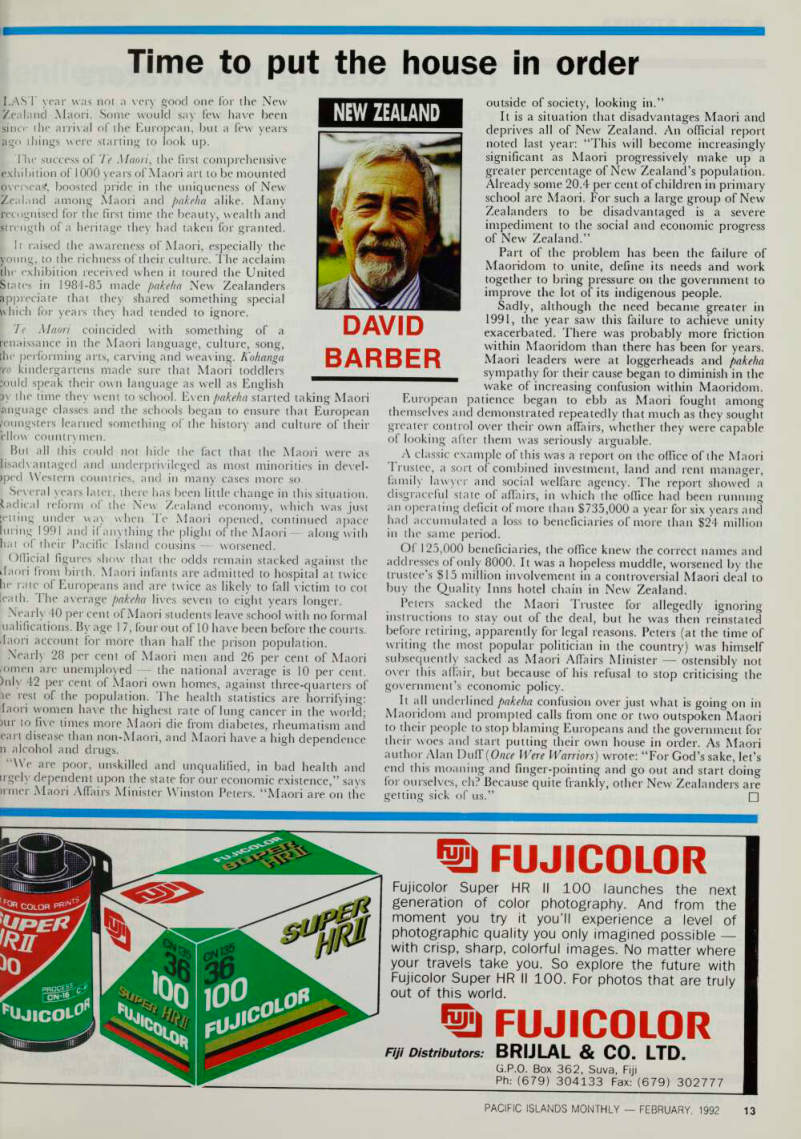
LAST year was not a very good one for the New Zealand Maori. Some would say few have been since the arrival of the European, but a few years ago things were starting to look up.
The success of Te Maori , the first comprehensive exhibition of 1000 years of Maori art to be mounted oversea.?, boosted pride in the uniqueness of New Zealand among Maori and pakeha alike. Many recognised for the first time the beauty, wealth and strength of a heritage they had taken for granted. [ It raised the awareness of Maori, especially the young, to the richness of their culture. The acclaim the exhibition received when it toured the United States in 1984-85 made pakeha New Zealanders
appreciate that they shared something special
which for years they had tended to ignore. 1 Te Maori coincided with something of a renaissance in the Maori language, culture, song, the performing arts, carving and weaving. Kohanga r eo kindergartens made sure that Maori toddlers Could speak their own language as well as English
:>> the time they went to school. Even pakeha started taking Maori language classes and the schools began to ensure that European youngsters learned something of the history and culture of their
Blow countrymen.
But all this could not hide the fact that the Maori were as |isad\ antaged and underprivileged as most minorities in devel >ped Western countries, and in many cases more so Several years later, there has been little change in this situation.
Radical reform of the New Zealand economy, which was just retting under way when Te Maori opened, continued apace luring 1991 and if anything the plight of the Maori along with hat of their Pacific Island cousins worsened.
Official figures show that the odds remain stacked against the Maori from birth. Maori infants are admitted to hospital at twice he rate of Europeans and are twice as likely to fall victim to cot lea th. The average pakeha lives seven to eight years longer.
Nearly 40 per cent of Maori students leave school with no formal ualifications. By age 17, four out of 10 have been before the courts.
Maori account for more than half the prison population.
Nearly 28 per cent of Maori men and 26 per cent of Maori -omen are unemployed the national average is 10 per cent. )nly 42 per cent of Maori own homes, against three-quarters of le rest of the population. The health statistics are horrifying: Maori women have the highest rate of lung cancer in the world; )ur to five times more Maori die from diabetes, rheumatism and eart disease than non-Maori, and Maori have a high dependence n alcohol and drugs.
“We are poor, unskilled and unqualified, in bad health and irgely dependent upon the state for our economic existence,” says inner Maori Affairs Minister Winston Peters. “Maori are on the
New Zealand
outside of society, looking in.”
It is a situation that disadvantages Maori and deprives all of New Zealand. An official report noted last year; “This will become increasingly significant as Maori progressively make up a greater percentage of New Zealand’s population.
Already some 20.4 per cent of children in primary school arc Maori. For such a large group of New Zealanders to be disadvantaged is a severe impediment to the social and economic progress of New Zealand.”
Part of the problem has been the failure of Maoridom to unite, define its needs and work together to bring pressure on the government to improve the lot of its indigenous people.
Sadly, although the need became greater in 1991, the year saw this failure to achieve unity exacerbated. There was probably more friction within Maoridom than there has been for years.
Maori leaders were at loggerheads and pakeha sympathy for their cause began to diminish in the wake of increasing confusion within Maoridom.
European patience began to ebb as Maori fought among themselves and demonstrated repeatedly that much as they sought greater control over their own affairs, whether they were capable of looking after them was seriously arguable.
A classic example of this was a report on the office of the Maori Trustee, a sort of combined investment, land and rent manager, family lawyer and social welfare agency. The report showed a disgraceful state of affairs, in which the office had been running an operating deficit of more than 5735,000 a year for six years and had accumulated a loss to beneficiaries of more than 524 million in the same period.
Of 125,000 beneficia lies, the office knew the correct names and addresses of only 8000. It was a hopeless muddle, worsened by the trustee’s SIS million involvement in a controversial Maori deal to buy the Quality Inns hotel chain in New Zealand.
Peters sacked the Maori Trustee for allegedly ignoring instructions to stay out of the deal, but he was then reinstated before retiring, apparently for legal reasons. Peters (at the time of writing the most popular politician in the country) was himself subsequently sacked as Maori Affairs Minister ostensibly not over this affair, but because of his refusal to stop criticising the government’s economic policy.
It all underlined pakeha confusion over just what is going on in Maoridom and prompted calls from one or two outspoken Maori to their people to stop blaming Europeans and the government for their woes and start putting their own house in order. As Maori author Alan Duff [Once Were Warriors ) wrote; “For God’s sake, let’s end this moaning and finger-pointing and go out and start doing for ourselves, eh? Because quite frankly, other New Zealanders are getting sick of us.” n
David
Barber
Advertisements & other items, p. 13 (1 item)
3*L Fujicolor
i> m r-l Ji % 13$ & 3 %
FUJICOLOR
Fujicolor Super HR II 100 launches the next generation of color photography. And from the moment you try it you’ll experience a level of photographic quality you only imagined possible with crisp, sharp, colorful images. No matter where your travels take you. So explore the future with Fujicolor Super HR II 100. For photos that are truly out of this world.
3*l FUJICOLOR
Fiji Distributors: BRIJLAL & CO. LTD.
G.P.O. Box 362, Suva, Fiji Ph: (679) 304133 Fax: (679) 302777
Pacific
Reshuffle
Last month many magazines in the Pacific and around the world carefully selected an individual who they considered “Man of the Year” to grace their cover. He was chosen for his contribution to shaping events either positively or negatively in his particular field or area of the world.
Late last year and early this year a number of Pacific islanders were chosen to take positions as heads of regional organisations in what can only be described as a “Pacific Reshuffle”, in which these proven performers moved between regional organisations.
Pacific Islands Monthly’s Martin Tiffany talks to five of these new regional heads Esekia Solofa (Western Samoa), Philipp Muller (Western Samoa), Jioji Kotobalavu (Fiji), Sir Peter Kenilorea (Solomon Islands), leremia Tabai (Kiribati) about their new role and the future.
Solofa becomes the first Pacific islander to be vice-chancellor of the University of the South Pacific and talks about his role in this important education position.
Muller leaves the Forum Fisheries Agency after 11 years to take over as director of the South Pacific Applied Geoscience Commission (SOPAC).
He replaces Kotobalavu who is likely to become executive secretary (Pacific) in the proposed United States Pacific Island Joint Commercial Commission (JCC).
Muller has been replaced at FFA by former Solomon Islands Prime Minister Kenilorea. Kenilorea left the Solomon government as Minister of Foreign Affairs and Trade Relations to take up his present position.
Kiribati’s former president Tabai becomes the new secretary general of the Forum Secretariat.
These men will shape many important events from fishing and off-shore minerals to education and trade in this area of the world for at least the next three years.
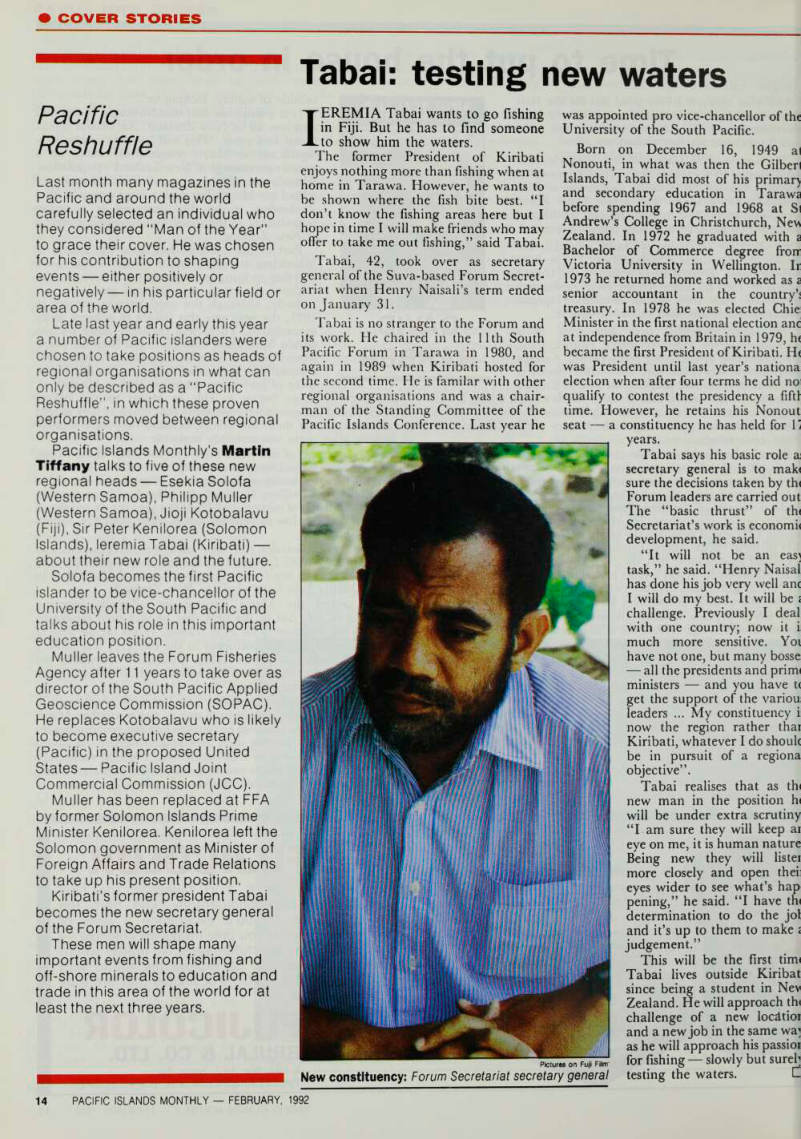
Tabai: testing new waters
lEREMIA Tabai wants to go fishing in Fiji. But he has to find someone to show him the waters.
The former President of Kiribati enjoys nothing more than fishing when at home in Tarawa. However, he wants to be shown where the fish bite best. “I don’t know the fishing areas here but I hope in time I will make friends who may offer to take me out fishing,” said Tabai.
Tabai, 42, took over as secretary general of the Suva-based Forum Secret ariat when Henry Naisali’s term ended on January 31.
Tabai is no stranger to the Forum and its work. He chaired in the 11th South Pacific Forum in Tarawa in 1980, and again in 1989 when Kiribati hosted for the second time. He is familar with other regional organisations and was a chair man of the Standing Committee of the Pacific Islands Conference. Last year he
was appointed pro vice-chancellor of the University of the South Pacific.
Born on December 16, 1949 at Nonouti, in what was then the Gilbert Islands, Tabai did most of his primary and secondary education in Tarawa before spending 1967 and 1968 at Si Andrew’s College in Christchurch, New Zealand. In 1972 he graduated with a Bachelor of Commerce degree frorr Victoria University in Wellington. Ir 1973 he returned home and worked as a senior accountant in the country’: treasury. In 1978 he was elected Chie Minister in the first national election anc at independence from Britain in 1979, h( became the first President of Kiribati. H( was President until last year’s nationa election when after four terms he did no qualify to contest the presidency a fiftl time. However, he retains his Nonout seat a constituency he has held for 1'
years.
Tabai says his basic role a: secretary general is to mak< sure the decisions taken by tin Forum leaders are carried out The “basic thrust” of th« Secretariat’s work is economi< development, he said.
“It will not be an task,” he said. “Henry Naisal has done his job very well anc I will do my best. It will be i
challenge. Previously I deal
with one country; now it i much more sensitive. Yoi have not one, but many bosse all the presidents and prirm ministers and you have t< get the support of the variou leaders ... My constituency i now the region rather thai Kiribati, whatever I do shouk be in pursuit of a regiona
objective”.
Tabai realises that as th< new man in the position h( will be under extra scrutiny “I am sure they will keep ai eye on me, it is human nature Being new they will listei more closely and open thei: eyes wider to see what’s hap pening,” he said. “I have th< determination to do the jol and it’s up to them to make i
judgement.”
This will be the first thru Tabai lives outside Kiribat since being a student in Nev Zealand. He will approach th< challenge of a new locitioi and a new job in the same wa? as he will approach his passior for fishing slowly but sureb testing the waters. L
Plctures on Fuji Film' New constituency: Forum Secretariat secretary general
Steps to climb
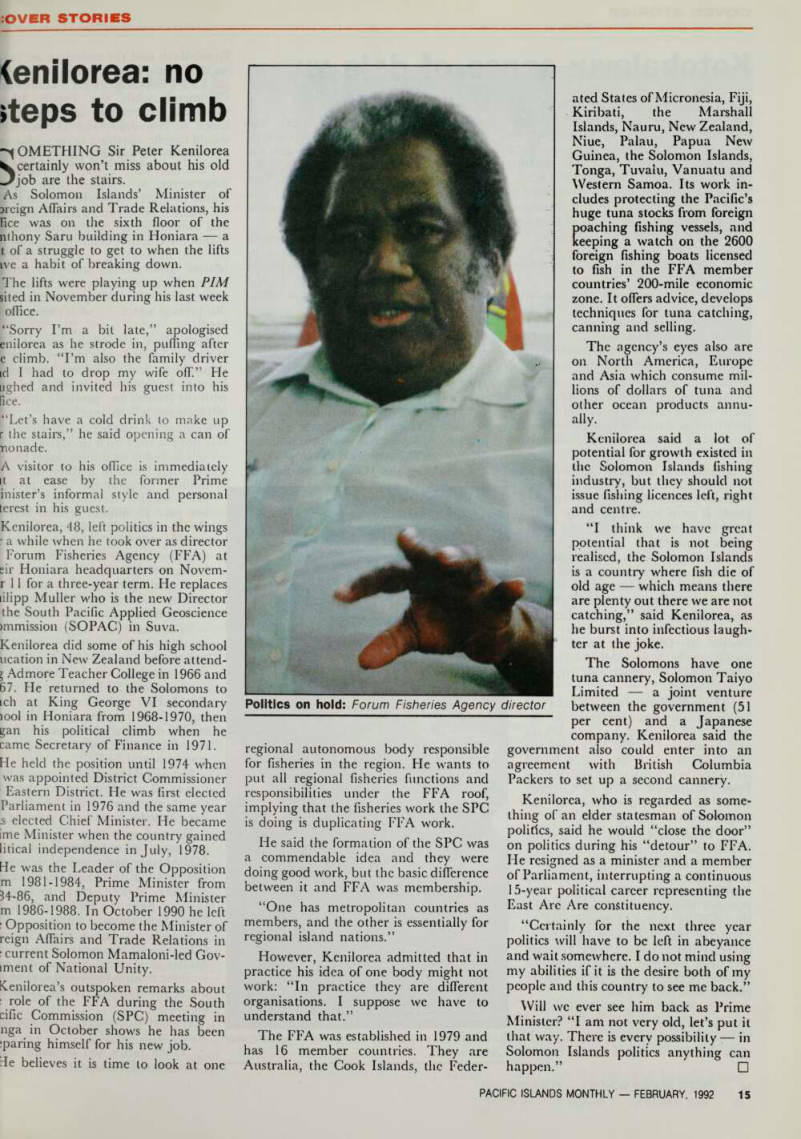
Kenilorea: no Steps to climb
SOMETHING Sir Peter Kenilorea won’t miss about his old «Jjob are the stairs.
As Solomon Islands’ Minister of jrcign Affairs and Trade Relations, his fice was on the sixth floor of the nthony Saru building in Honiara a t of a struggle to get to when the lifts ive a habit of breaking down.
The lifts were playing up when PIM sited in November during his last week office.
“Sorry I’m a bit late,” apologised enilorea as he strode in, puffing after e climb. “I’m also the family driver id I had to drop my wife off.” He ughed and invited his guest into his [ice.
“Let’s have a cold drink to make up r the stairs,” he said opening a can of nonade.
A visitor to his office is immediately it at ease by the former Prime mister’s informal style and personal terest in his guest.
Kenilorea, 48, left politics in the wings r a while when he took over as director Forum Fisheries Agency (FFA) at cir Honiara headquarters on Novem rll for a three-year term. He replaces lilipp Muller w'ho is the new Director the South Pacific Applied Geoscience jmmission (SOPAC) in Suva.
Kenilorea did some of his high school ucation in New Zealand before attend r Admore Teacher College in 1966 and 67. He returned to the Solomons to ich at King George VI secondary tool in Honiara from 1968-1970, then gan his political climb when he came. Secretary of Finance in 1971.
He held the position until 1974 w'hen was appointed District Commissioner Eastern District. He was first elected Parliament in 1976 and the same year s elected Chief Minister. He became ime Minister when the country gained litical independence in July, 1978.
He was the Leader of the Opposition m 1981-1984, Prime Minister from 34-86, and Deputy Prime Minister m 1986-1988. In October 1990 he left : Opposition to become the Minister of reign Affairs and Trade Relations in : current Solomon Mamaloni-led Gov
iment of National Unity.
ECenilorea’s outspoken remarks about ! role of the FFA during the South cific Commission (SPC) meeting in nga in October show's he has been :paring himself for his new job.
He believes it is time to look at one
regional autonomous body responsible for fisheries in the region. He wants to put all regional fisheries functions and responsibilities under the FFA roof, implying that the fisheries work the SPC is doing is duplicating FFA work.
He said the formation of the SPC was a commendable idea and they were doing good work, but the basic difference between it and FFA was membership.
“One has metropolitan countries as members, and the other is essentially for regional island nations.”
However, Kenilorea admitted that in practice his idea of one body might not work: “In practice they are different organisations. I suppose we have to understand that.”
The FFA was established in 1979 and has 16 member countries. They are Australia, the Cook Islands, the Feder
ated States of Micronesia, Fiji, Kiribati, the Marshall Islands, Nauru, New Zealand, Niue, Palau, Papua New Guinea, the Solomon Islands, Tonga, Tuvalu, Vanuatu and Western Samoa. Its work in cludes protecting the Pacific’s huge tuna stocks from foreign poaching fishing vessels, and keeping a watch on the 2600 foreign fishing boats licensed to fish in the FFA member countries’ 200-mile economic zone. It offers advice, develops techniques for tuna catching, canning and selling.
The agency’s eyes also are on North America, Europe and Asia which consume mil lions of dollars of tuna and other ocean products annu ally.
Kenilorea said a lot of potential for growth existed in the Solomon Islands fishing industry, but they should not issue fishing licences left, right and centre.
“I think we have great potential that is not being realised, the Solomon Islands is a country where fish die of old age which means there are plenty out there we are not catching,” said Kenilorea, as he burst into infectious laugh ter at the joke.
The Solomons have one tuna cannery, Solomon Taiyo Limited a joint venture between the government (51 per cent) and a Japanese company. Kenilorea said the
government also could enter into an agreement with British Columbia Packet's to set up a second cannery.
Kenilorea, who is regarded as some thing of an elder statesman of Solomon politics, said he would “close the door” on politics during his “detour” to FFA.
He resigned as a minister and a member of Parliament, interrupting a continuous 15-year political career representing the East Arc Are constituency.
“Certainly for the next three year politics will have to be left in abeyance and wait somewhere. I do not mind using my abilities if it is the desire both of my people and this country to see me back.”
Will we ever see him back as Prime Minister? “I am not very old, let’s put it that way. There is every possibility- — in Solomon Islands politics anything can
happen.” □
Politics on hold: Forum Fisheries Agency director
Kotobalavu: sense of deja vu
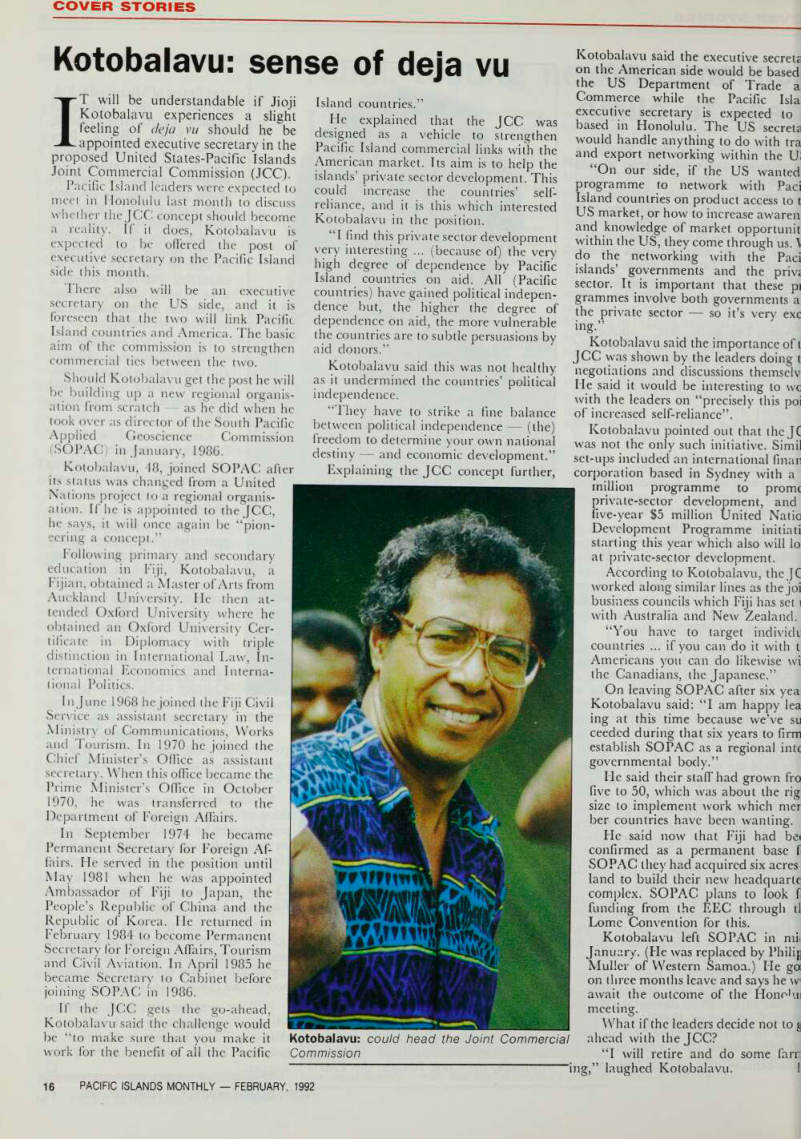
IT will be understandable if Jioji Kotobalavu experiences a slight feeling of deja viz should he be appointed executive secretary in the proposed United States-Pacific Islands Joint Commercial Commission (JCC).
Pacific Island leaders were expected to meet in Honolulu last month to discuss whether the JCC concept should become a reality. If it does, Kotobalavu is expected to be offered the post of executive secretary on the Pacific Island side this month.
There also will be an executive secretary on the US side, and it is foreseen that the two will link Pacific Island countries and America. The basic aim of the commission is to strengthen commercial ties between the two.
Should Kotobalavu get the post he will be building up a new regional organis ation from scratch as he did when he took over as director of the South Pacific Applied Geoscience Commission (SOPAC) in January, 1986.
Kotobalavu, 48, joined SOPAC after
its status was changed from a United Nations project to a regional organis ation. If he is appointed to the JCC, he says, it will once again be “pion eering a concept.”
Following primary and secondary education in Fiji, Kotobalavu, a Fijian, obtained a Master of Arts from Auckland University. He then at tended Oxford University where he obtained an Oxford University Cer tificate in Diplomacy with triple distinction in International Law, In ternational Economics and Interna tional Politics.
In June 1968 he joined the Fiji Civil Service as assistant secretary in the
Ministry of Communications, Works
and Tourism. In 1970 he joined the Chief Minister’s Office as assistant secretary. When this office became the Prime Minister’s Office in October 1970, he was transferred to the
Department of Foreign Affairs.
In September 1974 he became Permanent Secretary for Foreign Af fairs. He served in the position until May 1981 when he was appointed Ambassador of Fiji to Japan, the People’s Republic of China and the Republic of Korea. He returned in February 1984 to become Permanent Secretary for Foreign Affairs, Tourism and Civil Aviation. In April 1985 he became Secretary to Cabinet before joining SOPAC in 1986.
If the JCC gets the go-ahead, Kotobalavu said the challenge would be “to make sure that you make it work for the benefit of all the Pacific
Island countries.”
He explained that the JCC was designed as a vehicle to strengthen Pacific Island commercial links with the American market. Its aim is to help the islands’ private sector development. This could increase the countries’ self reliance, and it is this which interested Kotobalavu in the position.
“I find this private sector development very interesting ... (because of) the very high degree of dependence by Pacific Island countries on aid. All (Pacific countries) have gained political indepen dence but, the higher the degree of dependence on aid, the more vulnerable the countries are to subtle persuasions by aid donors.”
Kotobalavu said this was not healthy as it undermined the countries’ political
independence.
“They have to strike a fine balance
between political independence (the)
freedom to determine your own national
destiny and economic development.”
Explaining the JCC concept further,
Kotobalavu said the executive secrets on the American side would be based the US Department of Trade a Commerce while the Pacific Isla executive secretary is expected to based in Honolulu. The US secrets would handle anything to do with tra and export networking within the Ui “On our side, if the US wanted programme to network with Paci Island countries on product access to t US market, or how to increase awaren and knowledge of market opportunit within the US, they come through us. \ do the networking with the Paci islands’ governments and the privz sector. It is important that these pi grammes involve both governments a the private sector so it’s very exc
ing.”
Kotobalavu said the importance of t JCC was shown by the leaders doing t negotiations and discussions themselv He said it would be interesting to wc with the leaders on “precisely this poi of increased self-reliance”.
Kotobalavu pointed out that the JC was not the only such initiative. Simil set-ups included an international fiman corporation based in Sydney with a
million programme to promt private-sector development, and five-year S 5 million United Natio Development Programme initiati starting this year which also will lo at private-sector development.
According to Kotobalavu, the JC worked along similar lines as the joi business councils which Fiji has set i with Australia and New Zealand.
“You have to target individu countries ... if you can do it with t Americans you can do likewise wi the Canadians, the Japanese.”
On leaving SOPAC after six yea Kotobalavu said: “I am happy lea ing at this time because we’ve su ceedcd during that six years to firm establish SOPAC as a regional intc governmental body.”
He said their staff had grown fro five to 50, which was about the rig size to implement work which mer ber countries have been wanting.
He said now that Fiji had be* confirmed as a permanent base f SOPAC they had acquired six acres land to build their new headquarte complex. SOPAC plans to look f funding from the EEC through tl Lome Convention for this.
Kotobalavu left SOPAC in mu January. (He was replaced by Philifj Muller of Western Samoa.) Me got on three months leave and says he w' await the outcome of the HonoUu meeting.
What if the leaders decide not lo g ahead with the JCC?
“I will retire and do some farn
ing,” laughed Kotobalavu. I
Kotobalavu: could head the Joint Commercial Commission
Solofa: playing

Cover Stories
Solofa: playing [?] role in education
[T is fitting that some of Esekia Solofa’s earliest memories are of education he is soon to play one of the region’s most important lucation roles.
As a child in Magiagi village on the itskirts of Apia, he recalls going to the llage primary school carrying a mat d a soap box to write on. He also members, in his last four years of |mary school in the late 19505, being in all-boys’ boarding school and in the me class with boys twice his age.
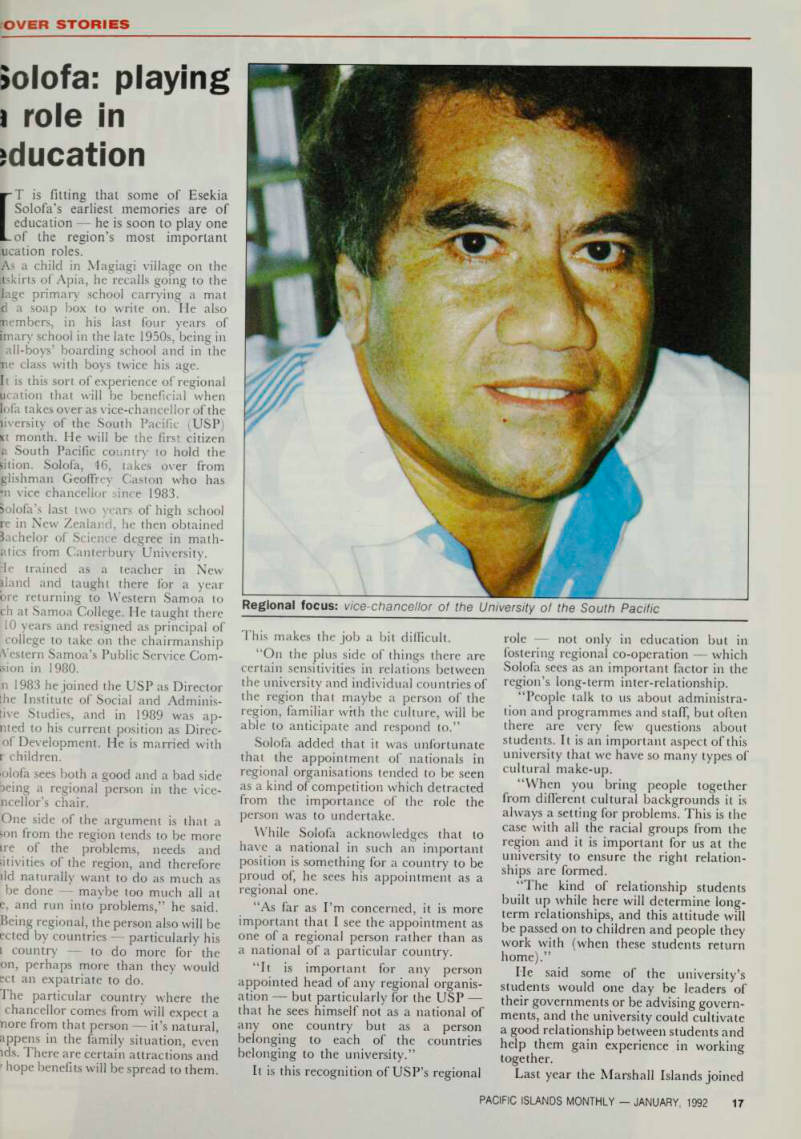
It is this sort of experience of regional ucation that will be beneficial when lofa takes over as vice-chancellor of the liversity of the South Pacific (USP) Kt month. He will be the first citizen a South Pacific country to hold the sition. Solofa, T 6, takes over from glishman Geoffrey Gaston who has fen vice chancellor since 1983.
Solofa’s last two years of high school re in New Zealand, he then obtained bachelor of Science degree in math
atics from Canterbury University,
de trained as a teacher in New aland and taught there for a year ore returning to Western Samoa to ch at Samoa College. He taught there 10 years and resigned as principal of college to take on the chairmanship Western Samoa’s Public Service Com ision in 1980. n 1983 he joined the USP as Director the Institute of Social and Adminis tive Studies, and in 1989 was ap nted to his current position as Direc of Development. He is married with r children. iolofa sees both a good and a bad side being a regional person in the vice ncellor’s chair.
One side of the argument is that a son from the region tends to be more ire of the problems, needs and iitivities of the region, and therefore ild naturally want to do as much as be done maybe too much all at e, and run into problems,” he said.
Being regional, the person also will be
ected by countries particularly his
i country to do more for the on, perhaps more than they would ect an expatriate to do.
The particular country where the chancellor comes from will expect a nore from that person it’s natural, appens in the family situation, even ids. There are certain attractions and r hope benefits will be spread to them.
This makes the job a bit difficult.
“On the plus side of things there are certain sensitivities in relations between the university and individual countries of the region that maybe a person of the region, familiar with the culture, will be able to anticipate and respond to.”
Solofa added that it was unfortunate that the appointment of nationals in regional organisations tended to be seen as a kind of competition which detracted from the importance of the role the person was to undertake.
While Solofa acknowledges that to have a national in such an important position is something for a country to be proud of, he sees his appointment as a regional one. r T , , . . • r/ t col ( £ erned > 15 more important that I see the appointment as one of a regional person rather than as a national of a particular country. ‘Tt is important for any person appointed head of any regional organisbut P. artl( : l r llarl y for the y~ ■ that he sees himself not as a national of any one country but as a person e onging to each of the countries belonging to the university.
It is this recognition of USP’s regional
role not only in education but in fostering regional co-operation which Solofa sees as an important factor in the
region’s long-term inter-relationship,
“People talk to us about administra tion and programmes and staff, but often there are very few questions about stu . dents - It is an important aspect of this university that we have so many types of
cultural make-up.
“When you bring people together from different cultural backgrounds it is always a setting for problems. This is the case with al| the racial groups from the re ? lon and " 15 important for us at the university to ensure the right relation sh,.Pll are , ror " ,ecl : , . , Ihe kir l d °* relationship students built up while here will determine lone term relationships, and this attitude wUI be don to ‘ hi dren and |e (h /i „ y homey ' He said some of the university’s students would one day be leaders of their governments or be advising govern ments, and the university could cultivate a good relationship between students and help them gain experience in working together. 5 Last year the Marshall Islands joined
Regional focus: vice-chancellor of the University of the South Pacific
the Solomon Islands, Vanuatu, Fiji, Nauru, Kiribati, Tuvalu, the Tokelaus, Western Samoa, Tonga, Niue and the Cook Islands as members of the univer sity. This move will no doubt be watched with much interest by the Federated States of Micronesia which have shown interest in joining the USP.
Sitting in his office on Suva’s Laucala Campus, Solofa was realistic and frank about future plans, development and growth for the university.
“One tends to assume that things always go well and therefore just extrapolate where we are now to where we will be in 10 years time.”
He said at present the region was just as short of teachers as it was 10 years ago, with the rise in population and the demand for more education. He sus pects the university will have to again do something about training teachers.
“We can’t say in 10 years we will be producing nuclear scientists. Of course that is the direction we want to go, but it would be more realistic to say we would like to see the university continue to play a meaningful part in the development of individual countries of the region.
“I see a continuing need in all sorts of assistance in education curricu lum development, teacher training, in service up-grading of teachers.”
One question which Solofa thinks should be asked is “how affordable is education to the region”.
He said at present almost 90 per cent of the university’s students are spon sored by their government or some other source. He cautioned that, as aid diminishes, there will be less money for sponsored students which leaves the countries to fund their own students.
He said this might lead to a situation in 10 years time where there would be a higher proportion of self-paid students and the university might have to attract foreign students.
“If the university is to maintain its current levels of funding it may have to go out of its way to attract foreign students, which may mean attracting students from outside the region.
“This may mean a university quite different from what we have now our courses will have to recognise the needs of the international students ... (at present) many of the courses that we teach are more for regional relevance.”
Asked if he thought his appointment as vice chancellor was a coming of age for the university, Solofa said one could look at it that way. “One could also look at it as maybe it’s time the
university took the plunge into testing
the waters for the region to try to set its own directions. Whether or not it means we are ready to do that remains to be seen I would like to think we are.” □
Advertisements & other items, pp. 18-19 (1 item)
Here’S Your
For 61 years
PACIFIC ISLANDS MONTHLY
has brought the Pacific Islands to you...
HERE’S YOUR
CHANCE TO
.*->• 16 '
fl P
& l*n
TONCAN
v \ S 3
ROYAL
« 3 r> tuutauu* 5^ - *#• - £ Get away: Royal Tonga Airlines flight it might even be free!
Be pampered: at the Ramanlal Hotel Every month Pacific Islands Monthly keeps you up to date with what’s happening in the Pacific Islands, and how major events overseas affect the island countries.
It’s a must for anyone living in the region, or interested in the region.
We are the only magazine which gives you full colour coverage and reliable, extensive editorial on a full range of topics from politics and business to history and culture. And, for fun, we take you off the beaten track with yachting and tourism.
Now’s your chance to subscribe to the magazine which has covered the islands for 61 years, through a network of contributors living in the region, and analysts in many capital cities of the world.
This month, you can take advantage of us through our special fishing and handicraft connoisseurs.
Subscribe now... you could WIN!
No employees of the Fiji Times Ltd or their immediate family are eligible to enter. subscription offer... as a bonus, we’ll give you a chance to win a trip to the Heilala Festival in Tonga. You can either extend your visit to Fiji and fly from Nadi to Sense the history: The Ha'amonga’a Maui coral trilithon Nuku’alofa, or fly from Auckland to Nuku’alofa.
You’ll fly Royal Tongan Airlines and enjoy one week at the Ramanlal Hotel in the heart of Nuku’alofa.
You’ll be enchanted by this unspoiled ancient Kingdom, a Garden of Eden for boating, M .
K ewf.
I f, ■ ■ > .■ 9 please send me RIM at the special rate and enter me in the Trip to Tonga competition. I would like to take advantage of the following offer; □ 15 magazines for the price of 12 □ 32 magazines for the price of 24 (tick one box only) I enclose my cheque/bankdraft for $
USUAL RATES
per annum (made payable to Pacific Islands Monthly) or Debit $ to my □ Visacard □ Mastercard Card No.: Expiry Date; ame: Signature: City: Country; Post to: Pacific Islands Monthly P.O. Box 1167 or Fax: (679) 303809 This offer ends on March 15. 1992.
Muller: new fish to fry
OF all the new leaders of re gional organisations who take up their post this year, one may find it a little easier than the others.
Philipp Muller, 53, took over in mid- January as director of the South Pacific Applied Geoscience Commission (SOPAC), after 11 years as director of Forum Fisheries Agencies (FFA). He was on the SOPAC founding committee when it was established in 1971, and has a background of scientific research in line with SOPAC’s work.
Muller also should feel at home at SOPAC headquarters in Suva he is of Western Samoan descent, but was born in Fiji and did his primary and secondary education there. He went to Western Samoa in the early 19605, then obtained a Bachelor of Science at the University of Auckland in 1962. In 1963 he became a trainee with the New Zealand Meteoro logical Service, and in 1964 returned to Western Samoa as officer in charge of the meteorological office in Apia.
In 1965 he became superintendent at the Apia Observatory. In 1976 he was appointed chairman of Western Samoa’s
Public Service Commission before be coming a Food and Agriculture Organ isation field expert in hydrology. He joined FFA in 1981.
He said FFA was protecting the ocear resources of its member countries and maximising benefits to them, but the competition from distant-water fishing nations was acute. Handicaps were lack of expertise, technology, funding and the market the core of the problem being the Pacific’s vast oceans and small economies.
Muller said there will be attempts tc get more involvement in tuna e.g. buying our own fleets and getting more canneries through joint ventures. How ever he warned that Pacific governments should not try to look after fisheries themselves.
Apart from tuna, Muller talks about development and coordination of dom estic policy how to manage or develop local fisheries as opposed to tuna. The FFA will be developing other ocear
resources and providing development
services.
Muller said he can understand the concerns of his FFA replacement, Sir
Peter Kenilorea.
“We in the agency are concerned with containing the foreign fishermen, maximising how much they pay. We have to keep the
Japanese, Taiwan
ese, Americans and Koreans at arms’ length. The SPC on their tuna research need cooperation and data from these fleets so they need to bring them closer there is a conflict.
“It is up to the (Pacific Island) countries to make the decision, but it’s al most at a position where one may de velop at the expense of the other.”
Muller said it was a delicate situation about fish prices and relations with coun tries some, like Japan, were big aid donors. He said he has a lot of refocuss ing to do, but mostly is confident he will feel at home with
Ffa. □
Refocussing: new director of SOPAC
Knee-jerk reaction to trying times
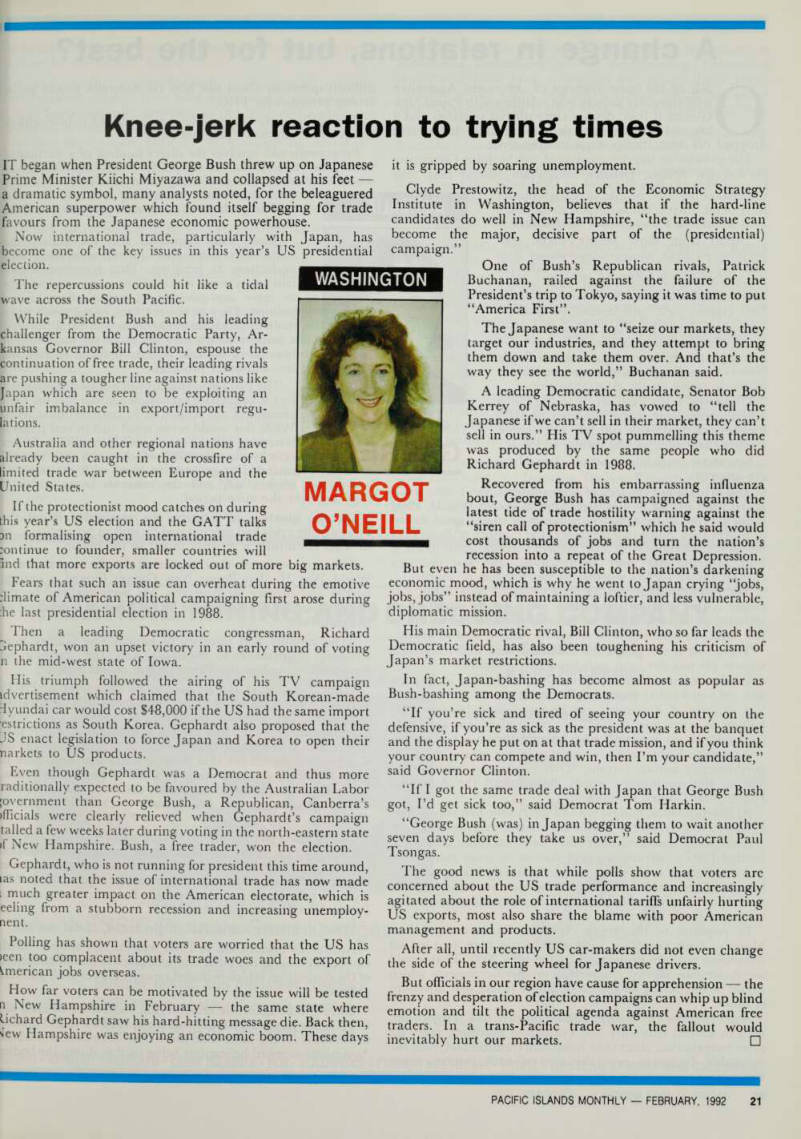
IT began when President George Bush threw up on Japanese Prime Minister Kiichi Miyazawa and collapsed at his feet a dramatic symbol, many analysts noted, for the beleaguered American superpower which found itself begging for trade favours from the Japanese economic powerhouse.
Now international trade, particularly with Japan, has become one of the key issues in this year’s US presidential
election.
The repercussions could hit like a tidal wave across the South Pacific.
While President Bush and his leading challenger from the Democratic Party, Ar kansas Governor Bill Clinton, espouse the continuation of free trade, their leading rivals are pushing a tougher line against nations like Japan which are seen to be exploiting an unfair imbalance in export/import regu lations.
Australia and other regional nations have already been caught in the crossfire of a limited trade war between Europe and the United States.
If the protectionist mood catches on during this year’s US election and the GATT talks 3n formalising open international trade continue to founder, smaller countries will
Ind that more exports are locked out of more big markets.
Fears that such an issue can overheat during the emotive dimate of American political campaigning first arose during ;he last presidential election in 1988.
Then a leading Democratic congressman, Richard Gephardt, won an upset victory in an early round of voting n the mid-west state of lowa.
His triumph followed the airing of his TV campaign idvertisement which claimed that the South Korean-made Hyundai car would cost 548,000 if the US had the same import estrictions as South Korea. Gephardt also proposed that the JS enact legislation to force Japan and Korea to open their narkets to US products.
Even though Gephardt was a Democrat and thus more raditionally expected to be favoured by the Australian Labor [overnment than George Bush, a Republican, Canberra’s officials were clearly relieved when Gephardt’s campaign tailed a few w r eeks later during voting in the north-eastern state if New Hampshire. Bush, a free trader, won the election.
Gephardt, who is not running for president this time around, las noted that the issue of international trade has now made . much greater impact on the American electorate, which is eeling from a stubborn recession and increasing unemploy nent.
Polling has shown that voters are worried that the US has »een too complacent about its trade woes and the export of American jobs overseas.
How far voters can be motivated by the issue will be tested a New Hampshire in February the same state where Uchard Gephardt saw his hard-hitting message die. Back then, Hampshire was enjoying an economic boom. These days
Washington
it is gripped by soaring unemployment.
Clyde Prestowitz, the head of the Economic Strategy Institute in Washington, believes that if the hard-line candidates do well in New Hampshire, “the trade issue can become the major, decisive part of the (presidential) campaign.”
One of Bush’s Republican rivals, Patrick Buchanan, railed against the failure of the President’s trip to Tokyo, saying it was time to put “America First”.
The Japanese want to “seize our markets, they target our industries, and they attempt to bring them down and take them over. And that’s the way they see the world,” Buchanan said.
A leading Democratic candidate, Senator Bob Kerrey of Nebraska, has vowed to “tell the Japanese if we can’t sell in their market, they can’t sell in ours.” His TV spot pummelling this theme was produced by the same people who did Richard Gephardt in 1988.
Recovered from his embarrassing influenza bout, George Bush has campaigned against the latest tide of trade hostility warning against the “siren call of protectionism” which he said would cost thousands of jobs and turn the nation’s recession into a repeat of the Great Depression.
But even he has been susceptible to the nation’s darkening economic mood, which is why he went to Japan crying “jobs, jobs, jobs” instead of maintaining a loftier, and less vulnerable, diplomatic mission.
His main Democratic rival, Bill Clinton, who so far leads the Democratic field, has also been toughening his criticism of Japan’s market restrictions.
In fact, Japan-bashing has become almost as popular as Bush-bashing among the Democrats.
“If you’re sick and tired of seeing your country on the defensive, if you’re as sick as the president was at the banquet and the display he put on at that trade mission, and if you think your country can compete and win, then I’m your candidate,” said Governor Clinton.
“If I got the same trade deal with Japan that George Bush got, I’d get sick too,” said Democrat Tom Harkin.
“George Bush (was) in Japan begging them to wait another seven days before they take us over,” said Democrat Paul Tsongas.
The good news is that while polls show that voters arc concerned about the US trade performance and increasingly agitated about the role of international tariffs unfairly hurting US exports, most also share the blame with poor American management and products.
After all, until recently US car-makers did not even change the side of the steering wheel for Japanese drivers.
But officials in our region have cause for apprehension the frenzy and desperation of election campaigns can whip up blind emotion and tilt the political agenda against American free traders. In a trans-Pacific trade war, the fallout would inevitably hurt our markets. □
Margot
O’Neill
A change in relations, but for the best?
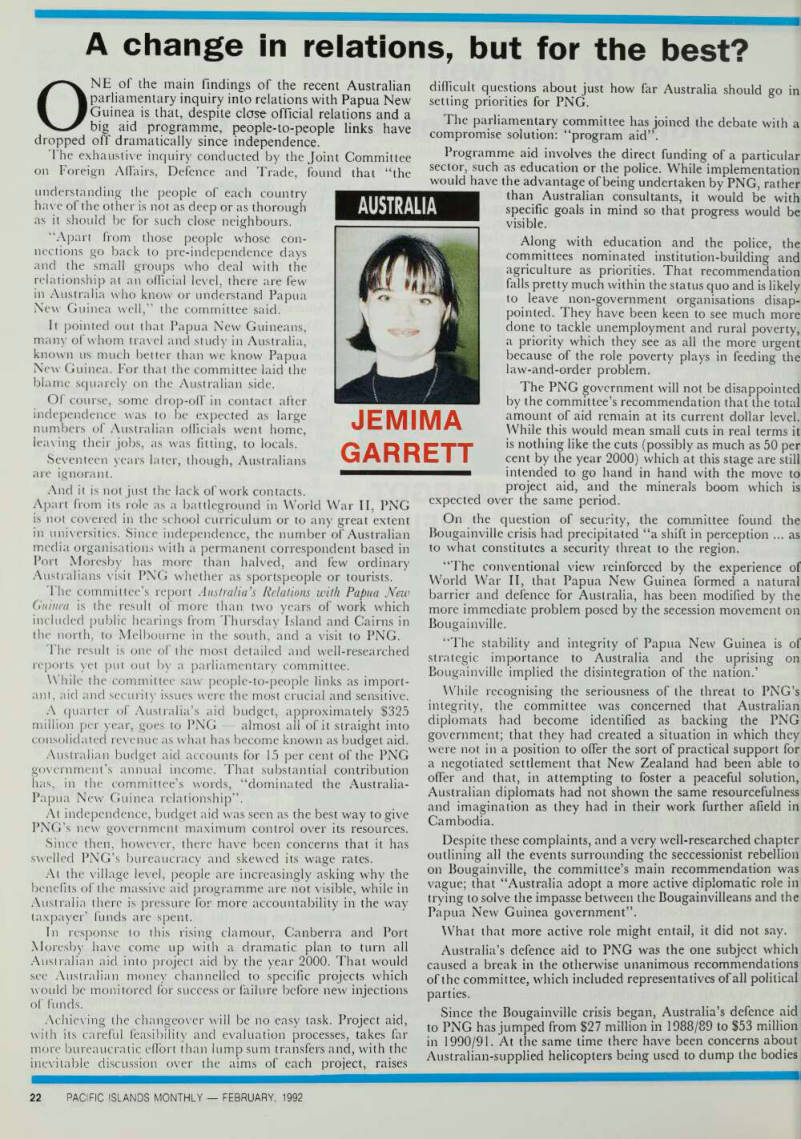
ONE of the main findings of the recent Australian parliamentary inquiry into relations with Papua New Guinea is that, despite close official relations and a big aid programme, people-to-people links have dropped off dramatically since independence.
The exhaustive inquiry conducted by the Joint Committee on Foreign Affairs, Defence and Trade, found that “the
understanding the people of each country have of the other is not as deep or as thorough as it should be for such close neighbours.
“Apart from those people whose con nections go back to pre-independence days and the small groups who deal with the relationship at an official level, there are few in Australia who know or understand Papua New Guinea well,” the committee said.
It pointed out that Papua New Guineans, many of whom travel and study in Australia, known us much better than we know Papua New Guinea. For that the committee laid the blame squarely on the Australian side.
Of course, some drop-off in contact after independence was to be expected as large numbers of Australian officials went home, leaving their jobs, as was fitting, to locals.
Seventeen years later, though, Australians are ignorant.
And it is not just the lack of work contacts.
Apart from its role as a battleground in World War 11, PNG is not covered in the school curriculum or to any great extent in universities. Since independence, the number of Australian media organisations with a permanent correspondent based in Port Moresby has more than halved, and few ordinary Australians visit PNG whether as sportspeople or tourists.
The committee’s report Australia’s Relations with Papua New Guinea is the result of more than two years of work which included public hearings from Thursday Island and Cairns in the north, to Melbourne in the south, and a visit to PNG.
The result is one of the most detailed and well-researched reports yet put out by a parliamentary committee.
While the committee saw people-to-people links as import ant, aid and security issues were the most crucial and sensitive.
A quarter of Australia’s aid budget, approximately 5325 million per year, goes to PNG almost all of it straight into consolidated revenue as what has become known as budget aid.
Australian budget aid accounts for 15 per cent of the PNG government’s annual income. That substantial contribution has, in the committee’s words, “dominated the Australia-
Papua New Guinea relationship”.
At independence, budget aid was seen as the best way to give PNG’s new government maximum control over its resources.
Since then, however, there have been concerns that it has swelled PNG’s bureaucracy and skewed its wage rates.
At the village level, people are increasingly asking why the benefits of the massive aid programme are not visible, while in Australia there is pressure for more accountability in the way taxpayer’ funds arc spent.
In response to this rising clamour, Canberra and Port Moresby have come up with a dramatic plan to turn all Australian aid into project aid by the year 2000. That would see Australian money channelled to specific projects which would be monitored for success or failure before new injections of funds.
Achieving the changeover will be no easy task. Project aid, with its careful feasibility and evaluation processes, takes far more bureaucratic effort than lump sum transfers and, with the inevitable discussion over the aims of each project, raises
Australia
difficult questions about just how far Australia should go in setting priorities for PNG.
The parliamentary committee has joined the debate with a compromise solution: “program aid”.
Programme aid involves the direct funding of a particular sector, such as education or the police. While implementation would have the advantage of being undertaken by PNG, rather
than Australian consultants, it would be with specific goals in mind so that progress would be visible.
Along with education and the police, the committees nominated institution-building and agriculture as priorities. That recommendation falls pretty much within the status quo and is likely to leave non-government organisations disap pointed. They have been keen to see much more done to tackle unemployment and rural poverty, a priority which they see as all the more urgent because of the role poverty plays in feeding the law-and-order problem.
The PNG government will not be disappointed by the committee’s recommendation that the total amount of aid remain at its current dollar level.
While this would mean small cuts in real terms it is nothing like the cuts (possibly as much as 50 per cent by the year 2000) which at this stage are still intended to go hand in hand with the move to project aid, and the minerals boom which is
expected over the same period.
On the question of security, the committee found the Bougainville crisis had precipitated “a shift in perception ... as to what constitutes a security threat to the region.
“The conventional view reinforced by the experience of World War 11, that Papua New Guinea formed a natural barrier and defence for Australia, has been modified by the more immediate problem posed by the secession movement on Bougainville.
“The stability and integrity of Papua New Guinea is of strategic importance to Australia and the uprising on Bougainville implied the disintegration of the nation.’
While recognising the seriousness of the threat to PNG’s integrity, the committee was concerned that Australian diplomats had become identified as backing the PNG government; that they had created a situation in which they were not in a position to offer the sort of practical support for a negotiated settlement that New Zealand had been able to offer and that, in attempting to foster a peaceful solution, Australian diplomats had not shown the same resourcefulness and imagination as they had in their work further afield in Cambodia.
Despite these complaints, and a very well-researched chapter outlining all the events surrounding the secessionist rebellion on Bougainville, the committee’s main recommendation was vague; that “Australia adopt a more active diplomatic role in trying to solve the impasse between the Bougainvilleans and the
Papua New Guinea government”.
What that more active role might entail, it did not say.
Australia’s defence aid to PNG was the one subject which caused a break in the otherwise unanimous recommendations of the committee, which included representatives of all political
parties.
Since the Bougainville crisis began, Australia’s defence aid to PNG has jumped from 527 million in 1988/89 to 553 million in 1990/91. At the same lime there have been concerns about Australian-supplied helicopters being used to dump the bodies
Jemima
Garrett
of people executed by the army at sea, and about human rights abuses by the defence forces.
In a dissenting report Senator Jo Vallentine, nuclear disarmament Senator from Western Australia, recommended “that funds currently provided to the Defence Co-operation Program be re-directed into development assistance via NGOs, and that development assistance programmes be increased”
Although Senator Vallentine was alone in endorsing a dissenting report, she was not alone in expressing deep concern about the dangers of offensively trained armies working in the civilian sphere, or about human rights abuses by the PNGDF.
While the committee in no way underestimated the serious human rights abuses committed by the Bougainville Revol utionary Army, it was more concerned with those by the PNGDF because of the involvement of Australian taxpayers’ funds.
In dealing with Bougainville and Australia’s defence aid to PNG, the committee recommended that “where Australia is involved ... enhanced emphasis be placed on the training of the PNGDF for civilian tasks, encompassing humanitarian law and civic duties.
Regarding military gifts, such as helicopters, it suggested that “the Australian and PNG governments should develop clear and agreed guidelines about how the equipment will be used”.
The committee said it will also urge the Australian government “to press the Papua New Guinea government to lift is restrictions on humanitarian aid to Bougainville and actively co-operate with Australian NGOs in the provision of this aid”.
Since PNG has been pre-occupied with its own secessionist
rebellion, there has been a marked change in its attitude to Melanesian secessionists in the neighbouring Indonesian province of Irian Jaya. A tougher line against Irian Jayan secessionists has taken heat oIT a border which has posed security problems not just for PNG, but for Australia as well.
The parliamentary committee also identified problems with Australia’s border in the Torres Strait.
They include smuggling of marijuana, sometimes in quite large quantities, from PNG to Australia and the possibility of gun-smuggling to Irian Jayan rebels.
Traditional movements have also caused difficulties.
At some points, Australia’s border in the Torres Strait is only three kilometres from PNG. The committee found the treaty allowing Papua New Guineans to cross into Australia for traditional purposes has led to illegal immigration by people seeking better services and employment, and to friction with Torres Strait islanders who complain the Papua New Guineans are bringing diseases like malaria and creating overcrowding.
It recommended greater consultation with local people and strengthening of surveillance systems in those areas.
Despite the ignorance of PNG identified by the parliamen tary committee, there are also signs of a new, more mature relationship between Australians and Papua New Guineans which is seeing them working together on innovative projects.
A good example is the recent album put out by Melbourne based rock band Not Drowning , Waving. Recorded in collabor ation with Pelek and other Rabaul-based musicians, its mix of PNG traditional music and rock sent it to the top of the independent charts and saw it sell out in many city shops.□
Advertisements & other items, p. 23 (1 item)
Huahine Mining And Dredging Company
■ Contract Dredging ■ Land Reclamation ■ Beach Formation and Repair ■ Marina and Channel Clearing ■ Sales ■ Service Authorized Representatives for
NESSIE Portable Sand Dredges
For more information FAX, phone, or write:
HUAHINE MINING AND DREDGING COMPANY
B.P. 36 Fare, Huahine, Polynesie Francaise.
TEL: (689) 68.84.02 FAX: (689) 68.80.30
JAURU ■ KIRIBATI ■ VANUATU ■ COOK ISLANDS ■ FIJI ■ SOLOMONS ■ FRENCH POLYNESIA - TONGA ■ WESTERN SAMOA ■ NEW CALEDONIA % £ m m \ms*
In support of Bougainville
The Region
WHILE the Solomon Islands government and the country’s Opposition Party have been opposed on many issues in recent months, they agree on one thing Bougainville Last month, the Solomon cabinet rejected a proposed extradition treaty put to it by Papua New Guinea which would require the governments of both rn„nfries nrresf members nf the countries to anest members ol the Bougainville Revolutionary Army in the c , 5 T i , . 7 , ' . , .
For™ loresb Y C ° ’
Cabinet threw out the proposed treaty because they say the Solomons have had an extradition act since 1987, and there is no need for another one.
According to one Solomon Islands ministei, Appioxing the treat) would Rn „■ ui" brothers from
Bougainville.
Opposition leader Joses Tuhanuku feels the same way. .
In an interview with Pacific Islands Monthly Tuhanuku said Bougainvilleans were culturally and geographically Sol-
omon Islanders.
He said he would not go along with human rights violations on the island, and would help Bougainvilleans if they needed food or medicine.
However, Tuhanuku was quick to point out that, while many Bougainvilleans who arrived in the Solomons were in genuine need of help, there also were some bad elements. Some of these had been sent to jail in the Solomons.
He added that if Bougainville wanted to be independent from PNG, they should be allowed to.
“All these boundaries were drawn up by the colonial powers without our consent anyway,” Tuhanuku said.
Last month a former Solomon Island MP suggested that Australia, New Zea land and the Melanesian Spearhead Group urge PNG and France to grant independence to Bougainville and New Caledonia.
Sethuel Kelly said it is a known fact that Bougainville is geographically and
culturally not part of PNG, and that the island’s inclusion in the political control of PNG was the work of colonial powers.
Meanwhile, in a speech to the Sol omon Parliament in November, oppo sition foreign affairs spokesman Francis Saemala warned that the Solomon Islands’ own peace and security could be threatened by events in Indonesia and
Png.
Recently the Solomons and PNG have been in a war of words over territorial boundaries. The Solomon Islands MP for Shortlands, Albert Laore, maintains that a PNG patrol boat intruded into Sol omon territorial waters despite denials by the Port Moresby government.
Laore said last month the boat alleg edly crossed the maritime border and seized petrol, an outboard motor, spare parts and tools from three people resting on Maofu island, on the Solomon side of the border. However, PNG has strongly denied violating the Solomons territorial boundaries, and instead accused the Solomon islands of smuggling goods into Bougainville to sell them at exorbitant
prices.
Laore says this is not the first time a PNG patrol boat has entered the Sol omons without permission, and he says men, women and children have been harassed by crew members. □
Advertisements & other items, p. 24 (1 item)
The Pacific Islands Rely
ON THE ENERGY OF BORAL.
Norfolk Islands Norfolk Island 2419 Papna New Guinea Port Moresby 214248 Lae 422574 Rabaul 921225 Wewak 862125 Tonga Nukualofa 24035 All through the Pacific Islands, people rely on Boral Speed-E-Gas LP Gas for their energy needs.
Boral has terminals throughout the area, and is proud to be a leading supplier.
Speed-E-Gas is clean, efficient and low in cost.
It's the ideal energy source for cooking and water heating in homes, motels and hotels, and for a wide range of industrial uses.
So call Boral. We have the energy you're ’ooking for. ■f'S" i • ■'“ii Cook Islands Rarotonga 24460 American Samoa Pago Pago 699 2948 Suva 315522 Lautoka 60088 Sigatoka 50578 Labasa 82973 Vanuatu Santo 36455 Port Vila 22046
BORAL GAS
Solomon Islands Honiara 21833 Boral Gas Pacific. John Oxley Centre. 339 Coronation Dave. Brisbane. Tel: (07) 3671365
The crisis came after the cyclone
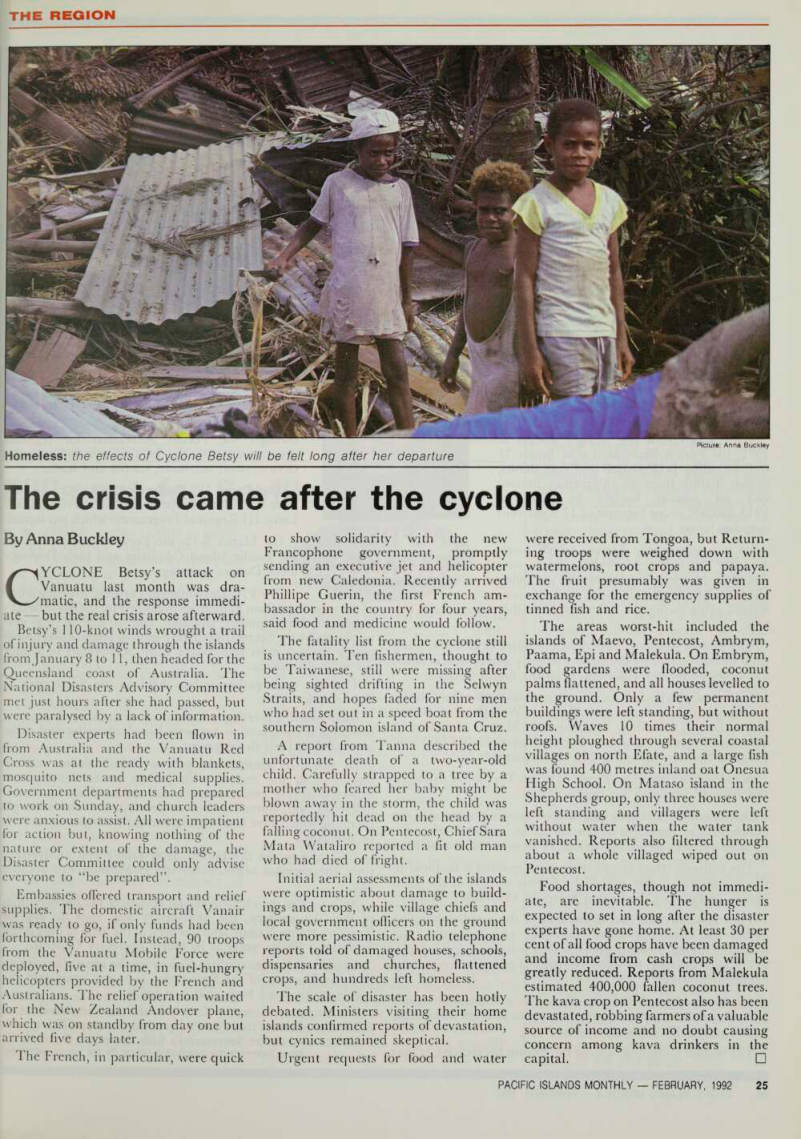
By Anna Buckley
CYCLONE Betsy’s attack on
Vanuatu last month was dra matic, and the response immedi ate but the real crisis arose afterward.
Betsy’s 110-knot winds wrought a trail of injury and damage through the islands from January 8 to 11, then headed for the Queensland coast of Australia. The National Disasters Advisory Committee met just hours after she had passed, but w ere paralysed by a lack of information.
Disaster experts had been flown in from Australia and the Vanuatu Red Cross w'as at the ready with blankets, mosquito nets and medical supplies.
Government departments had prepared to w'ork on Sunday, and church leaders were anxious to assist. All were impatient for action but, knowing nothing of the nature or extent of the damage, the Disaster Committee could only advise everyone to “be prepared”.
Embassies offered transport and relief supplies. The domestic aircraft Vanair was ready to go, if only funds had been forthcoming for fuel. Instead, 90 troops from the Vanuatu Mobile Force were deployed, five at a time, in fuel-hungry helicopters provided by the French and Australians. The relief operation waited for the Zealand Andover plane, which was on standby from day one but arrived five days later.
The French, in particular, were quick
to show solidarity with the new Francophone government, promptly sending an executive jet and helicopter from new Caledonia. Recently arrived Phillipe Guerin, the first French am bassador in the country for four years, said food and medicine would follow.
The fatality list from the cyclone still is uncertain. Ten fishermen, thought to be Taiwanese, still were missing after
being sighted drifting in the Selwyn
Straits, and hopes faded for nine men who had set out in a speed boat from the southern Solomon island of Santa Cruz.
A report from Tanna described the unfortunate death of a two-year-old child. Carefully strapped to a tree by a mother who feared her baby might be blown away in the storm, the child was reportedly hit dead on the head by a falling coconut. On Pentecost, Chief Sara Mata Wataliro reported a fit old man who had died of fright.
Initial aerial assessments of the islands were optimistic about damage to build ings and crops, while village chiefs and local government officers on the ground were more pessimistic. Radio telephone reports told of damaged houses, schools, dispensaries and churches, flattened crops, and hundreds left homeless.
The scale of disaster has been hotly debated. Ministers visiting their home islands confirmed reports of devastation,
but cynics remained skeptical.
Urgent requests for food and water
were received from Tongoa, but Return ing troops were weighed down with watermelons, root crops and papaya.
The fruit presumably was given in exchange for the emergency supplies of tinned fish and rice.
The areas worst-hit included the islands of Maevo, Pentecost, Ambrym, Paama, Epi and Malekula. On Embrym, food gardens were flooded, coconut palms flattened, and all houses levelled to the ground. Only a few permanent buildings were left standing, but without roofs. Waves 10 times their normal
height ploughed through several coastal
villages on north Efate, and a large fish was found 400 metres inland oat Onesua High School. On Mataso island in the Shepherds group, only three houses were left standing and villagers were left without water when the water tank vanished. Reports also filtered through about a whole villaged wiped out on Pentecost.
Food shortages, though not immedi ate, are inevitable. The hunger is expected to set in long after the disaster experts have gone home. At least 30 per cent of all food crops have been damaged and income from cash crops will be greatly reduced. Reports from Malekula estimated 400,000 fallen coconut trees.
The kava crop on Pentecost also has been devastated, robbing farmers of a valuable source of income and no doubt causing concern among kava drinkers in the capital. □
Picture: Anna Buckley
Homeless: the effects of Cyclone Betsy will be felt long after her departure
Advertisements & other items, p. 25 (1 item)
The Region
Rare success story starred a tiny unknown
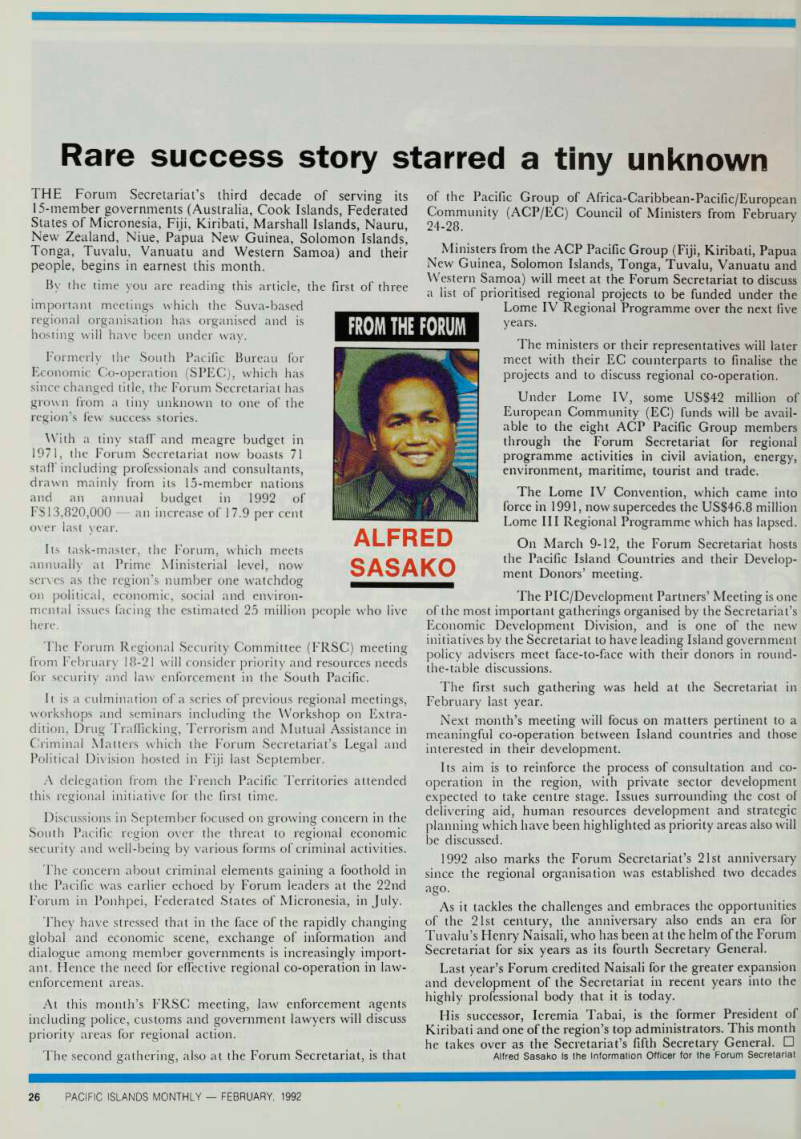
THE Forum Secretariat’s third decade of serving its 15-member governments (Australia, Cook Islands, Federated States of Micronesia, Fiji, Kiribati, Marshall Islands, Nauru, New Zealand, Niue, Papua New Guinea, Solomon Islands, Tonga, Tuvalu, Vanuatu and Western Samoa) and their people, begins in earnest this month.
By the time you are reading this article, the first of three
important meetings which the Suva-based regional organisation has organised and is hosting will have been under way.
Formerly the South Pacific Bureau for Economic Co-operation (SPEC), which has since changed title, the Forum Secretariat has grown from a tiny unknown to one of the region’s few success stories.
With a tiny staff and meagre budget in 1971, the Forum Secretariat now boasts 71 staff including professionals and consultants, drawn mainly from its 15-member nations and an annual budget in 1992 of FS 13,820,000 an increase of 17.9 per cent over last year.
Its task-master, the Forum, which meets annually at Prime Ministerial level, now serves as the region’s number one watchdog on political, economic, social and environ
mental issues facing the estimated 25 million people who live here.
The Forum Regional Security Committee (FRSC) meeting from February 18-21 will consider priority and resources needs for security and law enforcement in the South Pacific.
It is a culmination of a series of previous regional meetings, workshops and seminars including the Workshop on Extra dition, Drug Trafficking, Terrorism and Mutual Assistance in Criminal Matters which the Forum Secretariat’s Legal and Political Division hosted in Fiji last September.
A delegation from the French Pacific Territories attended this regional initiative for the first time.
Discussions in September focused on growing concern in the South Pacific region over the threat to regional economic security and well-being by various forms of criminal activities.
The concern about criminal elements gaining a foothold in the Pacific was earlier echoed by Forum leaders at the 22nd Forum in Ponhpei, Federated States of Micronesia, in July.
They have stressed that in the face of the rapidly changing global and economic scene, exchange of information and dialogue among member governments is increasingly import ant. Hence the need for effective regional co-operation in law enforcement areas.
At this month’s FRSC meeting, law enforcement agents including police, customs and government lawyers will discuss priority areas for regional action.
The second gathering, also at the Forum Secretariat, is that
From The Forum
of the Pacific Group of Africa-Caribbean-Pacific/European Community (ACP/EC) Council of Ministers from February 24-28.
Ministers from the ACP Pacific Group (Fiji, Kiribati, Papua New Guinea, Solomon Islands, Tonga, Tuvalu, Vanuatu and Western Samoa) will meet at the Forum Secretariat to discuss a list of prioritised regional projects to be funded under the
Lome IV Regional Programme over the next five years.
The ministers or their representatives will later meet with their EC counterparts to finalise the projects and to discuss regional co-operation.
Under Lome IV, some US$42 million of European Community (EC) funds will be avail able to the eight ACP Pacific Group members through the Forum Secretariat for regional programme activities in civil aviation, energy, environment, maritime, tourist and trade.
The Lome IV Convention, which came into force in 1991, now supercedes the US$46.B million Lome 111 Regional Programme which has lapsed.
On March 9-12, the Forum Secretariat hosts the Pacific Island Countries and their Develop ment Donors’ meeting.
The PIC/Development Partners’ Meeting is one of the most important gatherings organised by the Secretariat’s Economic Development Division, and is one of the new initiatives by the Secretariat to have leading Island government policy advisers meet face-to-face with their donors in round the-table discussions.
The first such gathering was held at the Secretariat in February last year.
Next month’s meeting will focus on matters pertinent to a meaningful co-operation between Island countries and those interested in their development.
Its aim is to reinforce the process of consultation and co operation in the region, with private sector development expected to take centre stage. Issues surrounding the cost of delivering aid, human resources development and strategic planning which have been highlighted as priority areas also will Idc discussed. 1992 also marks the Forum Secretariat’s 21st anniversary since the regional organisation was established two decades ago.
As it tackles the challenges and embraces the opportunities of the 21st century, the anniversary also ends an era for Tuvalu’s Henry Naisali, who has been at the helm of the Forum Secretariat for six years as its fourth Secretary General.
Last year’s Forum credited Naisali for the greater expansion and development of the Secretariat in recent years into the highly professional body that it is today.
His successor, Icremia Tabai, is the former President of Kiribati and one of the region’s top administrators. This month he takes over as the Secretariat’s fifth Secretary General, □ Alfred Sasako Is the Information Officer for the Forum Secretariat
Alfred
Sasako
Fiji’s set for Seville
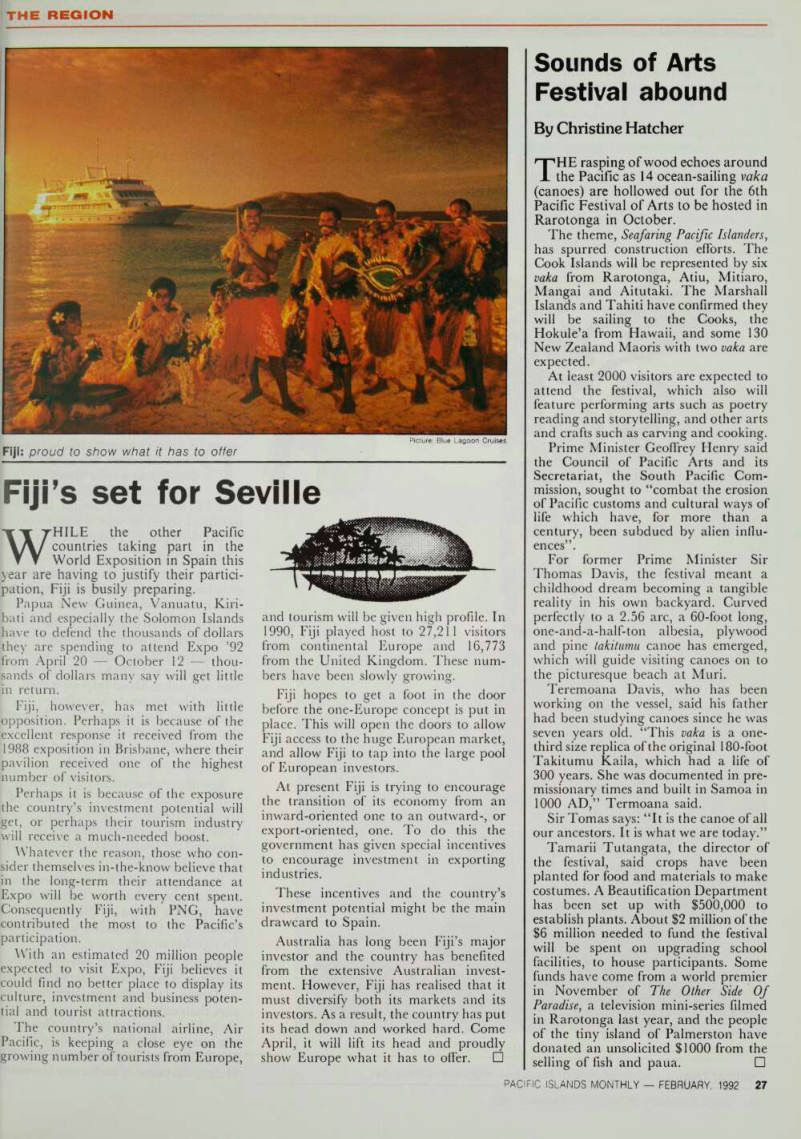
WHILE the other Pacific countries taking part in the World Exposition in Spain this year are having to justify their partici pation, Fiji is busily preparing.
Papua New Guinea, Vanuatu, Kiri bati and especially the Solomon Islands have to defend the thousands of dollars they are spending to attend Expo ’92 from April 20 October 12 thou sands of dollars many say will get little in return.
Fiji, however, has met with little opposition. Perhaps it is because of the excellent response it received from the 1988 exposition in Brisbane, where their pavilion received one of the highest number of visitors.
Perhaps it is because of the exposure the country’s investment potential will get, or perhaps their tourism industry will receive a much-needed boost.
Whatever the reason, those who con sider themselves in-the-know believe that in the long-term their attendance at Expo will be worth every cent spent.
Consequently Fiji, with PNG, have contributed the most to the Pacific’s
participation.
With an estimated 20 million people expected to visit Expo, Fiji believes it could find no better place to display its culture, investment and business poten tial and tourist attractions.
The country’s national airline, Air Pacific, is keeping a close eye on the growing number of tourists from Europe,
and tourism will be given high profile. In 1990, Fiji played host to 27,211 visitors from continental Europe and 16,773 from the United Kingdom. These num bers have been slowly growing.
Fiji hopes to get a foot in the door before the one-Europe concept is put in place. This will open the doors to allow Fiji access to the huge European market, and allow Fiji to tap into the large pool of European investors.
At present Fiji is trying to encourage the transition of its economy from an inward-oriented one to an outward-, or export-oriented, one. To do this the government has given special incentives to encourage investment in exporting industries.
These incentives and the country’s investment potential might be the main drawcard to Spain.
Australia has long been Fiji’s major
investor and the country has benefited from the extensive Australian invest ment. However, Fiji has realised that it must diversify both its markets and its investors. As a result, the country has put its head down and worked hard. Come April, it will lift its head and proudly show Europe what it has to offer. □
Fiji; proud to show what it has to offer
Picture: Blue Lagoon Cruises
Sounds of Arts
Festival abound
By Christine Hatcher
THE rasping of wood echoes around the Pacific as 14 ocean-sailing vaka (canoes) are hollowed out for the 6th Pacific Festival of Arts to be hosted in Rarotonga in October.
The theme, Seafaring Pacific Islanders , has spurred construction efforts. The Cook Islands will be represented by six vaka from Rarotonga, Atiu, Mitiaro, Mangai and Aitutaki. The Marshall Islands and Tahiti have confirmed they will be sailing to the Cooks, the Hokule’a from Hawaii, and some 130 New Zealand Maoris with two vaka are
expected.
At least 2000 visitors are expected to attend the festival, which also will feature performing arts such as poetry reading and storytelling, and other arts and crafts such as carving and cooking.
Prime Minister Geoffrey Henry said the Council of Pacific Arts and its Secretariat, the South Pacific Com mission, sought to “combat the erosion of Pacific customs and cultural ways of life which have, for more than a century, been subdued by alien influ ences”.
For former Prime Minister Sir Thomas Davis, the festival meant a childhood dream becoming a tangible reality in his own backyard. Curved perfectly to a 2.56 arc, a 60-foot long, one-and-a-half-ton albesia, plywood and pine lakitumu canoe has emerged, which will guide visiting canoes on to the picturesque beach at Muri.
Teremoana Davis, who has been working on the vessel, said his father had been studying canoes since he was seven years old. “This vaka is a one third size replica of the original 180-foot Takitumu Kaila, which had a life of 300 years. She was documented in pre missionary times and built in Samoa in 1000 AD,” Termoana said.
Sir Tomas says: “It is the canoe of all our ancestors. It is what we are today.”
Tamarii Tutangata, the director of the festival, said crops have been planted for food and materials to make costumes. A Beautification Department has been set up with $500,000 to establish plants. About $2 million of the S 6 million needed to fund the festival will be spent on upgrading school facilities, to house participants. Some funds have come from a world premier in November of The Other Side Of Paradise , a television mini-series filmed in Rarotonga last year, and the people of the tiny island of Palmerston have donated an unsolicited SIOOO from the selling of fish and paua. □
Pa picks
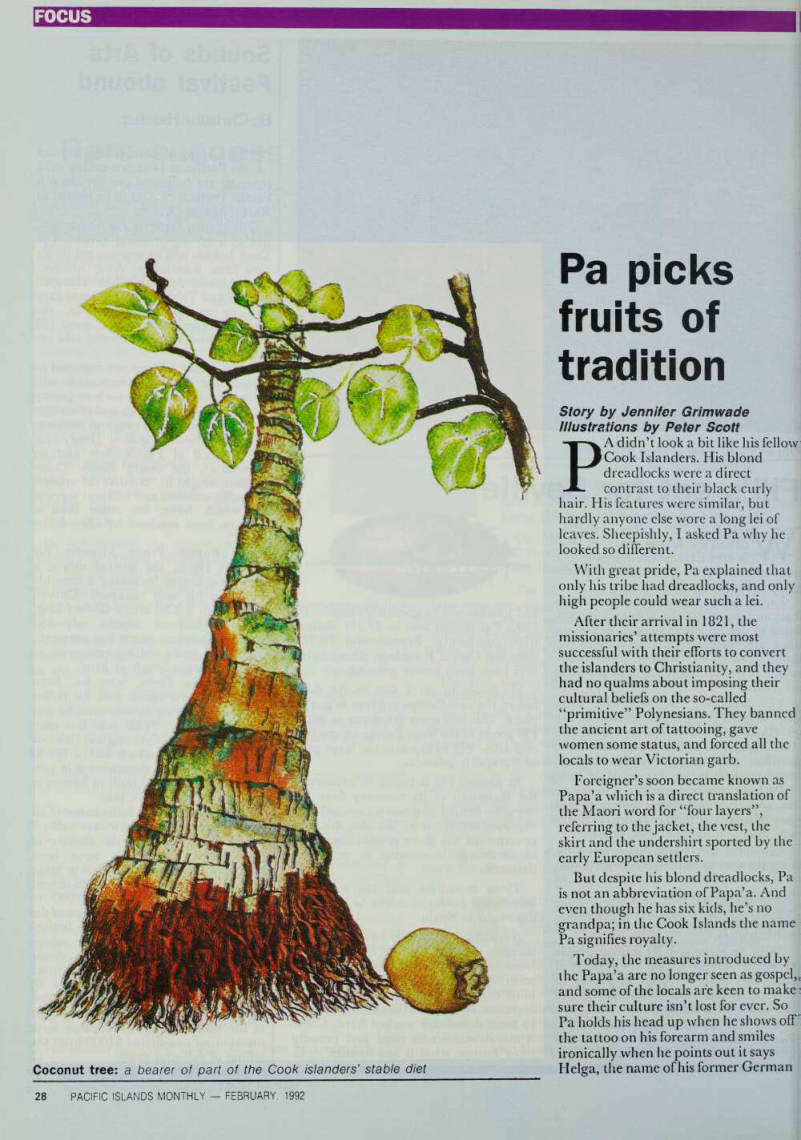
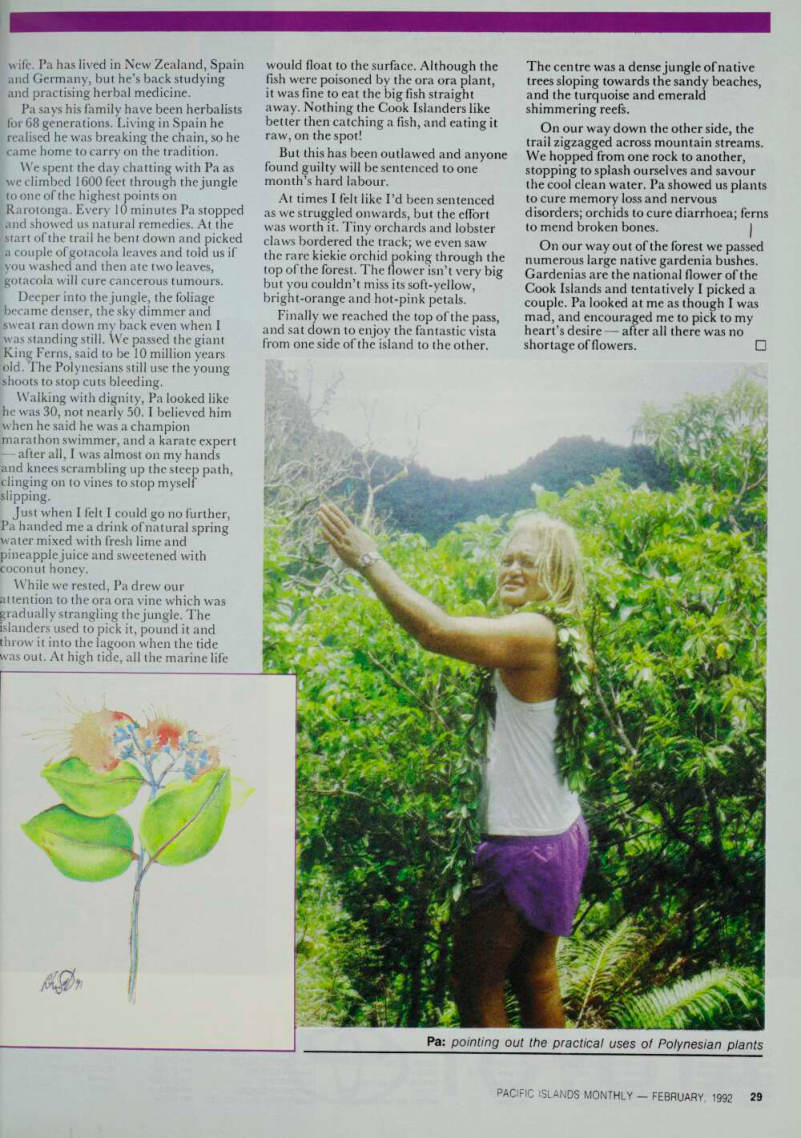
Focus
Pa picks fruits of tradition
Story by Jennifer Grim wade Illustrations by Peter Scott PA didn’t look a bit like his fellow Cook Islanders. His blond dreadlocks were a direct contrast to their black curly hair. His features were similar, but hardly anyone else wore a long lei of leaves. Sheepishly, I asked Pa why he looked so different.
With great pride, Pa explained that only his tribe had dreadlocks, and only high people could wear such a lei.
After their arrival in 1821, the missionaries’ attempts were most successful with their efforts to convert the islanders to Christianity, and they had no qualms about imposing their cultural beliefs on the so-called
“primitive” Polynesians. They banned
the ancient art of tattooing, gave women some status, and forced all the locals to wear Victorian garb.
Foreigner’s soon became known as Papa’a which is a direct translation of the Maori word for “four layers”, referring to the jacket, the vest, the skirt and the undershirt sported by the
early European settlers.
But despite his blond dreadlocks, Pa is not an abbreviation of Papa’a. And even though he has six kids, he’s no grandpa; in the Cook Islands the name
Pa signifies royalty.
Today, the measures introduced by the Papa’a are no longer seen as gospel,, and some of the locals are keen to make sure their culture isn’t lost for ever. So Pa holds his head up when he shows off the tattoo on his forearm and smiles ironically when he points out it says Helga, the name of his former German
Coconut tree: a bearer of part of the Cook islanders' stable diet
wife. Pa has lived in New Zealand, Spain and Germany, but he’s back studying and practising herbal medicine.
Pa says his family have been herbalists for 68 generations. Living in Spain he realised he was breaking the chain, so he came home to carry on the tradition.
We spent the day chatting with Pa as we climbed 1600 feet through the jungle to one of the highest points on Rarotonga. Every 10 minutes Pa stopped [ and showed us natural remedies. At the I start of the trail he bent down and picked ; a couple ofgotacola leaves and told us if lyou washed and then ate two leaves, gotacola will cure cancerous tumours.
Deeper into the jungle, the foliage became denser, the sky dimmer and 'sweat ran down my back even when I was standing still. We passed the giant King Ferns, said to be 10 million years old. The Polynesians still use the young shoots to stop cuts bleeding.
Walking with dignity, Pa looked like he was 30, not nearly 50. I believed him when he said he was a champion marathon swimmer, and a karate expert after all, I was almost on my hands and knees scrambling up the steep path, clinging on to vines to stop myself
slipping.
Just when I felt I could go no further, Pa handed me a drink of natural spring water mixed with fresh lime and pineapple juice and sweetened with
coconut honey.
While we rested, Pa drew our attention to the ora ora vine which was
gradually strangling the jungle. The
islanders used to pick it, pound it and throw it into the lagoon when the tide was out. At high tide, all the marine life
would float to the surface. Although the fish were poisoned by the ora ora plant, it was fine to eat the big fish straight away. Nothing the Cook Islanders like better then catching a fish, and eating it raw, on the spot!
But this has been outlawed and anyone found guilty will be sentenced to one month’s hard labour.
At times I felt like I’d been sentenced as we struggled onwards, but the effort W as worth it. Tiny orchards and lobster daws bordered the track; we even saw the rare kiekie orchid poking through the too of the forest The flower isn’t verv bier u ,j , “ owe * isn t very big but you couldn t miss its soft-yellow,
bright-orange and hot-pink petals.
Finally we reached the top of the pass, alld sat down to enjoy the fantastic vista from one side of the island to the other
The centre was a dense jungle of native trees sloping towards the sandy beaches, and the turquoise and emerald
shimmering reefs,
Qn our down the other sid the tra il zigzagged across mountain streams, We hopped from one rock to another, stopping to splash ourselves and savour the cool clean water. Pa showed us plants to cure memory loss and nervous disorders; orchids to cure diarrhoea; ferns to mend broken bones. ) On our wav out of the forest we nassed n \ . u \ ® , n a °usnes.
Gardenias are the national flower of the Cook Islands and tentatively I picked a coup le. Pa looked at me as though I was mad, and encouraged me to pick to my heart’s desire after all there was no shortage offiowers. □
Pa; pointing out the practical uses of Polynesian plants
Advertisements & other items, pp. 30-31 (1 item)
driving experience.
The new Toyota brand mark. Three ellipses forming a “T” which stand for our customer, our commitment to the satisfaction of that customer through our product and for our spirit of creativity.
I* & It’s not often that you hear descriptions like rugged or durable combined with refined and elegant. But then there’s never been a vehicle quite like the new Toyota Land Cruiser Station Wagon. The unrivalled legend of off-road reliability is now unsurpassed in comfort and sophistication as well. Attention to detail is found everywhere, from the fine trim to the instrument panel to the graceful lines of its exterior. Even in places you can’t see, like the heavy-duty ladder frame and suspension design that add to the superb
luxury-car ride.
But Toyota’s innovation goes beyond providing luxury and durability. The new Land Cruiser Station Wagon, and all of our cars, are designed to create a harmony between car and driver, and to provide you with the ultimate
driving experience.
The new Toyota Land Cruiser Station Wagon. Think of it as much more than a spacious luxury sedan with fourwheel drive. ■ w st 4 ' v* V* *
DISTRIBUTORS/DEALERS
AMERICAN SAMOA BURNS PHILP (S.S.) CO. LTD. PH 633-4281 GUAM & MICRONESIA ATKINS KROLL, INC. PH 646-1876/9 NORFOLK ISLANDS BORRY'S PTY LTD. PH 2114
SOLOMON ISLANDS MENDANA MOTORS PH 22884
VANUATU VANUATU MOTORS PH 2341
COOK ISLANDS PACIFIC MOTORS LTD. PH 20796
KIRIBATI TARAWA MOTORS PH 21090
PAPUA NEW GUINEA ELA MOTORS PH 217036
TAHITI NIPPON AUTOMOTO PH 429819
WESTERN SAMOA BURNS PHILP (S.S.) CO. LTD. PH 20800
FIJI
NEW CALEDONIA
SAIPAN
TONGA
Cruiser
' V r- - Id 3 i v
FOU
R WHEi
EEL. DRIVE
OJIH
& V :\
<J£> TOYOTA
band together
Headlines
Small islands band together
THE five smallest nations of the South Pacific have formed an organisation to unite them on matters ranging from fishing rights to the environment. The union was formed by leaders of Kiribati, Niue, Nauru, Tuvalu and the Cook Islands during meetings in Rarotonga.
“We are tired of being ignored,” Cook Islands Prime Minister Geoffrey Henry said.
The five nations have a combined population of 100,000 living on less than 1300 square kilometres of land, but they encompass 7.1 million square kilometres of ocean, about two-thirds the size of the United States. Tap Pryor, Cook Islands’ chief projects officer for the Ministry of
Planning and Economic Development,
said the five nations plan to negotiate fishing rights to their area, and will challenge shipping companies over access to shipping lanes passing through their exclusive economic zone. They also are concerned about fears that many atolls could disappear because of global cli mate changes caused by greenhouse gases produced by industrialised countries.
U.S. to stay THE United States has assured Pacific nations it will remain a military power in the region. President Bush said the US intends to maintain the appropriate military presence to protect its allies and counter any threats to peace.
Boat-people plan denied VANUATU has denied it is planning to accommodate thousands of Vietnamese
refugees now living in Hong Kong.
According to Foreign Affairs Minister, Serge Vohor, Prime Minister Maxime Carlot had not even considered the issue.
Return to Vanuatu SOME of the 3000 people deported from Vanuatu have started returning to the country. Radio Vanuatu says at least 20
French citizens deported after the pre independence Santo rebellion in 1980 are now back in Luganville. Vanuatu Foreign Affairs has confirmed that foreigners deported after the Santo rebellion have been told they are free to return.
Airline black-banned FIJI’S national airline, Air Pacific, stands to lose tens of thousands of dollars from a black ban slapped against it by Australian unions, in protest against Fiji’s labor laws. An Australian aviation source said that such a figure includes lost revenue and payments for hotels.
The Fiji Times says Air Pacific is to seek an injunction restraining the Transport Workers Union of Australia from dis rupting air services to Fiji, on the grounds it has breached the Australian Trade Practices Act.
Solomons set for Expo DESPITE strong opposition, the Sol omon Islands looks set to participate in the World Exposition in Spain from April 20 to October 12. The country’s opposition party say attending Expo ’92 is a waste of money, but the government argues that it give the Solomons great exposure and will be ofbenefit in the long run.
Pumpkin claims PUMPKIN exporters in Tonga are facing heavy claims from Japanese buyers because of undersized, dis coloured and rotten fruit, broken bins and a flooded market. The claims could result in payments to growers being below negotiated prices. A government delegation was recently in Japan to investigate the situation.
Prisoners released THE new government of Vanuatu released its entire prison population of almost 200 inmates on Christmas day in a general amnesty. At least one convicted murderer and several rapists are believed to be among the liberated. Home Affairs minister, Charley Nako, says the amnesty reflects the national reconciliation policy of Prime Minister Maxime Carlot’s newly elected government.
Surveillance call KIRIBATI has again raised concern over the increase in illegal fishing activities in its economic waters by international operators. They have ap proached Australia to speed up the patrol boat project, under which Kiribati can carry out its own surveillance work.
Visa-fees protest THE French South Pacific territories of Tahiti and New Caledonia protested to Paris last month against a decision to more than treble the cost of French visas, saying it would kill tourism from Austra lia. The Office for the Promotion of Tourism in Polynesia demanded that the increase be scrapped or at least reduced.
The charge for visas for French overseas
territories was increased from AS 17.47 toe A 561.82, more expensive than Fiji, Vanuatu, Bali or Hawaii.
Lottery for sports THE Cook Islands cabinet is considering* a submission prepared by the Crownlaw\ Office on the proposed introduction oft Tattersalls Lottery to fund sports devel opment in the country. A report has* estimated that people in the Cooks would! spend more than USSSOO,OOO a year om lotto and sport could receive about)
Uss 190,000.
Relations with Russia
KIRIBATI is monitoring developments*
in the former Soviet Union while con tinuing its relationship with the govern ment of the Russian Federation. Kiri bati’s Ministry of Foreign Affairs says* since the collapse of the USSR, and the: emergence of the Russian Federation as* the successor state to the Soviet Union,, Kiribati has maintained its ties withi Russia on a de facto basis.
Woman senator KIMIKO Elanzo is the first worn am senator in Pohnpei’s legislature of 23. She; was elected to office last month for a four year term. Radio Pohnpei says it’s the: first time in the state’s history that aj woman has done this.
Positions vacant: hangman THE Papua New Guinea government is; looking abroad for a professional hang man to execute convicted criminals; sentenced to death. The hangman will be; employed on contract. National radio* NBC says contact has already been made; with countries currently imposing the; death penalty by hanging such as;
Malaysia.
Election postponed
FIJI’S general election has again beem postponed, this time until May. It was to* have been held in March but hold-ups hu
preparation, including computer hic
cups, have been blamed for the delay.
Fatal capsizing FRENCH Polynesian authorities have; started an investigation into the capsiz ing of a shuttle boat in the LeewardJ Islands in which at least seven people are; known to have died. Up to 45 people; were reported on board the converted! wooded fishing boat although regu lations only allow 25.
Tonga’s Marcos bid A BOOK by the aide to the late: Philippines President Ferdinand Marcos; said the King of Tonga offered to shelter' the Marcos family, if Marcos helped! develop Tonga’s tourism industry. The: book, Malacenang to Makiki, be ex-colonel J Arturo Aruiza, says Marcos met with the: King after he and his family fled the; Philippines for Hawaii in 1986. Marcos* politely turned down the King’s offer. □
Advertisements & other items, p. 32 (1 item)
Rent — A — Car
THE WORLD S NO. 1
WHERE QUALITY AND SAFETY COUNT.
To drive the roads of Fiji is to experience some of the most beautiful scenery of the South Pacific, especially with Hertz.
A For Reservations Phone.
Nadi Airport 722146 Suva 383150,383411,383677 Tetec 2237, Fax; 370212 With Hertz you get more than Just a car.
Pacific
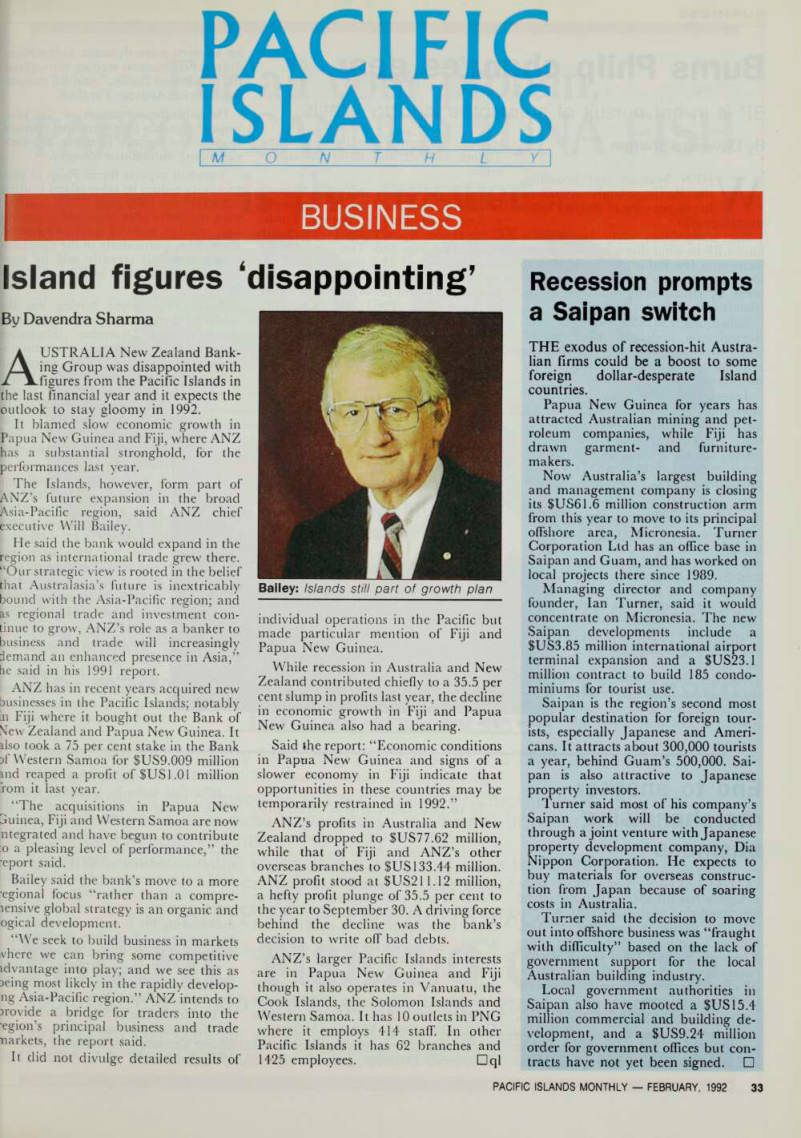
Islands
Monthly
Business
Island figures 'disappointing’
By Davendra Sharma
AUSTRALIA New Zealand Bank ing Group was disappointed with figures from the Pacific Islands in the last financial year and it expects the outlook to stay gloomy in 1992.
It blamed slow economic growth in Papua New Guinea and Fiji, where ANZ has a substantial stronghold, for the performances last year.
The Islands, however, form part of ANZ’s future expansion in the broad Asia-Pacific region, said ANZ chief executive Will Bailey.
He said the bank would expand in the region as international trade grew there.
“Our strategic view is rooted in the belief that Australasia’s future is inextricably bound with the Asia-Pacific region; and as regional trade and investment con tinue to grow, ANZ’s role as a banker to business and trade will increasingly demand an enhanced presence in Asia,” be said in his 1991 report.
ANZ has in recent years acquired new businesses in the Pacific Islands; notably in Fiji where it bought out the Bank of Mew Zealand and Papua New Guinea. It ilso took a 75 per cent stake in the Bank Western Samoa for 5U59.009 million md reaped a profit of SUSI.OI million Tom it last year.
“The acquisitions in Papua New Guinea, Fiji and Western Samoa are now ntegrated and have begun to contribute :o a pleasing level of performance,” the •eport said.
Bailey said the bank’s move to a more •egional focus “rather than a compre lensive global strategy is an organic and
ogical development.
“We seek to build business in markets vhere we can bring some competitive idvantage into play; and we see this as Deing most likely in the rapidly develop ng Asia-Pacific region.” ANZ intends to provide a bridge for traders into the •egion’s principal business and trade narkets, the report said.
It did not divulge detailed results of
individual operations in the Pacific but made particular mention of Fiji and Papua New Guinea.
While recession in Australia and New Zealand contributed chiefly to a 35.5 per cent slump in profits last year, the decline in economic growth in Fiji and Papua New Guinea also had a bearing.
Said the report: “Economic conditions in Papua New Guinea and signs of a slower economy in Fiji indicate that opportunities in these countries may be temporarily restrained in 1992.”
ANZ’s profits in Australia and New Zealand dropped to 5U577.62 million, while that of Fiji and ANZ’s other overseas branches to SUS 133.44 million.
ANZ profit stood at 5U5211.12 million, a hefty profit plunge of 35.5 per cent to the year to September 30. A driving force behind the decline was the bank’s decision to write off bad debts.
ANZ’s larger Pacific Islands interests are in Papua New Guinea and Fiji though it also operates in Vanuatu, the Cook Islands, the Solomon Islands and Western Samoa. It has 10 outlets in PNG where it employs 414 staff. In other Pacific Islands it has 62 branches and 1425 employees. Dql
Bailey: Islands still part of growth plan
Recession prompts
a Saipan switch
THE exodus of recession-hit Austra lian firms could be a boost to some foreign dollar-desperate Island countries.
Papua New Guinea for years has attracted Australian mining and pet roleum companies, while Fiji has drawn garment- and furniture makers.
Now Australia’s largest building and management company is closing its SUS6I.6 million construction arm from this year to move to its principal offshore area, Micronesia. Turner Corporation Ltd has an office base in Saipan and Guam, and has worked on local projects there since 1989.
Managing director and company founder, lan Turner, said it would concentrate on Micronesia. The new
Saipan developments include a
SUSS.BS million international airport terminal expansion and a SUS23.I million contract to build 185 condo miniums for tourist use.
Saipan is the region’s second most popular destination for foreign tour ists, especially Japanese and Ameri cans. It attracts about 300,000 tourists a year, behind Guam’s 500,000. Sai pan is also attractive to Japanese
property investors.
Turner said most of his company’s Saipan work will be conducted through a joint venture with Japanese property development company, Dia Nippon Corporation. He expects to buy materials for overseas construc tion from Japan because of soaring costs in Australia.
Turner said the decision to move out into offshore business was “fraught with difficulty” based on the lack of government support for the local
Australian building industry.
Local government authorities in Saipan also have mooted a SUSIS.4 million commercial and building de velopment, and a 5U59.24 million order for government offices but con tracts have not yet been signed. □
Burns Philp changes gear
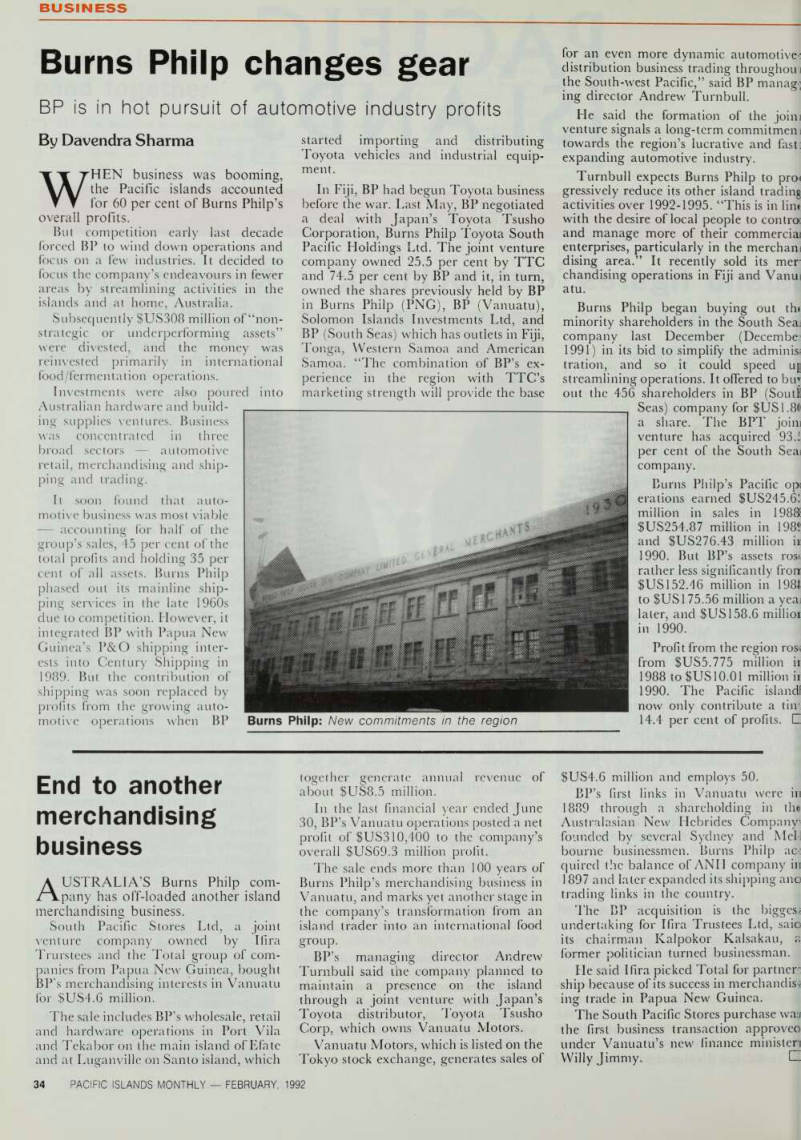
BP is in hot pursuit of automotive industry profits
By Davendra Sharma
WHEN business was booming,
the Pacific islands accounted for 60 per cent of Burns Philp’s overall profits.
But competition early last decade forced BP to wind down operations and focus on a few' industries. It decided to focus the company’s endeavours in fewer areas by streamlining activities in the islands and at home, Australia.
Subsequently SUS3OB million of “non strategic or underperforming assets” were divested, and the money was reinvested primarily in international food/fermentation operations.
Investments were also poured into
Australian hardware and build ing supplies ventures. Business was concentrated in three broad sectors automotive retail, merchandising and ship ping and trading.
It soon found that auto motive business was most viable accounting for half of the group’s sales, 45 per cent of the total profits and holding 35 per cent of all assets. Burns Philp phased out its mainline ship ping services in the late 1960 s due to competition. However, it integrated BP with Papua New Guinea’s P&O shipping inter ests into Century Shipping in 1989. But the contribution of shipping was soon replaced by profits from the growing auto motive operations when BP
started importing and distributing
Toyota vehicles and industrial equip ment.
In Fiji, BP had begun Toyota business before the war. Last May, BP negotiated a deal with Japan’s Toyota Tsusho Corporation, Burns Philp Toyota South Pacific Holdings Ltd. The joint venture company owned 25.5 per cent by TTC and 74.5 per cent by BP and it, in turn, owned the shares previously held by BP in Burns Philp (PNG), BP (Vanuatu), Solomon Islands Investments Ltd, and BP (South Seas) which has outlets in Fiji, Tonga, Western Samoa and American Samoa. “The combination of BP’s ex perience in the region with TTC’s marketing strength will provide the base
for an even more dynamic automotive': distribution business trading throughou the South-west Pacific,” said BP manag; ing director Andrew Turnbull.
He said the formation of the joim venture signals a long-term commitment towards the region’s lucrative and fast expanding automotive industry.
Turnbull expects Burns Philp to pn> gressively reduce its other island trading activities over 1992-1995. “This is in lin# with the desire of local people to control and manage more of their commercial enterprises, particularly in the merchan dising area.” It recently sold its mer chandising operations in Fiji and Vanu atu.
Burns Philp began buying out th* minority shareholders in the South Sea. company last December (Decembe: 1991) in its bid to simplify the adminisi tration, and so it could speed uj streamlining operations. It offered to bin out the 456 shareholders in BP (Souti
Seas) company for SUSI.BO a share. The BPT joim venture has acquired 93. 1 per cent of the South Seai company.
Burns Philp’s Pacific op< erations earned 5U5245.6* million in sales in 19881 5U5254.87 million in 198$ and 5U5276.43 million in 1990. But BP’s assets rosi. rather less significantly fronr 5U5152.46 million in 1981 to 5U5175.56 million a yeaj later, and SUS 158.6 millioi in 1990.
Profit from the region rosi from 5U55.775 million ii 1988 toSUSIO.OI million ii 1990. The Pacific island! now only contribute a tin; 14.4 per cent of profits. C
Burns Philp: New commitments in the region
merchandising
End to another merchandising business
AUSTRALIA’S Burns Philp com pany has off-loaded another island
merchandising business.
South Pacific Stores Ltd, a joint venture company owned by Ifira Trurstees and the Total group of com panies from Papua New Guinea, bought BP’s merchandising interests in Vanuatu for SUS 4.6 million.
The sale includes BP’s wholesale, retail and hardware operations in Port Vila and Tekabor on the main island of Efate and at Luganvillc on Santo island, which
together generate annual revenue of about SUSB.S million.
In the last financial year ended June 30, BP’s Vanuatu operations posted a net profit of SUSS 10,400 to the company’s overall 5U569.3 million profit.
The sale ends more than 100 years of Burns Philp’s merchandising business in Vanuatu, and marks yet another stage in the company’s transformation from an island trader into an international food group.
BP’s managing director Andrew Turnbull said the company planned to maintain a presence on the island through a joint venture with Japan’s Toyota distributor, Toyota Tsusho Corp, which owns Vanuatu Motors.
Vanuatu Motors, which is listed on the Tokyo stock exchange, generates sales of
SUS 4.6 million and employs 50.
BP’s first links in Vanuatu were in 1889 through a shareholding in the Australasian New Hebrides Company' founded by several Sydney and MelJ bourne businessmen. Burns Philp acx cjuired (he balance of ANH company in 1897 and later expanded its shipping ano trading links in the country.
The BP acquisition is the bigges« undertaking for Kira Trustees Ltd, saio its chairman Kalpokor Kalsakau, a former politician turned businessman.
He said Ifira picked Total for partner: ship because of its success in merchandise ing trade in Papua New Guinea.
The South Pacific Stores purchase wa:/ the first business transaction approveo under Vanuatu’s new finance minister!
Willy Jimmy. d
Advertisements & other items, pp. 34-35 (2 items)
Business
Pacific Fishing Co. Ltd.
For all your protein,
PAFCO’s CANNED TUNA FISH
is the answer
L'«ht
WtKT
•Te A**! tuna FL
< BRANDS TO SELECT FROM:-)
★ OVALAU BLUE ★ SUNBELL YELLOW ★ OLD CAPITAL ★ SUNBELL GREEN ★ KORO SEA ★ SUNBELL RED No matter how it’s stack , PAFCO canned
tuna is the best.
Pacific Fishing Company Limited packs tuna for the highest quality markets in the world.
PAFCO tuna is recognised as the top quality product in those markets.
Solid chunk and flake tuna is packed in oil, broth, brine or water according to customer requirements.
Watch the leaders in the high value markets and ask the question — Do your customers deserve the best?
QUALITY TUNA PRODUCTS FROM FIJI
PACIFIC FISHING CO. LTD.
MANUFACTURERS AND SUPPLIERS OF CANNED TUNA AND FISH MEAL SUVA: P.0. BOX 1371. SUVA. Fill. PHONE: (679) 313 354 OR 311852 TELEX; FJ 2349, FAX: (679) 301 904 LEVUKA; P.O. BOX 41, LEVUKA, FIJI. PHONE: 440005 OR 440055, TELEX: FJ 7252 FAX: 440400
home-owners
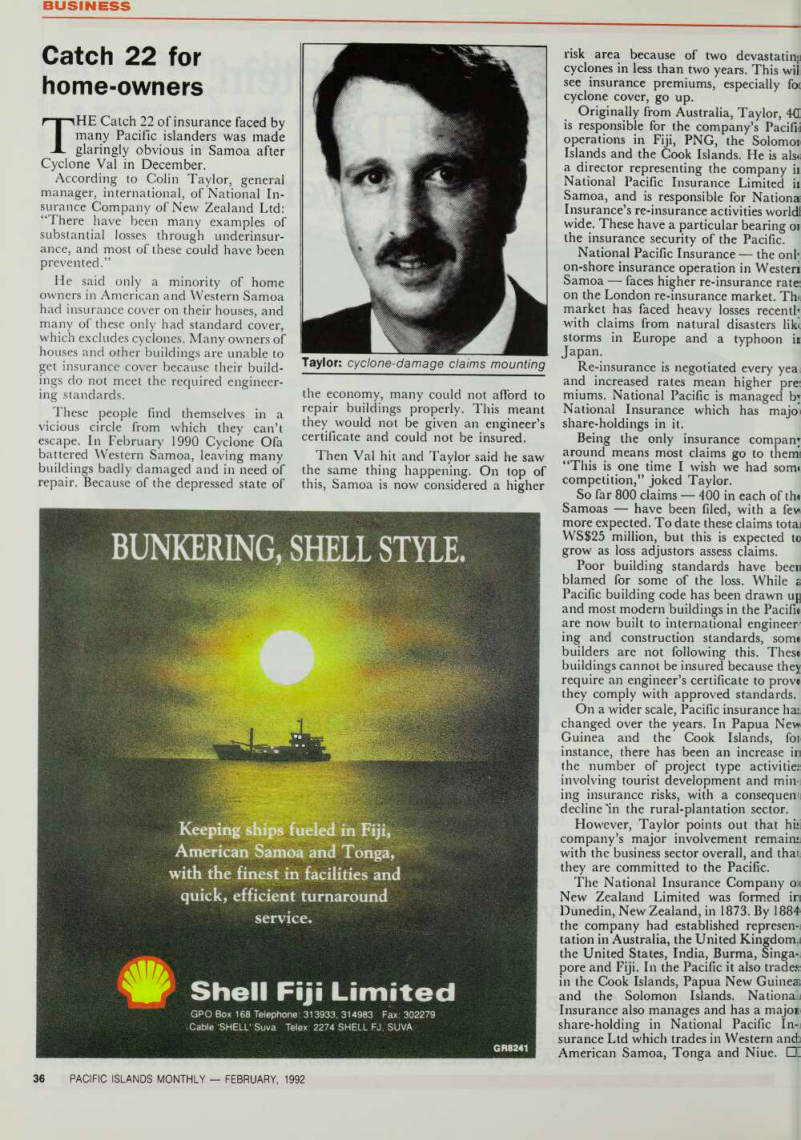
Catch 22 for home-owners
THE Catch 22 of insurance faced by many Pacific islanders was made glaringly obvious in Samoa after Cyclone Val in December.
According to Colin Taylor, general manager, international, of National In surance Company of New Zealand Ltd: “There have been many examples of substantial losses through underinsur ance, and most of these could have been prevented.”
He said only a minority of home owners in American and Western Samoa had insurance cover on their houses, and many of these only had standard cover, which excludes cyclones. Many owners of houses and other buildings are unable to get insurance cover because their build ings do not meet the required engineer ing standards.
These people find themselves in a vicious circle from which they can’t escape. In February 1990 Cyclone Ofa battered Western Samoa, leaving many buildings badly damaged and in need of repair. Because of the depressed state of
the economy, many could not afford to repair buildings properly. This meant they would not be given an engineer’s certificate and could not be insured.
Then Val hit and Taylor said he saw the same thing happening. On top of this, Samoa is now considered a higher
risk area because of two devastating cyclones in less than two years. This wili see insurance premiums, especially foe cyclone cover, go up.
Originally from Australia, Taylor, 4(1 is responsible for the company’s Pacifii operations in Fiji, PNG, the Solomon Islands and the Cook Islands. He is als«; a director representing the company ii National Pacific Insurance Limited ii Samoa, and is responsible for Nationae Insurance’s re-insurance activities world! wide. These have a particular bearing oi the insurance security of the Pacific.
National Pacific Insurance the onh on-shore insurance operation in Westeri Samoa faces higher re-insurance rate; on the London re-insurance market. Thd market has faced heavy losses recenth with claims from natural disasters like storms in Europe and a typhoon in Japan.
Re-insurance is negotiated every yeaj and increased rates mean higher pre; miums. National Pacific is managed by National Insurance which has majo< share-holdings in it.
Being the only insurance company around means most claims go to therm “This is one time I wish we had sorm competition,” joked Taylor.
So far 800 claims 400 in each of th« Samoas have been filed, with a few more expected. To date these claims total VVSS2S million, but this is expected to grow as loss adjustors assess claims.
Poor building standards have been blamed for some of the loss. While s Pacific building code has been drawn ufj and most modern buildings in the Pacific are now built to international engineer' ing and construction standards, some builders are not following this. These buildings cannot be insured because they require an engineer’s certificate to prove they comply with approved standards.
On a wider scale, Pacific insurance hajj changed over the years. In Papua New Guinea and the Cook Islands, for instance, there has been an increase in the number of project type activities involving tourist development and min i ing insurance risks, with a consequent decline *in the rural-plantation sector.
However, Taylor points out that hisi company’s major involvement remains with the business sector overall, and than they are committed to the Pacific.
The National Insurance Company ok New Zealand Limited was formed in Dunedin, New Zealand, in 1873. By 1884 the company had established represen-i tation in Australia, the United Kingdom,! the United States, India, Burma, Singa-i pore and Fiji. In the Pacific it also trades; in the Cook Islands, Papua New Guineas and the Solomon Islands. National!
Insurance also manages and has a major share-holding in National Pacific In-j surance Ltd which trades in Western aneb American Samoa, Tonga and Niue. □!
Taylor: cyclone-damage claims mounting
Advertisements & other items, pp. 36-37 (1 item)
Bunkering, Shell Style.
Keeping ships fueled in Fiji, American Samoa and Tonga, with the finest in facilities and quick, efficient turnaround service.
Shell Fiji Limited
GPO Box 168 Telephone; 313933, 314983 Fax: 302279 Cable SHELL' Suva Telex; 2274 SHELL FJ, SUVA GR8241
OFFICE
COMMUNICATIONS?
ANSWER THE CALLS WITH A
RANGE OF PABX’s, FAX’S,
TELEX’S, DATA SERVICES,
PAGERS & MOBILE PHONES
CALL YOUR
PTC BUSINESS OFFICE
PORT MORESBY GOROKA BOROKO
21 4644 72 2153 27 4080 The PTC Telecommunications Network P.O. Box 736 Fax: 21 3521
LAE
43 5011 P.O. Box 1476 Fax: 42 5668 P.O. Box 100 Fax: 72 2141
MT. HAGEN MADANG
52 2400 82 3232 P.O. Box 485 Fax: 52 2729 P.O. Box 411 Fax: 82 2620 P.O. Box 5950 Fax: 25 3827
WEWAK
86 2888 P.O. Box 133 Fax: 86 2700
RABAUL
92 1099 P.O. Box 1134 Fax; 92 1484 PNG’s most valuable asset make it work for you today
POST & TELECOMMUNICATION CORPORATION
KEEPING YOU IN TOUCH WITH OFFICE COMMUNICATION f
Wider gateway
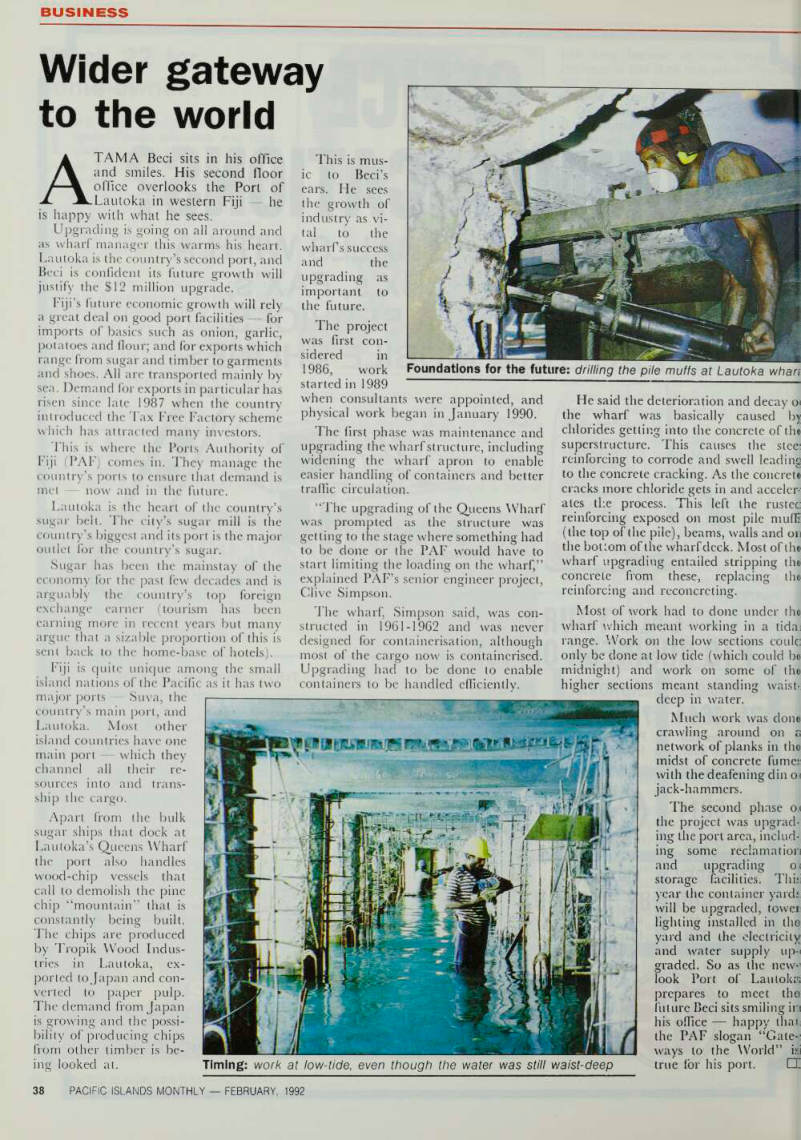
to the world
A TAMA Beci sits in his office and smiles. His second floor office overlooks the Port of Lautoka in western Fiji he is happy with what he sees.
Upgrading is going on all around and as wharf manager this warms his heart.
Lautoka is the country’s second port, and Beci is confident its future growth will justify the Sl2 million upgrade.
Fiji’s future economic growth will rely a great deal on good port facilities for imports of basics such as onion, garlic, potatoes and flour; and for exports which range from sugar and timber to garments and shoes. All are transported mainly by sea. Demand for exports in particular has risen since late 1987 when the country introduced the Tax Free Factory scheme which has attracted many investors.
This is where the Ports Authority of Fiji (PAF) comes in. They manage the country’s ports to ensure that demand is met ■— now and in the future.
Lautoka is the heart of the country’s sugar belt. The city’s sugar mill is the country’s biggest and its port is the major outlet for the country’s sugar.
Sugar has been the mainstay of the economy for the past few decades and is
arguably the country’s top foreign
exchange earner (tourism has been earning more in recent years but many argue that a sizable proportion of this is sent back to the home-base of hotels).
Fiji is quite unique among the small island nations of the Pacific as it has two
major ports Suva, the country’s main port, and Lautoka. Most other island countries have one main port which they channel all their re sources into and trans ship the cargo.
Apart from the bulk sugar ships that dock at Lauloka’s Queens Wharf the port also handles wood-chip vessels that call to demolish the pine chip “mountain” that is
constantly being built.
The chips are produced
by Tropik Wood Indus
tries in Lautoka, ex ported to Japan and con verted to paper pulp.
The demand from Japan is growing and the possi bility of producing chips from other limber is be ing looked at.
This is mus ic to Beci’s ears. He sees the growth of industry as vi tal to the wharf s success and the
upgrading as
important to
the future.
The project was first con sidered in 1986, work started in 1989
when consultants were appointed, and physical work began in January 1990.
The first phase was maintenance and upgrading the wharf structure, including widening the wharf apron to enable easier handling of containers and better traffic circulation.
“The upgrading of the Queens Wharf was prompted as the structure was getting to the stage where something had to be done or the PAF would have to start limiting the loading on the wharf,” explained PAF’s senior engineer project,
Clive Simpson.
The wharf, Simpson said, was con structed in 1961-1962 and was never
designed for containerisation, although
most of the cargo now is containerised.
Upgrading had to be done to enable containers to be handled efficiently.
He said the deterioration and decay oi the wharf was basically caused by chlorides getting into the concrete of the superstructure. This causes the slec: reinforcing to corrode and swell leading to the concrete cracking. As the concrete cracks more chloride gets in and acceler ates the process. This left the rustec reinforcing exposed on most pile muff (the top of the pile), beams, walls and on the bottom of the wharf deck. Most of the wharf upgrading entailed stripping the concrete from these, replacing the reinforcing and reconcrcting.
Most of work had to done under the wharf which meant working in a tida. range. Work on the low sections conic only be done at low tide (which could be midnight) and work on some of the higher sections meant standing waist
deep in water.
Much work was clone crawling around on a network of planks in the midst of concrete fumei with the deafening din o<
jack-hammers.
The second phase o<
the project was upgrad
ing the port area, includ ing some reclamation and upgrading oi storage facilities. This year the container yards will be upgraded, tower lighting installed in the yard and the electricity and water supply up * graded. So as the new look Port of Lautokn prepares to meet the future Beci sits smiling in his office happy that the PAF slogan “Gate-' ways to the World” isi true lor his port. d
Timing: work at low-tide, even though the water was still waist-deep
Foundations for the future: drilling the pile muffs at Lautoka whan
Shipping
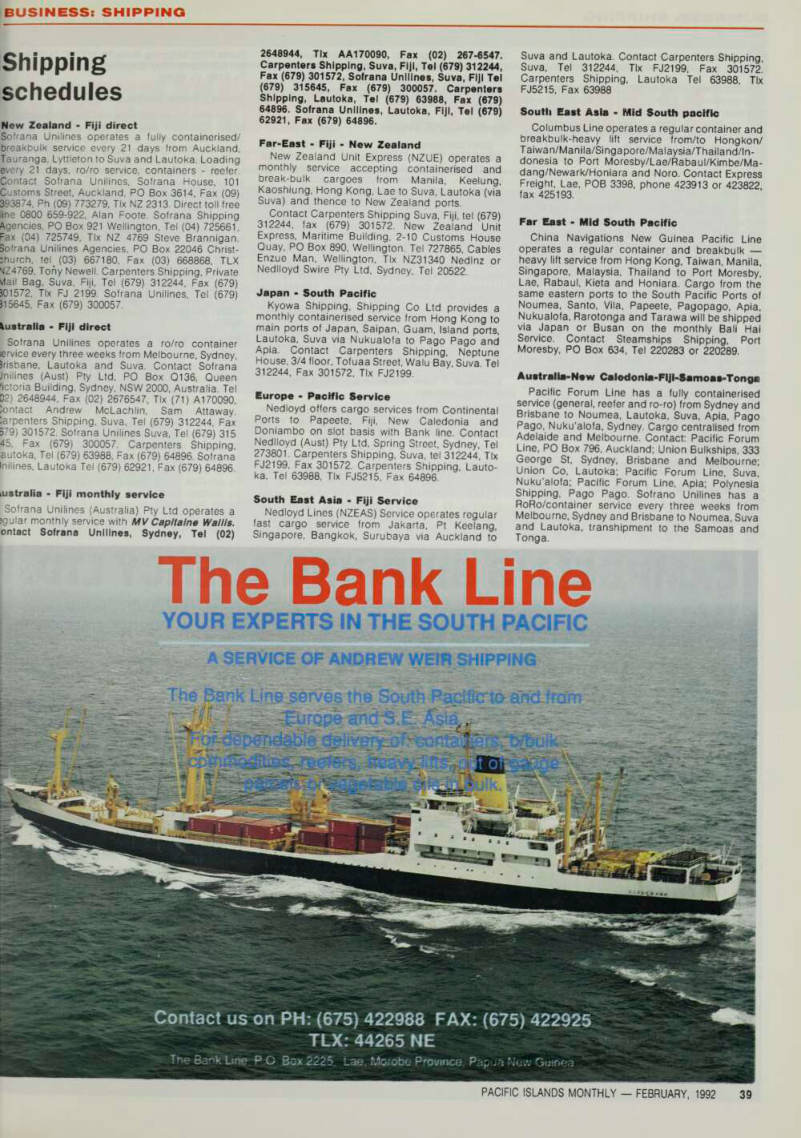
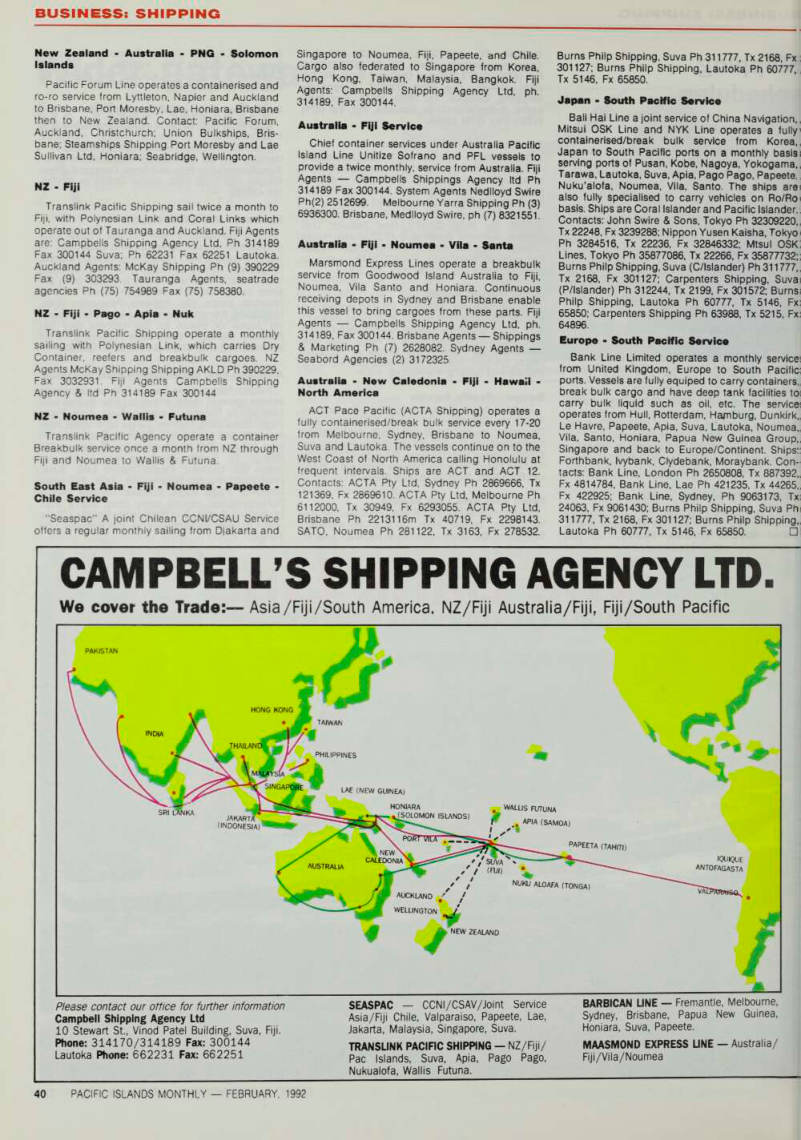
schedules
New Zealand - Fiji direct Sofrana Unilines operates a fully containerised/ breakbulk service every 21 days from Auckland.
Tauranga, Lyttleton to Suva and Lautoka. Loading every 21 days, ro/ro service, containers - reefer.
Contact Sofrana Unilines, Sofrana House. 101 Customs Street, Auckland. PO Box 3614, Fax (09) 393874, Ph (09) 773279. Tlx NZ 2313. Direct toll free line 0800 659-922, Alan Foote. Sofrana Shipping Agencies. PO Box 921 Wellington, Tel (04) 725661.
Fax (04) 725749. Tlx NZ 4769 Steve Brannigan.
Sofrana Unilines Agencies, PO Box 22046 Christ :hurch, (03) 667180, Fax (03) 668868, TLX MZ4769, Tony Newell. Carpenters Shipping, Private Vlail Bag, Suva, Fiji. Tel (679) 312244, Fax (679) )01572, Tlx FJ 2199. Sofrana Unilines. Tel (679) J 15645. Fax (679) 300057. lustralia • Fiji direct Sofrana Unilines operates a ro/ro container iervice every three weeks from Melbourne, Sydney, kisbane, Lautoka and Suva. Contact Sofrana jnilines (Aust) Pty Ltd, PO Box Q 136, Queen Victoria Building. Sydney. NSW 2000, Australia. Tel 02) 2648944, Fax (02) 2676547, Tlx (71) A 170090.
Contact Andrew McLachlin, Sam Attaway.
Carpenters Shipping. Suva, Tel (679) 312244, Fax 579) 301572. Sofrana Unilines Suva, Tel (679) 315 45, Fax (679) 300057. Carpenters Shipping, autoka, Tel (679) 63988, Fax (679) 64896. Sofrana Inilines, Lautoka Tel (679) 62921, Fax (679) 64896.
Australia - Fiji monthly service Sofrana Unilines (Australia) Pty Ltd operates a ;gular monthly service with MV Capita Ine Wallis. ontact Sofrana Unlllnes, Sydney, Tel (02)
2648944, Tlx A A 170090, Fax (02) 267-6547.
Carpenters Shipping, Suva, Fiji, Tel (679) 312244, Fax (679) 301572, Sofrana Unlllnes, Suva, FIJI Tel (679) 315645, Fax (679) 300057. Carpenters Shipping, Lautoka, Tel (679) 63988, Fax (679) 64896. Sofrana Unlllnes, Lautoka, Fiji, Tel (679) 62921, Fax (679) 64896.
Far-East - Fiji - New Zealand New Zealand Unit Express (NZUE) operates a monthly service accepting containerised and break-bulk cargoes from Manila, Keelung, Kaoshiung, Hong Kong, Lae to Suva, Lautoka (via Suva) and thence to New Zealand ports.
Contact Carpenters Shipping Suva, Fiji, tel (679) 312244, fax (679) 301572. New Zealand Unit Express, Maritime Building, 2-10 Customs House Quay. PO Box 890, Wellington. Tel 727865. Cables Enzue Man. Wellington. Tlx NZ31340 Nedlnz or Nedlloyd Swire Pty Ltd. Sydney. Tel 20522.
Japan - South Pacific Kyowa Shipping. Shipping Co Ltd provides a monthly containerised service from Hong Kong to main ports of Japan, Saipan, Guam, Island ports, Lautoka. Suva via Nukualofa to Pago Pago and Apia. Contact Carpenters Shipping, Neptune House, 3/4 floor. Tofuaa Street, Walu Bay, Suva Tel 312244, Fax 301572. Tlx FJ2199.
Europe - Pacific Service Nedloyd offers cargo services from Continental Ports to Papeete, Fiji, New Caledonia and Doniambo on slot basis with Bank line. Contact Nedlloyd (Aust) Pty Ltd. Spring Street, Sydney. Tel 273801. Carpenters Shipping, Suva, tel 312244, Tlx FJ2199, Fax 301572. Carpenters Shipping, Lauto ka. Tel 63988, Tlx FJ5215. Fax 64896.
South East Asia - Fiji Service Nedloyd Lines (NZEAS) Service operates regular fast cargo service from Jakarta. Pt Keelang, Singapore, Bangkok, Surubaya via Auckland to
Suva and Lautoka. Contact Carpenters Shipping, Suva. Tel 312244, Tlx FJ2199. Fax 301572.
Carpenters Shipping. Lautoka Tel 63988, Tlx FJ5215, Fax 63988 South East Asia - Mid South pacific Columbus Line operates a regular container and breakbulk-heavy lift service from/to Hongkon/
Taiwan/Manila/Singapore/Malaysia/Thailand/ln
donesia to Port Moresby/Lae/Rabaul/Kimbe/Ma dang/Newark/Honiara and Noro. Contact Express Freight, Lae, FOB 3398, phone 423913 or 423822 fax 425193.
Far East - Mid South Pacific China Navigations New Guinea Pacific Line operates a regular container and breakbulk heavy lift service from Hong Kong. Taiwan, Manila.
Singapore. Malaysia, Thailand to Port Moresby.
Lae. Rabaul. Kieta and Honiara. Cargo from the same eastern ports to the South Pacific Ports of Noumea. Santo, Vila, Papeete, Pagopago, Apia.
Nukualofa. Rarotonga and Tarawa will be shipped via Japan or Busan on the monthly Bali Hai Service. Contact Steamships Shipping. Port Moresby. PO Box 634, Tel 220283 or 220289.
Australia-New Calodonia-Fiji-Samoas-Tonga
Pacific Forum Line has a fully containerised service (general, reefer and ro-ro) from Sydney and Brisbane to Noumea. Lautoka, Suva. Apia. Pago Pago, Nukualofa. Sydney. Cargo centralised from Adelaide and Melbourne. Contact: Pacific Forum Line, PO Box 796, Auckland: Union Bulkships, 333 George St, Sydney, Brisbane and Melbourne: Union Co, Lautoka: Pacific Forum Line, Suva.
Nukualofa: Pacific Forum Line, Apia; Polynesia Shipping, Pago Pago. Sofrano Unilines has a Roßo/container service every three weeks from Melbourne. Sydney and Brisbane to Noumea. Suva and Lautoka. transhipment to the Samoas and Tonga.
New Zealand • Australia ■ PNG - Solomon Islands Pacific Forum Line operates a containerised and ro-ro service from Lyttleton, Napier and Auckland to Brisbane, Port Moresby, Lae, Honiara, Brisbane then to New Zealand. Contact: Pacific Forum.
Auckland, Christchurch; Union Bulkships, Bris bane: Steamships Shipping Port Moresby and Lae Sullivan Ltd, Honiara; Seabridge, Wellington.
NZ - Fiji Translink Pacific Shipping sail twice a month to Fiji, with Polynesian Link and Coral Links which operate out of Tauranga and Auckland. Fiji Agents are; Campbells Shipping Agency Ltd. Ph 314189 Fax 300144 Suva: Ph 62231 Fax 62251 Lautoka.
Auckland Agents: McKay Shipping Ph (9) 390229 Fax (9) 303293. Tauranga Agents, seatrade agencies Ph (75) 754989 Fax (75) 758380.
NZ - Fiji - Pago - Apia - Nuk Translink Pacific Shipping operate a monthly sailing with Polynesian Link, which carries Dry Container, reefers and breakbulk cargoes. NZ Agents McKay Shipping Shipping AKLD Ph 390229, Fax 3032931. Fiji Agents Campbells Shipping Agency & ltd Ph 314189 Fax 300144 NZ - Noumea • Wallis - Futuna Translink Pacific Agency operate a container Breakbulk service once a month from NZ through Fiji and Noumea to Wallis & Futuna.
South East Asia - Fiji - Noumea - Papeete - Chile Service "Seaspac" A joint Chilean CCNI/CSAU Service offers a regular monthly sailing from Djakarta and
Singapore to Noumea. Fiji, Papeete, and Chile.
Cargo also federated to Singapore from Korea, Hong Kong. Taiwan, Malaysia, Bangkok. Fiji Agents: Campbells Shipping Agency Ltd. ph. 314189. Fax 300144.
Australia • Fiji Service Chief container services under Australia Pacific Island Line Unitize Sofrano and PFL vessels to provide a twice monthly, service from Australia. Fiji Agents Campbells Shippings Agency ltd Ph 314189 Fax 300144. System Agents Nedlloyd Swire Ph(2) 2512699. Melbourne Yarra Shipping Ph (3) 6936300. Brisbane, Medlloyd Swire, ph (7) 8321551.
Australia - Fiji • Noumea • Vila • Santa Marsmond Express Lines operate a breakbulk service from Goodwood Island Australia to Fiji.
Noumea, Vila Santo and Honiara. Continuous receiving depots in Sydney and Brisbane enable this vessel to bring cargoes from these parts. Fiji Agents Campbells Shipping Agency Ltd, ph. 314189. Fax 300144. Brisbane Agents Shippings & Marketing Ph (7) 2628082. Sydney Agents Seabord Agencies (2) 3172325 Australia - New Caledonia • Fiji • Hawaii • North America ACT Pace Pacific (ACTA Shipping) operates a fully containerised/break bulk service every 17-20 from Melbourne. Sydney. Brisbane to Noumea.
Suva and Lautoka. The vessels continue on to the West Coast of North America calling Honolulu at frequent intervals. Ships are ACT and ACT 12.
Contacts: ACTA Pty Ltd, Sydney Ph 2869666, Tx 121369, Fx 2869610. ACTA Pty Ltd. Melbourne Ph 6112000, Tx 30949, Fx 6293055. ACTA Pty Ltd, Brisbane Ph 2213116 m Tx 40719. Fx 2298143.
SATO. Noumea Ph 281122, Tx 3163, Fx 278532.
Burns Philp Shipping, Suva Ph 311777, Tx 2168. Fx 301127; Burns Philp Shipping. Lautoka Ph 60777.
Tx 5146. Fx 65850.
Japan - South Pacific Service Bali Hai Line a joint service of China Navigation.
Mitsui OSK Line and NYK Line operates a fully containerised/break bulk service from Korea.
Japan to South Pacific ports on a monthly basis serving ports of Pusan, Kobe, Nagoya, Yokogama, Tarawa, Lautoka, Suva, Apia, Pago Pago. Papeete, Nukualofa, Noumea, Vila. Santo. The ships are also fully specialised to carry vehicles on Ro/Ro basis. Ships are Coral Islander and Pacific Islander.
Contacts: John Swire & Sons, Tokyo Ph 32309220, Tx 22248, Fx 3239288: Nippon Yusen Kaisha, Tokyo Ph 3284516, Tx 22236, Fx 32846332; Mtsul OSK Lines. Tokyo Ph 35877086, Tx 22266. Fx 35877732; Burns Philp Shipping, Suva (C/Islander) Ph 311777.
Tx 2168, Fx 301127; Carpenters Shipping. Suva (P/lslander) Ph 312244, Tx 2199, Fx 301572; Burns; Philp Shipping. Lautoka Ph 60777, Tx 5146, Fx: 65850; Carpenters Shipping Ph 63988, Tx 5215. Fx: 64896.
Europe - South Pacific Service Bank Line Limited operates a monthly service; from United Kingdom, Europe to South Pacific; ports. Vessels are fully equiped to carry containers, break bulk cargo and have deep tank facilities to carry bulk liquid such as oil, etc. The service; operates from Hull. Rotterdam. Hamburg, Dunkirk, Le Havre, Papeete, Apia. Suva. Lautoka, Noumea.
Vila. Santo, Honiara, Papua New Guinea Group, Singapore and back to Europe/Continent. Ships: Forthbank, Ivybank, Clydebank, Moraybank. Con tacts: Bank Line. London Ph 2650808, Tx 887392.
Fx 4814784. Bank Line, Lae Ph 421235. Tx 44265.
Fx 422925: Bank Line. Sydney. Ph 9063173, Tx 24063, Fx 9061430: Burns Philp Shipping. Suva Ph 311777, Tx 2168, Fx 301127; Burns Philp Shipping.
Lautoka Ph 60777, Tx 5146, Fx 65850. □
Advertisements & other items, pp. 39-42 (1 item)
The Bank Line
YOUR EXPERTS IN THE SOUTH PACIFIC
A SERVICE OF ANDREW WEIR SHIPPING
The Bank Line serves the South Racificrto and from e mm m j If ■*- A Contact us on PH: (675) 422988 FAX: (675) 422925
TLX; 44265 NE
TheßahkUne P C Box £225, Lae, tJionobv Province Pap ua New Guinea
CAMPBELL’S SHIPPING AGENCY LTD.
We cover the Trade:— Asia/Fiji/South America. NZ/Fiji Australia/Fiji, Fiji/South Pacific
PAK IS AN
HONG KONG
x r
TAIWAN
I ** *
THAI LAN
PHILIPPINES
S
LAE (NEW GUINEA)
HONIARA
• (SOLOMON ISLANDS)
WALUS FUTUNA
SRI LANKA
I ' \
PAPEETA (TAHITI)
NEW '
CALEDONIA
IOUK?UE
IA / / ' — w *' / (njl) V
/ NUKU ALOAFA (TONGA)
AUCKLAND f !
AUSTRALIA
WELUNGTON
b NEW ZEALAND
Please contact our office for further information Campbell Shipping Agency Ltd 10 Stewart St., Vinod Patel Building, Suva, Fiji.
Phone: 314170/314189 Fax: 300144 Lautoka Phone: 662231 Fax: 662251 SEASPAC CCNI/CSAV/Joint Service Asia/Fiji Chile, Valparaiso, Papeete, Lae, Jakarta, Malaysia, Singapore, Suva.
TRANSLINK PACIFIC SHIPPING - NZ/Fiji/
Pac Islands, Suva, Apia, Pago Pago, Nukualofa, Wallis Futuna.
BARBICAN UNE Fremantle, Melbourne, Sydney, Brisbane, Papua New Guinea, Honiara, Suva, Papeete.
MAASMOND EXPRESS UNE Australia/
Fiji/Vila/Noumea
KIMHILL KRAMER
Professional Project Managers Consulting Engineers Architects Surveyors
edibility...continuity...
commitment... quality...excellence
arc all terms synonymous with Papua
New Guinea's leading engineering
consultant.
mii imii
fiiPiSiil "SSBSS
in i *
PAPUA NEW GUINEA
Head Office Port Moresby
KINHILL KRAMER PTY LTD.,
Kinhill Kramer Building Cnr Islander Drive & Wards Road
HOHOLA
National Capital District
PO Box 1948, BOROKO,
Papua New Guinea Telephone (675) 256033 Facsimile (675) 211049
Telex CAMAKRA NE 23050
OVERSEAS OFFICES
Solomon Islands
KINHILL KRAMER (SOLOMON ISLANDS) LTD
Australia Head Office Adelaide
KINHILL ENGINEERS PTY. LTD.
Fourth Floor NPF Building Mendana Avenue PO Box 377 Honiara, Solomon Islands Telephone (677) 21996 Facsimile (677) 22190 Vanuatu
KINHILL KRAMER (VANUATU) LTD.,
Ist FLoor, Drugstore Building Kumul Highway P.O. Box 96, Port Vila Vanuatu Telephone (678) 23 457 Facsimile (678) 22455 200 East Terrace, GPO Box 2702, Adelaide South Australia 5001 Telephone (08) 2237011 Facsimile (08) 2320163 Telex AA82364 Fiji
KINHILL KACIMAIWAI PTY LTD
First Floor, 6-12 Andrews Street, Nadi Fiji Islands PO Box 9213 Nadi Airport, Fiji Islands Telephone (679) 780033 Facsimile (679) 780131 A MEMBER OF THE I Nil ILL GROUP OF COMPANIES
a \ Cable and Wireless began keep-
ing people in touch around the
world more than a century ago. Today,
while the technology has changed,
the tradition of service to our customers in the
South Pacific is just the same.
We work in partnership with Governments,
dedicated to meeting the need of communities and businesses to stay in touch. From one island to the next or to the other side of the world, the message is the same: Cable and Wireless is
your South Pacific connection bringing the
islands together.
CABLE & WIRELESS
THE WORLD TELEPHONE COMPANY
Asia Pacific Head Office Cable and Wireless pic Cable and Wireless (Pacific) Limited 22nd Floor Office Tower Convention Plaza 1 Harbour Road Hong Kong Tel: (852) 848 8620 Facsimile: (852) 868 5195 Australia Cable and Wireless (Australia) Pty. Ltd.
Level 66, M.L.C. Centre 19 Martin Place
Sydney
NSW 2000
Tel: (61-2) 2382252 Fiji In association with the Government of Fiji Fiji International Telecommunications Ltd.
RO. Box 59 Mercury House 158 Victoria Parade Suva Fiji Tel: (679) 312933 Solomon Islands In association with the Government of the Solomon Islands Solomon Telekom Company Limited RO. Box 148 Honiara Solomon Islands Tel: (677) 21576 Tonga Cable and Wireless pic Private Mail Bag 4 General Post Office Nuku Alofa Tonga South Pacific Tel: (676) 23499 Vanuatu In association with the Government of Vanuatu and France Cables et Radio Vanuatu International Telecommunications Ltd.
P.O. Box 164 Port Vila Vanuatu Tel: (678) 22185
Space
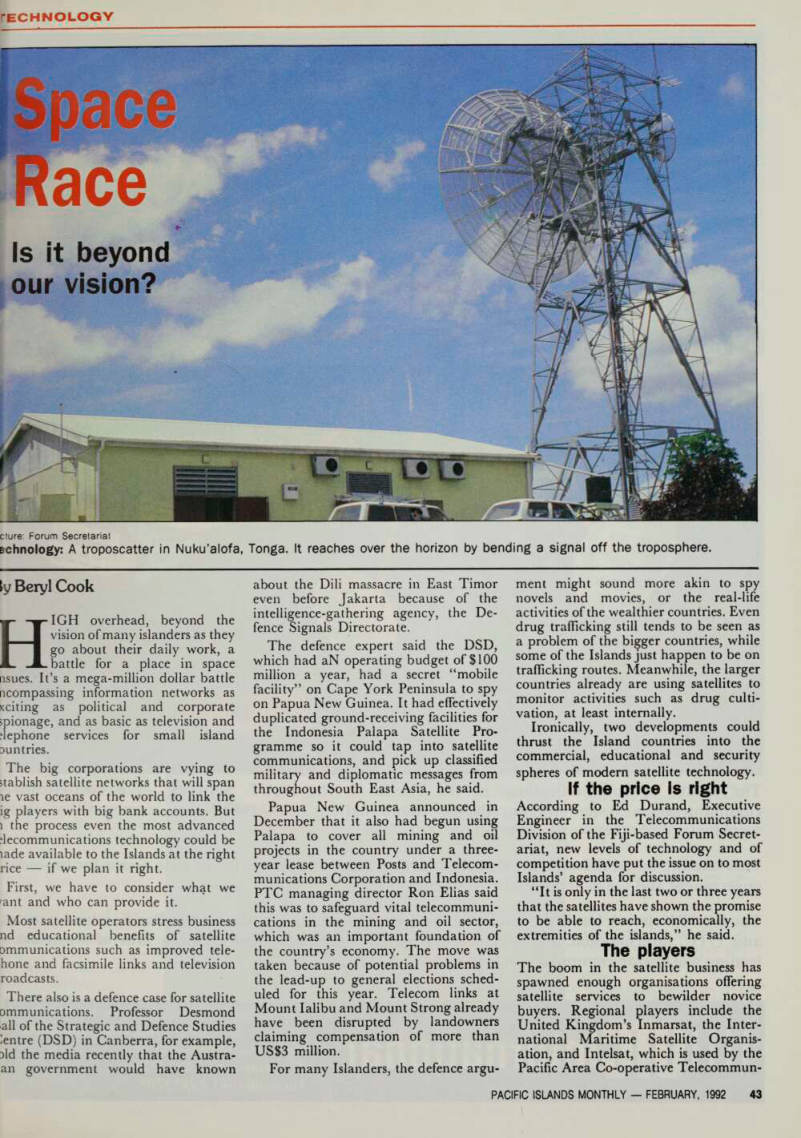
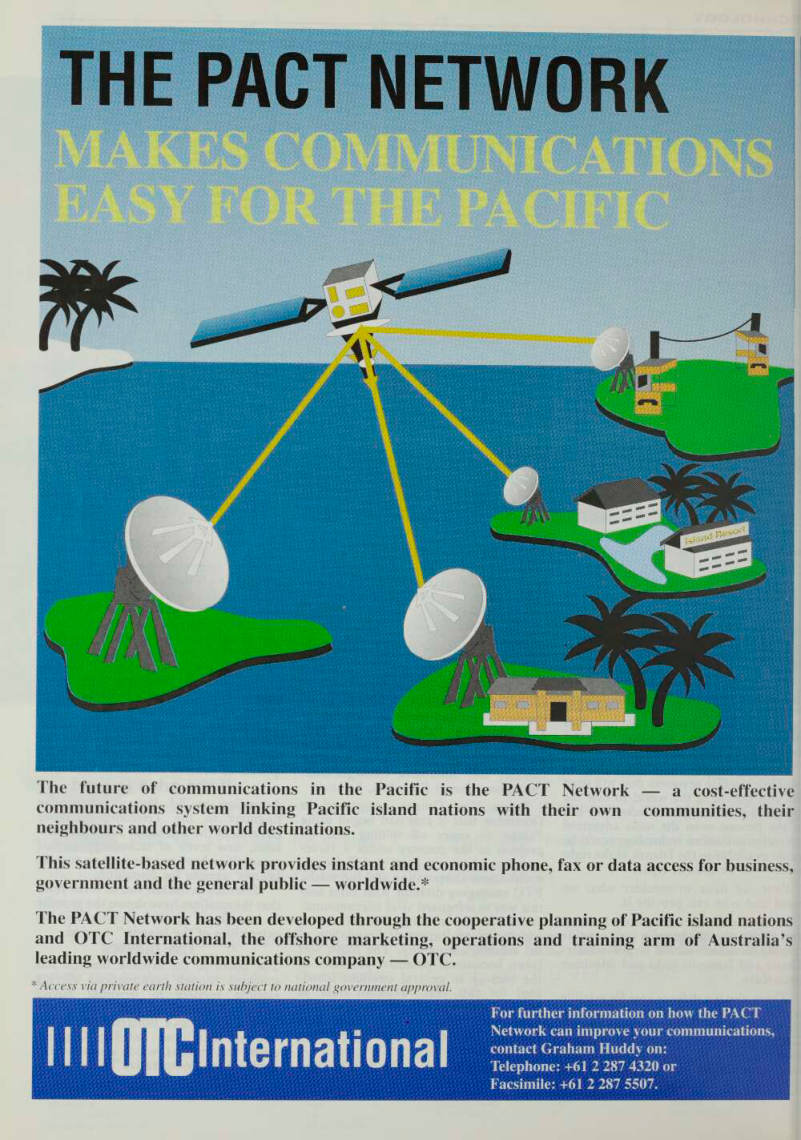
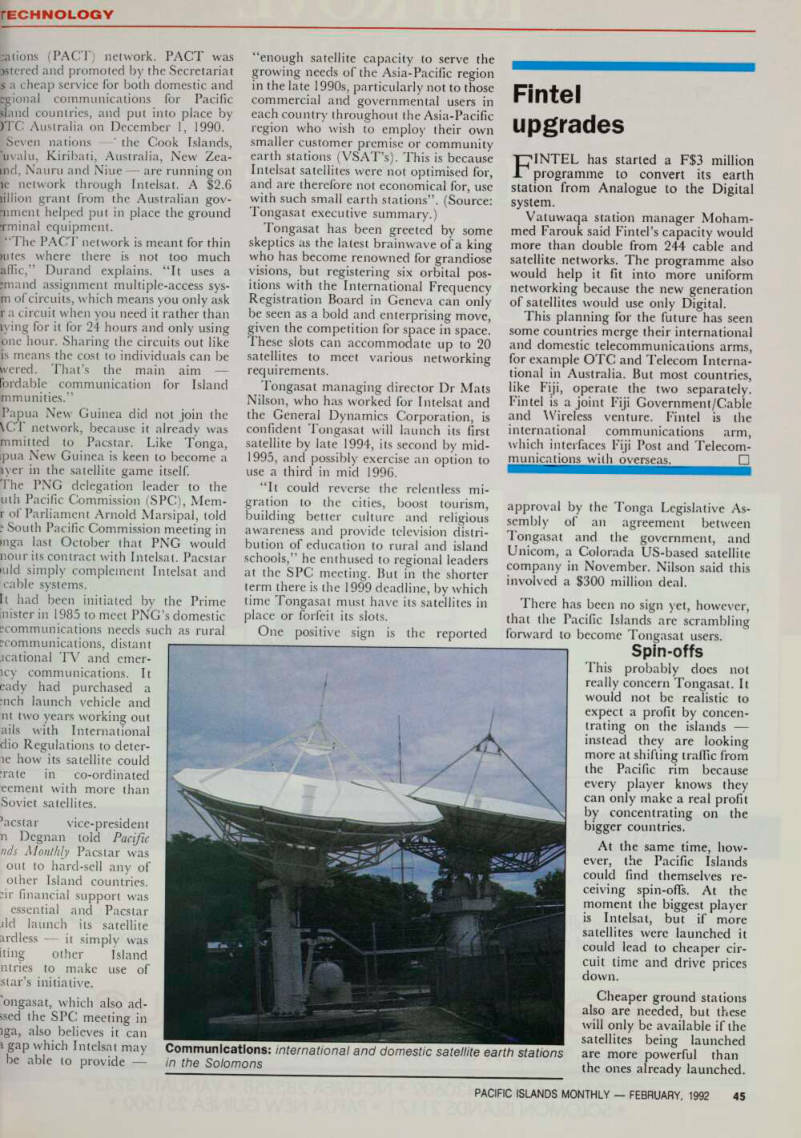
Technology
Race Is it beyond our vision?
By Beryl Cook
HIGH overhead, beyond the vision of many islanders as they go about their daily work, a battle for a place in space nsues. It’s a mega-million dollar battle ncompassing information networks as as political and corporate >pionage, and as basic as television and ‘lephone services for small island Dun tries.
The big corporations are vying to stablish satellite networks that will span ic vast oceans of the world to link the ig players with big bank accounts. But i the process even the most advanced technology could be lade available to the Islands at the right rice if we plan it right.
First, we have to consider what we 'ant and who can provide it.
Most satellite operators stress business nd educational benefits of satellite ommunications such as improved tele hone and facsimile links and television roadcasts.
There also is a defence case for satellite ommunications. Professor Desmond all of the Strategic and Defence Studies Centre (DSD) in Canberra, for example, Did the media recently that the Austra an government would have known
about the Dili massacre in East Timor even before Jakarta because of the intelligence-gathering agency, the De fence Signals Directorate.
The defence expert said the DSD, which had aN operating budget of $lOO million a year, had a secret “mobile facility” on Cape York Peninsula to spy on Papua New Guinea. It had effectively duplicated ground-receiving facilities for the Indonesia Palapa Satellite Pro gramme so it could tap into satellite communications, and pick up classified military and diplomatic messages from throughout South East Asia, he said.
Papua New Guinea announced in December that it also had begun using Palapa to cover all mining and oil projects in the country under a three year lease between Posts and Telecom munications Corporation and Indonesia.
PTC managing director Ron Elias said this was to safeguard vital telecommuni cations in the mining and oil sector, which was an important foundation of the country’s economy. The move was taken because of potential problems in the lead-up to general elections sched uled for this year. Telecom links at Mount lalibu and Mount Strong already have been disrupted by landowners claiming compensation of more than US$3 million.
For many Islanders, the defence argu
ment might sound more akin to spy novels and movies, or the real-life activities of the wealthier countries. Even drug trafficking still tends to be seen as a problem of the bigger countries, while some of the Islands just happen to be on trafficking routes. Meanwhile, the larger countries already are using satellites to monitor activities such as drug culti vation, at least internally.
Ironically, two developments could thrust the Island countries into the commercial, educational and security spheres of modem satellite technology.
If the price Is right
According to Ed Durand, Executive Engineer in the Telecommunications Division of the Fiji-based Forum Secret ariat, new levels of technology and of competition have put the issue on to most Islands’ agenda for discussion.
“It is only in the last two or three years that the satellites have shown the promise to be able to reach, economically, the extremities of the islands,” he said.
The players
The boom in the satellite business has spawned enough organisations offering satellite services to bewilder novice buyers. Regional players include the United Kingdom’s Inmarsat, the Inter national Maritime Satellite Organis ation, and Intelsat, which is used by the Pacific Area Co-operative Telecommun
Picture: Forum Secretarial Technology; A troposcatter in Nukualofa, Tonga. It reaches over the horizon by bending a signal off the troposphere.
cations (PACT) network. PACT was Dstered and promoted by the Secretariat s a cheap service for both domestic and cgional communications for Pacific si and countries, and put into place by )TC Australia on December 1, 1990.
Seven nations —' the Cook Islands, ’uvalu, Kiribati, Australia, New Zea ind, Nauru and Niue are running on ic network through Intelsat. A $2.6 lllion grant from the Australian gov mment helped put in place the ground srminal equipment. [“The PACT network is meant for thin lutes where there is not too much affic,” Durand explains. “It uses a cmand assignment multiple-access sys m of circuits, which means you only ask r a circuit when you need it rather than lying for it for 24 hours and only using one hour. Sharing the circuits out like is means the cost to individuals can be wered. That’s the main aim fordable communication for Island mmunities.”
Papua New Guinea did not join the VCT network, because it already was mmitted to Pacstar. Like Tonga, ipua New Guinea is keen to become a ayer in the satellite game itself.
The PNG delegation leader to the nth Pacific Commission (SPC), Mem r of Parliament Arnold Marsipal, told i South Pacific Commission meeting in inga last October that PNG would nour its contract with Intelsat. Pacstar luld simply complement Intelsat and cable systems.
It had been initiated by the Prime inister in 1985 to meet PNG’s domestic needs such as rural
distant jcational TV and emer icy communications. It eady had purchased a inch launch vehicle and nt two years working out ails with International dio Regulations to deter le how its satellite could ;rate in co-ordinated cement with more than Soviet satellites.
*acstar vice-president
n Degnan told Pacific nds Monthly Pacstar was out to hard-sell any of other Island countries, sir financial support was essential and Pacstar ild launch its satellite
ardless it simply was
iting other Island ntries to make use of star’s initiative.
'ongasat, which also ad »sed the SPC meeting in iga, also believes it can \ gap which Intelsat may be able to provide
“enough satellite capacity to serve the growing needs of the Asia-Pacific region in the late 19905, particularly not to those commercial and governmental users in each country throughout the Asia-Pacific region who wish to employ their own smaller customer premise or community earth stations (VSAT’s). This is because Intelsat satellites were not optimised for, and are therefore not economical for, use with such small earth stations”. (Source: Tongasat executive summary.) Tongasat has been greeted by some skeptics as the latest brainwave of a king who has become renowned for grandiose visions, but registering six orbital pos itions with the International Frequency Registration Board in Geneva can only be seen as a bold and enterprising move, given the competition for space in space.
These slots can accommodate up to 20 satellites to meet various networking requirements.
Tongasat managing director Dr Mats Nilson, who has worked for Intelsat and the General Dynamics Corporation, is confident Tongasat will launch its first satellite by late 1994, its second by mid -1995, and possibly exercise an option to use a third in mid 1996.
“It could reverse the relentless mi gration to the cities, boost tourism, building better culture and religious awareness and provide television distri bution of education to rural and island schools,” he enthused to regional leaders at the SPC meeting. But in the shorter term there is the 1999 deadline, by which time Tongasat must have its satellites in place or forfeit its slots.
One positive sign is the reported
approval by the Tonga Legislative As sembly of an agreement between Tongasat and the government, and Unicom, a Colorada US-based satellite company in November. Nilson said this involved a $3OO million deal.
There has been no sign yet, however, that the Pacific Islands are scrambling forward to become Tongasat users.
Spin-offs
This probably does not really concern Tongasat. It would not be realistic to expect a profit by concen trating on the islands instead they are looking more at shifting traffic from the Pacific rim because every player knows they can only make a real profit by concentrating on the bigger countries.
At the same time, how ever, the Pacific Islands could find themselves re ceiving spin-offs. At the moment the biggest player is Intelsat, but if more satellites were launched it could lead to cheaper cir cuit time and drive prices down.
Cheaper ground stations also are needed, but these will only be available if the satellites being launched are more powerful than the ones already launched.
Communications: international and domestic satellite earth stations in the Solomons
Advertisements & other items, p. 44 (1 item)
The Pact Network
* V s® i The future of communications in the Pacific is the PACT Network a cost-effective communications system linking Pacific island nations with their own communities, their neighbours and other world destinations.
This satellite-based network provides instant and economic phone, fax or data access for business, government and the general public worldwide.* The PACT Network has been developed through the cooperative planning of Pacific island nations and OTC International, the offshore marketing, operations and training arm of Australia’s leading worldwide communications company OTC. * Access via private earth station is subject to national government approval.
International
For further information on how the PACT Network can improve your communications, contact Graham Huddy on: Telephone: +6l 2 287 4320 or Facsimile: +6l 2 287 5507.
upgrades
Fintel upgrades
F INTEL has started a Fs3 million programme to convert its earth station from Analogue to the Digital system.
Vatuwaqa station manager Moham med Farouk said Fintel’s capacity would more than double from 244 cable and satellite networks. The programme also would help it fit into more uniform networking because the new generation of satellites would use only Digital.
This planning for the future has seen some countries merge their international and domestic telecommunications arms, for example OTC and Telecom Interna tional in Australia. But most countries, like Fiji, operate the two separately.
Fin tel is a joint Fiji Government/Cable and Wireless venture. Fintel is the international communications arm, which interfaces Fiji Post and Telecom munications with overseas. □
Advertisements & other items, p. 46 (1 item)
Gestetner & INliislhim
IVV7 y ij
IMPROVE
IMPROVE
IMPROVE
YOUR
PRODUCTIVITY
CHOOSE FROM THE RANGE OF
GESTETNER & NASHUA
Photocopiers, Loser Printers and Facsimile machines...
AND WATCH YOUR BOTTOM LINE GROW!
REMEMBER!
Gestetner & Nashua office systems are available throughout the South Pacific and are backed up by the most efficient after sales service and support available in the region.
Call us today for an obligation free introduction.
Gestetner & INliislhim
PARTNERS IN YOUR SUCCESS
• FIJI 302195 • TAHITI 430609 • NOUMEA 285258 • VANUATU 3245 • • SOLOMON ISLANDS 21171 • PAPUA NEW GUINEA 251500 •
Solar power
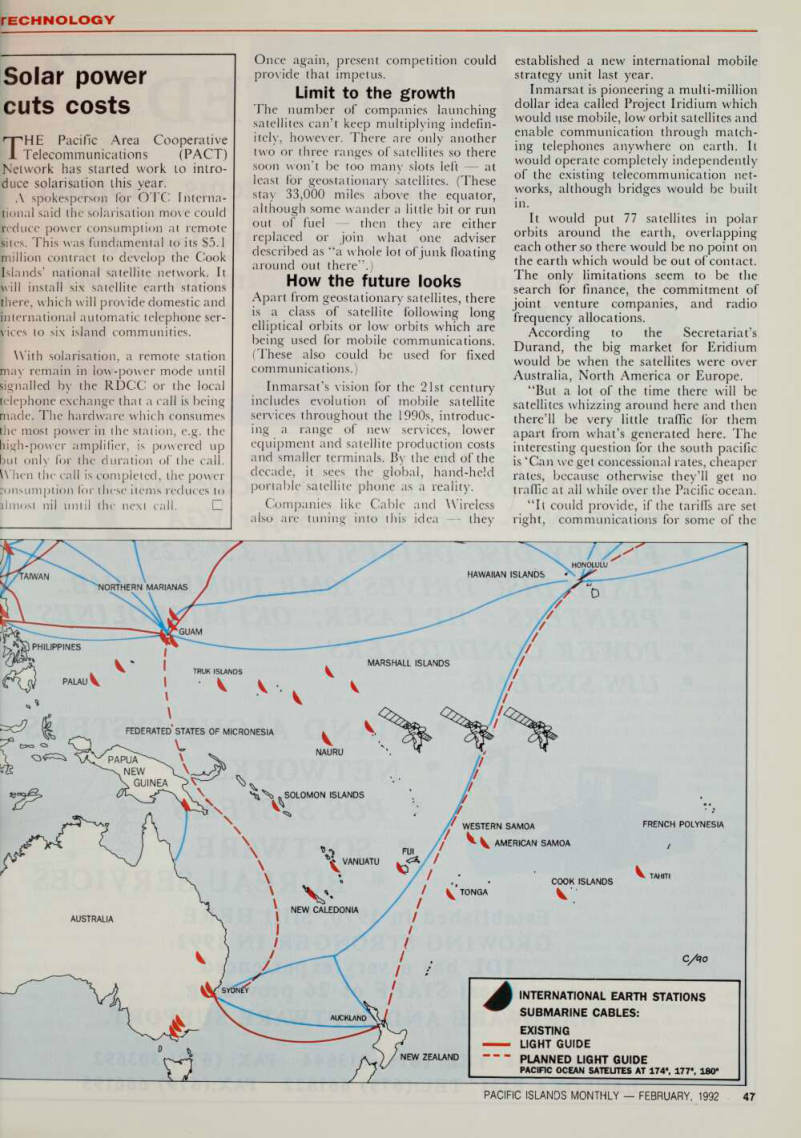

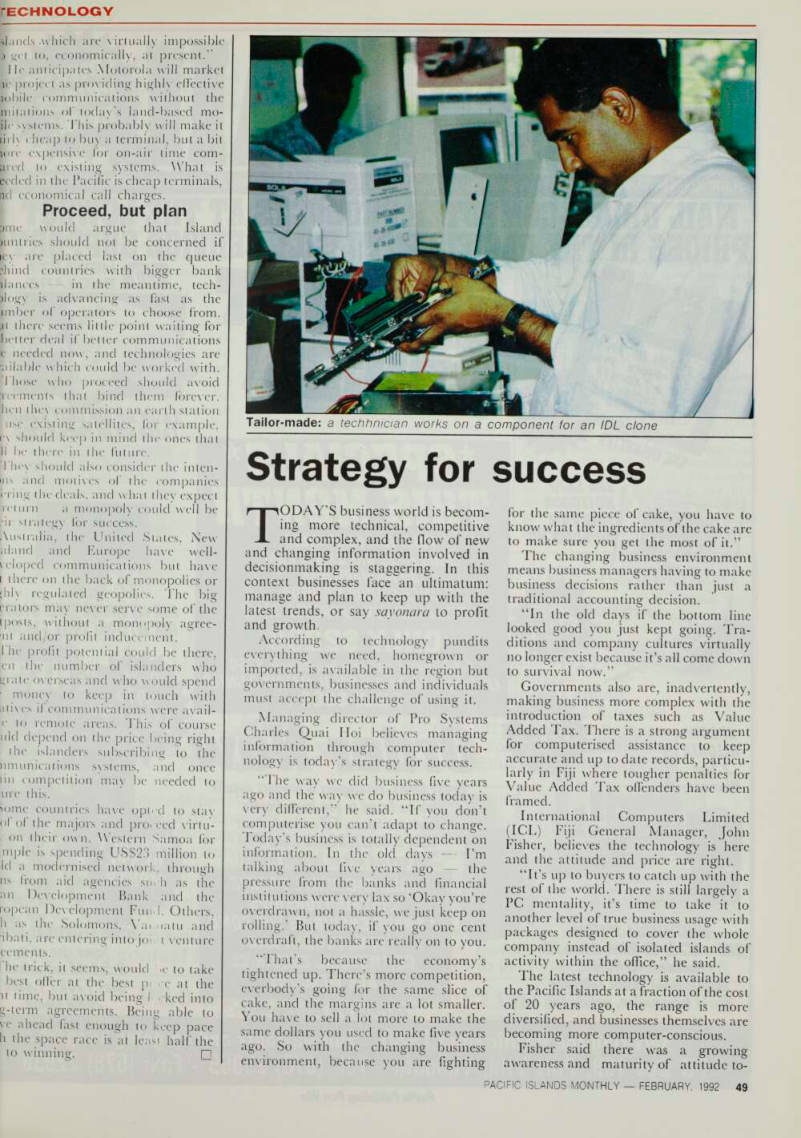
cuts costs
THE Pacific Area Cooperative Telecommunications (PACT) Network has started work to intro duce solarisation this year.
A spokesperson for OTC Interna tional said the solarisation move could reduce power consumption at remote sites. This was fundamental to its s>s.l million contract to develop the Cook Islands’ national satellite network. It will install six satellite earth stations there, which will provide domestic and international automatic telephone ser vices to six island communities.
W ith solarisation, a remote station may remain in low-power mode until signalled by the RDCC or the local telephone exchange that a call is being made. The hardware which consumes the most power in the station, e.g. the high-power amplifier, is powered up but only for the duration of the call.
When the call is completed, the power consumption for these items reduces to almost nil until the next call. □
Once again, present competition could provide that impetus.
Limit to the growth The number of companies launching satellites can’t keep multiplying indefin itely, however. There are only another two or three ranges of satellites so there soon won’t be too many slots left at least for geostationary satellites. (These stay 33,000 miles above the equator, although some wander a little bit or run out of fuel then they are either replaced or join what one adviser described as “a whole lot of junk floating around out there”.) How the future looks Apart from geostationary satellites, there is a class of satellite following long elliptical orbits or low orbits which are being used for mobile communications. (These also could be used for fixed communications.) Inmarsat’s vision for the 21st century includes evolution of mobile satellite services throughout the 19905, introduc ing a range of new services, lower equipment and satellite production costs and smaller terminals. By the end of the decade, it sees the global, hand-held portable satellite phone as a reality.
Companies like Cable and Wireless also are tuning into this idea they
established a new international mobile strategy unit last year.
Inmarsat is pioneering a multi-million dollar idea called Project Iridium which would use mobile, low orbit satellites and enable communication through match ing telephones anywhere on earth. It would operate completely independently of the existing telecommunication net works, although bridges would be built in.
It would put 77 satellites in polar orbits around the earth, overlapping each other so there would be no point on the earth which would be out of contact.
The only limitations seem to be the search for finance, the commitment of joint venture companies, and radio
frequency allocations.
According to the Secretariat’s Durand, the big market for Eridium would be when the satellites were over Australia, North America or Europe.
“But a lot of the time there will be satellites whizzing around here and then there’ll be very little traffic lor them apart from what’s generated here. The interesting question for the south pacific is ‘Can we get concessional rates, cheaper rates, because otherwise they’ll get no traffic at all while over the Pacific ocean.
“It could provide, if the tariffs are set right, communications for some of the
llands -w hich are virtually impossible d get to, economically, at present.” lie anticipates Motorola will market k project as providing highly effective lobile communications without the nutations of today’s land-based mo if systems. This probably will make it irly cheap to bu\ a terminal, but a bit lore expensive for on-air time com a red to existing systems. What is ceded in the Pacific is cheap terminals, bd economical call charges.
Proceed, but plan
Dine would argue that Island Inn tries should not be concerned if ley are placed last on the queue [hind countries with bigger bank dances in the meantime, tech ilogy is advancing as fast as the Imber of operators to choose from. .11 there seems little point waiting for better deal if better communications e needed now , and technologies are piilablc which could be worked with. 1 hose who proceed should avoid reernents that bind them forever, hen they commission an earth station I use existing satellites, lor example, i‘v should keep in mind the ones that II be there in the future.
I hey should also consider the inlcn ms and motives of the companies bring the deals, and what they expect return a monopoly could well be hr strategy for success.
Australia, the United Stales, New aland and Europe have w'dl ieloped communications but have l there on the back of monopolies or fhly regulated geopolies. The big praters may never serve some of the t posts, without a monopoly agree nt and/or profit inducement.
I he profit potential could be there, cn the number of islanders who grate overseas and w ho would spend money to keep in touch with mix es if communications xvere avail e to remote areas. This of course uld depend on the price being right the islanders subscribing to the n inimical ions systems, and once tin competition may be needed to lure this, iome countries have opt. cl to stay of of the majors and proceed virtu on their own. Western Samoa for mple is spending USS 23 million to Id a modernised network, through ns from aid agencies such as the an Dcxclopment Bank and the
ropean Development Fund. Others,
h as the Solomons, Vanuatu and ■ibati. are entering into job i venture cements. he trick, it seems, would be to take best offer at the best pi cc at the it time, but avoid being I ked into g-term agreements. Being able to xc ahead fast enough to keep pace li the space race is at least half the to winning. □
Advertisements & other items, p. 48 (1 item)
Idl Limited
Fiji's Leading Computer Systems Supplier
IDL Micro computers are fully Industry
compatible and feature a minimum of IMB
RAM EXPANDABLE to 16MB
AT SYSTEMS 286, 386, 486
LAPTOPS IB
NOTEPADS "=
MEMORY CHIPS ssmm
KEYBOARDS ENHANCED, + Calculator SCREENS Monochrome /Super VGA
FLOPPY DISC DRIVES; H/L, 3.5"/5.25'
FIXED DISC DRIVES 10M8..100M8.. 700M8..
PRINTERS HP LASER, OKI MICROLINES
POWER CONDITONERS
UPS SYSTEMS
* STAND ALONE SYSTEMS
* NETWORKS
POS SYSTEMS
SOFTWARE
* BUREAU SERVICES
Established in 1970. Still HERE
GROWING STRONGER IN 1992.
IDL has a very experienced Local STAFF of 26 providing
HARDWARE AND SOFTWARE SUPPORT.
SUVA FIJI TEL: (679) 313844 FAX: (679) 303692
LAUTOKA FIJI TEL:(679) 661822 FAX:(679) 666195
Strategy for success

TODAY’S business world is becom ing more technical, competitive and complex, and the flow of new and changing information involved in decisionmaking is staggering. In this context businesses face "an ultimatum: manage and plan to keep up with the latest trends, or say sayonara to profit and growth.
According to technology pundits everything we need, homegrown or imported, is available in the region but governments, businesses and individuals must accept the challenge of using it.
Managing director of Pro Systems Charles Qiiai Hoi believes managing information through computer tech nology is today’s strategy for success.
“The way we did business five years ago and the way we do business today is very different,” he said. “If you don’t computerise you can’t adapt to change.
Today’s business is totally dependent on information. In the old days I’m talking about five years ago the pressure from the banks and financial institutions were very lax so ‘Okay you’re overdrawn, not a hassle, we just keep on rolling. But today, if you go one cent overdraft, the banks are really on to you.
“That's because the economy’s tightened up. There’s more competition, everbody’s going for the same slice of cake, and the margins are a lot smaller.
You have to sell a lot more to make the same dollars you used to make five years ago. So with the changing business environment, because you are fighting
for the same piece of cake, you have to know what the ingredients of the cake arc to make sure you get the most of it.”
The changing business environment means business managers having to make business decisions rather than just a traditional accounting decision.
“In the old days if the bottom line looked good you just kept going. Tra ditions and company cultures virtually no longer exist because it’s all come down to survival now.”
Governments also are, inadvertently, making business more complex with the introduction of taxes such as Value Added Tax. There is a strong argument for computerised assistance to keep accurate and up to date records, particu larly in Fiji where tougher penalties for Value Added Tax offenders have been framed.
International Computers Limited (ICL) Fiji General Manager, John Fisher, believes the technology is here and the attitude and price are right.
“It’s up to buyers to catch up with the rest of the world. There is still largely a PC mentality, it’s time to lake it to another level of true business usage with packages designed to cover the whole company instead of isolated islands of activity within the office,” he said.
The latest technology is available to the Pacific Islands at a fraction of the cost of 20 years ago, the range is more diversified, and businesses themselves are becoming more computer-conscious.
Fisher said there was a growing awareness and maturity of attitude to
Tailor-made: a techhnician works on a component for an IDL clone
■vard computers and what they could do.
“There is an enthusiasm there instead >f just the old mystery. It’s a nice combination now: affordable solutions md people who want to use them.”
Prices also have gone down a lot. In ibout 1974 a small electro-mechanical nachine would cost about $50,000 to 180,000 dollars. Now the average per onal computer is far more powerful and css expensive.
“And for the sake of adding a couple f extra terminals you can start adding total business solution to a company for tenth of that price,” Fisher said.
He believes attitudes are slowly chang !g- “Small business sectors are looking tore toward computerisation to help lem run their businesses, and we’re spending to that with smaller but more owerful computers with application Iftware, with business solutions on lere. Whereas it might have been a sale r a computer to a company which then t about developing its own software, »day we’re focused on providing a total usiness solution which includes the ;btors ledger, creditors ledger, training ?ople and providing an ongoing assist ice to the users.”
Managers also are changing their
attitude toward users.
“They’re more aware of what commputers can do for them. We used to use a backroom computer which a few people used to work and produce historic reports about whether you made a profit or not, but now we are putting terminals out on desks and they’re being used by people in the day-to-day running of the business, helping to make business de cisions based on the information at your
fingertips.”
Fisher said there was not much technology that wasn’t available to Fiji and to a lesser extent the other islands.
“In general terms we’re providing technology which is as new as anywhere else in the world. The actual use of it still has a lot of catching up to do we’re about five or 10 years behind in that, but the opportunity is there.”
The market is fast catching up.
“The industry is much more market driven now because people know the things they need to succeed. That makes the market more price conscious and competitive, and that’s good.
“On top of that there is a great awareness of computers and a desire to learn which shows Fiji is desperately trying to be part of the world, and it is succeeding.” □
Advertisements & other items, pp. 50-51 (1 item)
Discount
a acme B M m
Computer
ea
CJystems
soFTWifIF - (o mmm - mum sums - iwi Nimm - m urns ■ books . cum on sue insjamion sma . ummi & sowim mom mo mm
MAILI
PRICES
■COMPUTER PRODUCTS AT THE LOWEST
THE PACIFIC WITH FULL SERVICE SUPPORT
DISCOUNT
I
PRICES;
$25 m $l5 n° k \ 3.5 $lB Mb 3-5 sl° 15 3601'* 10 25 Box Per
HEWLETT
PACKARD
386 SX2O
n 1 NOTEBO
2MB RAM
0/60MB HD
Jv
* SPECIALS*
THIS MONTH
LASER HP lIIPONS24OO
LASER HP 111 ONLY $3700
FULLY IBM COMPATIBLE
386SX-25 with 2MB of RAM
80 MG HARD DISK
SVGA COLOUR MONITOR
AUSTRALIAN GOV. APPROVED SPECS
ONLY $2200
INK JET HPSOO ONLY $lOOO
INK JET SOOC ONLY $lB5O
ARROW
ALLDATA
2 Year Warranty * Additional software bundle only $250 EPSON 10550 24 PIN 80C0L MATRIX PRINTER
ONLY $BOO
Order Now
Order forms, catalogues 8 product details can be faxed to you immediately Payment terms: TIT or bank draft
VISA & MASTERCARD (Add 4%)
*AII quoted prices include freight
MULTIMEDIA SYSTEM
386 - SX2S, CD ROM, SOmbHD
Includes: CD ROMS: encyclopedia, music software World Information, games etc
*ALL EXCLUSIVE PACIFIC
DISTRIBUTORSHIPS
* TRADE ENQUIRIES WELCOME
,ji ?
* GOVERNMENT AND
COMMERCIAL ENQUIRIES
ARE WELCOME
* All Pricing is m Australian Dollars
20MB FLOPTICAL Dm
Same size as a 3,5 1,45 mb drive!
Uses 720 k/ I,4Mb 20Mb media * Servicing the Pacific since 1980 * Full warranty and on going support PO Box 198, Port Vila, Vanuatu - Tel: (678) 25065 - Fax: (678) 22938 Pacific Publishing Port Vila
TOTAL COMPUTER SOLUTIONS!!
Including: - Laptop & Notebook Computers - Personal Computers - Mini Computers & Mainframe - Networks & Multiuser Systems - Terminals & Printers - Communications & Cabling - Computer Stationary & Supplies - MS-DOS PC Application Software - UNIX 4GL Software Solutions - Training , Education & Support Meed a new computer solution??
Meed computer software solutions?? /ou've run out of computer supplies??
Having problems with your computer??
Meed computer training, education & support?? four computer is not providing the solution you expected or was promised?? iiiiiiiiiiiiiiiiiiiiiiiiiiiiii iiiiiiiiiiiiiiiiiiiiiiiiiiiiii
Whatever your computer requirements
* re contact the experts now!!
If you can't find a ready made software solution to match your needs then we will develop one to your specific requirements!!
PRO SYSTEMS (PACIFIC) LIMITED
81 MOALA ST., SAMABULA, SUVA, FIJI
G.P.O. BOX 1075, SUVA, FUI.
PHONE: (679) 381-644 FAX: (679) 370-461
photocopiers
Bright note for colour photocopiers
FIJI’S government has indicated it wwill lift its ban on importing full colour photocopiers in the middle of the year, when new currency notes will be introduced.
In the past the quality reproduction of full-colour photocopiers generated concern over counterfeiting of cur rency. However, the new notes will include security features such as a windowed silver thread weaving through the front left-hand side of the note, and a metallic, fluorescent, ink pattern band at the top and bottom of the left-hand side of the $2O note.
Photocopier suppliers are optimistic
about the market for colour photocopiers once the ban is lifted.
The price could be as little as $lO,OOO to $15,000, compared to $25,000 for bigger black-and-white photocopiers.
Cost per copy is about 10 times the cost of a black and white copy. The market would be bigger companies but they could also end up in shopping centres for personalised printing such as photos, calendars or enlarging slides.□
Clones: cheap, but are they nasty?
TALK to computer retailers and they’ll offer two sides to the price/ quality coin.
Ask DATEC’s senior sales representa tive in Fiji, David Anstice, why IBM is “the big apple in the world computer market and he answers: “a standard operating system, lots and lots and lots of software, and it’s readily available. It can also get serviced anywhere in the world.”
I CL, which recently sold 80 per cent of its shares to Fujitsu to become the second largest computer company in the world, touts the same message.
Ihe big guys also like to caution buyers about the risks of buying anything but industry standard software there arc about 2000 viruses which can get into your computer through pirated software and erode everything from files to the hard-disc, making the original cost saving short-lived.
But there are those who believe a consumer with a broader perspective can get a more individualised system, software and service back-up. The home grown Fiji company, IDE, owmed by Doren Chew and Vijay Madhavan sells IBMs, Olivetti and its own DOS-based, IBM-compatible clones made from com ponents from Singapore, Taiwan, Hong Kong and Korea.
Software manager Sunil Nand believes the only difference w ith the clones is “we don’t have one of the more well-known brand names on it”. But there also are pluses, not the least of which is price.
IDE, for example, says it can offer a standard black and w'hite machine for about 52246, less than half.some of the majors.
On top of that there is no delay with back-up service: “We know every con figuration of our machines and we can be on the spot quickly and solve the problem quickly,” Nand said.
IDE specialises in Novel networks and deals in software including Lotus and
Word Perfect, but they also have six staff members who can rewrite or create software. “It’s not that we want to reinvent the wheel, it’s a matter of getting computers to do exactly what you want,” Nand said.
Pro Systems, a relative newcomer among the region’s computer retailers, also covers the market by selling both clones and brand names. Established less than two years ago by David Cork and Charles Quai Hoi, it looks at total solutions mainly in commercial oper ations.
It uses Dos Unix and Open Systems Strategy, Taiwanese clones and Wyse Technology, and is the exclusive value added resaler for the more upmarket and expensive NCR. Their main emphasis is on software rather than hardware.
Quai Hoi said the clones appeal because of cost, but there naturally is a quality correlation. He also stresses this when talking about personal computer users who travel outside the region and use the “grey market” (in which PCs can virtually be bought off the supermarket shelf in countries such as Australia, Singapore and the United States.) He cautions: “It’s okay for people to go outside and purchase a computer so long as the attitude is ‘Okay, if it lasts me two years I’ll throw it away and no problem’. Because of the price they pay they must look at it as disposable.”
Those who try to service such ma chines also may find it is substandard, and servicing can cost more because of time taken to diagnose the fault and find the right component.
Quai Hoi says businesses in particular are better off looking at buying a computer as investment production.
Larger retailers also suggest buyers look for a system which is expandable, so it can accommodate changes in tech nology, while retailers of cheaper clones argue that a cheaper system could be phased out or replaced. □
computers could
New VAT penalties: computers could be the key
COMPUTERISATION could eat the transition to Value Added Tt for businesses and the governmen according to computer retailers.
And, in the process, it could kic start a high-tech boom in business.
Pro Systems’ Charles Quai HI believes that, without computerisatioc VAT could see the government end u with “1000 shopkeepers all wii scribbled notes and books”.
This kind of operation might won for smaller, family-style businesses “b( for most businesses the result could 1 chaos for the business owners and f] the Government trying to polii VAT,” he said.
Qpai Hoi suggests a governmet subsidy: “There are no incentives fl shopkeepers to computerise that I knee of. There are penalties for late sui mission of records and the onus is on tl shopkeepers. I think the governme:; could provide some sort of subsidy (o computers) to help itself in terms
policing VAT.”
The government’s tougher stance o late or incomplete lodgement of stat) ments (PIM January, 1991) shoui already add weight to the argumei; from the businesses’ point of view.
Quai Hoi said the minimum for shopkeeper would be a standard ele' tronic cash register costing about sBof but a computer and software all would be needed to record purchase and sales, and VAT paid and receiver “You’re looking at S4OOO investmei just to control your business, becaut it’s become essential furniture”.
ICL’s general manager in Fiji, JoH Fisher, predicts a lot of activity at til small end of the market early this yea “because businesses need to get the act together to safely record the infoc mation they need to pass on i government bodies, and to ensure the correctly claim back the VAT the deserve.”
According to IDE’s software man ager, Sunil Nand, computer companii are ready, willing and able to incorpoc ate VAT through established or indt vidualised software.
“But it seems the VAT people hav not emphasised enough how computes could make life so much easier fol shopkeepers. Computers could allow ' shopkeeper to know even to the horn how much he has sold and how muo VAT he has incurred.” tl
Advertisements & other items, p. 52 (1 item)
You Know?
TOO HIGH. This light indicates POWER GUARD is protecting your appliances from a damaging high voltage condition.
TOO LOW. mis light indicates POWER GUARD is protecting your appliance from a damaging low voltage condition.
DELAY MODE. This light indicates delay condition. As power variations often come in multiples, power guards advanced, Patent Pending circuitry prevents rapid On/Off switching.
SAFE. This light indicates POWER GUARD is monitoring and allowing a safe power condition for your appliance.
I
YOU KNOW?
That power surges (sudden increases in the flow of electricity to your home factory, office) are happening every day, slowly destroying your video, television set, computers, office equipment and all Other valuable electrical appliances?
Your electrical appliances require protection against power surges.
YOU WOULD LIKE TO SAVE MONEY
ON REPAIRS WOULDN’T YOU?
START SAVING NOW
Contact:-
Irer UNIVERSAL ELECTRONICS
31 KNOLLY STREET. SUVA PHONE: (679) 312808, 300620, GPO BOX 230 TELEX FJ2641, SUVA FAX 302878
TRADE ENQUIRIES WELCOME.
What the future holds
A KEYCARD and a machine /\ which gives you cash from your [JLbank account any time, any day; lectronic scanning cash registers; a card 4iich allows you to pay for groceries irect from your bank account. They’re [st some of the items tipped for the gion’s future. [And, according to at least one compu ir retailer, there’s a killing for the first usinesses to take on the challenge.
Pro Systems believes keycards and utomatic Teller Machines (ATMs) ill be a winner. “Initially I think it’ll kne in as a gimmick, but whichever ink goes first is going to make a cream it of it. A lot of working people will ove their accounts there to have easy Icess to their cash,” according to einaging director Charles Quai Hoi.
He believes it also could mean big
lings in productivity.
“Government workers, for example, t paid on a Thursday so 30,000 civil rvants queue up at banks trying to get sh, taking an hour and a half, maybe □re than their lunch hour. The card is ing to cost somebody, the technology going to cost somebody, but the pay ' is there in productivity.”
But, he says, most workers are having ough problems keeping money in their counts. ATMs are a great idea, but the ne may not be right.
Nor. he says, is the region ready for ectronic Funds Transfer Point of le (Eftpos), in which an electronic >h register reads a consumer’s card and bits his/her bank account for pur ascs. Enthusiasts like IDL’s Sunil fnd stress the convenience for shoppers d advantages for businesses in infor ition flowing directly from the point of e to the main computer records.
Qjuai Hoi, however, is not convinced it the time is right even for credit cards :ause of the level of responsibility |uired on the part of shoppers. He does
believe, however, that the time is right for cash-register scanning.
“Because of changing trends, business has become very competitive, margins have dwindled away. Now businesses have got into promotions like “sweet eners” selling at a loss to get customers into the shop to balance the books.
Businesses here also have problems with “sweethearting” or pilferage selling cheaper to relatives by keying in a lesser price. With scanning the price is fixed, there’s no discounting, that’s it.”
Qiiai Hoi says scanning allows retailers to “know exactly what they are selling at any point in time, what has been sold in what area. They can work out the right products to have on the shelf, so they don’t sit there. Scanning can help increase sales figures and help you make the right buying decisions, and decisions in negotiation over buying prices.”
ICL already has electronic scanning cash registers operational at the Morris Hedstrom outlet in Tamavua, Suva, Fiji.
ICL’s general manager, John Fisher, admitted the cost, if it was not confiden tial, could seem exorbitant, but he believes a business with sufficient sales could improve its gross margin by a couple of per cent per annum, and cover the cost within a few years.
Laptop and notebook computers: enthusiasm abounds on these. IDL’s Sunil Nand points out that $4OOO to $6OOO can allow businessmen to carry their business with them. Battery packs give users the ability to access and store vital information even in remote areas.
With access to communications net works, modems can send information through phone lines.
According to Pro System’s Qiiai Hoi: “You have to make the right decisions, and have the information to make the right decisions. The investment in a laptop (Fs4ooo up for a clone with a 20-40 megabite hard disc) is minimal
compared to the losses if you make a wrong decision.”
There is general agreement that desktop publishing also is a growth market. IDL’s Nand explains its appeal: “The desktop publisher lets you take a publication like a newsletter to a stage where you give it straight to the printer the Tourism Council of the South Pacific is doing this. Or you can use a colour printer and print it yourself. You have total control.”
DATEC’s senior sales representative in Fiji, David Anstice, said there is a revolution in computer printing, par ticularly with today’s high-quality and decreased-cost laser printers.
Some retailers see growth in the home market in personal computers (PCs).
“The price of computers has come right down,” Anstice said. “Next after your television set and the video deck families will buy a computer.”
The latest IBM PCs are selling at less than $2OOO (hardware and software) in New Zealand, and negotiations are under way to release them here.
Another growth market is going to be in high level graphical presentations where video technology, for example, links into computers so seminar partici pants can be involved in presentations by selecting from visual displays.
Computer networks linking compu
ters within an office, and between offices
using telephones, are a growth market.
The price has come down a five-user network now costs about $15,000.
Total solutions for small busi ness: also are a growth market. These can include the debtors ledger, creditors ledger, training, details on phone mess ages, and records tracking progress with clients. PIM thought for a moment this could mean managers being able to just shut the door, not talk to anyone, and let business carry on around them.
But, as ICL’s Fisher pointed out: “It’s more a case of keeping in touch, and
knowing exactly what’s happening
throughout the business. That’s the idea of computers.” □
paperless’ system
PTL moves to paperless’ system
'HI Posts and Telecommunications Ltd’s (FPTL) new $2.5 million nputer system means a transition “to paperless system”, according to TL’s Manager, Management Infor tion Services, Hans Danford.
Hie system, using an IBM AS 400 >del D 45 with 8.9 gigabites of storage I 48 megabites of memory, will •vide cycle billing for about 48,000 tomers. The first phase was expected be operational by this month. □
Advertisements & other items, p. 53 (1 item)
Design Engineering
* AO Plain Paper Copiers MINOLTA * Plotters & Supplies * Photocopiers * Drafting & Printing Media Facsimile Machines * Drafting Machines * Microfilm equipment * Plan Printers * Binding Machines (Electric & Manual)
Binding Supplies Covers, Strips, Coils, etc.
IONE: (679) 303101
AX: (679) 303097 Shop 2/10, Vishal Arcade, Waimanu Rd, Suva. ta P.0.80X 15965
SUVA. FIJI 1
Micronesia appetiser for US businesses
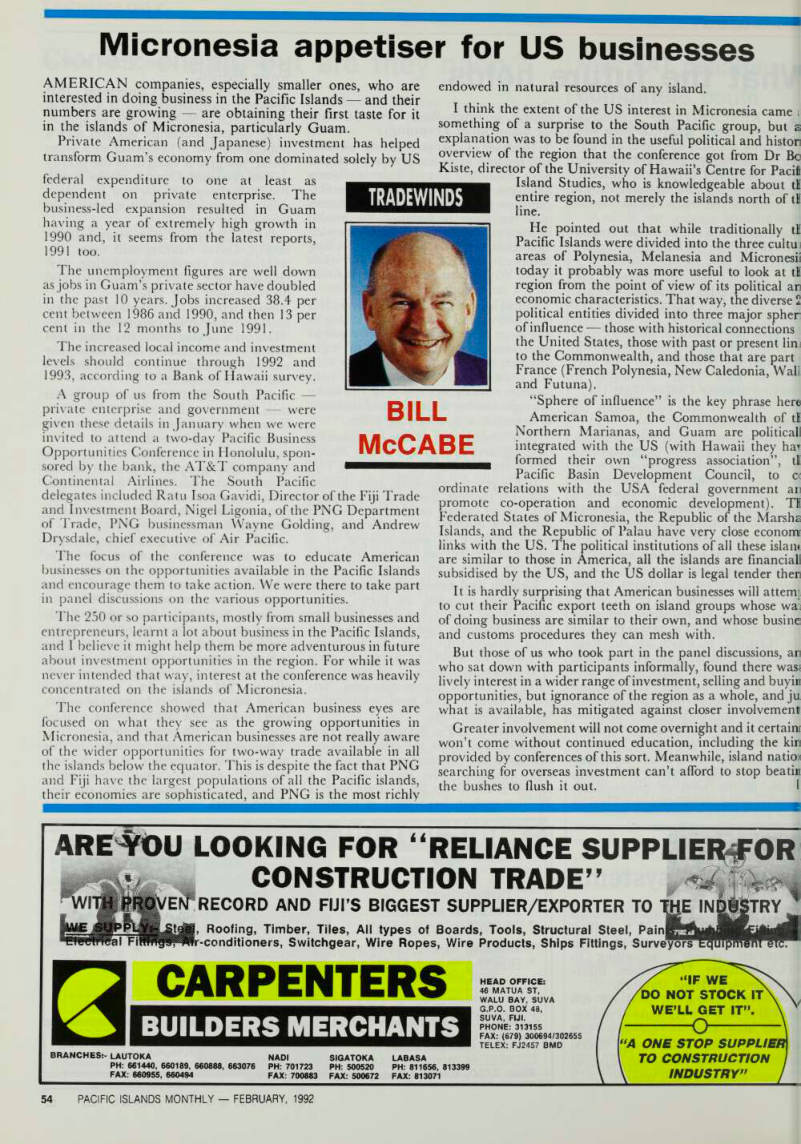
AMERICAN companies, especially smaller ones, who are interested in doing business in the Pacific Islands and their numbers are growing are obtaining their first taste for it in the islands of Micronesia, particularly Guam.
Private American (and Japanese) investment has helped transform Guam’s economy from one dominated solely by US
federal expenditure to one at least as
dependent on private enterprise. The
business-led expansion resulted in Guam having a year of extremely high growth in 1990 and, it seems from the latest reports, 1991 too.
The unemployment figures are well down as jobs in Guam’s private sector have doubled in the past 10 years. Jobs increased 38.4 per cent between 1986 and 1990, and then 13 per cent in the 12 months to June 1991.
The increased local income and investment levels should continue through 1992 and 1993, according to a Bank of Hawaii survey.
A group of us from the South Pacific private enterprise and government were given these details in January when we were invited to attend a two-day Pacific Business Opportunities Conference in Honolulu, spon sored by the bank, the AT&T company and Continental Airlines. The South Pacific
delegates included Ratu Isoa Gavidi, Director of the Fiji Trade and Investment Board, Nigel Ligonia, of the PNG Department of Trade, PNG businessman Wayne Golding, and Andrew Drysdale, chief executive of Air Pacific.
The focus of the conference was to educate American businesses on the opportunities available in the Pacific Islands and encourage them to take action. We were there to take part in panel discussions on the various opportunities.
The 250 or so participants, mostly from small businesses and entrepreneurs, learnt a lot about business in the Pacific Islands, and I believe it might help them be more adventurous in future about investment opportunities in the region. For while it was never intended that way, interest at the conference was heavily concentrated on the islands of Micronesia.
The conference showed that American business eyes are focused on what they see as the growing opportunities in Micronesia, and that American businesses are not really aware of the wider opportunities for two-way trade available in all the islands below the equator. This is despite the fact that PNG and Fiji have the largest populations of all the Pacific islands, their economies are sophisticated, and PNG is the most richly
Tradewinds
endowed in natural resources of any island.
I think the extent of the US interest in Micronesia came ; something of a surprise to the South Pacific group, but a explanation was to be found in the useful political and histon overview of the region that the conference got from Dr Be Kiste, director of the University of Hawaii’s Centre for Pacifl
Island Studies, who is knowledgeable about tH entire region, not merely the islands north of tH line.
He pointed out that while traditionally tH Pacific Islands were divided into the three cultu i areas of Polynesia, Melanesia and Micronesii today it probably was more useful to look at tH region from the point of view of its political an economic characteristics. That way, the diverse 2 political entities divided into three major sphen of influence those with historical connections the United States, those with past or present linj to the Commonwealth, and those that are part France (French Polynesia, New Caledonia, Walli
and Futuna).
“Sphere of influence” is the key phrase here American Samoa, the Commonwealth of tH Northern Marianas, and Guam are politicall integrated with the US (with Hawaii they ha* formed their own “progress association”, tH Pacific Basin Development Council, to cc
ordinate relations with the USA federal government an promote co-operation and economic development). TH Federated States of Micronesia, the Republic of the Marsha Islands, and the Republic of Palau have very close economr links with the US. The political institutions of all these islain are similar to those in America, all the islands are financiall subsidised by the US, and the US dollar is legal tender then It is hardly surprising that American businesses will attemp to cut their Pacific export teeth on island groups whose waj of doing business are similar to their own, and whose busine and customs procedures they can mesh with.
But those of us who took part in the panel discussions, an who sat down with participants informally, found there was? lively interest in a wider range of investment, selling and buyin opportunities, but ignorance of the region as a whole, and jn what is available, has mitigated against closer involvement Greater involvement will not come overnight and it certainr won’t come without continued education, including the kin provided by conferences of this sort. Meanwhile, island natiox searching for overseas investment can’t afford to stop beatin the bushes to flush it out.
Bill
Mccabe
Advertisements & other items, p. 54 (1 item)
Carpenters
ARE'YOU LOOKING FOR “RELIANCE SUPPLIE
CONSTRUCTION TRADE”
EN" RECORD AND FIJCS BIGGEST SUPPUER/EXPORTER TO Roofing, Timber, Tiles, All types of Boards, Tools, Structural Steel, Pain -conditioners, Switchgear, Wire Ropes, Wire Products, Ships Fittings, Surve* Fi *■ ■ IN
TRY
CARPENTERS
BUILDERS MERCHANTS
BRANCHES:- LAUTOKA NADI SIGATOKA LABASA
PH: 661440, 660189, 660888, 663076 PH: 701723 PH: 500520 PH: 811656, 813399 FAX: 660955, 660494 FAX: 700883 FAX: 500672 FAX: 813071
HEAD OFFICE:
46 MATUA ST,
WALU BAY, SUVA
G.P.O. BOX 48,
SUVA, FIJI.
PHONE: 313155
FAX: (679) 300694/302655
TELEX: FJ2457 BMD
IF WE DO
STOCK
NOT
IT WE LL
GET
IT O
ONE
E STOP SUPPLH
CONSTRUCTION
INDUSTRY”
TO
F antasy about Third World women
Films
Ivelyn Hogan looks at some not so deep and leaningful aspects of Dennis O’Rourke’s latest film
”N crisis, at the end of his marriage to his Papua New Guinean wife, Aus tralian filmmaker Dennis O’Rourke ent to Bangkok to “fall in love” and ake a film.
[After establishing his fame making
me of the most sensitive and insightful krumentary films of the Pacific, especi y in Papua New Guinea, O’Rourke is Kv in the process of making a new film:
\e Good 11 Oman of Bangkok.
Money from the Australian Film
jmmission’s Documentary Fellowship
heme allowed O’Rourke to make the ti on any subject he chose. He chose “a lie in the process of being freed of his image .
He spent nine months in Bangkok ning hours of footage in a hotel room th a Thai prostitute, Oai. Every three mths he returned to Canberra to spend ew weeks with his children.
In Canberra, early in the 1980 s, the <G community knew the marriage was making up. There were rumours of cord in the family. O’Rourke and his e were rarely seen out together. On ■ rare occasion when he joined the nmunity for dinner he left early, ring other important commitments, never lingered, PNG style, reluctant end a night out. n an interview for the magazine emu Papers August 1991; O’Rourke :ussed his motivations for making the i. He said he would not have worked naking documentary films for 15 years it had not been a very high form of indeed” with a “possibility of creating lething of very great value ...”, but he ests the way filmmakers rather than subjects become the heroes of the nmit ted documentary and “are al ed by their sense of their goodness and :th le says his inspiration for the film ics from Brecht s play: The Good Person i zechwan. This play about a prostitute n ironic parable about the impossibil of being good in an evil world. It is the Papua New Guinean play, The d 11 ornan of honedabo. This is also ut a prostitute caught up in the evil Vestern capitalism. )’Rourke chose Thailand rather than igs Cross to seek out a prostitute to fall ove with. He says this w ? as because of incredible fantasies Western men e about Asian women. He wanted the is-line of culture with jet planes ling and going: “It had to be first Id. third world, of brown and white, i and poor”.
The making of this film brings together the deep contradictions of O’Rourke’s life and work. He seems capable of such sensitive work and such an insensitive life. He became one of many thousands of Australian men on sex-tours of Asia
exploiting, cannibal tours. Intellectually
he sees the fantasy, yet he enters into it.
Each film is only a fleeting moment of his life; he always moves on. He says: “I don’t live anywhere but in the present and a film becomes a tombstone of a particular period ... It’s pathetic in a way, and an impoverished way of covering your whole life”.
In the film, Oai talks in the most intimate way, pouring out for hours exactly what she is thinking. After her Thai was translated, O’Rourke found out what she thought of him: “You are the sky and I am the ground.
I am just rotten garbage. You pulled me out of the rubbish heap only because you want to make this film. I think every thing you do and say to me is to manipulate me for your film. My friends tell me that, even if you have promised to buy me a rice farm, it’s not a big thing.
Compared to your film it’s not much. I’m sure you’ll get much more from your film, but I think it’s alright. You’re doing me a favour. I can help you too.”
O’Rourke bought Oai a rice farm before he left Thailand. He was disap pointed to return several months later to find her working in a place “even worse than before”. Several years earlier, when he broke up his marriage with his wife,
he told her she should return to her Papuan village “to rediscover herself’.
The alternative he envisages for women of the Third World is not to enter more fully into an equal place with men in the modern world. They are to return to a half-life in the mythical past of subsistence farming and the digging stick.
For O’Rourke, now far from the dairy farm in Queensland where he grew up, the place of women is bound up in the myth of the countryside. Men are active.
Their conquest of women is like their conquest of the earth. But in the Third World, as in the First, women do not want to be limited by the male expec tation of their role. D.H. Lawrence expresses this well in his novel, The Rainbow.
“It was enough for the men, that the earth heaved and opened its furrows to them ... But the women wanted another form of life than this, something that was not blood-intimacy. She stood to see the far-off world of cities and government and the active scope of men ... She faced outwards to where men moved dominant and creative, having turned their back on the pulsing heat of creation.”
The film will be completed within a year. It will be acclaimed as a most sensitive and original work. O’Rourke will be a hero; the film maker who gave a Thai prostitute a means of expression and a rice farm. But Oai will continue in the bars of Bangkok. His Papua New Guinean ex-wife will continue in Can berra, a single mother bringing up three children alone.
He will jet off to the film festivals of Europe. He will not have fallen in love.
He will have no long-term commitment to another Third World woman he has caught up in his life and work. Both have been plavthings of cow-cockie fantasy. □
Advertisements & other items, p. 55 (1 item)
Hie South Sea Digest
jt
The Newsletter on Islands affairs. Every Other Friday.
South Sea Digest has all the latest business news, expectly streamlined and obtainable nowhere else.
Subcriptions: 25 issues SAISO for Australian subcriber; SAI7S overseas, all airmailed. Payment by cheque in $A and SUS, otherwise by bank draft.
Send payment to: The South Sea Digest, GPO Box 4245, Sydney, NSW 2001, Australia.
Name Address
Product liability law plea for reform
By Julian Moti
SCRATCHING the surface of the very complex laws regulating product liability in the Pacific opens up a ‘pandora’s box’ perhaps even a ‘can of worms’!
Exploding kerosene stoves, benzene lanterns and other defective products’ have inflicted serious physical injury, claimed several lives and destroyed the homes and worldly posessions of many Pacific islanders.
Obtaining legal redress for losses caused by defective products rarely dawns upon the victim. Even if it does, the expense and uncertainty of litigation act as powerful deterrents.
Against whom should proceedings be commenced? In which jurisdiction? On what basis can an action be maintained? These questions, which are bound to agonise the plaintiffs lawyer, also highlight the limitations of current laws regulating product liability in the Pacific Islands. 1 here is no discrete body of law dealing with product liability in the Pacific. Traditionally English common law (which has been ‘inherited’ in many Pacific countries) has allowed recovery of damages for loss caused by defective products on two bases. The first ground, based on the law of contract, enables the purchaser of a defective product to sue the retailer (shopkeeper) for breach of contract. Both the common law and sale of goods legislation require that certain terms be implied in contracts for the sale of goods. For example, goods must be fit for their intended purpose and be of
merchantable quality.
A number of factors affect the plaintiffs ability to recover damages for breach of these implied conditions. First, the implied terms may have been expressly negatived in the written (or oral) contract of sale. Secondly, the right of action is only available to the purchaser. The doctrine of privity of contract prevents action by those who are not parties to the contract.
Hence, the injured consumer who received the defective product from the purchaser is effectively deprived of contractual remedies (although it is possible to argue that the purchaser bought the defective product as an agent of the consumer). Thirdly, the arcane doctrine of privity also bars any direct action against the manufacturer of the defective product.
The local shopkeeper with whom the purchaser has a contractual relationship might not have the financial capacity to satisfy a judgment in the purchaser’s favour. 1 here also is the prospect of multiple proceedings being instituted. If the purchaser succeeds in obtaining judgment against the retailer, the retailer will claim indemnity from the wholesaler, who will in turn seek indemnity from the manufacturer. This is a rather cumbersome, protracted and expensive way of bringing liability home to the manufacturer for marketing defective products. The process is likely to be frustrated when a party in the chain of distribution becomes insolvent or excludes its liability under an exemption clause in the contract.
The second avenue of redress is founded on the tort (civil wrong) of negligence. The manufacturer owes a ‘duty of care’ to those who it is ‘reasonably foreseeable’ may sufTer loss or injury caused by a defective product. Significantly, this principle allows the injured consumer direct recourse against the manufacturer. No spectacular problems should arise where the manufacturer is based locally.
Overseas manufacturers, on the other hand, may not be amenable to the jurisdiction of a number of Pacific courts.
Some courts will decline jurisdiction if the ‘substance of the tort’ did not occur within its territory. There is some uncertainty as to what constitutes the ‘substance of the tort’. Is the ‘substance of the tort’ constituted by the negligence in the manufacturing process? Or is the ‘substance of the tort’ the manufacturer’s
failure to warn of the possible hazards associated witht product? In the former case, the local court is deprived jurisdiction since the negligent act occurred at the place; manufacture. In the latter situation, the negligent act occv at the place of sale or consumption thus enabling the local cov to hear the case.
Apart from the obvious problems in locating the overso manufacturer, there is also the attendant expense, inconve:; ence and risk in suing the manufacturer in its home count:; The gist of the action in negligence is that the plaintiff bes the onus of proving that the defendant breached its duty of cs to him. The plaintiffs difficulty in establishing that 0 manufacturer was negligent is compounded by the fact that lacks knowledge about the defendant’s manufacturii processes. The manufacturer may be able to demonstrate tfi there was no shortcoming in the manufacturing process, tH its employees had not been careless, or that fault lay inr component part of the product, supplied by anotb manufacturer.
The problems generated by claims based in contract aj negligence are easily surmounted by the imposition of stn liability on manufacturers of defective products. This approai has been adopted in the USA and the EEC, and is likely be followed in Australia. The chief attraction of a strict liabil! regime is that it dispenses with the need for the plaintiff to pro fault on the manufacturer’s part. The manufacturer’s liabil I is determined solely by reference to the fact that it has marked a ‘defective’ product. Strict liability may be absolute qualified by statutory defences.
The threat of liability is usually an incentive to take positi steps to prevent the risk of loss. Faced with an order to pc compensation (irrespective of whether liability is based contract, negligence or strict liability), the prudent manufs turer will attempt to seek economically rational ways spreading the impact of loss. Pricing and insurance are commi mechanisms for loss distribution. The manufacturer w attempt to recoup the amount of damages paid out increasing the price of its product. Alternatively, it may arranr insurance cover. The cost of insurance premiums will reflected in higher prices. Ultimately, it is the consumer w' pays for the losses caused by defective products.
The concept of strict liability recognises that the manufs turer is in a belter position to distribute losses than the rando victim (who is unlikely to be insured). Liability without far also is an efficient vehicle for promoting accident preventio To minimise its exposure to liability, a manufacturer will nes to install a system of quality control. Design and manufacture! defects may be detected by testing procedures. The alarmii news for manufacturers is that there is no guarantee that} product’s trouble-free history will continue.
At the end of the day, the decision to adopt a strict liabiliJ regime is essentially a political one. Consumer organisatioc assert that the right to product safety is a basic consumer rigl; Manufacturers argue that strict liability will unduly incres production costs and stifle product innovation. Yet 100 manufacturers who export their products to the USA and EH arc already exposed to strict liability rules.
Product liability should occupy a pre-eminent place on tJ agenda for legislative reform in the Pacific. Statutory adopthi of any particular regime of product liability should, howevr be postponed until current laws are properly analyse Comprehensive studies could be undertaken by a regional la; reform body operating perhaps under the aegis of the Foruu Secretariat, without extra expense and multiplication of effoc The plight of victims of exploding kerosene stoves and othri defective products should be addressed in public debate, au
remedied by appropriate legislative action.
Julian Moti is an international lawyer based in Sydney.
The spark in their lives
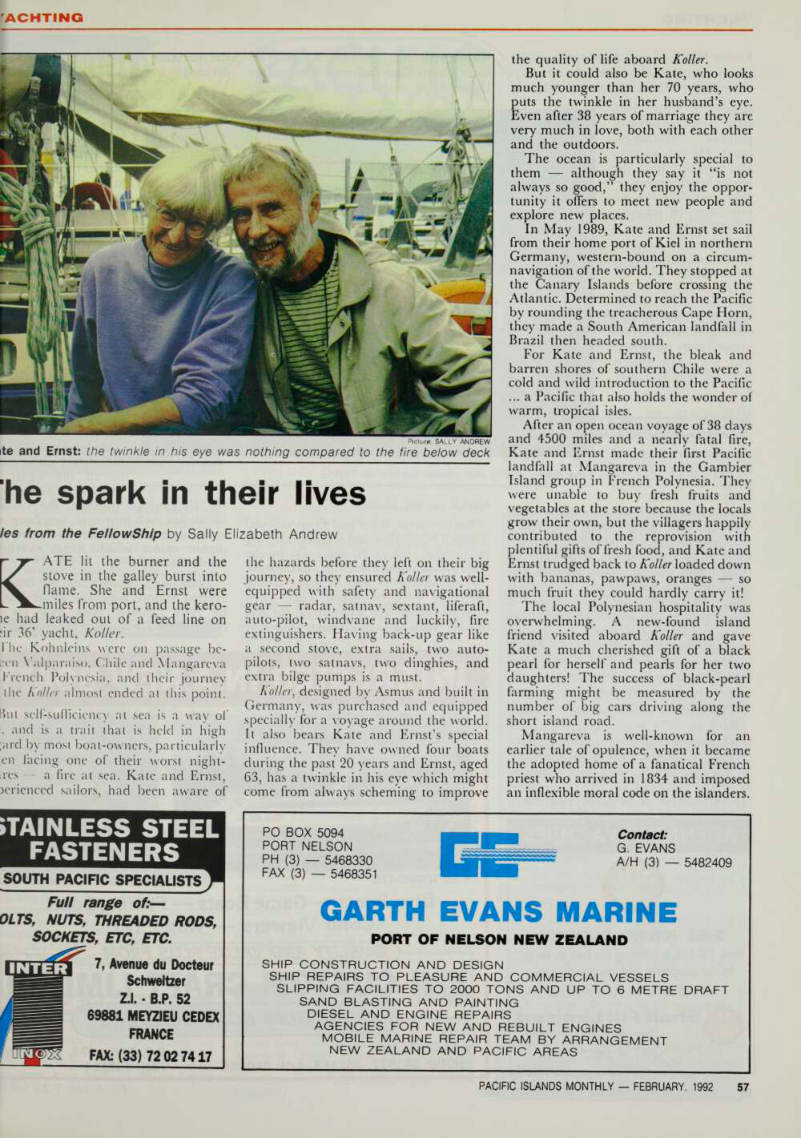
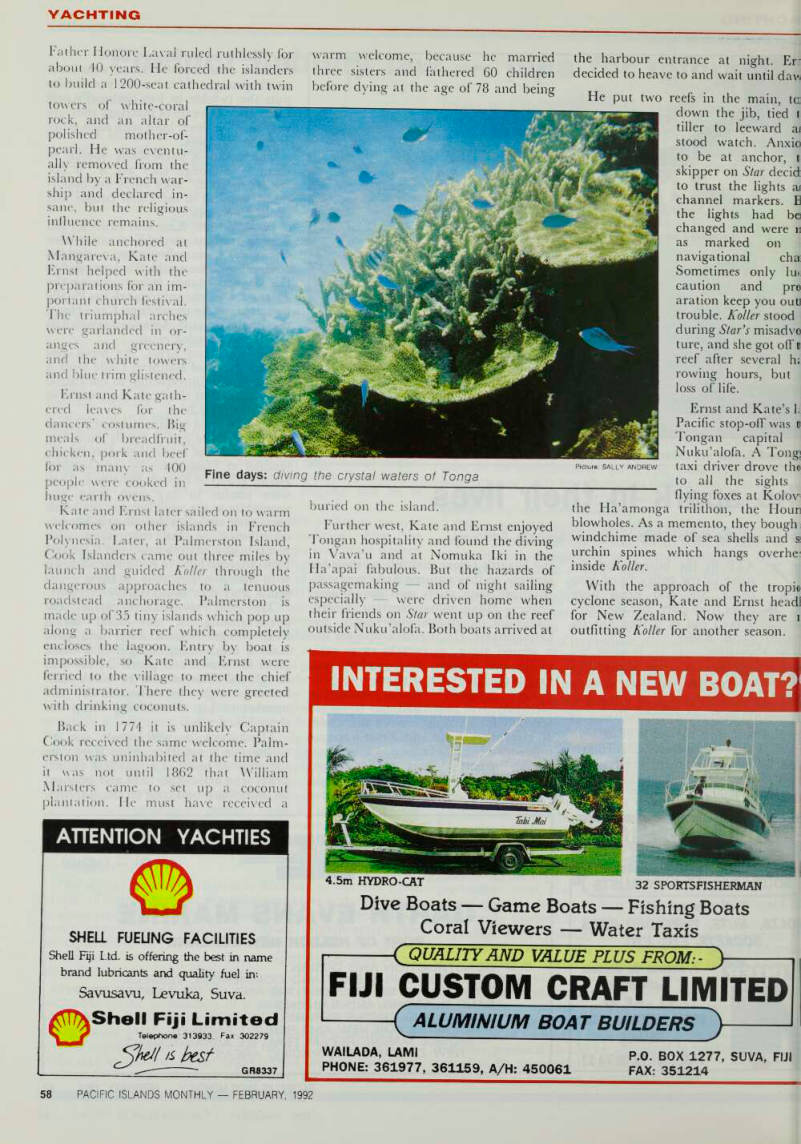
Yachting
les from the Fellowship by Sally Elizabeth Andrew
r JT ATE lit the burner and the stove in the galley burst into flame. She and Ernst were L- from port, and the kerole had leaked out of a feed line on nr 36’ yacht, Koller.
I he Kohnleins were on passage be-
Len Valparaiso, Chile and Mangareva
French Polynesia, and their journey the Koller almost ended at this point. „ n , . . 3m self-sufficiency at sea is a way ol . and is a trait that is held in high ,ard b) most boat-owners, particularly en facing one of their worst nightres a fire at sea. Kate and Ernst, Dcrienccd sailors, had been aware of
the hazards before they left on their big journey, so they ensured Koller was well equipped with safety and navigational gear radar, satnav, sextant, liferaft, auto-pilot, windvane and luckily, fire extinguishers. Having back-up gear like a second stove, extra sails, two auto pilots, two satnavs, two dinghies, and extra bilge pumps is a must, Koller, designed by Asmus and built in Germany, was purchased and equipped specially for a voyage around the world. [t also bears Kate and Ernst’s special influence. They have owned four boats during the past 20 years and Ernst, aged 63, has a twinkle in his eye which might come from always scheming to improve
the quality of life aboard Koller.
But it could also be Kate, who looks much younger than her 70 years, who puts the twinkle in her husband’s eye.
Even after 38 years of marriage they are very much in love, both with each other and the outdoors.
The ocean is particularly special to them although they say it “is not always so good,” they enjoy the oppor tunity it offers to meet new people and explore new places.
In May 1989, Kate and Ernst set sail from their home port of Kiel in northern Germany, western-bound on a circum navigation of the world. They stopped at the Canary Islands before crossing the Atlantic. Determined to reach the Pacific by rounding the treacherous Cape Horn, they made a South American landfall in Brazil then headed south.
For Kate and Ernst, the bleak and barren shores of southern Chile were a cold and wild introduction to the Pacific ... a Pacific that also holds the wonder of warm, tropical isles.
After an open ocean voyage of 38 days and 4500 miles and a nearly fatal fire, Kate and Ernst made their first Pacific landfall at Mangareva in the Gambier Island group in French Polynesia. They were unable to buy fresh fruits and vegetables at the store because the locals grow their own, but the villagers happily contributed to the reprovision with plentiful gifts of fresh food, and Kate and Ernst trudged back to Koller loaded down with bananas, pawpaws, oranges so much fruit they could hardly carry it!
The local Polynesian hospitality was overwhelming. A new-found island friend visited aboard Koller and gave Kate a much cherished gift of a black pearl for herself and pearls for her two daughters! The success of black-pearl
farming might be measured by the
number of big cars driving along the short island road.
Mangareva is well-known for an earlier tale of opulence, when it became the adopted home of a fanatical French priest who arrived in 1834 and imposed an inflexible moral code on the islanders.
Picture: SALLY ANDREW te and Ernst: the twinkle in his eye was nothing compared to the fire below deck
Father Honorc Laval ruled ruthlessly for about 40 years. He forced the islanders to build a 1200-seat cathedral with twin
towers of white-coral rock, and an altar of polished mother-of pearl. He was eventu ally removed from the island by a French war ship and declared in sane, but the religious influence remains.
While anchored at Mangareva, Kate and Ernst helped with the preparations for an im portant church festival.
The triumphal arches were garlanded in or anges and greenery, and the white towers and blue trim glistened.
Ernst and Kale gath ered leaves for the dancers’ costumes. Big meals of breadfruit, chicken, pork and beef for as many as 100 people were cooked in huge earth ovens.
Kate and Ernst later sailed on to warm welcomes on other islands in French Polynesia. Later, at Palmerston Island, Cook Islanders came out three miles by launch and guided Koller through the dangerous approaches to a tenuous roadstead anchorage. Palmerston is made up of 35 tiny islands which pop up along a barrier reef which completely encloses the lagoon. Entry by boat is impossible, so Kate and Ernst were ferried to the village to meet the chief administrator. There they were greeted with drinking coconuts.
Back in 1774 it is unlikely Captain Cook received the same welcome. Palm erston was uninhabited at the time and it was not until 1862 that William Marsters came to set up a coconut plantation. He must have received a
warm welcome, because he married three sisters and fathered 60 children before dying at the age of 78 and being
buried on the island.
Further west, Kate and Ernst enjoyed Tongan hospitality and found the diving in Vava’u and at Nomuka Iki in the Ha’apai fabulous. But the hazards of
passagemaking and of night sailing
especially were driven home when their friends on Star went up on the reef outside Nuku’alofa. Both boats arrived at
the harbour entrance at night. Er~ decided to heave to and wait until daw He put two reefs in the main, tea
down the jib, tied I tiller to leeward at stood watch. Anxio to be at anchor, t skipper on Star decicfc to trust the lights at channel markers. B the lights had be changed and were n as marked on navigational chae Sometimes only lun caution and pre aration keep you out) trouble. Koller stood during Star’s misadve ture, and she got off tt reef after several h; rowing hours, but loss of life, Ernst and Kate’s I; Pacific stop-off was tl Tongan capital Nukualofa. A Tong; taxi driver drove the to all the sights flying foxes at Kolov'
the Ha’amonga trilithon, the Hour blowholes. As a memento, they bough windchime made of sea shells and s urchin spines which hangs overhe inside Koller.
With the approach of the tropic cyclone season, Kate and Ernst headl for New Zealand. Now they are i outfitting Koller for another season.
Fine days: diving the crystal waters of Tonga
Picture: SALLY ANDREW
Advertisements & other items, pp. 57-60 (1 item)
Garth Evans Marine
STAINLESS STEEL
FASTENERS
SOUTH PACIFIC SPECIALISTS
Full range of: —
OLTS, NUTS, THREADED RODS,
SOCKETS, ETC, ETC.
7, Avenue du Docteur Schweitzer
Z.I. • B.P. 52
69881 MEYZIEU CEDEX
FRANCE
FAX; (33) 72 02 74 17
PO BOX 5094
PORT NELSON
PH (3) 5468330
FAX (3) 5468351
Eb Contact:
G. EVANS
A/H (3) 5482409
GARTH EVANS MARINE
PORT OF NELSON NEW ZEALAND
SHIP CONSTRUCTION AND DESIGN
SHIP REPAIRS TO PLEASURE AND COMMERCIAL VESSELS SLIPPING FACILITIES TO 2000 TONS AND UP TO 6 METRE DRAFT
SAND BLASTING AND PAINTING
DIESEL AND ENGINE REPAIRS
AGENCIES FOR NEW AND REBUILT ENGINES
MOBILE MARINE REPAIR TEAM BY ARRANGEMENT
NEW ZEALAND AND PACIFIC AREAS
INTERESTED IN A NEW BOAT?
■ M® : « Mm
4.5 m HYDRO-CAT 32 SPORTSFISHERMAN
Dive Boats Game Boats Fishing Boats Coral Viewers Water Taxis
■C QUALITY AND VALUE PLUS FROM
FIJI CUSTOM CRAFT LIMITED
-( ALUMINIUM BOA T BUILDERS
WAILADA, LA Ml
PHONE: 361977, 361159, A/H: 450061
P.O. BOX 1277, SUVA, FIJI
FAX: 351214
ATTENTION YACHTIES
SHELL FUEUNG FACILITIES
Shell Fiji Ltd. is offering the best in name brand lubricants and quality fuel in; Savusavu, Levuka, Suva.
Fiji Limited
\ f Telephone 313933, Fa* 302279
/i best
GR8337
NATIONAL
IBRARY OF AUSTRALIA
PACIFI
ISLANDS
I MON T H L
flffltti Pine
For the benefit of our readers who would like to place a small classified advertisement in our magazine, Market Place will assist you in selling personal items, accommodation, real estate boating or a service ... in fact anything you would like to sell to our over 50,000 readers.
Market Place Advertising Rates are structured to allow you to place as many advertisements as you wish, economically.
V. “MANUIA” OF NUKUALOFA
el dry cargo ship. Length 53m 660 tonnes dweight, 492 gross. Capacity 820 cubic fwo x 3 tonne derricks. Engine MWM 500 \ 1.6 tonnes/day speed 9 knots. Built and 1958 in class BUREAU VERITAS. This i has been well maintained and crossed Tasman Sea 3 times last year. Very able for inter-island work. Laying Auckland, e US$l7O,OOO. Phone NZ 649 445 \2 or NZ 649 292 8035.
SCRAP METAL
j prices paid for your clean scrap Aluum, Brass, Copper, Lead, etc. Contact : erral Pty. Ltd. 23 Davis Rd. Wetherill Park ' 2164 Australia. Fax 612 604 1304 for ipt reply. Our Company is a long estabd smelter and a leading metals buyer the Pacific region. Telephone ! 604 8855.
TRAVEL GUIDES
3K ISLANDS COMPANION...The Visitors’ e to Rarotonga and The Outer Islands,” pages, 40 color photos; US$2O .(airht): Pacific Publishing, Box 8031, Tville, California, 94608, USA.
FISHING LINE
quality fishing lines from major regional jfacturer. Great opportunity to distribute d names or private labels of commercial, ational, tournament lines. Contact Mr
igs, AUSTRALIAN MONOFIL COMPANY.
Box 5584 Strathpine, Australia 4500. >1 7 8811523 Ph: 61 7 8811522
DANCE GROUPS
ing Agency for conventions, festivals, , needs South Pacific performers for ning events. Send resumes, details etc
kCIFIC PEOPLES, P.O. Box 5622, West
Brisbane, Australia 4101. Ph: 61 7 844 >. Fax 61 7 846 4709
FIJI MANUFACTURER/PARTNER WANTED
Brisbane (Austr.) based Trading Co. is looking to invest in small Fijian Furniture manufacturer (Gardensettings, Leisure) and small textile manufacturer (Beachtowels etc.) for export purposes. Principals of Trading Co. are Dutch Nationals, Permanent Residents of Australia.
Reply in writting: Confidential: to Amflw, GPO Box 2720 Brisbane 4001, Australia.
RARE INVESTMENT OPPORTUNI
A major block of shares in magnificent 100 hectare Uepi Island Resort, located in Marovo Lagoon in the beautiful Solomon Islands, one of the last unspoiled areas in the South Pacific and only a 3 hour flight from Brisbane. These shares are for sale in a block or individually.
This is a well established, recently upgraded Island Resort with rainforest, white sand beaches, 6 large self-contained cabins and diver's lodge. The main building comprises central dining room, bar. kitchen, guest rooms and sweeping sheltered verandah with dazzling view. Also included is a fully equipped dive centre, trade store, Manager’s house, staff quarters, workshops, laundry, generator room and 3 excellent jetties. This popular Resort is one of the top South Pacific diving .destinations. For further information, contact Bob Reed, 4 7 Warners Avenue North Bondi, NSW Australia 2026. Phone: (02) 30-2455 Fax: (02) 300-9889.
OCEANAMICS PTY. LTD.
We require unserviceable ships, hulks and floating equipment for scrapping. Contact: Oceanamics Pty. Ltd. P.O. Box 1303, Fremantle 6160. West. Australia. Tel: 61-9-3397804 Fax: 61-9-3191443. Singapore Fax: 65-2239144.
FOR SALE BY TENDER
The Tonga Commodities Board advises its intentions to sell by tender a wide range of construction and workshop equipment, desiccated coconut and snack food processing plant and equipment. For a list of assets available and the terms and conditions of the tender, please contact Mr Vic Huddleston, Commodities Board P.O. Box 27 Nukualofa, Tonga. Tenders will close at 4.00 pm April 2nd 1992.
SCRAP METAL
Tall ingots operate from Brisbane, Australia and make frequent visits to the Pacific Islands, as they have done for twenty-five years. We are buyers of Copper, Brass. Aluminium, Lead, Cable etc. Inspection for big lots no problem.
Telephone 61 7 8922033. Fax 61 7 8922077.
DISTRIBUTOR WANTED
Manufacturer of Ball Point and Pens Disposable Gas Lighters.
Please contact JNJ CORPORATION (FIJI) LTD, G.P.O. Box 285, Suva, Fiji. Ph 394000, Fax: (679) 411898.
OPTICIANS AND OPTOMETRISTS
Spectacles, Contact Lenses, Sunglasses, See JEKISHAN & JEKISHAN, Epworth House, G.P.O.
Box 285, Suva, Fiji. Ph 311002 Fax: (679) 411898.
PACIFIC
SLANDS
'MONT H L Y I
MRRK€T PLRC€ CRN WORK
WONDCRS FOR VOU ...
Promote your business, or service, sell your household
items, cars or heavy machinery
etc.
ONLY AUSSI PER WORD.
NO COMPANY LOGO. NO
DISPLAY. NO BOLD TYPE.
Just forward your Advertisement together with payment to: PACIFIC ISLANDS MONTHLY "Market Place".
P.O. Box 1167, Suva, Fiji.
CONDITIONS:
1. All Advertisements are subject to acceptance and approval of publisher. 2. Advertisements are published as space permits; we cannot guarantee date of insertion. 3. All advertisements must be prepaid and should be typed or printed clearly, 4. Deadline for receipt of advertisements is the 10th of the month prior to issue.
5. PACIFIC ISLANDS MONTHLY
assumes no responsibility for any service other than publishing paid advertisements in this section.
Designed to be E c' asp ■ Proven in Every Comer of the World Stylish elegance and luxurious detail are the first things you’ll notice about the new Galant. So you might be surprised to learn that Galants have driven to victory in more than 10 major rally raid events — from the snowy slopes of Sweden, to the African savannah. And you’ll be pleased to know that the same performance features keeping those rally cars competitive on the course are also what make your Galant one of the best performance saloons on the road today.
For years, Mitsubishi engineers have known that motorsports are an ideal place for testing new and improved technologies.
The hard, fast driving required to win a rally strains every part of a car—generating pressures that exceed the demands of normal driving. Here, as drivers push their cars to the limit, the rigidity and strength of new space-age constructions can be checked and proven reliable.
The new Galant’s advanced triplelink torsion axle rear suspension is a good example. It is the result of many small yet critical refinements, ultimately designed to grip the road for safer, more comfortable control when changing lanes and cornering.
The severe demands of international motorsport competition: just further proof of how far Mitsubishi willgoW butldThe best r Of cars for you.
to 2 0 FEB 139
> I , A
MITSUBISHI GRLRNT
AMERICAN SAMOA: MORRIS SCANLAN SERVICE INC. P.O. Box 367, Pago Pago, Tel. 633 5520/AUSTRALIA: MITSUBISHI MOTORS AUSTRALIA LTD. Box 1284, South Road, Clovelly Park. South Australia 5042 Tel (08) 275 7223/FIJI: NIVIS MOTOR & MACHINERY CO . LTD. G.P.O. Box 150, Suva, Tel. 383411/FRENCH POLYNESIA (TAHITI): ETS-BREDIN FRERES ET FILS P.O, Box 21, Papeete, Tahiti, Tel. 4 202 58/NEW CALEDONIA: SOCIETE DTMPORTATION D AUTO DU PACIFIQUE SUD S A B P 438 Rond Point du Pacifique, Noumea, Tel 274144/NEW ZEALAND: MITSUBISHI MOTORS NEW ZEALAND LTD. Todd Park, Henot Drive, Private Bag, Ponrua. Ta 370 09 NORFOLK ISLAND: BORRYS LTD PO. Box 169, Norfolk Island Tel 2114/PAPUA NEW GUINEA: TOBA PTY. LTD. P.O. Box 503, Port Moresby, Tel. 21 7874/SOLOMON ISLANDS: HARVEST PACIFIC O x 88, Honiara, Guadalcanal, Tel. 30128/TONGA: SITANI MAFI CO., LTD. P.O. Box 83, Nuku ALOFA, T el. 21 044/VANUATU: SOCOMETRA B.P. 06 Route de Lagon, Port-Vila, Tel. 2314/WESTERN SAMOA: A M. MACDONALD HOLDINGS LTD.
P O Box 576 Apia Tel 22022/SAIPAN/POHNPEI/MAJURO/KOSRAE/TRUK/YAP/BELAU: MICRONESIAN MOTORS, INC. 997 South Mamne Drive, Tamuning, Guam 9691 1 , Tel. 646-6827