Bougainville:
pp. 20-21 · Read in the full issue
island of death
AS 1991 drew to a close it’s time to spare a thought for the people of Bougainville. In April they will embark on their third year without proper medical attention, with few schools, no transport and little contact with the outside world.
Since the PNG government first imposed its blockade on the secessionist held island, many have died of preventable illness.
While medical supplies are now getting into Buka Island, and to the three small areas on Bougainville itself held by PNG Defence Forces, they are only trickling into rebel held areas.
Services, such as crucial immunisation programmes for small children, are nowhere near back to normal.
The blockade of the island, more severe than anything imposed on Saddam Hussein’s Iraq at the height of the Gulf War, may have been officially lifted, but access, effectively controlled by the military, is still difficult.
In Australia, people are asking whether their government has done enough to press PNG toward negotiations for a
peaceful end to the rebellion. And there has been consistent concern about Canberra’s involve ment in, and responsibility for, the situation on
Bougainville.
The fact that Australian-supplied helicopters have been used to strafe villages and even to dump the bodies of Bougainvilleans executed by the PNG Defence Force at sea continues to worry humanitarian organisations. That concern was highlighted again last month when an ABC Television’s Four Corners reporter won a coveted VValkley journalism award for her report on the plight of the Bougainvilleans.
Recent revelations in the wake of the massacre in East Timor have raised more questions about the use to which Australia’s prior knowledge or forewarning of human rights abuse is being put.
On SBS Television leading defence expert, Des Ball, confirmed that the Australian Defence Department’s top secret Defence Signals Direc torate (DSD) monitors all electronic communi
cations going in and out of East Timor. As a result, DSD would have known about troop movements, the general orders given to the Indonesian army and the seriousness of the situation as it developed just prior to the November massacre which eyewitnesses say killed more than 100 people.
At the same time Dr Ball let slip that Australia has been monitoring military communications in PNG for the past four years using a signals unit based on the tip of the Cape York peninsula. Electronic surveillance or signals intelligence is one of the few peaceful tools available to the Defence Forces. It is designed to give early warning of armed or hostile actions against Australia. In doing so it offers governments an eleventh hour opportunity to find a peaceful solution to their problems.
Australia is now reported to be spending Asloo million a year on DSD. The defence establishment argues that because signals intelligence is so important to our most basic security needs, it should only be acted upon when Australia’s direct interests are under threat.
Others argue that if we are going to spend so much on the surveillance it should be used to help save lives, especially when the victims are our close neighbours. No one thinks the Bougainville dispute will be easy to resolve nor do they think it is impossible.
One such opportunity was lost by the PNG judiciary when the Bougainville state of emer gency lapsed, leaving no legal basis for the blockade. Section 41 of the PNG constitution protects all citizens from unreasonable or oppress ive actions by their government. If the judiciary has been prepared to challenge the government over the blockade at that point it may have been able to precipitate a solution.
Despite the situation on Bougainville, 1991 has been a year of consolidation, not just for Papua New Guinea, but for the region as a whole. In PNG the dismissal of deputy Prime Minister Ted Diro after the Leadership Commission found him guilty on 81 charges of misconduct proved the resilience and strength of PNG’s democratic institutions. 1991 has been another year in which the South Pacific expanded its dealings with other regions and took a bigger role on the world stage. In trade and diplomacy, island nations continued to look
further afield diversifying their contacts, particularly in Asia.
While the process of building new trade and investment links may seem agonisingly slow it is succeeding. In this, Fiji, with its tax free zone investments and exports, stands out. And it’s a model which is being adopted by other countries.
It is on the environment where the Pacific Island nations are really beginning to make their mark on the world stage. After their successful campaign against driftnet fishing, a campaign won against some of the world’s richest and most powerful nations, they have launched themselves into the battle to reduce emissions of damaging Greenhouse gases.
If predicted sea level rises associated with Greenhouse induced global warming eventuate, the very future of some Island states will be threatened.
The Pacific Islands have been playing a key role in the Alliance of Small Island States, a group which has been very active in international negotiations for a climate change convention. They are also likely to play a key role at the big United Nations Conference on Environment and Development (UNCED) which will take place in Rio De Janeiro in June.
Australia, too, is placing a great deal of importance on
Australia
Jemima
Garrett
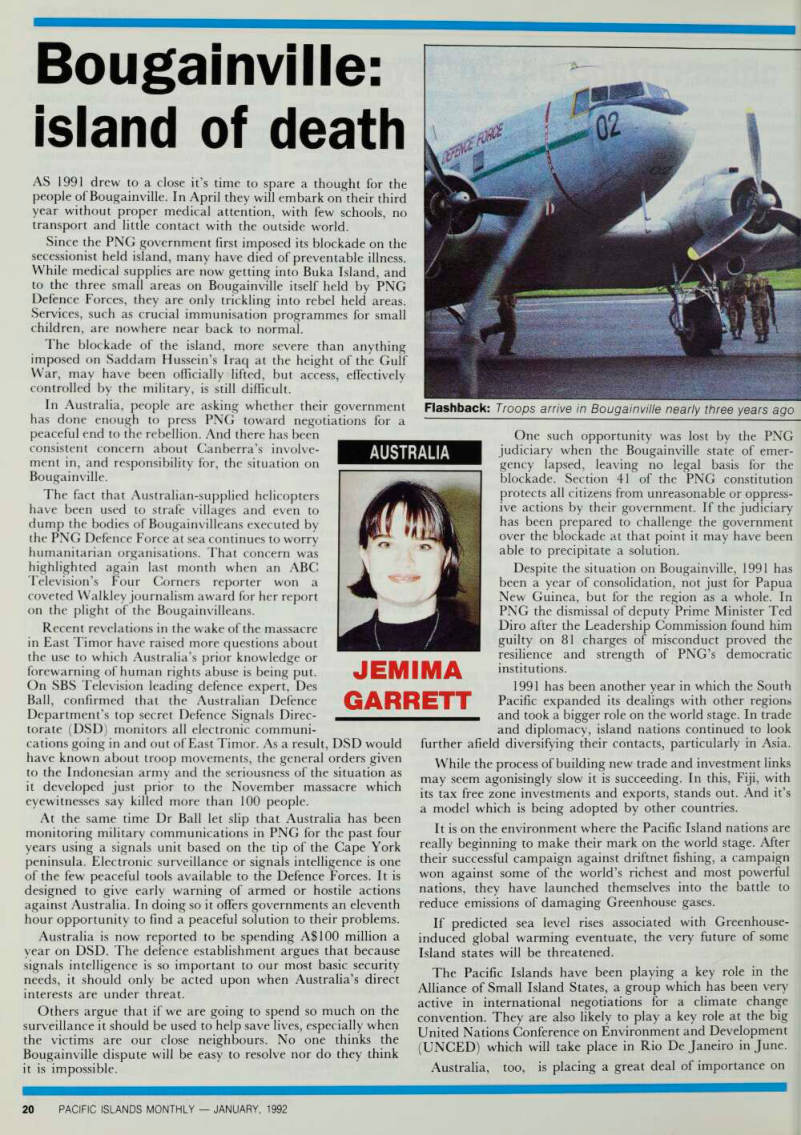
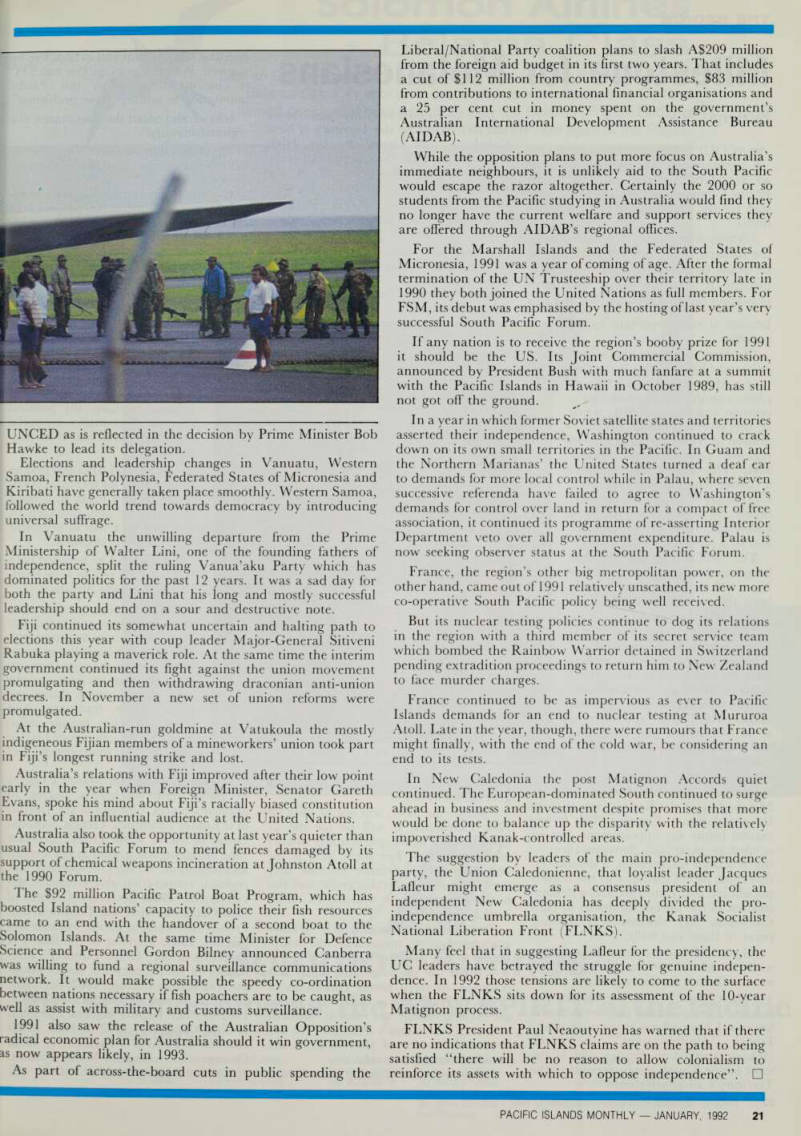
Flashback: Troops arrive in Bougainville nearly three years ago
UNCED as is reflected in the decision by Prime Minister Bob Hawke to lead its delegation.
Elections and leadership changes in Vanuatu, Western Samoa, French Polynesia, Federated States of Micronesia and Kiribati have generally taken place smoothly. Western Samoa, followed the world trend towards democracy by introducing
universal suffrage.
In Vanuatu the unwilling departure from the Prime Ministership of Walter Lini, one of the founding fathers of independence, split the ruling Vanua’aku Party which has dominated politics for the past 12 years. It was a sad day for both the party and Lini that his long and mostly successful leadership should end on a sour and destructive note.
Fiji continued its somewhat uncertain and halting path to elections this year with coup leader Major-General Sitiveni Rabuka playing a maverick role. At the same time the interim government continued its fight against the union movement promulgating and then withdrawing draconian anti-union decrees. In November a new set of union reforms were promulgated.
At the Australian-run goldmine at Vatukoula the mostly indigeneous Fijian members of a mineworkers’ union took part in Fiji’s longest running strike and lost.
Australia’s relations with Fiji improved after their low point early in the year when Foreign Minister, Senator Gareth Evans, spoke his mind about Fiji’s racially biased constitution in front of an influential audience at the United Nations.
Australia also took the opportunity at last year’s quieter than usual South Pacific Forum to mend fences damaged by its support of chemical weapons incineration at Johnston Atoll at the 1990 Forum.
The 592 million Pacific Patrol Boat Program, which has boosted Island nations’ capacity to police their fish resources came to an end with the handover of a second boat to the Solomon Islands. At the same time Minister for Defence Science and Personnel Gordon Bilney announced Canberra was willing to fund a regional surveillance communications network. It would make possible the speedy co-ordination between nations necessary if fish poachers are to be caught, as well as assist with military and customs surveillance. 1991 also saw the release of the Australian Opposition’s radical economic plan for Australia should it win government, as now appears likely, in 1993.
As part of across-the-board cuts in public spending the
Liberal/National Party coalition plans to slash AS2O9 million from the foreign aid budget in its first two years. That includes a cut of SI 12 million from country programmes, SB3 million from contributions to international financial organisations and a 25 per cent cut in money spent on the government’s Australian International Development Assistance Bureau
(Aidab).
While the opposition plans to put more focus on Australia’s immediate neighbours, it is unlikely aid to the South Pacific would escape the razor altogether. Certainly the 2000 or so students from the Pacific studying in Australia would find they no longer have the current welfare and support services they are offered through AIDAB’s regional offices.
For the Marshall Islands and the Federated States of Micronesia, 1991 was a year of coming of age. After the formal termination of the UN Trusteeship over their territory late in 1990 they both joined the United Nations as full members. For FSM, its debut was emphasised by the hosting of last year’s very successful South Pacific Forum.
If any nation is to receive the region’s booby prize for 1991 it should be the US. Its Joint Commercial Commission, announced by President Bush with much fanfare at a summit with the Pacific Islands in Hawaii in October 1989, has still not got off the ground.
In a year in which former Soviet satellite states and territories asserted their independence, Washington continued to crack down on its own small territories in the Pacific. In Guam and the Northern Marianas’ the United States turned a deaf ear to demands for more local control while in Palau, where seven successive referenda have failed to agree to Washington’s demands for control over land in return for a compact of free association, it continued its programme of re-asserting Interior Department veto over all government expenditure. Palau is now seeking observer status at the South Pacific Forum.
France, the region’s other big metropolitan power, on the other hand, came out of 1991 relatively unscathed, its new more co-operative South Pacific policy being well received.
But its nuclear testing policies continue to dog its relations in the region with a third member of its secret service team which bombed the Rainbow Warrior detained in Switzerland pending extradition proceedings to return him to New Zealand to face murder charges.
France continued to be as impervious as ever to Pacific Islands demands for an end to nuclear testing at Mururoa Atoll. Late in the year, though, there were rumours that France might finally, with the end of the cold war, be considering an end to its tests.
In New Caledonia the post Matignon Accords quiet continued. The European-dominated South continued to surge ahead in business and investment despite promises that more would be done to balance up the disparity with the relatively impoverished Kanak-controlled areas.
The suggestion by leaders of the main pro-independence party, the Union Caledonienne, that loyalist leader Jacques Lafleur might emerge as a consensus president of an independent New Caledonia has deeply divided the pro independence umbrella organisation, the Kanak Socialist National Liberation Front (FLNKS).
Many feel that in suggesting Lafleur for the presidency, the UC leaders have betrayed the struggle for genuine indepen dence. In 1992 those tensions are likely to come to the surface when the FLNKS sits down for its assessment of the 10-year Matignon process.
FLNKS President Paul Neaoutyine has warned that if there are no indications that FLNKS claims are on the path to being satisfied “there will be no reason to allow colonialism to reinforce its assets with which to oppose independence”. □