Friendly Islands
pp. 56-57 · Read in the full issue
Tales From The Fellowship
Making it to the Friendly Islands
“IT’S not the journey or how you get there that’s important, it’s the people you meet.” I tried to remember this maxim as we struggled to make port in northern Tonga. Sailing conditions were ideal when we left the island of Penrhyn in the northern Cooks, but as usual, states of mind and sea are always temporary.
Two days from Vava’u we encoun tered boisterous seas and high winds. The seas whipped themselves into a fury in a matter of hours, getting much higher than the wind conditions at the time would have dictated. With a five-meter swell and winds to 40 knots, we scooted along at close to seven knots under a triple reefed mainsail. Lots of water came
aboard, uninvited. The intermittent rain and squalls, common to the convergence zone between Tonga and Samoa, ob scured our vision and eventually we closed up the boat and ventured on deck only to check or adjust our course. Down below, the heat and noise and movement
were oppressive.
Fifty miles from port we took down all sail and ran with bare poles at four knots through the night! We made landfall in the morning and luckily did not over shoot the cliffs of Port Refugio. With the rain, the cool temperatures and the fiord like harbour entrance, our landfall re minded us more of the Pacific Northwest than the South Pacific.
Checking in with customs and immi gration is often vexatious, but at Neiafu on the island of Vava’u it was easy. We tied up to the customs wharf and in between visits from customs, agriculture and immigration, a schoolboy intro duced himself and escorted me to the bank and to the propane depot. Hiki is 15 years old and attends Vava’u High School. He returns to his village and family on Matamaka (“Number 15”, he told me) each weekend. Many of the villages are referred to by their desig nation on a sailing chart used by Moorings, a local charter operation. It is amusing to hear Tongans use the num bered designations. Hiki told us that English was his favourite subject in school, and I got the impression he was good in all his subjects “except math!”
Hiki was not alone on the customs dock; ’Aisea Sikaleti, one of many Tongan entrepreneurs who organise “Tongan feasts” for the pa’alangis (whites) that visit Vava’u, came to announce his weekly feast at Lisa Beach (Number 10). On Kapa Island (number 8) we were invited to a feast of “island delights, wrapped in taro leaves, deli cately flavoured with coconut cream, garlic and onions and cooked to perfec tion in a Tongan microwave.” We must have looked puzzled because our Tongan host soon fessed up that his “Tongan microwave” was none other than the traditional underground oven or “umu”.
Tongan entrepreneurial skill and tenaciousness was reaffirmed as we visi ted many of the 34 islets that make up the Vava’u group. Boats of all designs stopped by and showed us their tapa, baskets, carvings, shells, fruits, vegetables and mats. One boat even came alongside to sell us vegetables while we were under sail.
Near Mala Island (Number 6) we met a young Tongan girl named Mele who visits the boats in the anchorage every evening in her leaky outrigger. She seemed to be successful at selling her family’s handicraft, but we were quite concerned for her safety. The outrigger
Sally Andrew
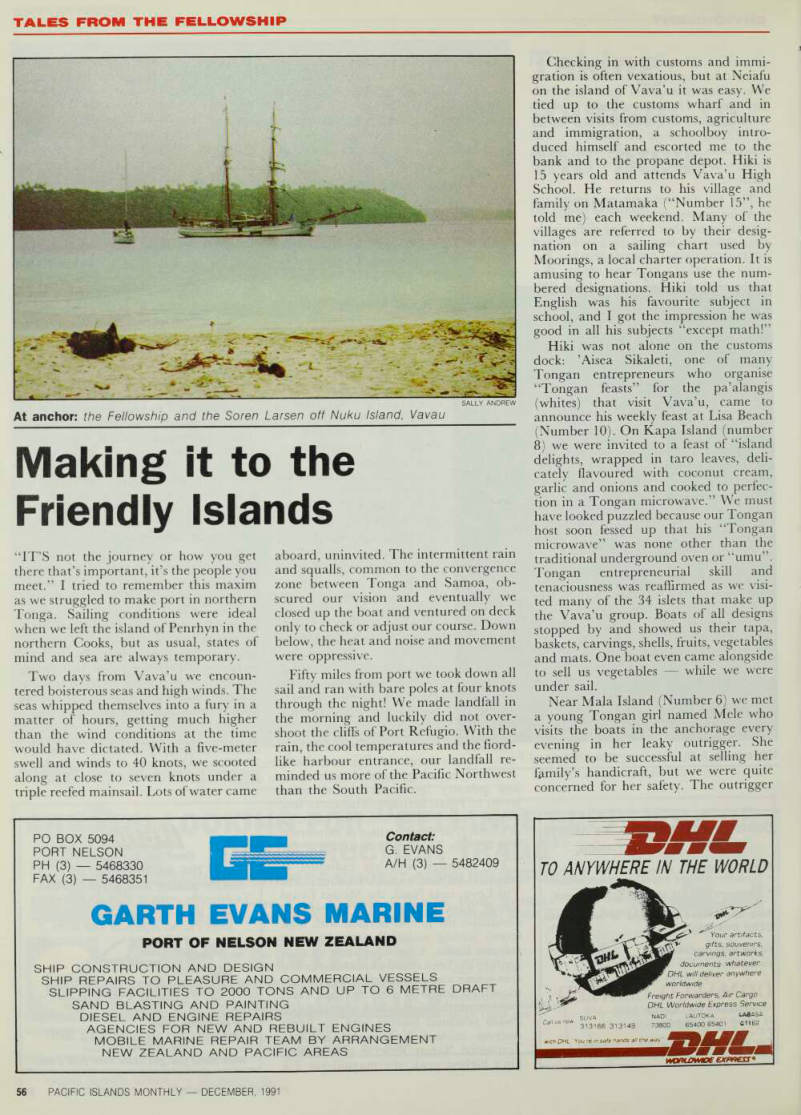
At anchor: the Fellowship and the Soren Larsen off Nuku Island, Vavau
filled up with water almost as fast as her younger cousin could bail it out. We bought two very sturdy baskets made of pandanus wrapped around coconut-leaf midribs. The basketwork in Vava’u is excellent.
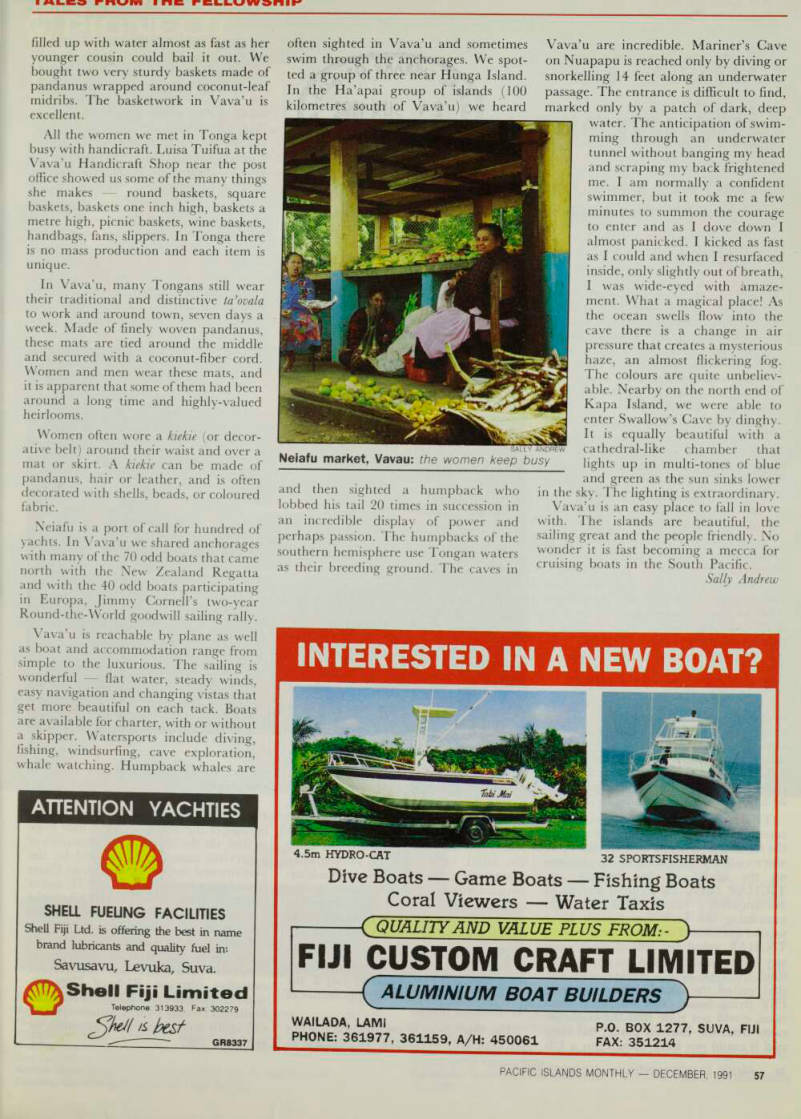
All the women we met in Tonga kept busy with handicraft. Luisa Tuifua at the Vava’u Handicraft Shop near the post office showed us some of the many things she makes round baskets, square baskets, baskets one inch high, baskets a metre high, picnic baskets, wine baskets, handbags, fans, slippers. In Tonga there is no mass production and each item is unique.
In Vava’u, many Tongans still wear their traditional and distinctive ta’ovala to work and around town, seven days a week. Made of finely woven pandanus, these mats are tied around the middle and secured with a coconut-fiber cord.
Women and men wear these mats, and it is apparent that some of them had been around a long time and highly-valued heirlooms.
Women often wore a kiekie (or decor ative belt) around their waist and over a mat or skirt. A kiekie can be made of pandanus, hair or leather, and is often decorated with shells, beads, or coloured fabric.
Neiafu is a port of call for hundred of yachts. In Vava’u we shared anchorages with many of the 70 odd boats that came north with the New Zealand Regatta and with the 40 odd boats participating in Europa, Jimmy Cornell’s two-year
Round-the-World goodwill sailing rally.
Vava’u is reachable by plane as well as boat and accommodation range from simple to the luxurious. The sailing is wonderful flat water, steady winds, easy navigation and changing vistas that get more beautiful on each tack. Boats are available for charter, with or without
a skipper. Watersports include diving,
fishing, windsurfing, cave exploration,
whale watching. Humpback whales are
often sighted in Vava’u and sometimes swim through the anchorages. We spot ted a group of three near Hunga Island.
In the Ha’apai group of islands (100 kilometres south of Vava’u) we heard
and then sighted a humpback who lobbed his tail 20 times in succession in an incredible display of power and perhaps passion. The humpbacks of the southern hemisphere use Tongan waters as their breeding ground. The caves in
Vava’u are incredible. Mariner’s Cave on Nuapapu is reached only by diving or snorkelling 14 feet along an underwater passage. The entrance is difficult to find, marked only by a patch of dark, deep
water. The anticipation of swim ming through an underwater tunnel without banging my head and scraping my back frightened me. I am normally a confident swimmer, but it took me a few minutes to summon the courage to enter and as I dove down I almost panicked. I kicked as fast as I could and when I resurfaced inside, only slightly out of breath, I was wide-eyed with amaze ment. What a magical place! As the ocean swells flow into the cave there is a change in air pressure that creates a mysterious haze, an almost flickering fog.
The colours are quite unbeliev able. Nearby on the north end of Kapa Island, we were able to enter Swallow’s Cave by dinghy.
It is equally beautiful with a cathedral-like chamber that lights up in multi-tones of blue and green as the sun sinks lower
in the sky. The lighting is extraordinary.
Vava’u is an easy place to fall in love with. The islands are beautiful, the sailing great and the people friendly. No wonder it is fast becoming a mecca for cruising boats in the South Pacific.
Sally Andrew
Sally Andrew
Neiafu market, Vavau: the women keep busy