Taking
pp. 54-55 · Read in the full issue
Environment
Taking tourism to the bush
By Sean Weaver
THE Fiji tourism industry has placed almost all of its eggs into the same basket of cliches white sand, bright sun, blue sea and a fruit cocktail sipped to the distant sound of drums beating in a token of traditional ism. Indeed, many travellers who cur rently venture to Fiji do so with the specific intention of relaxing beneath the rustling sway of palm trees on a beach somewhere.
In the past there may have been ample justification for the dominance of this form of tourism in Fiji, but in more recent times Fiji’s principle market (Australia) has been indicating a growing boredom with what it is presently offering. Other countries in the Pacific are also growing rapidly as competitors in the tourism game, selling more of the same. Fiji needs to market something unique.
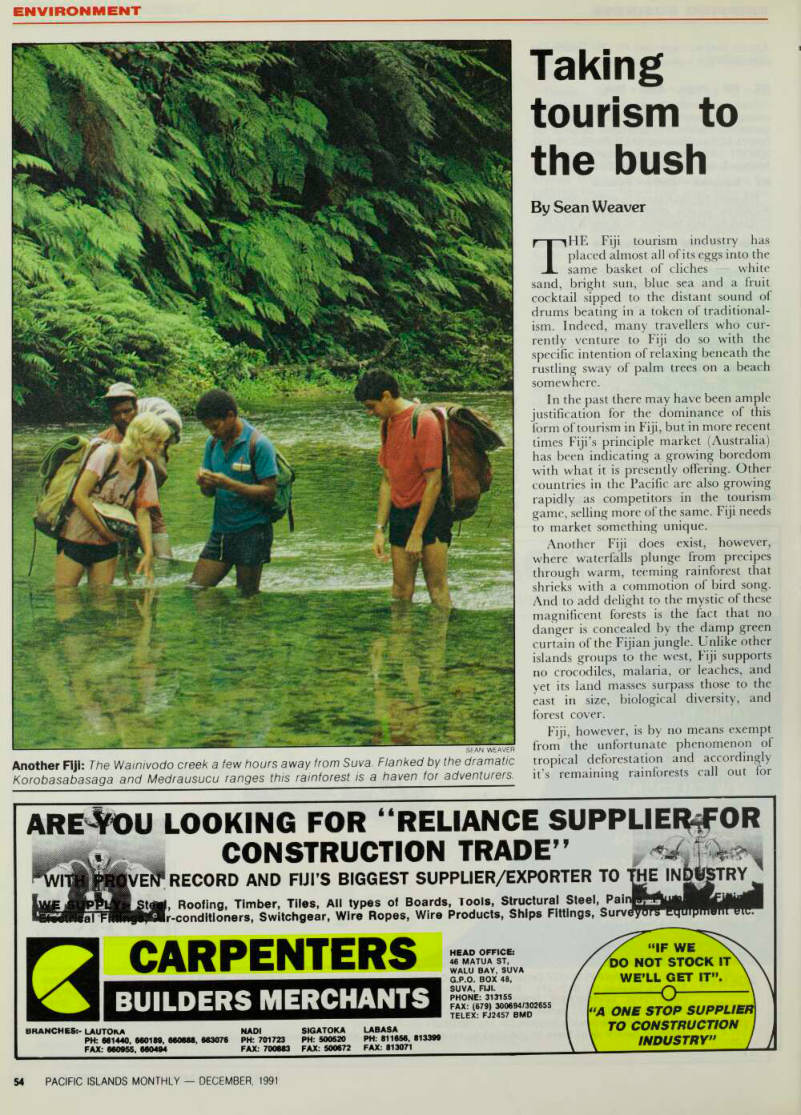
Another Fiji does exist, however, where waterfalls plunge from precipes through warm, teeming rainforest that shrieks with a commotion of bird song.
And to add delight to the mystic of these magnificent forests is the fact that no danger is concealed by the damp green curtain of the Fijian jungle. Unlike other islands groups to the west, Fiji supports no crocodiles, malaria, or leaches, and yet its land masses surpass those to the east in size, biological diversity, and forest cover.
Fiji, however, is by no means exempt from the unfortunate phenomenon of tropical deforestation and accordingly it’s remaining rainforests call out for
Sean Weaver
Another Fiji: The Wainivodo creek a few hours away from Suva. Flanked by the dramatic Korobasabasaga and Medrausucu ranges this rainforest is a haven for adventurers.
protection. These unique, complex, and spectacular ecosystems are no less vulner able to the onslaught of the timber trade any other. However, many of Fiji’s rainforests still lie quietly undisturbed by the dismal clamour of machinery and chain-saws and await appreciation by those who might venture to experience them.
The Fiji Government recognises the need for greater protection of its surviv ing rainforests, but is having difficulty in pinpointing solutions to the wide ranging need for income, whilst sustaining the fabric of these ecosystems. There is a
compelling need to provide for the needs of the tribal owners of these resources if they are to allow their forests to remain standing. Trees, once cut down, can usually fetch a good price, and because of this Fiji’s forest heritage is so often squeezed through a mill. But there are alternatives. Listen to this.
It was mid-morning as I sat in the clear warm stream water of the Busa River near the constant muffled roar of a waterfall. Above me a hanging forest quivered in the gentle breeze that wafted up from Viti Levu’s Coral Coast not far from the Naviti Resort. It was a quiet
time to contemplate after being shown through the ruins of an ancient temple site, built by people of the mysterious Nanga religion that once reigned in these parts well before the first Europeans set eyes on these islands. A hot spring empties itself into the Busa river a short way upstream from the temple ruins.
Waikatakata, or “hot water” as its translation reveals, provides a new twist in the story of devel opment in Fiji.
The newly established Waikatakata Forest Park with its archaeological treasures is an experiment
in landowner-operated,
nature-based tourism.
Championed by the Native Lands Trust Board and the
Forestry Department,
Waikatakata, if successful, could help pave the way for the much neeeded diversi fication in Fiji’s tourism industry.
Many other well kept
secrets in Fiji are slowly being revealed as the tour
ism industry begins to cherish these jewels of Fijian heritage. This move into nature tourism will broaden the meaning of forestry, as conservation of rainforests will become a commercial activity.
Fiji possesses countless examples of potential nature tourism localities. On Viti Levu, near Nadi, the Mount Evans Range leaps to over 1200 metres and dominates the inland horizon with high forests tossing waterfalls from its steep volcanic flanks. A humble nature tourism venture has been quietly operating in this area where tourists are taken by villagers to witness some of these majestic falls.
Further north a concoction of attractions awaits potential tourists with the forest reserves around Nadarivatu, the Mr Tomaniivi Nature Reserve surrounding Fiji’s highest peak, the magnificent Fiji
kauri forest in the Wabu creek catch ment, Sigatoka Trail, and the Monasavu Lake. To the south, near Suva, the forest clad Namosi Peaks pierce the sky and the nearby Sovi Basin sinks into the land scape with its edges held high by a crowning range of mountains.
On Vanua Levu the forested ridge back of the Tunuloa Peninsula overlooks Natewa Bay to the north and Taveuni island to the south. The Waisali Amenity Reserve goes largely unnoticed beside the highway on the crest of the main Vanua Levu axial mountains. The Vunivia Catchment near Udu Point has a wide range of lowland forest types, extensive everglades of mangrove swamp and a vast reef system off shore.
The “Garden Island" of Taveuni rises steeply from beneath the ocean carrying with it the wettest forests in Fiji that are rinsed with more than 10 metres of rain each year. It is drained by enormous waterfalls that in places plunge directly into the sea. On its eastern fringe the people of Bouma have taken to showing their rainforest, rivers and falling water to tourists as means of gathering an income. Like Waikatakata, Bouma has received much attention and assistance from the Fiji Government as well as a grant from the New Zealand Govern ment for the construction of nature trails and tourist facilities.
But of course the test is in the tasting and the ability of nature-based tourism to live up to the commercial expectations of its advocates is still to be demon strated. Indeed the survival of many natural forest areas in this Pacific Islands landscape could well depend on the attention they receive from international travellers. Otherwise tribal landowners will have no choice but to use logging as the only tangible means of gaining an income from their magnificent forests. □ • Sean Weaver, the author of this article, is a research biologist doing his doctrate at University of Canterbury, Wellington. He is attached to the Fiji government's National Environment Management Project
Sean Weaver
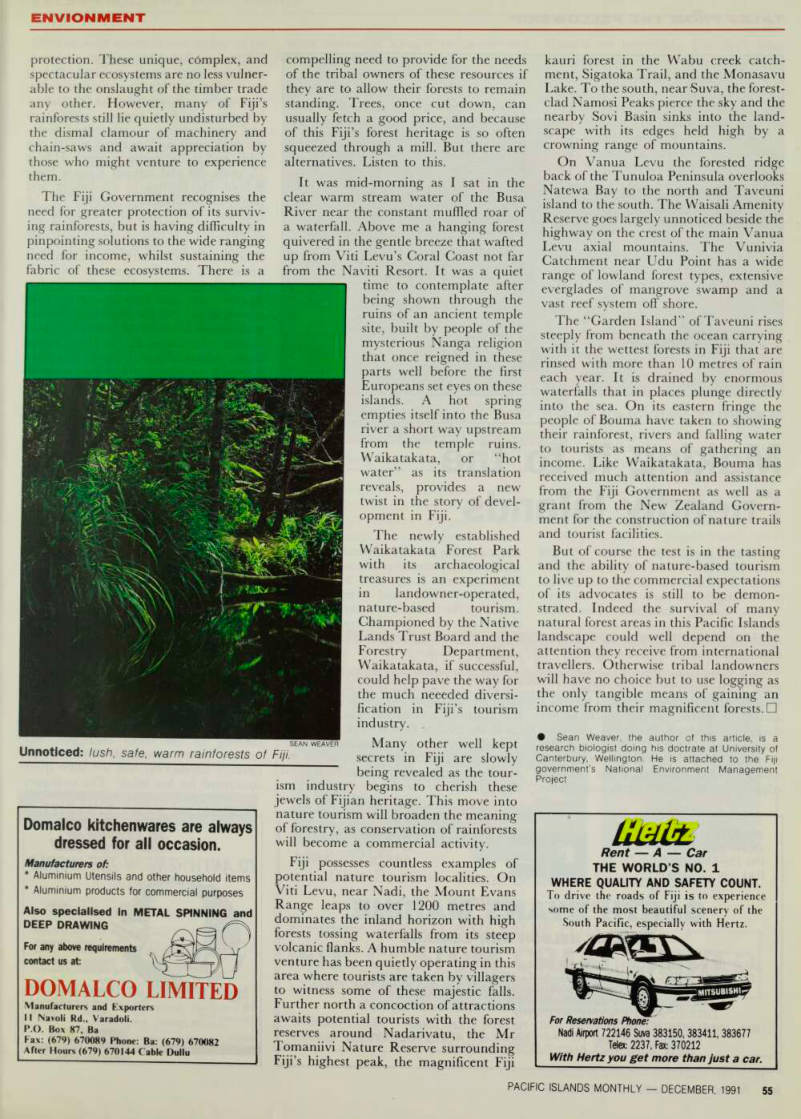
Unnoticed: lush, safe, warm rainforests of Fiji.