Nikumaroro
p. 58 · Read in the full issue
The Search
Back to Nikumaroro
A reader with a long memory rekindles new hope in finding Amelia Earhart’s camp on an isolated atoll
By David North
HELPED by a magazine reader
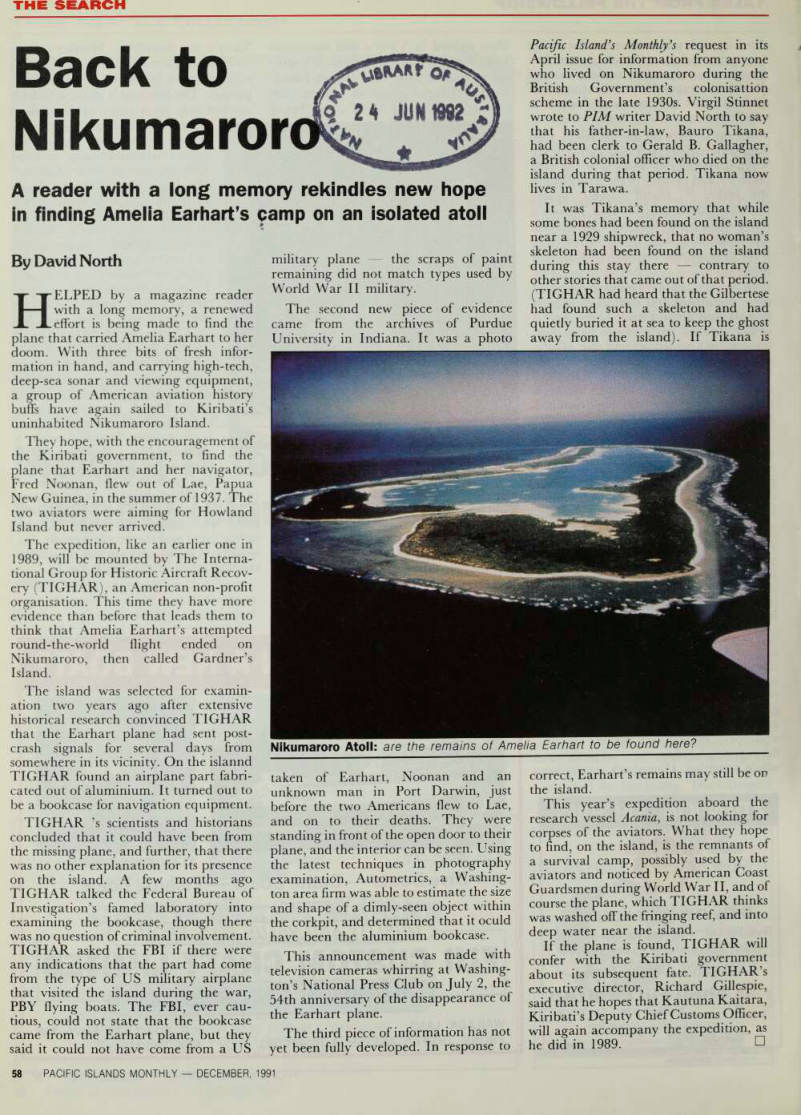
with a long memory, a renewed effort is being made to find the plane that carried Amelia Earhart to her doom. With three bits of fresh infor mation in hand, and carrying high-tech, deep-sea sonar and viewing equipment, a group of American aviation history buffs have again sailed to Kiribati’s uninhabited Nikumaroro Island.
They hope, with the encouragement of the Kiribati government, to find the plane that Earhart and her navigator, Fred Noonan, flew out of Lae, Papua New Guinea, in the summer of 1937. The two aviators were aiming for Howland Island but never arrived.
The expedition, like an earlier one in 1989, will be mounted by The Interna tional Group for Historic Aircraft Recov ery (TIGHAR), an American non-profit organisation. This time they have more evidence than before that leads them to think that Amelia Earhart’s attempted round-the-world flight ended on Nikumaroro, then called Gardner’s Island.
The island was selected for examin ation two years ago after extensive historical research convinced TIGHAR that the Earhart plane had sent post crash signals for several days from somewhere in its vicinity. On the islannd TIGHAR found an airplane part fabri cated out of aluminium. It turned out to be a bookcase for navigation equipment.
TIGHAR ’s scientists and historians concluded that it could have been from the missing plane, and further, that there was no other explanation for its presence on the island. A few months ago TIGHAR talked the Federal Bureau of Investigation’s famed laboratory into examining the bookcase, though there was no question of criminal involvement.
TIGHAR asked the FBI if there were any indications that the part had come from the type of US military airplane that visited the island during the war, PBY flying boats. The FBI, ever cau tious, could not state that the bookcase came from the Earhart plane, but they said it could not have come from a US
military plane the scraps of paint remaining did not match types used by World War II military.
The second new piece of evidence came from the archives of Purdue University in Indiana. It was a photo
taken of Earhart, Noonan and an unknown man in Port Darwin, just before the two Americans flew to Lae, and on to their deaths. They were standing in front of the open door to their plane, and the interior can be seen. Using the latest techniques in photography examination, Autometrics, a Washington area firm was able to estimate the size and shape of a dimly-seen object within the corkpit, and determined that it oculd have been the aluminium bookcase.
This announcement was made with television cameras whirring at Washington’s National Press Club on July 2, the 54th anniversary of the disappearance of the Earhart plane.
The third piece of information has not yet been fully developed. In response to
Pacific Island’s Monthly’s request in its April issue for information from anyone who lived on Nikumaroro during the British Government’s colonisattion scheme in the late 19305. Virgil Stinnet wrote to PIM writer David North to say that his father-in-law, Bauro Tikana, had been clerk to Gerald B. Gallagher, a British colonial officer who died on the island during that period. Tikana now lives in Tarawa.
It was Tikana’s memory that while some bones had been found on the island near a 1929 shipwreck, that no woman’s skeleton had been found on the island during this stay there contrary to other stories that came out of that period. (TIGHAR had heard that the Gilbertese had found such a skeleton and had quietly buried it at sea to keep the ghost away from the island). If Tikana is
correct, Earhart’s remains may still be on the island.
This year’s expedition aboard the research vessel Acania, is not looking for corpses of the aviators. What they hope to find, on the island, is the remnants of a survival camp, possibly used by the aviators and noticed by Ame:ncan Coast Guardsmen during WorW War 11, and o course the plane which TIGHAR thinks was washed off the fringing reef, and into de< ~P water near the island.
If the plane is found, 11GHAK will con f er w i t h t h e Kiribati government about its subsequent fate. TIGHAR’s execut i V e director, Richard Gillespie, said tbat he hopes that Kautuna Kaitara, Kiribati’s Deputy Chief Customs Officer, will again accompany the expedition, as he did in 1989. LJ
Nikumaroro Atoll: are the remains of Amelia Earhart to be found here?