Fire
pp. 29-33 · Read in the full issue


Power
By Beryl Cook
IN the not so remote regions of Fiji, men walk unharmed on fire and lie unscratched on beds of nails. In fact, the ceremonies are now performed before crowds of visit ing tourists on the popular Coral Coast, in a strange ritual which weds ancient tradition to the modern call of the tourism dollar.
Since the Pacific Harbour Cultural Centre opened in 1978, groups of Fijians from Beqa Island have walked over hot stones to show the gift bestowed on them by a grateful spirit (see p 33).
And in recent months, a group of Fiji Indian performers have drawn the disap proval of more conservative members of their own ethnic background by walking on knives, lying on nails, and walking through fire for tourists on the Coral Coast, the tourist belt on the southern shores of the main island of Viti Levu, and for the Hindu god, Ram.
The tinkling of the dantal, or cymbals, signals the approach of the group of men who come from Nadi in Fiji’s West to work as carpenters at the resort by day, but moonlight by night as performers.
One of the Hideaway Resort’s pro prietors, Kelvin Wade, has dubbed them the “New Delhi Troop”.
As they approach the small stage in the restaurant, the clatter of cutlery and loud guffawing of the Australian tourists hushes to a minimum now they strain and squint to see whether the buxom figure in red and saffron robes really is a woman. I wonder what they would think if they fyad seen Ram Kali a few months ago at the Fiji Accountants Congress he had a moustache then, but his dervish dancing still drove a few accountants to join him in part-fun, part-frenzied gy rations on stage.
Tonight, Ram Kali begins the ritual
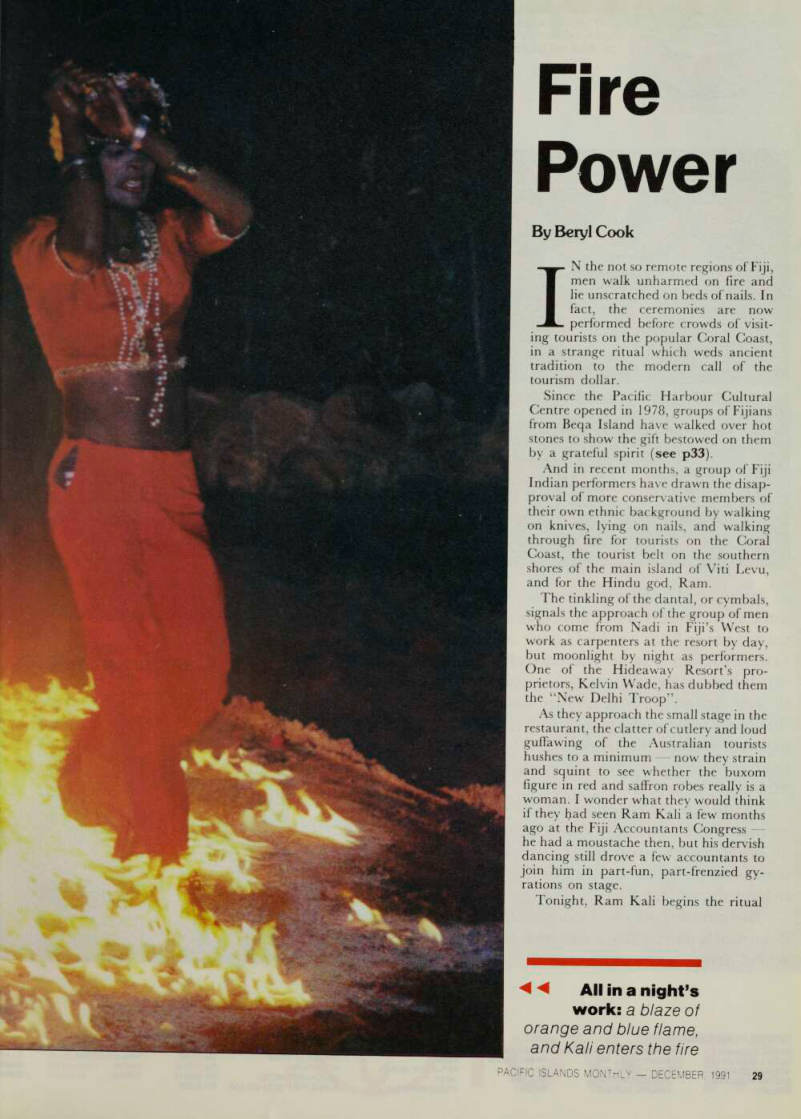
All in a night’s work: a blaze of orange and blue flame, and Kali enters the fire
with an evocative, skirt-swirling dance designed to gain the attention and favour of the gods, but he fails to keep the attention of many of the beer-swilling diners. The commentator, Ratu Maiyale, explains that Ram Kali dresses as a woman to appear more attractive to the gods, but most of the male tourists are
only joking when they wolf-whistle and cheer.
The members of the orchestra play the dholak (drum, the dantal (cym bals), the harmunium, the magira and the kartal in a mounting frenzy of thumping and chiming, which drowns out the clatter of cutlery and the diners’ fruitless calls for drink waiter service.
By the time Ram Kali lights a fire on the head of his assistant, Sachide, he has the audience’s atten tion, however. Prem Chand holds a small metal teapot over the flame and Ram Kali resumes his dance. In no time at all the water in the teapot is boiling and a cup of steaming tea is thrust into my hands.
“Do I drink this, or is it baptismal tea?” I won
der to myself. But the show whirls on.
Ram Kali performs a wailing song and dance to attract the attention of the gods before he performs his next offering, and the wooden blocks studded with nails are shown to the audience for inspection. By now the tourists are shuffling their chairs forward and one shoots a sidelong glare
at another to keep her front row position.
The camera flashes explode as Ram Kali walks across the nails, pausing often to take small jumps and bat
his eyelashes
seductively at the pho
tographers. Another
barrage of flashes ... he is lowered onto the bed of nails.
Finally, the children have forgotten to eat as they watch Sachide stand on Ram Kali’s stomach to increase the force of the nails.
His slash of red lipstick
barely quivers.
He emerges smiling to perform a love dance to the Gods.
Now, mouths are agape and expressions confused as Ram Kali is ready to walk on the
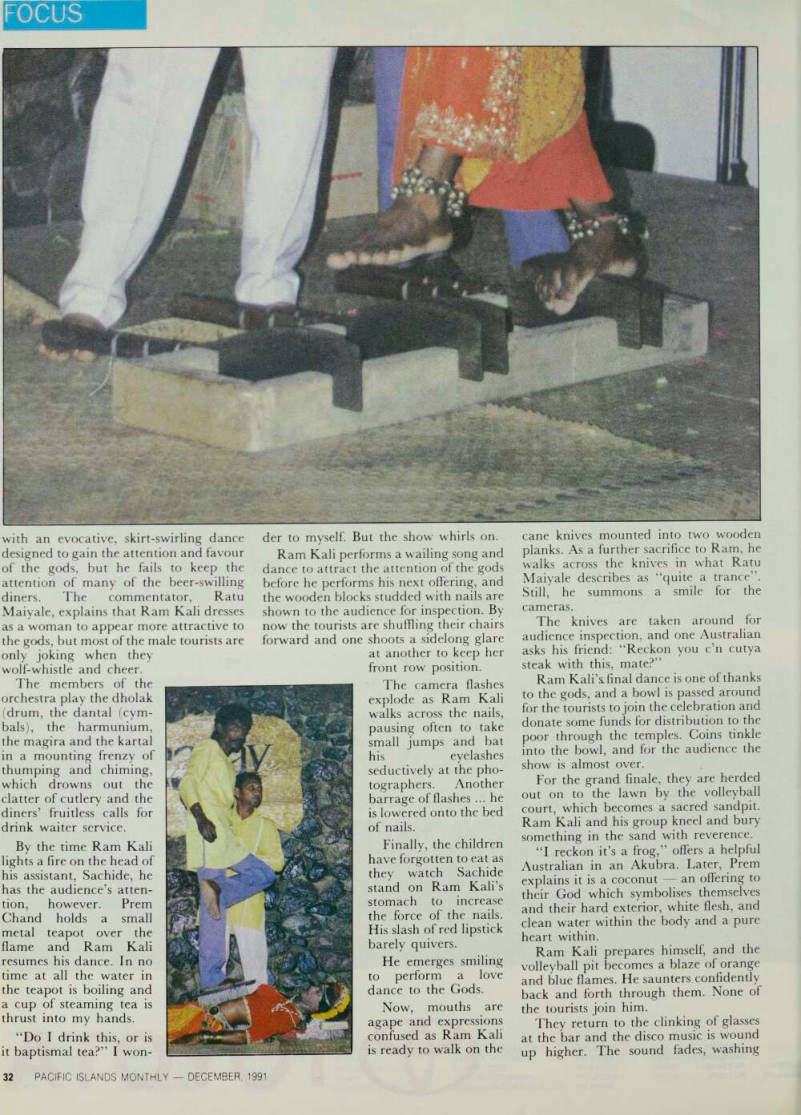
cane knives mounted into two wooden planks. As a further sacrifice to Ram, he walks across the knives in what Ratu Maiyale describes as “quite a trance”.
Still, he summons a smile for the cameras.
The knives are taken around for audience inspection, and one Australian asks his friend: “Reckon you c’n cutya steak with this, mate?”
Ram Kali’sTmal dance is one of thanks to the gods, and a bowl is passed around for the tourists to join the celebration and donate some funds for distribution to the poor through the temples. Coins tinkle into the bowl, and for the audience the show is almost over.
For the grand finale, they are herded out on to the lawn by the volleyball court, which becomes a sacred sandpit.
Ram Kali and his group kneel and bury something in the sand with reverence.
“I reckon it’s a frog,” offers a helpful Australian in an Akubra. Later, Prem explains it is a coconut an offering to their God which symbolises themselves and their hard exterior, white flesh, and clean water within the body and a pure heart within.
Ram Kali prepares himself, and the volleyball pit becomes a blaze of orange and blue flames. He saunters confidently back and forth through them. None of the tourists join him.
They return to the clinking of glasses at the bar and the disco music is wound up higher. The sound fades, washing
away by the swssshing of waves as I follow the group down to the sea.
Here, Prem explains, they will finish their dedication and prayers. Few words are spoken, but the purple bougainvillea blooms are laid gently on the sea, where they bob in the light of flickering candles floating on small plates.
“The flowers are offerings. They are perfect. They must not be allowed to be stood on or bruised in any way,” Prem explains.
We walk back into the dim kerosene lamp light of the galvanised iron shed, where I had tried to interview Ram Kali before the show. He and his followers, who had been squatting on the bare floor of the shack, had not been too welcoming then. Now, they are relaxed and happy to talk.
“We prepare right up to just before the show. We fast for a day and we have to pray for at least 15 minutes beforehand to make our god, Durga Mata, happy,”
Prem Chand explained. “Then the priest will know that she is happy and allow us to walk on the nails, knives and fire.”
The preparations for the performance were sacred, and it was a privilege to be allowed to witness the final rites by the sea. The bit in the middle may well prove to be a tourism attraction, but the group seem to believe it can retain an untar nished place in the deeper, spiritual aspects of their lives.
This belief has been with the Fiji Indians since they arrived in Fiji as indentured labourers more than 100 years ago, and it still is evident in the life of the high priest himself today.
By day 22-year-old Satish Raj cuts cane, but by night he is Rami Kali one of Fiji’s three Singh High Priests. The ritual he leads as a priest is thousands of years old, introduced by the indentured labourers who were brought in from India in the 1880 s and 1890 s to do the same work on the British-owned sugarcane fields which Satish does today.
The indentured labourers of last centuij fared little better than slaves, receiving minimal wages and living in conditions of poverty, but held tight to their customs and religion for commun ity, strength and survival. By the time their indenture was finished, the Govern ment encouraged them to stay in Fiji by offering them attractive leases. Today, about 43 per cent of the population are descendants of these labourers and many have expanded new businesses and prospered. □