Cracking the American market
p. 27 · Read in the full issue
IT is difficult to waylay the average harried New Yorker long enough to ask directions. It is a city where the guy in front of you will elbow his way into your taxi and where jaded inhabitants barely blink when they bump into celebrities like Madonna or when they step over a ragged man groaning on the pavement.
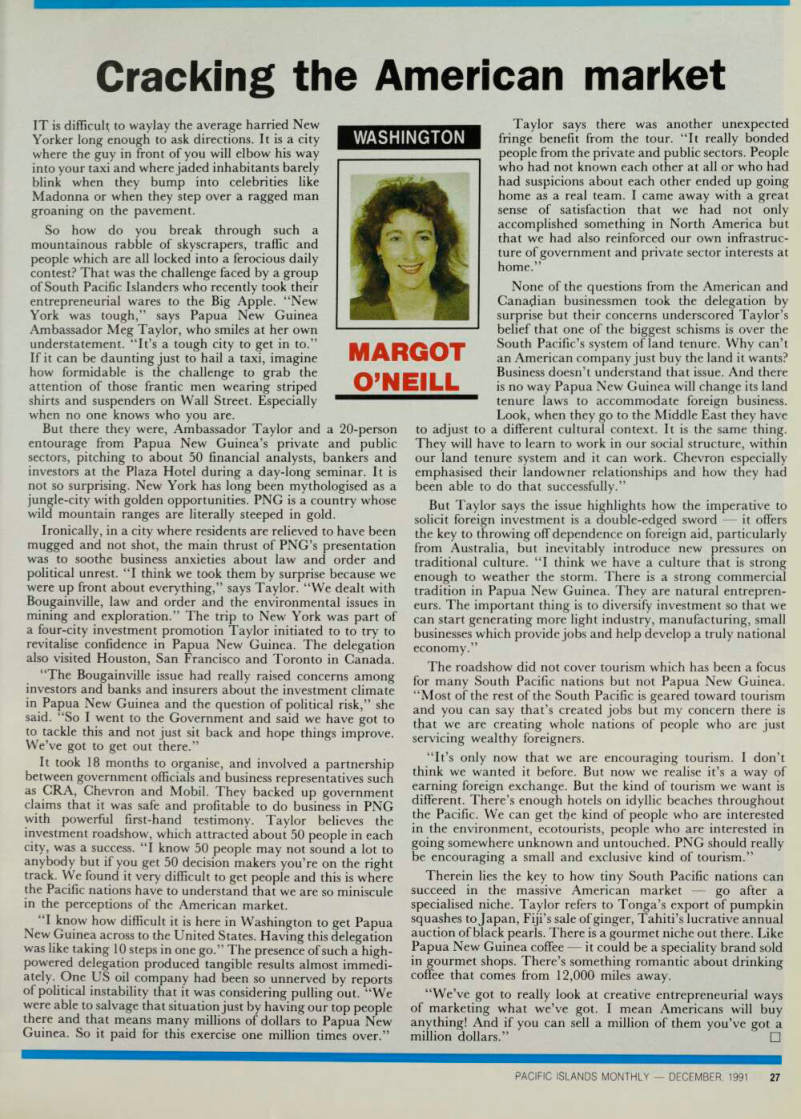
So how do you break through such a mountainous rabble of skyscrapers, traffic and people which are all locked into a ferocious daily contest? That was the challenge faced by a group of South Pacific Islanders who recently took their entrepreneurial wares to the Big Apple. “New York was tough,” says Papua New Guinea Ambassador Meg Taylor, who smiles at her own understatement. “It’s a tough city to get in to.”
If it can be daunting just to hail a taxi, imagine how formidable is the challenge to grab the attention of those frantic men wearing striped shirts and suspenders on Wall Street. Especially when no one knows who you are.
But there they were, Ambassador Taylor and a 20-person entourage from Papua New Guinea’s private and public sectors, pitching to about 50 financial analysts, bankers and investors at the Plaza Hotel during a day-long seminar. It is not so surprising. New York has long been mythologised as a jungle-city with golden opportunities. PNG is a country whose wild mountain ranges are literally steeped in gold.
Ironically, in a city where residents are relieved to have been mugged and not shot, the main thrust of PNG’s presentation was to soothe business anxieties about law and order and political unrest. “I think we took them by surprise because we were up front about everything,” says Taylor. “We dealt with Bougainville, law and order and the environmental issues in mining and exploration.” The trip to New York was part of a four-city investment promotion Taylor initiated to to try to revitalise confidence in Papua New Guinea. The delegation also visited Houston, San Francisco and Toronto in Canada.
“The Bougainville issue had really raised concerns among investors and banks and insurers about the investment climate in Papua New Guinea and the question of political risk,” she said. “So I went to the Government and said we have got to to tackle this and not just sit back and hope things improve.
We’ve got to get out there.”
It took 18 months to organise, and involved a partnership between government officials and business representatives such as CRA, Chevron and Mobil. They backed up government claims that it was safe and profitable to do business in PNG with powerful first-hand testimony. Taylor believes the investment roadshow, which attracted about 50 people in each city, was a success. “I know 50 people may not sound a lot to anybody but if you get 50 decision makers you’re on the right track. We found it very difficult to get people and this is where the Pacific nations have to understand that we are so miniscule in the perceptions of the American market.
“I know how difficult it is here in Washington to get Papua New Guinea across to the United States. Having this delegation was like taking 10 steps in one go.” The presence of such a high powered delegation produced tangible results almost immedi ately. One US oil company had been so unnerved by reports of political instability that it was considering pulling out. “We were able to salvage that situation just by having our top people there and that means many millions of dollars to Papua New Guinea. So it paid for this exercise one million times over.”
Taylor says there was another unexpected fringe benefit from the tour. “It really bonded people from the private and public sectors. People who had not known each other at all or who had had suspicions about each other ended up going home as a real team. I came away with a great sense of satisfaction that we had not only accomplished something in North America but that we had also reinforced our own infrastruc ture of government and private sector interests at home.”
None of the questions from the American and Canadian businessmen took the delegation by surprise but their concerns underscored Taylor’s belief that one of the biggest schisms is over the South Pacific’s system of land tenure. Why can’t an American company just buy the land it wants?
Business doesn’t understand that issue. And there is no way Papua New Guinea will change its land tenure laws to accommodate foreign business.
Look, when they go to the Middle East they have
to adjust to a different cultural context. It is the same thing.
They will have to learn to work in our social structure, within our land tenure system and it can work. Chevron especially emphasised their landowner relationships and how they had been able to do that successfully.”
But Taylor says the issue highlights how the imperative to solicit foreign investment is a double-edged sword it offers the key to throwing off dependence on foreign aid, particularly from Australia, but inevitably introduce new pressures on traditional culture. “I think we have a culture that is strong enough to weather the storm. There is a strong commercial tradition in Papua New Guinea. They are natural entrepren eurs. The important thing is to diversify investment so that we can start generating more light industry, manufacturing, small businesses which provide jobs and help develop a truly national economy.”
The roadshow did not cover tourism which has been a focus for many South Pacific nations but not Papua New Guinea.
“Most of the rest of the South Pacific is geared toward tourism and you can say that’s created jobs but my concern there is that we are creating whole nations of people who are just
servicing wealthy foreigners.
“It’s only now that we are encouraging tourism. I don’t think we wanted it before. But now we realise it’s a way of earning foreign exchange. But the kind of tourism we want is different. There’s enough hotels on idyllic beaches throughout the Pacific. We can get the kind of people who are interested in the environment, ecotourists, people who are interested in going somewhere unknown and untouched. PNG should really be encouraging a small and exclusive kind of tourism.”
Therein lies the key to how tiny South Pacific nations can succeed in the massive American market go after a specialised niche. Taylor refers to Tonga’s export of pumpkin squashes to Japan, Fiji’s sale of ginger, Tahiti’s lucrative annual auction of black pearls. There is a gourmet niche out there. Like Papua New Guinea coffee it could be a speciality brand sold in gourmet shops. There’s something romantic about drinking coffee that comes from 12,000 miles away.
“We’ve got to really look at creative entrepreneurial ways of marketing what we’ve got. I mean Americans will buy anything! And if you can sell a million of them you’ve got a million dollars.” □