Childbirth, without frills
p. 59 · Read in the full issue
Pacific Women
By Eileen Tugum
COLD, frightened, and writhing in pain Mary died in the jungle in a remote part of Papua New Guinea.
Alone, exhausted, in desperate need of help, she clung to a sapling and died with her unborn baby stuck between her legs.
Her family buried her without cer emony the next day. Her sin: she had got pregnant outside of marriage. Shunned by the village, ashamed, and fearful, she had tried to deliver her baby herself.
In the same area another woman also died in childbirth. She had complained of pain and confided to women relatives of stench and discharges. But in a society that doesn’t talk about these things the problem was not brought to health workers’ attention. She died.
Even if it could have been talked about, the nearest health centre was a day’s walk through rugged country.
A trainee health extension officer on leave delivered the child. It had been dead for some time. The infant’s skin was peeling off. The woman’s family had to put on a big party to compensate the man who had broken tradition and cultural taboos to deliver the child.
Over 1000 women in Papua New Guinea are reported to die annually from problems related to childbirth but only about one in 10 maternal deaths are estimated to be reported.
Some studies say the most immediate cause is lack of care.
However, they say social and cultural factors usually underlie biological and physical reasons.
These include poverty, ignor ance, isolation, poor nutrition, overwork or heavy workload, no
family planning (many
pregnancies, or closely spaced children), violence based on lack of respect between partners, inaccessibility of health services, cultural food taboos, and cul tural attitudes to women and their role and childbearing.
Studies say many of these are related to low status of women.
The good news is that the health and welfare of PNG women has finally gained a national focus, as at the 19th Waigani Seminar in June in Port Moresby. About 100 men and women representing women’s leaders, health workers, policy
makers, project planners and educators attended the one-day meeting the culmination of a four-year project focus ing on the status of women’s health.
The meeting looked at the issue under the sub-topics of education, social and cultural issues, health services and gen eric issues which were seen as contribu ting to women’s health. The aim was
identifying major barriers and develop
ing strategies and projects.
For education and literacy there was a call to carry out a mass campaign to change community attitudes to women and their role, including sensitising men on women’s issue and educating them to share responsibilities. There was a call to set up village reading programs and village resource centres, and for efforts to improve the status of women at the national level through lobbying and boosting their role in decision-making.
There was a call for updating health worker curriculum, training more female workers, strengthening women’s organis-
ations on the local level, as well as the Women’s Division which would be made its own Ministry.
Participants stressed that women’s health was very important it was the key to the health of her children and family.
Group discussions revealed that de spite a shortage of resources in specific areas such as health services, there are general financial and human resources available. What is missing is coordi nation of efforts and integration of programs within existing projects. They said a coordinating body should be established to ensure ideas are implemen ted, not put in a document and forgotten.
The Departments of Health, Home Affairs and Youth, Education, Finance and Planning and donor agencies at the meeting gave their commitment to mak ing the ideas a reality.
A meeting will be organised to follow through the call to establish a coordinat ing body and set up future directions.
The Prime Minister’s wife and Patron of the 19th Waigani Seminar, Margaret Nakikus, in her address said the current health situation of women is “unaccept
able and must change”.
She said the country had seen some major improvements in some health indicators, for ex ample infant and child mortality rates have been decreasing, but the same cannot be said for women’s health. “In fact there are indications that the situation is worsening,” she said.
She pointed out that: • Papua New Guinea women today make up 47 per cent of the
country’s population;
• 43 per cent of them are in the child-bearing years of 15-44; and on average each will bear 5.4 children; • each stands a lifetime chance of one in 26 of dying during a pregnancies; • access to family planning is limited and less than 3 per cent are using it.
According to Acting Secretary
for Home Affairs and Youth Giant Alok: “What we need is commitment to the overall status of women. We need not only to identify factors affecting the health of women and develop strategies and projects to address these barriers, but to give human and financial support.”
Otherwise the bright ideas will just remain bright ideas, and the status of women’s health will not improve. □
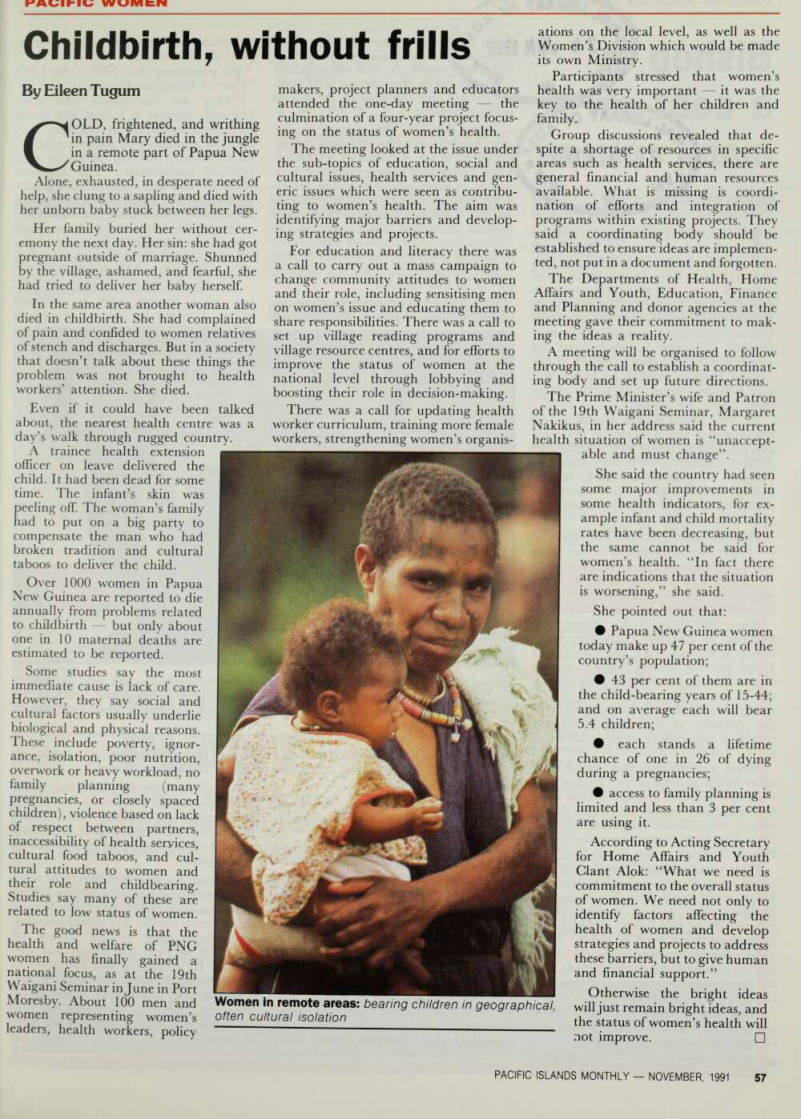
Women in remote areas: bearing children in geographical, often cultural isolation