SSSir, there’s a stowaway aboard
p. 58 · Read in the full issue
Environment
By David North
THE US military wiped out the world’s fourth-largest army in 100 hours in the Persian Gulf, but now it has been asked to tackle a really tough task prevention of the spread of the Brown Tree Snake into snake-free Pacific islands.
US Senator Dan Akaka (D.
Hawaii) has introduced two bills which ask the Secretary of Defence (as well as the Secretary of Agriculture) to mount campaigns against the fertile snake which
has spread havoc through Guam for the past 40 years.
Without natural enemies on the island, the Brown Tree Snake has killed off nine species of forest birds (including three unknown elsewhere in the world), has caused numerous power outages (they like
to crawl up utility poles), and has bitten at least seven Guam children. The Brown Tree Snake, like the Mainland rattle snake, is poisonous but, unlike the rattlesnake, its method of delivering venom is considerably less efficient, so no one on Guam has yet died of its bite.
There have been reports of Brown Tree Snake sightings, many of them confirmed, on an array of Pacific islands, including Saipan and Tinian in the Marianas, Oahu in Hawaii, Kwajalein in the Marshalls, and Pohnpei in FSM.
It is a good-sized snake; those found in Guam are typically three to four feet long, but the really mature ones grow to eight to 10 feet in length.
Senator Akaka’s choice of the Secre tary of Defense as a potential ally is a logical one, for it is generally believed that it was the US military that brought the Brown Tree Snake to Guam, and there have been military connections to many of the other sightings.
During World War II the US built a number of large military bases through out the Pacific, one of the largest of these was on PNG’s Manus Island. According to Tom Fritts, America’s leading expert on the snakes, the Brown Tree Snake is common on Manus, but controlled to some extent by its natural enemies. One or more of the Manus snakes, perhaps seeking to avoid those enemies, crawled into some military cargo containers which were on their way to Guam, and that’s apparently how they reached
Guam during or just after World War 11.
The US military may continue, unwit tingly, to help spread the snake around the Pacific. For example, the one sighting on Kwajalein was of a Brown Tree Snake that had crawled out of the landing gear assembly of a military cargo plane.
Similarly, there have been four sightings on Oahu, three of them on or near Hickman Air Force Base. In one case a dead Brown Tree Snake was identified near a C-141 cargo plane.
The snakes seen on Saipan probably hitched rides on planes or ships from
Guam, Fritts explained. One was found dead in an air cargo container that had just arrived from Guam, that was last November. Earlier this year there were two more sightings, one near the Charley Dock on Saipan, and the other a mile or so from the airport.
While Senator Akaka wants a law
passed mandating the Department of
Defense to defend Hawaii from the snakes, another Department, Interior, is doing something about it. Fritts, a herpetologist (snake expert) by training, heads a major effort within the US Fish and Wildlife Service to cope with the pesky snakes. Further, Stella Guerra, Assistant Secretary of Interior for Insular and iHtcmational Affairs, has just an nounced a $147,000 grant to the Com monwealth of the Northern Manana Elands so that CNMI can mount its own a nti-Brown Tree Snake campaign.
What can you do to control these slithery creatures?, PIM asked Fritts, «*L° has ‘ ectu / ed , on the subject on 14 d f erent Pac,f ‘ c * slands - ‘ 15 not , eas >'' The y f" a " d do ct ™} ' nt ° thin f’ particularly shipments of food (hence the interest m the Secretary of Agriculture) that move from island to island. Once in a ne , w environment they hide, and their fertlllt y 15 legendary.
“How about poisoning them?”, he was asked. This is at least a possibility with the Brown Tree Snake, unlike other kinds of snakes which only eat living creatures, like mice. (It is hard to put
snake-killing poison in a mouse without killing the mouse.) “The Brown Tree Snake will eat things other than living animals,” Fritts said, “they eat balls of hamburger in zoos, for instance; they also eat things that have been smeared with blood.”
The problem is that there is no way yet known to poison the Brown Tree Snakes without endangering the environment threatening order, harmless animals, or small children. Fritts and his staff, however, are working on it.
One of the reasons why the CNMI Government and Senator Akaka are so concerned about the Brown Tree Snake is because their islands are snake-free.
“The only indigenous snake on most
Pacific islands is the Blind Snake,”
Fritts explains,
“and most people would not think of it as a snake. It is about as thin as the lead in your pencil, and about as long.” It eats insects and gener ally stays away from humans, who often do not know that it is there.
What should people in the islands do about these snakes?
“First, don’t panic; there is a danger, but the snakes have yet to kill any humans,” Fritts replied. But he said that if a suspected Brown Tree Snake is sighted, it should be reported to the authorities.
If possible, capture the snake, alive or dead, and give it someone who can identify it. Information is valuable. If that is not possible, a photo of it might help.
Fritts’ final advice, came with the sigh G f an experienced public servant, as he
said “support quarantine procedures”,
Quarantine procedures may, for ex ample, require that incoming shipments G f lumber must be kept at the dock for a wee k, to make sure that no snakes are hiding ther e. Xhe i um ber merchant or builder may want his shipment of wood right away, and complain about government-imposed delays on his get ting his hands on his property, Further, the future of the Port of Guam may be adversely affected by the snake scare. Businessmen in Saipan may not want to receive goods shipped through Guam if the goods are more 1 kely - even though the chances are slim to have Brown Tree Snakes than goods shipped direct yto aipan.
Apparently there is no easy way to control snakes, which is why Senator Akaka wants as powerful allies as he can muster in this battle.
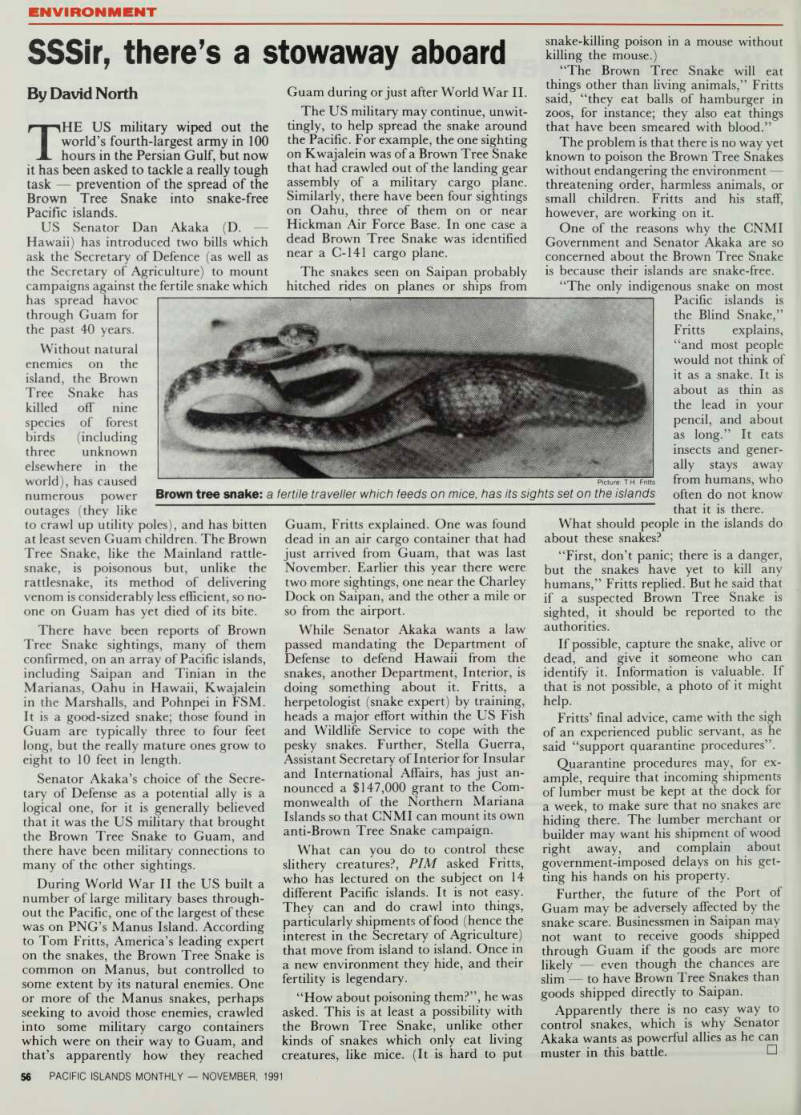
Picture: T.H. Fritts Brown tree snake: a fertile traveller which feeds on mice, has its sights set on the islands