Bishop in
p. 60 · Read in the full issue
Pacific People
Bishop in a coat of many colours
By Ian Williams
THE survival of indigenous peoples and the welfare of the South Pacific are two of Sir Paul Reeves’s big priorities. This happy juncture of interests is not too surprising, since he was the first Maori to became Arch bishop of New Zealand, and then the first to become the country’s Governor General. This year he has become the Anglican Church’s first observer at the United Nations, which he hopes will give him an opportunity to do some thing about his interests.
He told Pacific Islands Monthly: “My grandmother was a Maori so my roots and associations are as well. The Maoris in New Zealand are relatively strong so perhaps it wasn’t surprising that I became Archbishop and Governor Gen eral. But merely by going somewhere, you make a statement”.
How did you get into the church?
“It just sort of happened there was no great Damascus experience. I went to University and felt that being a priest was a means of attaching myself to the hopes and aspirations of my people”.
How did you move from the Church to State? “I became Arch bishop at the age of 45, and then David Lange put the idea of being Governor General to me. I considered whether it would be consistent with what I was doing, and decided that I could relate to the country as a whole. I always regarded privilege as being a means of access.”
What access did you gain? “To other Pacific peoples in New Zealand. As Governor General I would attend their functions, and visited the islands them selves. My official responsibilities for those five years ranged from the South Pole to Tokelau in the North.
“One gets confused. For most of the world, Asia-Pacific means Taiwan or Japan, or the Pacific Rim. But for me, the Pacific is tiny isolated nations, small groups of people with rudimentary technology surrounded by ocean. They are struggling to survive in a world which doesn’t especially want their goods and services, except tourism. And tourism can be fickle and devastating as well”.
Why the United Nations? “It’s where the world comes to do its business.
In fact it is not the only place.”
’.deeply concerned that vital *f(Tmon<*'?and social matters are decided dsefptmf, usually by rich industrialised while the relevant UN com rfntees are only attended by the second string diplomats.
From the UN he reports to the Consultative Council, whose liPresident is the Archbishop of Canter pbury. Living in a nearby seminary, he is now in premises provided by the Ameri can Episcopal Church, a short walk from the UN Building in New York. His modest two-person office, sporting the “alternative” New Zealand flag, is next to that of the Bishop for the US Armed Forces. However, Sir Paul is a different sort of church militant.
“My first job is to try to represent this global network of people, the Anglican
church, to see if I can form and influence UN activity. And, of course, to see how the UN can help us”.
He began by knocking on doors,
starting with the heads of missions. “I went to the Pacific Missions first it’s .my territory, after all. I found to my pleasant surprise that they knew of me as Governor-General I had travelled around the region. In the amorphous stew of the UN, it’s good to come from somewhere. After that I went to the Frontline African Ambassadors”.
But what was he going to do with these contacts? “I have identified areas of concern for us: the environment I am involved in drawing up an Earth Char ter; secondly human rights monitoring the debate about South Africa and Apartheid, the Palestinian/Israeli issue,
the problems of refugees, and children, must all be considered.”
He points out that 1993 is the UN’s
“Year of Indigenus Peoples”.
“They are the people who were originally present in a land and found themselves swamped by colonists, and are now a minority in their own land,” he explained, drawing upon his own personal background. “The Anglican Church contains many indigenous people, in the South Pacific, in South Africa, and even among Palestinians.”
Having identified the problems, and met many of the people who may help a solution what do he and the Anglican Church propose to do about it?
“It’s the time-honoured thing of work ing out a strategy with an advisory group. I might be able to provide a
neutral place. Someone who seeks to inform rather than coerce.”
As one example, he points out, while many people see religion as one of the problems in the Middle East. “Some possibilities are beginning to arise that
religious leaders might be encouraged to
talk together.”
But t j ien secretary interrupts with a parcel that has just been delivered. The interv iew, with PIM finishes, as it began, i n the South Pacific. The parcel contains a facsimile copy of the Treaty of Waitangi between the British and the Maoris. He unfolds it, and scrutinises it and explains the marks of the chiefs, for a few minutes transported 12,000 miles from the concrete Megapolis in the Northern Hemisphere to the green hills of home. □
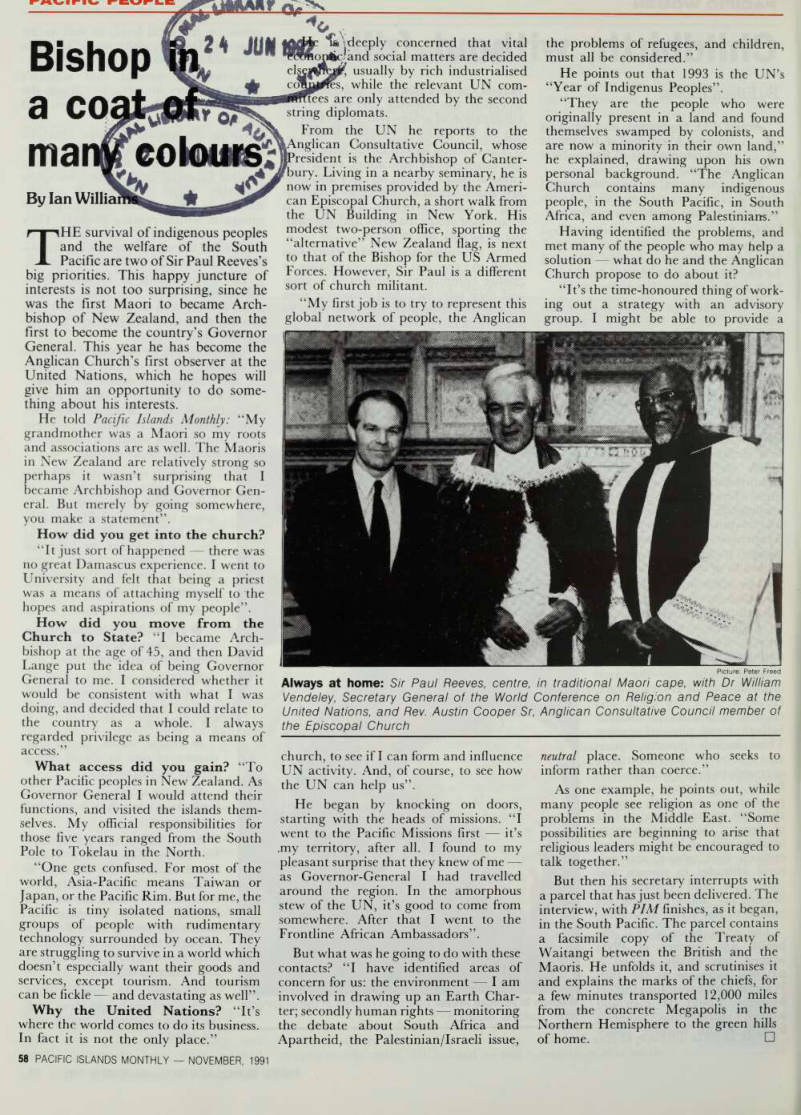
Always at home: Sir Paul Reeves, centre, in traditional Maori cape, with Dr William Vendeley, Secretary General of the World Conference on Religion and Peace at the United Nations, and Rev. Austin Cooper Sr, Anglican Consultative Council member of the Episcopal Church