For the future?
pp. 41-42 · Read in the full issue
I fright man
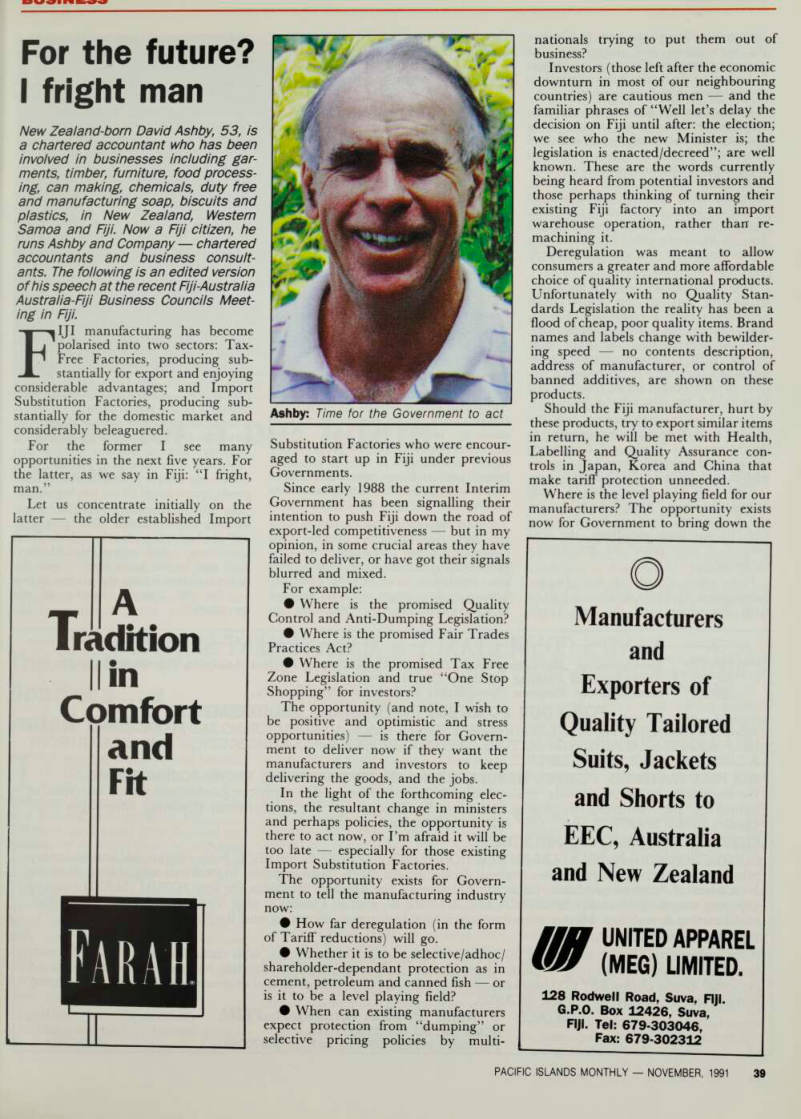
New Zealand-born David Ashby, 53, is a chartered accountant who has been involved in businesses including gar ments, timber, furniture, food process ing, can making, chemicals, duty free and manufacturing soap, biscuits and plastics, in New Zealand, Western Samoa and Fiji. Now a Fiji citizen, he runs Ashby and Company chartered accountants and business consult ants. The following is an edited version of his speech at the recent Fiji-Australia Australia-Fiji Business Councils Meet ing in Fiji.
FIJI manufacturing has become polarised into two sectors: Tax- Free Factories, producing sub stantially for export and enjoying considerable advantages; and Import Substitution Factories, producing sub stantially for the domestic market and considerably beleaguered.
For the former I see many opportunities in the next five years. For the latter, as we say in Fiji: “I fright, man.”
Let us concentrate initially on the latter the older established Import
Substitution Factories who were encour aged to start up in Fiji under previous Governments.
Since early 1988 the current Interim Government has been signalling their intention to push Fiji down the road of export-led competitiveness but in my opinion, in some crucial areas they have failed to deliver, or have got their signals blurred and mixed.
For example:
• Where is the promised Quality
Control and Anti-Dumping Legislation?
• Where is the promised Fair Trades Practices Act? • Where is the promised Tax Free Zone Legislation and true “One Stop Shopping” for investors?
The opportunity (and note, I wish to be positive and optimistic and stress opportunities) is there for Govern ment to deliver now if they want the manufacturers and investors to keep delivering the goods, and the jobs.
In the light of the forthcoming elec tions, the resultant change in ministers
and perhaps policies, the opportunity is
there to act now, or I’m afraid it will be too late especially for those existing Import Substitution Factories.
The opportunity exists for Govern ment to tell the manufacturing industry now: • How far deregulation (in the form of Tariff reductions) will go. • Whether it is to be selective/adhoc/ shareholder-dependant protection as in cement, petroleum and canned fish or is it to be a level playing field? • When can existing manufacturers expect protection from “dumping” or selective pricing policies by multi
nationals trying to put them out of business?
Investors (those left after the economic downturn in most of our neighbouring countries) are cautious men and the familiar phrases of “Well let’s delay the decision on Fiji until after: the election; we see who the new Minister is; the legislation is enacted/decreed”; are well known. These are the words currently being heard from potential investors and
those perhaps thinking of turning their
existing Fiji factory into an import warehouse operation, rather than re
machining it.
Deregulation was meant to allow consumers a greater and more affordable choice of quality international products.
Unfortunately with no Quality Stan dards Legislation the reality has been a flood of cheap, poor quality items. Brand names and labels change with bewilder ing speed no contents description, address of manufacturer, or control of banned additives, are shown on these
products.
Should the Fiji manufacturer, hurt by these products, try to export similar items in return, he will be met with Health, Labelling and Quality Assurance con trols in Japan, Korea and China that make tariff protection unneeded.
Where is the level playing field for our manufacturers? The opportunity exists now for Government to bring down the
Ashby: Time for the Government to act
decrees they have promised, to alleviate the nervousness and uncertainty. As quite a percentage of our existing Import Substitution Factories have Australian shareholders then time is running out.
What can be done? The Customs Department should be moved from Finance into the Ministry of Trade and Commerce. Our Government must start using tariffs as an instrument of develop ment rather than as a source of revenue.
I recommend that 40 per cent nett protection across the board be the norm: duty on raw materials 10 per cent, excise duty on finished goods 10 per cent, nett protection 40 per cent, duty on competi tive imports 60 per cent.
Why? With all the world trying madly to export and all our Pacific Rim neighbours having economies of scale, what chance does a small manufacturer, 1500 kilometres into the wide blue Pacific, with a domestic buying popu lation of a medium size Australian town, have to offer against them? But if he had Customs on his side, what a boost.
Let’s level up the teams and the playing field. With Customs reporting to the Minister of Trade and Commerce there would be much more consultation with manufacturers before tariffs were set (or reduced). Our Minister could surely be counted on to “blow the whistle” on the professional fouls the dumping and the standards avoidance, the “ex porters at any price” to get foreign
exchange.
Five years ahead of our Import Substitution Factories, without a halt to tariff reductions until the Fair Trade
Practices Act and Quality Assurance/ Consumers Rights Legislation is in place, I don’t like what I see! That said for import substitution factories what do I see five years ahead for manufacturing?
I see concern for political stability and for continuation of previously announced economic policies to which manufactur ers are now slowly starting to adopt. I see rising wage costs fuelled by demands for better living standards, rising social welfare costs with staffing costs rising in concert with those of Australia, rising energy costs, rising freight costs and clearance charges, and the current freight war leaving fewer players.
I see increased competition from leaner, hungrier manufacturers in Aus tralia and New Zealand and from imports from our Asian neighbours as shipping routes open to follow the political desire for less dependence on Australia and New Zealand.
But (and I leave the most optimistic for last), I see more use made of Australian raw materials converted and shipped back, as an alternative to fully made-up imports from Asia. I see increased opportunities for progressively higher technologies to use our educated labour pool and our export advantages under LOME into the European Com munity and GSP into the United States.
This is where Fiji manufacturing must go over the next five years, with opportunities for Government to stop prevaricating and implement the tax free zone legislation, to make the FTIB truly a one-stop shop, to get one clear message to incoming investors “We want you
and your money, and we will make it very easy for you to start your new business here”.
The contradictory messages from Cus toms, Reserve Bank, and Immigration at present are making Trade and Com merce a joke in trying to encourage investment in manufacturing in Fiji.
Deregulation today. With Reserve
Bank of Fiji regulations, Customs, Stat istics and Inland Revenue Department Regulations the Manufacturing investor finds that Fiji has one of the most regulated business environments in the region. There is more form filling, monetary returns and exchange controls than in the Colonial era “hay-day”.
Opportunities exist and will expand for manufacturing in jewellery, fashion accessory and leisure equipment: any thing with fast changing styles, fads or fashions; anything requiring small runs, quick delivery, personal selection/super vision from Australia; anybody requiring low inventory, fast stock turns, flexible production scheduling. Downstream products of the sugar industry phar maceutical as well as alcohol based. The furniture and fashion hardwood products industry, after a hesitant start is just beginning to settle down. Peripherals of the sewing industry: sails, towels, leather goods, sports goods all are just beginning!
In the terminology of the sports minded: “Government, after preparing the pitch, setting the boundaries and appointing a fair referee, should stand back and let the game flow with the ticket collector letting the players in free for the overall benefit of the spectators.” □