Fitted for a big future
pp. 43-44 · Read in the full issue
By Martin Tiffany
ASK Mark Halabe what the past two years have been like and he claims, with a smile, that in 1989 he didn’t have a grey hair.
It was in September of that year that he opened a garment manufacturing firm, Mark One Apparel, in Fiji. He has had to overcome a few problems, to
which he jokingly attributes his change of hair colour, but he is happy with the result.
He shows you around his Suva factory and points out with obvious pride the
specialised machines, the airy working
conditions, the staff canteen area and the
finished product.
Halabe is typical of the new breed of investors who have come to Fiji since
1987 because of the Tax Free Factories, cheap labour and preferential access to Australia and New Zealand under
Sparteca.
Before coming to Fiji Halabe owned and ran two clothing manufacturing companies in Sydney. He streamlined operations, merged the two and left his younger brother in charge.
“The Australian government decided to reduce the protection in the industry.
Faced with mounting wage increases, deregulation that is cheaper imports we realised in the short term it was going to be impossible for us to manufac ture in Australia economically.”
So he looked at alternatives including China, Indonesia, Thailand and the South Pacific. For personal as much as economic reasons he chose Fiji it offered his family security, an attractive lifestyle and no language barriers.
Halabe’s highly automated factory
specialises in men’s and boys’ shirts and exports 80 per cent of its output to New Zealand and 20 per cent to Australia.
According to Halabe the largest single
problem he faces is the efficiency of the
factory.
“My Australian company employs 90 people and produces 100 per cent more than we produce here where I employ 160 to 170 persons. Here we produce around 5500 shirts a week whereas in Australia we produce 7000 to 8000 shirts per week and the type and amount of machinery is duplicated,” Halabe said.
But he is quick to point out that his Australian workers have an average of 20 years experience, and that Fiji workers
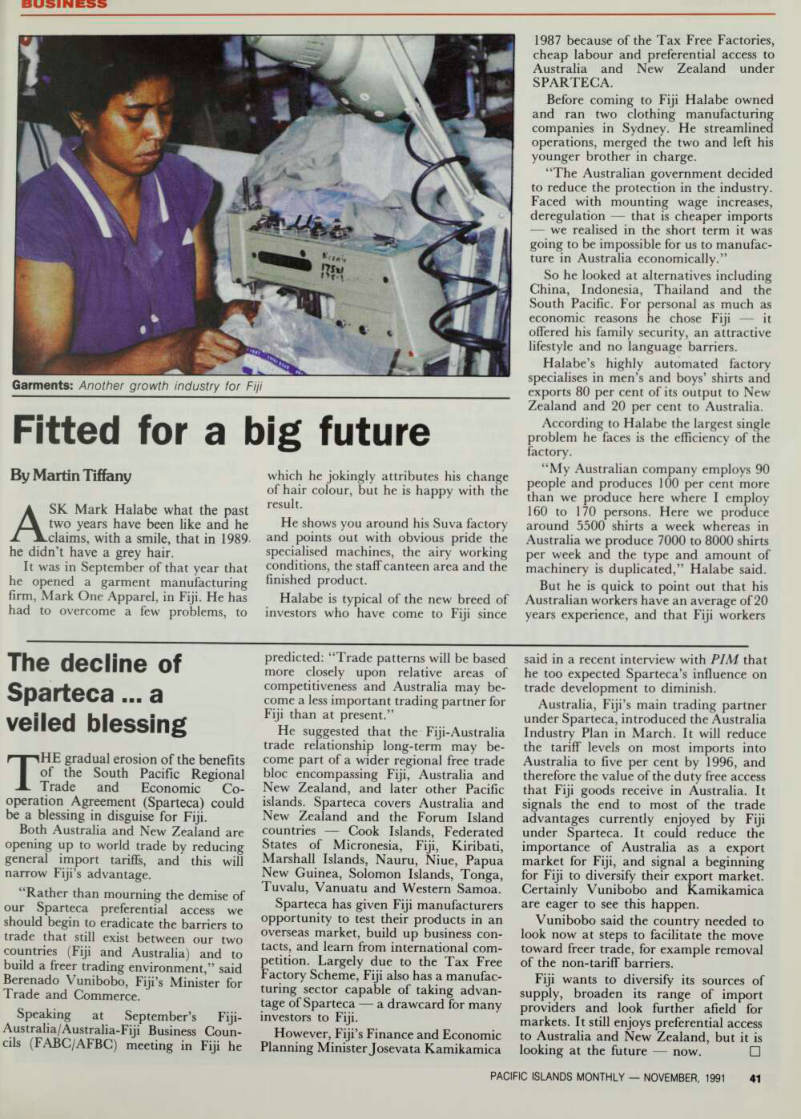
Garments: Another growth industry for Fiji
already are expanding their experience with time. The Fiji government also has established a garment training school in Suva to upgrade skills.
Halabe also faced problems from unexpected quarters. He said after being asked to come to Fiji to invest, the Fiji government did its best to ensure every thing went smoothly but three depart ments gave him problems.
“Customs don’t like Tax Free Factor ies because they’ve lost income from them and they give a lot more work to them with no real benefit. It’s also hard to convince Customs that things have to be done quickly samples passed, spare parts handled as any delay in manufacturing causes us to be less efficient.
“As far as the Immigration Depart ment is concerned, we were promised we would be allowed to bring in our own expats we feel are required. What we weren’t told is we had to advertise locally first, prove there was nobody available locally then apply for somebody overseas and leave it up to their discretion to give us a work visa.
“I also found it very hard to convince the Reserve Bank of Fiji I was not a carpet-bagger and was here not only to improve my business but the garment industry in Fiji.”
Halabe said he now has developed a
better rapport with the departments.
He, like other investors, also pointed out too that the Fiji Trade and Invest ment Board (FTIB) are helpful but limited.
Fiji’s Deputy Prime Minister and Minister of Finance and Economic Planning, Josevata Kamikamica, ac knowledges that there are some prob lems. “Incentives for investors have been significantly improved in recent years and the procedures by which the incen tives are granted have been simplified.
However, we have to acknowledge that there remain bottlenecks and inefficiencies in the investment approvals process. We need to review the situation to establish what is going wrong and what needs to be done.”
However, despite a few blemishes the garment industry in Fiji looks healthy.
For the first six months of this year garment export from Tax Free Factories (TFF) is FSBO million. For the year it is estimated to be about FSIBO million.
Most of the garments exported are from the TFF sector. Last year the TFF garment sector had exports worth F 5159.4 million compared to F 5100.7 million in 1989 and F 530.1 million in 1988. Numbers employed have increased with 3022 employed in 1988, 6434 in 1989 and 7829 last year.
Padam Lala, the president of the Fiji Garment Manufacturers Association,
predicts that the garment industry will employ 25,000 people and its exports will be worth FSSOO million in four or five years. Predictions for the year 2000 are exports of F$ 1000 million, To date there are about 115 garment factories operating about 13 are wholly foreign owned. As of June this year, 81 of these enjoyed Tax Free
Factory status.
The garment sector continues to dominate the TFF sector in terms of employment generation. It increased its share in the total TFF employment from 71.8 per cent in 1988 to 81.1 per cent in 1989 to 82.4 per cent last year. Of the 9503 people employed by the TFF sector at the end of last year, 7829 were employed in the garment industry.
Exports to Australia and New Zealand hav e fallen off with the recession, but W ‘ U P lck , U P- Current figures show N f w Zealand as < he la rgest market taking 50 per cent of output, the United estimated States takes 24 per cent goes, Australia 22 per cent, Britain two per cent and the remaining two per cent is shared between Pacific Islands. Some manufacturers are looking to Europe, but to avoid duty they must buy expensive European cloth. ' The future looks bright. The Austra lian Industry Plan, which will see removal of import quotas into Australia from next year, is expected to produce a boom for Fiji manufacturers. □