Pacific
pp. 37-40 · Read in the full issue


Islands
Monthly
Business
Masterminding an economic comeback
By Martin Tiffany
AS you gaze from Josevata Kami kamica’s window across the serene setting of Albert Park towards the lush botanical gardens and the sea wall, there is a
definite calming effect.
It may have been on this scene that the deputy Prime Minister and Minister of Finance and Economic Planning looked as he pondered Fiji’s economic future after the 1987 coups a future that many predicted would take years to recover. But, with the quietly-spoken
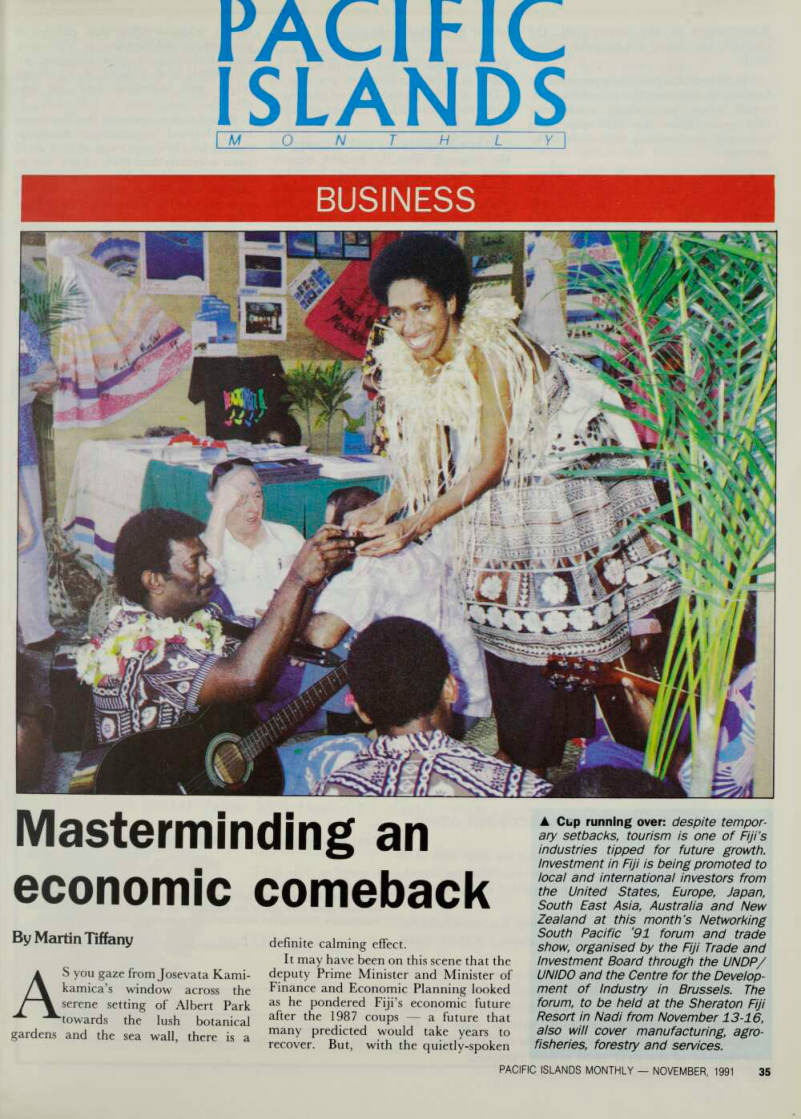
▲ Cup running over: despite tempor ary setbacks, tourism is one of Fiji’s industries tipped for future growth.
Investment in Fiji is being promoted to local and international investors from the United States, Europe, Japan, South East Asia, Australia and New Zealand at this month’s Networking South Pacific ‘91 forum and trade show, organised by the Fiji Trade and Investment Board through the UNDP/ UNIDO and the Centre for the Develop ment of industry in Brussels. The forum, to be held at the Sheraton Fiji Resort in Nadi from November 13-16, also will cover manufacturing, agro fisheries, forestry and services.
Kamikamica as the mastermind, the economy has staged a remarkable come back.
Fiji already has proved its potential by holding its own over the past three-and a-half years, particularly considering that even before the 1987 events its economic performance left much to be desired.
Economic growth, in real terms, measured by Gross Domestic Product (GDP) totalled only six per cent between 1981 and 1986 an average of about one per cent per annum. Per capita growth in real incomes was negative between 1980 and 1986. Average real income per capita fell by seven per cent during this time.
Numbers in total paid employment declined from 81,406 in 1981 to 79,854 in 1986. This was at a time when about 11,000 young people were joining the
labour force each year.
Government debt had risen from FS26B million (27 per cent of GDP) in 1980, to FSSBI million (40 per cent of GDP) in 1986. Annual interest payments had risen from Fsl6 million to FS49 million.
When Kamikamica took the reigns of the economy after the interim govern ment was appointed, Fiji had lost international friends, its foreign reserves were depleted, business confidence had fallen, the inflow of tourists had halved, and unemployment had soared. The interim-government commissioned a “stocktake” of the economy.
“The unavoidable conclusion from the economic stocktake was that what was required was not a strategy to correct the immediate impact of the coups, but to put the economy on a path of sustained
growth,” Kamikamica explained. “This
meant acknowledging that policies of government intervention in the econ omy, including its own economic in volvement, and policies of regulating wages and industries, had not suc ceeded.”
Kamikamica explained that the lesson to be learned (regardless of hardships caused by the coups) was that a small open economy has little choice but to adjust to world conditions if it wants to improve its living standards. Policies were designed to change Fiji from a high cost, high-tax and slow-growth country, to an efficient and competitive producer.
The idea is to put the country’s resources into efficient domestic pro duction and export-oriented production rather than inefficient production for local markets. Consequently, many im port duties and fiscal duties were reduced in the 1989 and 1990 budgets.
In a recent appraisal of Pacific island
economies, the World Bank reports that Fiji has potential for faster progress than neighbouring island states. It parallels Fiji and Mauritius and says the key to sustained growth will be greater private participation in investment and econ omic affairs. Results show things are going the right way.
Economic growth in Fiji in real terms from 1989 to 1990 totalled 18.6 per cent of GDP an annual average increase of 6.2 per cent. GDP in 1986 was F$ 1326.1 million, in 1987 FS 1329.2 million, in 1988 F 51433.3 million, in 1989 F 51661.4 and last year it rose to FS 1859.9 million.
Income per head has increased from 1987 to 1990 by nearly 40 per cent from about FSIBOO to F 52500.
The number in total paid employment has increased from 78,200 in 1987 to 89,900 in 1990, recording a fall in unemployment from 9.3 per cent in 1987 to 6.4 per cent in 1990 and it is expected to fall below six per cent this year.
The biggest rise in employment has been in manufacturing a direct result
of the Tax Free Factory (TFF) scheme introduced in late 1987. In the first quarter of this year manufacturing employed 22,089 people, compared with 13,482 em ployed in the last quarter of 1987. The TFF scheme also is currently one of the major generators of foreign
exchange earnings. Last year
it attracted F 553.3 million of investment and generated F 5231.1 million of exports.
“To encourage the transi tion of Fiji from an inward oriented economy to an out ward, or export, oriented economy, the government has given special incentives
to encourage investment in exporting industries,” Kamikamica said.
“We think that manufacturing for export has good potential for Fiji. This view is supported by the immediate and dramatic development of the garment industry in Fiji. We expect production of other manufactured goods to expand in future. Footwear, furniture and food processing have been mentioned as good prospects, but there are plenty of others.
“Outside manufacturing, we still look to the tourist industry as a major source of economic growth... I see
opportunities also in forest products, fishing, mining and non-sugar agricul ture,” Kamikamica said.
According to Len Wilson of Fiji Forest Industries (FFI) the forest industry could contribute up to double the present levels. About 500,000 cubic metres of logs per year are presently produced, of which half is from the pine industry.
Last year gross tourism earning was estimated at F 5335 million while sugar earnings are around FS2OO million.
Other major exports include unrefined gold, timber and fish.
Andrew Thomson, chief executive of the Japanese giant LIE International which is developing the major integrated resort at Denarau Island near Nadi International Airport, says tourism has helped transform the islands into the region’s top vacation destination.
“Last year, our 4500 hotel rooms provided accommodation for a record 278,000 visitors who generated FS34O million in foreign exchange. In terms of a GDP of F$ 1.229 billion, tourism
represented about 12 per cent.
“It employs, directly
and indirectly, some 24,000 but the multiplier effect of the tourism dollar brings the wealth of the industry to every village and settle ment,” said Thomson.
On a broad scale the economy is largely based
on private enterprise, with
government ownership of service utilities, the na tional airline (Air Pacific), and the Fiji Sugar Corpor ation which mills all the country’s sugar.
Sada Reddy, the re search director at the Re
serve Bank of Fiji (RBF), says at present Fiji businesses rely predominantly on overdraft and term lending from the commercial banks and the non-banks.
He said alternatives need to be developed like greater equity participation and raising funds in the market place through issues of various debt instruments.
“But to move on these fronts it may require institutional strengthening. For instance, this may mean strengthening the Suva Stock Exchange. Various finance legislations will need to be reviewed so that they provide the right legal framework to undertake financial reforms,” Reddy explained.
Reddy said the RBF already has undertaken a major organisational restructuring. The bank is strengthening its supervisory capabilities to help main tain a stable financial system in a more deregulated economy.
Meanwhile, the RBF says the drop in foreign reserves and continued high demand for private sector credit has seen further contraction in liquidity.
Fiji’s external reserves fell to U 55203.8 million at the end ofjuly, from U 55239.4 million at the end of June and U 55215.5 million at the end ofjuly last year.
Kamikamica said most of the invest ment in Fiji was by local businessmen so a study had been taken to develop new types and sources of finance. But invest ment from overseas still would be
required, preferably in joint ventures.
He offered investors assurances about next year’s elections.
“It is widely recognised in Fiji, and has been for many years, that investment is essential to the well-being of our people.
I do not think that it will be possible to form a government in Fiji that does not have a clear commitment to the encour agement of investment.”
Despite the fine comeback staged by the Fiji economy it faces some problems and criticism. For example, the Fiji Manufacturers Association says the country’s contradictory economic re forms are discouraging potential invest ment from Asia, especially Hong Kong and Taiwan.
Association president, Padam Lala, says the interim government is deregulat ing selected industries in Fiji, but not following suit in infrastructure and labour costs. Lala, a garment manufac turer, says changes to labour laws promised October 1 have not happened and instead, delays in labour reforms and the government’s contradictory policies are hampering manufacturing from ex panding and upgrading businesses.
Lala says investors from Hong Kong, Taiwan, Australia and the United States are postponing operations in Fiji.
Another problem faced is the lack of skilled workers to meet the needs of investors, but Kamikamica said if invest
ment grows at 10 to 20 per cent per annum or less it will not be a problem.
Meanwhile, they had opened a garment training school, were establishing a tourism training school in Nadi, and were bringing in skilled expatriates to address the outflow after 1987.
Looking at the economy as a whole, Kamikamica said strike threats and world recession have combined to rob Fiji of a projected 3.4 per cent economic growth this year. He now predicts the growth to be around 1.5 per cent.
But, in the longer term, Kamikamica sees a rosy future if Fiji pursues financial
stability, economy-wide competitiveness,
a price structure which reflects world market opportunities, and a regulatory framework that encourages competition.
“In the next five years, if we pursue these policies, we can look forward to growth of up to six per cent per annum, provided that both non-traditional ex ports and tourism grow at about 9-10 per cent per year. We are hoping that our imports of capital goods and raw ma terials will grow at a similar pace, to finance expansion in both the traditional and the new export-oriented sector,”
Kamikamica said.
The key to all this? “If we are to achieve the accelerated growth rates we are looking for, we need very substantial additional investment.” □