Message of peace
p. 45 · Read in the full issue
peace in Maori art
By Nicholas Rothwell
THE war-like art of the New Zealand Maori is playing a new role in today’s Ireland as part of a move to improve relations between divided Ireland’s north and south.
A major exhibition of Maori artefacts, titled Te Ao Maori (The Maori World) is on display in the Ulster Museum of Belfast, capital of British-ruled Northern Ireland, after transferring from the National Museum of Ireland in Dublin, capital of the independent south. As Patrick Wallace, director of the Irish Museum, explains, “we are strengthen ing close cultural cross-border ties”.
Te Ao Maori was staged to commem orate the 150th anniversary of the signature of the Treaty of Waitangi, and to mark the participation of a lone Irishman, Captain William Hobson of County Waterford. It also gives the Dublin Museum an opportunity to display its rich holdings of Maori art, which rival those of Britain and conti
nental Europe.
The National Museum of New Zea land’s Chairman, Maui Pomare, in the
accompanying catalogue, draws parallels
between ancient Irish and Polynesian traditions, and calls attention to the prominent Irish part in New Zealand’s history: “Like Cuchulainn, Meadhbh and Fionn MacCumhaill of Ireland, there are many stories of famous warriors and fabulous men and women of myth and legend the demi-God Maui of a thousand tricks slowed the sun, took fire from his grandmother’s fingernails and perished trying to find immortality;
Tawhaki climbed the heavens to bring back the baskets of knowledge; and Tinirau was the first to kill a man.”
After this rhapsodic evocation the intricate curvings and traceries of Maori woodwork lintels, staffs, canoe prows, masks seem like presences from a distant spirit realm, summoned up by some strange combination of Gaelic and Maori magic in the sedate Georgian chambers of the museum.
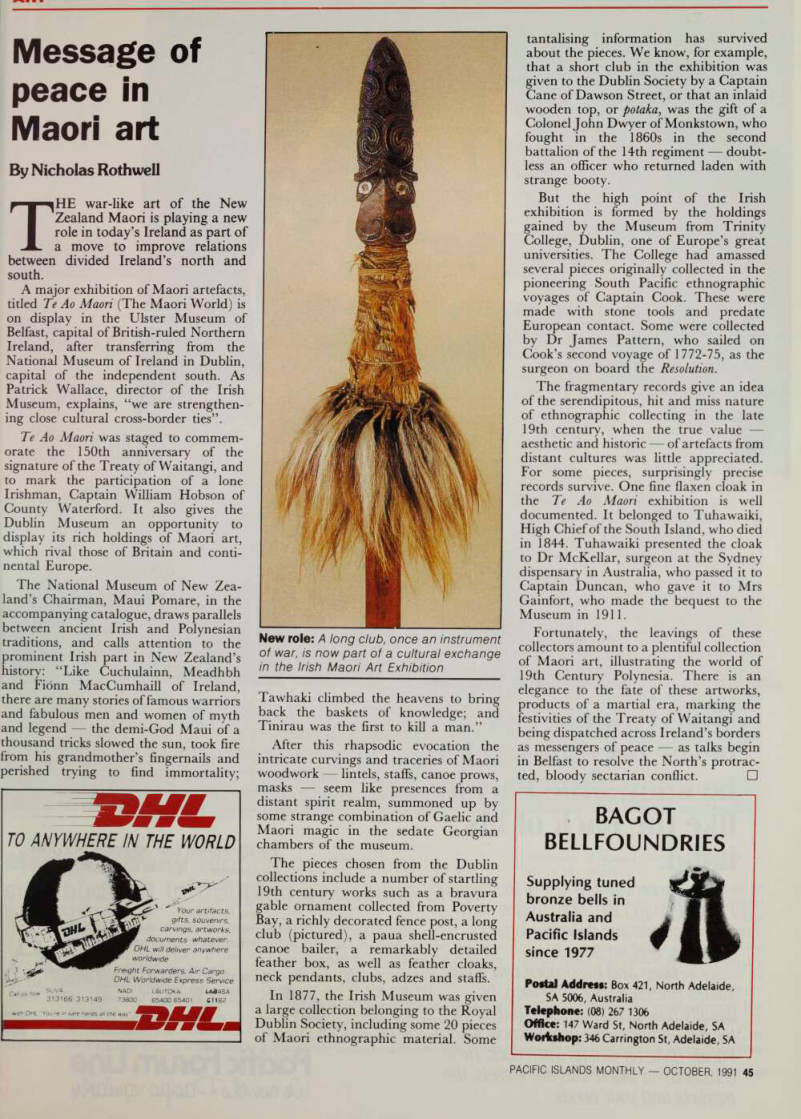
The pieces chosen from the Dublin collections include a number of startling 19th century works such as a bravura gable ornament collected from Poverty Bay, a richly decorated fence post, a long club (pictured), a paua shell-encrusted canoe bailer, a remarkably detailed feather box, as well as feather cloaks, neck pendants, clubs, adzes and staffs.
In 1877, the Irish Museum was given a large collection belonging to the Royal Dublin Society, including some 20 pieces of Maori ethnographic material. Some
tantalising information has survived about the pieces. We know, for example, that a short club in the exhibition was given to the Dublin Society by a Captain Cane of Dawson Street, or that an inlaid wooden top, or potaka , was the gift of a Colonel John Dwyer of Monkstown, who fought in the 1860 s in the second battalion of the 14th regiment doubt less an officer who returned laden with strange booty.
But the high point of the Irish exhibition is formed by the holdings gained by the Museum from Trinity College, Dublin, one of Europe’s great universities. The College had amassed several pieces originally collected in the pioneering South Pacific ethnographic voyages of Captain Cook. These were made with stone tools and predate European contact. Some were collected by Dr James Pattern, who sailed on Cook’s second voyage of 1772-75, as the surgeon on board the Resolution.
The fragmentary records give an idea of the serendipitous, hit and miss nature of ethnographic collecting in the late 19th century, when the true value aesthetic and historic of artefacts from distant cultures was little appreciated.
For some pieces, surprisingly precise
records survive. One fine flaxen cloak in the Te Ao Maori exhibition is well documented. It belonged to Tuhawaiki, High Chief of the South Island, who died in 1844. Tuhawaiki presented the cloak to Dr McKellar, surgeon at the Sydney dispensary in Australia, who passed it to Captain Duncan, who gave it to Mrs Gainfort, who made the bequest to the Museum in 1911.
Fortunately, the leavings of these collectors amount to a plentiful collection of Maori art, illustrating the world of 19th Century Polynesia. There is an elegance to the fate of these artworks, products of a martial era, marking the festivities of the Treaty of Waitangi and being dispatched across Ireland’s borders as messengers of peace as talks begin in Belfast to resolve the North’s protrac ted, bloody sectarian conflict. □
New role: A long club, once an instrument of war, is now part of a cultural exchange in the Irish Maori Art Exhibition