clean-up
pp. 40-43 · Read in the full issue
Chemical warfare clean-up
In the Solomon Islands, Jim Nielsen reports on the US Army’s removal of mustard gas
THE unnatural, pungent smell clung to the nose like a claw. There was something different about these howitzer rounds ... something wrong.
The rusting projectiles had waited on
the damp jungle floor 45 years for
discovery, quietly holding their poison.
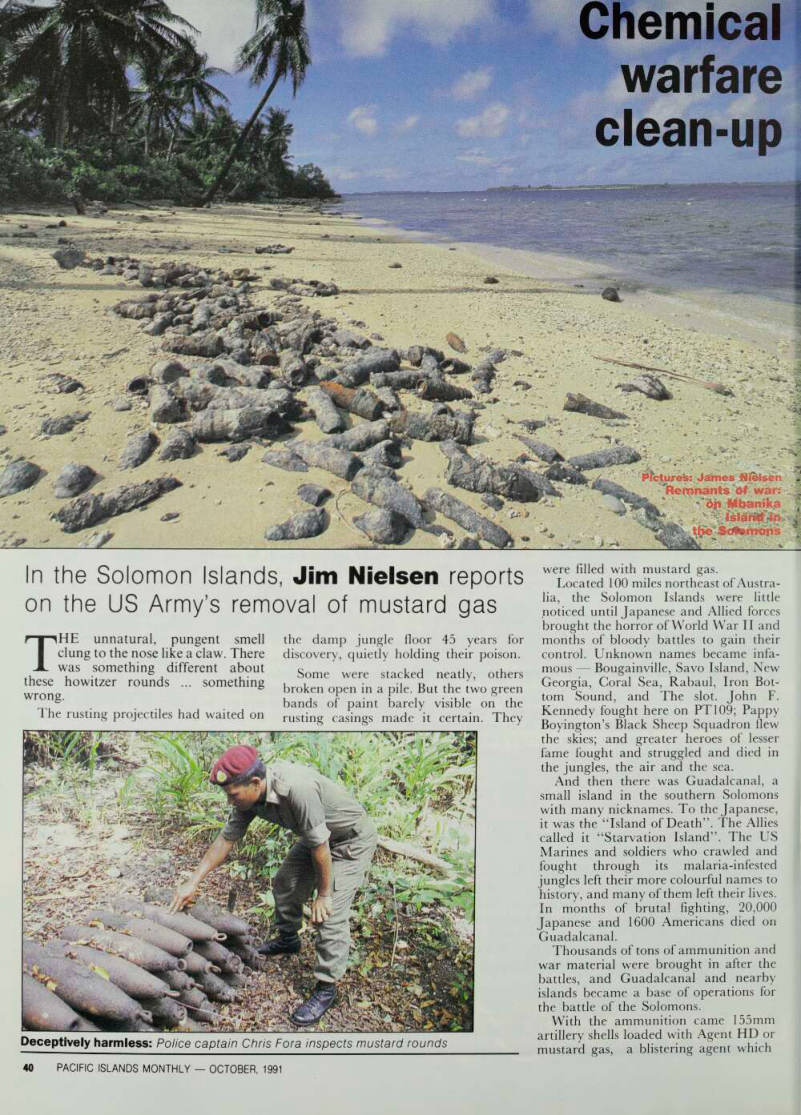
Some were stacked neatly, others broken open in a pile. But the two green bands of paint barely visible on the rusting casings made it certain. They
were filled with mustard gas.
Located 100 miles northeast of Austra lia, the Solomon Islands were little noticed until Japanese and Allied forces brought the horror of World War II and months of bloody battles to gain their control. Unknown names became infa mous Bougainville, Savo Island, New Georgia, Coral Sea, Rabaul, Iron Bot tom Sound, and The slot. John F.
Kennedy fought here on PTIO9; Pappy Boyington’s Black Sheep Squadron flew the skies; and greater heroes of lesser fame fought and struggled and died in the jungles, the air and the sea.
And then there was Guadalcanal, a small island in the southern Solomons with many nicknames. To the Japanese, it was the “Island of Death”. The Allies called it “Starvation Island”. The US Marines and soldiers who crawled and fought through its malaria-infested jungles left their more colourful names to history, and many of them left their lives.
In months of brutal fighting, 20,000 Japanese and 1600 Americans died on Guadalcanal.
Thousands of tons of ammunition and war material were brought in after the battles, and Guadalcanal and nearby islands became a base of operations for the battle of the Solomons.
With the ammunition came 155 mm artillery shells loaded with Agent HD or mustard gas, a blistering agent which
Pictured: James Nieisen Remnants of war: on Mbanika
Islands in
the Solomons
Deceptively harmless: Police captain Chris Fora inspects mustard rounds
chemically burns the skin, eyes and lungs.
But where the mustard rounds went after the war, or how they were disposed of is a mystery. Records no longer exist to show where they went, although most likely they were returned to the United States for storage and destruction.
But on tiny Mbanika Island, a PT boat base and logistical depot 40 miles northwest of Guadalcanal in the Russell Group, some remained forgotten.
In late 1943 the Pacific war moved north toward Japan. By 1946 the PT boat base closed, the people of Mbanika returned to their coconut plantations, and the jungle moved back in to cover the abandoned equipment, machinery, and various abandoned munitions, in cluding the 109 rounds of mustard gas.
Forty-five years passed peacefully,
until a coconut plantation worker called on Captain Chris Fora, bomb disposal officer in the Solomon Islands police. The worker and a friend, walking through a little used area of beach and jungle, had discovered the mustard rounds.
“Bombs!” he said. “Come I’ve found big bombs.”
This was not surprising news to Fora.
He made his living locating and explod ing tons of ordnance left over from the war. His assistants, two Australian Army
Explosive Ordnance Disposal (EOD)
specialists, had gone home on Christmas leave, so he went out alone.
“I thought they were W-P,” said Fora, referring to white phosphorous shells commonly used to make dense white smoke for battlement concealment.
Using standard procedure for conven tional rounds, Fora stacked a number of
them together, placed an ex plosive charge, backed up and set them off. But he saw no white smoke, only a very strange cloud of gas. In advertently, many pounds of mustard agent had been ex ploded. They called in the US Army.
Soon after Lt Col. Joe King, a chemical war fare expert at Pacific Com mand, was on a C-130 Hercules aircraft enroute to Mbanika with a task force of 45 military and civilian ex-
plosive ordnance and chemical tech nicians from Hawaii and Johnston Island.
Commanded by Lt Col. Kert Peterson, the task force had been as sembled to remove the mustard rounds and take them by ship to the US Army
Chemical Activity, Pacific (USACAP)
for storage and later disposal by the
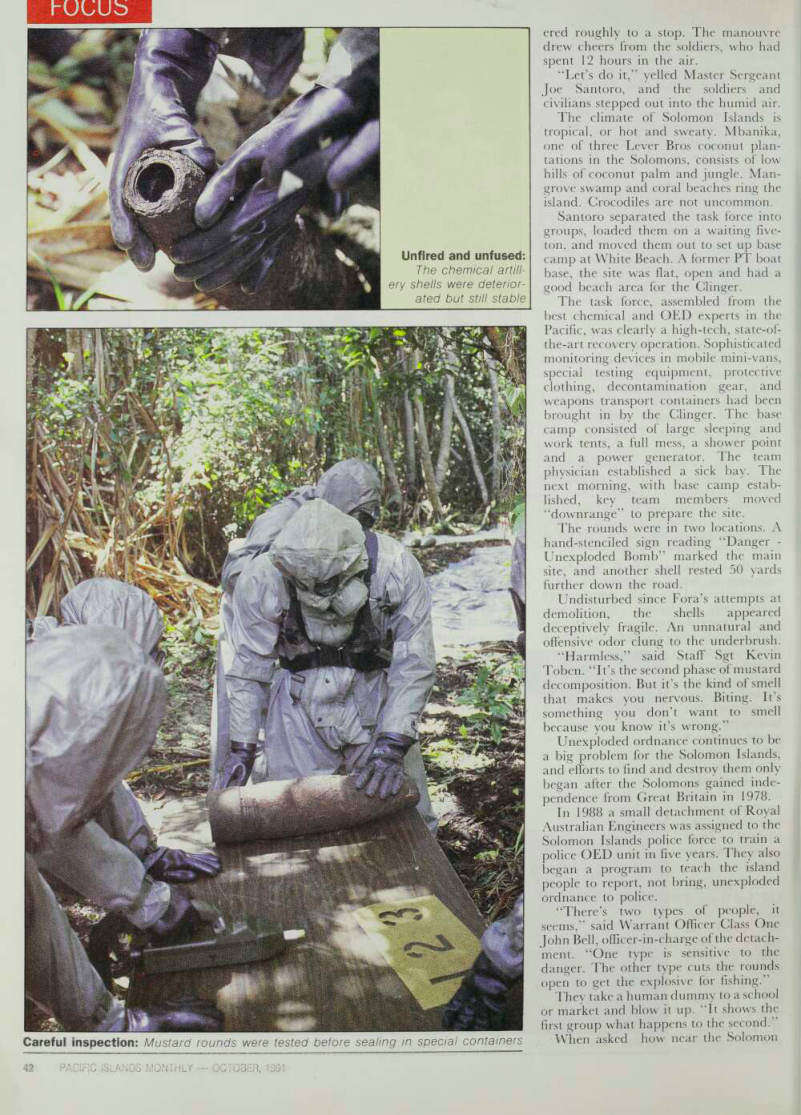
Johnston Atoll Chemical Agent Disposal System (JACADS). Already waiting at the island was the US Army Vessel Clinger, a 272-foot landing craft. An other C-130 Hercules was enroute to Guadalcanal’s Henderson Field for a possible medical evacuation.
The crew chief bellowed something unintelligible over the noise of the cabin
that the task force took to mean “put your seatbelts on, we’re coming in”.
The Hercules dipped low, then with full power suddenly pulled up and turned sharply left. The pilot was giving the short, narrow grass and coral runway a sharp look. His was the largest aero plane ever to land there.
Dipping low again, then
touching down,
reversing en gines and apply ing full brake, the C-130 pow-
Old and new: the USAV Clinger is conspicuous near a Solomon Islands canoe
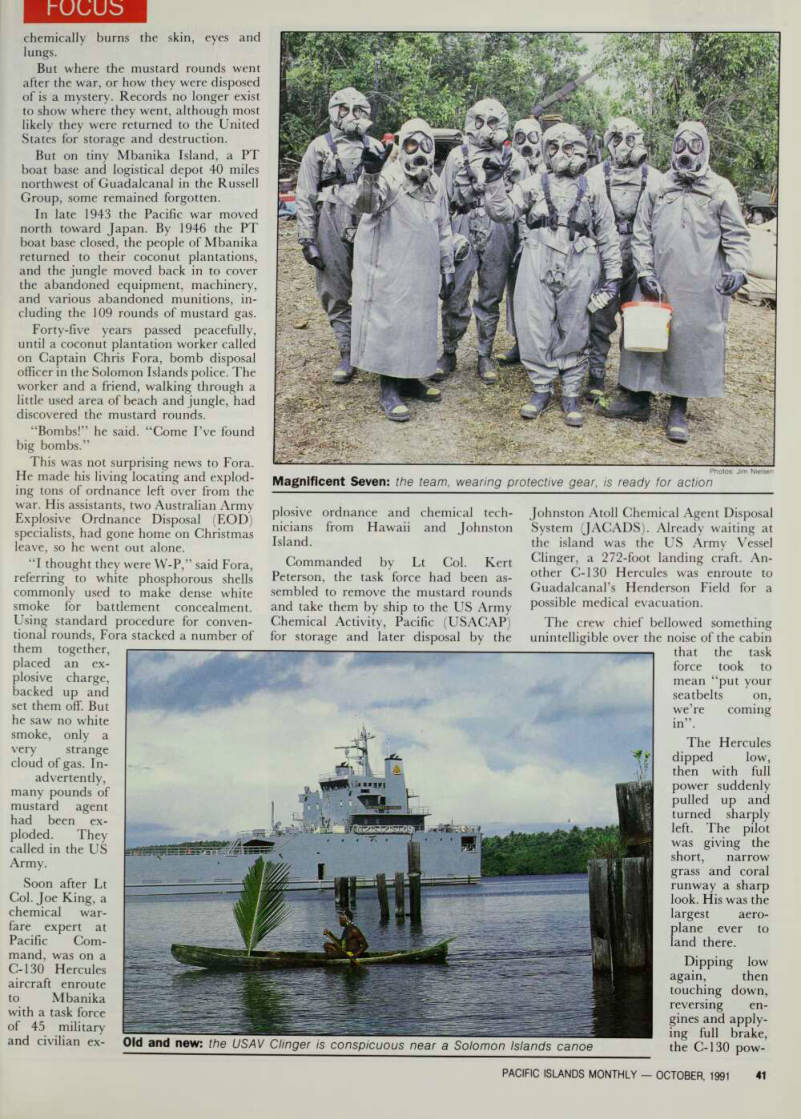
Photos: Jim Nielsen Magnificent Seven: the team, wearing protective gear, is ready for action
ered roughly to a stop. The manouvre drew cheers from the soldiers, who had spent 12 hours in the air.
“Let’s do it,” yelled Master Sergeant Joe Santoro, and the soldiers and civilians stepped out into the humid air.
The climate of Solomon Islands is tropical, or hot and sweaty. Mbanika, one of three Lever Bros coconut plan tations in the Solomons, consists of low hills of coconut palm and jungle. Man grove swamp and coral beaches ring the island. Crocodiles are not uncommon.
Santoro separated the task force into groups, loaded them on a waiting five ton, and moved them out to set up base camp at White Beach. A former PT boat base, the site was flat, open and had a good beach area for the Clinger.
The task force, assembled from the best chemical and OLD experts in the Pacific, was clearly a high-tech, state-of the-art recovery operation. Sophisticated monitoring devices in mobile mini-vans, special testing equipment, protective clothing, decontamination gear, and weapons transport containers had been brought in by the Clinger. The base camp consisted of large sleeping and work tents, a full mess, a shower point and a power generator. The team physician established a sick bay. The next morning, with base camp estab lished, key team members moved “downrange” to prepare the site.
The rounds were in two locations. A hand-stenciled sign reading “Danger - Unexploded Bomb” marked the main site, and another shell rested 50 yards further down the road.
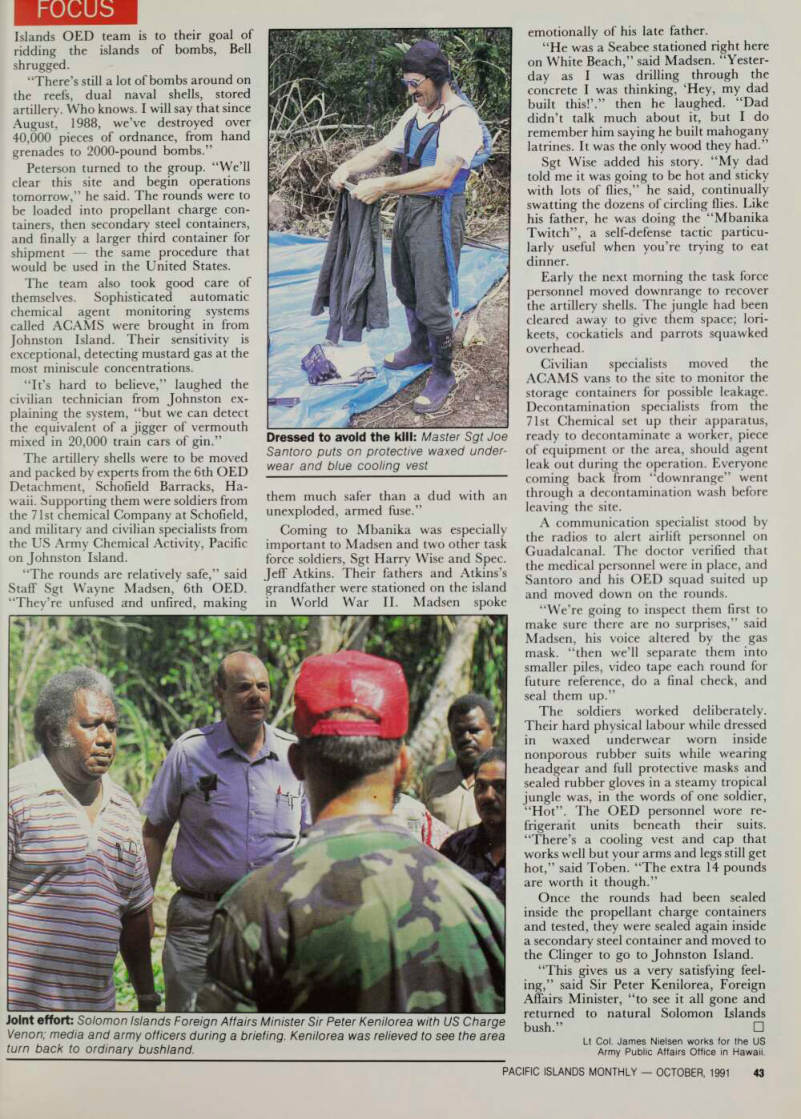
Undisturbed since Fora’s attempts at demolition, the shells appeared deceptively fragile. An unnatural and offensive odor clung to the underbrush.
“Harmless,” said Staff Sgt Kevin Toben. “It’s the second phase of mustard decomposition. But it’s the kind of smell that makes you nervous. Biting. It’s something you don’t want to smell because you know it’s wrong.”
Unexploded ordnance continues to be a big problem for the Solomon Islands, and efforts to find and destroy them only began after the Solomons gained inde pendence from Great Britain in 1978.
In 1988 a small detachment of Royal Australian Engineers was assigned to the Solomon Islands police force to train a police OED unit in five years. They also began a program to teach the island people to report, not bring, unexploded ordnance to police.
“There’s two types of people, it seems,” said Warrant Officer Class One John Bell, officer-in-charge of the detach ment. “One type is sensitive to the danger. The other type cuts the rounds open to get the explosive for fishing.”
They take a human dummy to a school or market and blow it up. “It shows the first group what happens to the second.”
When asked how near the Solomon
Careful inspection: Mustard rounds were tested before sealing in special containers
Unfired and unfused: The chemical artill ery shells were deterior ated but still stable
Islands OED team is to their goal of ridding the islands of bombs, Bell
shrugged.
“There’s still a lot of bombs around on the reefs, dual naval shells, stored artillery. Who knows. I will say that since August, 1988, we’ve destroyed over 40,000 pieces of ordnance, from hand grenades to 2000-pound bombs.”
Peterson turned to the group. “We’ll clear this site and begin operations tomorrow,” he said. The rounds were to be loaded into propellant charge con tainers, then secondary steel containers, and finally a larger third container for shipment the same procedure that would be used in the United States.
The team also took good care of themselves. Sophisticated automatic chemical agent monitoring systems called ACAMS were brought in from Johnston Island. Their sensitivity is exceptional, detecting mustard gas at the most miniscule concentrations.
“It’s hard to believe,” laughed the civilian technician from Johnston ex plaining the system, “but we can detect the equivalent of a jigger of vermouth mixed in 20,000 train cars of gin.”
The artillery shells were to be moved and packed by experts from the 6th OED Detachment, Schofield Barracks, Ha waii. Supporting them were soldiers from the 71st chemical Company at Schofield, and military and civilian specialists from the US Army Chemical Activity, Pacific on Johnston Island.
“The rounds are relatively safe,” said Staff Sgt Wayne Madsen, 6th OED.
“They’re unfused and unfired, making
them much safer than a dud with an unexploded, armed fuse.”
Coming to Mbanika was especially important to Madsen and two other task force soldiers, Sgt Harry Wise and Spec.
Jeff Atkins. Their fathers and Atkins’s grandfather were stationed on the island in World War 11. Madsen spoke
emotionally of his late father.
“He was a Seabee stationed right here on White Beach,” said Madsen. “Yester day as I was drilling through the concrete I was thinking, ‘Hey, my dad built this!’.” then he laughed. “Dad didn’t talk much about it, but I do remember him saying he built mahogany latrines. It was the only wood they had.”
Sgt Wise added his story. “My dad told me it was going to be hot and sticky with lots of flies,” he said, continually swatting the dozens of circling flies. Like his father, he was doing the “Mbanika Twitch”, a self-defense tactic particu larly useful when you’re trying to eat dinner.
Early the next morning the task force personnel moved downrange to recover the artillery shells. The jungle had been cleared away to give them space; lori keets, cockatiels and parrots squawked overhead.
Civilian specialists moved the ACAMS vans to the site to monitor the storage containers for possible leakage.
Decontamination specialists from the 71st Chemical set up their apparatus, ready to decontaminate a worker, piece of equipment or the area, should agent leak out during the operation. Everyone coming back from “downrange” went through a decontamination wash before leaving the site.
A communication specialist stood by the radios to alert airlift personnel on Guadalcanal. The doctor verified that the medical personnel were in place, and Santoro and his OED squad suited up and moved down on the rounds.
“We’re going to inspect them first to make sure there are no surprises,” said Madsen, his voice altered by the gas mask, “then we’ll separate them into smaller piles, video tape each round for future reference, do a final check, and seal them up.”
The soldiers worked deliberately.
Their hard physical labour while dressed in waxed underwear worn inside nonporous rubber suits while wearing headgear and full protective masks and sealed rubber gloves in a steamy tropical jungle was, in the words of one soldier, “Hot”. The OED personnel wore re frigerant units beneath their suits.
“There’s a cooling vest and cap that works well but your arms and legs still get hot,” said Toben. “The extra 14 pounds are worth it though.”
Once the rounds had been sealed inside the propellant charge containers and tested, they were sealed again inside a secondary steel container and moved to the Clinger to go to Johnston Island.
“This gives us a very satisfying feel ing,” said Sir Peter Kenilorea, Foreign Affairs Minister, “to see it all gone and returned to natural Solomon Islands bush.” □ Lt Col. James Nielsen works for the US Army Public Affairs Office in Hawaii.
Joint effort: Solomon Islands Foreign Affairs Minister Sir Peter Kenilorea with US Charge Venon; media and army officers during a briefing. Kenilorea was relieved to see the area turn back to ordinary bush land.
Dressed to avoid the kill: Master Sgt Joe Santoro puts on protective waxed under wear and blue cooling vest