Pacific
pp. 47-48 · Read in the full issue
Islands
Monthly
Business
Forum Line on stormy waters
Martin Tiffany reports on the battle to stay buoyant in troubled economic times
AFTER five years of uninterrup ted profit, the wave of success has crested for PFL. It has recorded a WSS3.6 million loss for the 1990 financial year.
But PFL’s general manager/chief executive, John Maclennan, hastens to add it is a “managed loss” that was expected. He explains that it is all part
of strengthing operations.
“In 1989 we recognized the line was plateauing and in regards to the shipping network we felt we were in danger of being cut out of the market.
“We were only operating one vessel up into PNG via Australia and this was worrying because if our competitor or anyone else brought another vessel into
operation it would very quickly cut us out of the market.”
So MacLennan put a proposition to the board of directors suggesting they put a second vessel into the circuit. The board tested the feasibility and agreed.
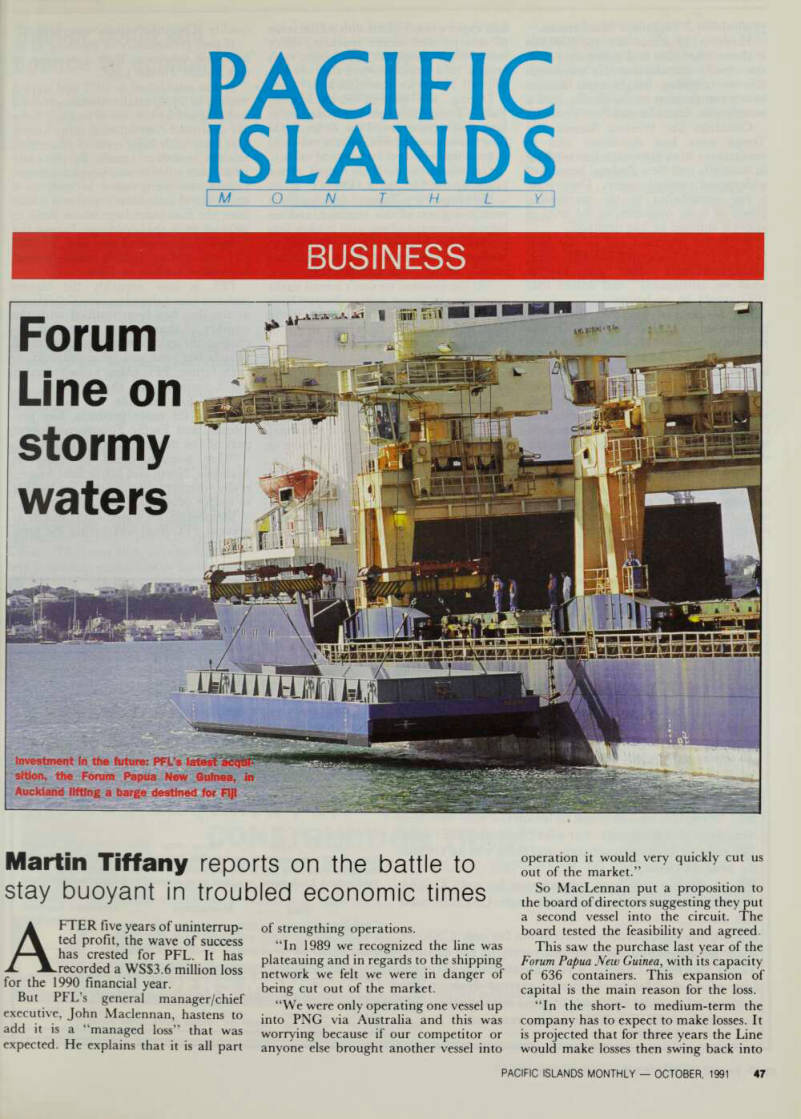
This saw the purchase last year of the Forum Papua New Guinea, with its capacity of 636 containers. This expansion of capital is the main reason for the loss.
“In the short- to medium-term the company has to expect to make losses. It is projected that for three years the Line would make losses then swing back into
Investment In the future: PFL’s latest sition, the Forum Papua New Guinea, in Auckland lifting a barge destined for FIJI
profitability,” explained MacLennan.
However, he admits that the 1990 loss is above what they had anticipated with the vessel s introduction. He attributed this to tumbling freight rates due to heavy competition m the Pacific, and a recession m Australia and New Zealand.
Countries like Western Samoa and longa have had significant cuts m remittances from their islanders working in Australia and New Zealand because of widespread unemployment. These were a big contributor to the purchasing power ol those countries, so the level of imports shipped m has declined.
While he preferred not to say how much over the budgetted loss PFL went, MacLennan said it had “gone beyond ™ hat we a ntici P ated ” and added that 991 would be no better.
But he pointed out that there was hardly a shipping line operating that was not losing money. He said things were tough in the Pacific at the moment with
intense competition.
“When other shipping lines feel the pinch they look at the Pacific and think there s a huge dollar to be made. The cake is only a certain size and, as it is carved jip by more operators, we feel the eff ects.”
MacLennan said many of these operators called at their own convenience, diverting en route to other destinations when tonnages are low. Immediately the situation changed, they moved on.
As MacLennan points out, importers
and exporters get lulled into a false sense of security and secure markets. When competitors disappear and freight rates return to a realistic level they find it difficult to service these markets.
During the present rough patch,
Pacific Forum Line plan to consolidate, Last year s purchase of the Forum Papua New Guinea boosted PFL’s list of vessels to three chartered and two owned ones.
Optimistically the Line hopes to see profit by 1993 or early 1994.
“We hope New Zealand and Australia soon swing out of this recession and we hope to be swept along with it back into profitability, but as I said, in the short to medium term things have impacted heavily on us,” MacLennan said.
“At the moment we don’t intend to cut operations or prune services but we have to be careful as all our reserves are in the ship. But this is the right way to go, to have a balance of ships owned by the line and those chartered.”
MacLennan knows things may not go
as planned.
“We planned for losses but not of that magnitude. Whilst the line can cope with those losses for the moment if the trend continues for a long time we will have to look at funding them in some way.”
He said this may be done by a capital injection or by selling the vessels PFL owns and leasing them back.
“This is only a last resort, we are praying that tonnage, which is cargo, will increase, and at the same time the
quality of revenue will increase with it ”
If past performance is anything to go by it will take more than a recession to sink Pacific Forum Line It was established in 1977 and started trading in 1978, totally undercapitalised and plagued by the cost of running three old chartered conventional cargo vessels and later with high costs of chartering modern container vessels By the early 1980 s many felt it was beyond salvage Consultants were called in and, as a result, the shareholders negotiated a loan from the European Investment Bank to increase their shareholdings. It gave the company a stronger capital base. By 1985 PFL was making a profit, which jumped to WSS6.6 million in 1986.
PFL is now arguably the biggest
regional-based shipping line. Confidence
in the line has been instilled with the number of shareholders increasing, in eluding the government of the Marshall Islands last year and Niue this year, In future, PFL plans to look further afield, working with shareholders,
“Fiji, for example, is looking to
Malaysia for more products, like pet roleum, and Pacific Forum could form part of the thrust in that direction.
“Our horizon could be more to Malaysia, North and South East Asia really wherever the countries are looking to source products,” MacLennan said, Meanwhile, a few swells are unlikely to prevent PFL from weathering the pres ent storm. □