Just gorgeous!
p. 42 · Read in the full issue
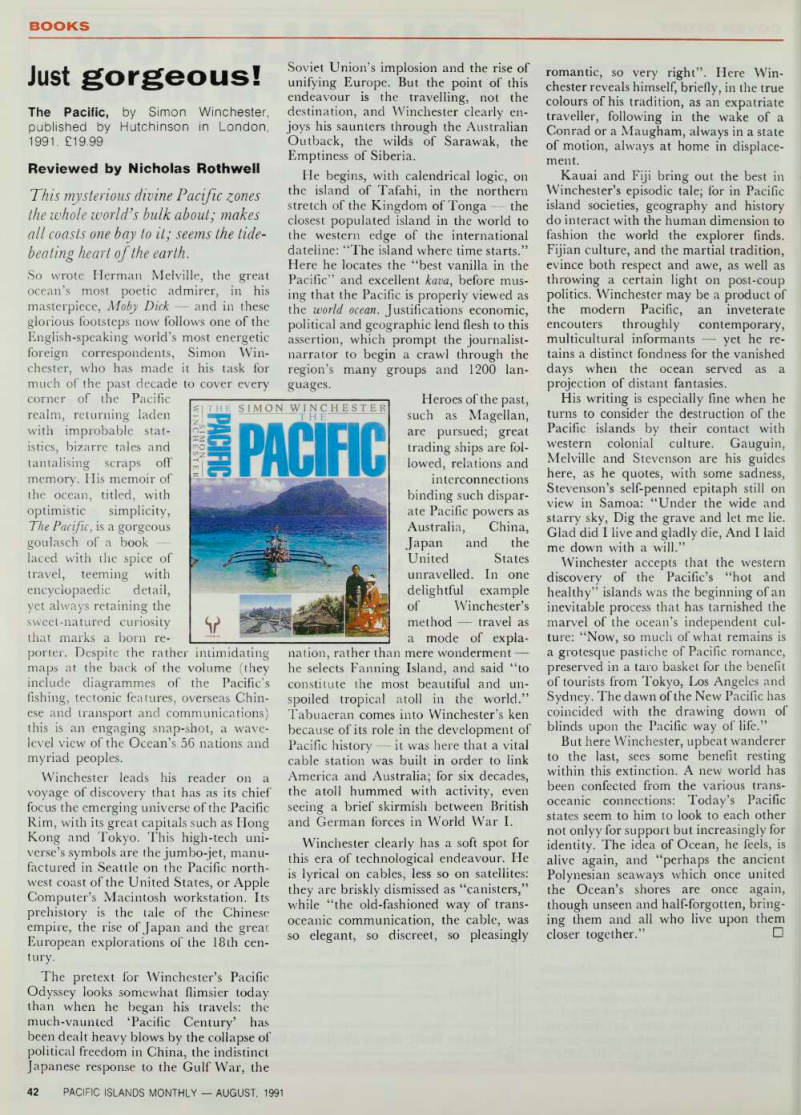
The Pacific, by Simon Winchester, published by Hutchinson in London, 1991. £19.99 Reviewed by Nicholas Rothwell This mysterious divine Pacific zones the whole world’s bulk about; makes all coasts one bay to it; seems the tide beating heart of the earth.
So wrote Herman Melville, the great ocean’s most poetic admirer, in his masterpiece, Moby Dick and in these glorious footsteps now follows one of the English-speaking world’s most energetic foreign correspondents, Simon Win chester, who has made it his task for much of the past decade to cover every
corner of the Pacific realm, returning laden with improbable stat istics, bizarre tales and tantalising scraps of!' memory. His memoir of the ocean, titled, with optimistic simplicity, The Pacific, is a gorgeous goulasch of a book laced with the spice of travel, teeming with encyclopaedic detail, yet always retaining the sweet-natured curiosity that marks a born re
porter. Despite the rather intimidating maps at the back of the volume (they include diagrammes of the Pacific’s fishing, tectonic features, overseas Chin ese and transport and communications) this is an engaging snap-shot, a wave level view of the Ocean’s 56 nations and
myriad peoples.
Winchester leads his reader on a voyage of discovery that has as its chief focus the emerging universe of the Pacific Rim, with its great capitals such as Hong
Kong and Tokyo. This high-tech uni
verse’s symbols are the jumbo-jet, manu factured in Seattle on the Pacific north west coast of the United States, or Apple Computer’s Macintosh workstation. Its prehistory is the tale of the Chinese empire, the rise of Japan and the great; European explorations of the 18th cen tury.
The pretext for Winchester’s Pacific Odyssey looks somewhat flimsier today than when he began his travels: the much-vaunted ‘Pacific Century’ has been dealt heavy blows by the collapse of political freedom in China, the indistinct Japanese response to the Gulf War, the
Soviet Union’s implosion and the rise of unifying Europe. But the point of this endeavour is the travelling, not the destination, and Winchester clearly en joys his saunters through the Australian Outback, the wilds of Sarawak, the Emptiness of Siberia.
He begins, with calendrical logic, on the island of Tafahi, in the northern stretch of the Kingdom of Tonga the closest populated island in the world to the western edge of the international dateline: “The island where time starts.”
Here he locates the “best vanilla in the Pacific” and excellent kava, before mus ing that the Pacific is properly viewed as the world ocean. Justifications economic, political and geographic lend flesh to this assertion, which prompt the journalist narrator to begin a crawl through the region’s many groups and 1200 lan guages.
Heroes of the past, such as Magellan, are pursued; great trading ships are fol lowed, relations and interconnections binding such dispar ate Pacific powers as Australia, China, Japan and the United States unravelled. In one delightful example of Winchester’s method travel as a mode of expla
nation, rather than mere wonderment he selects Fanning Island, and said “to constitute the most beautiful and un spoiled tropical atoll in the world.”
Tabuaeran comes into Winchester’s ken because of its role in the development of Pacific history it was here that a vital cable station was built in order to link America and Australia; for six decades, the atoll hummed with activity, even seeing a brief skirmish between British and German forces in World War I.
Winchester clearly has a soft spot for this era of technological endeavour. He is lyrical on cables, less so on satellites: they are briskly dismissed as “canisters,” while “the old-fashioned way of trans oceanic communication, the cable, was so elegant, so discreet, so pleasingly
romantic, so very right”. Here Win chester reveals himself, briefly, in the true colours of his tradition, as an expatriate traveller, following in the wake of a Conrad or a Maugham, always in a state of motion, always at home in displace ment.
Kauai and Fiji bring out the best in Winchester’s episodic tale; for in Pacific island societies, geography and history do interact with the human dimension to fashion the world the explorer finds.
Fijian culture, and the martial tradition, evince both respect and awe, as well as throwing a certain light on post-coup politics. Winchester may be a product of the modern Pacific, an inveterate encouters throughly contemporary, multicultural informants yet he re tains a distinct fondness for the vanished days when the ocean served as a projection of distant fantasies.
His writing is especially fine when he turns to consider the destruction of the Pacific islands by their contact with western colonial culture. Gauguin, Melville and Stevenson are his guides here, as he quotes, with some sadness, Stevenson’s self-penned epitaph still on view in Samoa: “Under the wide and starry sky, Dig the grave and let me lie.
Glad did I live and gladly die, And I laid me down with a will.”
Winchester accepts that the western discovery of the Pacific’s “hot and healthy” islands was the beginning of an inevitable process that has tarnished the marvel of the ocean’s independent cul ture: “Now, so much of what remains is a grotesque pastiche of Pacific romance, preserved in a taro basket for the benefit of tourists from Tokyo, Los Angeles and Sydney. The dawn of the New Pacific has coincided with the drawing down of blinds upon the Pacific way of life.”
But here Winchester, upbeat wanderer to the last, sees some benefit resting within this extinction. A new world has been confected from the various trans oceanic connections: Today’s Pacific states seem to him to look to each other not onlyy for support but increasingly for identity. The idea of Ocean, he feels, is alive again, and “perhaps the ancient Polynesian seaways which once united the Ocean’s shores are once again, though unseen and half-forgotten, bring ing them and all who live upon them closer together.” □