Pacific
pp. 43-45 · Read in the full issue

Islands
Monthly
Business
Manihiki’s $3m harvest
50 buyers check out a pearly paradise and the treasure not all that special
By Angela MacCarthy
THE Manihiki black pearl industry,
which made NZ$3.2 million at its June auction, has many problems to resolve before the industry can reach its full potential. The industry’s main problems centre around management,
marketing and the local people taking
control of their industry.
Manihiki Atoll is situated about 1000 kilometres from Rarotonga, the capital of the Cook Islands. Expensive airfares, erratic’ shipping and poor radio telephone communications facilities have kept Manihiki isolated for decades. But over the past four years the growth of the cultured black pearl industry has brought many changes.
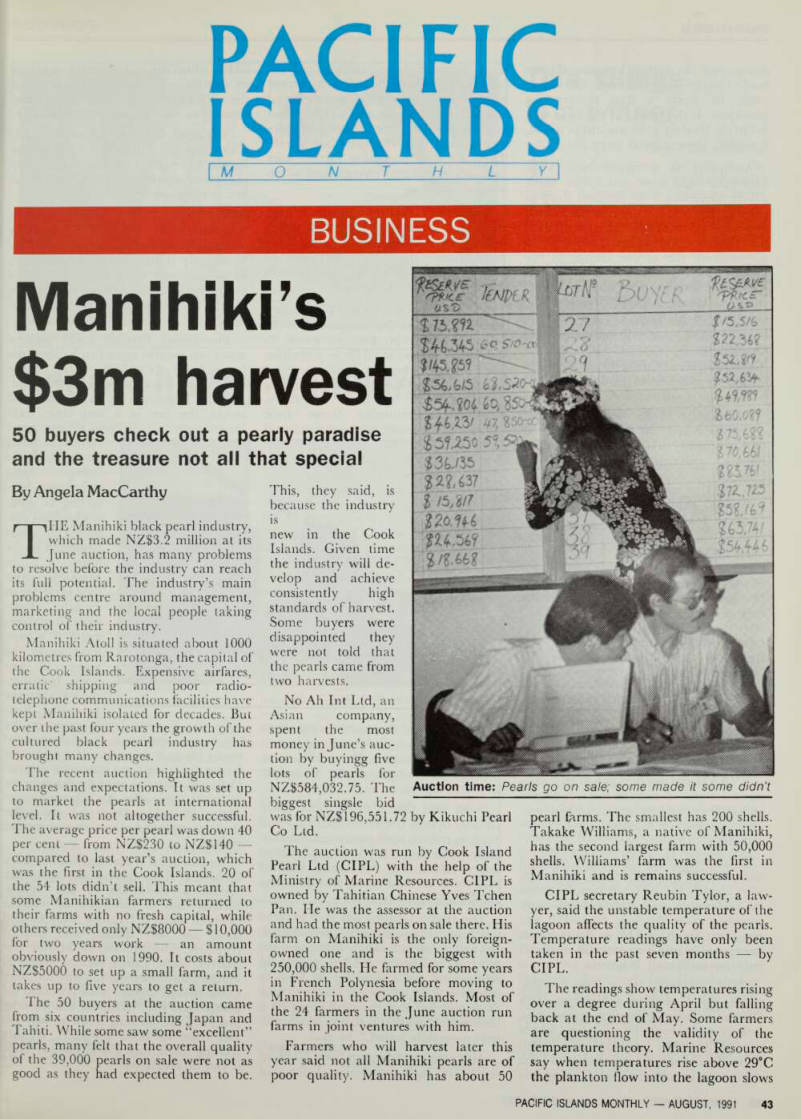
The recent auction highlighted the changes and expectations. It was set up to market the pearls at international level. It was not altogether successful.
The average price per pearl was down 40 per cent from NZ$23O to NZ$l4O compared to last year’s auction, which was the first in the Cook Islands. 20 of the 54 lots didn’t sell. This meant that some Manihikian farmers returned to their farms with no fresh capital, while others received only NZ$BOOO $ 10,000 for two years work an amount obviously down on 1990. It costs about NZ$5OOO to set up a small farm, and it takes up to five years to get a return.
The 50 buyers at the auction came from six countries including Japan and Tahiti. While some saw some “excellent” pearls, many felt that the overall quality of the 39,000 pearls on sale were not as good as they had expected them to be.
This, they said, is because the industry is new in the Cook Islands. Given time the industry will de velop and achieve
consistently high
standards of harvest.
Some buyers were
disappointed they
were not told that the pearls came from two harvests.
No Ah Int Ltd, an Asian company, spent the most money in June’s auc
tion by buyingg five
lots of pearls for NZ5584,032.75. The
biggest singsle bid
was for NZ5196,551.72 by Kikuchi Pearl Co Ltd.
The auction was run by Cook Island Pearl Ltd (CIPL) with the help of the Ministry of Marine Resources. CIPL is owned by Tahitian Chinese Yves Tchen Pan. He was the assessor at the auction and had the most pearls on sale there. His farm on Manihiki is the only foreign owned one and is the biggest with 250,000 shells. He farmed for some years in French Polynesia before moving to Manihiki in the Cook Islands. Most of the 24 farmers in the June auction run farms in joint ventures with him.
Farmers who will harvest later this year said not all Manihiki pearls are of poor quality. Manihiki has about 50
pearl farms. The smallest has 200 shells.
Takake Williams, a native of Manihiki, has the second largest farm with 50,000 shells. Williams’ farm was the first in Manihiki and is remains successful.
CIPL secretary Reubin Tylor, a law yer, said the unstable temperature of the lagoon affects the quality of the pearls.
Temperature readings have only been taken in the past seven months by
Cipl.
The readings show temperatures rising over a degree during April but falling back at the end of May. Some farmers are questioning the validity of the temperature theory. Marine Resources say when temperatures rise above 29°C the plankton How into the lagoon slows
Auction time: Pearls go on sale; some made it some didn't
down, and the oysters have insufficient food. Oysters filter through 220 cubic yards of waste a day looking for planktons. If the pearl has not been well fed in the final six to 12 months of its life, it doesn’t grow a good lustre.
According to a recent New York Connoisseur magazine article on black pearls, there was a 40 per cent drop in pearl production last year on the French Polynesian farm of pearl magnate Salva dor Assael. This coincided with a temperature rise of one degree in the lagoon. Although there is no proof that the rising temperature was to blame, Assael is taking steps to overcome the temperature problem. He has also de cided to experiment with cutting back on the numbers of oysters he farms to see if he has become “too piggish” by stocking the lagoon beyond its ecological capabili ties.
In Manihiki, Tylor said CIPL is not overstocked and has no disease. But it
refused recently to let French Polynesian Fisheries Agency (EVAAM) marine biologists onto the farm to take tissue
samples.
EVAAM was asked by the Cook Islands’ Ministry of Marine Resources to inspect the farms after a Manihiki farmer told Marine Resources he was worried about a number of dead oys ters on the CIPL farm. Marine Re
source Secretary Dashwood said the oysters could either have been killed by disease or by the stress of implantation.
EVAAM did not find any of the usual physicl signs of disease but to double check they are doing an electro miscropy analysis report on Manihiki lagoon tissue
samples.
Tylor said EVAAM wasn’t allowed onto the Cl PL farm because the owners were already having tissue samples tested in Wellington and didn’t need more sampling done. Anyway, he said, it was not right for EVAAM to do the tests because of its involvement with the pearl
industry in French Polynesia.
CIPL, which set up its farm in 1986, made jopint venture agreements with farmers to provide seeding technicians, finance and harvest. For this it got 40 per cent of the profit. For Manihikians with no credit history, no securities and little
experience in cultured pearl farming, the
joint ventures were initially advan tageous. However, the newly-appointed legal counsel for the Manihiki Island Council, David Greig, said CIPL has not kept its promises. “They promised more seeding and then changed their minds.
They are now promising further joint ventures will they change their minds on that too?”
When CIPL first set up farm, it gave the Island Council 33.3 per cent share holding for NZS 100,000. Now the com pany shareholdings have increased to NZS2 million, diluting the council’s shareholding to 1.6 per cent.
Local discontent with CIPL came to a head shortly after that auction when the Island Council granted an extra 25 hectares of lagoon to CIPL a decision later revoked when the locals protested the area offered was a traditional fishing ground and a bird sanctuary.
Manihikians returning home from abroad to live are also wanting pearl
farms. CIPL said they need a bigger farm to space out the shells because the lagoon was getting hotter. The CIPL farm covers 16.4 hectares of the 48 square
kilimetre lagoon.
Tylor said that if CIPL can’t move 100,000 oysters elsewhere then they will have to reduce their operation substan tially, effectively halving employment and royalties. For the Island Council that could mean a loss of income up to NZ5250,000 a year.
The Island Council has now granted CIPL half the water area they wanted, but in a different location. Greig said the move is conditional on CIPL paying up rents owed and improving on farming practices. “No one really wants to kick them out, but that they roll along on a business footing that is commercially and environmetally sound,” he said.
Although some farmers want CIPL to reduce its shell population Tylor said
CIPL, which did its last outside seedings six months ago, just wants to get out of the limelight and leave the Island Council to exercise more responsibility.
Dashwood feels the Island Council, which has the ultimate control of the lagoon, has to start viewing the industry in the longer term rather than making ad hoc decisions as obstacles arise.
Said Greig: “There is a dependency mentality still, and lack of business understanding. It’s understandable. Un til recently transportation was so poor, Manihikians were on the atoll for months on end totally isolated from the rest of the
world. The pearls have rapidly changed
that.”
The Island Council made positive move two months ago when it closed the lagoon to divers of wild oysters, fearing the natural stocks were being depleted.
Marine Resources is surveying wild stocks, the first in a long time. Said Dashwood: “The success of any pearl
culture is based on the ability to collect spats rather than har vesting of wilds stocks. Spat col
lecting was
pioneered in the fifties in Manihiki and then perfected in French Poly nesia. A spat col lector is a rope dangling in the water 10 feet down. It attracts the oyster larvae to settle. Spat
collectors become fertile areas in the lagoon that don’t take from the natural stocks because they provide a home for larvae that would not otherwise survive.
Collected spats are good for the industry because they offer an alternative to diving for wild oysters and are better shell to implant because they are more resistant.
An ecological report done in February for Marine Resources said the lagoon can sustain a maximum of one million oysters, only if the ratio of wild to cultured shells is 2:1, and if the farmed shells are well spaced, and cleaned regularly. The Minister of Marine Re sources, Vaine Tairea, sees the Manihiki industry as pioneering the way for other Cook Islands lagoons with potential for pearls. Said he: “Manihiki is a learning process. Pearl farming is not an easy job and must be done properly. We are starting small, then if a mistake is made it can be corrected.” □
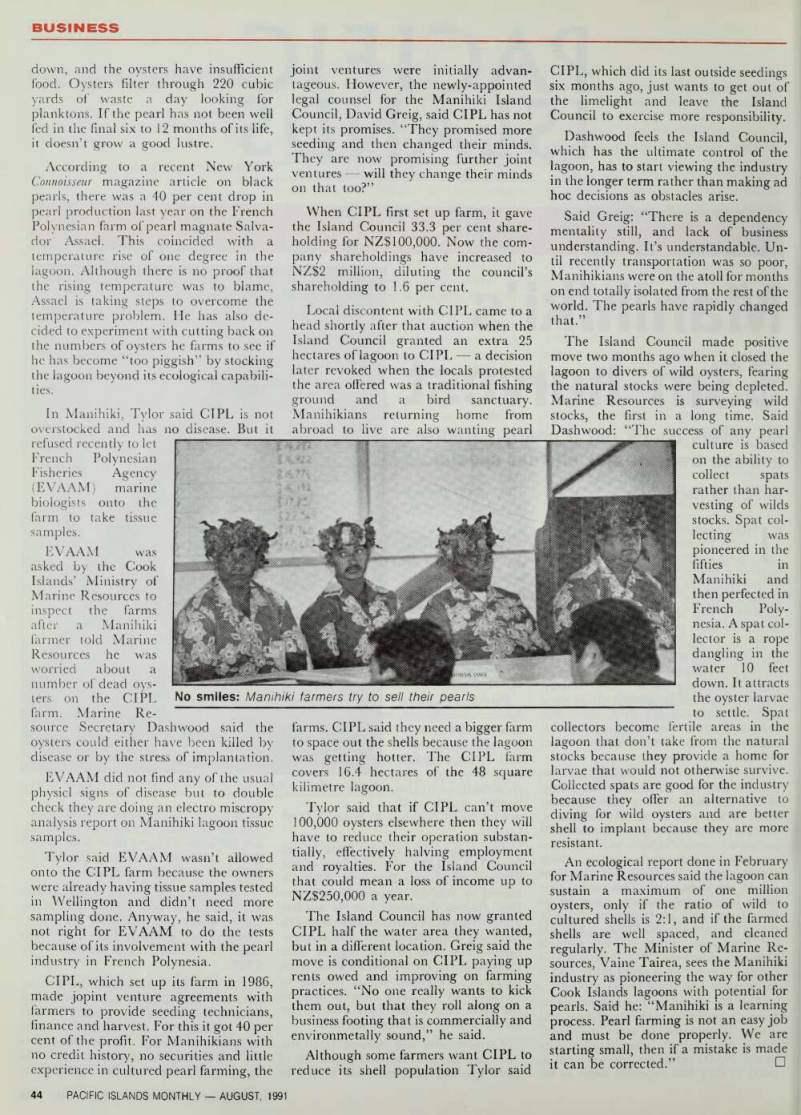
No smiles: Manihiki farmers try to sell their pearls
Proposals, proposals THE Fiji government approved hotel investment proposals worth nearly US$B3O million in the past four years.
Tourism Minister David Pickering said the proposals involve 8000 hotel rooms.
Airline waits THE Cook Islands’ newly-formed air
line, Avaiki Air, is grounded until the government gives it a licence to operate.
The airline was formed to take over the services of Cook Islands Air, which ceased operation on June 30 so its major shareholder, Air New Zealand, could concentrate on its international services.
New service AIR New Zealand is to introduce a
fourth North American service through Fiji from November. The airline’s route marketing manager, Eric Smitton, says the new Auckland-Nadi-Honolulu-Los Angeles service is part of Air New Zealand’s major effort to market the South West Pacific regionally.
Smitton said the overall growth of traffic to the South Pacific was expected to be 10 to 11 per cent. □