The Casey Jones case
pp. 39-41 · Read in the full issue
THE extent to which intercountry cooperation can succeed in the fight against drug trafficking is evident in the file for Casey Valentine Jones, which reads like a work of fiction.
The story has a happy ending for regional law enforcement agencies which discovered that, under a US move to reward countries which assist in law enforcement areas, crimebusting can pay. But it also has a lesson for those who
are tempted to get involved in the business as the fate of a lesser player in this saga, David McCain, suggests.
The United States Information Ser vice’s calendar for the case goes like this: Mid-January, 1990: Casey Valentine Jones ordered 15 rolls of woollen carpets in New Zealand for shipment to Los
Angeles, California.
Late January, 1990: Jones shipped the 15 rolls, along with other woollen goods and about 7400 pounds of marijuana
from Auckland to Los Angeles in a container.
Early-February, 1990: Shipment of carpets and marijuana arrives in Los Angeles.
Mid-February, 1990: Jones arranges for customs entry for the shipment.
Late February: Grand Jury of the US District Court for the Central District of California indicted Casey Valentine Jones and six others for conspiracy, importation and possession with intent to distribute marijuana.
March 1, 1990: US Customs Service
seized shipment.
March 16, 1990: US District Court, Central District of California, issued an arrest warrant on the indictment handed down by the Grand Jury in late February.
June 13, 1990: Jones departed Auck land, NZ, via the yacht, Rapid Transit.
Officials believed Jones might be headed to Fiji.
June 14, 1990: Carolyn Ann Martin, Jones’s girlfriend, arrived in Fiji.
June 15, 1990: Martin flew from Fiji to
Tonga.
June 25, 1990: Jones arrived on Vava’u in Tonga via the yacht.
June 29, 1990: Jones was excluded by
Tongan immigration for entering the
country using false documents.
June 30, 1990: Jones and Martin, who also was wanted for arrest by US authorities and who voluntarily de parted, were both flown by a US Coast
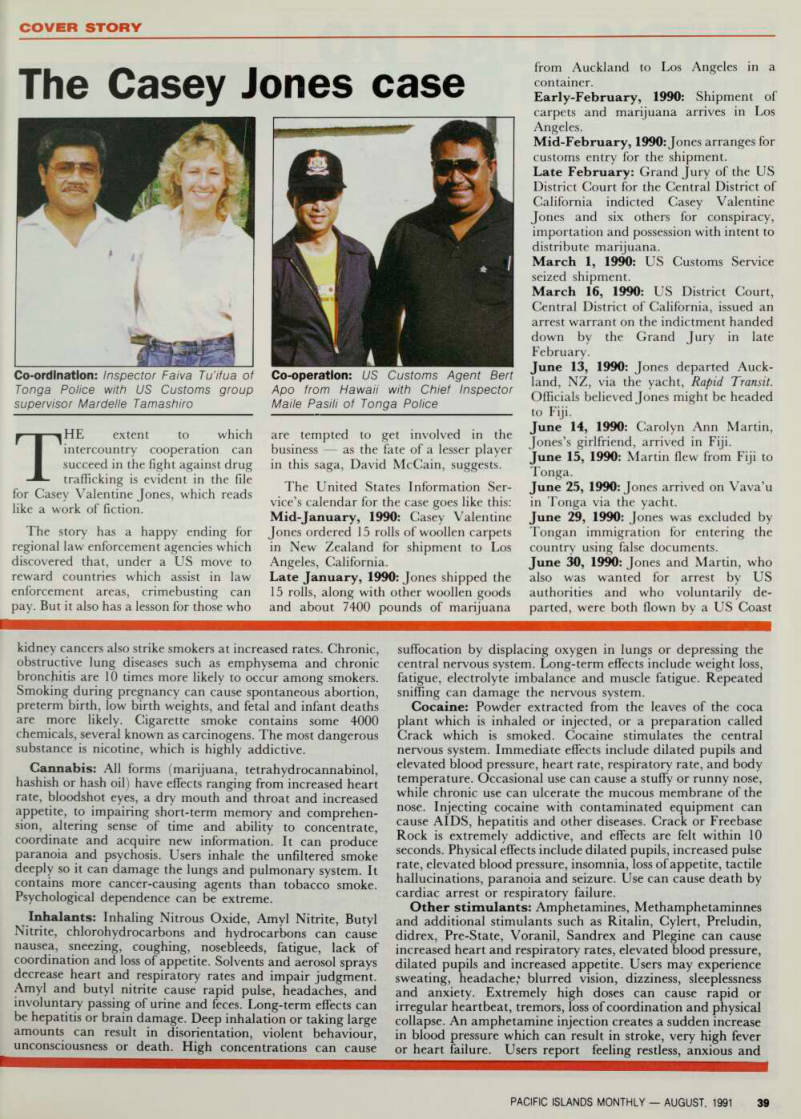
Co-ordination: Inspector Faiva Tu’ifua of Tonga Police with US Customs group supervisor Mardelle Tamashiro
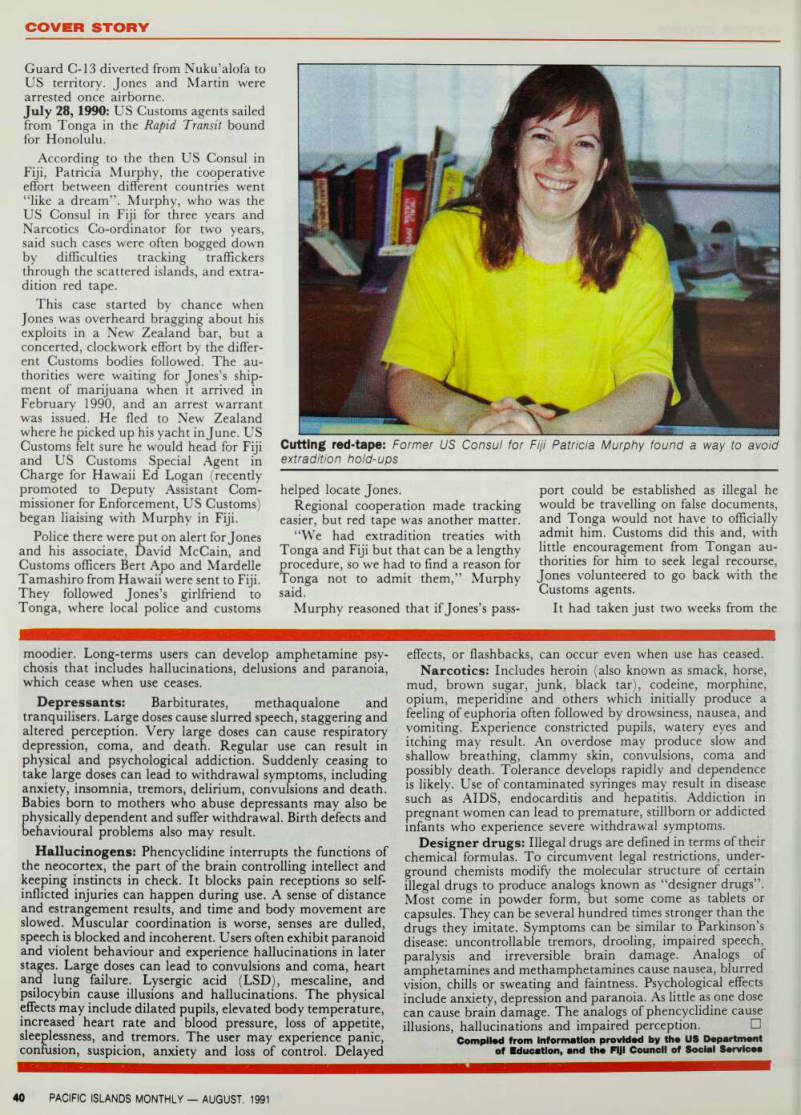
Co-operation: US Customs Agent Bert Apo from Hawaii with Chief Inspector Maile Pasili of Tonga Police
Guard C-13 diverted from Nuku’alofa to US territory. Jones and Martin were arrested once airborne.
July 28, 1990: US Customs agents sailed from Tonga in the Rapid Transit bound for Honolulu.
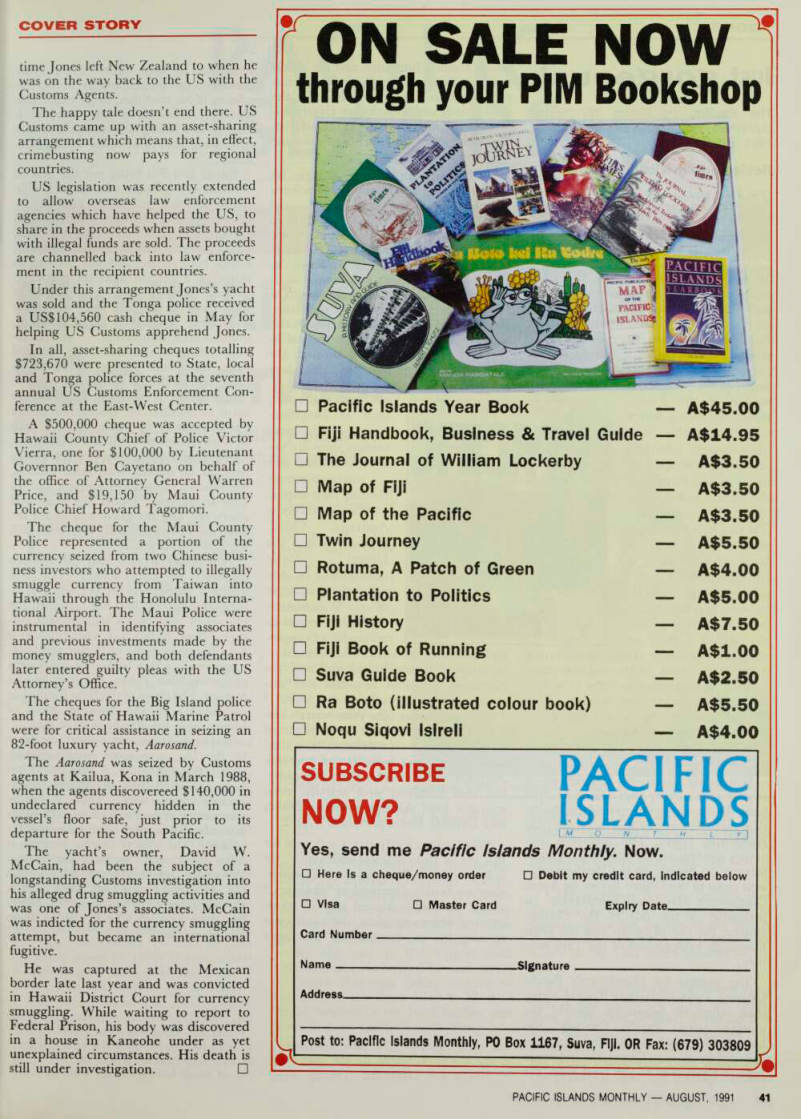
According to the then US Consul in Fiji, Patricia Murphy, the cooperative effort between different countries went “like a dream”. Murphy, who was the US Consul in Fiji for three years and Narcotics Co-ordinator for two years, said such cases were often bogged down by difficulties tracking traffickers through the scattered islands, and extra dition red tape.
This case started by chance when Jones was overheard bragging about his exploits in a New Zealand bar, but a concerted, clockwork effort by the differ ent Customs bodies followed. The au thorities were waiting for Jones’s ship ment of marijuana when it arrived in February 1990, and an arrest warrant was issued. He fled to New Zealand where he picked up his yacht in June. US Customs felt sure he would head for Fiji and US Customs Special Agent in Charge for Hawaii Ed Logan (recently promoted to Deputy Assistant Com missioner for Enforcement, US Customs) began liaising with Murphy in Fiji.
Police there were put on alert for Jones and his associate, David McCain, and Customs officers Bert Apo and Mardelle Tamashiro from Hawaii were sent to Fiji.
They followed Jones’s girlfriend to Tonga, where local police and customs
helped locate Jones.
Regional cooperation made tracking easier, but red tape was another matter.
“We had extradition treaties with Tonga and Fiji but that can be a lengthy procedure, so we had to find a reason for Tonga not to admit them,” Murphy said.
Murphy reasoned that if Jones’s pass
port could be established as illegal he would be travelling on false documents, and Tonga would not have to officially admit him. Customs did this and, with little encouragement from Tongan au thorities for him to seek legal recourse, Jones volunteered to go back with the Customs agents.
It had taken just two weeks from the
Cutting red-tape: Former US Consul for Fiji Patricia Murphy found a way to avoid extradition hold-ups
time Jones left New Zealand to when he was on the way back to the US with the Customs Agents.
The happy tale doesn’t end there. US Customs came up with an asset-sharing arrangement which means that, in effect, crimebusting now pays for regional countries.
US legislation was recently extended to allow overseas law enforcement agencies which have helped the US, to share in the proceeds when assets bought with illegal funds are sold. The proceeds are channelled back into law enforce ment in the recipient countries.
Under this arrangement Jones’s yacht was sold and the Tonga police received a U 55104,560 cash cheque in May for helping US Customs apprehend Jones.
In all, asset-sharing cheques totalling $723,670 were presented to State, local and Tonga police forces at the seventh annual US Customs Enforcement Con ference at the East-West Center.
A $500,000 cheque was accepted by Hawaii County Chief of Police Victor Vierra, one for $lOO,OOO by Lieutenant Governnor Ben Cayetano on behalf of the office of Attorney General Warren Price, and $19,150 by Maui County Police Chief Howard Tagomori.
The cheque for the Maui County Police represented a portion of the currency seized from two Chinese busi ness investors who attempted to illegally smuggle currency from Taiwan into Hawaii through the Honolulu Interna tional Airport. The Maui Police were instrumental in identifying associates and previous investments made by the money smugglers, and both defendants later entered guilty pleas with the US Attorney’s Office.
The cheques for the Big Island police and the State of Hawaii Marine Patrol were for critical assistance in seizing an 82-foot luxury yacht, Aarosand.
The Aarosand was seized by Customs agents at Kailua, Kona in March 1988, when the agents discovereed $ 140,000 in undeclared currency hidden in the vessel’s floor safe, just prior to its departure for the South Pacific.
The yacht’s owner, David W.
McCain, had been the subject of a
longstanding Customs investigation into
his alleged drug smuggling activities and was one of Jones’s associates. McCain was indicted for the currency smuggling attempt, but became an international
fugitive.
He was captured at the Mexican border late last year and was convicted in Hawaii District Court for currency smuggling. While waiting to report to Federal Prison, his body was discovered in a house in Kaneohe under as yet unexplained circumstances. His death is still under investigation, □