Testimonies of
p. 55 · Read in the full issue
Books
Testimonies of nuclear times
Chronology: The French Presence in the South Pacific (Greenpeace International, Auckland, 1991): Testimonies: Witnesses of French Nuclear Testing in the South Pacific (Greenpeace International, Auckland, 1990): Global Warming: The Greenpeace Report, editing by Jeremy Leggett (Oxford University Press, London, 1990); The Green peace Book of the Nuclear Age, by John May (Victor Gallanz, London, 1989).
Reviewed by David Robie.
EVERYONE is doomed, Edwin Haoa was told after a “successful” test in French Polynesia. They, or their children, would all experience health problems in 15 to 20 years’ time.
Haoa, a Tahitian leader of a decon tamination team on Moruroa and Fangataufa atolls during the atmospheric nuclear tests, is one of two Maohi witnesses who spoke out in the New Zealand-made independent tele vision documentary Nitikila Fri Pasifik in 1989. He is among 26 people who give hair-raising accounts of the cultural, economic, enviromental, health and social devastation of 44 atmospheric and 120 underground nuclear tests in Testimonies. This work hardly “proves” a relationship between the nuclear tests and increased rates of cancer, stillbirths or other medical complaints. The editors admit an exhaustive medical survey of the 12,000 people who worked on the
atolls, and analysis of health statistics over the past two decades would be needed to show if there is a health legacy comparable to Micronesia. But France would hardly allow this.
Many of the testimonies were gathered in secret during 1987 by Dr Andy Biederman, a Swiss doctor and crewman on the bombed Greenpeace flagship Rainbow Warrrior.
The book is a moving accoynt but Greenpeace has been slow in publishing three years is too long to wait for such
important testimonies.
Chronology, the just-published com
panion volume to Testimonies , is packed with useful data on the French presence in Polynesia, but it hardly lives up to its subtitle. In the opening double-page map of the “French presence in the Pacific”, for example, there is no indi cation of Wallis and Futuna.
The entries on New Caledonia are at times inaccurate and the editors appear to have relied heavily on inadequate newspaper reports. The assassinations of Jean-Marie Tjibaou and Yeiwene, and the Ouvea massacre, are brief.
There is not a single bibliography title about New Caledonia. Still the material on Tahiti is a must for any Pacific library.
Documenting “hidden history” on a far grander scale than Testimonies are The Greenpeace Book of the Nuclear Age and Global Warming. The former is a devastat ing 378-page account of civil and military nuclear accidents until 1989,
including a revealling and appalling descrip tion of Chernobyl.
The second demon strates how solutions to the global warming threat are obvious, but they hinge on paradigm shifts in hu man behaviour.
The nuclear age “began with two promises: a Promise of Plenty and a Promise of Security. After 50 years, our bombs and reactors have failed to deliver either of these”. But the end of the Cold War and the advantage of global communications could lead to a new age, based on co operation and ideas rather than confron tation and suspicion.
Nuclear weapons have no place in such an age. □
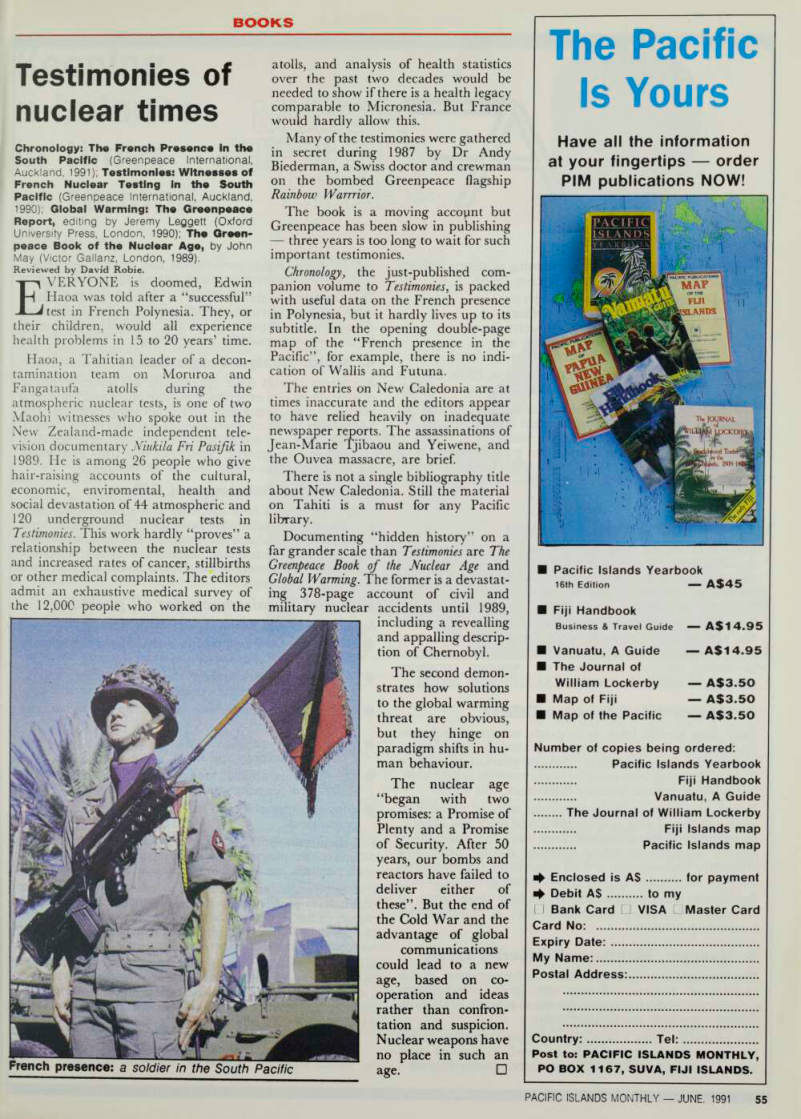
French presence: a soldier in the South Pacific