Tackling the ‘bad boy’ tag
p. 53 · Read in the full issue
Sport
By Loveni Enari
WHEN the Western Samoan rugby side lost to Auckland last month at Eden Park in the “test” of their five-match tour, most of the crowd walked away in awe of the mighty Auckland machine that rolled the Islanders 42-3.
The Auks had ruthlessly exposed deficiencies in the Samoans’ lineouts, scrums and competition for the loose ball and most' post-match discussions were about the merits of the Auckland side at the after-match function. But a hard-core
group of tour supporters was mulling over their drinks and discussing, of all things, respect.
Admittedly, the talk went, there was a lot of work needed before the World Cup on the lineouts, the scrums, the loose ball and all the rest of it. But first there was this “respect” question that had to be resolved.
They were referring to the fact Auckland seemed so totally in control of the match from the start. That control seemed to make an Auckland side, typically arrogant, puff their chests even more. They went slightly overboard as they illegally pushed the Samoans around in the lineouts, stomped on wayward bodies in rucks and mauls, and rubbed in the fact the Samoans still have some way to go before they approach the level of the
champion Ranfurly Shield side.
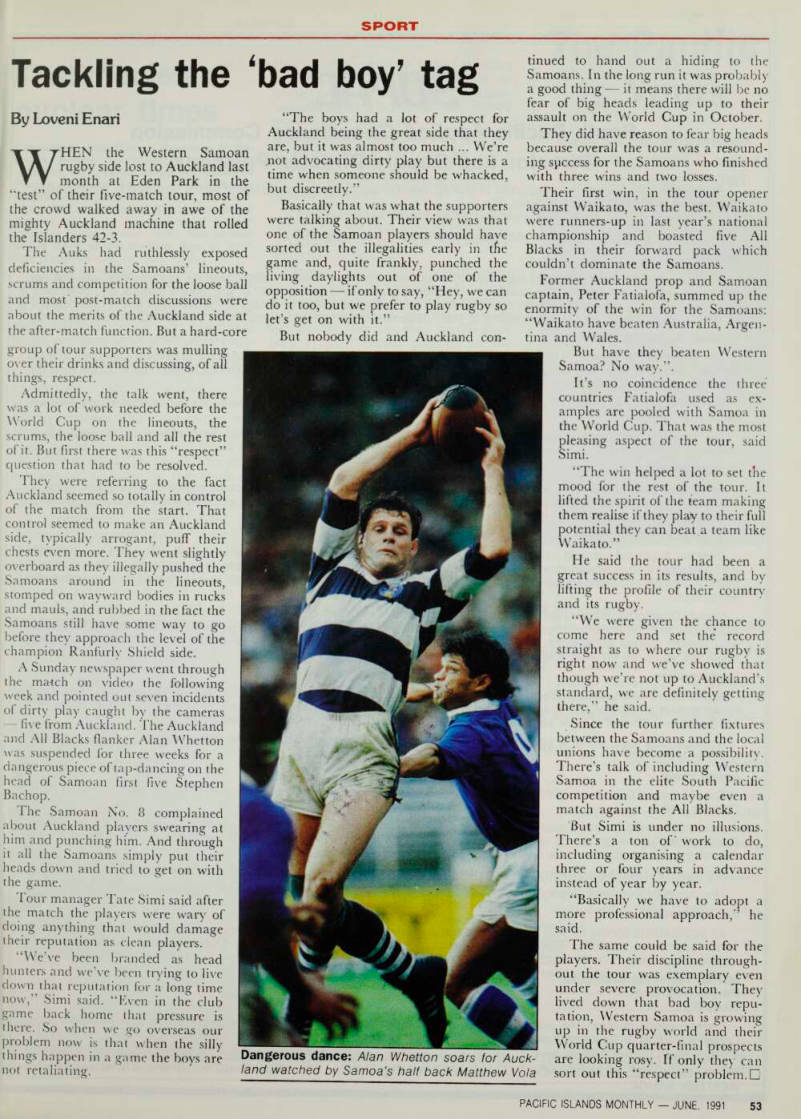
A Sunday newspaper went through the ma-tch on video the following week and pointed out seven incidents of dirty play caught by the cameras five from Auckland. The Auckland and All Blacks flanker Alan Whetton was suspended for three weeks for a dangerous piece of tap-dancing on the head of Samoan first five Stephen
Bachop.
The Samoan No. 8 complained about Auckland players swearing at him and punching him. And through it all the Samoans simply put their heads down and tried to get on with the game.
Tour manager Tate Simi said after the match the players were wary’ of
doing anything that would damage
their reputation as clean players.
“We’ve been branded as head hunters and we’ve been trying to live down that reputation for a long time now,” Simi said. “Even in the club game back home that pressure is there. So when we go overseas our problem now is that when the silly things happen in a game the boy's are not retaliating.
“The boys had a lot of respect for Auckland being the great side that they are, but it was almost too much ... We’re .not advocating dirty play but there is a time when someone should be whacked, but discreetly.”
Basically that was what the supporters were talking about. Their view was that one of the Samoan players should have sorted out the illegalities early in tfie
game and, quite frankly, punched the
living daylights out of one of the opposition if only to say, “Hey, we can do it too, but we prefer to play rugby so let’s get on with it.”
But nobody did and Auckland con-
tinued to hand out a hiding to the Samoans. In the long run it was probably a good thing — it means there will be no fear of big heads leading up to their assault on the World Cup in October.
They did have reason to fear big heads because overall the tour was a resound ing spccess for the Samoans who finished with three wins and two losses.
Their first win, in the tour opener against Waikato, was the best. Waikato were runners-up in last year’s national championship and boasted five All Blacks in their forward pack which couldn’t dominate the Samoans.
Former Auckland prop and Samoan captain, Peter Fatialofa, summed up the enormity of the win for the Samoans: “Waikato have beaten Australia, Argen tina and Wales.
But have they beaten Western Samoa? No way.”.
It’s no coincidence the three countries Fatialofa used as ex amples are pooled with Samoa in the World Cup. That was the most pleasing aspect of the tour, said Simi.
“The win helped a lot to set the mood for the rest of the tour. It lifted the spirit of the team making them realise if they play to their full potential they can beat a team like Waikato.”
He said the tour had been a great success in its results, and by lifting the profile of their country and its rugby.
“We were given the chance to come here and set the record straight as to where our rugby is right now and we’ve showed that though we’re not up to Auckland’s standard, we are definitely getting there,” he said.
Since the tour further fixtures between the Samoans and the local unions have become a possibility.
There’s talk of including Western Samoa in the elite South Pacific competition and maybe even a match against the All Blacks.
But Simi is under no illusions.
There’s a ton of work to do,
including organising a calendar
three or four years in advance instead of year by year.
“Basically we have to adopt a more professional approach,” he said.
The same could be said for the
players. Their discipline through
out the tour was exemplary even under severe provocation. They lived down that bad boy repu tation, Western Samoa is growing up in the rugby world and their World Cup quarter-final prospects are looking rosy. If only the) can sort out this “respect” problem.□
Dangerous dance: Alan Whetton soars for Auck land watched by Samoa's half back Matthew Vola