Keeping
pp. 57-58 · Read in the full issue
Pacific People
Keeping a balance in times of turmoil
By Martin Tiffany
PETER Sobby Tsiamalili sat in his Suva office and emphasised that he had to “maintain the bal ance.” He was speaking of his time on Bougainville island in Papua New Guinea during the Bougainville Copper Mine crisis when he had to keep an equilibrium between the national security forces and the Bougainvilleans.
But he could easily have been describing his own life.
Maintaining the balance is what Tsiamalili, 39, PNG’s new ambassador to Fiji, has done a lot of during his 19 years in government.
Being a Bougainvillean, from the village of Torokina, and working for the national government on Bougainville almost cost him his life because the
Bougainville Revolutionary Army
(BRA) saw him as a traitor. To this day he maintains it is nothing short of a miracle that he is alive.
In January and February last year there was bloody fighting between the security forces and the BRA, resulting in a death toll well past 100 lives. The next -month saw a ceasefire, followed by withdrawal of PNG soldiers and police.
Somehow, someone forgot to tell Tsiamalili.
He recalls that it was mid-March.
“Suddenly everybody was gone no police, no security forces I was a sitting duck,” said'Tsiamalili. The BRA wasted no time and abducted him on Sunday March 11. He was to be shot the following morning at their camp in the hills. When they captured him they also destroyed his home in Kieta, and with it 18 years of his and his family’s lives.
Fortunately he had sent his family off Bougainville earlier after numerous threats to his and their lives they left hastily with not much more than their clothes.
On the day he was to be executed he was positioned to be shot and a gun pointed at his head. “I thought that was it, it was just a matter of pulling the trigger. But at the last moment they changed their minds and demanded that I tell them everything I knew,”
Tsiamalili recalls. “They wanted me to explain about papers and documents
that they had found at my home, and I told them what I could.”
He was held for three-and-a-half weeks, wondering if he would live or die.
“During that time one thought kept
going through my mind if there is a will there is a way,” he recalled. A will there was as he tried to hold on to his sanity, managing only 15 to 20 minutes of sleep a day. Tsiamalili said at one point he thought he had lost his mind and had to do simple arithmetic to ensure he was still sane. “I did sums like six multiply by three to see how long I would take to answer it.”
Most of his days in captivity were spent praying the result of a strict Catholic upbringing. The full details of his time in captivity cannot be released due to security precautions and to protect people who helped him. Howwith the help of a writer, Tsiamalili
hopes to publish his autobiography next
year.
After almost being shot again by the
BRA and a failed attempt on his life by one of the BRA soldiers, Tsiamalili managed to slip away to Kieta and hide while figuring a way to get off Bougain ville. “I knew I only had a slim chance of getting out alive but I knew I had to try or die in the attempt as if I got
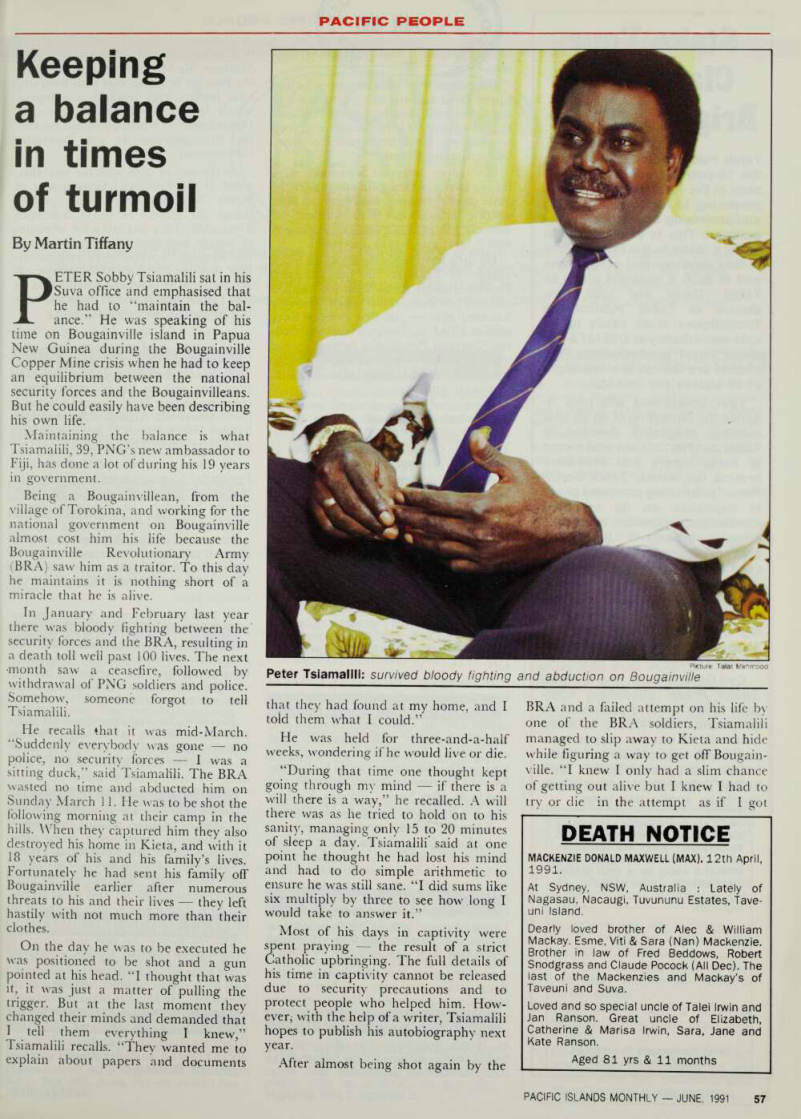
Picture: Talat Mehmood Peter Tsiamalili: survived bloody fighting and abduction on Bougainville
I woulcH;be killed any way His rations were running out he had sipped from a bottle of tomato sauce k> sustain himself; and he found it difficult to find anyone to help because everyone was scared. He almost gave up hope, before finding someone.
His helper wrapped Tsiamalili in a fishing neat and tarpaulin and, under the guise of going fishing, took him to a boat waiting six miles out of the harbour. “I owe my life to two guys - a jungle guy and a l:>oat guy,” said Tsiamalili.
He then went to his family at his wife’s village of Bakubari in the Northern Province, where he thought his troubles would be over. But again trouble haunted him the first defence force soldier killed on Bougainville was from the Northern Province, a rumour spread that Tsiamalili was collaborating with the BRA and a gang was hired to assasinate him.
But one of the gang members was a close relative of his wife and he looked upon Tsiamalili as a brother-in-law.
Tsiamalili was alerted and managed to talk with the gang and sort things out.
Another incident occured during the Bougainville crisis when he was beaten and almost killed by the security forces because they thought he was a traitor.
He admits he would have liked to stay in his wife’s village for the rest of his life and forget about the troubles of the world, but duty called and he went to Port Moresby to join the Prime Minister’s Department. With more security prob lems in Port Moresby he was sent to New York as PNG’s United Nations represen tative to cover the 45th cession of the UN.
In December 1990 he was surprised to learn he had been appointed Ambassa dor to Fiji. Surprised because he didn’t expect such an appointment so soon and because he was still physically and mentally winding down. But he took the post with confidence and is looking forward to the challenge. From Fiji he also looks after Nauru, Tuvalu, Kiribati and the Federated States,of Micronesia.
Tyamalili’s career in government started as a Cadet Patrol Officer looking after government functions in the district at a station in East New Britain in 1971.
He served in,, other stations and at headquarters as Special Fields Projects Officer and Acting District Officer Lands. From 1973 to 1975 he took a diploma in public administration and graduated with distinctions.
He then went to his birthplace the Bougainville province of North Sol omons, as a government liaison officer to monitor the situation because there was talk of secession from PNG. A Republic of North Solomons was declared on September 1, 1975, 15 days before PNG independence on September 16.
A delegation led by the then Prime Minister, Sir Michael Somare, currently the Foreign Minister, met with Bougain ville leaders and reached a comprise which led to the birth of Provincial Government North Solomons became the first province to get Provincial Government.
At the end of 1976 with the establish ment of the Provincial Government of North Solomons there were certain things the leaders of North Solomons demanded. They put out a list of names of people instrumental in carrying out the national Government’s responsibil ities and they wanted these people off Bougainville Tsimalili’s name was on that list. He was forced to leave his home but he vowed he would be back, In 1977 he furthered his studies with a Diploma in Commerce from the University of PNG. After graduating in 1978 he held various positions in the provinces and at headquarters before
studying Urban Planning and Develop
ment under an AIDAB scholarship in Sydney. He returned to become Princi pal Government Liaison Officer.
At that time the post of Deputy Provincial Commissioner of North Sol omons became vacant and the Adminis trative Secretary in North Solomons offered Tsiamalili the job.
He turned down a high position with the national Government and w r as in the North Solomons before they knew he was. His transfer was formalised six months later.
In 1985 he took over as Administrative Secretary of Department of North Sol omons and held that position until his narrow escape from Bougainville in 1990.
Despite all that has happened he still vows he will return.“lt is my home, I will return,” he explains simply.
For now, he and his wife Ruth and their four children are settling well into Fiji. Tsiamalili says it is the first place after the New York appointment where they can have peace of mind.
PNG, Tsiamalili feels, can learn a lot from cottage industries in Fiji'and Fiji can offer experience, because small scale industries will benefit the large rural community in PNG. Self-help and rural development programmes are one of his pet “ after-hours ” interests and he talks with enthusiasm about how rural people can help themselves they just need to be shown how.
On the future, he says that after 19 years in government he would Ikie to retire after this appointment to go home, and be a simple villager helping out in the village. He also has plans to continue his studies and do his Masters in Public Administration. In 1984 he did Post Graduate studies in Manchester Univer sity in England, studying Rural Develop ment and Planning. □