Return of the French
pp. 10-11 · Read in the full issue
The Region
Ten years of Mitterand highlighted by Rocard’s reconciliation tour. Nicolas Rothwell reports from Paris.
AS President Francois Mitter rand celebrates a decade in power this month, politicians and diplomats in Paris re viewed the tumultuous changes in France’s Pacific policies during his first 10 years in power a period that included the Rainbow Warrior bomb ing, the killing on Ouvea in New Caledonia, and repeated political struggles in French Polynesia.
Mitterrand’s Prime Minister, Michael Rocard, resigned on May 15 and was replaced by Edith Cresson, but not before making a path-breaking “visit of reconciliation” to New Zealand at the end of April. The visit was a neat piece of symbolic timing, designed to repair relations between Paris and the govern ment in Wellington. Rocard’s journey was welcomed by New Zealand officials, who invited the then French Prime Minister to pay a visit to Akaroa, the village where French pioneers first dis embarked on New' Zealand soil in 1840.
For Rocard, wdio had been trying to build up a powder base as a potential
successor to Mitterrand, the Pacific is a special area of concern — the scene of his first great triumph in office, the Matignon Accords that paved the way
for peace in New Caledonia.
French commentators regard relations between Paris and Wellington as definitively restored, after the virtual break-down caused by the Rainbow warrior bombing by French agents in July 1985. Rocard went as. far as any French minister could conceivably go in
making a veiled public apology during
his visit, when he declared that “errors were made in the past”.
For the Prime Minister, who was not in office at the time of the affair, this was a simple concession to make. A certain doubt still surrounds Mitterand’s con nection with the affair; at the time, and ever since, he has denied any knowledge of the bombing, while responsibility was shouldered by the Minister of Defence of the day, Mr Charles Hernu. Rocard found his New Zealand hosts eager to accept his amends, and put relations between the two countries back on a smooth footing; but in France, there has been rather less rejoicing. Ordinary public opinion has never shown much remorse over the Rainbow Warrior affair, which was widely viewed as an operation mounted to protect France’s national security interests by warding Greenpeace’s protest vessel away from
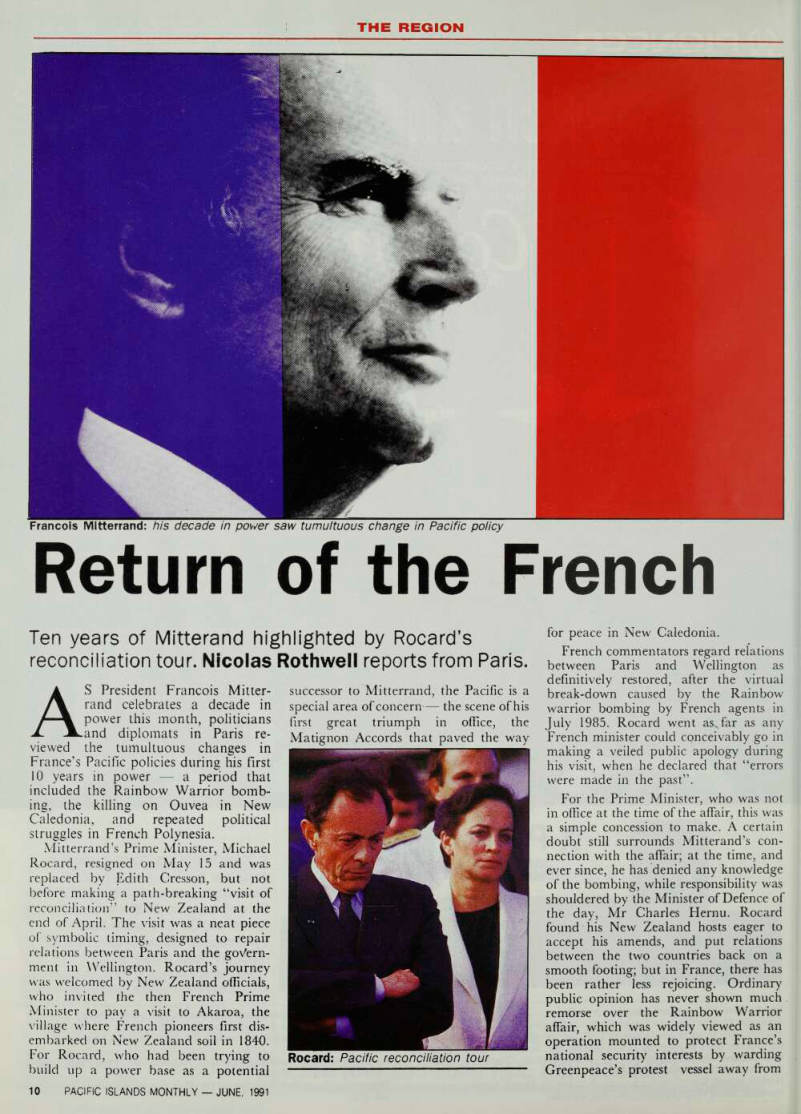
Francois Mitterrand: his decade in power saw tumultuous change in Pacific policy
Rocard: Pacific reconciliation tour
the nuclear test site at Moruroa. Conser vative critics of the Government were less than impressed by Rocard’s attempt to improve relations with Wellington: an editorial in the establishment newspaper, Le Figaro, caustically described Rocard as a “well-known masochist’ and ventured that if he was going to conduct himself in such an embarrassing manner while representing France overseas, he should resign. Rocard’s New Zealand hosts may be glad to have heard words of con trition, however measured, from a Paris official, but they remain less than happy with France’s continued nuclear testing in the Pacific. New Zealand’s Prime Minister, Jim Bolger, may have said that the two countries had agreed to disagree, and that “France and New Zealand must work more together to promote regional stability and development” but when France detonated its first warhead of the testing season under Moruroa barely a week after Rocard left Wellington, the reaction was one of predictable anger.
Rocard had made no attempt to hide the fact that France would continue its nuclear test programme which he stressed “posed no special danger either for New Zealand or for nearer islands”.
But the French decision to go ahead with testing gave a sharp indication that Paris still places its military program ahead of the sensitivities of its Pacific neighbours.
France’s Pacific policies also are un dergoing an intriguing evolution in its colonies. \\ hen President Mitterrand contested the 1988 elections against the
conservative candidate Jacques Chirac,
who was then Prime Minister, the status of New Caledonia was one of the key issues. On the eve of voting, Chirac ordered the storming of the Kanak militants on Ouvea in the Loyalty Islands an operation that failed to win him sufficient votes to dethrone his rival.
Since then, the prospects for the territory have oscillated, with the killing of Kanak leader Jean-Marie Tjibaou marking the low point on the journey towards greater autonomy and eventual independence.
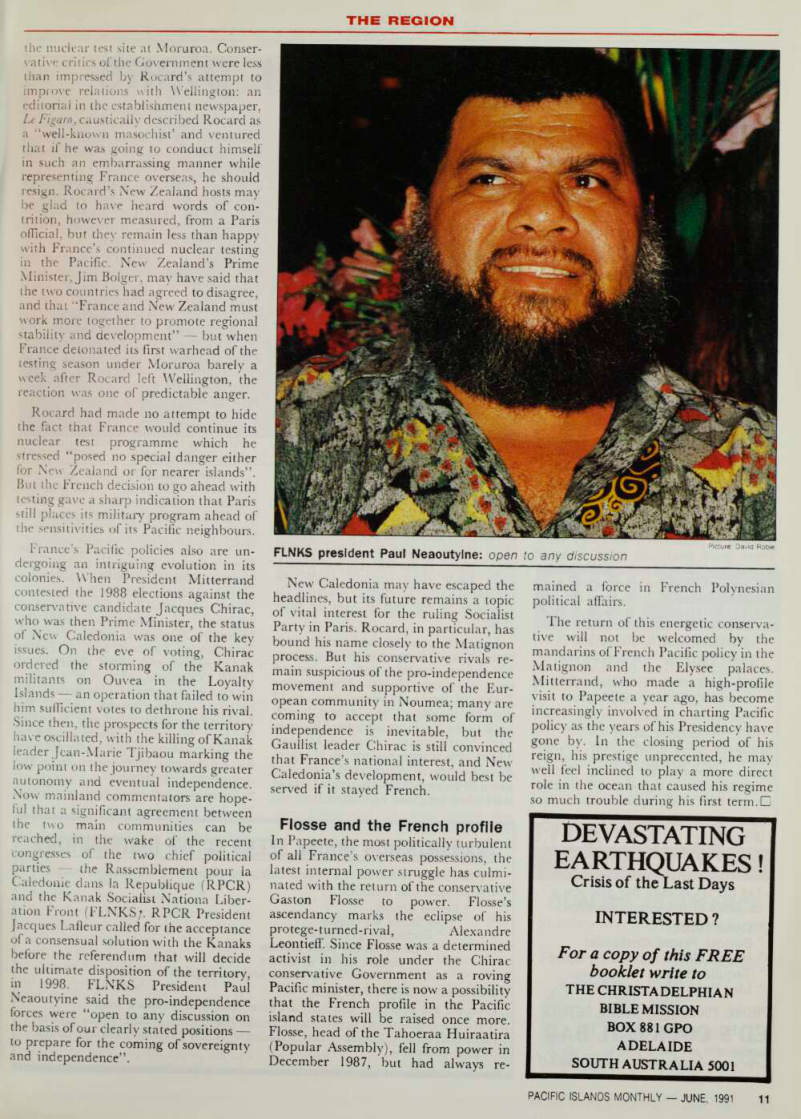
Now mainland commentators are hope ful that a significant agreement between the two main communities can be reached, in the wake of the recent congresses of the two chief political parties the Rassemblement pour la Caledonie dans la Republique (RPCR) and the Kanak Socialist Nationa Liber ation Front (i'LNKS;. RPCR President Jacques Lafleur called for the acceptance of a consensual solution with the Kanaks before the referendum that will decide the ultimate disposition of the territory in 1998. FLNKS President Paul
Neaoutyine said the pro-independence
forces were “open to any discussion on the basis of our clearly stated positions to prepare for the coming of sovereignty
and independence”.
New Caledonia may have escaped the headlines, but its future remains a topic of vital interest for the ruling Socialist Party in Paris. Rocard, in particular, has bound his name closely to the Matignon process. But his conservative rivals re main suspicious of the pro-independence movement and supportive of the Eur opean community in Noumea; many are coming to accept that some form of independence is inevitable, but the Gaullist leader Chirac is still convinced that France’s national interest, and New Caledonia’s development, would best be served if it stayed French.
Flosse and the French profile In Papeete, the most politically turbulent of all France’s overseas possessions, the latest internal power struggle has culmi nated with the return of the conservative Gaston Flosse to power. Flosse’s ascendancy marks the eclipse of his protege-turned-rival, Alexandre Leontieff. Since Flosse was a determined activist in his role under the Chirac conservative Government as a roving Pacific minister, there is now a possibility that the French profile in the Pacific island states will be raised once more.
Flosse, head of the Tahoeraa Huiraatira (Popular Assembly), fell from power in December 1987, but had always re
mained a force in French Polynesian
political affairs,
r , . • Thc " turn of , thls energetic conserva tlve ' vl .“ n ?‘ be , welcomed b X tbe " lanc lanns of I rench Pacific policy in the M atl g n °n and the Elysee palaces, Mitterrand, who made a high-profile VlSlt to . a P e ? te a e . a f a £° 5 bas >eco f ne involved in charting Pacific P ohc y as th e years of.his Presidency have gone b >/ In the closin § P eriod of his reign L pr , estlge unpreccntcd, he may , 1 . , mchned 10 P la ? a more direct ro e 111 tbe ocean th at caused his regime so much trouble during his first term.D
Picture David Robie FLNKS president Paul Neaoutyine: open to any discussion