Superministry, super plans
pp. 12-13 · Read in the full issue
By Al Prince
HOW to tackle Tahiti’s strug
gling and complex tourism
industry has been a major preoccupation of Gaston Flosse since he returned to power on April 4 as Territorial Government President, following the March 17 gen eral election.
As evidence of that concern, Flosse is the first president not to appoint govern ment cabinet ministers in charge of tourism and airline transportation.
Instead, he has created a sort of “superministry” at the presidency, which includes a few expert advisers like Alec Ata, who headed up Tahiti’s first tourist i board for many years then served as tourism minister in the late 19705.
Ironically, the optimistic goals of doubling Tahiti’s 1982 hotel capacity and yearly tourist volume began with the first of two Flosse governments, when Alexandre Leontieff was his tourism minister. The goals remained the same during Flosse governments from 1982-1987 and continued after Flosse resigned as president in February 1987.
Those goals continued after Leontieff bolted from Flosse’s party in November 1987, forced Flosse’s successor and loyal supporter Jacques Teuira to resign, and formed his own government, which lasted three years and four months before being defeated at the polls on March 17.
Thus, all that has changed over the past nine years has been the deadline for achieving 4000 hotel rooms and 200,000 tourists yearly in four to five years.
When reminded of that history, Flosse smiled and nodded his head affirmatively during an interview on May 16 with Pacific Islands Monthly. “We’ve come up with so many figures,” he said. “I don’t have any figures to give you.” He later agreed that 1500 quality rooms are
needed, although he did not fix a deadline.
He said the Government had been meeting with investors who had been told that, regardless of previous delays in government authorisations or any lack of push by the Leontieff government to realise tourism development projects, the Flosse government is ready to move quickly. One of the first things that will be done, he said, will be to improve Tahiti’s Investment Code without increased government financial aid but still assuring investors exactly how much government aid they will get.
Flosse claimed that under the Leontieff government investors were promised aid of up to 30 per cent of their investment,
The optimistic goals of doubling hotel capacity are the same as 1982
only to discover after final decisions that the amount was 12-15 per cent. “I don’t think things should be promised that aren’t kept,” Flosse said. He said Invest ment Code improvements would be presented to the Territorial Assembly for approval by the end of May or early June.
Listing his priorities for hotel develop
ment, Flosse first mentioned a two-phase, S3O-million expansion project to convert the 202-room Tahiti Beachcomber Parkroyal into a 322-room hotel in 18 months, making it the second largest hotel in the Territory after the 350-room Club Mediterranee village on Moorea.
Tahiti Beachcomber General Manager Philippe Brovelli later confirmed that this 120-room expansion project would start when the green light came from the
owner, Japanese investor Harunori Takahashi, the head of EIE Interna tional and the biggest Japanese hotel owner in the Territory.
Next on Flosse’s list was the $6-million renovation of the 200-room Hyatt Re gency Tahiti. The new Hyatt, also a Takahashi property, is destined to be Tahiti’s most deluxe hotel.
Massimo lanni, Hyatt’s general man ager, later confirmed that 75 renovated rooms, including the chain’s Regency Club, will be inaugurated on July 1.
Another 25 renovated rooms will be ready by September 1, with the final 100 ready by the end of this year, lanni said.
Work also will begin in mid-June, one to two months behind schedule, on the Territory’s first theme park recreation area opposite the hotel entrance. Spread over 43,057 square feet of land, it will be a sort of Fantasy Island on land overlooking the ocean. Completion date is by next January 1.
A third Takahashi-owned hotel, the 150-room Moorea Beachcomber Parkroyal, will finish most of a SI 1-million renovation and upgrade by mid-July.
The most controversial project on Flosse’s list is a SI 00-million, 250-room Sheraton Hotel and 18-hole golf course next to Oponohu Bay on Tahiti’s sister island of Moorea. This project was first proposed in December 1988 by Mitsuhiro Nishikawa, president of JIN Architectural Planners, Inc., of Tokyo, and president and board chairman of DOH Company, Ltd, of Tokyo.
Nishikawa apparently received the necessary authorisations from the Leontieff government last year, but work has been delayed by citizens groups on Moorea opposing the golf course planned for agricultural land leased from the Territorial Government.
Flosse said he had already met separ-
ately .with Nishikawa and some of the opposition groups at his presidential offices, and he and government members planned to go to Moorea on May 30 to “regulate this problem” so work could start.
Flosse s verbal list did not include an even more controversial Japanese project Advance Pacific Developments’ pro posal for a SI-billion tourist resort community with about 2000 rentable hotel, condominium and villa rooms, and a shopping centre on the privately owned atoll ofTupai, eight miles north northwest of Bora Bora. It would be the Territory s first self-contained public tourist resort community attracting a potential 160,000 tourists yearly with only a 75 per cent room occupancy rate. 1 his has been indefinitely delayed due to opposition from citizens groups on Bora Bora, A court order was needed last Near to evict squatters protesting the project on the atoll, nearly all of which is reportedly owned by Marcel Lejeune, one of Tahiti s first “notaires”, or solicitors.
Another delayed project is a SIO-million championship golf course next to the airport on Moorea, planned b\ California-based Bali Hai Corp., which owns three hotels and operates a fourth in french Polynesia. The Corp. announced last August plans to build the golf course, renovate the 63-room Moorea Bali Hai and reopen the 44-room Hotel Bali Hai on Huahine, which closed in November 1988 due to a labor dispute. Those plans were to be financed by new capital raised though American investors in the Bali Hai Corp.
But additional negotiations with poten tial Japanese investors since 1989 have yet to produce an agreement.
Flosse’s verbal list of projects also included an SBO-million, 440-room Hotel Meridien for what is known as the Rivnac property in Tahiti’s west coast Commune of Punaaui and a 2-300 room hotel by a Japanese group for the Tahiti Village property ne\t to the Meridien site. Meridien is also reportedly looking for investment to finance the construc tion of individual hotels on the islands of Moorea and Bora Bora.
Several hotel renovation and other expansion projects also are under way.
The biggest is a 535-million, 150-room new Club Mediterranee village on Bora Bora.
Although Tahiti may end up with Sheraton and Meridien, it also needs more chains, such as Hilton and Marriot, so that competition will increase promo tion, Flosse said. He also agreed that Tahiti would need to train more of its own people for hotel jobs. He said his Council of Ministers voted on May 15 to transfer an existing hotel training school to a new and bigger site with a capacity for 500 local students and 100 students from the South Pacific, but he also would look at training people overseas.
Besides hotel development, Flosse has been looking at increasing international airline service. He agrees that more hotels have to be built to attract more airlines, but he is attacking both prob lems simultaneously. He indicated a high priority was a US carrier serving Tahiti from the US mainland. Tahiti has not had such a carrier since Continental Airlines pulled out in October 1989 after
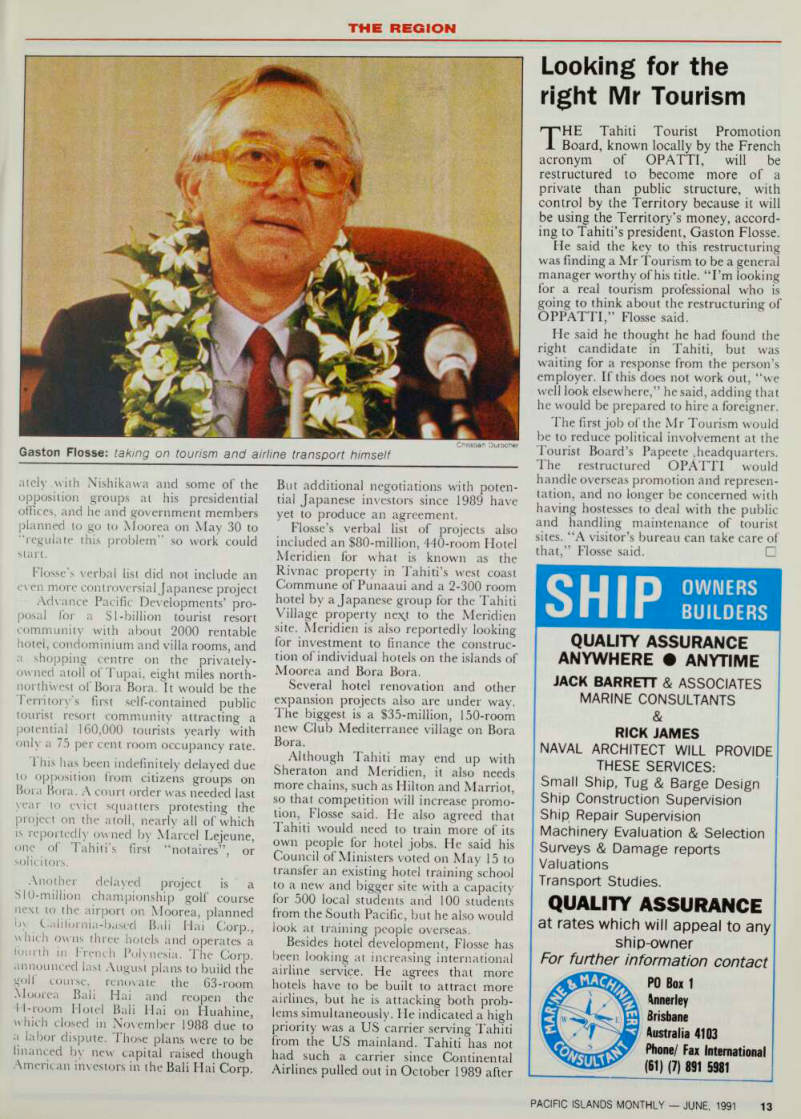
Christian Durocher Gaston Flosse: taking on tourism and airline transport himself