the islands
pp. 7-8 · Read in the full issue

Futa Held
Diaspora of Pacific Islanders
THE most recent large-scale movement of people in the Pacific has been a diaspora ofislanders. The causes have been connected with die search for greener fields, economically speaking, but nor through conquests or being led away to captivity. However, it is not as simple as it sounds. The phenomenon is the culmination of a long process initially set in motion by missionaries. Since that early period the islanders have been undergoing a transformation slow at first but lately becoming a terrifying rush from communalist-minded people to more individualistic persons.
The lure of high consumption and physicality in developed, industrial societies like Australia, New Zealand and the United States has been a sucking force on island populations. But we must not be blind to economic and cultural conditions in the islands that are unconsciously felt and which drive people to migrate. So there is a push-pull effect holding between island countries and industrialised countries. On top of this there are the immigration policies of the same countries that are designed to skim off the better educated and trained islanders despite their hypocritical message to the islands that they must do everything to stem the brain drain!
One of the earliest mass transport of people from the islands onto the bigger, affluent neighbours was the result of blackbirding in Papua New Guinea, Solomons, Vanuatu and New Caledonia for slaves to work in the canefieldsof Queensland. Their descendants now live in communities dispersed throughout Queensland and northeast New South Wales.
One of them, from the Fatnowna family (ofSolomon Islands origin), has published a history of how his ancestors and other members down to his own generation, fared in their adopted country. Jemima Garrett, in her May comment, says Canberra recently set up ATSIC giving Aborigines and Torres Straits wide powers in terms of land and other citizenship rights. The policy, says Garrett, leaves out South Pacific islanders — by which she means, I suspect, the Papua New Guineans, Solomon Islanders, but excluding other South Sea islanders like Fijians and Polynesians wlio now are banded together to form ASSIUC. Even if this first group of‘South Pacific' islanders are rehabilitated in the manner required, the other segment of Pacific peoples in Australia — Fijians, Tongans, Samoans, Maoris, Cook Islanders, etc would still be unaccounted for.
Apart from the forced removal of people from their island homelands, the recent exodus to metropolitan centres has causes unrelated to any military invasions like those behind the Jewish case whether through being led away by invaders or following in their wake. According to the migrants themselves they go in search of a better economic station or educational opportunities for their children. But it is also a fact that sociocultural contexts in the islands are not entirely serene, that they prod people along to leave for overseas.
The ‘global economy’ did not exist for the islands until well after the Second World War. Before that island economies were solely dependant on export earnings from cash crops like copra and banana.
These resources were, and are, extremely unreliable and created no economic momentum on which any kind of progress can be founded. Next thing, the islanders.believed they discovered a “river of money” flowing between North America and Australia and New Zealand but missing the islands or worming through them on its way to its destination. „ Therefore, they reasoned, migrating to these countries would enable them to tap part of the river for resources. Then the mass movement in those countries started, small at first
and travelling light, but increasing consistently to its peak in the late 60s and early 70s. The situation now is that there are islander communities some sizable, some mere pockets all over New Zealand and Australia, in California, Texas,-in and around Salt Lake City, New York and Philadelphia, in Miami, and British Columbia, Canada and many other places.
There the islanders live as third or fourth class citizens, employed in the most menial of jobs those that the people of those countries would not take and very largely ignored by the governments of their
adopted countries. They are
looked down upon, quietly discriminated against, exploited in national celebrations as exhibitionist, cultural freaks, and referred
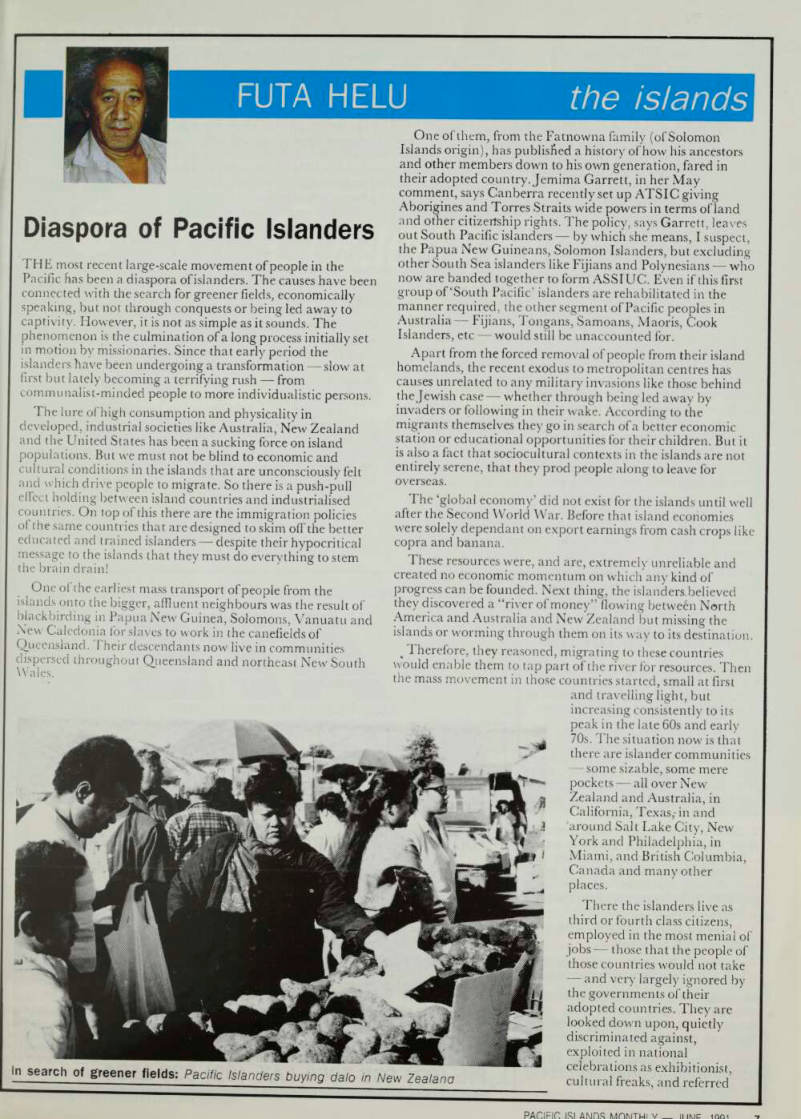
In search of greener fields: Pacific Islanders buying dalo in New Zealand
to as ‘coconuts’. Yet the islanders, especially the Polynesians, arc oblivious to this treatment.
However, the full fury of the animus usually levelled against Jews is avoided in the case of islanders mainly because they arc believed to possess very low IQs and do not represent a commercial or economic threat to the people of those countries. But at the same time their cultures are being dramatically changed or simply eroded by mere contact with stronger cultures abroad. Island cultures are weak because they are based on the morality of cooperation and friendliness that is so out of place in a dog eat dog environment. The church is the only institution that provides a context for the propagation and preservation of island culture.
And yet the churches batten on the meagre economic means of the islanders. Through annual donations, church appeals, cathedral development projects, and whatnot, they do not permit the poor migrants to become economically
independent.
The island migrants are a persecuted lot. In the social field they are encircled by hostile cultures. In the economic domain they are exploited by the churches. So far as I can see the only way for them to function with some measure of dignity is to give up their own cultures and adopt those of their new homes cultures that are based on individualism, thrift, acquisitiveness and independence. But they don’t have options, really. Environment and experience shall see that they embrace just those values.
The Pacific diaspora is quite extensive and its effect on island economies very significant. Though agricultural export could have been much higher, some island states are only able to stay economically afloat because of remittances from islanders who live abroad. Resources generated economically are miserable compared to foreign aid and remittances. All major development projects in the islands are aid-funded and at least 60 per cent of domestic
consumption expenditure in some countries is paid for by remittances.
There are more Niueans in New Zealand than Niue. The position in the Cooks is similar. Same for Samoans though their distribution is wider, with American Samoans concentrating in the United States (there are Samoans in Congress) and Western Samoans massing in New Zealand (it is predicted that a Samoan will be Prime Minister of that country within the next 20 years or so). The number of Tongans who live outside Tonga is close to that of Tongans who are still at home.
The Fijians were somewhat slow to join the exodus but since the coups more people have left Fiji for overseas. One can imagine the size of the capital transfers that such numbers can effect via different means. It is a source for lucrative business and ‘secondary’ (we must not say ‘parasitic’) commercial institutions like banks have already moved into
place.
The phase of the Return is already making an uncertain start. Many islanders go back home every year but only temporarily. They attend national celebrations, festivals and church conferences. They are regaled in feasts paid for by money they remitted to their feast-making relatives a case of earnings made in another country and consumed in another. But a few return for longer or for good.
These ‘Sephardic’ islanders set up businesses (most fail for lack of experience since they worked overseas only as factory hands) and some stand for parliament (here their failure is more pronounced because they are mostly with the wrong educational background and the electorate does not regard former factory hands as ideal material for parliamentary' work).
I believe, however, these shortcomings will soon be corrected and a real confrontation between them and the ‘Askenatzen’ who never left the home reefs will become normal fare. □