Flosse’s inheritance
pp. 19-20 · Read in the full issue
Talk of huge debts threatens relations with Paris
By Al Prince
THE first month of Gaston Flosse’s return to political power as head of a new majority coalition govern ment was dominated by a running debate with leaders of the previous Territorial Government over Tahiti’s
financial solvency.
The debate focused squarely on the size of a debt that the Flosse government claimed it inherited on April 5 from the
previous govern ment of Alexandre Leontieff, whose majority coalition of the past three years was de feated in the March 17 general election for all 41 seats in the Terri torial Assembly.
Flosse’s party, the big winner in that legislative election with a surprising 18 seats, formed a
majority coalition
government with the five seats won by the party of Emile Vernaudon, who became Terri torial Assembly president. Follow ing the election, the Flosse-
Vernaudon coalition picked up another two votes for a comfortable 25-seat majority in the parliamentary-style legis lative body.
Describing the financial situation of this French Overseas Territory of 200,000 people as a catastrophy, Flosse and Vernaudon announced a rigorous plan of government cost-cutting. And Flosse immediately initiated an historic audit by the pretigious international certified public accounting firm of Arthur Andersen to determine not only the size of Tahiti’s governmental debt, but also its biggest causes, including whether the Leontieff government could be accused of mismanagement.
No official debt figure had been announced by the end of April. But Flosse and Vernaudon had announced publicly on separate occasions that the debt totalled 50 billion French Pacific
francs (about US$5OO million). Flosse later claimed the debt totalled around 60 billion francs, which, he said, represented 15.86 per cent of the Territory’s tax revenues.
However, when the debate over Ta hiti’s debt was originally touched off in Paris on March 21 during a French National Assembly session, an opposition deputy indicated that the French State may have fixed Tahiti’s debt at 700 million French francs, which is worth
about US$l27 million.
In Tahiti, while members of the former Leontieff government have never denied pub licly that a debt exists, they had not announced an amount. How ever, in a pub lished press com
munique they
claimed they had found a similar financial situation when the Leontieff govern ment took office in December 1987. At the time,
the communique
added, there was not even enough money to finance an outside audit.
The potential wide-ranging ramifications of the debt debate not only threatened Tahiti’s future relations with the French State, but, by pure coincidence, appeared to give Tahiti an unusually important, if not deciding, vote in the future of French socialist Prime Minister Michal Rocard’s
minority coalition.
Overshadowed in all this was another continuing debate over Tahiti’s econ omic situation, the Flosse government’s overall programme for the next five years and the eventual outcome of two court cases against Flosse initiated by the Leontieff government. If Flosse ends up losing either one of those cases, the first of which is expected to be decided in Paris in May or June, he could end up losing the right to hold office for several years or indefinitely.
Meanwhile, Flosse and Vernaudon returned to Tahiti on April 27 after
having made their first courtesy calls on several French Government officials in Paris. But the one important person they were unable to see was French Socialist President Francois Mitterrand. The of ficial reason was that Mitterrand’s busy schedule did not allow time for such a visit. The speculation was that the French President may have preferred to await the outcome of the Tahiti audit before meeting with Flosse and Vernaudon.
Such speculation highlights the special relationships that exist between poli ticians in Tahiti and politicians in the French capital. Flosse has traditionally been a loyal supporter ofjacques Chirac, the mayor of Paris and one of the main opposition leaders in the French Na tional Assembly. When Socialist Presi dent Mitterrand chose right wing party leader Chirac as French Prime Minister in 1986 following the right’s victory in legislative elections, Chirac appointed Flosse “secretaire-d’etat” (under minister) for South Pacific problems.
Although Flosse only had that post until 1988 when Chirac was defeated by Mitterrand in the French presidential election, it was the first, and only, time a Tahitian politician had been appointed to a French Government post.
Vernaudon, one of Tahiti’s two depu ties in the French National Assembly since defeating Flosse in 1988, has voted with and against Prime Minister Rocard’s socialist-communist majority coalition. Former Territorial Govern ment President Leontieff, Tahiti’s second National Assembly deputy, has voted with the Rocard coalition since 1988 when Leontieff was re-elected deputy.
However, Leontieff, a key cabinet minister in Flosse Territorial Govern ments from 1982-1987, bolted Flosse’s party, staged a sort of mini-coup de’etat’ and formed a majority coalition that ran Tahiti’s government for three years and four months (December 1987-April 1991).
With that history, it is not difficult to understand why President Mitterrand and the Prime Minister Rocard would undoubtedly have preferred to see Leontieffs majority coalition return to power following the March 17 Tahiti election. And that almost occurred when, immediately after that election, Vernaudon was prepared to commit his five Territorial Assembly seats to the 14 controlled by Leontieff and previous Assembly President Jean Juventin.
But that would have created a co alition of only 19 seats, two short of a majority for Leontiff and Juventin. And without any defections from the 18 seats controlled by Flosse, the four remaining seats controlled by Oscar Temaru’s independence party would have been put in the disproportionately powerful pos
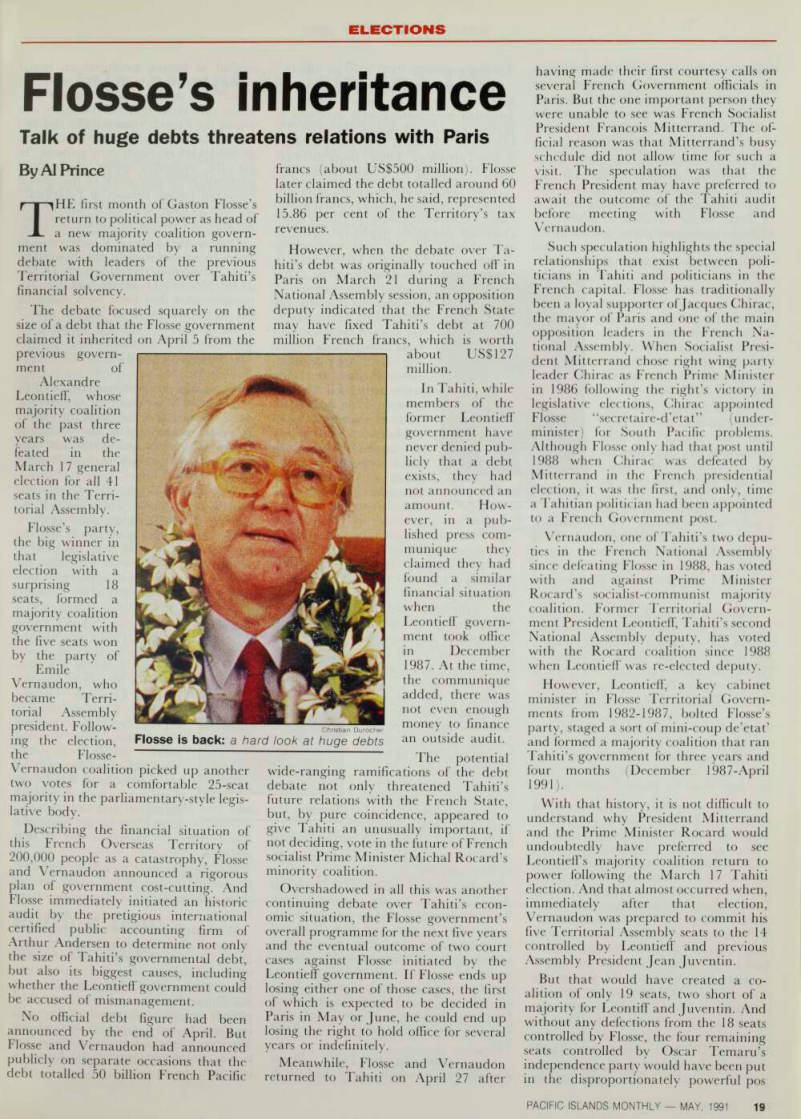
Christian Durocher Flosse is back: a hard look at huge debts
ition of either keeping the Lconticff- Juventin coalition in power, simply by never voting or casting blank ballots, or forcing that coalition out of power by voting with Flossc’s party.
Yet on March 21, the day Flosse and Vcrnaudon announced a detailed major ity coalition agreement for running Tahiti’s government over the next five years, there were some startling news out of Paris. Serge Charles, a member of Chirac’s opposition party, got up in the French National Assembly and accused the Rocard government of having en
gaged in “transactions” with the still incumbent Leontieff government aimed at erasing or cancelling Tahiti’s terri torial and communal debts for an amount of 700 million French francs, according to an Agence France-Presse report published in Tahiti.
Charles not only asked the Rocard government to con firm “the reality” of such discussions, but also called on the government to clarify whether such a measure in Tahiti’s favour “is en visioned regardless of which
government is formed” or whether the offer “is linked to the renewal of the present (Leontieff) government with a coalition of minority parties (that of Leontieff and Juventin) contrary to nature.”
No one from the Rocard government responded to Deputy Charle’s comments during the National Assembly session.
Six days later the office of Louis Le Pensec, the French Government’s Minis ter of Overseas Departments and Terri
tories (DOM-TOM), acknowledged,
without comment, having received a request from Vernaudon for the State to defer or annul Tahiti’s debt. This request has been registered, as is normally done with any deputy’s request, a com munique from Le Pensec’s office stated.
Flosse, meanwhile, had lots to say about the French State’s alleged at tempts to help the Leontieff government return to power despite the former majority coalition’s weak performance in the March 17 elections. Criticising the role of the French High Commissioner in Tahiti, Jean Montpezat, and State officials in Paris for “direct intervention” in “a purely local affair,” Flosse called such alleged actions “inadmissable.”
And Flosse added: “It’s not the role of the High Commissioner, it’s not the role of the DOM-TOM Minister, or even the President of the Republic to intervene and try to alter the elections. That we cannot tolerate.” Flosse told the State during an RFO-TV interview in Tahiti on the night of March 21 “to occupy itself with State affairs and let the
Torritory occupy itself with its affairs.”
As for the Rocard government’s al leged offer to cancel Tahiti’s debt if the Leontieff government were returned to power, Flosse said during the same TV interview: “There is only one Polynesia in this Territory ... I don’t think there are
good Polynesians and bad Polynesians.”
What later became clear, after the Paris trip by Flosse and Vernaudon, was that Vcrnaudon’s vote in the French National Assembly would be linked to the amount of aid and cooperation Tahiti received from the French State in
handling its debt. That undoubtedly became a concern for a politically beleagured Prime Minis ter Rocard, who was kept busy in later April count ing his majority coalition votes in order to decide what legislation his gov ernment could propose without risking a vote of confidence constantly threatened by the French
right opposition in its
effort to bring about a dissolution of the Na tional Assembly.
A recent experience by Vernaudon illustrates the importance of his single vote these days in the National Assembly.
In a published letter to Assembly President Laurent Fabius, Vernaudon
strongly protested what
he indicated was a fraudulent use of his vote on April 8. Although he said he was not in Paris on that day and had not authorised any other deputy to vote for him, Vernaudon said he was surprised to discover that his vote had been cast in favour of a piece of legis lation that the National
Assembly adopted by a
one-vote majority.
Vernaudon added in his letter that “this type of
incident has reoccurred several times since” he had withdrawn his proxy from
another deputy.
During a press conference in Tahiti on April 29 after having returned from Paris, Vernaudon said he had given his proxy for a vote in the National Assembly that same day, a vote that ended up being postponed. Vernaudon equated his proxy with the good recep tion he and Flosse received among State officials in Paris. Vernaudon described his proxy decision as a “small gesture,” but only for that particular day (April 29).
Upon returning to Tahiti, Flosse described their overall visit to the French
capital as having produced an initial
positive contact. While still in Paris, Flosse said during one of several tele vision interviews that the Territory was asking the French State to defer Tahiti’s debt. That would permit the Territory to devote its tax revenues to investment “to get the economy going again and particularly to give work to the several thousand jobless persons in Polynesia,” he said. Flosse said there are 16,000
unemployed people in Tahiti.
During the same TV interview in Paris, Flosse said that the official word he and Vernaudon received from DOM TOM Minister Le Pensec was that “all commitments that have been made by the State will be kept. This is good,”
Flosse added, “but this is perhaps not quite enough because to really get the Territory going again the State will have to help us.
Flosse said he and Vernaudon told Le Pensec that “if we don’t arrive together, the Territory and the State, in getting
Polynesia going again, in rebuilding
Polynesia, we risk going towards skid dings and, who knows, perhaps towards
independence.”
Five days later, during a similar TV inter iew in Paris, Flosse raised the spectre of independence once again, a tactic that Tahiti government officials have used on and off over the past 30 years each time they want more than the French government is apparently pre
pared to give at the moment.
Thus, when a Paris RFO TV journalist asked if Tahiti risked having a riot like the one that occured in down town Papeete in October 1987, or the riots like the French Overseas Depart ment of Reunion recently
experienced, Flosse replied;
“You know, this is what we’re saying, President Vernaudon and myself, to all our interlocutors. Really, the Territory is in a disturbing situation, and only a com mon effort by the State and
the Territory” can get it out of that situation.
If nothing is done, he added, the worst fear would be increasing power among those seeking Tahiti’s independence from France.
While in Paris, Vernaudon and Flosse discussed Tahiti’s debt problem with Prime Minister Rocard, as they did with all the other State officials they met with.
Flosse told an RFO-TV journalist that the Prime Minister asked them to be patient and await the results of the audit in order to have a precise idea of the Territory’s financial situation. Flosse said he was completely satisfied with Rocard’s comment. D
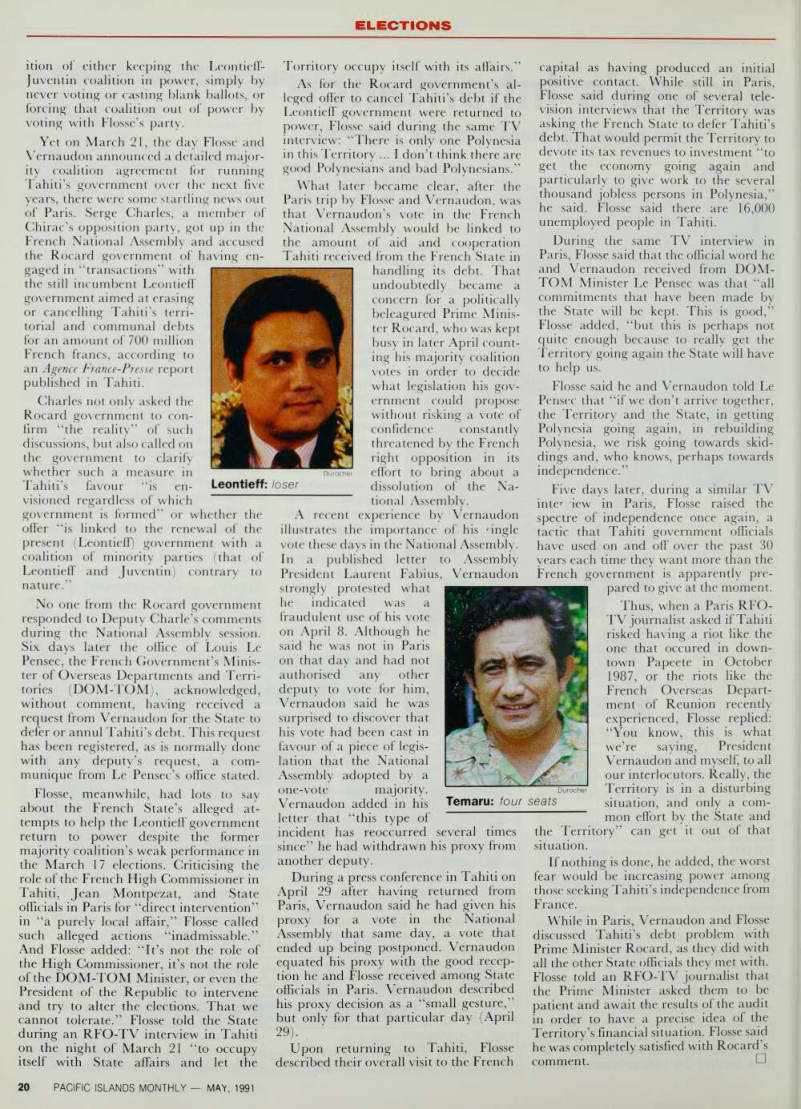
Durocher Leontieff: loser
Durocher Temaru: four seats