Smooth road to electoral change
p. 18 · Read in the full issue
Elections
By Ulafala Aiavao
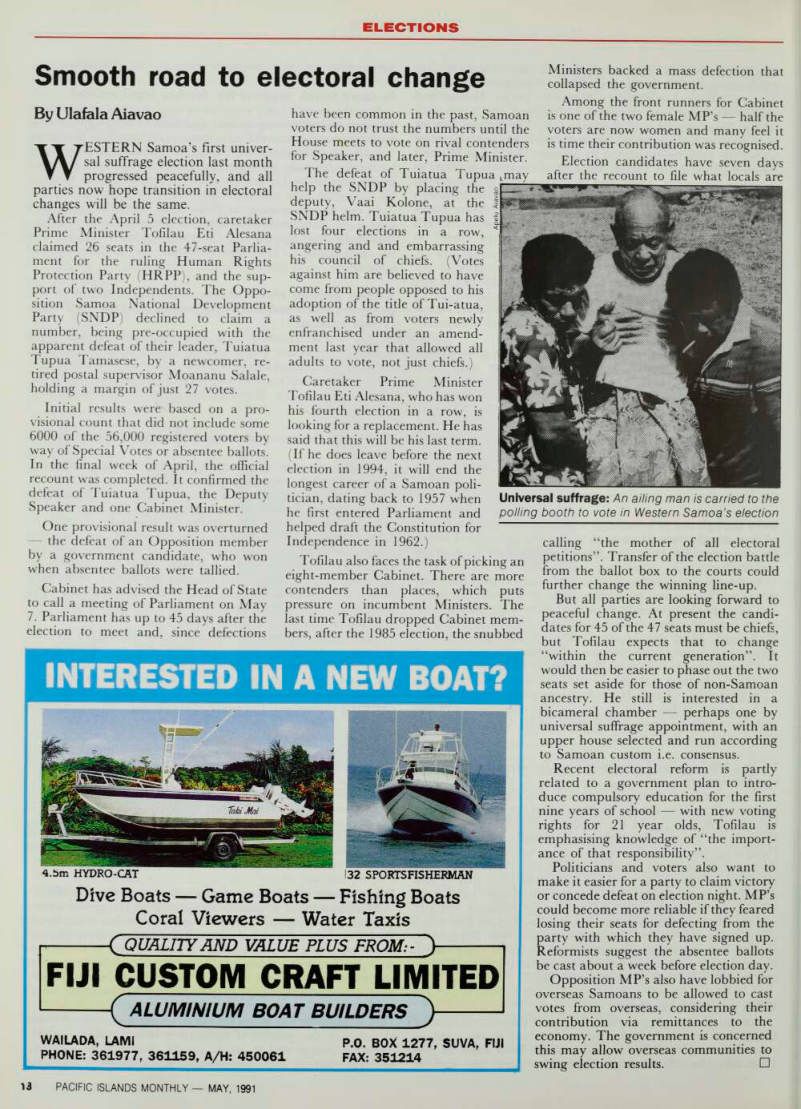
WESTERN Samoa’s first univer sal suffrage election last month progressed peacefully, and all parties now hope transition in electoral changes will be the same.
After the April 5 election, caretaker Prime Minister Tofilau Eti Alesana claimed 26 seats in the 47-seat Parlia ment for the ruling Human Rights Protection Party (HRPP), and the sup port of two Independents. The Oppo sition Samoa National Development Party (SNDP) declined to claim a number, being pre-occupied with the apparent defeat of their leader, Tuiatua Tupua Tamasese, by a newcomer, re tired postal supervisor Moananu Salale, holding a margin of just 27 votes.
Initial results were based on a pro visional count that did not include some 6000 of the 56,000 registered voters by way of Special Votes or absentee ballots.
In the final week of April, the official recount was completed. It confirmed the defeat of Tuiatua Tupua, the Deputy Speaker and one Cabinet Minister.
One provisional result was overturned - the defeat of an Opposition member by a government candidate, who won when absentee ballots were tallied.
Cabinet has advised the Head of State to call a meeting of Parliament on May 7. Parliament has up to 45 days after the election to meet and, since defections
have been common in the past, Samoan voters do not trust the numbers until the House meets to vote on rival contenders for Speaker, and later, Prime Minister.
The defeat of Tuiatua Tupua t may
help the SNDP by placing the deputy, Vaai Kolone, at the SNDP helm. Tuiatua Tupua has lost four elections in a row,
angering and and embarrassing
his council of chiefs. (Votes against him are believed to have come from people opposed to his adoption of the title of Tui-atua, as well as from voters newly enfranchised under an amend ment last year that allowed all adults to vote, not just chiefs.) Caretaker Prime Minister Tofilau Eti Alesana, who has won his fourth election in a row, is looking for a replacement. He has said that this will be his last term. (If he does leave before the next election in 1994, it will end the longest career of a Samoan poli tician, dating back to 1957 when he first entered Parliament and helped draft the Constitution for Independence in 1962.)
Tofilau also faces the task of picking an eight-member Cabinet. There are more contenders than places, which puts pressure on incumbent Ministers. The last time Tofilau dropped Cabinet mem bers, after the 1985 election, the snubbed
Ministers backed a mass defection that collapsed the government.
Among the front runners for Cabinet is one of the two female MP’s half the voters are now women and many feel it is time their contribution was recognised.
Election candidates have seven days after the recount to file what locals are
calling “the mother of all electoral petitions”. Transfer of the election battle from the ballot box to the courts could
further change the winning line-up.
But all parties are looking forward to peaceful change. At present the candi dates for 45 of the 47 seats must be chiefs, but Tofilau expects that to change “within the current generation”. It would then be easier to phase out the two seats set aside for those of non-Samoan ancestry. He still is interested in a bicameral chamber perhaps one by universal suffrage appointment, with an upper house selected and run according to Samoan custom i.e. consensus.
Recent electoral reform is partly related to a government plan to intro duce compulsory education for the first nine years of school with new voting rights for 21 year olds, Tofilau is emphasising knowledge of “the import ance of that responsibility”.
Politicians and voters also want to make it easier for a party to claim victory or concede defeat on election night. MP’s could become more reliable if they feared losing their seats for defecting from the party with which they have signed up.
Reformists suggest the absentee ballots be cast about a week before election day.
Opposition MP’s also have lobbied for overseas Samoans to be allowed to cast votes from overseas, considering their contribution via remittances to the economy. The government is concerned this may allow overseas communities to swing election results. □
Apelu Aiavao
Universal suffrage: An ailing man is carried to the polling booth to vote in Western Samoa's election