The quiet
pp. 14-17 · Read in the full issue
crusader
AKALISI Pohiva is a quietly-spoken, yet imposing figure.
His measured oratory, dogged research and uncompromis ing crusade against corruption and lawbreaking have become the scourge of Tonga’s political and social establishment.
He is at the Centre of the reformist movement seeking better accountability from the government and a more democratic parliamentary system.
The 49-year-old former schoolteacher from Ha’apai has a long history as a non-conformist, although he rejects most of the over-the-top accusations levelled at him such as “terrorist”, according to Police Minister ‘Akau’ola, or “Marxist” as King Taufau’ahau Tupou IV once claimed in a television interview.
As People’s Representative No 1 for Tongatapu, Pohiva insists changes must come to make the government more accountable and less feudal. But he stresses his commitment to peaceful change. He is undaunted by the upheaval his political challenges are
unleashing.
In an historic legal victory over the government by a commoner in 1988, he was awarded T 529,000 in damages plus costs for unfair dismissal and denial of free speech. He had been sacked over hosting a controversial radio programme which aired sensitive issues. Since then the commoner MP and the newsletter Kele’a (conch shell) which he co-edits with parliamentary colleague Viliami Fukofuka have become a symbol of change.
At times, debate in the Legislative Assembly has become rather heated. On one occasion last October, members were told to go outside and “cool off”. The Speaker, Fusitu’a, followed Pohiva and called out: “I’ll kill you! What are you and how can a person like you
challenge me?”
The controversial passport case has triggered a “domino” fear in the kingdom cabinet ministers don’t quite know what will fall next. More than two and a half years ago, Pohiva resolved to take on an
unprecedented struggle to challenge the government
and expose the illegality of the Tonga passport sales to
foreigners.
It took a year for him to convince his legal counsel, New Zealand civil rights lawyer Dr Rodney Harrison and Tongan-born Nalesoni Tupou, that he had a case worth fighting. Then it took another year to finally get it before the Tongan Supreme Court. Panicked by the crisis, the government hastily convened an emergency session of Parliament in February and legalised passport sales to 426 foreigners by changing the constitution.
But the moral victory belongs to Pohiva.
Recently visiting New Zealand to speak to Tongans
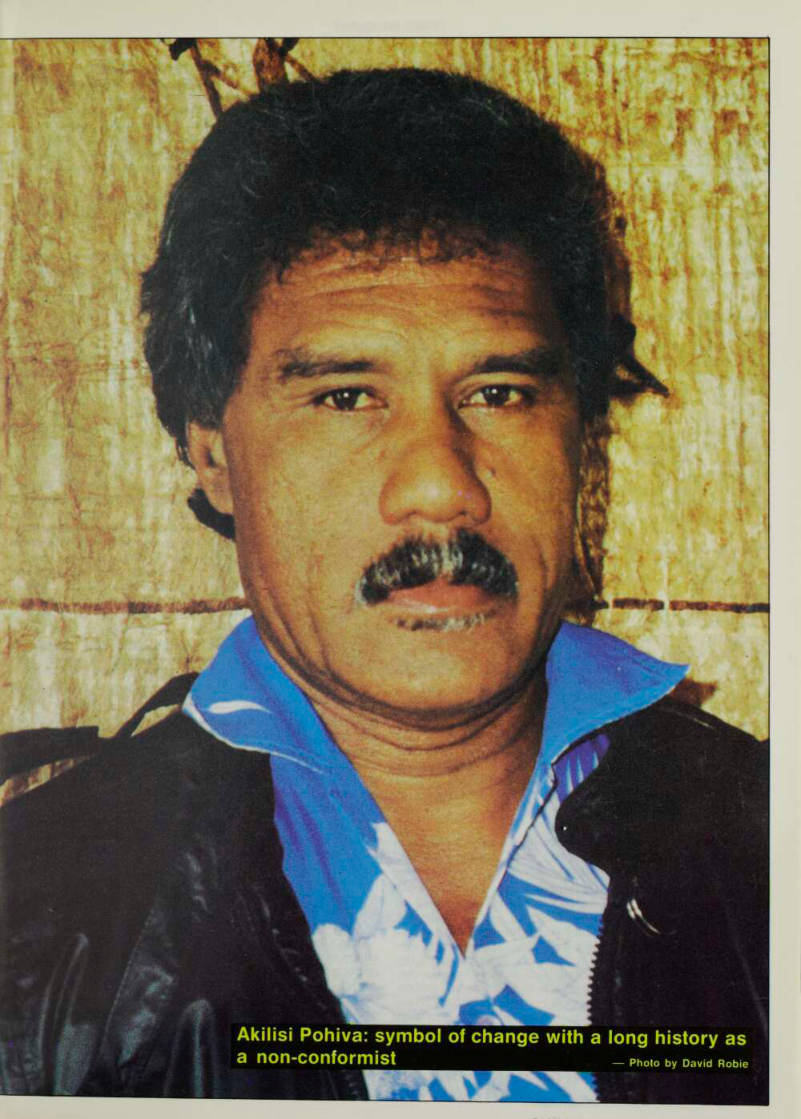
Akilisi Pohiva: symbol of change with a long history as a non-conformist - Photo by David Robie
who enthusiastically support the parliamentarian’s cause, Pohiva talked to Pacific Islands Monthly’s David Robie in Auckland.
How did people respond to your unprecedented opening public meeting in Auckland which heard you and fellow people’s representative Laki Niu speak?
This was the first ever political gathering of this kind in New Zealand, just as it has become a new phenomenon in Tonga I was surprised that so many people were already well acquainted with the issues. Many of them had read the Times of Tonga which has published a lot of articles and writings about the situation in Tonga. Before we started, I talked with several people about the events. They were quite understanding and they had good background. Most responded positively to what we told them.
What sort of questions were you asked?
The kinds of questions we got showed clearly that most people are unhappy with what has been going on in Tonga over the last few years the aberrations of the Tongan government. They know a lot about the motives behind the actions of His Majesty and the ministers. They understand the corruption and the scandals and all sorts of evils that are taking place. These are the sorts of things I could tell from the meeting.
What is troubling the people?
They wonder what is going to happen if the government is not prepared to accommodate the concerns and requests of the people and their parliamentary representatives. There is a feeling that participation and accommo dation is very close to the end. We are trying to use the consti tutional provisions and laws to settle things. But what is going to
happen if these piecemeal steps come to a halt? I told them: “We must use all the constitutional provisions and make sure of the rights of the people to remedy the situation”. Assuming His Majesty and the ministers put off change, then disaster will follow. In the end it will be the people who will decide the final step for themselves. I advised them to work together in cooperation to make sure the country is safe.
Why has the Tongan government taken such arbitrary action in turning your passport case junior counsel, Nalesoni Tupou, into a virtual exile?
The government can do anything it wants, but the people will be very upset with any unjust act. Most Tongans will be angry with what they have done to Nalesoni it is a deliberate move by the government to isolate me from my legal counsel.
The government shouldn’t have done that. It won’t stop me.
Nothing will stop me. I’ll continue to challenge the government. And I’ll go on calling legal counsel to assist me.
This has been a deliberate attempt to discourage and isolate me. They haven’t done anything to my senior counsel, (New Zealander) Dr Rodney Harrison. If they think they can stop legal counsel coming to Tonga then they’re making a big mistake. They’re making the people angry.
Does the Tongan government fear you?
I think so. What they have been doing over the last few months reflects this. They fear being forced into being accountable. The emergency meeting of Parliament (in February) was a deliberate attempt by the government to escape its responsibilities. Their panic change to the consti tution is another indication of the failure of the government to face up to a better solution, or a compromise over what they have done. They will continue to make more mistakes in the future.
The Minister of Police, ‘Akau’ola, should have resigned over this scandal and probably the Finance Minister, Cecil Cocker, as well.
Do you have any concern for your own personal safety?
I still feel free and I still feel safe. My experience in challinging the government and in my court cases has taught me that I have nothing to fear. The growing support I have
from many Tongans, even senior people, has encouraged me to struggle on. Many senior people in government leak highly confidential information to us this shows a lot of high level support. We have a lot of encouragement from the
Churches and respected people
in Tonga, like Futa Helu of ‘Atenesi. The last demonstra tion (in March) against the action taken by His Majesty and his government, supported by (Roman Catholic) Bishop Patelisio Finau and Free Wes leyan moderator Dr ‘Amanaki Havea, was a big vote of confidence. All these things combine to make His Majesty fear the movement and the rising power of the people.
As an ally, how crucial is the Church in your cru sade?
Our people are highly re spectful of the Church. Power
in Tonga is slowly transferring from the nobles to the Churches and the elected representatives. The two Church leaders supported the demonstration, not because we asked them to.
We have an informal association to discuss strategy, but they came out on their own initiative. They understand the situation in our country. They see their responsibility as supporting what
is just and good.
I have a feeling that His Majesty and his ministers think that I and my colleagues use the Church leaders as political tools in the pro-democracy movement. This is not correct. We have regularly provided Bishop Finau and Dr Havea with information; it is our responsiblity as people’s representatives to provide information to key people in our society. We never ask them to take part we just told them about the march to the palace. They said it was a good move and joined in, The Church in Tonga plays a very significant role in the affairs of the nation. Their leaders are influential and highly respected. Tonga is very religious, almost everybody goes to church. What the leaders say is accepted and respected. Now they are the most respected leaders in Tonga. They are in the new middle class group, a high status in the Church as well as in social and political heirarchy.
How did the King respond to the petition?
We’ve had no formal reply from his Majesty. We are
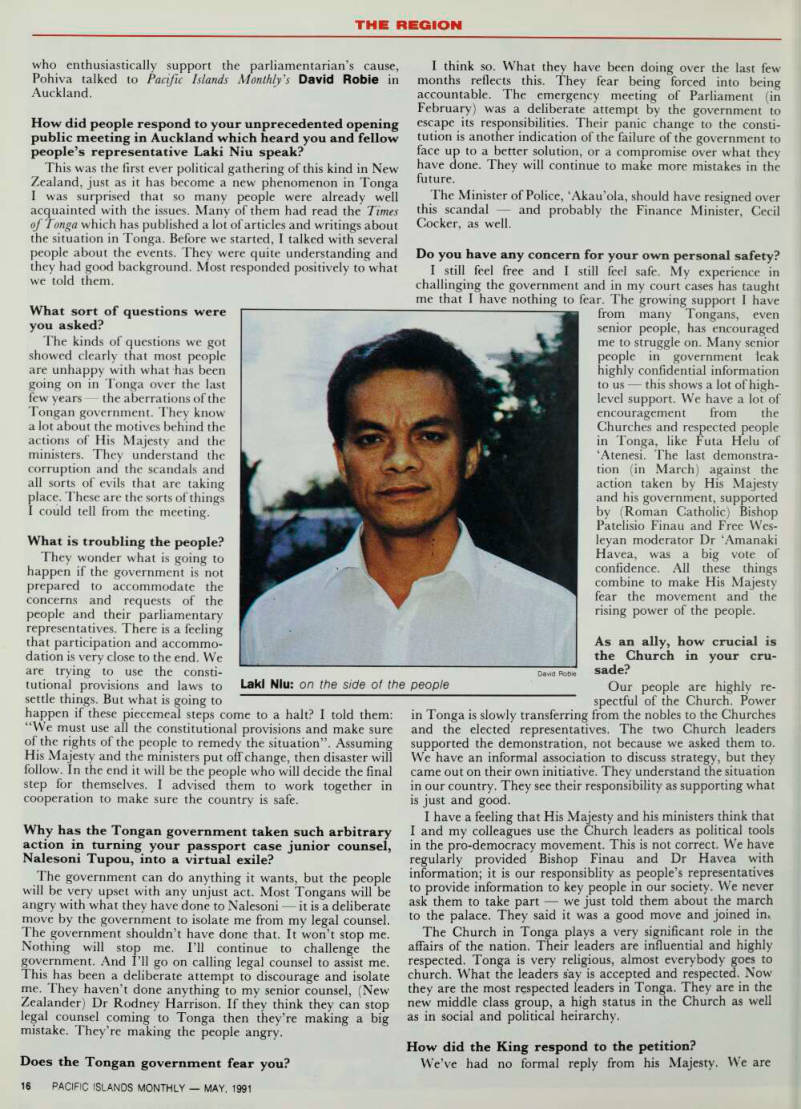
David Robie Lakl Niu: on the side of the people
disappointed with the statement in the Chronicle (the government-owned newspaper). It was repetition of what the Attorney-General and Justice Minister (Tevita Tupou) had said in the emergency session of Parliament. The fact is they had no firm ground over the passports. The information we have been providing for the country clearly demonstrates how wrong the government was in its actions. The Police Minister pleaded guilty in the House. His sort of explanation failed to convince the people. They were saying lies, giving inconsistent information. All these things combined to make His Majesty’s statement look stupid. For example, even though the Police Minister (’Akau’ola) admitted he was acting illegally, His Majesty blamed the honourary consul (George Chen) in
Hong Kong. That was stupid.
The consul denied it was his fault for continuing to sell passports after 1988. He said he has not been informed of any change in policy by the government. When the statement by the King was published in the Chronicle it was a farce. People laughed. Some said the King was making a fool of himself.
Can you confirm that the Marcoses were given their passports as a “gift”, as reported in the South China Morning Post?
Mr Marcos was named in the emergency session of Parliament among the 426 foreigners who had gained Tongan passports and letters of naturalisation. I haven’t had time to find out much about the Marcos family. Yes, it was reported they got their passports as “gifts”. But I don’t believe the passports would have been given to the Marcos family for free.
Nobody was there to witness what happened. It was raised in the House but the questions remain unanswered.
Even though the proceedings were dismissed as a result of the constitution change to make the passports legal, do you consider that you have achieved an important victory?
The court dismissal doesn’t mean the passport issue has come to an end. The money aspect has still to be settled. How much and what has happened to it? Although we have settled some of the legal or constitutional issues there is still much to be challenged. Most people are dissatisfied with government’s actions in the case. To me and most Tongans, the passport case is still in existence, still under discussion at all levels of Tongan society. At the time of the dismissal of the case, I told the court: “The case does not end. It marks a new page in our history.”
Our march to the royal palace was the first product of this and there will be more demonstrations in future unless the passport case is fully settled.
Do the 426 legalised passports really account for all of
the foreigners?
This is hidden information. We still don’t know how many passports have been issued. We have asked the Police Minister, but we haven’t received the relevant information. We don’t know how many passports were actually issued to the Hongkong consulate and sold. Unless we have that basic information we won’t be able to find out. They have only admitted 426 passports that’s what they have told us and it could be very wrong. This is one of the things that I have asked in three letters to the Police Minister, Finance Minister and the Deputy Prime Minister. I wanted to find out how many passports have been sent to Hongkong since 1984. No answer.
I asked how many passports are still held out of those issued.
No answer. We need an audited financial statement before we can accept the list they have made public.
What is your next step?
I’m still planning legal action. It is quite unconstitutional for the government to hide the money involved in the passport case. We need to bring to account the trust fund in San Francisco. In seven years there has been no audited
accounting of the passport revenue to Parliament.
Is there much support for further legal action?
Yes, the people don’t want me to stop. At the first Auckland meeting, one guy stood up and appealed to the people to start organising and fund-raising to continue the struggle. This is not actually something for me: I explain the issues to people and let them undertake their own initiatives. It has been the same in the villages in Tonga. We didn’t tell people what to do ... we answered their questions and left it up to them.
In our second meeting at Nuku’alofa (after the emergency session of Parliament discussing a petition to the King), somebody stood up and said: “Let us all go instead of just one or two people”. They all endorsed the motion without opposition.
Stories abound about senior officials involved in the passport affair suddendly becoming obviously affluent.
Is this rumour?
This is true. A senior clerk has completed building a big home. Three senior police officials involved in immigration seem to enjoy remarkable privileges very nice buildings, nice cars, fax machines and all those sorts of things. It is easy to tell.
It is easy to calculate. How can these people on low wages have all these things?
What does the passport issue in Tonga represent for the future?
People are becoming increasingly aware that the government is trying to make easy money, to gamble, to use the country.
People are now more aware that a privileged few in high places in government are using unlawful tactics and strategies for their personal benefit. They are milking the system for themselves.
Most people feel the existing political system isn’t able to accommodate the needs, aspirations and expectations of the people. If things stay as they are there could be a disaster for the country. It is hard to tell whether the King is really fully aware of what is happening, how times are changing. The writing is on the wall for those who have enjoyed the privileges and status they have enjoyed for so long.
Their failure to read the signs indicates they have no time to think about things other than themselves or what we seek for the future. There is no time to consider the people. The elite are too proud. They are deaf and perhaps they find it difficult to listen. Political and social circumstances are changing throughout the world. Everywhere Asia, Eastern Europe there are moves toward greater democracy.
Tonga cannot remain isolated. There have to be certain basic changes. His Majesty should surrender his power and stay out of politics like the British monarch, let the country be run by the people. However, the changes cannot be too abrupt.
It would be better if the people were to elect their representatives and His Majesty could appoint ministers from the parliament. There could be an upper house for the nobles, just like the Commons and the Lords in Britian. I’d like to have a conference to discuss possible changes. It would be better to have a conference of this kind outside Parliament.
What about the future of democracy in the Pacific?
Most important is what is happening in the global arena These are powerful influences on small countries the South Pacific is part of the global arena. I don’t see anything positive about putting up a system isolated from the rest of the world.
Any pro-democracy movement in small Third World countries will eventually succeed sooner or later in the Pacific like anywhere else. What happened in Eastern Europe is the trend now.
It is important to adapt and survive using some traditional elements in this process of integration into the global arena.
Tonga is unique and so are its people. We have the capacity to make changes and survive with our uniqueness. □