Tonga’s missing millions
pp. 10-14 · Read in the full issue
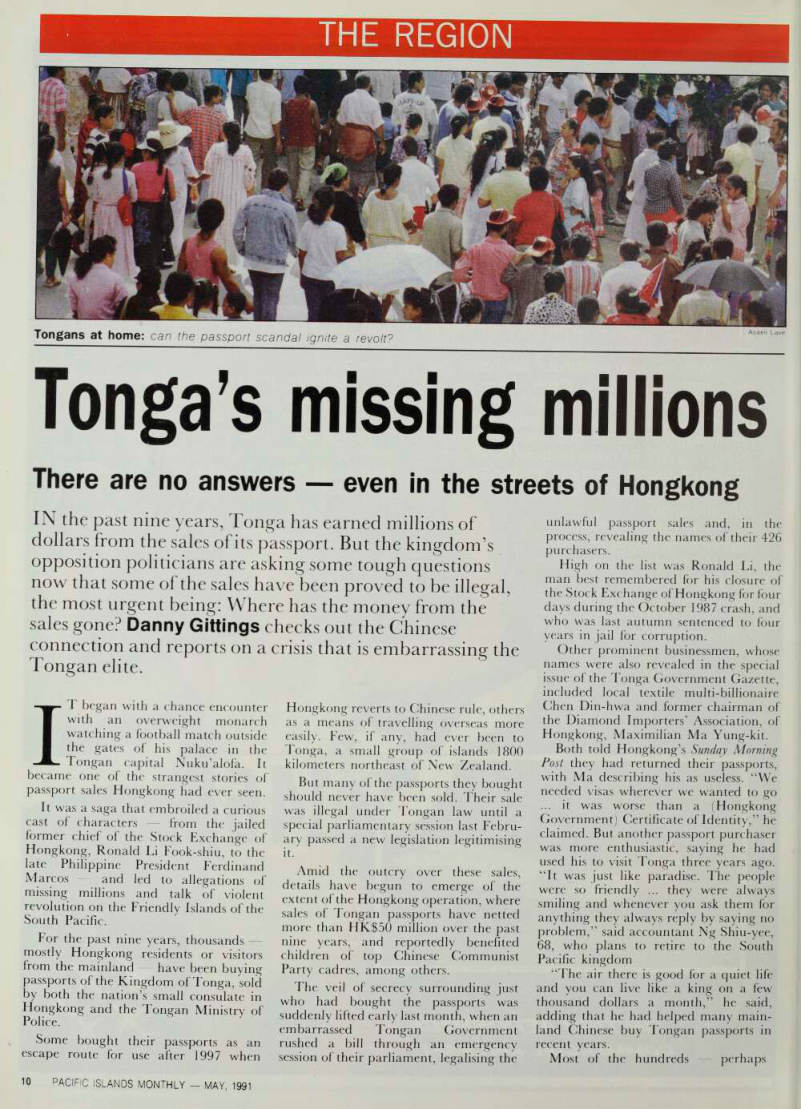
There are no answers - even in the streets of Hongkong
IN the past nine years, Tonga has earned millions of dollars from the sales of its passport. But the kingdom’s opposition politicians are asking some tough questions now that some of the sales have been proved to be illegal, the most urgent being: Where has the money from the sales gone? Danny Gittings checks out the Chinese connection and reports on a crisis that is embarrassing the
Tongan elite.
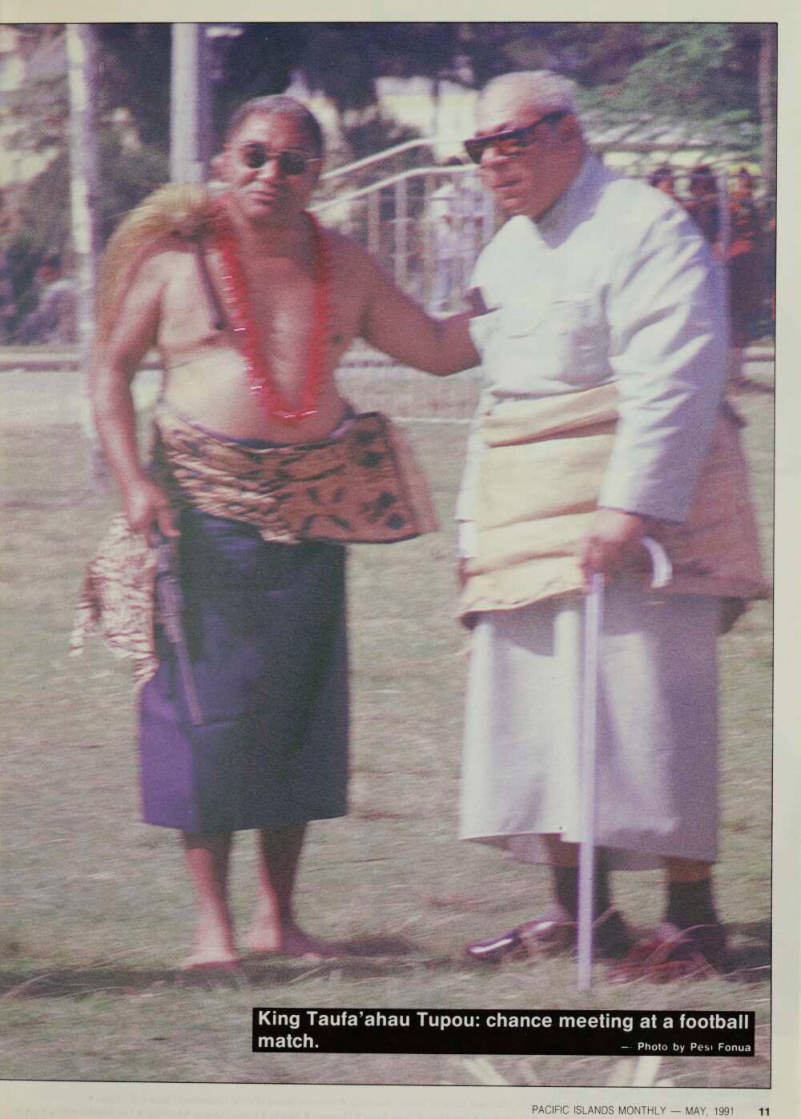
IT began with a chance encounter with an overweight monarch watching a football match outside the gates of his palace in the Tongan capital Nukualofa. It became one of the strangest stories of passport sales Hongkong had ever seen.
It was a saga that embroiled a curious cast of characters from the jailed former chief of the Stock Exchange of Hongkong, Ronald Li Fook-shiu, to the late Philippine President Ferdinand Marcos and led to allegations of missing millions and talk of violent revolution on the Friendly Islands of the South Pacific.
For the past nine years, thousands mostly Hongkong residents or visitors from the mainland have been buying passports of the Kingdom of Tonga, sold by both the nation’s small consulate in Hongkong and the Tongan Ministry of Police.
Some bought their passports as an escape route for use after 1997 when
Hongkong reverts to Chinese rule, others as a means of travelling overseas more easily. Few, if any, had ever been to Tonga, a small group of islands 1800 kilometers northeast of New Zealand.
But many of the passports they bought should never have been sold. Their sale was illegal under Tongan law until a special parliamentary session last Febru ary passed a new legislation legitimising it.
Amid the outcry over these sales, details have begun to emerge of the extent of the Hongkong operation, where sales of Tongan passports have netted more than HK$5O million over the past nine years, and reportedly benefited children of top Chinese Communist Party cadres, among others.
The veil of secrecy surrounding just who had bought the passports was suddenly lifted early last month, when an embarrassed Tongan Government rushed a bill through an emergency session of their parliament, legalising the
unlawful passport sales and, in the process, revealing the names of their 426 purchasers.
High on the list was Ronald Li, the man best remembered for his closure of the Stock Exchange of Hongkong for four days during the October 1987 crash, and who was last autumn sentenced to four years in jail for corruption.
Other prominent businessmen, whose names were also revealed in the special issue of the Tonga Government Gazette, included local textile multi-billionaire Chen Din-hwa and former chairman of the Diamond Importers’ Association, of
Hongkong, Maximilian Ma Yung-kit.
Both told Hongkong’s Sunday Morning Post they had returned their passports, with Ma describing his as useless. “We needed visas wherever we wanted to go ... it was worse than a (Hongkong Government) Certificate of Identity,” he claimed. But another passport purchaser was more enthusiastic, saying he had used his to visit Tonga three years ago.
“It was just like paradise. The people were so friendly ... they were always smiling and whenever you ask them for anything they always reply by saying no problem,” said accountant Ng Shiu-yee, 68, who plans to retire to the South
Pacific kingdom
“The air there is good for a quiet life and you can live like a king on a few thousand dollars a month,” he said, adding that he had helped many main land Chinese buy Tongan passports in recent years.
Most of the hundreds perhaps
King Taufa'ahau Tupou: chance meeting at a football match. -Photo by Pesi Fonua
thousands of mainlanders who bought Tongan passports did so to allow them to go overseas. As one legal source noted last week; “It’s a lot easier to travel to most countries on a Tongan passport than it is on a Chinese one.”
TT . .
Arriving in Hongkong on Chineseissued travel papers, they would pick up a Tongan passport from the consulate there, and use that to travel overseas.
Although most are rich busi nessmen from the prosperous special economic zones across the border in Guangdong, un confirmed reports say some of he passport purchasers are children of high-ranking New China News Agency officials stationed in the territory.
It is a possibility that George Chen Kai-cheng, Tonga’s Honorary Consul in Hongkong, does not dismiss.
“It’s impossible to tell,” he said.
“If there were any then they wouldn’t tell me.”
It was Chen, a US-based businessman, who began the process that led to the passport sales: He visited the South Pacific kingdom in the late
1970 s to investigate the setting
up of a lobster export company.
“There were only a couple of ethnic Chinese there at that time so I stood out among the crowds,” Chen recalled. “I was standing outside the royal pal ace watching a soccer match when they told me the king wanted to talk to me ...I looked over and saw the king sitting nearby under a canopy.”
That chance encounter not only sparked off a long-term friendship between the two men, but also changed Tongan history and led to the sale of thousands of the nation’s pass ports.
King Taufa’ahau Tupou IV
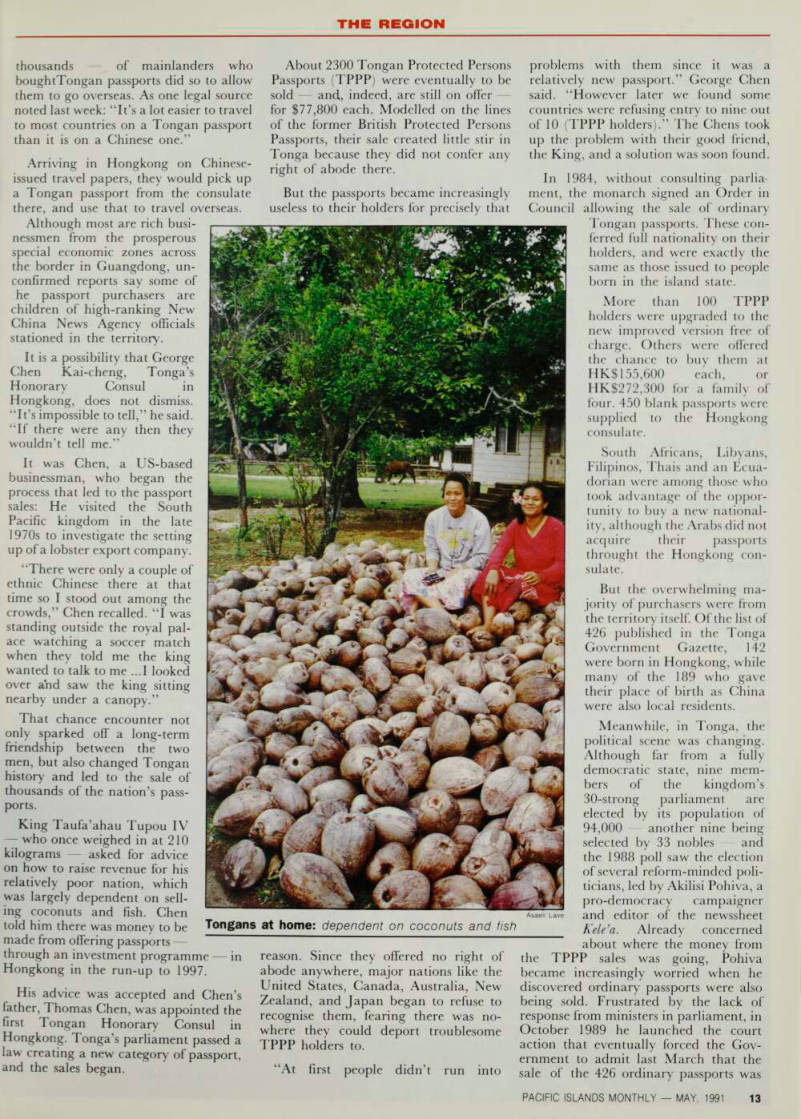
who once weighed in at 210 kilograms asked for advice on how to raise revenue for his relatively poor nation, which was largely dependent on sell ing coconuts and fish. Chen told him there was money to be made from offering passports
through an investment programme in Hongkong in the run-up to 1997.
His advice was accepted and Chen’s father, Thomas Chen, was appointed the first Tongan Honorary Consul in Hongkong. Tonga’s parliament passed a law creating a new category of passport, and the sales began.
About 2300 Tongan Protected Persons Passports (TPPP) were eventually to be sold and,, indeed, are still on offer for $77,800 each. Modelled on the lines of the former British Protected Persons Passports, their sale created little stir in Tonga because they did not confer any ■ h( of abode there But the passports became increasingly useless to their holders for precisely that
reason. Since they offered no right of abode anywhere, major nations like the United States, Canada, Australia, New Zealand, and Japan began to refuse to recognise them, fearing there was no where they could deport troublesome TPPP holders to.
“At first people didn’t run into
problems with them since it was a relatively new passport.” George Chen said. “However later we found some countries were refusing entry to nine out of 10 (TPPP holders).” The Chens took up the problem with their good friend, the King, and a solution was soon found.
In 1984, without consulting parlia ment, the monarch signed an Order in Council allowing the sale of ordinary
Tongan passports. These con ferred full nationality on their holders, and were exactly the same as those issued to people born in the island state.
More than 100 TPPP holders were upgraded to the new improved version free of charge. Others were offered the chance to buy them at HK5155,600 each, or HK5272,300 for a family of four. 450 blank passports were supplied to the Hongkong consulate.
South Africans, Libyans, Filipinos, Thais and an Ecua dorian were among those who took advantage of the oppor tunity to buy a new national ity, although the Arabs did not acquire their passports throught the Hongkong con sulate.
But the overwhelming ma jority of purchasers were from the territory itself. Of the list of 426 published in the Tonga Government Gazette, 142 were born in Hongkong, while many of the 189 who gave their place of birth as China were also local residents.
Meanwhile, in Tonga, the political scene was changing.
Although far from a fully democratic state, nine mem bers of the kingdom’s 30-strong parliament are elected by its population of 94,000 another nine being selected by 33 nobles and the 1988 poll saw the election of several reform-minded poli ticians, led by Akilisi Pohiva, a
pro-democracy campaigner
and editor of the newssheet Kele’a. Already concerned about where the money from
the TPPP sales was going, Pohiva became increasingly worried when he discovered ordinary passports were also being sold. Frustrated by the lack of response from ministers in parliament, in October 1989 he launched the court action that eventually forced the Gov ernment to admit last March that the sale of the 426 ordinary passports was
Asaell Lave Tongans at home: dependent on coconuts and fish
unlawful, causing a constitutional crisis in the South Pacific kingdom.
Pohiva leader of the unofficial opposition Peoples’ Party in the legis lature admits he has used the issue to further his group’s campaign for demo cratic reforms. “We have been able to demonstrate not only to His Majesty but to the public that we have been trying to do the right thing,” he said. “We have been successful in this very important case and we think we have the support and approval of the majority of the
population.”
Buoyed by an unprecedented 2000-strong street protest against the government’s handling of the passport issue, Pohiva has warned that unless the king gives up his political powers and becomes a constitutional monarch along the lines of. England’s Queen Elizabeth revolution may follow.
“We are trying to achieve our case in a peaceful way but if this turns out to be a failure the only alternative is to revolt,” he said.
Tongan sources said the king had faced sustained criticism in recent weeks over the passport scandal, with much public concern still fo ‘As f3f 3s cused on what had . happened to the pro- I know not ceeds from the sales, a single Tonga’s Justice Minis penny has fe !\ Tev ‘ ta Tu p ou . told parliament the sales had raised on luxury HKJ233 million in all.
C3pc 311 H Of this, about HK$55 £ million had been yachts or for raised through the any other sales in Hongkong and misuse' deposited in the Ton gan Trust Fund at the Bank of America in San Francisco, Chen said.
“All our accounts have been audited, the money we received fully accounted for, and paid into a fund whose sole purpose is to help the people of Tonga, Chen said. The consul said the money from the fund had only been used for social purposes such as cyclone relief, and starting an airline that doubles as a flying doctor service.
“As far as I know not a single penny has been used to buy luxury cars and yachts or for any other misuse.”
Opposition politicians say the govern ment has refused to release audited accounts of the later sales. “We still have no idea how much money Tonga col lected (from the passport sales) and where the money is,” Pohiva said.
And they plan to raise the issue of the missing millions when parliament resumes this month, a move that seems certain to ensure that the curious saga of the sale of Tongan passports will con tinue to cause controversy. □