GERMAN Ambassador
pp. 10-12 · Read in the full issue
The Region
Calendar of Fear
Namaliu cracks down on terrorists and the Rascals are on the run
By Frank Senge
GERMAN Ambassador
Herbert Kamps was driving back to the embassy in Port Moresby one afternoon in February when drunken youths staggered into the middle of the road outside the embassy block. Kamps stopped. Four men, armed with an axe and a golf club surrounded his car, smashed his window and forced him outside. They took his wallet and car keys and chased him inside the embassy.
A Japanese volunteer worker had been robbed the same way at the same spot three weeks earlier.
Both men were robbed in broad daylight five metres from gates manned by uniformed security guards. On each occasion the guards and by-standers did
not help.
Still in Port Moresby nearly a month later, at 3.45 am on Sunday March 10, Australian Defence Force Warrant Offi cer Greg Dowsett, 42, and wife Jenny drove home from a private function at a friend’s home. When they stopped at the entrance to their home at East Boroko, a car pulled up behind. Three men got out and held up the Australian couple with a shotgun and bushknives. The robbers took the Dowsetts’ wedding rings, the army walkie-talkie and other personnel items. They then tried to force jenny into their car. Greg Dowsett fought to save his wife. He was shot in the back. He died in hospital.
Later in the day, three men got out of a car at a football field in Port Moresby where Governor-General Sir Serei Eni was present. They crossed leisurely to the crowded sportsground and repeatedly stabbed a man. They walked back to their car and drove oflf.
These are pieces of Papua New Guinea’s calendar of terror, the fearful
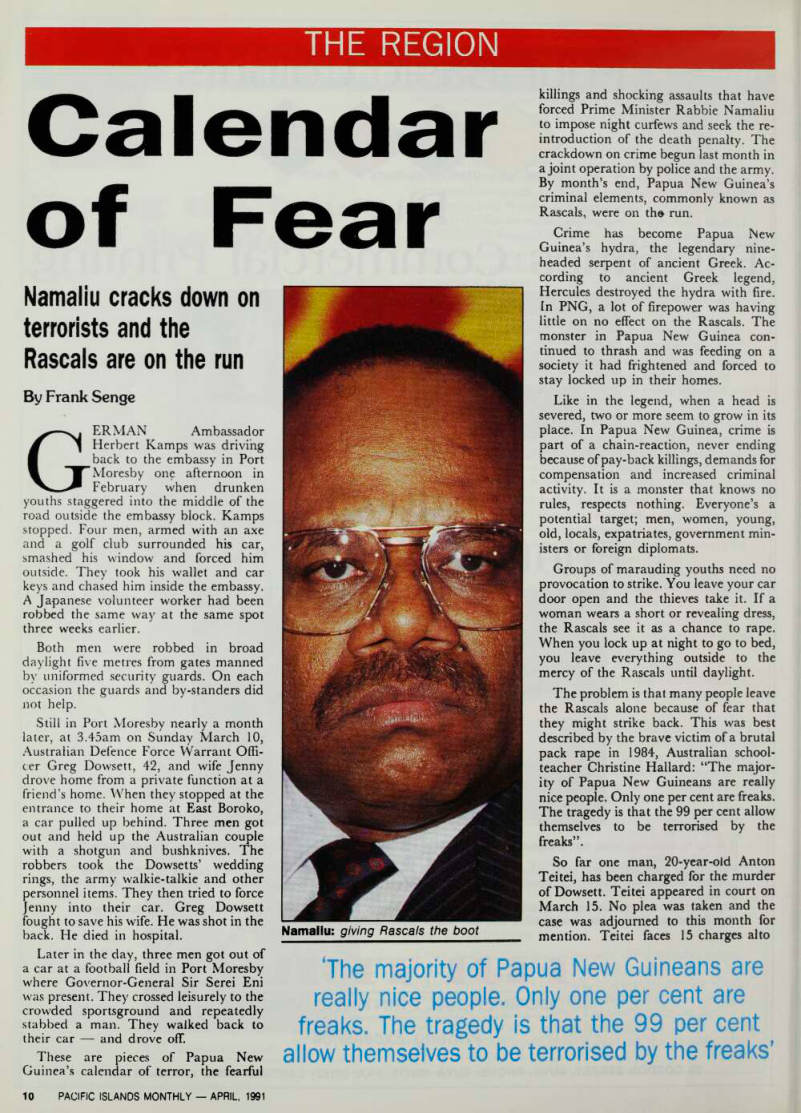
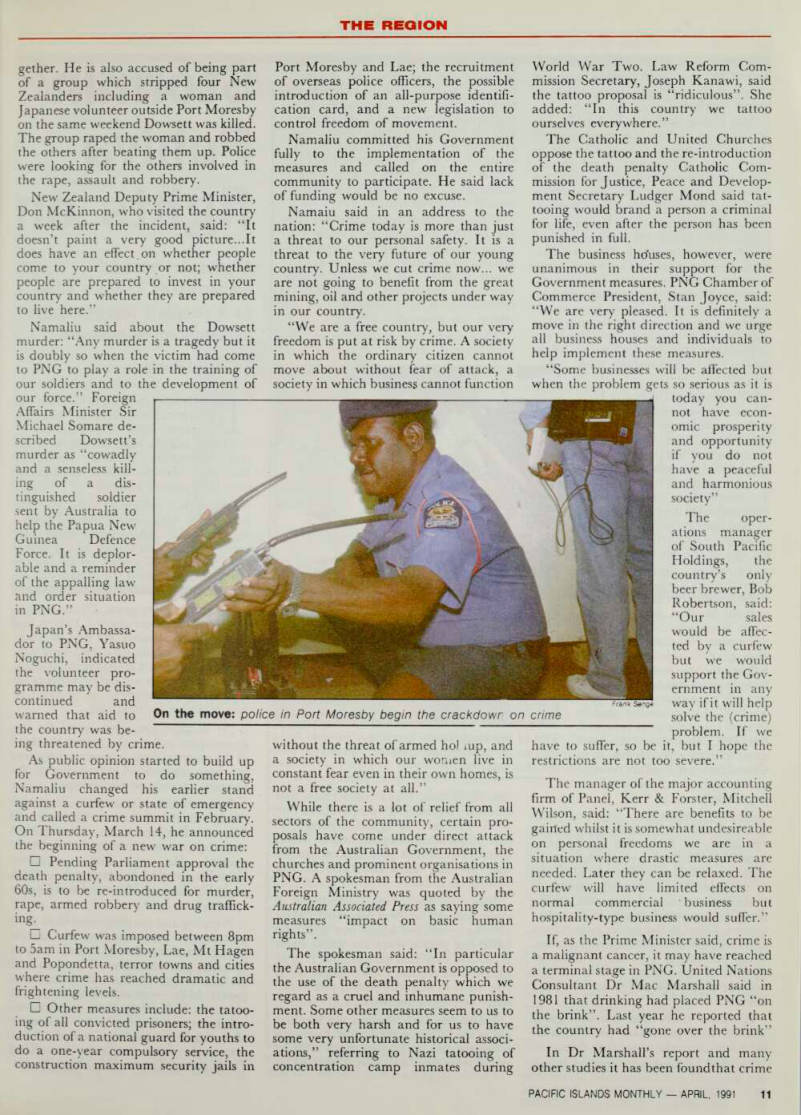
killings and shocking assaults that have forced Prime Minister Rabbie Namaliu to impose night curfews and seek the re introduction of the death penalty. The crackdown on crime begun last month in a joint operation by police and the army.
By month’s end, Papua New Guinea’s criminal elements, commonly known as Rascals, were on th& run.
Crime has become Papua New Guinea’s hydra, the legendary nine headed serpent of ancient Greek. Ac cording to ancient Greek legend, Hercules destroyed the hydra with fire.
In PNG, a lot of firepower was having little on no effect on the Rascals. The monster in Papua New Guinea con tinued to thrash and was feeding on a society it had frightened and forced to stay locked up in their homes.
Like in the legend, when a head is severed, two or more seem to grow in its place. In Papua New Guinea, crime is part of a chain-reaction, never ending because of pay-back killings, demands for compensation and increased criminal activity. It is a monster that knows no rules, respects nothing. Everyone’s a potential target; men, women, young, old, locals, expatriates, government min isters or foreign diplomats.
Groups of marauding youths need no provocation to strike. You leave your car door open and the thieves take it. If a woman wears a short or revealing dress, the Rascals see it as a chance to rape.
When you lock up at night to go to bed, you leave everything outside to the mercy of the Rascals until daylight.
The problem is that many people leave the Rascals alone because of fear that they might strike back. This was best described by the brave victim of a brutal pack rape in 1984, Australian school teacher Christine Hallard: “The major ity of Papua New Guineans are really nice people. Only one per cent are freaks.
The tragedy is that the 99 per cent allow themselves to be terrorised by the freaks”.
So far one man, 20-year-old Anton Teitei, has been charged for the murder of Dowsett. Teitei appeared in court on March 15. No plea was taken and the case was adjourned to this month for mention. Teitei faces 15 charges alto
‘The majority of Papua New Guineans are really nice people. Only one per cent are freaks. The tragedy is that the 99 per cent allow themselves to be terrorised by the freaks’
Namaliu: giving Rascals the boot
gether. He is also accused of being part of a group which stripped four New Zealanders including a woman and Japanese volunteer outside Port Moresby on the same weekend Dowsett was killed.
The group raped the woman and robbed the others after beating them up. Police were looking for the others involved in the rape, assault and robbery.
New Zealand Deputy Prime Minister, Don McKinnon, who visited the country a week after the incident, said: “It
doesn’t paint a very good picture...lt
does have an effect.on whether people come to your country or not; whether people are prepared to invest in your country and whether they are prepared to live here.”
Namaliu said about the Dowsett murder: “Any murder is a tragedy but it is doubly so when the victim had come to PNG to play a role in the training of our soldiers and to the development of
our force.” Foreign Affairs Minister Sir Michael Somare de scribed Dowsett’s murder as “cowadly and a senseless kill ing of a dis
tinguished soldier
sent by Australia to
help the Papua New
Guinea Defence Force. It is deplor able and a reminder of the appalling law and order situation in PNG.”
Japan’s Ambassa
dor to PNG, Yasuo
Noguchi, indicated
the volunteer pro gramme may be dis continued and warned that aid to the country was be-
ing threatened by crime.
As public opinion started to build up for Government to do something, Namaliu changed his earlier stand against a curfew or state of emergency and called a crime summit in February.
On Thursday, March 14, he announced the beginning of a new war on crime: □ Pending Parliament approval the death penalty, abondoned in the early 60s, is to be re-introduced for murder, rape, armed robbery and drug traffick ing. □ Curfew was imposed between Bpm to sam in Port Moresby, Lae, Mt Hagen and Popondetta, terror towns and cities where crime has reached dramatic and
frightening levels.
□ Other measures include: the tatoo ing of all convicted prisoners; the intro duction of a national guard for youths to do a one-year compulsory service, the construction maximum security jails in
Port Moresby and Lae; the recruitment of overseas police officers, the possible introduction of an all-purpose identifi cation card, and a new legislation to control freedom of movement.
Namaliu committed his Government fully to the implementation of the measures and called on the entire community to participate. He said lack of funding would be no excuse.
Namaiu said in an address to the nation: “Crime today is more than just a threat to our personal safety. It is a threat to the very future of our young country. Unless we cut crime now... we are not going to benefit from the great mining, oil and other projects under way in our country.
“We are a free country, but our very freedom is put at risk by crime. A society in which the ordinary citizen cannot move about without fear of attack, a society in which business cannot function
without the threat of armed ho) tup, and a society in which our women live in constant fear even in their own homes, is not a free society at all.”
While there is a lot of relief from all sectors of the community, certain pro posals have come under direct attack from the Australian Government, the churches and prominent organisations in PNG. A spokesman from the Australian
Foreign Ministry was quoted by the
Australian Associated Press as saying some measures “impact on basic human
rights”.
The spokesman said: “In particular the Australian Government is opposed to the use of the death penalty which we regard as a cruel and inhumane punish ment. Some other measures seem to us to be both very harsh and for us to have some very unfortunate historical associ ations,” referring to Nazi tatooing of concentration camp inmates during
World War Two. Law Reform Com mission Secretary, Joseph Kanawi, said the tattoo proposal is “ridiculous”. She added: “In this country we tattoo
ourselves everywhere.”
The Catholic and United Churches oppose the tattoo and the re-introduction of the death penalty Catholic Com mission for Justice, Peace and Develop ment Secretary Ludger Mond said tat tooing would brand a person a criminal f° r life, even after the person has been punished in full.
The business hduses, however, were unanimous in their support for the Government measures. PNG Chamber of Commerce President, Stan Joyce, said: “We are very pleased. It is definitely a move in the right direction and we urge a ll business houses and individuals to help implement these measures, “Some businesses will be affected but when the problem gets so serious as it is
today you can not have econ omic prosperity
and opportunity
if you do not have a peaceful and harmonious
society”
The oper ations manager of South Pacific Holdings, the country’s only beer brewer, Bob Robertson, said: “Our sales would be affec ted by a curfew but we would support the Gov ernment in any way if it will help solve the (crime) problem. If we
have to suffer, so be it, but I hope the restrictions are not too severe.”
The manager of the major accounting firm of Panel, Kerr & Forster, Mitchell Wilson, said: “There are benefits to be gained whilst it is somewhat undesireable on personal freedoms we are in a situation where drastic measures are needed. Later they can be relaxed. The curfew will have limited effects on normal commercial business but hospitality-type business would suffer.”
If, as the Prime Minister said, crime is a malignant cancer, it may have reached a terminal stage in PNG. United Nations Consultant Dr Mac Marshall said in 1981 that drinking had placed PNG “on the brink”. Last year he reported that the country had “gone over the brink”
In Dr Marshall’s report and many other studies it has been foundthat crime
Frank Senge On the move: police in Port Moresby begin the crackdown on crime
is directly linked to the abuse of alcohol.
Tribal fighting, wife beating and the many road accidents have all been linked to alcohol.
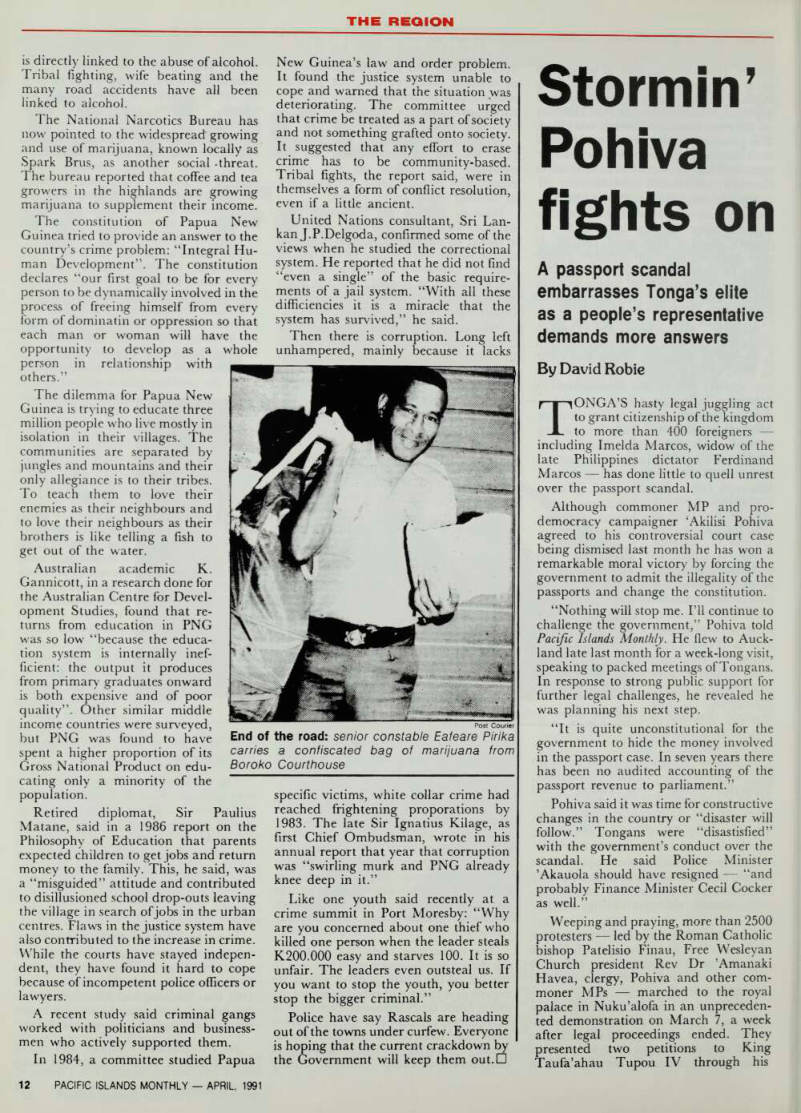
The National Narcotics Bureau has now pointed to the widespread growing and use of marijuana, known locally as Spark Brus, as another social -threat.
The bureau reported that coffee and tea growers in the highlands are growing marijuana to supplement their income.
The constitution of Papua New Guinea tried to provide an answer to the country’s crime problem: “Integral Hu man Development”. The constitution declares “our first goal to be for every person to be dynamically involved in the process of freeing himself from every form of dominatin or oppression so that each man or woman will have the opportunity to develop as a whole
person in relationship with others.”
The dilemma for Papua New Guinea is trying to educate three million people who live mostly in isolation in their villages. The communities are separated by jungles and mountains and their only allegiance is to their tribes.
To teach them to love their enemies as their neighbours and to love their neighbours as their brothers is like telling a fish to get out of the water.
Australian academic K.
Gannicott, in a research done for the Australian Centre for Devel opment Studies, found that re turns from education in PNG was so low “because the educa tion system is internally inef ficient: the output it produces from primary graduates onward is both expensive and of poor quality”. Other similar middle income countries were surveyed, but PNG was found to have spent a higher proportion of its Gross National Product on edu cating only a minority of the
population.
Retired diplomat, Sir Paulius Matane, said in a 1986 report on the Philosophy of Education that parents expected children to get jobs and return money to the family. This, he said, was a “misguided” attitude and contributed to disillusioned school drop-outs leaving the village in search of jobs in the urban centres. Flaws in the justice system have also contributed to the increase in crime.
While the courts have stayed indepen dent, they have found it hard to cope because of incompetent police officers or lawyers.
A recent study said criminal gangs worked with politicians and business men who actively supported them.
In 1984, a committee studied Papua
New Guinea’s law and order problem.
It found the justice system unable to cope and warned that the situation was deteriorating. The committee urged that crime be treated as a part of society and not something grafted onto society.
It suggested that any effort to erase crime has to be community-based.
Tribal fights, the report said, were in themselves a form of conflict resolution, even if a little ancient.
United Nations consultant, Sri Lan kan J.P.Delgoda, confirmed some of the views when he studied the correctional system. He reported that he did not find “even a single” of the basic require ments of a jail system. “With all these difficiencies it is a miracle that the system has survived,” he said.
Then there is corruption. Long left unhampered, mainly because it lacks
specific victims, white collar crime had
reached frightening proportions by
1983. The late Sir Ignatius Kilage, as first Chief Ombudsman, wrote in his annual report that year that corruption was “swirling murk and PNG already knee deep in it.”
Like one youth said recently at a crime summit in Port Moresby: “Why are you concerned about one thief who killed one person when the leader steals K 200.000 easy and starves 100. It is so unfair. The leaders even outsteal us. If you want to stop the youth, you better stop the bigger criminal.”
Police have say Rascals are heading out of the towns under curfew. Everyone is hoping that the current crackdown by the Government will keep them out.D
Post Courier End of the road: senior constable Eafeare Pirika carries a confiscated bag of marijuana from Boroko Courthouse