fights on
pp. 12-15 · Read in the full issue
Stormin’
Pohiva fights on
A passport scandal embarrasses Tonga’s elite as a people’s representative demands more answers
By David Robie
TONGA’S hasty legal juggling act to grant citizenship of the kingdom to more than 400 foreigners including Imelda Marcos, widow of the late Philippines dictator Ferdinand Marcos has done little to quell unrest over the passport scandal.
Although commoner MP and pro democracy campaigner £ Akilisi Pohiva agreed to his controversial court case being dismised last month he has won a remarkable moral victory by forcing the government to admit the illegality of the passports and change the constitution, “Nothing will stop me. I’ll continue to challenge the government,” Pohiva told Pacific Islands Monthly. He flew to Auck land late last month for a week-long visit, speaking to packed meetings of Tongans.
In response to strong public support for further legal challenges, he revealed he was planning his next step.
“It is quite unconstitutional for the government to hide the money involved in the passport case. In seven years there has been no audited accounting of the passport revenue to parliament.”
Pohiva said it was time for constructive changes in the country or “disaster will follow.” Tongans were “disastisfied” with the government’s conduct over the scandal. He said Police Minister ’Akauola should have resigned “and probably Finance Minister Cecil Cocker as well.”
Weeping and praying, more than 2500 protesters led by the Roman Catholic bishop Patelisio Finau, Free Wesleyan Church president Rev Dr ’Amanaki Havea, clergy, Pohiva and other com moner MPs marched to the royal palace in Nuku’alofa in an unpreceden ted demonstration on March 7, a week after legal proceedings ended. They presented two petitions to King Taufa’ahau Tupou IV through his
private secretary. The King was urged to cancel citizenship of the 426 foreigners and dismiss the Police Minister, ’Akau’ola, who has accepted responsibil ity for the illegal sales of naturalisation certificates and passports. ’Akau’ola had told an emergency session of the Legislative Assembly in mid-February: “I take the blame ... it is my fault. We acknowledge that things have been done illegally and we need to correct them.” He admitted that his police department, which is also in charge of immigration, was responsible after the commoner MPs challenged the government’s urgent legislation to amend the constitution.
“Whether things were done deliberately or not ... I accept full responsibility for what has gone wrong ...
If I am to be dismissed from my job, that is up to His Majesty.”
Pohiva told Pacific Islands Monthly the Tongan protestors who had petitioned the King had not received a formal reply.
He described a royal statement cited in the government-run newspaper, Tonga Chronicle , as “disappointing” and a
repetition of ‘unconvincing expla
nations” given by cabinet ministers to Parliament.
According to the Chronicle , the King
said the Kingdoom could not afford the expense of cancelling the passports. He said changing foreign exchange rates for the Tongan pa’anga, plus possible law suits by pasport holders, meant that paying out refunds and declaring ie documents null and void would be U i heavy a burden for the country.
He also said none of the forr.gners were living in Tonga and mr si were unlikely to ever do so. About the demand for the resignation of the Police Minister, the King said it was up to Parliament to amend legislation and to impeach min isters.
Most of the foreigners involved in the passport scandal are Asians. They in clude 189 mainland-born Chinese, 152 Hong Kong Chinese, nine Macau Chin ese, nine Thais, nine Burmeese, eight Singaporeans, four Filipinos and two Indonesians. One of the ethnic Chinese is Sam Wong, a Filipino-bom business man who reportedly plans to build a multimillion-dollar business complex in the capital, Nuku’alofa.
Exiled Imelda Marcos is the best known foreigner to have got a passport and the Philippines government has announced it would reject any passport application from her. This follows reports that she intends to file an application at
the Philippine consulate in New York.
Mrs Marcos, 61, fled into exile with her deposed husband when the people power revolt in the Philippines installed Corazon Aquino’s government in Febru ary 1986. Ferdinand Marcos died in Hawaii in 1989.
The South China Morning Post reported a claim that Mrs Marcos and her son, Ferdinand Martin, 33, her granddaugh ter Aimee, 13, had been given their passports as a “gift” by the kingdom.
“I don’t believe the passports would have been given to the Marcos family for free,” said Pohiva. “Nobody was there to witness what happened. It was raised in the House but the questions remain unanswered.”
Other nationalities listed in the Gov ernment gazette as having gained Ton gan passports include Americans, Libyans, South Africans and a Palestinian businessman, Touflc Barakeb, with five of his relatives scat tered from Israel to Dubai.
The former Hong Kong Stock Exchange chief, Ronald Li, who is serving a four-year jail term for bribery, and textile billionaire Chen Din-hwa are
also reportedly listed among the legal passport holders. According to the Morning Post, the combined assets of the two men are estimated to be worth more than US$l billion ‘‘equivalent to several decades of Tonga’s GDP.” ’Atenisi Institute’s Professor Futa Helu, one of Tonga’s few influential educators and a Pacific Islands Monthly columnist, condemned the government for changing a part of the 1875 constitution which had been drafted to protect the country and its people from a foreign takeover.
“The government chooses to save ministers rather than to uphold the constitutional clause that protects Tongans from foreigners,” he said. “It is trying to justify the deliberate constitutional abuse by some ministers who,
previously questioned by the
people’s representatives, fail to ad mit they are wrong.” Professor Helu added there was no way the government could cover up its law breaking.
In an editorial, the Times of Tonga said: “The consitution is never a sacred document that cannot be changed or amended, but the reason behind the amend ment is something that is hard to find in any civilised society.”
Under the illegal passports scheme, which has been operating since 1983, two kinds of Tongan passport have been for sale to foreigners: the Tonga Protected Person Passport and the Tongan Passport (issued to those who become naturalised). The “pro tected person” passport was cre ated in 1983 as primarily a travel document for non-Tongans who
had difficulties travelling beyond
their own national boundaries. It sold for US$lO,OOO. However, as this document did not give the holder automatic right of residence in Tonga and a visa was needed, a
growing number of countries includ ing Australia and New Zealand did not recognise it.
Further legislation was introduced in 1984 to deal with this problem. The King was given power to grant naturalisation to any foreigner of “good character on humanitarian grounds.” The naturalis ation fee was US$2O,OOO, but additional fees could take it up to around U 5537,000 (although the actual passport was only US$lO).
Commoner MPs and their lawyers exposed the scheme and challenged it as unconstitutional.
In 1988, ’Akau’ola admitted that the 1984 legislation was unconstitutional because it violated Section 29 of the constitution which requires residency of at least five years before naturalisation.
The 1984 Act was then repealed by the 1988 Nationality Act.
It is uncertain how many foreigners have been naturalised or how much money has been made from the scam, as these figures have not been revealed in Parliament but it is believed that considerably more than the 426 people named in the Government Gazette may have acquired passports.
“They have only admitted 426 pass ports that’s what they have told us and it could be very wrong,” said Pohiva. “This is one of the things that I have asked in three letters to the Police Minister, Finance Minister and the Deputy Prime Minister.
“I wanted to find out how many passports have been sent to Hong Kong since 1984. No answer. I asked how
many passports are still held out of those issued. No answer.
“We need an audited financial state ment before we can accept that list they have made public.”
Tonga’s Consul in Hong Kong, George Chen, who succeeded his father, Tom Chen, in 1989, told Matangi Tonga news magazine about how the scheme works. Opened in 1981, the consulate was said by Attorney-General Tevita Tupou to have issued all but three of the
purported naturalisations.
According to the magazine, the Chens and South Pacific Sea Land Air Ltd secured a 30-year lease on the volcanic island of Fonualei, in the northern Vava’u group. Through this “leasehold operation” foreign nationals could buy Tongan passports. By last year about 900
of the 20-year leases on Tongan land had been sold to foreigners.
Chan told Matangi Tonga a passport applicant needed to qualify first under the leasehold scheme before applying for protected person status or naturalisation as a Tongan.
Chen reportedly said his consulate had issued about 900 protected person pass ports and 84 certificates of naturalisation.
He added that about US$5 million had been received and this had been invested in the Tonga Trust Fund account with the Bank of America, San Francisco.
However, people’s representatives esti
mate the total is more likely at least $7 million; on a New Zealand television programme last year the King men tioned $2O million.
In August 1989, Pohiva and his legal
counsel, Auckland lawyers Dr Rodney Harrison and Nalesoni Tupou, filed their lawsuit against the kingdom and the Police Minister, claiming the passports should be declared ivalid because the sales were unconstitutional and illegal.
After lengthy legal proceed
ings and arguments for more than a year, the case was finally about to go before the Supreme Court. Chief Justice Geoffrey Martin had been due on Febru ary 22 to set a date for an open
hearing.
However, four days earlier, on February 18, the government suddenly called an emergency session of Parliament in an attempt to legalise its passport practices over the previous seven years. This was only the third time that an emergency session had ever been called for Parlia ment which usually meets between May and December.
Earlier times were in 1914 at the start of the First World War and in 1982 in the wake of the
devastation from Cyclone Isaac.
Under the constitution, Tonga’s 30-seat Parliament has 10 cabinet mem bers plus two governors appointed by the King, nine members voted for by the 33 nobles, and nine people’s representatives elected by voters from Tonga’s 100,000 commoners.
Parliament was bitterly divided be tween the cabinet and the nobles who supported the passport legislation and seven of the commoner MPs who argued it would be damaging for Tonga to amend the constitution to legalise a mistake. Pohiva and his colleagues also argued that Parliament should allow the court to pass its final ruling before any
further legislation was adopted.
Attorney-General Tupou insisted that the government was mainly concerned
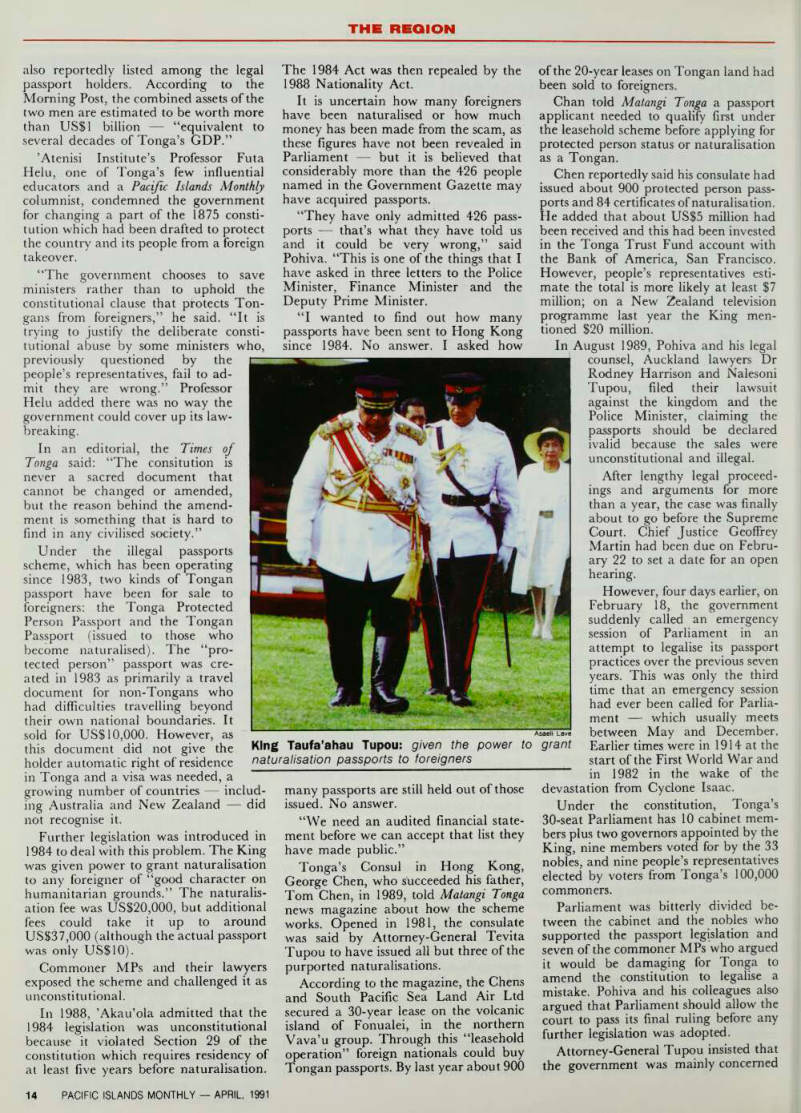
Asaeli Lave King Taufa’ahau Tupou: given the power to grant naturalisation passports to foreigners
with the fate of the 426 foreigners who had bought their passports in “good faith”. He also warned of the conse quences for the kingdom if the passports were not made legal.
“In addition to the inevitable return of all money paid for these naturalisation and passports (plus accrued interest),”
Attorney-General Tevita Tupou said: “The country is exposed to very substan tial claims for damages, which could be catastrophic if, for example, earlier nationalities have been relinquished ... or annulled.”
Pohiva declared that the government was passing laws which would legalise what had been done illegally. He added: “This is totally unnacceptable in any civilised society.”
Viliami Afeaki, the people’s represen tative from Ha’apai, said: “Imagine our constitution which has stood for more than 100 years being amended to accommodate the illegal acts of govern ment.”
Pohiva eventually stormed out of Parliament after distributing a letter
saying the government was withholding important information from the debate.
Tongatapu’s two other people’s rep resentatives, Laki Niu and Viliami Fukofuka, also later walked out after failing to pass amendments trying to block the legislative changes which were adopted by a 15-4 vote.
When the passports case was dismissed by the Supreme Court on March 1, Chief Justice Martin awarded Pohiva NZ523,500 in court costs. Pohiva told the court his legal advice from senior counsel Dr Harrison was that now the consti tudon had been changed it was no longer
possible to successfully press proceedings.
However, he added that “the position I have taken on behalf of the people ... has been vindicated by the statements of the Attorney-General to Parliament ac knowledging that what was done by the defendants was unconstitutional.
“With the passage of amending legis lation,” he added, “I believe that the issue has ceased to be one appropriately to be determined by the courts. But the case does not end. It marks a new page in our history.” □