Jemima Garret
Facing the future after the War
FEARS that the world’s preoccupation with the Gulf War and its aftermath might relegate the Pacific to a forgotten backwater are likely to be unfoundered. In fact, in almost every way, the Pacific has come out of the conflict more easily than other regions and nations.
Developing countries which export labour to the middle east: the Phillipines, Sri Lanka, India and Bangladesh for instance, have remittances. The thousands of refugees who returned home after the invasion of Kuwait were forced to leave behind all their assets. Many more remained in Iraq and Kuwait. \\ hile those in Kuwait may have some hope of taking part in the massive post-war reconstruction programme, those in Iraq continue to face a bleak future. Others likely to suffer the effects of the war in silence are those in famine striken
countries in Africa. While the world’s media attention has been focussing on the Gulf another catastrophe has been growing in
Ethiopia, Eritirea
and other countries in sub- Saharan Africa.
Those in the west who usually put their hands in their pockets are
suffering from
what aid agencies
call compassion
fatigue. Many
countries’ emergency aid funds, usually kept for this sort of problem, have been used on
refugees from
Iraq. Australia committed more than a AS4 million from its emergency relief fund. By contrast, life in the South Pacific is quiet and comfortable.
Innocent men and women and children have not lost their lives or experienced the
the austra
unprecedented bombing seen in Iraq. And the South Pacific has not lost any of its aid funding. Nor is it likely to, according to Australian aid officials.
In fact, despite the preoccupation with the Gulf, the United States has demonstrated its continuing firm commitment to expanding its links with the Pacific. During a swing through the region last month, a senior State Department official, Jon Huntsman, said Washington wants to see its Joint Commercial Commission (announced by President Bush at the US/Pacific Summit last year) running as soon as possible.
VV hile at this stage details of how the Commission will function are yet to be worked out, it is clear the initiative holds the potential to boost trade and investment and significantly raise the profile of the Pacific Islands with officials in the US capital.
In fact, trade is another area in which the Pacific has emerged from the Gulf War relatively unscathed. For countries which had big markets in Iraq the war has been a disaster. For some, like Sri Lanka, which sold a fifth of its major export tea to Iraq, lost trade came on top of other Gulf-induced economic problems.
For others, like Australia, the United States’ decision to sell subsidised wheat to nations suffering from Gulf War fallout has exacerbated difficulties in an industry already suffering from the loss of key contracts in Iraq and from earlier US subsidy schemes which lowered international prices.
For the Pacific Islands the challenge is not to find its place in the New World Order that is already secure. The challenge is to make the most of economic initiatives such as Wasington’s Joint Commercial Commission. Low prices for agricultural products, increasing competition in manufacturing and the push by crucial neighbours like Australia and New Zealand to lower their tariffs are all going to have far more impact in the long term that the Gulfwar.
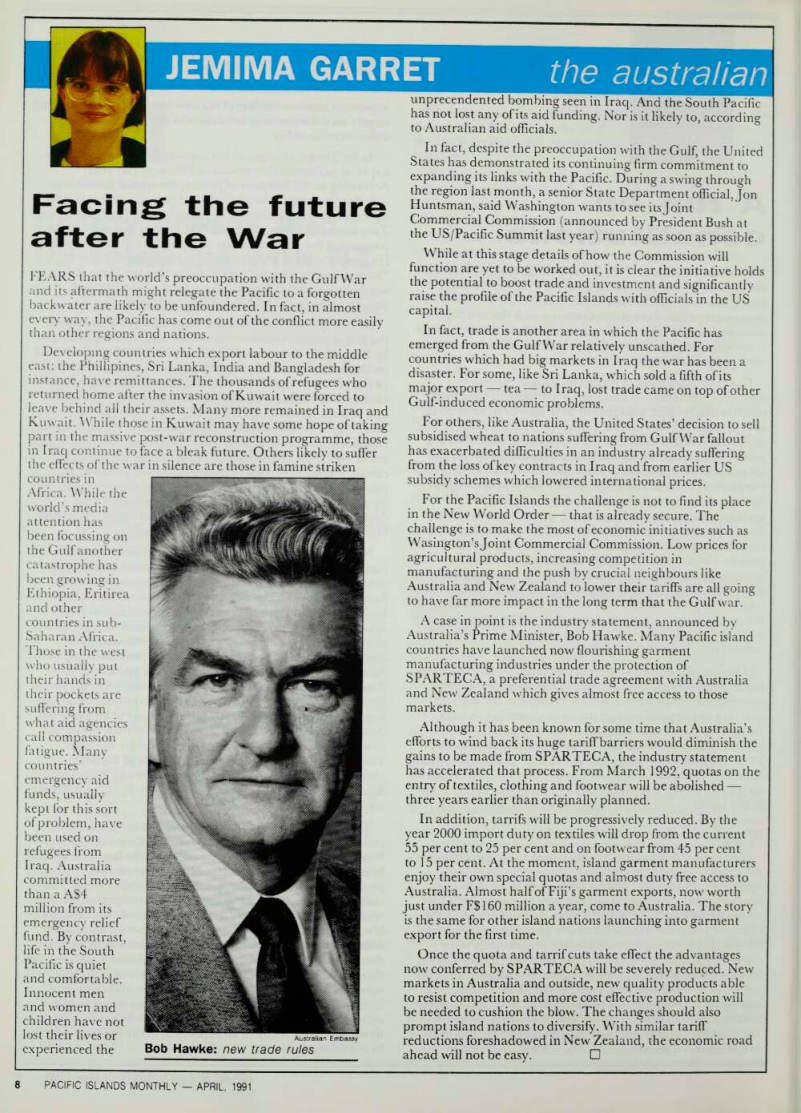
A case in point is the industry statement, announced by Australia’s Prime Minister, Bob Hawke. Many Pacific island countries have launched now flourishing garment manufacturing industries under the protection of SPARTECA, a preferential trade agreement with Australia and New Zealand which gives almost free access to those markets.
Although it has been known for some time that Australia’s efforts to wind back its huge tariff barriers would diminish the gains to be made from SPARTECA, the industry statement has accelerated that process. From March 1992, quotas on the entry of textiles, clothing and footwear will be abolished three years earlier than originally planned.
In addition, tarrifs will be progressively reduced. By the year 2000 import duty on textiles will drop from the current 55 per cent to 25 per cent and on footwear from 45 per cent to 15 per cent. At the moment, island garment manufacturers enjoy their own special quotas and almost duty free access to Australia. Almost half of Fiji’s garment exports, now worth just under FSI6O million a year, come to Australia. The story is the same for other island nations launching into garment export for the first time.
Once the quota and tarrifcuts take effect the advantages now conferred by SPARTECA will be severely reduced. New markets in Australia and outside, new quality products able to resist competition and more cost effective production will be needed to cushion the blow. The changes should also prompt island nations to diversify. With similar tariff reductions foreshadowed in New Zealand, the economic road ahead will not be easy. □
Australian Embassy Bob Hawke: new trade rules