the islands
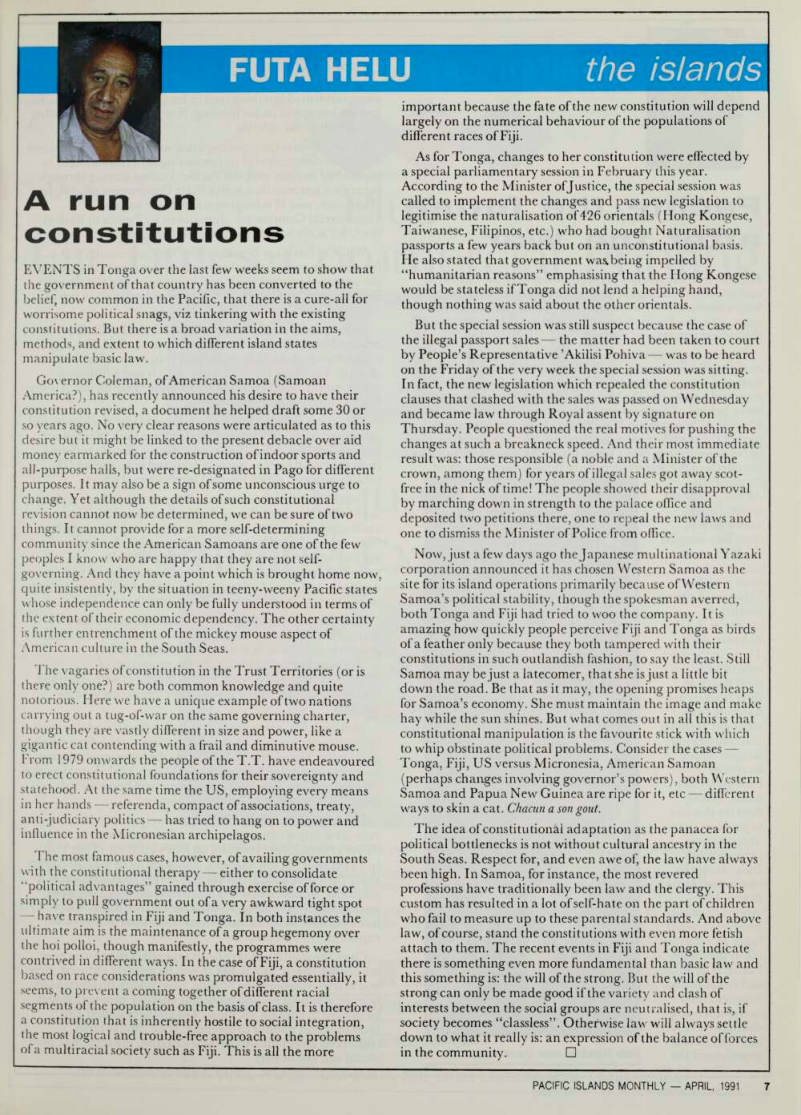
Futa Helu
A run on constitutions
EVENTS in Tonga over the last few weeks seem to show that the government of that country has been converted to the belief, now common in the Pacific, that there is a cure-all for worrisome political snags, viz tinkering with the existing constitutions. But there is a broad variation in the aims, methods, and extent to which different island states manipulate basic law.
Governor Coleman, of American Samoa (Samoan America?), has recently announced his desire to have their constitution revised, a document he helped draft some 30 or so years ago. No very clear reasons were articulated as to this desire but it might be linked to the present debacle over aid money earmarked for the construction of indoor sports and all-purpose halls, but were re-designated in Pago for different purposes. It may also be a sign of some unconscious urge to change. Yet although the details of such constitutional revision cannot now be determined, we can be sure of two things. It cannot provide fora more self-determining community since the American Samoans are one of the few peoples I know who are happy that they are not self governing. And they have a point which is brought home now, quite insistently, by the situation in teeny-weeny Pacific states whose independence can only be fully understood in terms of the extent of their economic dependency. The other certainty is further entrenchment of the mickey mouse aspect of American culture in the South Seas.
The vagaries of constitution in the Trust Territories (or is there only one?) are both common knowledge and quite notorious. Here we have a unique example of two nations carrying out a tug-of-war on the same governing charter, though they are vastly different in size and power, like a gigantic cat contending with a frail and diminutive mouse.
From 1979 onwards the people of the T.T. have endeavoured to erect constitutional foundations for their sovereignty and statehood. At the same time the US, employing every means in her hands referenda, compact of associations, treaty, anti-judiciary politics— has tried to hang on to power and influence in the Micronesian archipelagos.
The most famous cases, however, of availing governments with the constitutional therapy either to consolidate “political advantages” gained through exercise offeree or simply to pull government out of a very awkward tight spot have transpired in Fiji and Tonga. In both instances the ultimate aim is the maintenance of a group hegemony over the hoi polloi, though manifestly, the programmes were contrived in different ways. In the case of Fiji, a constitution based on race considerations was promulgated essentially, it seems, to prevent a coming together of different racial segments of the population on the basis of class. It is therefore a constitution that is inherently hostile to social integration, the most logical and trouble-free approach to the problems of a multiracial society such as Fiji. This is all the more
the islands
important because the fate of the new constitution will depend largely on the numerical behaviour of the populations of different races of Fiji.
As for Tonga, changes to her constitution were effected by a special parliamentary session in February this year.
According to the Minister ofjustice, the special session was called to implement the changes and pass new legislation to legitimise the naturalisation 0f426 orientals (Hong Kongese, Taiwanese, Filipinos, etc.) who had bought Naturalisation passports a few years back but on an unconstitutional basis.
He also stated that government was.being impelled by “humanitarian reasons” emphasising that the Hong Kongese would be stateless if Tonga did not lend a helping hand, though nothing was said about the other orientals.
But the special session was still suspect because the case of the illegal passport sales — the matter had been taken to court by People’s Representative ’Akilisi Pohiva was to be heard on the Friday of the very week the special session was sitting.
In fact, the new legislation which repealed the constitution clauses that clashed with the sales was passed on Wednesday and became law through Royal assent by signature on Thursday. People questioned the real motives for pushing the changes at such a breakneck speed. And their most immediate result was; those responsible (a noble and a Minister of the crown, among them) for years of illegal sales got away scot free in the nick of time! The people showed their disapproval by marching down in strength to the palace office and deposited two petitions there, one to repeal the new laws and one to dismiss the Minister of Police from office.
Now, just a few days ago the Japanese multinational Yazaki corporation announced it has chosen Western Samoa as the site for its island operations primarily because of Western Samoa’s political stability, though the spokesman averred, both Tonga and Fiji had tried to woo the company. It is amazing how quickly people perceive Fiji and Tonga as birds of a feather only because they both tampered with their constitutions in such outlandish fashion, to say the least. Still Samoa may be just a latecomer, that she is just a little bit down the road. Be that as it may, the opening promises heaps for Samoa’s economy. She must maintain the image and make hay while the sun shines. But what comes out in all this is that constitutional manipulation is the favourite stick with which to whip obstinate political problems. Consider the cases Tonga, Fiji, US versus Micronesia, American Samoan (perhaps changes involving governor’s powers), both Western Samoa and Papua New Guinea are ripe for it, etc different ways to skin a cat. Chacun a son gout.
The idea of constitutional adaptation as the panacea for political bottlenecks is not without cultural ancestry in the South Seas. Respect for, and even awe of, the law have always been high. In Samoa, for instance, the most revered professions have traditionally been law and the clergy. This custom has resulted in a lot of self-hate on the part of children who fail to measure up to these parental standards. And above law, of course, stand the constitutions with even more fetish attach to them. The recent events in Fiji and Tonga indicate there is something even more fundamental than basic law and this something is: the will of the strong. But the will of the strong can only be made good if the variety and clash of interests between the social groups are neutralised, that is, if society becomes “classless”. Otherwise law will always settle down to what it really is: an expression of the balance offerees in the community. □