paper but
p. 23 · Read in the full issue
Peace on paper but harm done
PAPUA New Guinea and the rebel Bougainville Island have signed a peace agreement after two years of violence, in which about 150 people died and the nation’s economy was seriously
damaged.
Under the terms of the agreement, the secessionists will be given immunity from prosecution and a multinational team will supervise the restoration of peace.
It is expected to be made up of police and military personnel from Australia, New Zealand, Canada, Fiji, Vanuatu and the Solomon Islands.
The agreement, called the Honiara Declaration on Peace, Reconciliation and Rehabilitation on Bougainville, was signed at midnight on January 24 by PNG’s chief negotiator, Foreign Affairs Minister Sir Michael Somare, and leader of the Bougainville team Joseph Kabui, the suspended Papua New Guinea Prem ier of the North Solomons province,
which incorporates Bougainville.
According to Sir Michael Somare, the PNG Government has agreed that secur ity forces will not return to the copper rich South Pacific island, 800 km north east of Port Moresby.
The agreement signed by the Bougain ville Revolutionary Army also stated that BRA would surrender and lay down its arms to members of the multinational team, and release all prisoners.
However, according to AAP Kabui later said the agreement had contained a typing error. He said he had earlier requested that the part which related to the BRA destroying its arms be deleted, but this had been left in and he had not noticed when he signed the document.
“If the word destruction is left in the agreement then it does not carry the spirit of the accord,” Kabui said.
Kabui said he had contacted BRA commander Sam Kaouna, who wel comed the agreement but stressed the importance of a neutral force supervising the restoration program. There could be no guarantee of peace without the international advisory team, he said.
The agreement came after two days of intensive negotiations in the Solomon Islands capital, Honiara.
In the declaration, both sides agreed to defer discussions on the future political status of Bougainville.
The restoration process is expected to take three years and will be reviewed
every six months, but in the event of sabotage from either party it will be terminated. The restoration will be in two phases, the first seeing the immediate resumption of essential services in health and education.
The second phase involves establish ment of a body known as the legal authority in Bougainville. Political ana lysts said this suggested the island might be granted some form of autonomous government. The program does not include the program of restoration of sendees undertaken by the PNG govern ment on Buka Island.
The agreement was welcomed by both Australia and New Zealand. Australia’s Foreign Affairs Minister Gareth Evans said the Australian Government was prepared to join a multinational team, and that the declaration was a very encouraging development in the search for a peaceful solution.
New Zealand’s External Relations and Trade Minister Don Mckinnon said in a statement he was delighted there had been “solid progress” towards resolving the conflict, and he hoped New Zealand could help in the multinational force as a neighbour and friend.
“We want to ensure that any agree ment between the PNG Government and Bougainville leadership has a real chance of succeeding and being sustainable.”
Mr McKinnon said whether New Zealand made a military or civilian commitment would be examined once there was a better idea of exactly what was needed.
“We’re very much in the hands of the Papua New Guineans in terms of defin ing what we can usefully do now to help achieve a lasting peace on Bougainville.”
Shares boom News of the agreement caused a surge in Bougainville Copper Ltd share prices.
But Bougainville copper’s 53 per cent parent, CRA Ltd, said it was premature to comment on the future of the Panguna Copper mine, which was closed in May 1989 after attacks by militant land owners on the island.
Bougainville copper shares jumped 19 cents to 82 cents on news that peace was to be restored on the island, and CRA shares soared to S9.62 from an early low of S9.42 the day of the news.
A spokesman for CRA said the mining giant was pleased to see there was a desire on both sides for peace to be restored, but it was too early to comment on the future of the mine.
Analysts said the signing of the agreement did not mean an end to the Bougainville mine saga because it would be “incredibly expensive” to reopen. ‘We don’t know yet what the agree ment means for the mine,” one analyst said. He said it was unlikely that the mine would be reopened in the short term, and there would be huge problems in returning the mine to working order.
In August Bougainville Copper re ported a half year loss of 69.33 million kina and warned that its mining assets were starting to deteriorate.
CRA said one year ago that it would need to spend the equivalent of SUS75 million to SUS100 million to reopen the mine, excluding costs from war-inflicted damage.
Another analyst said he saw little chance of the mine opening in the near future.
“But it raises the chances of it opening over the next few years,” he said. □
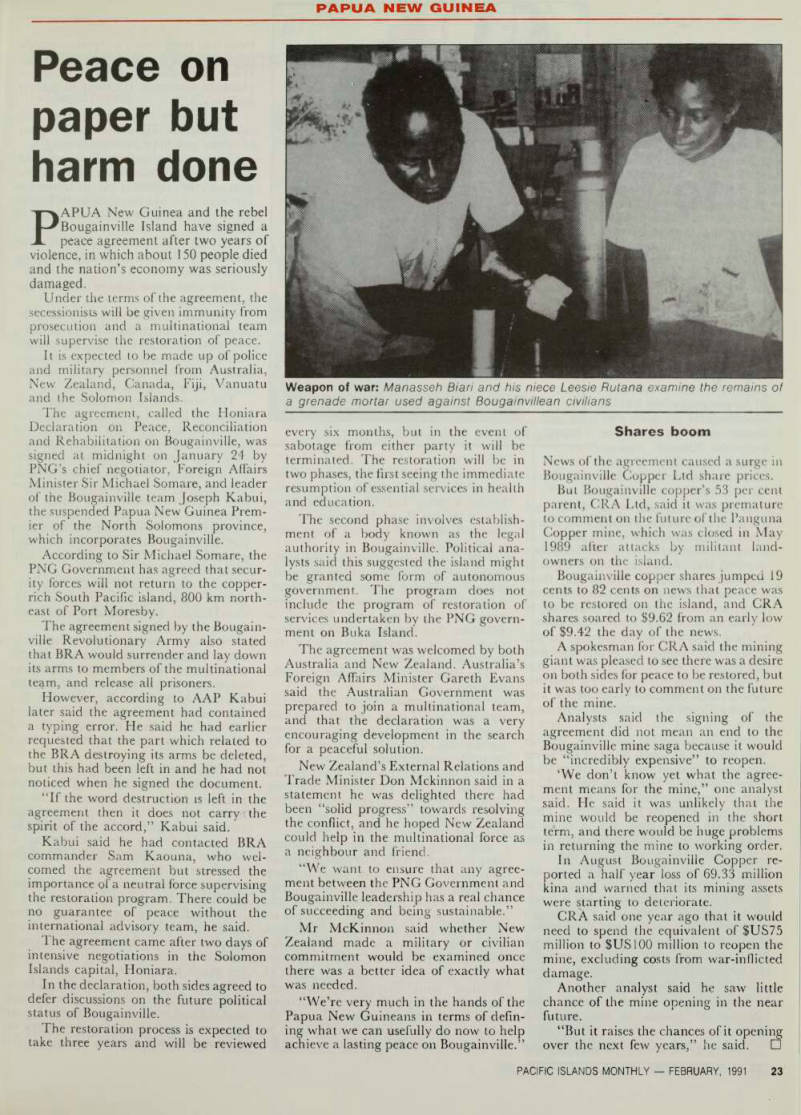
Weapon of war: Manasseh Biari and his niece Leesie Rutana examine the remains of a grenade mortar used against Bougainvillean civilians