Operation Somare
p. 22 · Read in the full issue
The Pacific bids for the United Nations presidency and wins key Asian support
By Ian Williams
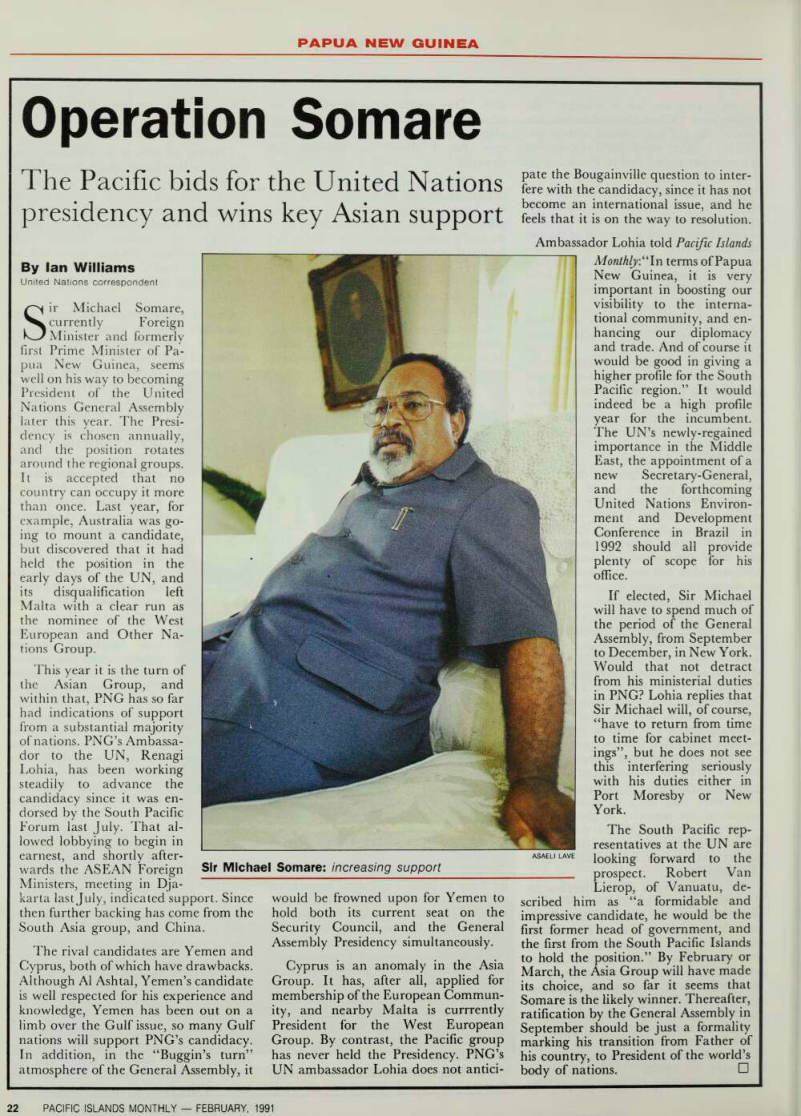
United Nations correspondent Sir Michael Somare,
currently Foreign
Minister and formerly first Prime Minister of Pa pua New Guinea, seems well on his way to becoming President of the United Nations General Assembly later this year. The Presi dency is chosen annually, and the position rotates around the regional groups.
It is accepted that no country can occupy it more than once. Last year, for example, Australia was go ing to mount a candidate, but discovered that it had held the position in the early days of the UN, and its disqualification left Malta with a clear run as the nominee of the West European and Other Na
tions Group.
This year it is the turn of the Asian Group, and within that, PNG has so far had indications of support from a substantial majority of nations. PNG’s Ambassa dor to the UN, Renagi Lohia, has been working steadily to advance the candidacy since it was en dorsed by the South Pacific Forum last July. That al lowed lobbying to begin in earnest, and shortly after wards the ASEAN Foreign Ministers, meeting in Dja
karta last July, indicated support. Since then further backing has come from the South Asia group, and China.
The rival candidates are Yemen and Cyprus, both of which have drawbacks.
Although A 1 Ashtal, Yemen’s candidate is well respected for his experience and knowledge, Yemen has been out on a limb over the Gulf issue, so many Gulf nations will support PNG’s candidacy.
In addition, in the “Buggin’s turn” atmosphere of the General Assembly, it
would be frowned upon for Yemen to hold both its current seat on the Security Council, and the General Assembly Presidency simultaneously.
Cyprus is an anomaly in the Asia Group. It has, after all, applied for membership of the European Commun
ity, and nearby Malta is currrently
President for the West European Group. By contrast, the Pacific group has never held the Presidency. PNG’s UN ambassador Lohia does not antici
pate the Bougainville question to inter fere with the candidacy, since it has not become an international issue, and he feels that it is on the way to resolution.
Ambassador Lohia told Pacific Islands
Monthly:“ln terms of Papua New Guinea, it is very
important in boosting our
visibility to the interna tional community, and en
hancing our diplomacy
and trade. And of course it would be good in giving a higher profile for the South Pacific region.” It would indeed be a high profile year for the incumbent.
The UN’s newly-regained importance in the Middle East, the appointment of a
new Secretary-General,
and the forthcoming United Nations Environ ment and Development Conference in Brazil in 1992 should all provide plenty of scope for his office.
If elected, Sir Michael will have to spend much of the period of the General
Assembly, from September
to December, in New York.
Would that not detract from his ministerial duties in PNG? Lohia replies that Sir Michael will, of course, “have to return from time to time for cabinet meet ings”, but he does not see this interfering seriously with his duties either in Port Moresby or New York.
The South Pacific rep resentatives at the UN are looking forward to the prospect. Robert Van Lierop, of Vanuatu, de
scribed him as “a formidable and impressive candidate, he would be the first former head of government, and the first from the South Pacific Islands to hold the position.” By February or March, the Asia Group will have made its choice, and so far it seems that Somare is the likely winner. Thereafter, ratification by the General Assembly in
September should be just a formality
marking his transition from Father of his country, to President of the world’s body of nations. □
Sir Michael Somare: increasing support