Inside Bougainville
pp. 19-21 · Read in the full issue
The Region
Papua New Guinea
Io 4. ■ I , .
I Here IS no turnino DOCK, S 3 VS Frsnc S .. ■' Ona as supplies run out and doctors watch women and children die
By Alfred Sasako
(First outside journalist to enter Bougainville since the blockade eight months aqo) 9 ' ELIAS Walu was born on De cember 22 last vear three davs hefnrp pL; ctmoo , a eight months into a maritime and communications blockade on Bougainville. Walu was born in a truck in the caoital Arawa while th* .ruck wen t from blouse h'ouse'ln search of a doctor. When they finally found a doctor, it was too late- the babv was already born, his umblical cord cut with a razor blade. Three days later I arrived • R 1 arrived B ° Uga,nV,lle and became the
outside journalist to interview resistance leader Francis Ona.
A . .
According to Bougamvillean doctors
ic . l ? a ? l C ’ aruai ’ a Paediatrician, and Cyril Imako, Walu’s survival chances were nil. nm' 0 b .| ockade of Bougainville (about 12°° kllometres north-east of Port Moresby) b Y the Pa pua New Guinea Government meant that essential medi “Pi"** had not been able to get in. ! hls m . eant tbat some 6000 babies born rf tbe jsl a nd between October 1989 and E ? ec *j mber . last Y ear were never immu disLs f gams ? common Y et preventable diseases such as measles, whooping cough, diptheria, polio, tetanus, mJmp!
and Hepatitis B.
Dr Garui and Dr Imako agree that the children’s chances of surviving an epi demic in the next 18 months were nil. If we are to rate their chances of survival, it will be a 100 per cent mortality, they said, adding that while the picture was gloomy, it was real. There have been 200 malaria-related deaths in Bougainville in the period of the embargo, an increase of 182 per cent on 1989 figures. Cases of tuberculosis, leprosy and yaws or tropical ulcers have increased by up to 20 per cent. Chronic drug-dependent patients like those suffering from diabetes, hyper tensions and asthma are in trouble.
Dr Garuai and Dr Imako say there will be a lot of deaths in the 30-40 age group as the situation deteriorates: “We have had no basic life-saving drugs such as pencillin and other antibiotics since July last year. The health situation is very critical. The cases we have reported are those that came to our notice. We have no reason to doubt that the situation has worsened.”
Attempts to get medical supplies into Bougainville have failed because Papua New Guinea Prime Minister Rabbie Namaliu insists that all humanitarian aid go through Port Moresby. And the Port Moresby administration has rejected an
Alfred Sasako For Aap
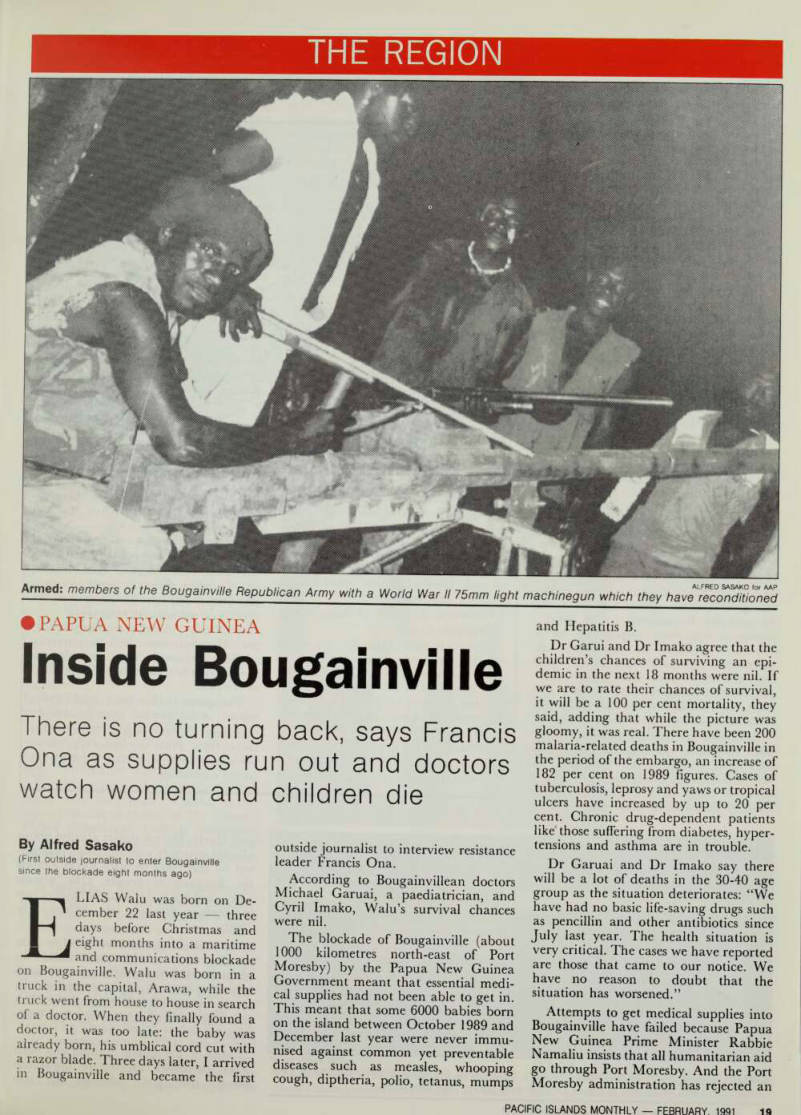
Armed: members of the Bougainville Republican Army with a World War II 75 light machinegun which they have reconditioned
attempt by Solomon Islands Foreign Minister Sir Peter Kenilorea to person ally mediate in the crisis.
The two and a half year-old crisis is turning Arawa, once the seat of the provincial government headed by Joseph Kabul as premier, into a ghost town.
There is no electricity, no medicine, no healthcare and no fuel. Few people are seen. Once home to an estimated 30,000 people including 8000 white expatriates, the town is now nearly deserted. Its streets are empty and houses are covered in overgrown bushes.
The crisis has forced local public servants to return home to their villages.
Contract officers who worked for the now closed Bougainville Copper Ltd have returned to their countries.
Surprisingly, more than a dozen expatriates from New Zealand, Austra lia, Holland and the Philippines have decided to ride out the trouble.
Many are businessmen, others were once employees of the Bougainville Copper Ltd (BCL). They form part of the small community that still endures the hardships in Kieta and Arawa. “I have nowhere else to go,” said business man Ross Noone, of New Zealand, who still lives at Arawa. “I have lived here for the last 20 years and all my assets are here. I have little else elsewhere.”
Another New Zealander, Richard Harty, is married to a Bougainvillean and he has made Bougainville his home.
He and Noonen spoke highly of the Bougainville Republican Army (BRA), saying it has been responsible for a “drastic reduction in crime and (an increase in) law and order control over the last two years. We have little problems moving around town. The BRA have contained the law and order situation here and it is a credit to them.”
Both men say that for members of the BRA to handle the situation as well as they do is something that the people of Bougainville should be proud of. “I can’t say the same thing about the PNG security forces when they were here,”
THE secessionist movement on the island of Bougainville is serious about staying away from Papua New Guinea. A draft has been drawn up on the form of government they will adopt and a sample passport has been printed. Here’s how the rebel leaders see their new republic: Country: Republic of Bougainville Capital: Arawa Government: Initially, members will be appointed and not elected to all four tiers of government headed by a president at the national level. A decision is yet to be made on whether the president should be elected by the people or by members.
Area: 8730 sq km (3371 sq miles) Population: 140,000 to 150,000
Climate: tropical
Religion: Catholic, United Church, Seventh-Day Adventists and a small number of others Language:English will be the official language. Tok Pisin will also be in use.
Resources: copper, gold, cocoa, copra, coffee and tea. Some uranium has been found but the landowners are said to be against its extraction Currency: initially, leaders prefer to use the Solomon Islands currency (dollars and cents) until such time as the nation’s own currency is fully
developed.
Passport: pocket-sized, dark blue in colour. A sample has been produced.
Army: 20,000 plus a 200-member police force. Plans are under way for an air wing and a naval unit to patrol the island’s coastline. □
said Harty. Horror stories abound about alleged atrocities and brutalities commit ted by the PNG security forces against the Bougainville people. One witness who asked not to be identified told of two incidents in Arawa in late 1989 or early 1990: A 13 year-old-girl and her brother were on their way to visit their mother in hospital when the public bus they were travelling in was stopped at a roadblock set up by the PNG Defence Force. The passengers were ordered out for body searches.
“I was in the queue waiting my turn when the soldier carrying out the search asked the girl whether the boy
Alfred Sasako For Aap
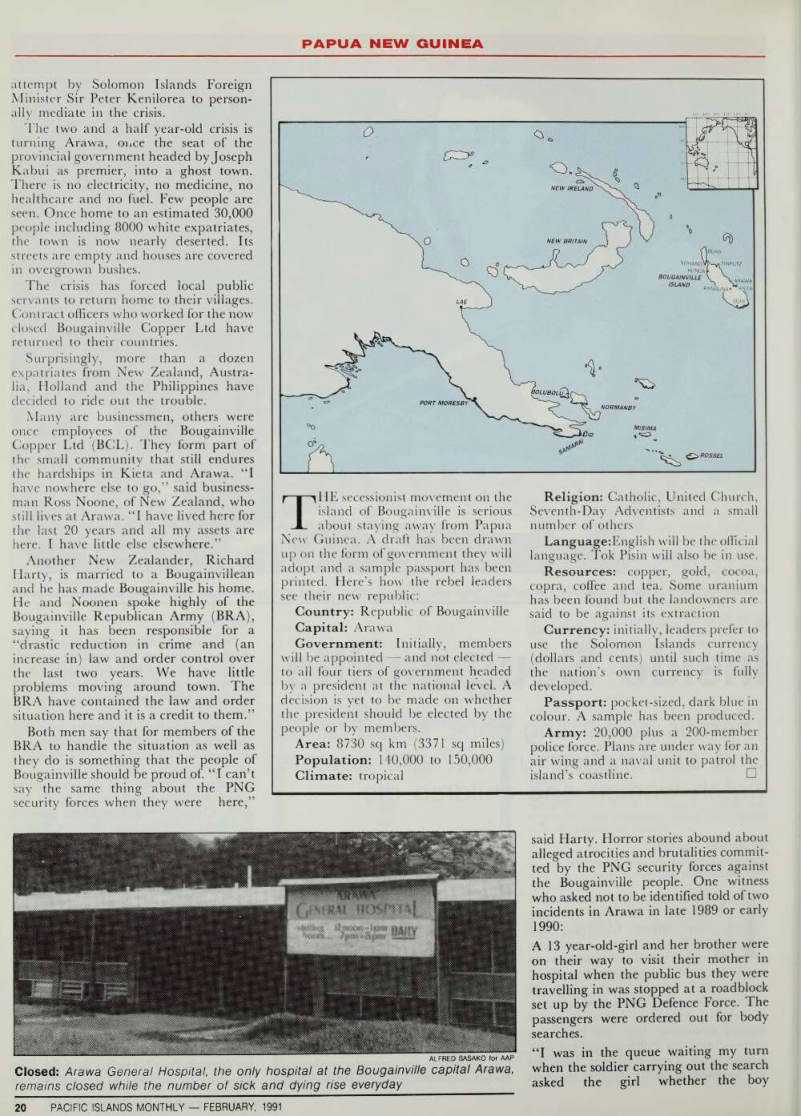
Closed: Arawa General Hospital, the only hospital at the Bougainville capital Arawa. remains closed while the number of sick and dying rise everyday
accompanying her was a relative,” the witness said. “When she said he was her brother, the girl was ordered to strip and then her brother was ordered at gunpoint to fondle her breast and to touch her all over.”
The second incident, the witness said, involved a young mother who was on her way to the shop when members of the security forces ordered her out of the car she was driving. The witness said the woman was ordered at gunpoint to take off all her clothes including her panties and the all-male soldiers did a body search on her.
The crisis which has so far cost more than 200 lives on both sides seems destined to linger as the stalemate between Port Moresby and Bougainville leaders continues. Among things agreed upon during peace talks abord the New Zealand naval ship Endeavour last August was the restoration of all essential services to Bougainville and that the BRA be responsible for law and order. The peace agreement, called the Endeavor Accords, stipulates that “such restoration of services would be done without force”. It said: “The return of services, particularly health, education and communications are accepted as a matter of urgent priority.” But a few days after the agreement was signed, PNG sent back 400 troops to Buka Island on the northern tip of Bougainville.
Francis Ona, the rebellion leader who is now Supreme Commander and Presi dent of the self-declared republic, said future peace talks must involve Father John Momis, the Provincial Affairs Minister who represents Bougainville in Parliament. “We want to talk with Father Momis, not with (Foreign Minis ter) Sir Michael Somare and (Justice Minister) Bernard Narokobi (who rep resented the PNG Government at the Endeavor peace talks last August),” Ona said. “There’s no trust anymore.”
Port Moresby insisted that the security forces were sent back to Buka at the request of the majority of the Island’s 40,000 population. Official documents show, however, that the petition request ing the return of the troops carried only
125 signatures.
According to Ona in an interview on December 27 at the Panguna minesite, just outside Arawa, Bougainville’s desire for independence isn’t new. The seed of dissent, Ona said, was sown in 1899 when the Convention and Declaration Treaty between Great Britain and Germany for the settlement of the Samoan and other
Questions, including Bougainville, was
signed in London on November 14 that year. The Treaty which sealed Bougain ville’s integration with PNG was ratified and exchanged in London and Berlin on February 16, 1900. “This was done without consulting the local people,” he
said. “Our people were forced into the situation and generations after gener ations grew up only to accept the status quo. But I think the thinking has
changed.”
For Bougainvilleans, the question of independence has been simmering since the London-Berlin treaty. It surfaced prior to PNG gaining independence from Australia in September 1975. “We in fact declared our unilateral independence at least 17 days before PNG’s indepen dence, but this was ignored by the Australian administration,” Ona said.
“Today, there is no turning back.”
According to Ona, his interim govern ment has set up a 200-member police force and an army with 20,000 members.
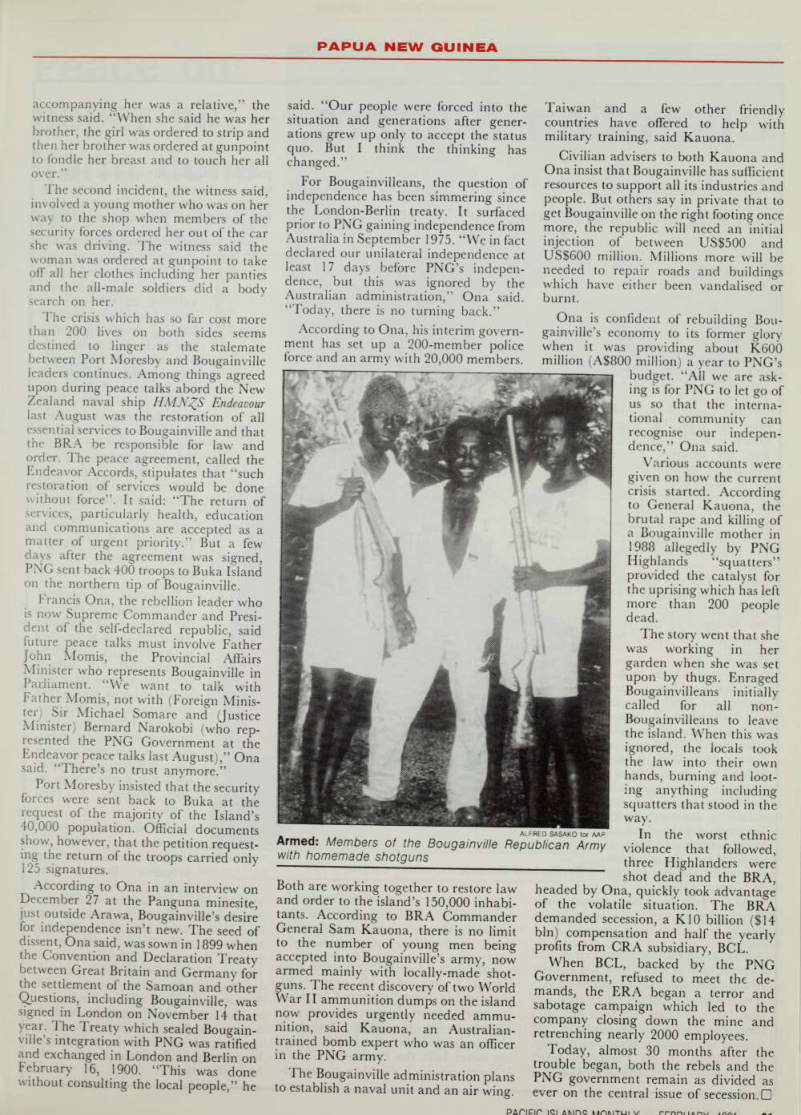
Both are working together to restore law and order to the island’s 150,000 inhabi tants. According to BRA Commander General Sam Kauona, there is no limit to the number of young men being accepted into Bougainville’s army, now armed mainly with locally-made shot guns. The recent discovery of two World War II ammunition dumps on the island now provides urgently needed ammu nition, said Kauona, an Australian trained bomb expert who was an officer in the PNG army.
The Bougainville administration plans
to establish a naval unit and an air wing.
Taiwan and a few other friendly countries have offered to help with
military training, said Kauona.
Civilian advisers to both Kauona and Ona insist that Bougainville has sufficient resources to support all its industries and people. But others say in private that to get Bougainville on the right footing once more, the republic will need an initial injection of between USSSOO and USS6OO million. Millions more will be needed to repair roads and buildings which have either been vandalised or burnt.
Ona is confident of rebuilding Bou gainville’s economy to its former glory when it was providing about K6OO million (ASBOO million) a year to PNG’s
budget. “All we are ask ing is for PNG to let go of us so that the interna tional community can recognise our indepen dence,” Ona said.
Various accounts were given on how the current crisis started. According to General Kauona, the brutal rape and killing of a Bougainville mother in 1988 allegedly by PNG Highlands “squatters” provided the catalyst for the uprising which has left more than 200 people dead.
The story went that she was working in her garden when she was set
upon by thugs. Enraged
Bougainvilleans initially called for all non- Bougainvilleans to leave the island. When this was ignored, the locals took the law into their own hands, burning and loot ing anything including squatters that stood in the way.
In the worst ethnic violence that followed, three Highlanders were shot dead and the BRA,
headed by Ona, quickly took advantage of the volatile situation. The BRA demanded secession, a KlO billion (SI4 bln) compensation and half the yearly profits from CRA subsidiary, BCL.
When BCL, backed by the PNG Government, refused to meet the de mands, the ERA began a terror and sabotage campaign which led to the company closing down the mine and retrenching nearly 2000 employees.
Today, almost 30 months after the trouble began, both the rebels and the PNG government remain as divided as ever on the central issue of secession. □
Alfred Sasako For Aap
Armed: Members of the Bougainville Republican Army with homemade shotguns