firing
p. 24 · Read in the full issue
In the firing line
How the wives
wait for their
men in the Gulf
WHEN Corporal
Jonasa Vueti flew out of Fiji on November 27 he was part of the last lift of soldiers for the year, who would serve in Lebanon with the United Nations peacekeeping force. He had
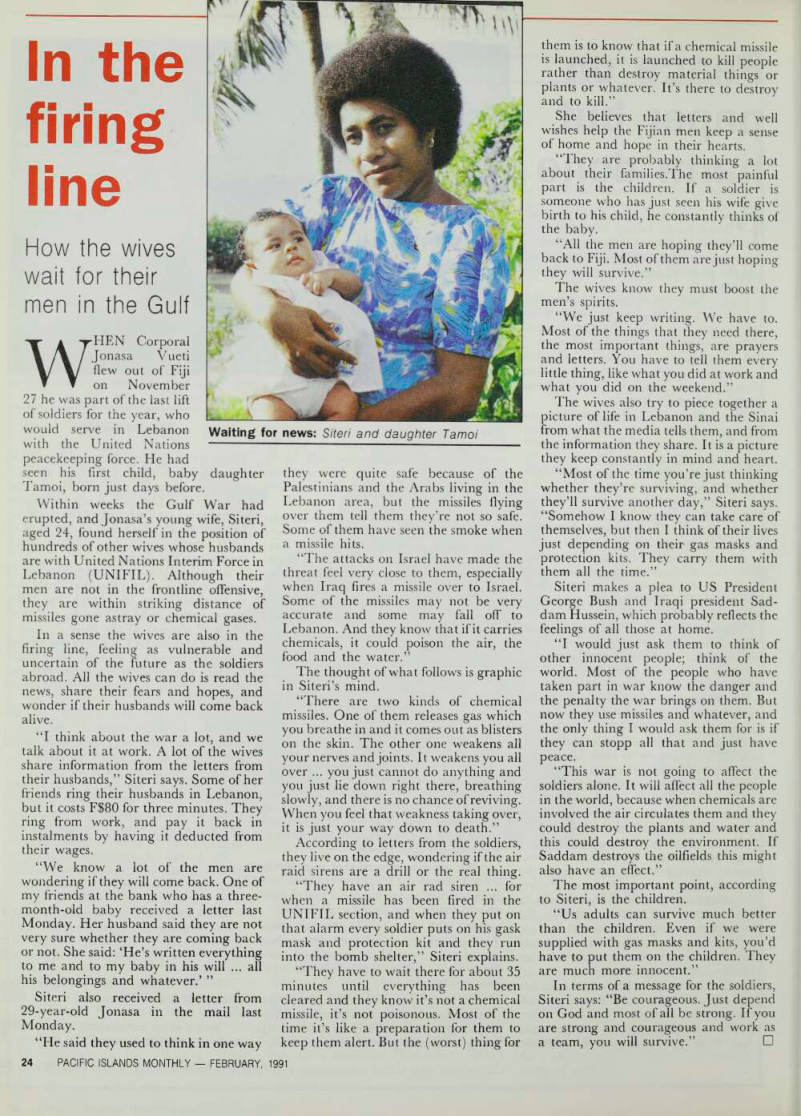
seen his first child, baby daughter Tamoi, born just days before.
Within weeks the Gulf War had erupted, and Jonasa’s young wife, Siteri, aged 24, found herself in the position of hundreds of other wives whose husbands are with United Nations Interim Force in
Lebanon (UNIFIL). Although their
men are not in the frontline offensive, they are within striking distance of missiles gone astray or chemical gases.
In a sense the wives are also in the firing line, feeling as vulnerable and uncertain of the future as the soldiers abroad. All the wives can do is read the news, share their fears and hopes, and wonder if their husbands will come back aFve t<T .. i u u , , 1I think about the war a lot and we talk about it at work. A lot of the wives sharc mformaoon from the letters from their husbands. Siteri says. Some of her friends ring their husbands in Lebanon, but it costs FMO for three minutes. They ring from work, and pay it back in thSr wa"es V " g eir wages.
We know a lot of the men are wondering if they will come back. One of my ftj en ds at the bank who has a threemonth-old baby received a letter last Monday. Her husband said they are not very sure whether they are coming back or not. She said: He s written everything to me and to my baby in his will ... all his belongings and whatever.
Siteri also received a letter from 29-year-old Jonasa in the mail last
Monday.
“He said they used to think in one way
they were quite safe because of the Palestinians and the Arabs living in the Lebanon area, but the missiles flying over them tell them they’re not so safe.
Some of them have seen the smoke when a missile hits.
“The attacks on Israel have made the threat feel very close to them, especially when Iraq fires a missile over to Israel.
Some of the missiles may not be very accurate and some may fall off to Lebanon. And they know that if it carries chemicals, it could poison the air, the food and the water.”
The thought of what follows is graphic in Siteri’s mind.
“There are two kinds of chemical missiles. One of them releases gas which you breathe in and it comes out as blisters on the skin. The other one weakens all your nerves and joints. It weakens you all over ... you just cannot do anything and you just lie down right there, breathing slowly, and there is no chance of reviving.
When you feel that weakness taking over, it is just your way down to death.”
According to letters from the soldiers, they live on the edge, wondering if the air raid sirens are a drill or the real thing.
“They have an air rad siren ... for when a missile has been fired in the UNI FI L section, and when they put on that alarm every soldier puts on his gask mask and protection kit and they run into the bomb shelter,” Siteri explains.
“They have to wait there for about 35 minutes until everything has been cleared and they know it’s not a chemical missile, it’s not poisonous. Most of the time it’s like a preparation for them to keep them alert. But the (worst) thing for
them is to know that if a chemical missile is launched, it is launched to kill people rather than destroy material things or plants or whatever. It’s there to destroy and to kill.”
She believes that letters and well wishes help the Fijian men keep a sense of home and hope in their hearts.
“They are probably thinking a lot about their families. The most painful part is the children. If a soldier is someone who has just seen his wife give birth to his child, he constantly thinks of
the baby.
“All the men are hoping they’ll come back to Fiji. Most of them are just hoping they will survive.”
The wives know they must boost the men’s spirits.
“We just keep writing. We have to.
Most of the things that they need there, the most important things, are prayers and letters. You have to tell them every little thing, like what you did at work and what you did on the weekend.”
The wives also try to piece together a picture of life in Lebanon and the Sinai from what the media tells them, and from the information they share. It is a picture they keep constantly in mind and heart.
“Most of the time you’re just thinking whether they’re surviving, and whether they’ll survive another day,” Sited says.
“Somehow I know they can take care of themselves, but then I think of their lives just depending on their gas masks and protection kits. They carry them with them all the time.”
Sited makes a plea to US President George Bush and Iraqi president Sad dam Hussein, which probably reflects the feelings of all those at home.
“I would just ask them to think of other innocent people; think of the world. Most of the people who have taken part in war know the danger and the penalty the war brings on them. But now they use missiles and whatever, and the only thing I would ask them for is if they can stopp all that and just have peace.
“This war is not going to affect the soldiers alone. It will affect all the people in the world, because when chemicals are involved the air circulates them and they could destroy the plants and water and this could destroy the environment. If Saddam destroys the oilfields this might also have an effect.”
The most important point, according to Siteri, is the children.
“Us adults can survive much better than the children. Even if we were supplied with gas masks and kits, you’d have to put them on the children. They are much more innocent.”
In terms of a message for the soldiers, Siteri says: “Be courageous. Just depend on God and most of all be strong. If you are strong and courageous and work as a team, you will survive.” □
Waiting for news: Siteri and daughter Tamoi