Pacific
pp. 31-33 · Read in the full issue

Islands
Monthly
Business
It's the end to the road for some
1990 was alright for the Pacific as a whole, but future fortunes will be sharply divided
By Robin Bromby
GIVEN that the pacific island nations have so much stacked against their aspirations for economic development, 1990 was not such a bad year. Fiji continued its recovery and is building a viable indus trial sector, which adds a new dimension to an economy once reliant on sugar and tourism.
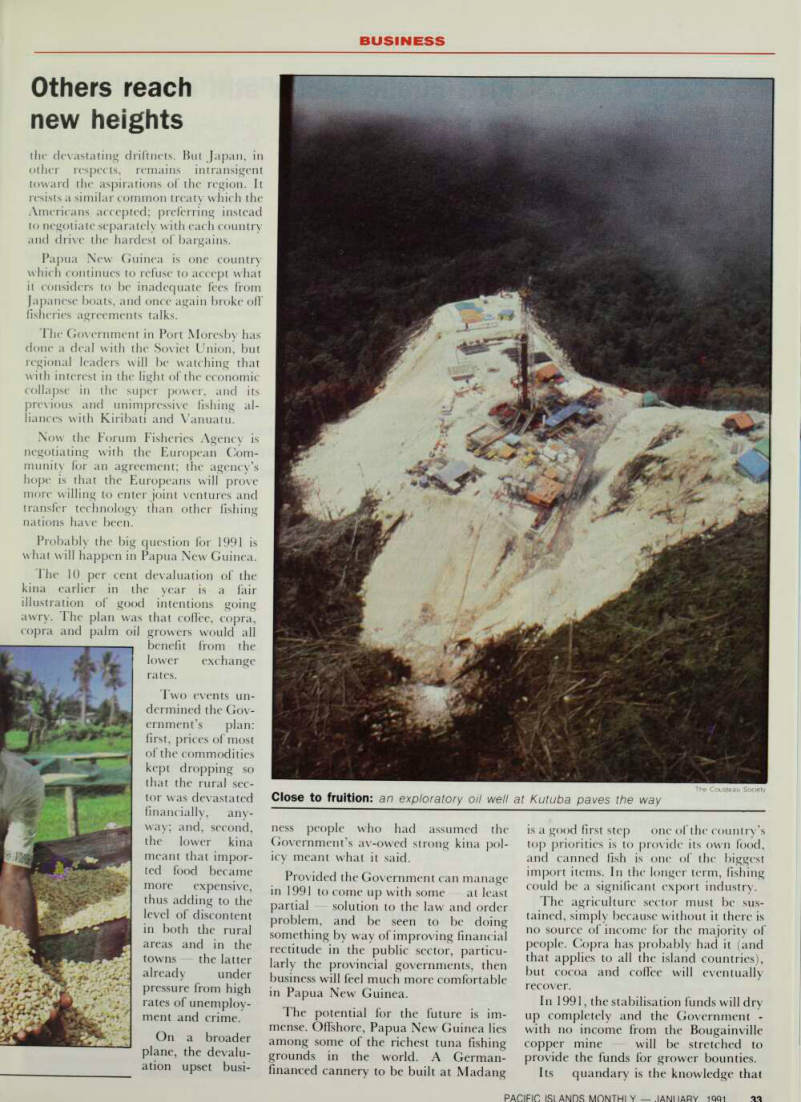
Papua New Guinea which is looking more and more like a fragile national union survived disastrous crop prices and the continued closure of its huge copper mine at Panguna, and ended the year with Porgera and Misima mines a reality and the Kutubu oil project about to become so.
On the regional scene, it looked as if driftnet fishing was becoming a thing of the past, and real progress was made in negotiations over a fishing agreement with the European Community.
Polynesian Airlines made a historic breakthrough by winning fifth freedom rights on the busy Auckland-Sydney air route, breaking out of the bind of having only low-profit routes which has ham pered the small airlines of the islands.
Tourism kept on growing especially in Micronesia where it is assuming boom proportions.
The problem, though, is that there is a continually widening gap between the nations which have economic potential and those which do not.
Fiji has its tourism and, now, a growing industrial workforce. Papua
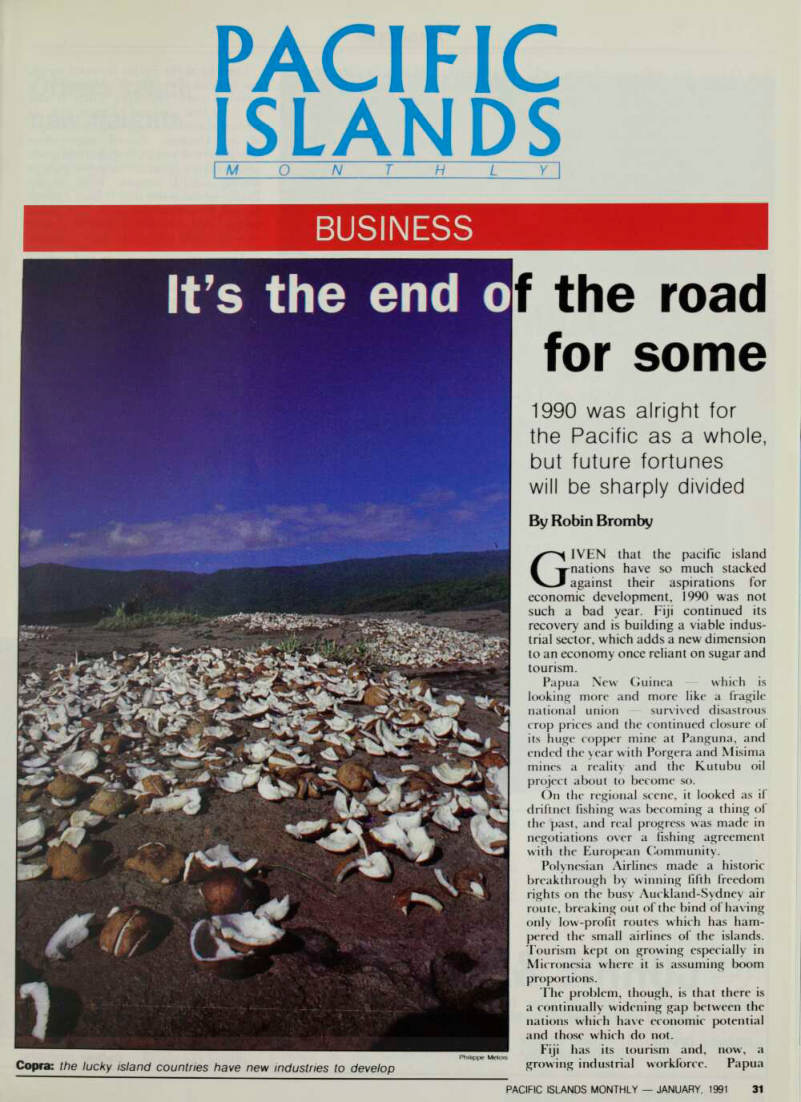
Philippe Metois Copra: the lucky island countries have new industries to develop
New Guinea has sufficient mineral and oil wealth to outweigh the doubts generated by law and order problems and unreliable politicians.
Then there are the medium-sized (in South Pacific terms) states, which muddle through. Tonga has a handful of small industries now exporting, and has managed to attract Asian investment.
Hie Solomon Islands has a growing fishing industry and considerable timber resources. Vanuatu and the Cook Islands have financial centres and tourism.
But for the others, economic develop-
ment seems as illusory as ever. Western Samoa has its own financial centre, but little else happened of economic signifi cance in 1990 (apart from Cyclone Ofa which caused extensive damage). Kiri ath Niue and Tuvalu are no less dependent on aid.
The countries which are spread over vast areas of ocean also sufFer from expensive internal transport. Kiribati aild the Cook Islands will be helped by a new telecommunications system, but essentia i infrastructure will continue to be contingent upon foreign aid.
Looking at the Pacific in world terms, the outlook for 1991 is clouded by a looming world recession. There is also the very real prospect of more difficult trading conditions following the collapse of the Uruguay Round negotiations which were aimed at freeing world trade and breaking down protectionist policies among GATT nations. Most of the Pacific island states find it hard enough to sell their products as it is: either a world trade recession or greater protec tionism would just add to their problems.
More particularly, a very real worry is that the state of the Australian and New Zealand economies the dominant trade partners for most of the Pacific islands. New Zealand is, for all intents and purposes, engulfed in a fully-fledged depression with nil growth. Australia is not so badly off, but its recession and rate of business failure will ensure a flat economy for most of 1991, perhaps even beyond. The effects of economic slump in those two countries will cause a ripple effect through the islands.
Fiji’s booming garment industry is
heavily dependent on exports to Austra lia and New Zealand. Pacific companies exporting to those countries will also have to reckon in 1991 with the determination both in Wellington and Canberra to reduce their tariff barriers across the board, a move which will lessen the advantage the Forum states have under existing treaties which often give them duty- and quota-free entry to Australia and New Zealand.
One valuable resource common to the
South Pacific re gion is the ocean and its living wealth.
There is no question that the region has made
significant steps
toward reaping a greater reward from fisheries, but there is still a long way to go. The United States tuna fleet seems to have come to terms with its (reluctant) commitment to pay fees to the states in whose ex clusive economic zones they fish, and the Asian dis tant water fishing
nations (Japan,
South Korea and Taiwan) have bowed to pressure against the use of
Philippe Metois Coffee: promising