pearls of
pp. 24-30 · Read in the full issue
Precious pearls of Polynesia
By Helen Averley
IN MAEVA school the youngest sight. In the plane, eager eyes scoaHhe seascape. The twin islands of Huahine Nui and Huahine Iti, which are joined only by a bridgeware jewel-like. Together
they are ringed by low coral islands {motu), fringed with silver sand, set in brilliant turquoise shallows, laced with foaming surf and mounted on the lapis lazuli blue of the deep Pacific.
The little people, skipping and scream as it comes in low over the lagoon. I can see their village, themed tinroof and spire organ pipe coral on a reef. Faintly I can §
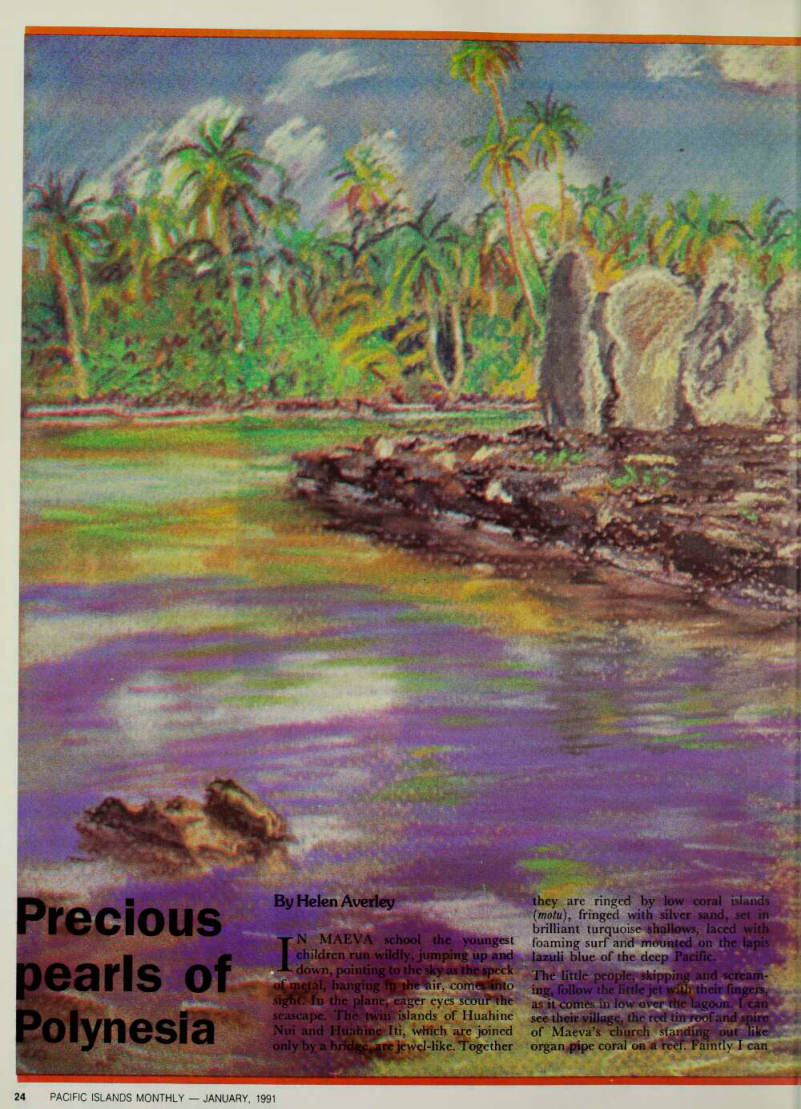
make oul the zig sagging of the stone walled (ish traps in the neck of the Jpgoon. It is low tide. The
js.it plays with us.
*f ; JPhesc stones, the volcanic rubble on rough hillsides, first witnessed the arrival ol canoes from the Marquesas on Huahine. The inafflthands of these people Motfilt the stones into shrines for ( and Hiro. The stones were importof the gods’
f others vplaccd memorial some worked as fish traps. acrojir#!e lagoons; safe Marae, and wenyprivy-to <j}l the rd|p«us ancl eivic decisions. neurone is of the smr®/, * **' '£bf lstones slently%bsorbed poured apS watched the , p«*sfsle "begin to.change, to lose touch \yilff their "past; some fled ta the then urtknown of New Zealand- TJ^
Helen Averley is born artlst/lllustrator frpm
NorthejxuketerW.
visiteoTl'ench the article and r illustrations are her inspired
respoiafl| to two spe^^K^nds.
Marae Fare Miro, by Irish artist Helen Averley: inspired by her visit to the Huahine islands
stones, almost forgotten, were lost in smothering vegetation. One Marae lay consumed by the roots of a huge banyan.
People remembered them in their times of distress and ran to them, wetting the stones with their tears.
W c drop down towards the reef, flashing past the shiny red fire engine, which, no longer needed, drives off to fill the water tanks on the small dry coral mo/ns. The main town of Fare has a half dozen shops, packed with French imports chocolate biscuits, condensed milk in
tubes, bottled water and colourful school books.
In the morning you can sit outside the mobile Patisserie, enjoying coffee and croissants while the town busies itself about the few vegetable stalls selling coconut milk and bags of kidney-shaped Mape. “Le Truck”, (the local bus), fills gradually with its first load of passengers, while a young man waters a hank offish hanging from the tree near the two telephone boxes. They glisten.
On a Saturday afternoon Fare is a ghost town save for the man seated outside the hotel. Eventually, the Chin ese shop opens, and the whole island seems to enter, emerging, each with two long loaves.
The nights in Fare are loud. The geckoes quarrel, eating each others’ tails; the cats prowl after the mice and rats
which thump warnings on the ceiling.
Clicking land crabs scurry on concrete floors. Crickets and dogs add to the chorus and, when the ferry is in port, the night becomes louder with busy attend ant trucks. The ferry pipes a few quick blasts on the horn and, clanking, pulls out. A brief silence ends with the coughing of the Chinese man making dough for the next day’s bread.
Dawn comes with the cockerels, earlier on a Sunday when the market must be finished by 7am, well before church.
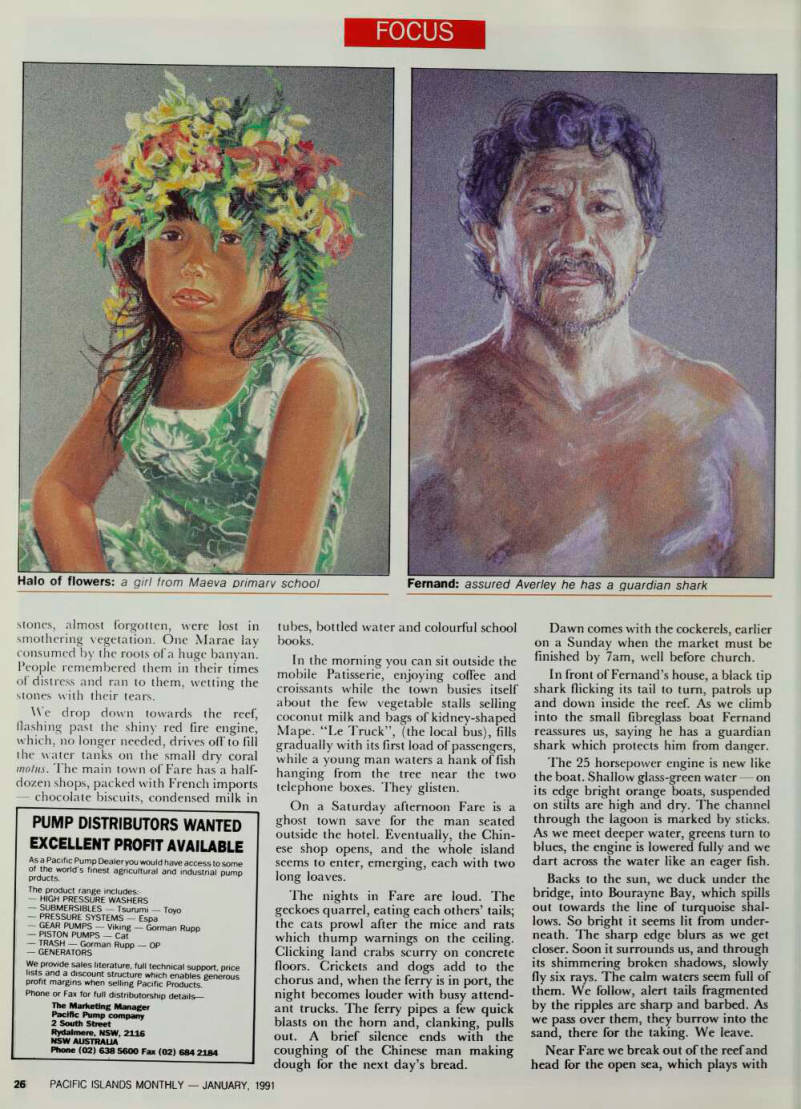
In front of Fernand’s house, a black tip shark flicking its tail to turn, patrols up and down inside the reef. As we climb into the small fibreglass boat Fernand reassures us, saying he has a guardian shark which protects him from danger.
The 25 horsepower engine is new like the boat. Shallow glass-green water on its edge bright orange boats, suspended on stilts are high and dry. The channel through the lagoon is marked by sticks.
As we meet deeper water, greens turn to blues, the engine is lowered fully and we dart across the water like an eager fish.
Backs to the sun, we duck under the bridge, into Bourayne Bay, which spills out towards the line of turquoise shal lows. So bright it seems lit from under neath. The sharp edge blurs as we get closer. Soon it surrounds us, and through its shimmering broken shadows, slowly fly six rays. The calm waters seem full of them. We follow, alert tails fragmented by the ripples are sharp and barbed. As we pass over them, they burrow into the sand, there for the taking. We leave.
Near Fare we break out of the reef and head for the open sea, which plays with
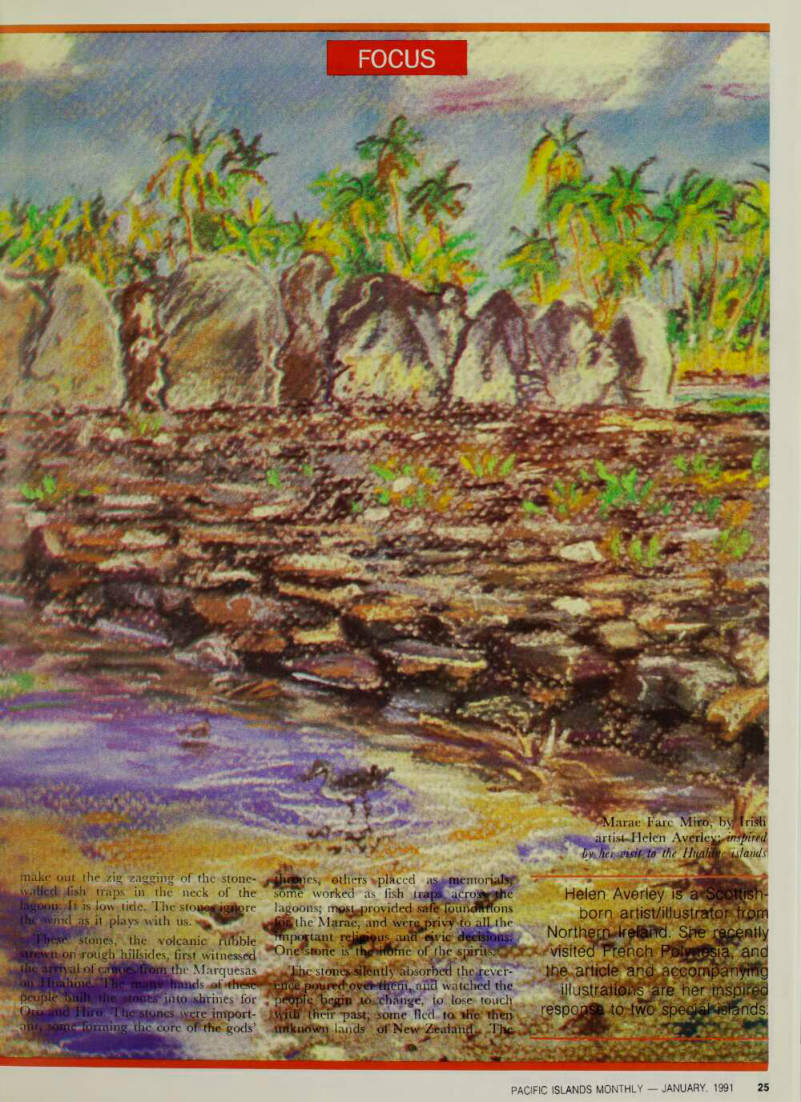
Halo of flowers: a girl from Maeva primary school
Fernand: assured Averley he has a guardian shark
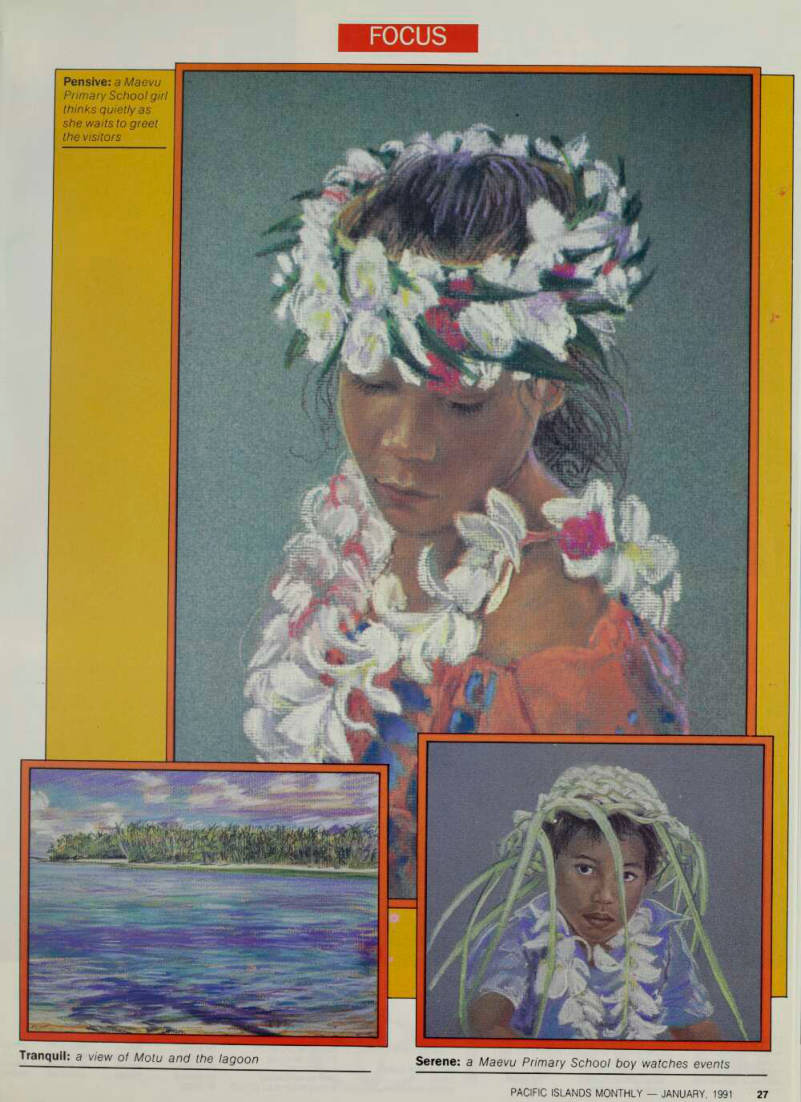
Pensive: a Maevu Primary School girl thinks quietly as she waits to greet the visitors
Tranquil: a view of Motu and the lagoon
Serene: a Maevu Primary School boy watches events
our little boat. 1 he hull crashes down on the harsh slate-grey face of the waves as they come towards us.
Turned towards the shore they show their other face, benign and blue. They push on to quench long beaches, which scream white like bleached bones. They ever reach them. Desperately they dash themselves against the reef, and echo white against the backdrop of dark hills.
We shock whole squadrons of flying fish out of the water, the tail-end-charlies forever trying to catch the flock. A brief glimpse of green as a turtle takes a sip of air and dives. We arc joined by a school of dolphins, who come to tease us, to play hide and seek in the waves, like silent film stars in (he distance. We catch up, but they are fickle. We’re left, our necks straining after them.
We turn full circle, the little boat surfs.
The huge wall of water racing behind pushes us into the lagoon, "and the soothing, sedate calm waters rest us.
It is the “International Day of the 1 ourist”, and the Maeva primary school has been preparing to entertain the tourists from one of the posh hotels. The children sit on the edge of their seats,
waiting.
Unsuspectingly, while looking for the path to the ancient stones, we catch a glimpse of little heads wearing flower tiaras. We take a second look, and are beckoned to by a teacher. As we enter,
a cascade of flower fairies pour out of the classroom jumping around. Pushed back into the classroom, singing, they watch as the two tourists pass. We stare back.
In the assembly hall, the youngest children break free from the mat they’ve been tidily sitting on. Flowers every where. They catch the drone of another plane coming on the wind. They begin to rush about pointing to the sky.
Gradually the hall fills, the children growing in size, as each class swells the bouquet. We sit on the benches and watch.
Magic. The excitement is wild and brims over. The children are uncontain able and run like confetti caught in a
whirlwind. Singing, laughing, blowing
whistles on plucked petals, grinning at our cameras. There is no sign of their other guests, and before it gets too much for them they are calmed down, their pareus fixed by the teachers, and like a flock of birds of paradise the children settle and adjust themselves.
They begin to sing, just for us.
Breathless six year olds, mouthing exageratedly, the older girls fiddling with each others’ hair, the boys throwing up clouds of petals. The older ones dance, the girls shaking their hips, whilst the boys clap their knees together.
Suddenly it is over, and our appreci ation seems all too inadequate. The children then place flowers over our heads, a tidal wave engulfs us, thousands of flowers. A heady bouquet of frangipangi, tiare de Tahiti, mingled with wild basil and fern, we’re almost drowned in blossom. The children disap pear, and in their wake, as a receding tide leaves shells, they leave petals precious as pearls. □
Sylviane: a study by Averley