Living in someone else’s rubbish
p. 23 · Read in the full issue
WHEN a Greenpeace environ mental team entered a second time into the 12-mile exclusion zone around France’s nuclear test site at Moruroa Atoll just a fortnight before Christmas the fireworks began. Taking plankton samples right under the noses of French authorities was just too much.
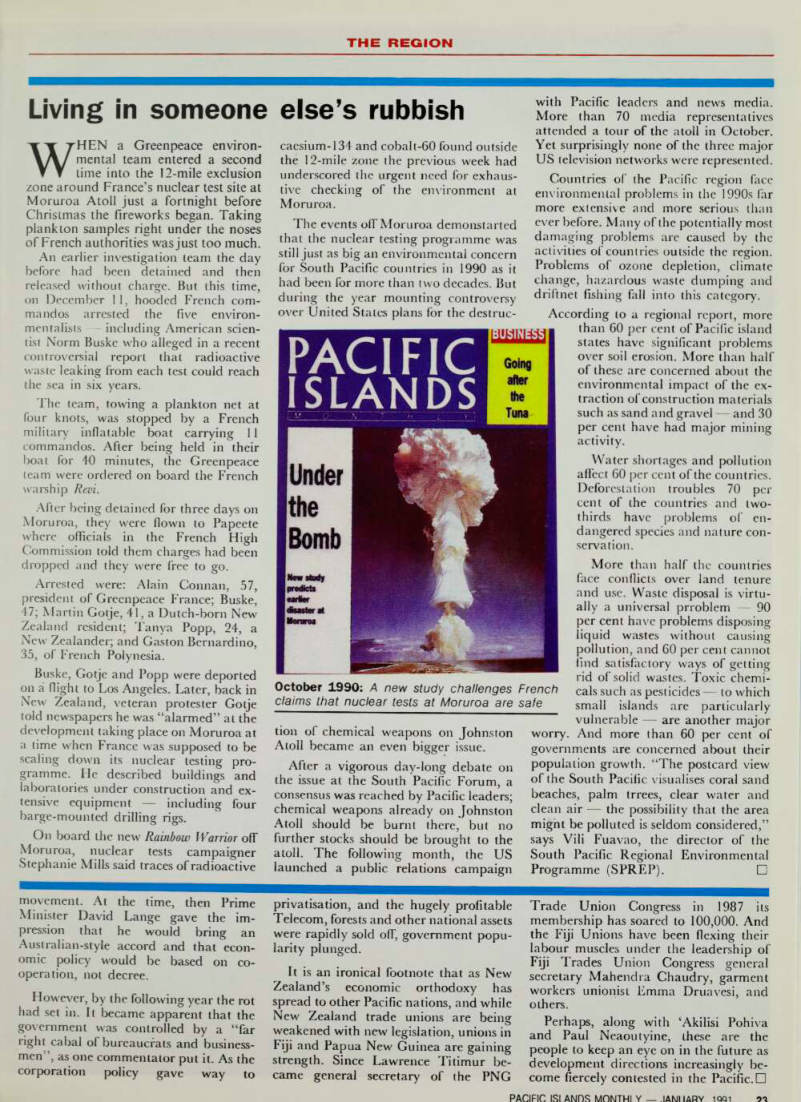
An earlier investigation team the day before had been detained and then released without charge. But this time, on December 11, hooded French com mandos arrested the five environ mentalists including American scien tist Norm Buske who alleged in a recent controversial report that radioactive waste leaking from each test could reach the sea in six years.
The team, towing a plankton net at four knots, was stopped by a French military inflatable boat carrying 11 commandos. After being held in their boat for 40 minutes, the Greenpeace team were ordered on board the French warship Rem.
After being detained for three days on Moruroa, they were flown to Papeete where officials in the French High Commission told them charges had been dropped and they were free to go.
Arrested were: Alain Connan, 57, president of Greenpeace France; Buske, 47; Martin Gotje, 41, a Dutch-born New Zealand resident; Tanya Popp, 24, a New Zealander; and Gaston Bernardino, 35, of French Polynesia.
Buske, Gotje and Popp were deported on a flight to Los Angeles. Later, back in New Zealand, veteran protester Gotje told newspapers he was “alarmed” at the development taking place on Moruroa at a time when France was supposed to be scaling down its nuclear testing pro gramme. He described buildings and laboratories under construction and ex tensive equipment including four
barge-mounted drilling rigs.
On board the new Rainbow Warrior off Moruroa, nuclear tests campaigner Stephanie Mills said traces of radioactive
caesium-134 and cobalt-60 found outside the 12-mile zone the previous week had underscored the urgent need for exhaus tive checking of the environment at Moruroa, The events off Moruroa demonstarted that the nuclear testing programme was still just as big an environmental concern for South Pacific countries in 1990 as it had been for more than two decades. But during the year mounting controversy over United States plans for the destruc-
tion of chemical weapons on Johnston Atoll became an even bigger issue.
After a vigorous day-long debate on the issue at the South Pacific Forum, a consensus was reached by Pacific leaders; chemical weapons already on Johnston Atoll should be burnt there, but no further stocks should be brought to the atoll. The following month, the US launched a public relations campaign
with Pacific leaders and news media.
More than 70 media representatives attended a tour of the atoll in October.
Yet surprisingly none of the three major US television networks were represented.
Countries of the Pacific region face environmental problems in the 1990 s far more extensive and more serious than ever before. Many of the potentially most damaging problems are caused by the activities of countries outside the region.
Problems of ozone depletion, climate change, hazardous waste dumping and driftnet fishing fall into this category.
According to a regional report, more
than 60 per cent of Pacific island states have significant problems over soil erosion. More than half of these are concerned about the environmental impact of the ex traction of construction materials such as sand and gravel - and 30 per cent have had major mining
activity.
Water shortages and pollution
affect 60 per cent of the countries.
Deforestation troubles 70 per cent of the countries and two thirds have problems of en dangered species and nature con servation.
More than half the countries face conflicts over land tenure and use. Waste disposal is virtu ally a universal prroblem 90 per cent have problems disposing
liquid wastes without causing
pollution, and 60 per cent cannot find satisfactory ways of getting rid of solid wastes. Toxic chemi cals such as pesticides to which small islands are particularly vulnerable are another major
worry. And more than 60 per cent of governments are concerned about their population growth. “The postcard view of the South Pacific visualises coral sand beaches, palm trrees, clear water and clean air the possibility that the area might be polluted is seldom considered,” says Vili Fuavao, the director of the South Pacific Regional Environmental Programme (SPREP). □
October 1990: A new study challenges French claims that nuclear tests at Moruroa are safe