The year of survival
pp. 20-23 · Read in the full issue
The Region
In Fiji and Bougainville, the political problems of 1989 remained unresolved
By David Robie
THE New Year began with the Gulf crisis perilously close to war.
“Aftershocks” from the economic and political upheavals in Eastern Eur ope continued unabated during 1990, and the debt burden strangled a growing number of Third World nations.
IN the South Pacific, the two major political and economic issues that cast a shadow over the region at the start of 1990 Fiji and Bougainville were still there at the beginning of 1991, posing uncertainties for the future. And
political debate raged about the legit
imacy of democratic integrity of other governments.
In the Solomon Islands, for example, beleagured Prime Minister Solomon Mamaloni deftly saved his political skin
by declaring himself “independent”,
sacking his ruling party and appointing
a coalition government. But it was a disturbing reflection of the growing chaos and volatility in the political systems of both Papua New Guinea and Solomon Islands.
Australian Prime Minister Bob Hawke survived in office when the country went to the polls, but became increasingly unpopular in several island states. His Labour counterparts were dumped in New Zealand in the biggest election defeat of a government since the 19305.
Yet even though the new National government won 70 per cent of the seats, it gained only 48 per cent of the vote.
A fragile coalition in French Polynesia nervously ponders the territorial elec tions in March, Vanuatu’s democracy will be severely tested at the next ballot,
Western Samoa faces an uncertain election, and there is specu lation on whether the interim government
in Fiji will spring an early ballot under the post-coup constitution.
Aid from France and Japan, in particular, is becoming an increasingly vital and controversial factor in develop ment for the region. Both countries have at times been accused of “chequebook
diplomacy” or “buying silence”.
Japan’s Overseas Development Assist
ance (ODA) “tied” aid channelled through Japanese companies to the Third World has largely been used for
projects directly linked to tropical forest destruction. The money is used for construction roads, dams, port facilities, and large-scale agriculture schemes. In the Pacific, Japanese ODA and logging mainly in Papua New Guinea have
also been linked.
Japanese investors are in the lead in Fiji with the real estate and tourism sectors. Japan’s corporate giant Elec tronic Industrial Enterprises (EIE), the biggest foreign investor in Australia, is the most prominent new investor in Fiji.
From 1983 to 1987 alone, Japan in-
Ratu Mara is very clear on our thinking on their constitution ... but we’re not going there to re-write it’
creased its ODA to the Pacific from SIB million to S6B million.
French aid programmes are also rapidly expanding, particularly in the Cook Islands, Fiji and Tonga. More funds and places for foreign students are being provided at the new French University of the Pacific in Noumea and Papeete.
Ironically, while France has commit ted itself to new Pacific environmental programmes, its involvement in the
region is still overshadowed by continued use of Moruroa and Fangataufa atolls for
underground nuclear-weapons testing.
The French connection gets stronger further east across the Pacific. Cook Islanders, who have close geographic, kinship and cultural ties with their neighbouring French Polynesians have been given a series of development soft loans totalling S2O million. In Tonga, the aid has also been generous, with more than S 5 million being provided under the South Pacific Co-operation Fund.
But it is in Fiji that aid has raised most eyebrows, particularly after helicopters and 52 Renault trucks were provided for the military. Aid officials believe both
France and Japan have much to offer Pacific nations, but point out that devel opment assistance should be geared more to economic needs rather than political agendas.
However, Australia and New Zealand are also criticised for putt ing economic self interest first. Both countries are often viewed as surrogates for metropolitan influ ence. The policy re view prepared for the ousted Labour govern ment in New Zealand, Towards a Pacific Island Community , supported privatisation and in creasing foreign in vestment in the region.
This is ironical in view
of the failure of many of New Zealand’s own privatisation plans.
Although the New Zealand report was pigeonholed, parts of it are still likely to provide a framework for some New Zealand policies in the region. The recommendation, for example, for a resumption of ministerial contact with Fiji was turned down by the Labour government, but new External Relations Minister Don McKinnon has moved quickly towards establishing more cor dial relations.
McKinnon has already met Prime Minister Ratu Sir Kamisese Mara in Auckland. Now his planned visit to Fiji in late January as part of a whistlestop tour of the Pacific will be the first official stopover by any New Zealand cabinet minister since the 1987 coups.
But he has been quick to stress that the racially-weighted constitution will not be a priority item for discussion: “Ratu Mara is very clear on our thinking on
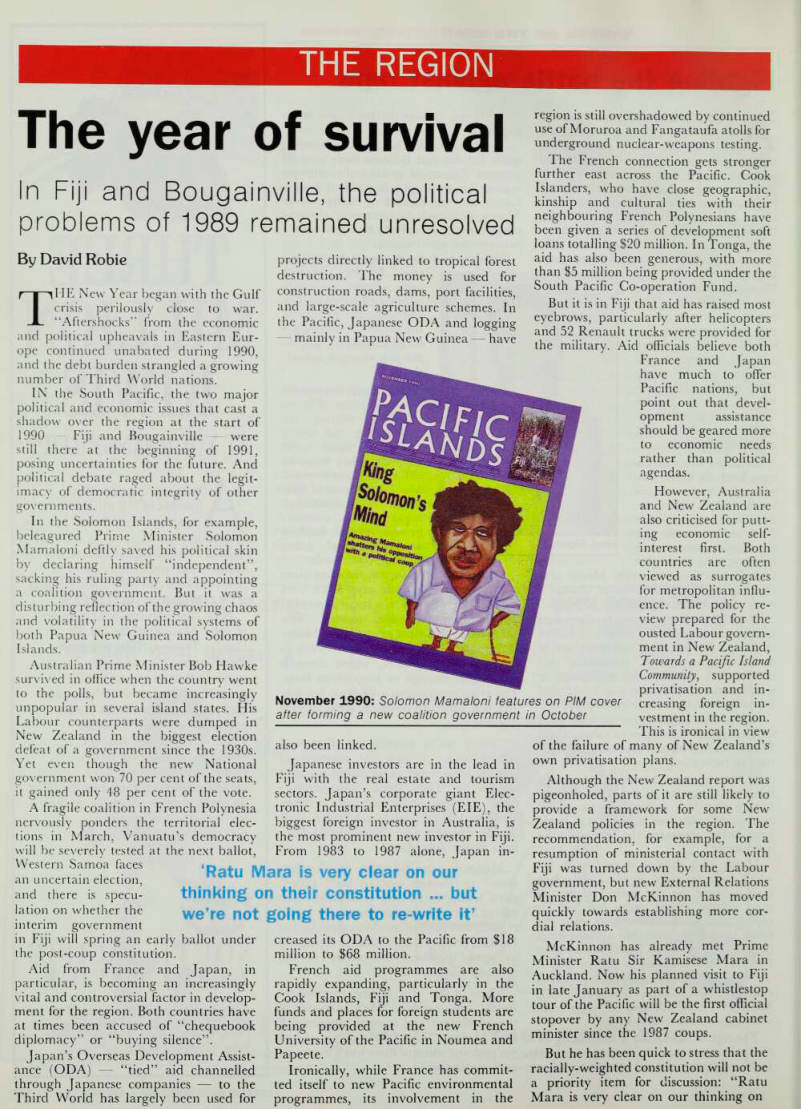
November 1990: Solomon Mamaloni features on PIM cover after forming a new coalition government in October
their constitution but we’re not going there to rewrite it!”
Along with Defence Minister Warren Cooper, McKinnon is also visiting Cook Islands, Niue, New Caledonia and Sol omon Islands.
Fiji was one of the topics scrupulously avoided by the South Pacific Forum when it met in Port Vila in August, coinciding with celebrations marking the 10th anniversary of Vanuatu’s indepen dence. While seeking traditional consen sus, Forum leaders have been reluctant to address “internal” crises even when they have vital implications for the security of the rest of the region.
As a result, issues such as Bougainville, the “restlessness” of Indonesia on the Pa pua New Guinea bor der and the contro versial sale of Tongan citizenships to Asians and other foreigners also barely got an
airing.
Ratu Sir Kamisese
pointedly excluded
both Hawke and then New Zealand Prime
Minister, Geoffrey
Palmer, from a brief ing he gave to other Forum members and snubbed a function hosted by Palmer. In the end he consented to talk, but only on condition that the content of their dis
cussion remained private.
At the opening of the decade for the eradication of colonialism, the Forum noted that most of the world’s remaining non self-governing territories are in the Pacific. It called on the United Nations to send a special envoy to each country still on the decolonisation list.
It also called on France to allow regular visits to New Caledonia by UN missions, and established a ministerial mission comprising Fiji, Nauru and the Solomon Islands to monitor events in
New Caledonia, hopefully ensuring
progress towards the vote on indepen dence in 1998.
The Forum took steps to strengthen the South Pacific Regional Environment Programme (SPREP) which took effect in August. New Zealand provided $500,000 for 1990 to help accomplish this, and is paying out a further $1 million this year. Concern over the greenhouse effect and climatic change were important, but it was the Johnston Atoll controversy which dominated, and
continues as a major issue confronting the region until mid-decade.
While the Forum was in progress, delegations from Papua New Guinea and Bougainville were trying to negotiate a durable peace in the wardroom of the New Zealand supply ship, Endeavour.
Peace was desperately wanted by both sides Foreign Minister Sir Michael Somare, Justice Minister Bernard Narokobi and senior officials for Papua New Guinea, and former North Sol omons provincial premier Joseph Kabui,
Bishop Gregory Singkai and Bougain
ville Revolutionary Army’s James Singko for the secessionists. But, in the
event, the PNG Post-Courier was too premature when it carried a banner headline proclaiming “Peace at last”.
Links with Bougainville had been cut off since May when the Port Moresby government imposed a naval blockade on the island in retaliation for the unilateral declaration of independence.
The peace accord bound the national
The Forum noted that most of the world’s remaining non self-governing territories are in the Pacific
government to re-establish health, edu cation, banking, transport and electricity services. While the most crucial long term issues such as secession and the future of the giant Panguna copper mine, controlled by the Australian mining transnational CRA Ltd, were deferred to a later unspecified date, the prospects for peace still seemed strong.
However, with the resumption of essential services on the northern island
of Buka, the Port Moresby government landed troops and riot police. Scores of people died in the fighting, and neither side trusts each other.
In Fiji, an announcement by Ratu Sir Kamisese to step down before the post coup elections has fuelled speculation about the troubled nation’s future.
Surprisingly frank, Ratu Sir Kamisese admitted in an interview in The Fiji Times that he was a controversial and
unpopular leader.
Defending his interim government’s policies of helping indigenous interests push for greater participation in the private sector, he added: “We want somebody who will unite (ethnic) In dians and (indigenous) Fijians together.”
Ratu Sir Kamisese insisted that peace and stability would be difficult to maintain without a fairer share of economic wealth for Fijians. The interim government moved to boost economic growth with fresh measures aimed at
encouraging industrial development. A
further S 5 million was made available to the Fiji Development Bank, and the
European Economic Community grant
ed Sl3 million for anew tax-free zone at Suva.
But uncertainty remained about the election planned under the new consti tution. Who would be likely to emerge as the new prime minister? While the Coalition, ousted from power in the 1987 coups, declared it would boycott any election under the constitution it rejected as discriminatory, there were signs of growing disagreement with that stance.
Widespread criticsm of the consti tution continued with the International Commission of Jurists taking up the cudgels. Justice Michael Kirby, presi dent of the Australian section of the commission, described the document as “quite as bad” as the apartheid laws of South Africa. “Those who lift their voice against that form of entrenched legal discrimination must do so against this new and completely unacceptable consti tution,” he said. “The veneer of consti
tutionalism will de ceive no one.”
Still some critics were admitting that Fiji was at least taking
steps forward democratic “normalcy” with the promulgation of the consti tution, flawed though it was said to be.
Meanwhile, democracy was taking a firmer hold on its neighbours to the east.
Western Samoa, which gained indepen dence from New Zealand in 1962, and the Kingdom of Tonga, formerly a British Protectorate, are regaarded as the most conservative of Polynesian nations.
But remarkable changes have taken place in both countries. In Western
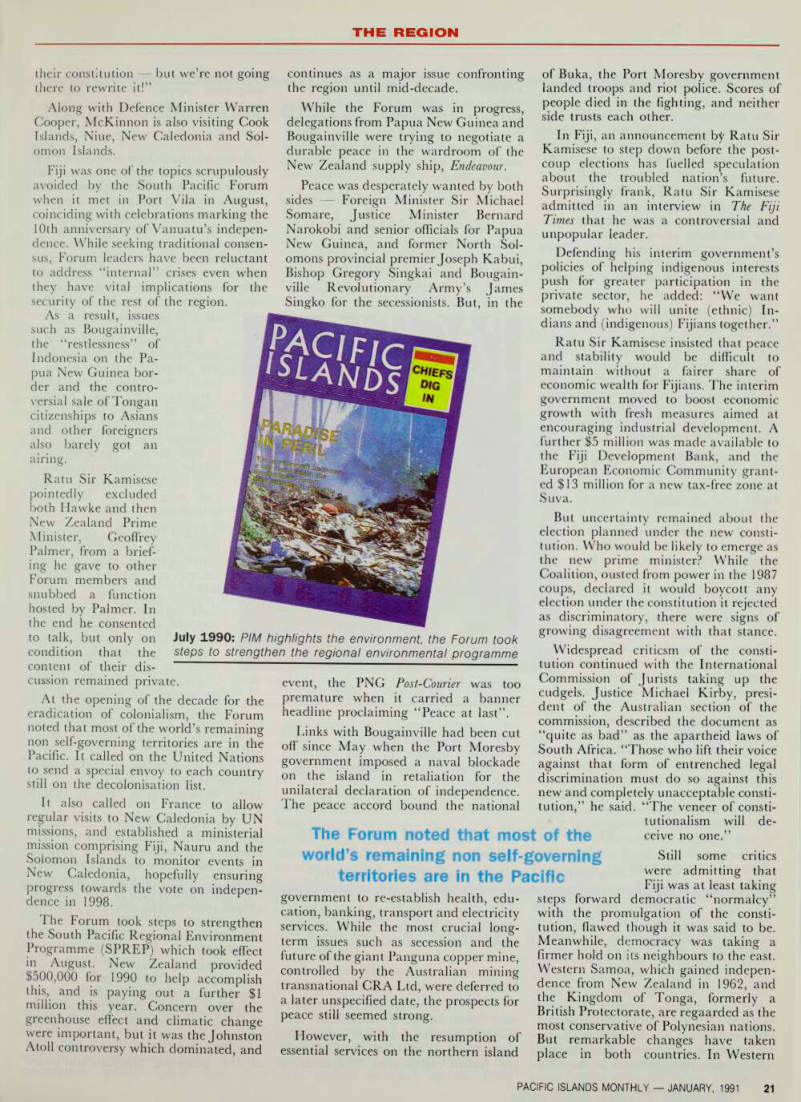
July 1990: PIM highlights the environment, the Forum took steps to strengthen the regional environmental programme
Samoa, a referendum forced by growing pressure has endorsed universal suffrage.
Until the promulgation of anew law after the historic referendum in October, voting in general elections has been restricted to the matai (traditional titlcholders or chiefs). But the mush rooming number of chiefs and titles in recent years has eroded the system.
Although only chiefs can still stand for election to the Fono (parliament), the vote has been extended to men and women aged 21 and over. Almost 53 per cent of voters supported the change, but 60 per cent voted against a proposed upper house of parliament for customary groups.
In Tonga, reformist commoner MP and news-sheet editor ‘Akilisi Pohiva is continuing to combat mounting pressure to silence him in his quest "for open
government and public accountability.
He has filed a lawsuit over accusations of corruption and unconstitutional prac tises in the sale of Tongan passports to
foreigners, mainly Asians.
Auckland-based lawyer Nalesoni Tupou believes the case could change the history of Tonga. He is confident the result will eventually lead to open government.
Pohiva caused an uproar in August when he called for replacement of the
parliamentary Speaker, 75-year-old
Malupo, a nobles representative. One noble threatened Pohiva during the angry debate, which was later struck off the parliamentary minutes.
Pohiva accused the Speaker of allow ing to overspend by 35 per cent.
Appointed by the King, Taufa’ahau Tupou IV, in 1987, Malupo rejected the accusation and said he had been trying to trim costs.
In New Caledonia the election of Paul Neaoutyine as president of the Kanak Socialist National Liberation Front (FLNKS) ended a 10-month period of limbo for the Kanak nationalists. Once the righthand man of Jean-Marie Tjibaou in the former Nothern Region
administration, perhaps
it was fitting that he should succeed the as sassinated leader to head the umbrella
Kanak independence movement.
Neaoutyine, of Palika, has the charisma and respect to heal the rifts between the dominant Caledonian Union, and the smaller partners in the FLNKS which have persisted since the 1989 assassin ations.
But he is under no illusions about the Matignon Accords. He is sceptical about whether France’s development aid pour ing into New Caledonia will really help Kanaks gain independence in the 1998
referendum. Neaoutyine remains vigil
ant for the need to change tactics: “I know some see me as a revolutionary.
I’m not renouncing my convictions, nor my militant past. But today I am obliged to represent all of the FLNKS ... We tailor our strategy to the circumstances of the struggle.”
On a remote marae in the picturesque inlet of Pawarenga, of New Zealand’s Nothland, more than 130 delegates from indigenous and people’s movements in 25 Asia-Pacific countries gathered in No vember to ponder the 19905. Campaign ing for a “Nuclear —free and indepen dent Pacific”, the delegates considered
issues ranging from foreign militry bases and “development aggression” against indigenous peoples, to waste dumping, the greenhouse effect and human rights violations.
Founded in Fiji in 1975, the Nuclear
‘ln 1940 (New Zealanders) knew where they were going, which gave them a sense of great energy and destiny’
Free and Independent Pacific (NFIP) movement’s original sights were on establishing a nuclear-free zone which evolved into the Rarotonga Treaty and curbing foreign military control. In recent years it has adopted a more hardline “indigenous agenda”.
However, through this sixth confer ence most delegates considered that being indigenous did not necessarily mean being oppressed all the time. Said one Kanak campaigner: “Exploitation
and oppression can come from the indigenous people.” And a Japanese Catholic nun, Sister Yasuko Shimuzu, added: “There are indigenous who are oppressors of their own people or tribe.”
It was on the debate on Fiji that the indigenous agenda made the strongest impact after fierce discussions a resolution was passed condemning the “racist, divisive and authoritarian” post coup constitution. “The debate on the indigenous issue,” said Rita Baua, of the Phillippines, “will go on as long as there are no sincere efforts on the part of the indigenous people’s leaders themselves to study the real political-economic situ
ation in present-day societies.”
New Zealand’s much vaunted sesquicentenary celebration year was judged by many to be a failure. According to one leading historian, Dr Jock Phillips, author of A Man’s Country , 1990 failed because New Zealanders no longer knew what to celebrate in their society. The celebration was an embarrassment compared with the 1940 centenary, which had been one of unabashed enthusiasm.
“In 1940 (New Zealanders) knew where they were going, which gave a sense of great
energy and destiny,” Phillips
said.
At the time, New Zealanders accepted a broad consensus of values. They believed, for ex ample, in a romantic image of Maoris as pioneers and warriors happily progressing towards total integration; a worship of the
pioneer spirit; confidence in ma terial progress; and an acceptance of the nuclear family with “mum at home looking after the kids”.
What has really become striking now, believes Phillips, is the focus on the Treaty of Waitangi in 1990. In 1940 it wasn’t.
“This is an expression of how signifi cant the Maori perspective on New Zealand has become,” says Phillips.
“Today we have a much more diverse society with very distinctive groups the radical Maori view of New Zealand, a small-town Pakeha view and a middle class liberal view. They have very different voices and a very different vision of what New Zealand should be.”
This was the year that the Labour government finally collapsed and was dumped in a devastating defeat in the October general election. Prime Minister Jim Bolger became the nation’s fourth leader in 14 months. When Labour had been elected in 1984 it had the support of the unionists, faminists and peace
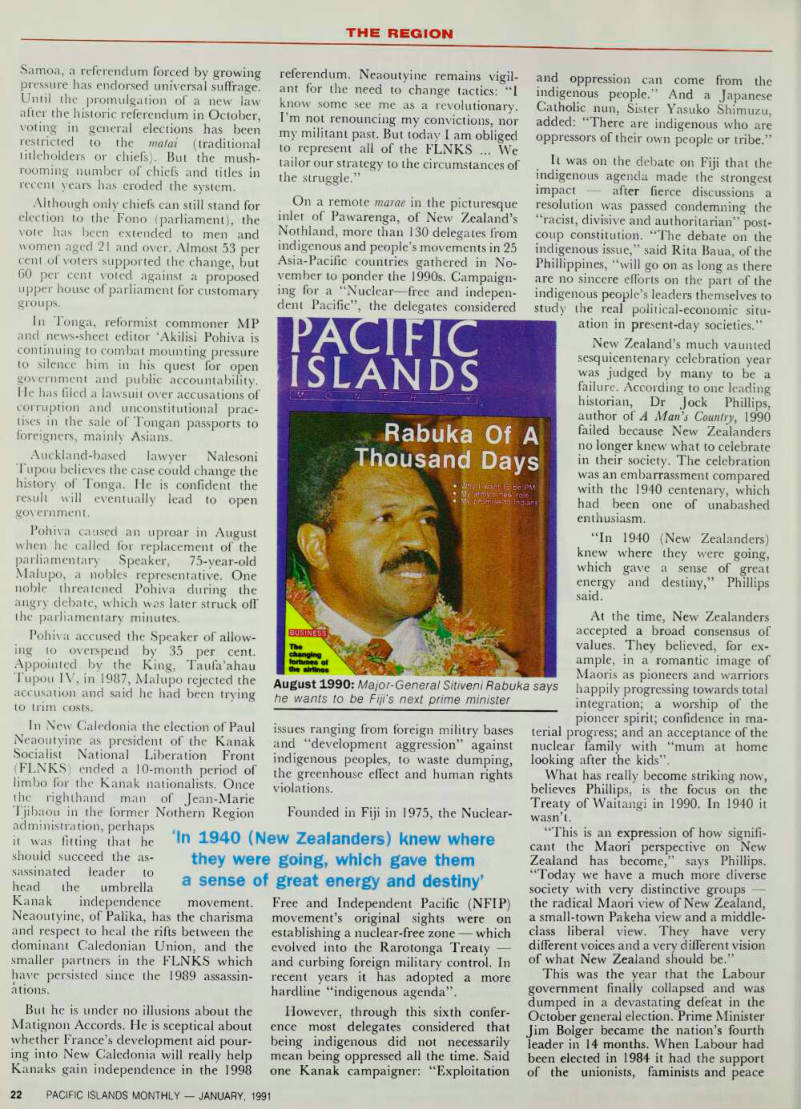
August 1990: Major-General Sitiveni Rabuka says he wants to be Fiji’s next prime minister
movement. At the time, then Prime Minister David Lange gave the im pression that he would bring an Australian-style accord and that econ omic policy would be based on co operation, not decree.
However, by the following year the rot had set in. It became apparent that the government was controlled by a “far right cabal of bureaucrats and business men ’, as one commentator put it. As the corporation policy gave way to
privatisation, and the hugely profitable Telecom, forests and other national assets were rapidly sold off, government popu larity plunged.
It is an ironical footnote that as New Zealand’s economic orthodoxy has spread to other Pacific nations, and while New Zealand trade unions are being weakened with new legislation, unions in Fiji and Papua New Guinea are gaining strength. Since Lawrence Titimur be came general secretary of the PNG
Trade Union Congress in 1987 its membership has soared to 100,000. And the Fiji Unions have been flexing their labour muscles under the leadership of
Fiji Trades Union Congress general
secretary Mahendra Chaudry, garment workers unionist Emma Druavesi, and others.
Perhaps, along with ‘Akilisi Pohiva and Paul Neaoutyine, these are the people to keep an eye on in the future as
development directions increasingly be
come fiercely contested in the Pacific. □