new heights
pp. 33-34 · Read in the full issue
Others reach new heights
the devastating driftnets. But Japan, in other respects, remains intransigent toward the aspirations of the region. It resists a similar common treaty which the Americans accepted; preferring instead to negotiate separately with each country and drive the hardest of bargains.
Papua New Guinea is one country which continues to refuse to accept what it considers to be inadequate fees from Japanese boats, and once again broke off fisheries agreements talks.
The Government in Port Moresby has done a deal with the Soviet Union, but regional leaders will be watching that with interest in the light of the economic collapse in the super power, and its previous and unimpressive fishing al liances with Kiribati and Vanuatu.
Now the Forum Fisheries Agency is negotiating with the European Com munity for an agreement; the agency’s hope is that the Europeans will prove more willing to enter joint ventures and transfer technology than other fishing nations have been.
Probably the big question for 1991 is what will happen in Papua New Guinea.
The 10 per cent devaluation of the kina earlier in the year is a fair illustration of good intentions going awry. The plan was that coffee, copra, copra and palm oil growers would all
benefit from the
lower exchange
rates.
Tvv o events un dermined the Gov ernment’s plan: first, prices of most of the commodities kept dropping so that the rural sec tor was devastated
financially, any
way; and, second, the lower kina meant that impor ted food became more expensive, thus adding to the level of discontent in both the rural areas and in the towns the latter
already under
pressure from high rates of unemploy ment and crime.
On a broader plane, the devalu ation upset busi-
ness people who had assumed the Government’s av-owed strong kina pol icy meant what it said.
Provided the Government can manage in 1991 to come up with some at least partial solution to the law and order problem, and be seen to be doing something by way of improving financial rectitude in the public sector, particu larly the provincial governments, then business will feel much more comfortable in Papua New Guinea.
The potential for the future is im mense. Offshore, Papua New Guinea lies among some of the richest tuna fishing grounds in the world. A German financed cannery to be built at Madang
is a good first step one of the country’s top priorities is to provide its own food, and canned fish is one of the biggest import items. In the longer term, fishing could be a significant export industry.
The agriculture sector must be sus tained, simply because without it there is no source of income for the majority of people. Copra has probably had it (and that applies to all the island countries), but cocoa and coffee will eventually recover.
In 1991, the stabilisation funds will dry up completely and the Government with no income from the Bougainville copper mine will be stretched to provide the funds for grower bounties.
Its quandary is the knowledge that
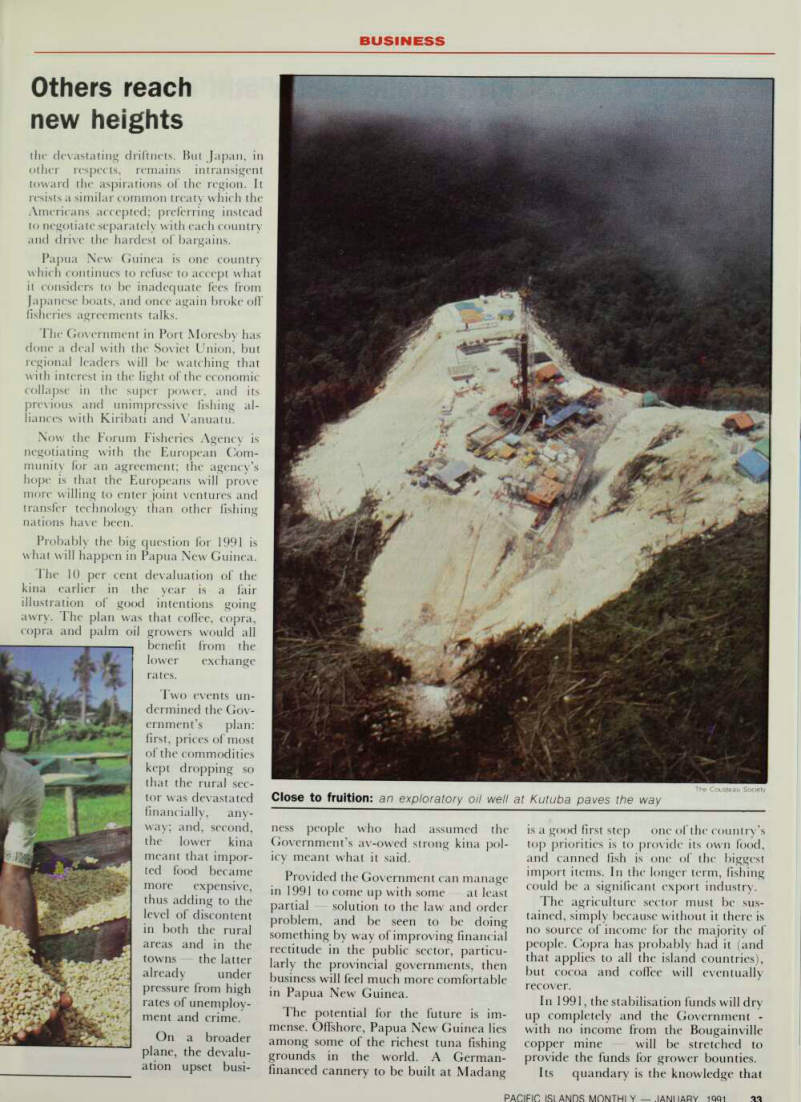
The Cousteau Society Close to fruition: an exploratory oil well at Kutuba paves the way
financial hardship in the rural areas is the last thing the country needs; already, in parts of East New Britain, some cocoa plantations have been hard hit by criminal harassment. Further, the country has made some real progress in improving coffee and cocoa strains and this will have been worth while only if it leads to greater economic benefit.
But it is mining and oil which hold out the greatest promise. The Porgera and Misima mines are now producing, but there are mines such as Lihir yet to come. Wells are being drilled right along the Papua Fold, and there is every chance that Kutubu is the beginning of Papua New Guinea’s oil story.
For Fiji, the most likely advances during 1991 will be in the Govern ment’s plan to widen the industrial base. The garment industry has been a great success (except in terms of labour relations), but the country’s hopes for a more dynamic economy rely on attract ing a wider range of manufacturing to its tax-free zones.
A continuing effort to build more quality accommodation and arrange better air services will be needed throughout the region. Aviation took some important leaps forward during 1990 the Polynesian Airlines trans- Tasman coup; the Airlines of the Marshall Islands flew a chartered Hawaiian Airlines DC-8 and Kiribati’s Air Tungaru an Aloha 737, while Solomon Airlines became the proud operator of its own Boeing 737 ( which it leased once a day to Niue Airlines, thus providing that small territory with a regular air link to Auckland, at last).
Air Pacific acquired its first 767 and signed a landing rights agreement with Malaysia, signalling its new thrust into the Asian markets. Air Niugini, despite having to close down a domestic subsidiary and losing money on some routes, made a success of its Port Moresby-Singapore service. Air Vanu atu also spread its wings.
But the vulnerability of the small regional was illustrated through Air Raratonga. It entered the international business by chartering seats to Auck land with Hawaiian’s DC-8. But when the Honolulu carrier withdrew its aircraft, Air Raratonga was left high and dry. It then tried to find another aircraft, but was thwarted by Air New Zealand’s announcement of an ad ditional weekly service out of Auckland to the Cook Islands a move which removed any hope of Air Rarotonga generating enough business.
Fisheries and tourism are the two avenues which offer real economic growth to all the nations of the area. It can therefore be expected that 1991 will see much greater efforts to try and reap some of the benefits of these. □