Big noise over Star Wars test
p. 10 · Read in the full issue
Star Wars test
HOT on the heels of the controversy over United States plans to destroy chemical weapons on Johnston Atoll, environmental groups and the State of Hawaii are protesting new military scheme to test fire missiles across the Pacific for ‘Star Wars’ research.
The US Army wants to begin launching new rockets for the Strategic Defense Initiative next year from the Kauai Test Facility located on the western edge of Kauai Island, in Hawaii. The missiles to be tested are reportedly larger and more dangerous than those fired previously and will land at Kwajalein Atoll in the Marshall Islands.
The State of Hawaii and the Sierra Club environment group have taken legal action to try and delay the tests until a full environmental impact study is conducted. Their concerns include the use of 20-year-old Polaris solid fuel boosters. They cite a September 6
accident at Edwards Air Base in California when part of a Titan 4 rocket burst into flames and forced the evacuation of 1200 people.
The transportation of highly toxic fuels on narrow, winding roads between Nawiliwili Harbour and the Kauai test site more than 30 miles away has also upset state officials. “We are dealing here with a situation involving extremely dangerous chemicals and old propellants that could be transported to Kauai by ocean, unloaded at Nuwiliwili Harbour, carried over Kauai’s roadways and ultimately blasted into the atmosphere over Kauai,” said Hawaii’s Attorney General, Warren Price, when he filed the state’s lawsuit against the tests.
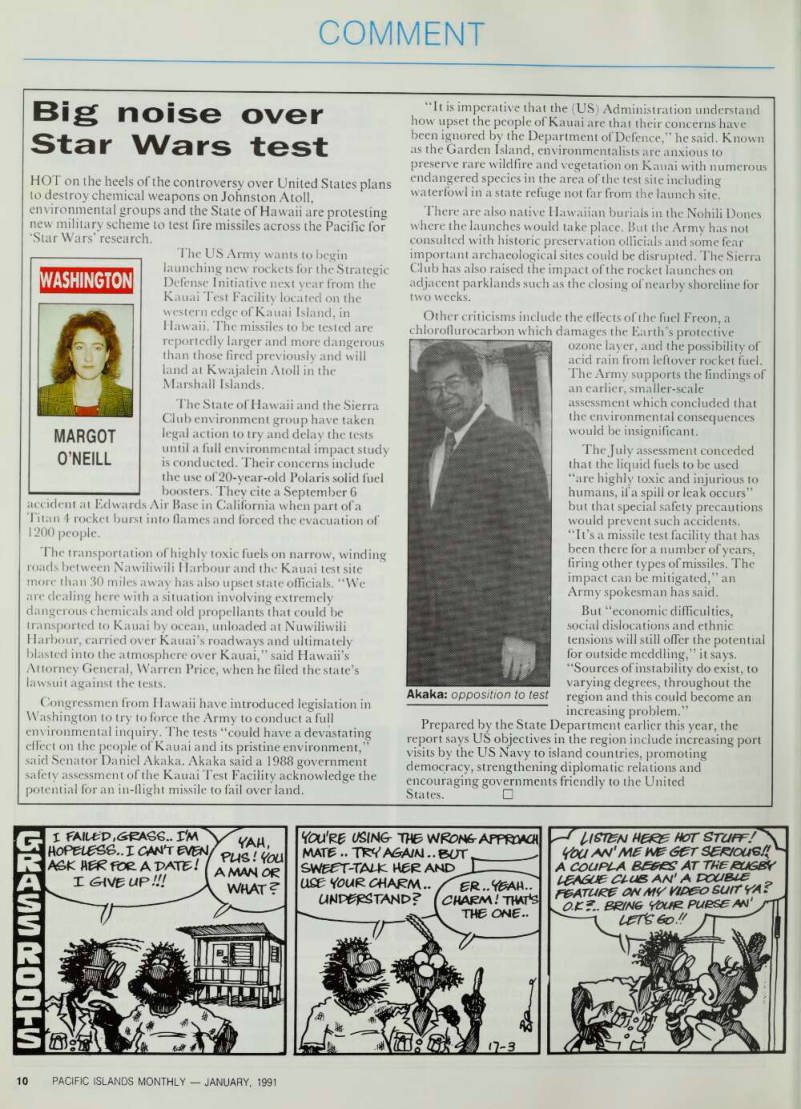
Congressmen from Hawaii have introduced legislation in Washington to try to force the Army to conduct a full environmental inquiry. The tests “could have a devastating effect on the people of Kauai and its pristine environment,” said Senator Daniel Akaka. Akaka said a 1988 government safety assessment of the Kauai Test Facility acknowledge the potential for an in-flight missile to fail over land.
It is imperative that the (US) Administration understand how upset the people of Kauai are that their concerns have been ignored by the Department of Defence,” he said. Known as the Garden Island, environmentalists are anxious to preserve rare wildfire and vegetation on Kauai with numerous endangered species in the area of the test site including waterfowl in a state refuge not far from the launch site.
There are also native Hawaiian burials in the Nohili Dones where the launches would take place. But the Army has not consulted with historic preservation officials and some fear important archaeological sites could be disrupted. The Sierra Club has also raised the impact of the rocket launches on adjacent parklands such as the closing of nearby shoreline for two weeks.
Other criticisms include the effects of the fuel Freon, a chloroflurocarbon which damages the Earth’s protective
ozone layer, and the possibility of acid rain from leftover rocket fuel.
The Army supports the findings of an earlier, smaller-scale assessment which concluded that the environmental consequences would be insignificant.
The July assessment conceded that the liquid fuels to be used “are highly toxic and injurious to humans, if a spill or leak occurs” but that special safety precautions would prevent such accidents.
“It’s a missile test facility that has been there for a number of years, firing other types of missiles. The impact can be mitigated,” an Army spokesman has said.
But “economic difficulties, social dislocations and ethnic tensions will still offer the potential for outside meddling,” it says.
“Sources of instability do exist, to varying degrees, throughout the region and this could become an
increasing problem.”
Prepared by the State Department earlier this year, the report says US objectives in the region include increasing port visits by the US Navy to island countries, promoting democracy, strengthening diplomatic relations and encouraging governments friendly to the United States. □
Washinton
Margot
O’Neill
Akaka: opposition to test