Waking up from
a nuclear dream
WHEN New Zealand’s new National government and the United States talk about restoring a security relationship, it’s a bit like Pollyanna meeting Rip Van Winkle.
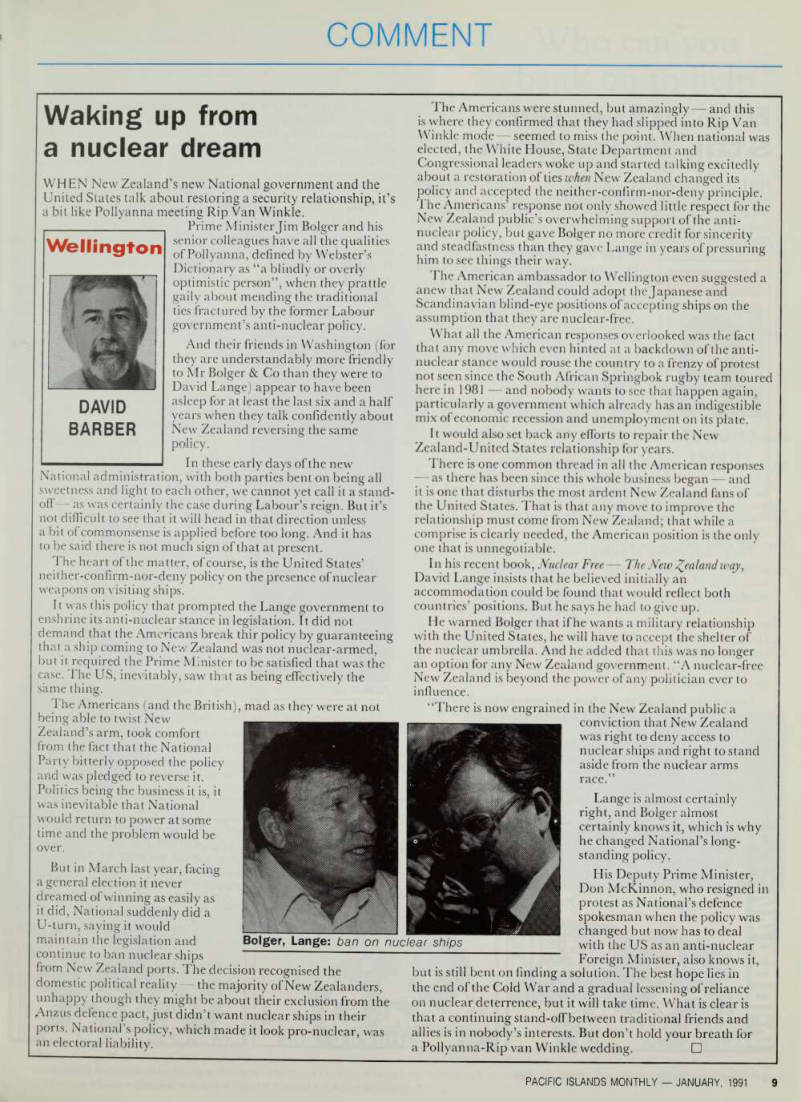
Prime Minister Jim Bolger and his senior colleagues have all the qualities of Pollyanna, defined by Webster’s Dictionary as “a blindly or overly optimistic person”, when they prattle gaily about mending the traditional ties fractured by the former Labour
government’s anti-nuclear policy.
And their friends in Washington (for they are understandably more friendly to Mr Bolger & Co than they were to David Lange) appear to have been asleep for at least the last six and a half years when they talk confidently about New Zealand reversing the same
policy.
In these early days of the new
National administration, with both parties bent on being all sweetness and light to each other, we cannot yet call it a stand off — as was certainly the case during Labour’s reign. But it’s not difficult to see that it will head in that direction unless a bit ofcommonsense is applied before too long. And it has to be said there is not much sign of that at present.
The heart of the matter, of course, is the United States’ neither-confirm-nor-deny policy on the presence of nuclear weapons on visiting ships.
It was this policy that prompted the Lange government to enshrine its anti-nuclear stance in legislation. It did not demand that the Americans break thir policy by guaranteeing that a ship coming to New Zealand was not nuclear-armed, but it required the Prime Minister to be satisfied that was the case. The US, inevitably, saw that as being effectively the
same thing.
The Americans (and the British), mad as they were at not
being able to twist New Zealand’s arm, took comfort from the fact that the National
Party bitterly opposed the policy
and was pledged to reverse it.
Politics being the business it is, it was inevitable that National would return to power at some time and the problem would be over.
But in March last year, facing a general election it never dreamed of winning as easily as it did, National suddenly did a U-turn, saying it would maintain the legislation and continue to ban nuclear ships
from New Zealand ports. The decision recognised the domestic political reality the majority of New Zealanders, unhappy though they might be about their exclusion from the Anzus defence pact, just didn’t want nuclear ships in their ports. National’s policy, which made it look pro-nuclear, was an electoral liability.
The Americans were stunned, but amazingly and this is where they confirmed that they had slipped into Rip Van Winkle mode seemed to miss the point. When national was elected, the White House, State Department and Congressional leaders woke up and started talking excitedly about a restoration of ties when New Zealand changed its
policy and accepted the neither-confirm-nor-deny principle.
The Americans’ response not only showed little respect for the New Zealand public’s overwhelming support of the anti nuclear policy, but gave Bolger no more credit for sincerity and steadfastness than they gave Lange in years of pressuring him to see things their way.
The American ambassador to Wellington even suggested a anew that New Zealand could adopt the Japanese and Scandinavian blind-eye positions of accepting ships on the assumption that they are nuclear-free.
What all the American responses overlooked was the fact that any move which even hinted at a backdown of the anti nuclear stance would rouse the country to a frenzy of protest not seen since the South African Springbok rugby team toured here in 1981 and nobody wants to see that happen again, particularly a government which already has an indigestible mix of economic recession and unemployment on its plate.
It would also set back any efforts to repair the New Zealand-United States relationship for years.
There is one common thread in all the American responses as there has been since this whole business began and it is one that disturbs the most ardent New Zealand fans of the United States. That is that any move to improve the relationship must come from New Zealand; that while a comprise is clearly needed, the American position is the only one that is unnegotiable.
In his recent book, Nuclear Free — The New Zealand way , David Lange insists that he believed initially an accommodation could be found that would reflect both countries’ positions. But he says he had to give up.
He warned Bolger that ifhe wants a military relationship with the United States, he will have to accept the shelter of the nuclear umbrella. And he added that this was no longer an option for any New Zealand government. “A nuclear-free New Zealand is beyond the power of any politician ever to influence.
“There is now engrained in the New Zealand public a
conviction that New Zealand was right to deny access to nuclear ships and right to stand aside from the nuclear arms race.”
Lange is almost certainly right, and Bolger almost certainly knows it, which is why he changed National’s long standing policy.
His Deputy Prime Minister, Don McKinnon, who resigned in protest as National’s defence spokesman when the policy was changed but now has to deal with the US as an anti-nuclear Foreign Minister, also knows it,
but is still bent on finding a solution. The best hope lies in the end of the Cold War and a gradual lessening of reliance on nuclear deterrence, but it will take time. What is clear is that a continuing stand-offbetween traditional friends and allies is in nobody’s interests. But don’t hold your breath for a Pollyanna-Rip van Winkle wedding. □
Wellington
David
Barber
Bolger, Lange: ban on nuclear ships