Peacekeeping or sabre rattling
sabre rattling
THE suggestion that the South Pacific nations establish a regional peacekeeping force has been around for a decade; since PNG’s Kumul force helped smooth Vanuatu’s transition to independence from British-French rule by putting down the separatist rebellion on the island of Santo.
While the possibility of a peacekeeping force has often been raised in the context of security problems facing the island nations, it has never met enthusiasm from crucial regional bodies such as the South Pacific Forum.
Despite that, Canberra-based
Pacific Security Expert, Greg Fry, says
the formation of a regional force is likely - that recent events such as the Bougainville crisis, the 1988 riot in Vanuatu and the Fiji coups opened the door to the formation of an ad hoc regional force to deal with specific crisis. Not only is a collective force a strong possibility according to Fry but,
he warns, it would most likely be formed under emergency conditions with little time for forethought.
Before that takes place, he says, there are a number of serious questions which need answering. For example, who is to determine whether intervention is justified and on what criteria? What groups will it assist or disadvantage? If the action is to protect the interests of a ‘legitimate government’, who is to decide whether the government is legitimate?
For Australia, likely to be the main actor in such a force, the questions are all the more urgent.
The sort of regional force Pacific governments are likely to be talking about in the 1990 s is a very different proposition from the traditional idea of a ‘peacekeeping force’.
Peacekeeping forces set up by the United Nations are neutral, invited in by both sides usually to supervise an agreement. In Namibia, for instance, the UN peacekeeping force oversaw the withdrawal ofSouth African forces and it acted as an impartial observer, verifying the fairness of the new nation’s first elections.
In the South Pacific, a regional force would most likely be deployed against one group of a nation’s citizens without their permission. Urban riots, seccessionist or separatist movements, military uprisings and major law and order problems such as rascal gangs, all have their beginnings in the people’s perceptions of the fairness with which wealth and power is being shared out by their elected representatives.
In Bougainville and in Vanuatu in 1988, Australian military assistance came at the request of the government for use against its own disenchanted citizens. In Bougainville, as Fry points out, the military solution has not only been effective but is likely to exacerbate tensions.
If an ad hoc regional force were to be set up it would most likely compromise Australia’s Operational Deployment Force, the New Zealand Ready Reaction Force and the Papua New Guinea Defence Force. It might also involve police or para-military units from other island nations.
Australia, with by far the biggest forces, would most likely play a leadership role an experience without historical precedent.
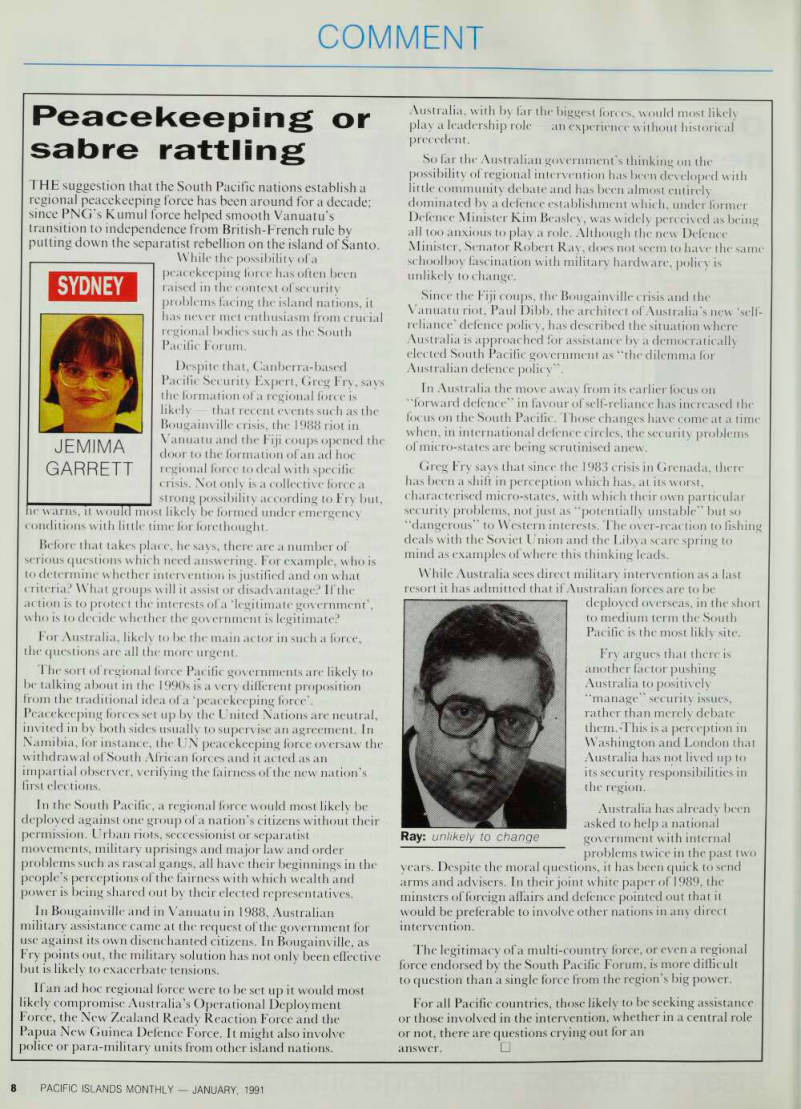
So far the Australian government's thinking on the possibility of regional intervention has been developed with little community debate and has been almost entirely dominated by a defence establishment which, under former Defence Minister Kim Beasley, was widely perceived as being all too anxious to play a role. Although the new Defence Minister, Senator Robert Ray, does not seem to have the same schoolboy fascination with military hardware, policy is unlikely to change.
Since the Fiji coups, the Bougainville crisis and the Vanuatu riot, Paul Dibb, the architect of Australia’s new ‘self reliance’ defence policy, has described the situation where Australia is approached for assistance by a democratically elected South Pacific government as “the dilemma for Australian defence policy”.
In Australia the move away from its earlier focus on “forward defence” in favour of self-reliance has increased the focus on the South Pacific. Those changes have come at a time when, in international defence circles, the security problems of micro-states are being scrutinised anew.
Greg Fry says that since the 1983 crisis in Grenada, there has been a shift in perception which has, at its worst, characterised micro-states, with which their own particular security problems, not just as “potentially unstable” but so “dangerous” to Western interests. The over-reaction to fishing deals with the Soviet Union and the Libya scare spring to mind as examples of where this thinking leads.
While Australia sees direct military intervention as a last resort it has admitted that if Australian forces are to be
deployed overseas, in the short to medium term the South Pacific is the most likly site.
Fry argues that there is another factor pushing Australia to positively
“manage” security issues,
rather than merely debate them. *This is a perception in Washington and London that Australia has not lived up to its security responsibilities in
the region.
Australia has already been asked to help a national government with internal problems twice in the past two
years. Despite the moral questions, it has been quick to send arms and advisers. In their joint white paper of 1989, the minsters of foreign affairs and defence pointed out that it would be preferable to involve other nations in any direct intervention.
The legitimacy of a multi-country force, or even a regional force endorsed by the South Pacific Forum, is more difficult to question than a single force from the region’s big power.
For all Pacific countries, those likely to be seeking assistance or those involved in the intervention, whether in a central role or not, there are questions crying out for an answer. □
Sydney
Jemima
Garrett
Ray: unlikely to change