Pacific Women
pp. 12-13 · Read in the full issue
Women Of The Year
Pacific Women of the year
By Karen Mangnall
WOMEN hold up half the sky, or so the saying goes. For many women in developing nations, including most of the Pacific, the burden is wide and heavy, and recognition is scant.
One of the problems is that much of what women do is “invisible”. It is difficult for women to burst into the media spotlight. With the exception of newsworthy political figures such as Adi Kuini Bavadra, women feature rarely on their own and even less frequently as “talking heads” quoted as experts.
Pacific women are only just beginning to break into areas such as business, government, and the professions.
Usually, it’s only once they stamp their mark in these fields of endeavour, as individuals, that they rate any recog nition.
This year, PIM is devoting its annual review to Pacific women, in the plural “Pacific Women of the Year”. It’s not an easy task. Not because women don’t do enough, but because they do so much.
Women in most Pacific nations form the backbone of traditional society.
Women raise the children, do much of the labour for subsistence agriculture, and act as unpaid health and social workers. Often, it’s women’s groups
which form to organise small
development projects.
Frequently, women’s groups cut across otherwise trenchant political and racial divisions.
In the midst of Fiji’s crisis in 1987, one senior Fijian chief cast her eyes skyward and passed the opinion that if the women were in charge, none of it would have happened.
Women are equal partners, and some would say more than equal partners, in the struggle for greater economic develop ment in their own countries.
Yet they also struggle to assert their rights within domestic structures which often hold them back traditionally, and continue to do so in different ways as Western models of behaviour are adopted.
So, when looking across the
range of women’s activities in the Pacific in the past year, what do we see? A mixture of individual achievements and group successes which illustrate the diversity of Women’s roles; a diversity which illustrates the precarious balanc ing act between the individual opportunities of the modern world and the threat that world poses to tradition.
Remember Dame Kiri Te Kanawa,
New Zealand’s famed international so prano who finally returned home to sing and was stunned when 140,000 came out on a balmy summer night to pay tribute.
Mililani Trask and her sister Haunani Kay-Trask, Hawaiian indi genous activists in a country which hasbeen doubly colonised by the haole Americans and then Japanese.
Mary Beetham, American Samoa’s
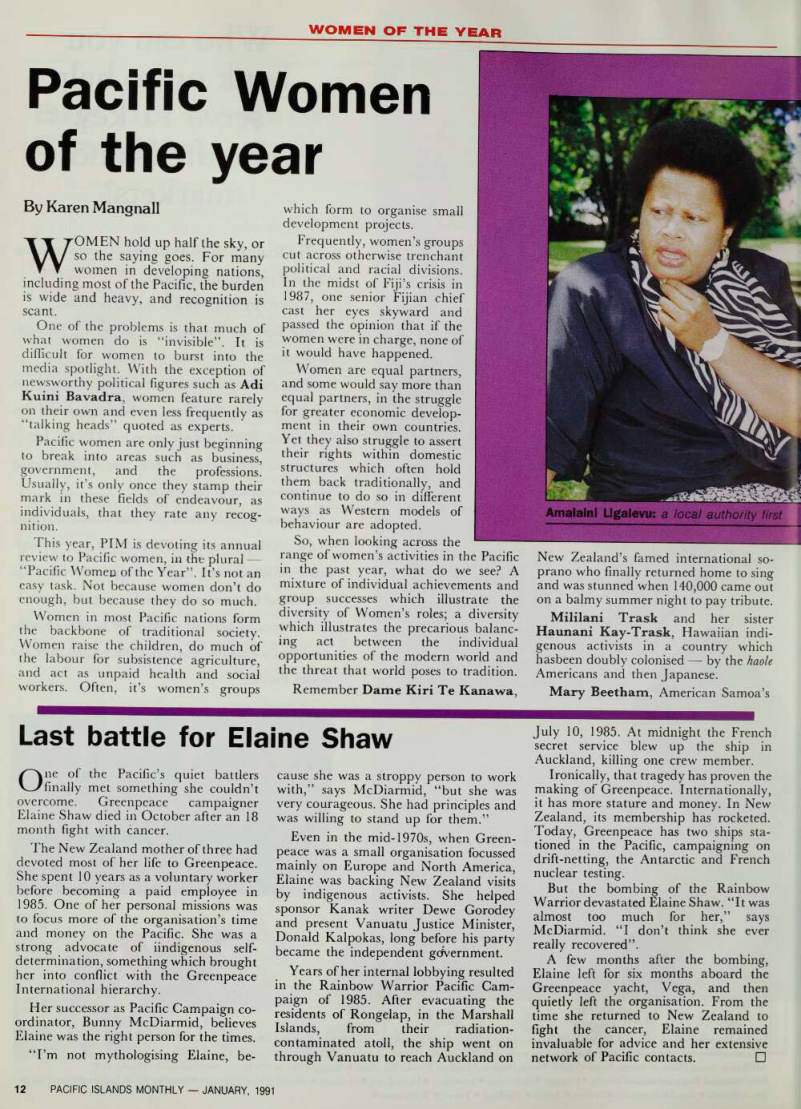
Amalaini Ligalevu: a local authority first
first female Supreme Court judge, also the first without a matai title.
Majorie Crocombe, director of the Pacific Studies Centre at Auckland University. Marie-Claire Beccalossi, appointed French Government delegate for women’s affairs in New Caledonia. Or Marie-Glaude Tjibaou, compiling an archive of her late husband’s materials for the Kanak Cultural Agency.
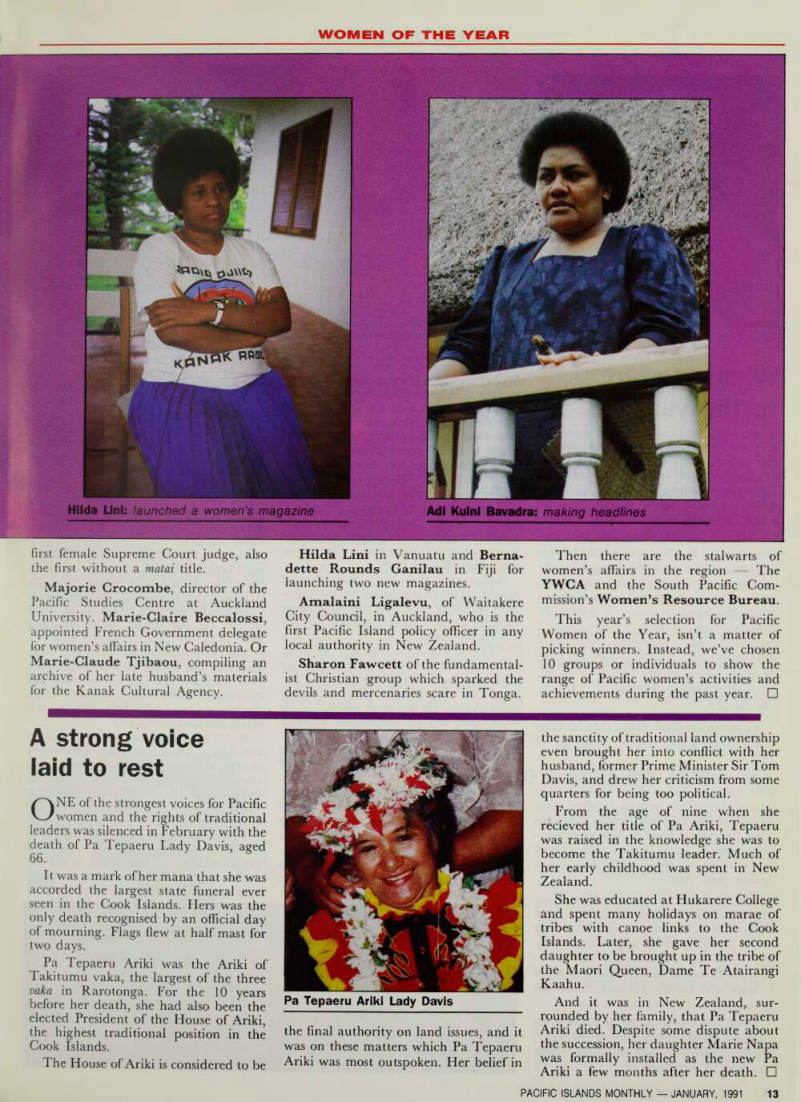
Hilda Lini in Vanuatu and Berna dette Rounds Ganilau in Fiji for
launching two new magazines.
Amalaini Ligalevu, of Waitakere City Council, in Auckland, who is the first Pacific Island policy officer in any local authority in New Zealand.
Sharon Fawcett of the fundamental ist Christian group which sparked the devils and mercenaries scare in Tonga.
Then there are the stalwarts of women’s affairs in the region The YWCA and the South Pacific Com mission’s Women’s Resource Bureau.
This year’s selection for Pacific Women of the Year, isn’t a matter of picking winners. Instead, we’ve chosen 10 groups or individuals to show the range of Pacific women’s activities and achievements during the past year. □
Hilda Lini: launched a women’s magazine
Adi Kuinl Bavadra: making headlines